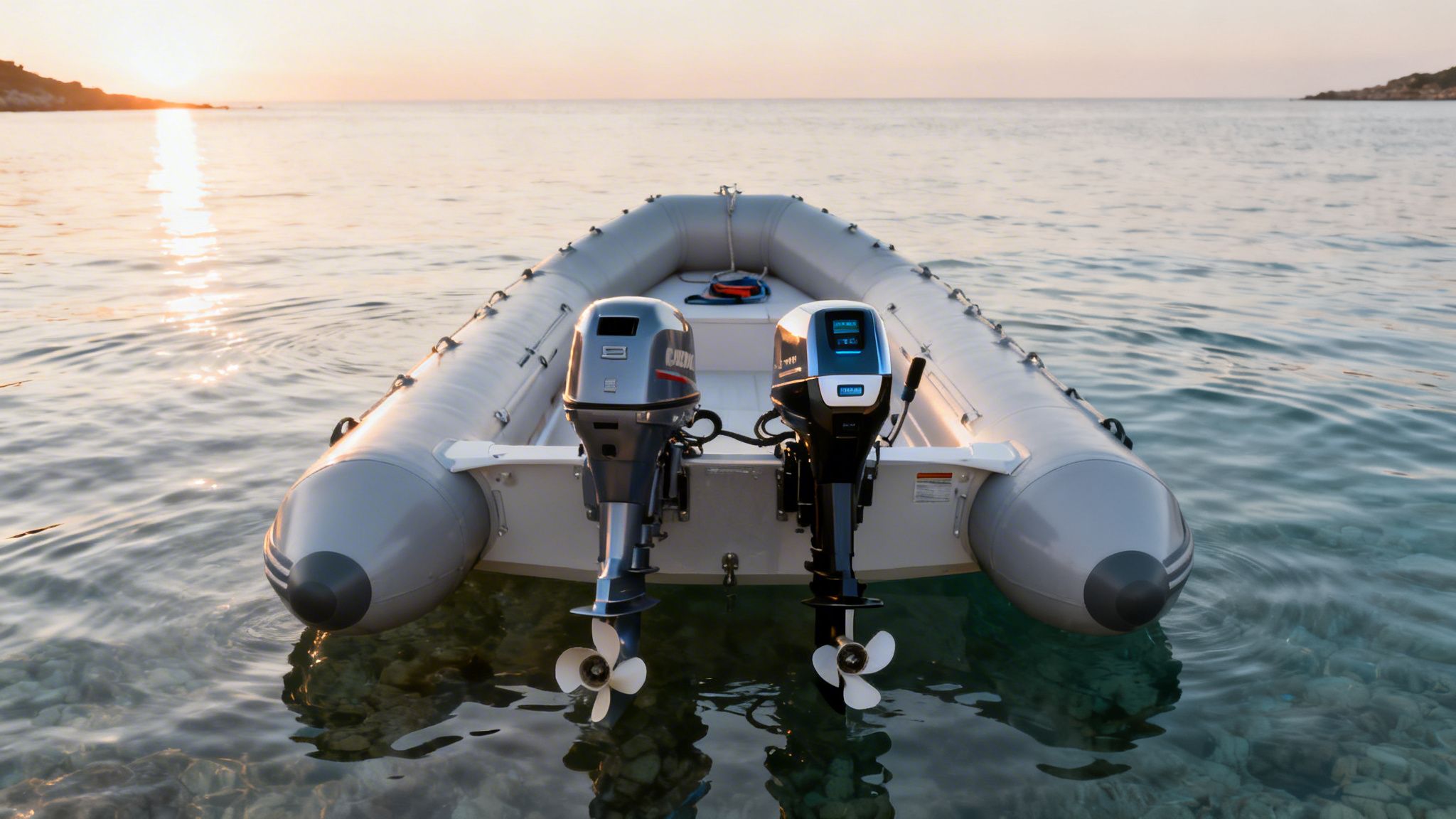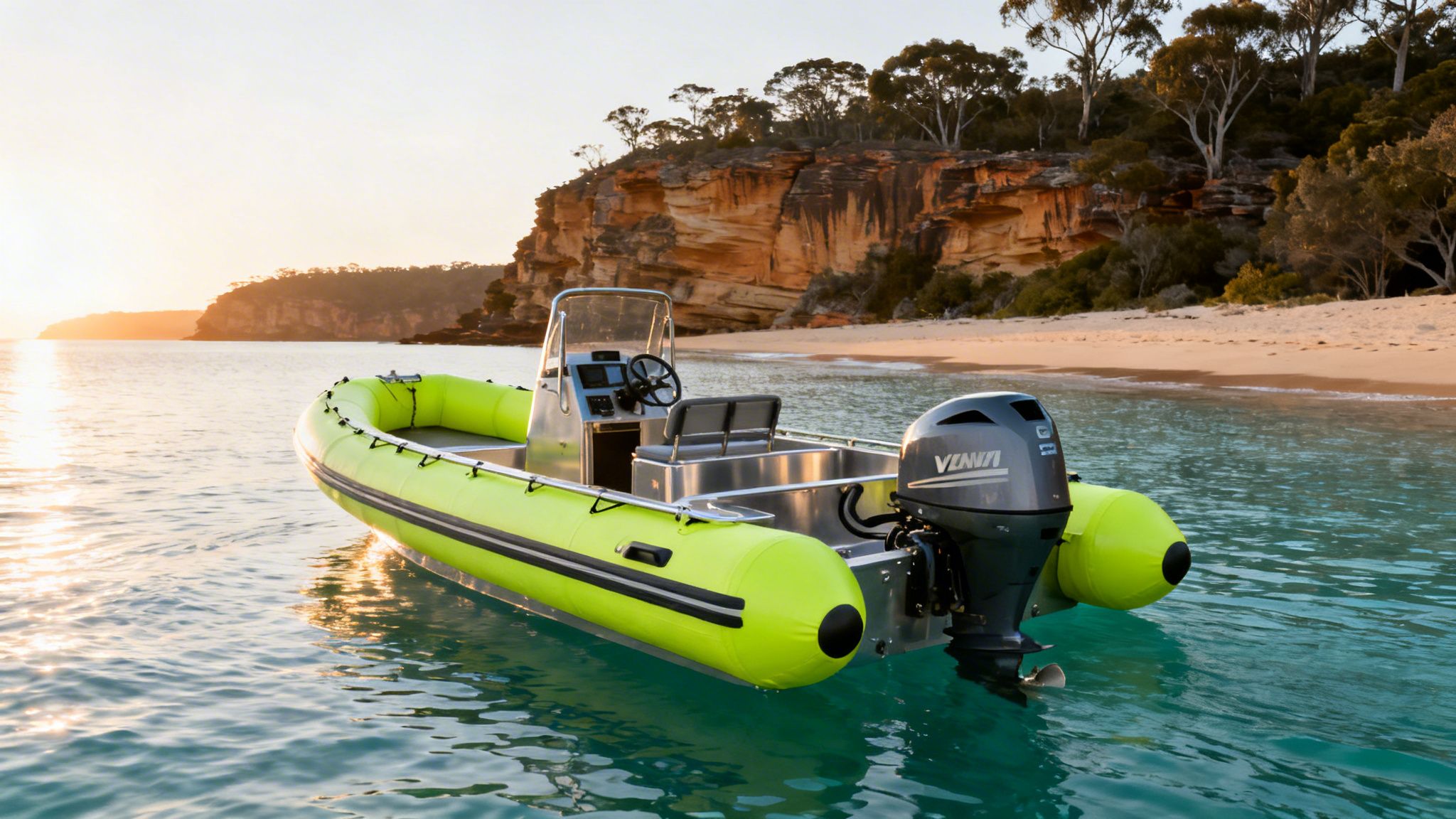


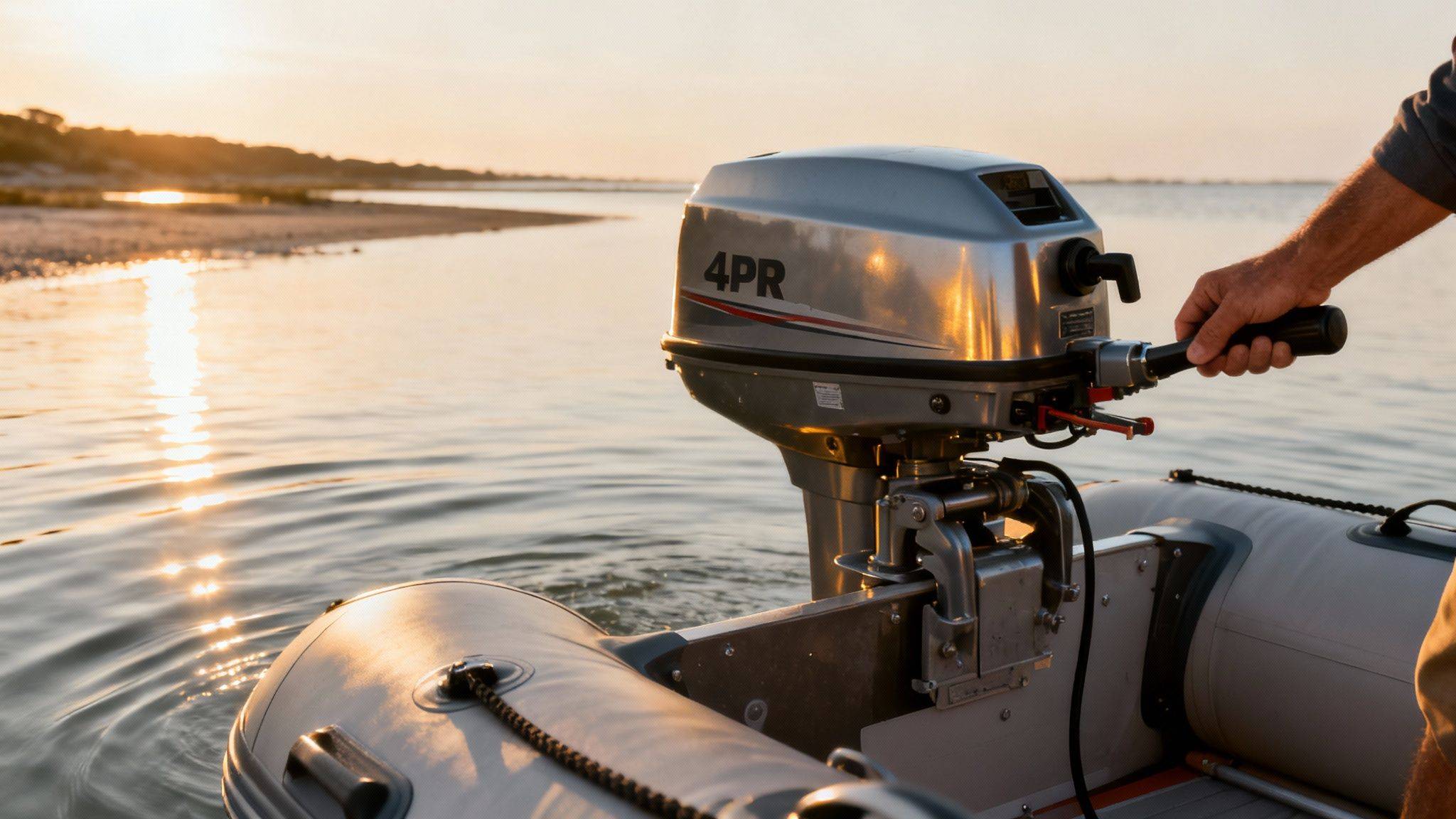
A 4 hp boat motor is the sweet spot for portable power, hitting that perfect balance of grunt and efficiency for smaller watercraft. It’s got just enough thrust to push tenders, inflatable boats, and small tinnies along with confidence, yet it’s still light enough for one person to carry and mount without breaking a sweat. For plenty of Aussie boaters, it’s the ultimate multi-tool for the water.
So, why does the 4 hp outboard motor nail it for thousands of boaters across Australia? The answer comes down to a killer combo of three things: usable power, genuine portability, and seriously good fuel efficiency. It’s the go-to for everything from powering a yacht tender to exploring a quiet estuary on an inflatable catamaran.
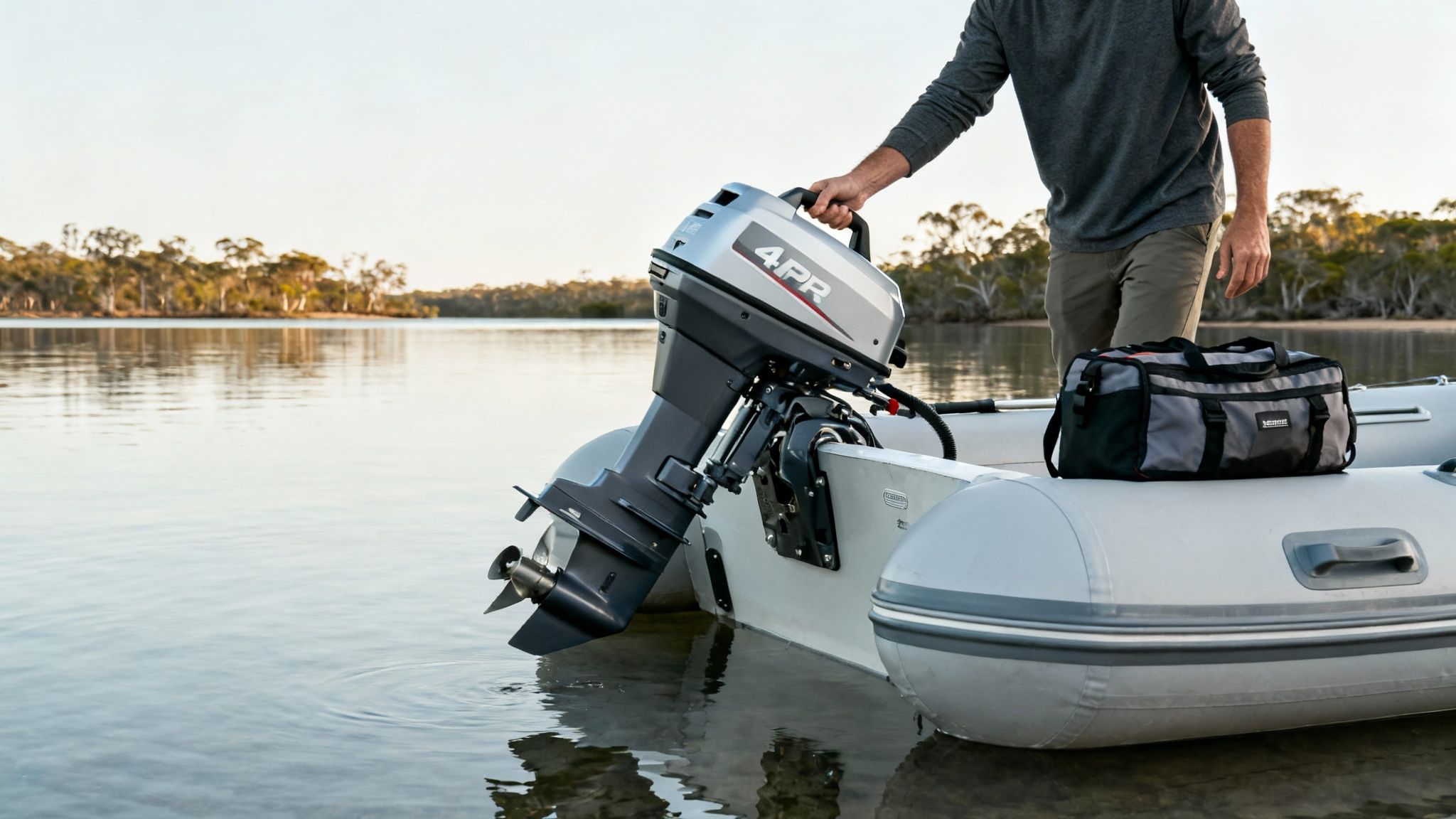
This motor isn’t about chasing speed records; it’s all about smart, accessible boating. Think of it like a versatile hand tool versus a massive power saw. Sure, bigger motors go faster, but they come with heavy trade-offs in weight, cost, and complexity. The 4 hp outboard, on the other hand, is simple, reliable, and just plain easy to use.
One of its biggest wins is just how manageable it is. Most 4 hp models weigh between 20-25 kg, making them a piece of cake to chuck in the car boot, carry down to the beach, and clamp onto a transom solo. This kind of portability opens up a whole world of possibilities for adventurers who just want to get on the water without a fuss. It’s the perfect companion for:
The real magic of a 4 hp motor is how accessible it makes boating. It cuts out the need for boat ramps, trailers, and heavy lifting, letting you get on the water with minimum hassle and maximum fun.
Affordability is another huge part of the 4 hp motor’s appeal. With economic pressures being felt everywhere, finding good value is more important than ever. The Australian outboard boat motors market recently saw a 2.7% decrease to $122 million, a reflection of how rising inflation has hit people’s spending.
For boat owners, this just highlights the benefit of smart, turnkey packages that pair an affordable, reliable motor like a Hidea 4 hp outboard with a purpose-built inflatable boat. It’s a practical way to get on the water without breaking the bank. For more detailed advice, check out our guide on choosing a motor for inflatable boats.
Okay, let’s move past the spec sheet and talk about what a 4 hp boat motor actually feels like out on the water. Performance isn’t just about hitting a top speed; it’s about control, efficiency, and knowing you have the right amount of power for the job. Getting this right sets you up for a great day.
A 4 hp motor is the undisputed king of displacement speed. Think of it less like a speedboat and more like a determined little tugboat. Instead of trying to lift the hull out of the water to ‘plane’ on the surface, it pushes the boat through the water with quiet efficiency. This is exactly what you want for relaxed, controlled cruising.
For a typical inflatable boat around 3 metres long with one or two people on board, you can expect a comfortable cruising speed of about 8-12 km/h. This is the sweet spot for exploring estuaries, poking around calm bays, or finding that perfect fishing spot.
But that speed isn’t set in stone. It can change quite a bit depending on a few key things:
The main takeaway here is that a 4 hp motor gives you predictable and safe power for smaller boats. It excels at getting you from A to B quietly and efficiently, making the journey just as enjoyable as the destination itself.
One of the best things about modern 4-stroke outboards is just how quiet and fuel-sipping they are. If you’re used to the noisy, smoky two-strokes of yesteryear, you’re in for a pleasant surprise. You can actually hold a conversation without shouting, and the low vibration means you won’t feel rattled after a few hours on the water.
This efficiency is also great for your wallet. You can explore for hours on a single tank of fuel. Outboard manufacturers have made huge leaps in technology, and smaller motors like the 4 HP Hidea range pack in advanced features that deliver fantastic fuel economy. For Aussie boaters, this means lower running costs for every weekend adventure.
If you’re keen to learn more about getting the best value, check out our guide on finding affordable outboard motors in Australia.
Pairing your 4 hp boat motor with the right inflatable is the secret to unlocking its full potential. Think of it like choosing the right tyres for a car; the wrong match leads to poor performance, inefficiency, and even safety risks. A great pairing, however, ensures you get the most out of every drop of fuel and every moment on the water.
The first step is a simple one: look at the manufacturer’s compliance plate on the boat, which you’ll usually find on the transom. This plate is your guide, spelling out the maximum horsepower and motor weight the boat is designed to handle safely. Never, ever exceed these ratings.
When you’re on the hunt for the best inflatable to partner with a 4 hp motor, certain features really stand out. Size is the big one. The sweet spot is typically a boat between 2.5 metres and 3.8 metres in length.
Boats in this range are light enough for the motor to push efficiently but large enough to offer proper stability and useful space on deck. Hull design also plays a massive role in performance. An inflatable catamaran, for example, is an excellent choice. Its twin-hull design creates less drag in the water, allowing it to move more freely and stay incredibly stable, even with the modest thrust of a 4 hp engine. This efficiency is a game-changer for maximising your range and getting the most out of your setup.
Before you commit to a boat and motor combo, run through this simple checklist. It will help you avoid the common mistake of underpowering a heavy boat or creating a dangerously overpowered setup.
A correctly matched boat and motor work in harmony. The goal is a balanced setup where the motor operates without strain, the boat handles predictably, and you can focus on enjoying your time exploring Australia’s beautiful waterways.
Making the right choice from the start prevents a lot of headaches later on. If you need more guidance, our article on selecting the right engine for an inflatable boat provides even more valuable insights. With a little planning, you can find the perfect inflatable boat to create a reliable and fun package with your 4 hp motor.
When you’re in the market for a 4 hp boat motor, the choice often boils down to a trusted, value-driven brand like Hidea versus the lure of an ultra-cheap generic motor from an online marketplace. To make a smart choice, you need to look at the whole picture: real-world usability, long-term durability, and the peace of mind that comes with a trusted brand.
Let’s put the Hidea 4 HP outboard under the microscope and see how it really stacks up head-to-head on the factors that matter most to Australian boaters.
The initial price tag is what catches everyone’s eye, but it’s just the start of the story. The true total cost of ownership is a mix of fuel efficiency, maintenance, and potential repair bills. A cheap, generic motor might save you a few hundred dollars upfront, but that advantage can vanish quickly.
Hidea motors are engineered with modern 4-stroke efficiency, meaning they sip fuel and stick to a standard maintenance schedule. In contrast, a generic motor with lower build quality could be a gas-guzzler or need frequent, costly repairs with parts that are nearly impossible to source in Australia. Over a few years, the Hidea almost always proves to be the smarter financial choice.
A portable motor should be a reliable partner, not a source of frustration. It all comes down to the simple things: how easily it starts, its weight and balance when you’re carrying it, and how natural the controls feel. Hidea focuses on refining these user-friendly details, providing a reliable pull-start and an ergonomic tiller you can count on.
This is where many budget motors fall short. Think inconsistent starting that leaves you pulling the cord until your arm aches, excessive vibration that rattles your teeth, or clunky handles that make carrying the motor an awkward balancing act. A great day on the water starts with a motor that works with you, not against you.
Durability is where a reputable brand truly leaves the no-name competition in its wake. Hidea uses quality, corrosion-resistant alloys and coatings specifically designed to handle the harsh Aussie saltwater environment. More importantly, buying from an authorised Australian dealer means you get a proper local warranty and support.
This local backing provides an invaluable safety net. If something goes wrong with a generic motor you bought from an overseas marketplace, you’re often on your own. Having an Australian dealer network for warranty claims, servicing, and spare parts gives you genuine consumer confidence. It means there’s a real person you can talk to and a workshop that can handle any issues, ensuring your investment is protected.
To make it even clearer, let’s break down the key differences in a simple table. This isn’t about marketing fluff; it’s about the practical realities that impact your time, money, and enjoyment on the water.
| Feature | Hidea 4 HP Outboard (from Easy Inflatables) | Typical Generic/Budget 4 HP Outboard |
|---|---|---|
| Total Cost | Competitive initial price with lower long-term running costs due to fuel efficiency and reliability. | Lower initial purchase price, but potential for higher costs from poor fuel economy and repairs. |
| Warranty | Backed by a full Australian warranty with local dealer support for claims and service. | Often limited or non-existent warranty support in Australia; difficult to claim or find parts. |
| Build Quality | Constructed with high-grade, corrosion-resistant materials designed for marine environments. | Variable quality, often using cheaper materials that are more susceptible to corrosion and wear. |
| Support Network | Access to an established network of Australian dealers for sales, parts, and technical advice. | No local dealer network; support is typically via email with overseas sellers, if at all. |
| Resale Value | Holds value better due to brand recognition, proven reliability, and available service history. | Significantly lower resale value; buyers are wary of unknown brands and lack of support. |
When you lay it all out, the choice becomes clear. While a generic motor might seem tempting at first glance, the Hidea 4 HP offers superior long-term value, reliability, and the priceless peace of mind that comes with Australian-backed support.
Getting the technical details of your 4 hp boat motor setup right is the difference between a great day on the water and a frustrating one. The three pillars of a perfect installation are shaft length, propeller choice, and a secure mounting. Nail these fundamentals, and your motor will perform efficiently, safely, and exactly as it was designed to.
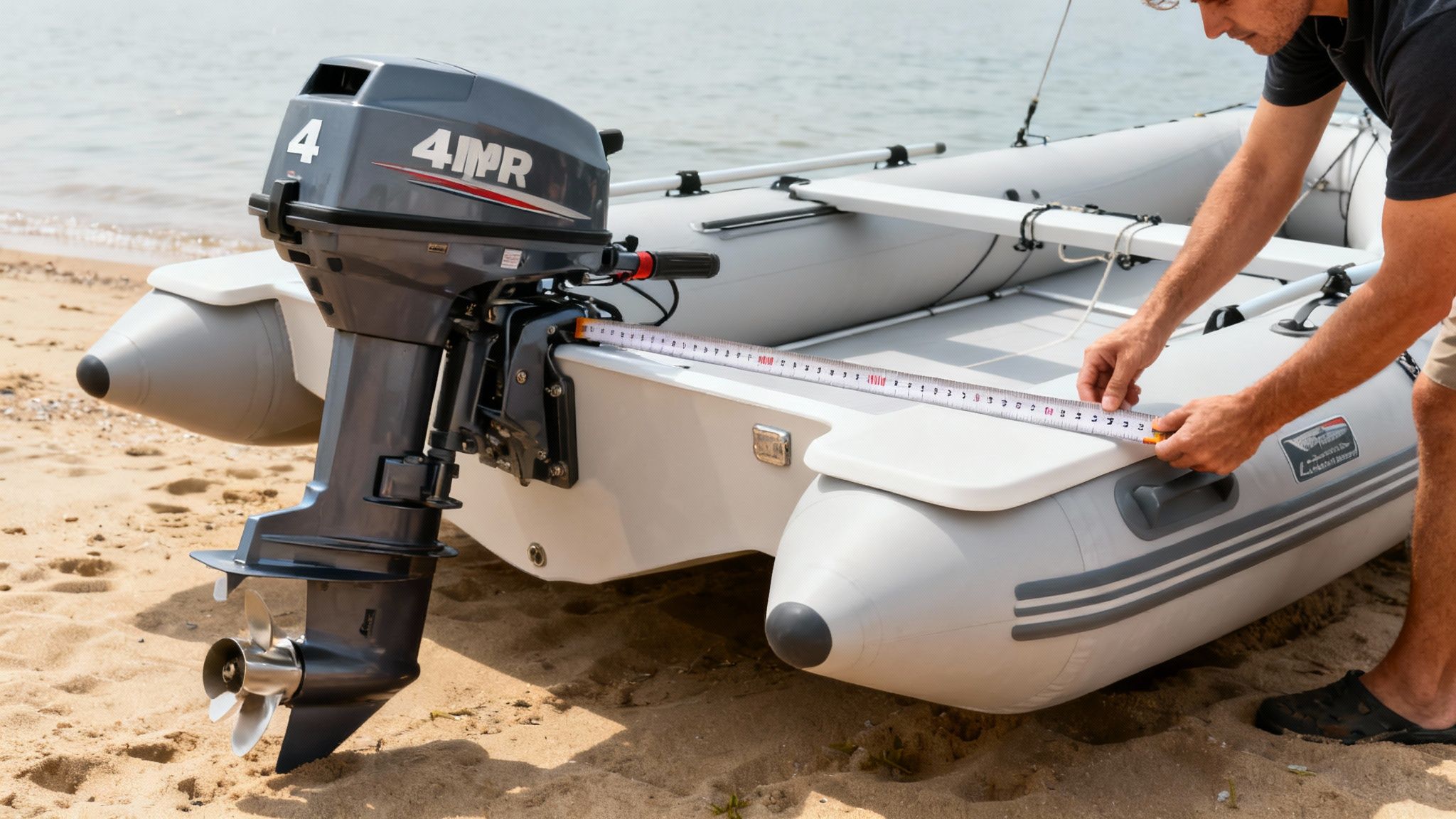
Choosing the correct shaft length is arguably the most critical first step. It’s all about making sure the propeller sits at the perfect depth in the water—not too high, not too low. To get it right, you need to measure the transom height of your boat, which is simply the distance from the top of the transom (where the motor clamps on) down to the bottom of the hull.
For most inflatable boats, tenders, and inflatable catamarans suited to a 4 hp motor, you’ll be looking for a “short shaft” model. This is typically 15 inches (around 38 cm) and is the standard for boats with a transom height of approximately 15-16 inches. A long shaft (20 inches) is designed for boats with taller transoms and is rarely the correct choice for the kind of portable inflatables we’re talking about here.
Using the wrong shaft length creates problems right away. A shaft that’s too short will cause the propeller to suck in air from the surface—a phenomenon called cavitation. This makes the engine race without giving you any real thrust, just like spinning your car’s wheels on ice. On the other hand, a shaft that’s too long creates excessive drag, robbing you of precious power and efficiency.
This flowchart breaks down the key things to think about when choosing a motor, boiling it down to cost, usage, and the support you can count on.
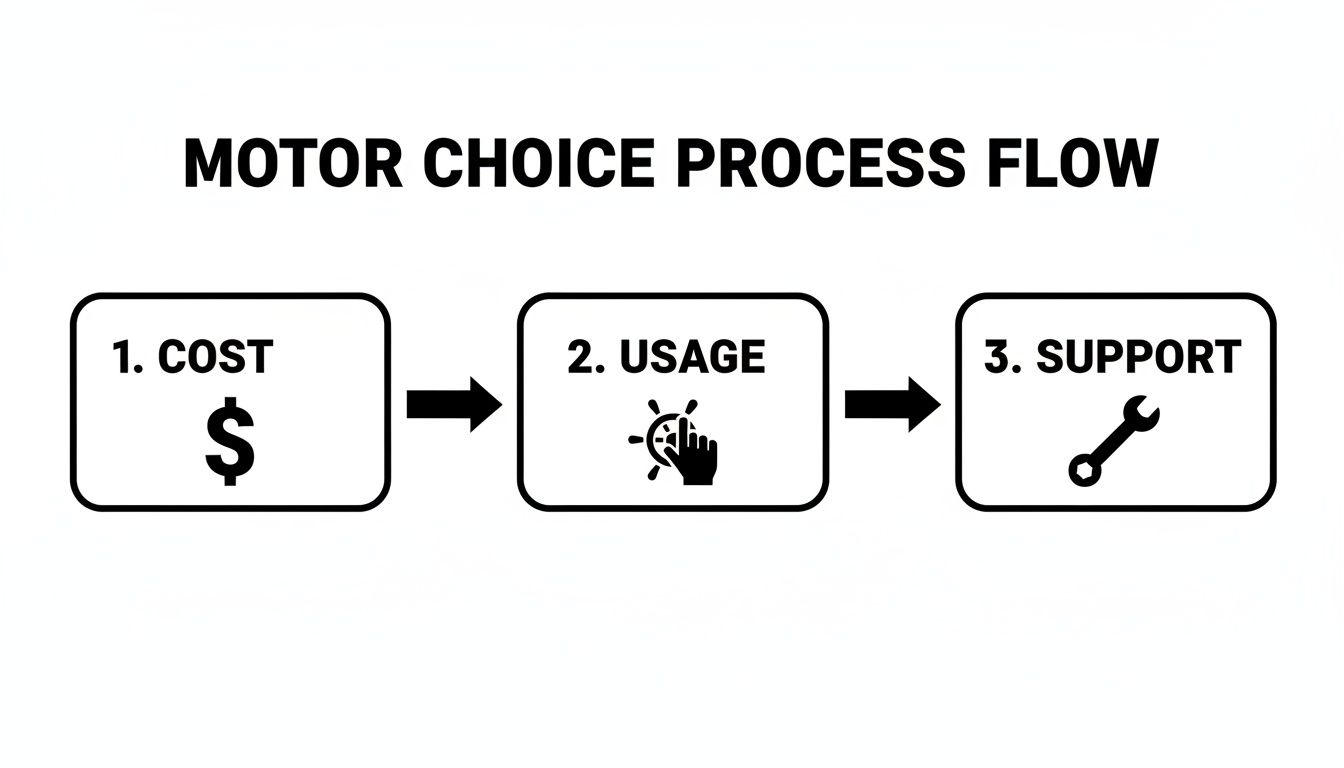
As you can see, a smart choice isn’t just about the price tag. It’s about balancing the initial cost with how you’ll actually use the motor and the long-term support you’ll have behind you.
Once you have the right shaft length, mounting the motor is pretty straightforward. Start by lowering the motor onto the centre of the transom. Tighten the clamp screws by hand until they’re good and firm, ensuring the motor is sitting snug against the transom plate. It’s vital to use both clamp screws and tighten them evenly to get a solid, secure fit.
Next, attach the safety lanyard, often called a kill switch cord. This is a non-negotiable safety step. Clip one end to the motor’s kill switch and the other securely to yourself—usually on your wrist or clipped to your life jacket. If you happen to fall overboard, the cord will pull out and instantly stop the engine, preventing the boat from running away from you.
For a deeper dive into setup specifics, our guide on choosing the right motor for an inflatable boat offers a few more valuable tips.
There are two things that guarantee a great day on the water: a motor that starts every time and the peace of mind that comes from knowing you’re following the local rules. Getting both right is easier than you think. A little bit of care keeps your 4 hp boat motor reliable, while a quick check of the local regulations keeps your adventures safe and stress-free.
Let’s be honest, nobody loves maintenance, but for an outboard, it’s ridiculously simple and makes a massive difference. The single most important job is flushing the engine with fresh water after every single saltwater trip. Seriously. This ten-minute task stops corrosive salt from crystallising inside the cooling system, which is the number one killer of outboard motors.
Beyond that, it’s just a matter of common sense. Before you head out, give the motor a quick once-over. Check your fuel and oil, and make sure there’s no fishing line wrapped around the propeller. Simple checks prevent big headaches.
To keep your 4 hp motor ready for action year-round, here’s a maintenance schedule that’s easy to stick to.
Knowing the rules of the water is just as important as knowing how to start your engine. In Australia, the regulations for boat licensing and registration can be wildly different from one state to the next, especially when you’re dealing with smaller motors.
The golden rule is to never assume. Before you launch, always check the specific requirements with the local maritime authority for the exact waterway you plan to visit.
For example, in New South Wales, you generally don’t need a boat licence to drive a boat with any size engine, as long as you keep the speed below 10 knots (about 18.5 km/h). Head north to Queensland, and the rule changes: no licence is needed for a boat with an engine of 6 hp (4.5kW) or less.
But here’s where it gets tricky—boat registration is often a separate issue. Many states require the boat itself to be registered, no matter how small the motor is. These rules aren’t there to spoil your fun; they’re for safety and identification. Staying informed means you can hit Australia’s amazing waterways legally and with total confidence.
To wrap things up, let’s tackle some of the most common questions boaters have about the 4 hp boat motor. These quick, direct answers will help you finalise your decision and get the most from your new outboard.
This is a big one, and it varies significantly between states. In many places like NSW, you may not need a licence for a vessel powered by a smaller motor, provided you stay below a speed of 10 knots.
However, the rules in states like QLD are different, often based on horsepower (e.g., anything under 6 hp might be exempt). Beyond your motor’s maintenance, understanding local rules is paramount. For instance, anyone planning to use their motor in Australia should be aware of specific Australian boating regulations. Your best bet is always to confirm the current requirements with your local maritime authority before heading out.
On a typical inflatable boat around three metres long with one or two people, you can expect a comfortable displacement speed of about 8-12 km/h. Think of it as a steady, relaxed cruising speed, not a high-speed sprint. These motors are designed for efficiency, not for getting a boat up on a plane.
Your final speed is heavily influenced by total weight, water conditions, and the boat’s hull design. An inflatable catamaran, for example, is often more efficient and may achieve slightly better performance due to having less drag in the water.
These days, virtually all modern 4 hp boat motor options, including the Hidea models we offer, are 4-stroke engines. The simple reason? They are much quieter, more fuel-efficient, and produce far fewer emissions than the old 2-stroke outboards.
Another big plus is that 4-strokes have their own self-contained oil systems, so you never have to pre-mix oil with your fuel. While old 2-strokes were a bit lighter, today’s 4-stroke technology is the clear winner for its superior overall performance and environmental benefits.
Ready to find the perfect power source for your adventures on the water? Explore the reliable, efficient, and affordable range of Hidea 4 hp motors at Easy Inflatables and get a turnkey package shipped free anywhere in Australia.