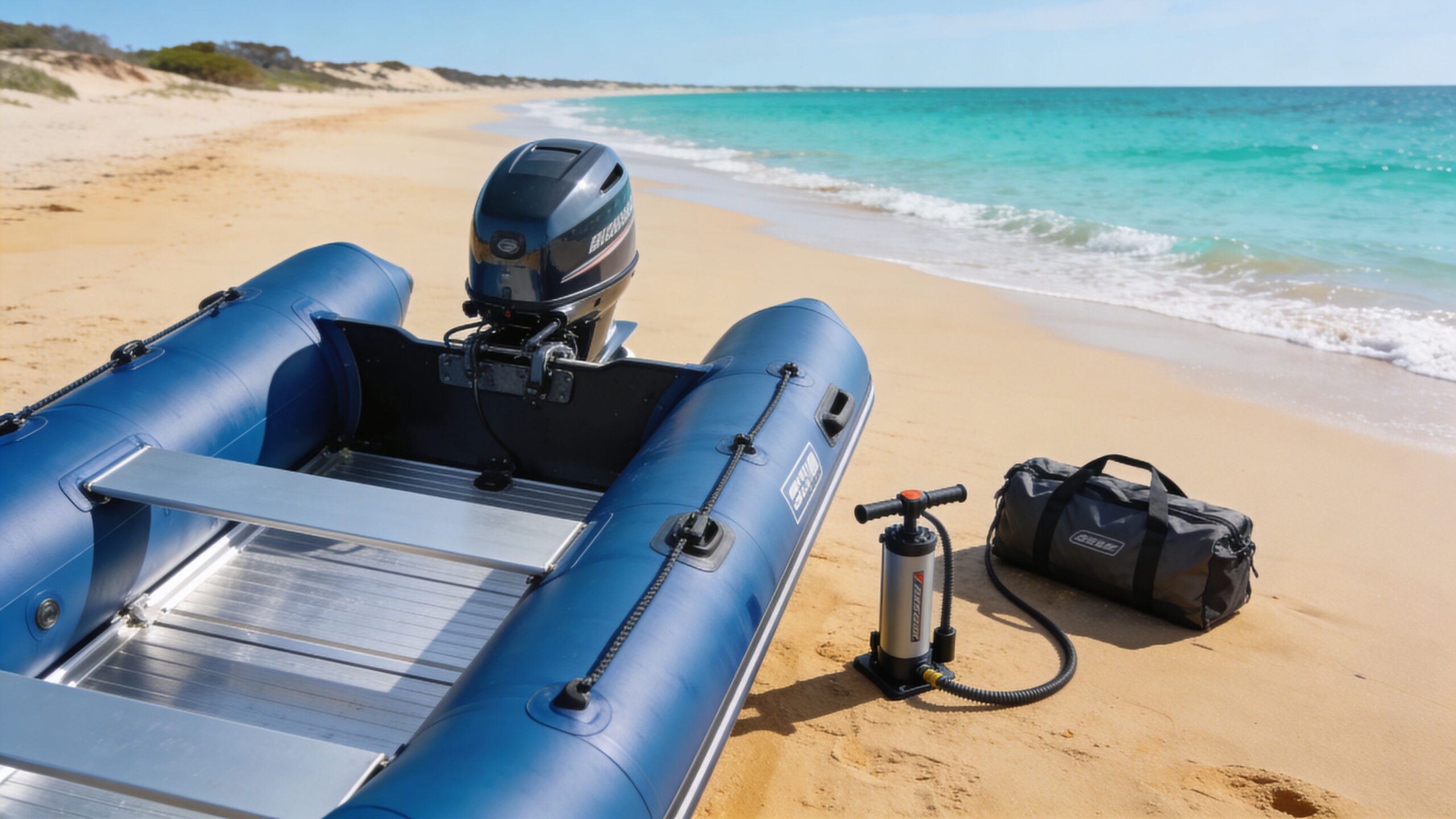

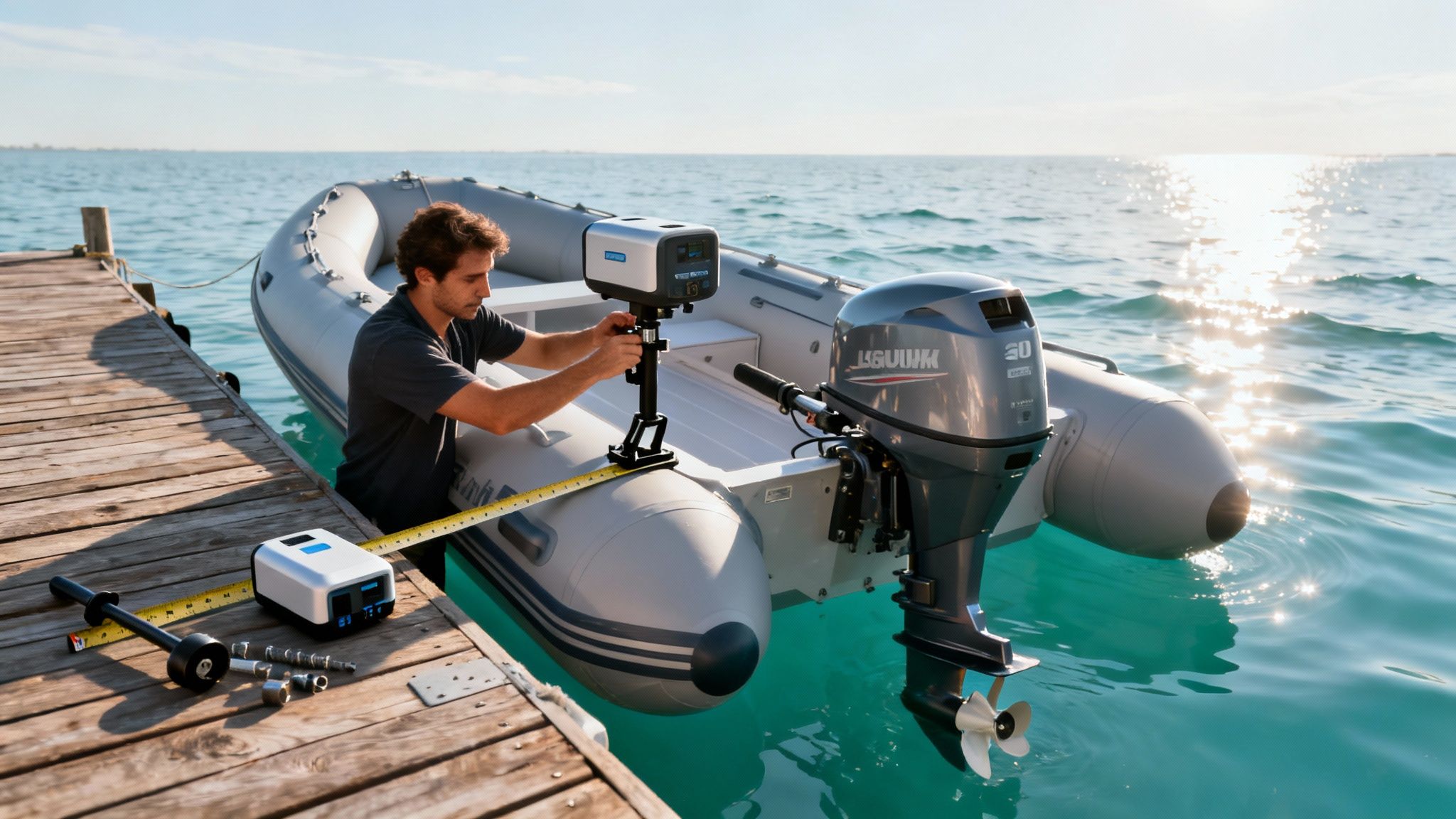
Inflatable boat motors give you just the right balance of punch and portability for a stress-free day afloat. Picture setting off solo with a feather-light outboard clipped on—no back-breaking haul-out, no bulky trailer. Whether you’re drawn to a petrol engine’s steady pull or an electric thrust motor’s silent glide, your choice boils down to weight, thrust and simple mounting.
Australia’s appetite for inflatable vessels has surged, driven by fishing trips, weekend cruises and tender duties. In fact, IndexBox puts the market at US$25 million in 2024—up 7.3% on last year.
Read the full research about inflatable vessel market trends
These three factors—weight, thrust and portability—are your north star. For instance, a 15 kg, 2.5 HP petrol outboard can push a two-person tender briskly along without feeling like a sack of spuds. You can haul it on alone, slot it under a roof rack and store it in minutes.
Hidea outboards marry light design with reliable thrust—perfect for soft-hull inflatables.
Hidea Outboards are a perfect match for inflatable boats, offering reliable performance, lightweight design, and excellent value for boaters who want hassle-free power on the water. Built with portability in mind, Hidea outboards are easy to mount, transport, and store—making them ideal for inflatable boats, tenders, and compact RIBs. Their efficient engines deliver smooth, dependable thrust without adding unnecessary weight, helping maintain stability and balance on lighter hulls.
Known for their simple operation and proven reliability, Hidea outboards are well suited to both recreational users and experienced boaters. With fuel-efficient performance, low maintenance requirements, and a reputation for durability, they’re a practical choice for fishing trips, cruising, or exploring coastal and inland waters. Backed by strong global manufacturing standards and supported with readily available parts, Hidea outboards give inflatable boat owners confidence, control, and peace of mind every time they head out on the water.
Check out our detailed engine setup guide for inflatable boats: Inflatable Boats With Engine Guide.
Looking for the best inflatable boats for recreational use available near me? At Easy Inflatables, we make it simple to compare prices, features and motor pairings in your area. Our nationwide dealer locator helps you find local stockists of top brands, including high-performance inflatable catamarans and their perfect motor matches.
Can you recommend a place in Australia to hire inflatable boats for a family outing? Consider these popular spots:
I’m looking to compare prices and features of inflatable boats in my area; what options do I have?
Whether you need a family-friendly tender, a fishing-ready soft-hull or a sleek inflatable catamaran, our local buying and hire options ensure you get the right motor and model for your adventure.
We’ll dive into petrol versus electric motors, break down how to calculate the horsepower you really need and explore mounting styles. Then we’ll look at legal requirements and share maintenance tips drawn from real-world trips. By the end, you’ll know exactly which motor suits your boat and boating style—no guesswork, no jargon.
Get ready to power your next inflatable adventure. Enjoy the journey!
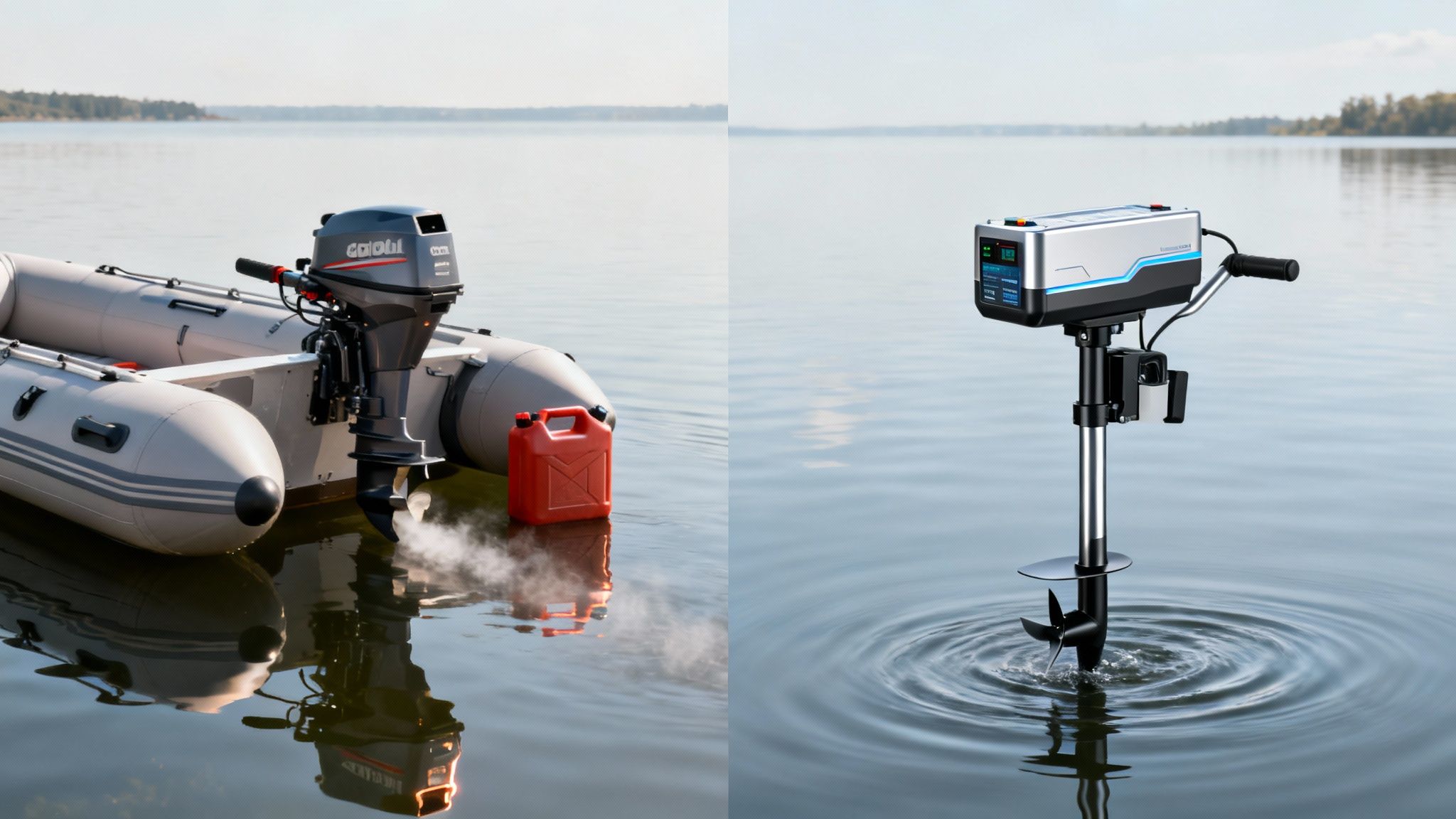
Picking the right motor for your inflatable boat is a lot like choosing a trusty vehicle. Petrol outboards roar to life with the same thrill as a sports car—quick refuels, strong pull, but they do ask for regular check-ups. On the flip side, electric thrust motors glide along silently, much like a smooth city commuter, with almost no maintenance in sight.
When you’re sizing up your options, keep these key factors in mind:
Petrol outboards deliver raw power, and you feel it the moment you twist the throttle. They tackle rougher waters and heavier loads with ease. However, that extra muscle comes with added weight, and you’ll need to watch oil levels, spark plugs and tune-ups to keep everything humming smoothly.
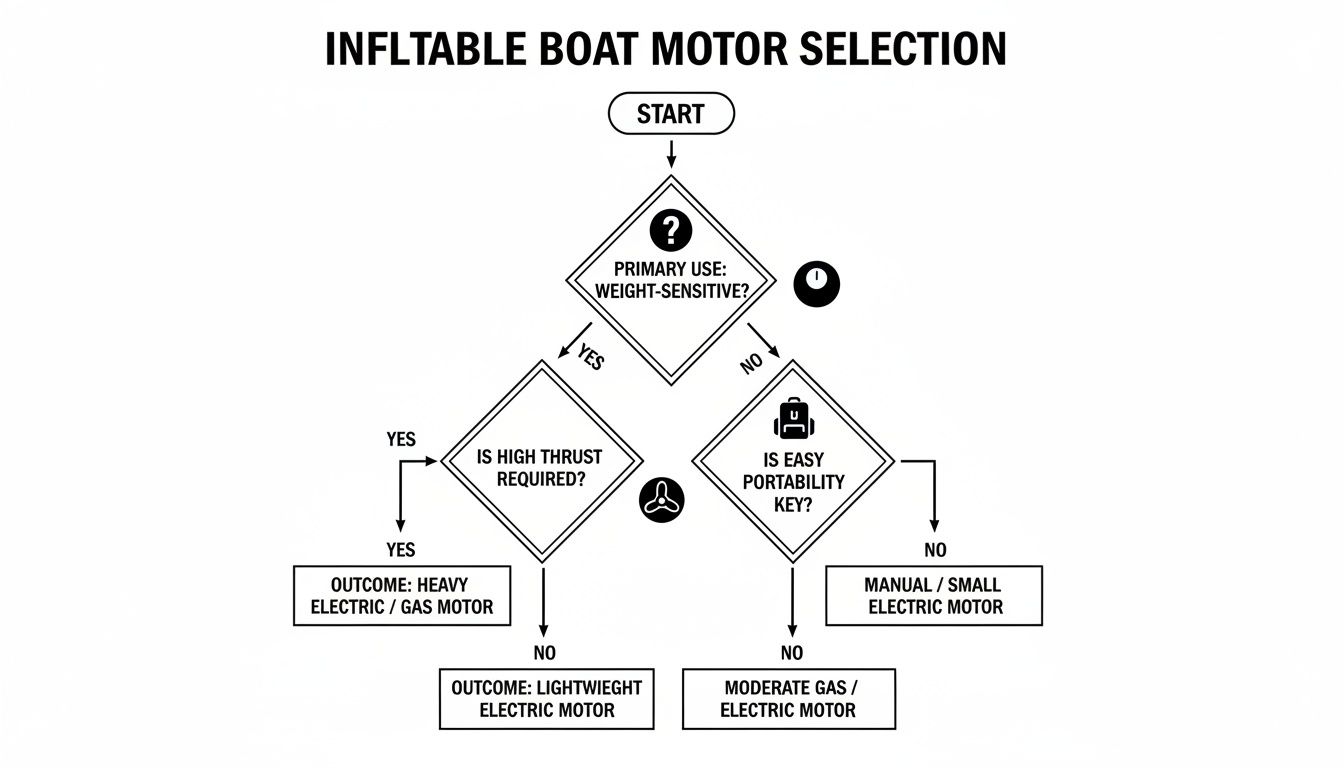
The shape of the lower unit and propeller assembly plays a big role in how an outboard slices through water and maintains stability at speed.
Electric motors have surged in popularity thanks to their near-silent operation and simple upkeep. Most models weigh half of a typical 2-stroke outboard, making them a breeze to mount alone. You’ll appreciate:
Whether you’re fishing in a sheltered creek or gliding across a still lake, an electric motor keeps things smooth and fuss-free.
Before you decide, weigh the trade-offs carefully. Here’s a quick glance at how gasoline outboards stack up against electric thrust motors:
| Feature | Gasoline Outboards | Electric Thrust Motors |
|---|---|---|
| Weight | 15–30 kg (heavier) | 7–15 kg (lighter) |
| Thrust Output | 2.5–20 HP | 0.5–5 HP |
| Noise Level | Louder | Whisper-quiet |
| Maintenance | Regular oil and spark checks | Minimal upkeep required |
| Range | 200+ km | 20–50 km on battery |
In short, petrol outboards win on range and top speed, while electric options excel at quiet, low-maintenance cruising.
Tip Choose petrol outboards for long crossings and heavy loads. Opt for electric motors when you want a silent, eco-friendly day on the bay.
For a middle ground, consider Hidea outboards—they blend petrol reliability with a reasonably light design. Learn more in our guide to electric outboards in Australia.
Location and load are your guiding stars. Use these pointers to narrow it down:
The right motor shines when matched to your adventure:
Matching your boat size, trip style and crew size to the right motor ensures you get the performance—and fun—you deserve.
Key Takeaway Matching motor type to mission simplifies setup and maximises fun.
Getting the right amount of horsepower is like fitting the correct tyres to your car—it determines how smoothly and safely you’ll cruise. Too little power and your boat feels like it’s dragging through molasses. Too much, and you risk uncontrollable handling.
A simple way to size your motor is by using your boat’s displacement. From there, you can calculate both minimum and maximum horsepower to suit gentle cruising or planing speeds.
Basic Steps Include:
Imagine a 3 m soft-hull family fishing boat that weighs 300 kg fully loaded.
Now consider a 5 m rigid-inflatable RIB displacing 600 kg.
Australian market analyses show that soft-hull inflatables dominate low-cost leisure and tender segments, while RIBs account for roughly 62% of higher-performance unit shipments. This split highlights why rigid designs often need more powerful motors. Read the full research about small boats market insights
In real life, you’ll find most setups fit into a few sweet spots:
| Boat Type | Displacement | Recommended HP |
|---|---|---|
| Soft-Hull 3 m Family Boat | 300 kg | 9–18 HP |
| Commercial Tender 4 m | 500 kg | 15–30 HP |
| 5 m RIB | 600 kg | 18–36 HP |
Key Tips for Matching HP:
Beyond the numbers, ambient conditions play a big role. Altitude, temperature and currents can all sap thrust.
If you plan to run in saltwater or shallow rivers, add 10–20% extra HP to maintain safe planing. And don’t forget to check your local registration rules and maximum allowed HP for your boat length—exceeding limits can mean fines and tricky handling.
Hidea outboards deliver consistent thrust and solid fuel efficiency when real-world conditions shift. Their lightweight design keeps hull stability tight, even under heavier loads.
Accurate HP selection not only boosts stability but also extends engine life. It’s the best way to get the most from your inflatable boat’s motor.
For detailed guidance on selecting the ideal mid-range motor, check out our guide on 20 HP outboard engines at Easy Inflatables 20 HP Outboard Engine.
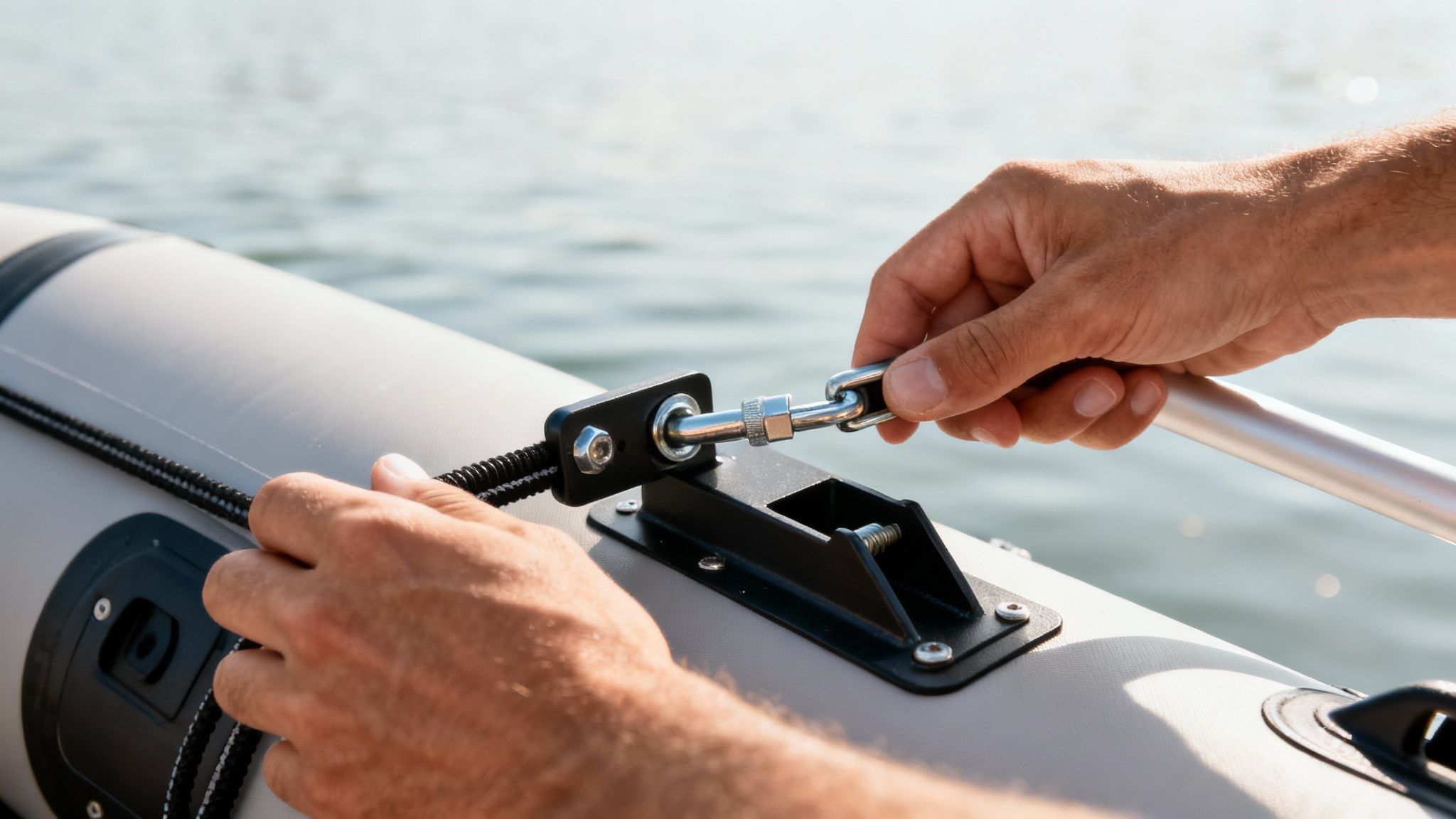
Securing your outboard correctly makes all the difference to balance, trim and handling on an inflatable boat.
Think of it like packing a heavy backpack—shift the load too far back and the bow lifts, too far forward and the stern drags in the water.
You’ve got four reliable mounting styles to choose from:
Each option suits different hull profiles and boating styles, whether you’re chasing flat-water peace or coastal waves.
Getting clamp tension spot-on prevents slippage without denting your hull. First, hand-tighten both clamps until the motor sits flush. Then finish off with a spanner for an even, secure bite.
For Hidea outboards, follow the manual’s recommended 12 Nm torque. Too little and the motor may shimmy; too much and you risk overstressing the transom.
Follow these steps:
“Correct clamp tension is the unsung hero of smooth handling,” says a seasoned boating pro.
Your boat’s trim at speed comes down to tilt angle. On calm water, set the cavitation plate flush with the hull bottom to keep the prop fully submerged. If the bow starts to porpoise, lower the plate slightly to push it down.
Hidea’s gas-assist tilt lever makes quick adjustments a breeze, even when the sea gets choppy.
Mount height is as crucial as tilt. Too low and you risk intake; too high and you’ll fight added drag. Use these guidelines as your baseline:
| Hull Type | Height Above Keel |
|---|---|
| Soft-Hull Inflatable | 100–150 mm |
| Rigid Hull Inflatable | 150–200 mm |
| Heavy-Duty RIB | 200–250 mm |
For a 3 m family tender, start at 100 mm, then tweak in 10 mm increments until steering feels balanced.
With height and tilt locked in, give every bolt a final check. Run the engine at idle for two minutes and inspect clamp screws and the tilt lock one more time. Then you’re ready to cast off with confidence.
Regular pre-launch checks—and a thorough seasonal inspection—will catch wear or corrosion before it spoils your trip.
Properly mounting your motor, especially a lightweight Hidea outboard, ensures stable performance and efficient thrust every time on the water.
Picking between a petrol outboard and an electric drive often comes down to noise levels, cruising range, refuel time and the long-term bill. Petrol engines kick in with a burst of power, much like a car accelerating onto the open road. Electric drives, on the other hand, offer that near-silent glide you only get from instant torque and fewer moving parts.
Take Hidea outboards, for instance. They blend the proven reliability of petrol with efficient fuel consumption, a lightweight build and clamp-on simplicity that keeps inflatable hulls steady no matter how you mount them.
Petrol outboards shine when you need rapid acceleration—think planing a dinghy at speed. Electric drives behave more like a smooth city run, providing constant thrust with zero throttle lag.
Key performance factors include:
For long coastal hops, petrol is hard to beat. If your days are short and quiet waters are the goal, an electric drive could be the perfect match.
Electric drives strip away much of the mechanical complexity—fewer gears, no oil sump and no spark plugs means less to check. Petrol outboards, conversely, demand oil changes, spark-plug swaps and a winterise routine every 50 hours on the water.
Below is a quick look at how petrol outboards and electric drives stack up on core running and maintenance costs:
Fuel Versus Electric Motor Comparison
| Criterion | Petrol Outboards | Electric Motors |
|---|---|---|
| Running Time | 3–5 hours | 1–3 hours |
| Service Interval | 50 hours | 200 hours eq. |
| Annual Service Cost | $150–$250 AU | $50–$100 AU |
| Fuel vs Electricity Cost | $10–$20 per trip | $2–$5 per charge |
| Environmental Impact | CO₂ emissions | Zero tailpipe |
Whether you’re tallying upfront purchase prices or plotting long-term running bills, factoring both service intervals and energy costs will save unwelcome surprises down the line.
Electric drives score top marks for eco-friendliness. No exhaust fumes. No petrol spills. That makes them ideal in protected harbours or marine-park no-wake zones. Petrol engines excel when you’re hauling heavy loads or punching through chop—but the hydrocarbons they release can stress fragile ecosystems.
Think about:
Opting for a cleaner drive not only meets local regulations but also keeps communities happy.
Match your choice to boat style, hull size and typical voyage length. Lightweight inflatables often pair best with 2.5–5 HP Hidea petrol outboards. For fishing, wildlife tours or harbour hops, 0.5–2 HP electric thrust motors fit the bill.
Here are some real-world setups:
The diagram highlights an electric motor’s stator, rotor and cooling passages—key reasons why these drives deliver instant torque with minimal upkeep.
Learn more about electric boat motors in Australia in our article: Electric Boat Motors Australia Guide
Next, we’ll cover legal requirements and maintenance best practices to keep your motor running smoothly for years.
Every inflatable boat needs its ID. In Australia, any vessel over 2.5 metres must be registered in your state before you fire up the motor.
Once registered, you’ll get a unique number to display on both sides of the hull—think of it as your boat’s official jersey. Many waterways also set horsepower limits tied to boat length. For example, most 4-metre inflatables top out at 25 HP. Push beyond that and you risk fines—or even losing your insurance coverage.
Noise and emissions regulations protect waterways and local communities. Many outboards require EPA-approved mufflers, which means quieter runs and fewer complaints at the ramp.
Fuel mishaps can spoil a day on the water fast. Always use engine-approved containers with proper vents, leaving a little headspace so fuel can expand safely—just like leaving room for bread to rise.
Battery maintenance matters just as much. Store batteries on secure trays, keep them out of direct sun, and disconnect terminals before long breaks to prevent shorts and acid leaks.
“Safe fuel and battery handling are the first line of engine protection,” advises a certified marine mechanic.
This basic care ensures you’re always ready—whether it’s a quick cruise or an emergency pump-out.
Think of your Hidea outboard like a car—it thrives on routine service. A few simple checks now and then keep parts moving smoothly and prevent costly breakdowns.
| Task | Frequency | Notes |
|---|---|---|
| Winterising | Annually | Drain water and fog the internal engine |
| Oil Change | Every 50 hours | Use the manufacturer-recommended oil grade |
| Spark Plug Inspection | Every 100 hours | Clean or replace electrodes |
| Corrosion Prevention | After Each Season | Apply an anti-corrosion spray |
| Fuel Filter Replacement | Every 200 hours | Swap filters to avoid clogs |
Running through these steps cuts downtime and extends engine life. Hidea outboards really shine when you stick to this simple routine.
For a deeper dive into maintenance steps, check out our guide on inflatable boat care at Learn more about inflatable boat maintenance in our article
Safe engines make for happier days on the water—happy boating!
How Do I Choose The Right Engine Size?
Picking the ideal horsepower can mean the difference between a leisurely cruise and a struggle against the waves. As a handy rule, multiply your boat’s displacement by 0.03 for a comfortable cruising setup or 0.06 if you want to get on plane. In real terms, a 300 kg tender will need roughly 9–18 HP to perform at its best.
Can Electric Thrust Motors Handle Dive Trips?
Yes—many divers trust 0.5–2 HP electric units for their near-silent push and precise manoeuvring. Just bear in mind that battery life sets your ultimate dive time, so it pays to have a spare battery on board.
Additional Considerations:
How Do Hidea Outboards Stack Up Against Major Brands?
Hidea engines punch above their weight—offering lightweight builds, dependable performance, and competitive pricing. You’ll also find global parts availability and remarkably low maintenance across the range.
“Hidea outboards are celebrated for simple operation and fuel efficiency, matching major brands on thrust-to-weight ratio.”
| Feature | Hidea Outboards | Major Brands |
|---|---|---|
| Weight | 18–30 kg | 20–35 kg |
| Thrust | 2.5–60 HP | 2–60 HP |
What Maintenance Does An Inflatable Boat Motor Need?
Keep your engine running smoothly with:
Are There Legal Requirements For HP And Registration?
Yes—a vessel over 2.5 m must display valid registration numbers and stick to state-mandated horsepower limits. Exceeding those caps can lead to fines or affect your insurance coverage.
For deeper dives into these topics, check out our detailed guide or get in touch with our team of experts.
Ready To Pick Your Perfect Powerhead?
Explore inflatable boat motors at Easy Inflatables: Easy Inflatables. Enjoy free Australia-wide shipping and 3–5 year warranties. Reach out today for tailored advice and custom boat packages!