
Choosing the right oars for your boat is about so much more than just having a backup for your motor. A good set of oars is your key to silent navigation, precise control, and, most importantly, safety on the water. It’s the difference between a frustrating struggle and a perfect day out.
Think of your oars as your primary connection to the water. They’re not just an afterthought; they’re a fundamental piece of gear. This guide will walk you through what really matters when choosing a pair, moving beyond textbook definitions to give you a practical feel for the different types. We’ll explore why matching the right oars to your specific boat—whether it’s a nimble tender or a stable inflatable catamaran—is so critical for everything from a quiet fishing trip to a family outing in Australia.
For anyone with one of the best inflatable boats for recreational use available near me, a great place to start is by looking at oars designed specifically for them. You can check out a purpose-built selection of inflatable sports boat oars to see what modern designs offer. Mismatched oars can completely ruin a day, turning what should be a pleasant cruise into an exhausting battle against the wind and current.
Before we get into the nitty-gritty of oar anatomy and materials, let’s zoom out. Think of these core factors as your pre-purchase checklist. Getting these right will steer you toward the perfect set of oars for your needs.
Choosing oars is like picking the right tool for a job. You wouldn’t use a sledgehammer for a finishing nail; similarly, the oars for a heavy-duty fishing trip are different from those for a leisurely paddle around the bay. Matching the oar to the task ensures efficiency and enjoyment.
To make things even clearer, here’s a quick summary table to help guide your thinking. It breaks down the key considerations and points you in the right direction based on your specific situation.
| Factor | Key Consideration | Best For |
|---|---|---|
| Boat Type | The width (beam) of your boat is the most critical measurement. | Longer oars for wider boats (e.g., Inflatable Catamarans); shorter oars for narrow tenders. |
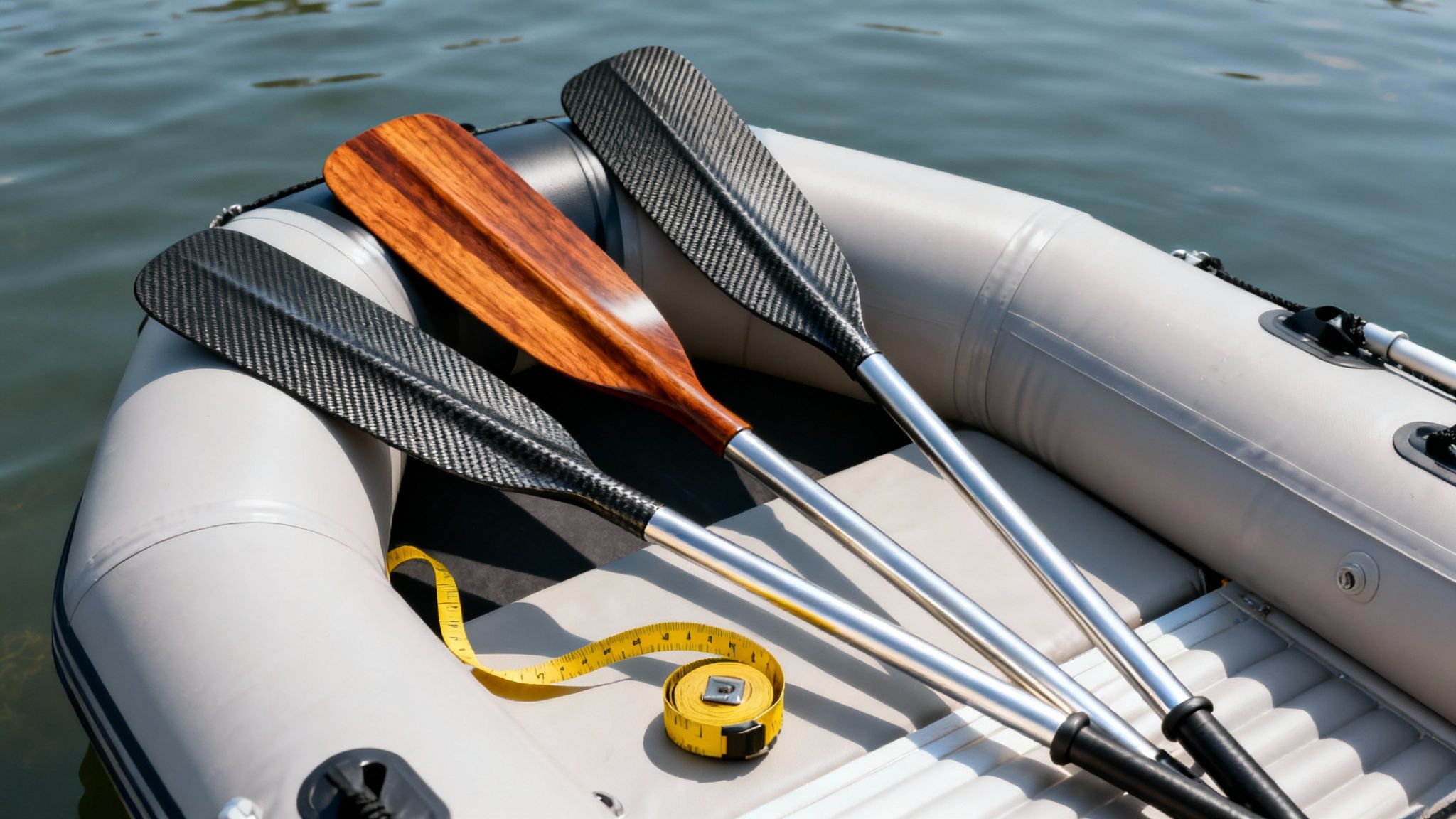
| Oar Material | Balance between weight, durability, and maintenance. | Aluminium: Lightweight & low maintenance. Wood: Traditional feel & flex. Composite: High performance & light. |
| Length | Proper length is vital for leverage and efficiency. | Measure from oarlock to oarlock and use a sizing formula (covered later in this guide). |
| Primary Use | Will you be rowing long distances or just short trips? | Serious Rowing: Longer, more efficient spoon blades. General Use: Lighter, flat blades are fine. |
This table is just a starting point, of course. As you read on, you’ll gain a deeper understanding of each of these factors, empowering you to make a choice you’ll be happy with for years to come.
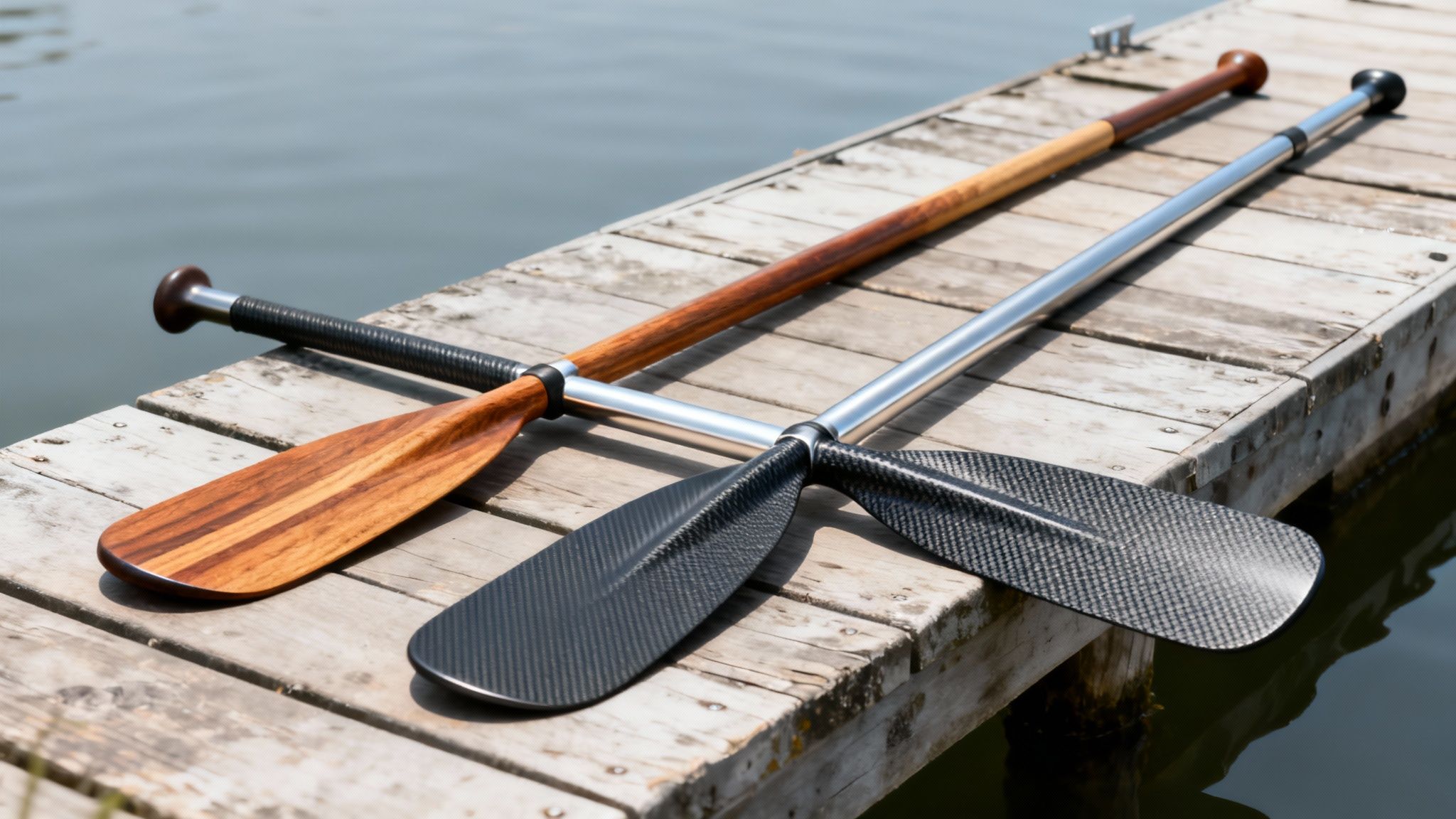
Think of an oar as a simple, elegant lever designed to move your boat through the water with the least amount of fuss. They look pretty straightforward, but each part has a specific job in turning your muscle power into forward motion. Getting to know these components is the first step to picking a quality set of oars for your boat.
Every oar breaks down into three main parts. The blade is the wide, flat end that digs into the water, acting a bit like a propeller to push you along. The long central part is the shaft (sometimes called the loom), which gives you all your leverage. Finally, the handle (or grip) is right where you apply your power. A great oar is one where all three parts work in perfect harmony for a smooth, powerful stroke.
The material an oar is made from completely changes how it performs—affecting its weight, durability, feel, and of course, the price tag. For owners of versatile boats like our Inflatable Catamarans, getting the material right is key to enjoying your time on the water.
Here’s a look at what you’ll typically find:
The right oar material should complement both your boat and your boating style. A rugged, low-maintenance aluminium oar is the perfect partner for a durable inflatable boat, ready for any family adventure. On the other hand, a sleek, high-performance tender might be better served by a pair of feather-light carbon fibre oars.
When you’re ready to compare prices and features of inflatable boats in my area, you’ll find that aluminium often hits the sweet spot between cost and resilience. Many are designed as two-piece oars, so you can break them down and tuck them away neatly in the boat’s carry bag—a massive plus for portable setups. A great starting point is exploring a specialised range like our aluminium oars for inflatable boats.
Here in Australia, our vibrant boating scene has always relied on good oars for exploring everything from Sydney Harbour to remote coastlines. The local manufacturing industry has evolved to meet this need. For instance, while textile production saw a 24% dip over one period, the output of polymer and rubber products—the stuff that makes the durable grips and components on modern oars—jumped by 44%. This shift, highlighted in Australian manufacturing trends on abs.gov.au, ensures that Aussie boaters today have access to tough, high-quality gear built for local conditions.
Choosing the right oars for your inflatable boat is about more than just looks or material; getting the length right is absolutely critical for an enjoyable day on the water. It’s the difference between a smooth, powerful stroke and a frustrating, back-breaking paddle.
Oars that are too short will have you hunched over, taking choppy, inefficient strokes that barely move you. Go too long, and they’ll feel heavy and clumsy, crossing over awkwardly and making it tough to manoeuvre. The perfect length gives you the right leverage, letting you sit comfortably and use your whole body for a strong, fluid pull.
Think of it this way: your oar is a lever, the oarlock is the pivot point (or fulcrum), and your boat is the weight you need to move. The ideal oar length perfectly balances the ‘inboard’ section (from handle to oarlock) and the ‘outboard’ section (from oarlock to blade). This perfect balance means every bit of your energy goes straight into pushing your boat forward.
Ready to find your ideal oar length? First, you’ll need to grab a tape measure and find the span — that’s the distance between your two oarlocks. For an inflatable boat, just measure from the centre of one oarlock mount to the centre of the other.
Got it? Now, just plug that number into this tried-and-true formula:
For example, if your boat’s oarlock span is 120 cm, the maths looks like this: (120 / 2 + 50) x 2 = 220 cm. This tells you a pair of 220 cm (about 7′ 2″) oars would be an excellent starting point for your boat. While this formula gets you very close, things like how high you sit above the water can also play a role in your final choice.
To help you get a quick estimate, here’s a handy chart that matches common boat widths with recommended oar lengths.
| Boat Beam (Width) | Recommended Oar Length (Each) | Ideal for Boat Type |
|---|---|---|
| 110-120 cm | 210-220 cm (approx. 7′) | Compact Inflatables, Small Tenders |
| 120-135 cm | 220-235 cm (approx. 7′ 6″) | All-Round Inflatables, Viper 330 Series |
| 135-150 cm | 235-250 cm (approx. 8′) | Wider Inflatables, Fishing Setups |
| 150+ cm | 250 cm+ (approx. 8′ 6″+) | Large Inflatables, Inflatable Catamarans |
This table provides a great starting point, but always remember to double-check your oarlock span for the most accurate sizing.
The real test for the perfect length is this: when you pull the oars straight back in a full stroke, the handles should just slightly overlap in front of you. This overlap means you’re using your full range of motion for maximum power—a technique perfected on everything from classic river boats to modern racing shells.
While shaft length is crucial, the blade’s shape at the other end plays a huge role in how the oar performs in the water. You’ll mostly come across two common types: flat blades and spoon blades.
The principles of blade dynamics are similar across different types of watercraft. If you also use a canoe or kayak and want to dive deeper into how blade design works, check out our guide to paddles for canoe and other small watercraft.
Even the world’s best oars are pretty useless without a solid pivot point. This all-important connection comes down to your mounts and oarlocks—the hardware that turns your muscle power into forward momentum. Getting this system right is critical, especially on an inflatable boat where the wrong setup can cause some serious headaches.
A well-matched oarlock system is the secret to a smooth, powerful stroke. It stops the oar from slipping or jamming up, letting you get into a fluid rhythm that makes rowing a joy instead of a chore. It’s the crucial link between you, your oars, and the water.
Oarlocks come in a few different styles, and each one offers a unique feel and function on the water. The most common ones you’ll see are pin-style and clamp-on oarlocks, both great choices depending on what you’re doing.
For those of us with inflatable boats, the mounting system is just as important as the oarlock. Most inflatables use specially designed PVC or Hypalon patches with the oarlock holders built right in. These are glued directly onto the boat’s tubes, creating a secure anchor point that won’t tear or damage the fabric. This is the standard setup you’ll find on quality vessels like the Aerowave inflatable catamarans.
The chart below shows how the position of your oarlocks influences the ideal oar length you’ll need for different boat sizes.

As you can see, wider boats like inflatable catamarans need much longer oars to get the right leverage and geometry for efficient rowing—proving just how important strong, well-placed mounts are.
A secure mount isn’t just a nice-to-have; it’s non-negotiable for both safety and performance. When you’re attaching oarlock patches to an inflatable, you have to use the right adhesive and follow the manufacturer’s instructions perfectly. A poorly glued mount can peel right off under pressure, leaving you stranded and powerless on the water.
Think of the oarlock as the boat’s wrist joint. A strong, flexible joint allows for a full range of motion and efficient power transfer. A weak or poorly fitted one leads to instability and wasted effort, turning a smooth row into a clumsy struggle.
Historically, oars have powered everything from Indigenous crafts to colonial rowboats across Australia. Their importance continues today with modern inflatable boats, supported by a surprisingly robust local manufacturing sector. In fact, this industry is Australia’s sixth largest, generating $137 billion in value-added output and employing 930,000 people, making sure we have access to quality gear for all our coastal adventures.
Ultimately, pairing the right oarlocks with solid, properly installed mounts is what creates a seamless rowing system. For more ideas on outfitting your vessel, check out our guide on essential inflatable boat accessories to complete your setup.
Proper care can turn your oars for boat use from a simple purchase into a long-term investment. Just a few minutes of maintenance after each trip can dramatically extend their life, ensuring they perform reliably for years to come. This is especially true after a day out on saltwater, which can be particularly harsh on just about any material.
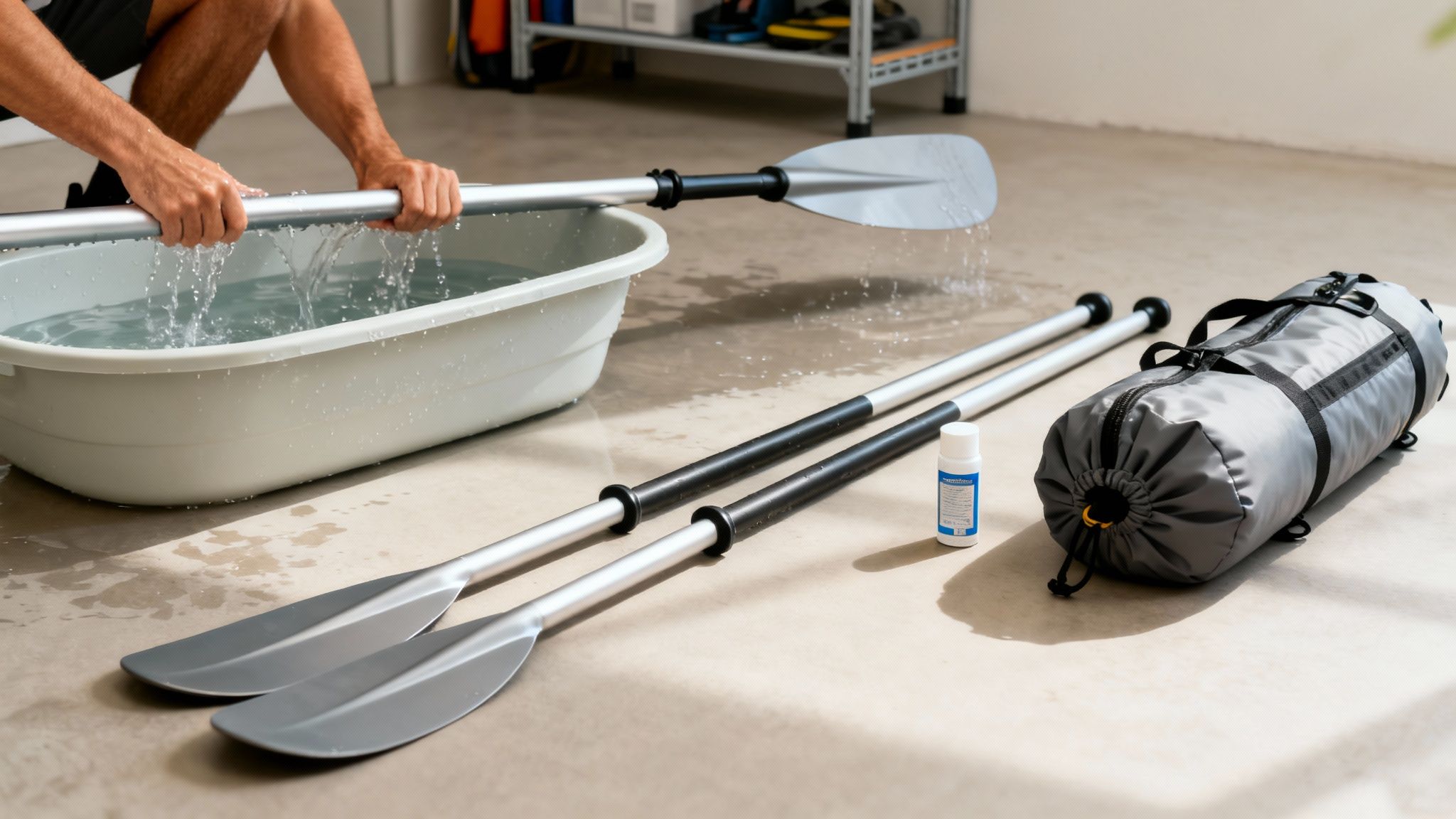
It’s a common mistake to neglect your oars, but that’s a shortcut to premature wear and tear. Whether yours are crafted from classic wood, modern composites, or rugged aluminium, each material has its own needs. Taking the time for a quick rinse and inspection now prevents much bigger problems down the line, saving you money and keeping you safe on the water.
Different oars need different care routines to stay in top condition. Follow these simple guidelines, and they’ll always be ready for action.
This proactive approach is all part of a larger maintenance mindset. For a complete rundown on keeping your vessel in prime condition, you can explore our detailed guide on inflatable boat maintenance made simple.
Think of your oar as a finely tuned tool. Just as a carpenter sharpens their chisel, a boater must care for their oars. A well-maintained oar feels balanced, delivers power efficiently, and instills confidence with every stroke.
For those of us living the portable ‘boat-in-a-bag’ lifestyle, smart storage is key. Two-piece oars are designed for convenience, but they still need to be stored correctly to avoid damage.
After rinsing and drying, always separate the oar sections. This simple step prevents them from getting stuck together and makes them much easier to pack away. Storing them in a protective bag will help you avoid scratches and dents from other gear rattling around during transit.
A cool, dry place is always best, whether that’s in a garage, a shed, or an onboard storage locker. This simple routine ensures your oars are always ready for your next adventure.
Choosing the right **oars for your boat** can feel like a big decision, but it doesn’t have to be complicated. To help you feel confident in your choice, we’ve gathered some of the most common questions we hear from fellow boaters. These clear, practical answers will tackle any lingering uncertainties and serve as a final checklist before you commit.
By addressing these key points, you can ensure you’ve covered all your bases. This final step helps you move forward with a set of oars that perfectly matches your boat and your on-water ambitions.
While it might be tempting to grab any old oar, it’s always best to use those specifically designed for inflatable boats. These oars are typically lighter and often come in two pieces for easy transport—a huge advantage for portable setups.
Most importantly, they are made to pair with oarlock systems that use glued-on fabric mounting patches. Using an oar that’s too heavy or has an incompatible oarlock can put excessive stress on the tubes, potentially causing damage over time. The best inflatable boats for recreational use available near me include perfectly matched oars for optimal performance and safety.
This is a classic question, and the key difference lies in how they connect to the boat. It’s a simple distinction but an important one for every boater to understand.
You should replace your oars at the first sign of significant wear and tear. A compromised oar can fail under pressure, creating a serious safety risk out on the water. The warning signs differ depending on the material.
For wooden oars, look for deep cracks, splintering wood, or any signs of rot that could weaken the structure. With aluminium oars, be wary of major dents, any noticeable bending in the shaft, or corrosion that has started to eat away at the metal. For composite oars, carefully inspect them for stress fractures or deep gouges that could signal a structural weakness.
Think of your oars as essential safety equipment, just like a life jacket. You wouldn’t trust a frayed life jacket, and you shouldn’t trust a damaged oar. Regular inspection is a small price to pay for peace of mind on the water.
This really comes down to your priorities and how you use your boat. A one-piece oar generally offers maximum strength and stiffness, making it a great choice for serious rowers or for boats that are kept permanently in the water.
However, a two-piece oar provides unmatched convenience for storage and transport. For owners of inflatable boats, especially portable ‘boat-in-a-bag’ models or compact inflatable catamarans, two-piece oars are far more practical. They break down easily to be stowed away in a carry bag or vehicle, making them the superior choice for the modern, mobile boater.
Ready to find the perfect set of oars that combine durability, performance, and convenience? At Easy Inflatables, we offer a range of high-quality aluminium oars designed specifically for the demands of inflatable boats. Explore our full collection and gear up for your next adventure. Find your perfect oars at Easy Inflatables.