
So, you’re thinking about getting into sea kayaking. Good on you. There’s nothing quite like gliding across open water, exploring Australia’s stunning coastlines from a perspective you just can’t get on land. Sea kayaks, or ocean kayaks, are your ticket to that freedom.
These aren’t your average recreational kayaks you might see on a calm river. They’re specifically engineered for the big blue—oceans, bays, and vast lakes. They are typically longer and narrower, designed to cut through waves and track straight, even when the wind picks up. This makes them perfect for everything from coastal exploring and fishing to epic multi-day camping trips.
Welcome to the ultimate guide for choosing the right ocean kayak for Australian waters. This isn’t just for the seasoned pros; it’s for anyone curious about getting out on the water, from families looking for a weekend paddle to serious anglers chasing the next big catch. We’ll cut through the jargon and get straight to what really matters.
The appeal of paddling our coastline is undeniable. It’s no surprise that boating is booming Down Under. According to the Boating Industry Association’s (BIA) State of the Industry Data Report Card, an incredible one in ten Australians hold a boat licence, helping to fuel a massive $10.2 billion national turnover for the industry.
Think of this guide as your trusted resource. We’ll break down how core design elements like hull shape and length directly impact stability for a fishing trip or speed for a long-distance tour. You’ll also get a real-world comparison between traditional rigid kayaks and modern, high-performance inflatables, giving you a clear path to making the right choice.
Here’s a quick look at what we’ll cover:
A sea kayak is more than just a boat; it’s your personal vessel for discovery. Choosing the right one transforms a simple day on the water into a memorable adventure, connecting you with the marine environment in a way few other activities can.
By the end of this guide, you’ll have the confidence to pick the perfect craft for your style of adventure. Whether you’re eyeing a classic sit-on-top or one of our versatile inflatable boats and kayaks, our goal is to make sure every trip is a remarkable one. Let’s get started.
What turns a simple plastic shell into a sea kayak that can handle the open ocean? It all comes down to its design DNA—the specific shapes and dimensions that dictate how it behaves in the water. Once you understand these core principles, you can look past the marketing hype and get a real feel for how a kayak will perform under you.
Think of it like choosing a car. You wouldn’t take a sports car off-roading, and you wouldn’t enter a city hatchback in a Formula 1 race. The same logic applies to kayaks; their performance is purpose-built, starting with the hull.
The hull is the main body of the kayak, and its shape is the single biggest factor in its performance. Different contours are engineered to excel at specific jobs, whether that’s slicing through choppy waves or giving you a rock-solid platform for fishing.
Let’s break down the most common types:
A kayak’s hull shape fundamentally defines its personality on the water. A V-hull prioritises speed and direction, while a flat hull prioritises stability. Choosing the right one means matching the kayak’s strengths to your intended adventure.
Beyond the hull’s contour, two other measurements dramatically change how a kayak handles: its length and its width (or beam).
A longer, narrower kayak will almost always be faster and track straighter than a shorter, wider one. This is because its streamlined shape creates less drag in the water. These sleek designs are favoured by paddlers looking to cover serious ground along the coast.
On the flip side, a shorter, wider kayak gives you way better stability and manoeuvrability. It might not win any races, but its steadiness gives confidence to beginners, families, and anglers. The extra width makes it feel more secure, and its shorter length lets it turn on a dime. Many paddlers start with a wider sit-on-top model for this very reason, and you can learn more in our guide to choosing a sit-on-top kayak in Australia.
Finally, let’s talk about rocker. This is just a fancy term for the amount of upward curve in the hull, from the front (bow) to the back (stern).
Picture a banana. A kayak with a high rocker has a noticeable banana-like curve. This design lifts the bow and stern out of the water, making the kayak incredibly nimble and easy to turn. It’s fantastic for playing in the surf or navigating tight spots.
In contrast, a kayak with low (or no) rocker is much flatter along its length. With more of the hull in the water, it tracks straighter and holds its course more effectively—exactly what you want for efficient, long-distance paddling.
By understanding how hull shape, length, beam, and rocker all work together, you can confidently size up any sea kayak and know exactly how it’s built to perform.
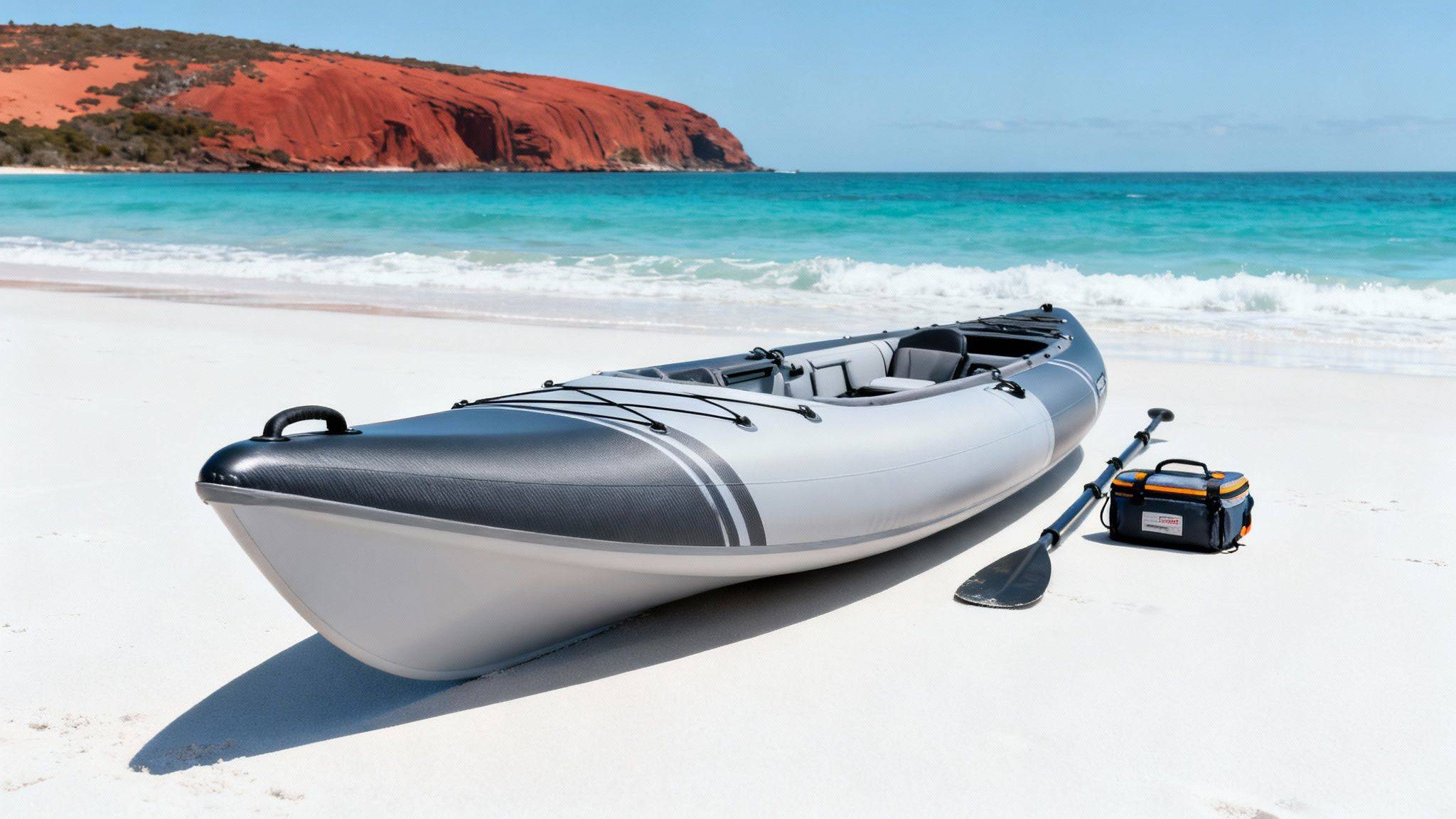
When you picture an ocean kayak, you probably imagine a sleek, hard-shell boat strapped to a roof rack. But the “boat-in-a-bag” revolution is here, and it’s changing the game. Today’s high-performance inflatable kayaks are a world away from cheap pool toys, giving their rigid cousins a serious run for their money.
This is one of the biggest decisions you’ll make. It affects everything from where you store it and how you get it to the water, to your actual experience paddling. It’s not about finding the “best” kayak, but the one that’s a perfect match for your lifestyle and your adventures.
First things first: let’s ditch any old ideas about flimsy, easily-popped inflatables. The premium models we’re talking about are built for serious coastal exploring.
They’re constructed from heavy-duty materials like German Valmex PVC, with seams that are thermo-welded. This process literally fuses the material together, creating an airtight and incredibly tough bond. The result is a kayak that’s not just durable but surprisingly rigid when inflated properly, delivering performance that honestly rivals many traditional kayaks.
The real game-changer with modern inflatables is accessibility. They smash the old barriers of storage space and transport, making sea kayaking a real possibility for people in apartments or those without roof racks. It’s all about getting more people on the water, more often.
This is where inflatables truly shine. A rigid kayak, often over four metres long, demands a garage, a shed, or some other dedicated storage spot. It also needs a vehicle with roof racks. An inflatable, on the other hand, packs down into a large bag that fits in the boot of your car or a cupboard at home.
That convenience completely changes how you kayak. A last-minute trip to a beautiful, remote beach becomes simple. No heavy lifting, no fiddling with straps and tie-downs—just grab the bag and go.
Let’s dive deeper and compare the two side-by-side.
This table breaks down the key differences to help you decide which type of sea kayak aligns best with your needs, from storage and transport to on-water performance.
| Feature | Premium Inflatable Sea Kayaks | Traditional Rigid Sea Kayaks |
|---|---|---|
| Portability | Excellent. Packs into a bag, fits in a car boot. | Poor. Requires roof racks and is heavy to lift. |
| Storage | Minimal. Fits in a closet or small garage space. | Significant. Requires a garage, shed, or dedicated rack. |
| Setup Time | 5-10 minutes to inflate and assemble. | Instant. Just unstrap from the car and go. |
| Stability | Generally very high due to wider base and buoyant tubes. | Varies. Performance models can be less stable. |
| Speed & Tracking | Good, but can be slightly slower than high-end rigids. | Excellent, especially V-hull designs built for speed. |
| Durability | High-grade PVC is tough and abrasion-resistant. | Very durable (fibreglass, composite, plastic). |
| Repairs | Simple on-the-go patch repairs are possible. | Can be complex and expensive, often requiring a professional. |
| Initial Cost | Often more affordable, with fewer hidden costs. | Can be more expensive, plus the cost of roof racks. |
| Best For | Paddlers with limited space, spontaneous trips, fishing. | Long-distance touring, racing, performance paddlers. |
Ultimately, the choice comes down to what you value most. If you want maximum convenience and stability without sacrificing too much performance, a premium inflatable is an incredible option. If you’re chasing pure speed for long-distance expeditions and have the means to transport and store it, a rigid kayak still holds its own.
So, how do they actually feel on the water? A high-end rigid kayak, particularly one with a sharp V-shaped hull, will usually have a slight edge in pure speed and tracking over long distances. Its solid structure lets it slice through choppy water with incredible efficiency.
However, inflatables almost always win on stability. Their wider base and air-filled tubes create a rock-steady platform. This is a massive confidence booster for beginners and a huge advantage for anyone fishing, as you can cast and move around without feeling tippy.
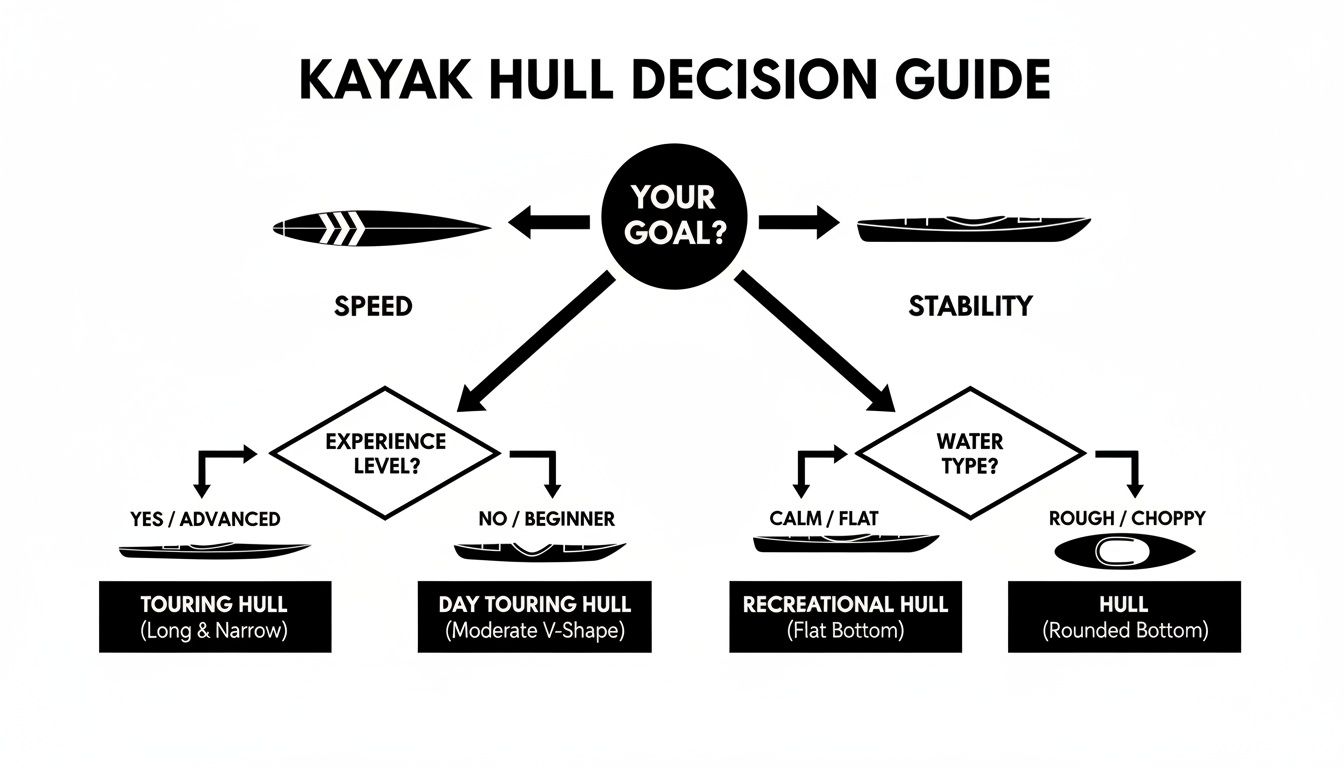
As the flowchart shows, it’s a trade-off. Narrower, sleeker hulls are built for speed, while wider, flatter hulls provide the stability you need for activities like fishing or just a relaxed paddle with the family.
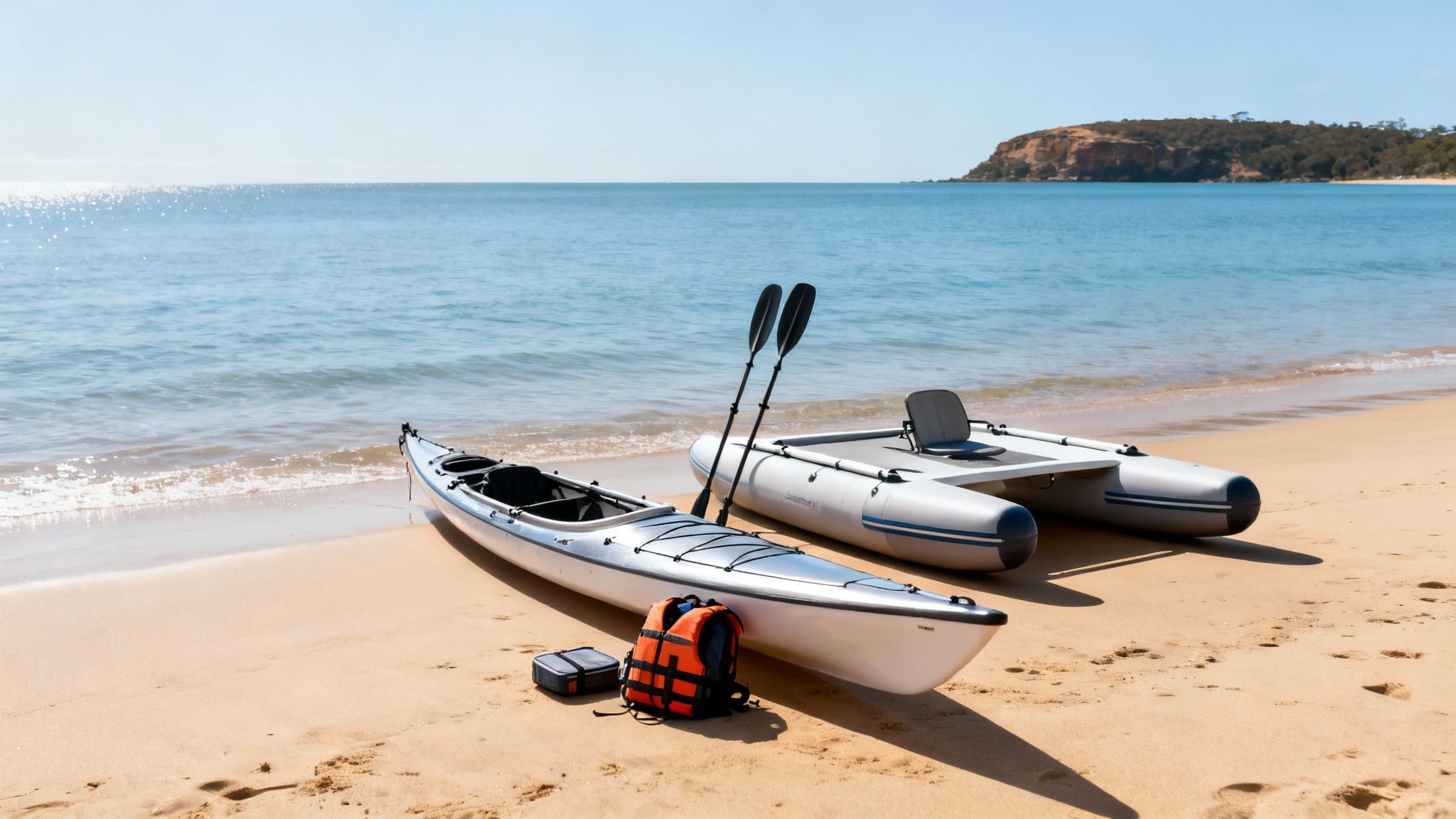
Even more advanced designs like inflatable catamarans take this stability to a whole new level. With two separate hulls, they offer an unbelievably secure and spacious platform that is almost impossible to capsize, making them a game-changer for families and serious anglers. You can learn more by checking out our guide on finding the best inflatable kayak for your weekend.
A common worry is durability, but modern inflatables are built tough. The thick PVC or Hypalon fabric is highly resistant to scrapes, bumps, and UV damage. And while a sharp oyster shell could puncture any boat, fixing an inflatable is often a simple job you can do on the spot with a patch kit.
When it comes to value, inflatables are often a more accessible way to get into kayaking. Once you factor in the money saved on roof racks and storage solutions, the total cost of ownership can be much lower. This frees up your budget for better paddles and essential safety gear. The choice really boils down to weighing the unbeatable portability and stability of an inflatable against the raw speed of a traditional rigid kayak.
Choosing an ocean kayak isn’t about finding the single “best” boat out there. It’s about finding the right boat for you. The perfect kayak for a solo adventurer tackling multi-day trips will be totally wrong for a family wanting to splash around at the local beach.
The key is to be honest about how you’ll actually use it. A few simple questions now will save you from buying a kayak that ends up gathering dust in the garage instead of becoming a core part of your adventures.
It’s no secret that paddle sports are booming across Australia as more of us discover the joy of our incredible waterways. The Water Sports Equipment market in Australia is forecast to hit a massive US$196.38 million in revenue, with sea kayaking right at the front of the pack. This is backed up by BIA data showing over 900,000 registered boats, and a huge 67% of them are under 6 metres—the sweet spot for versatile craft like sea kayaks. You can dive into the numbers yourself by exploring detailed market insights on Statista.
Dreaming of casting a line in a quiet estuary or trolling for tailor just beyond the break? If fishing is your main game, then stability is everything. You need a solid platform that won’t wobble when you’re leaning over to land a fish, rigging up your gear, or even standing to get a better view.
A wider beam is your best mate here. Kayaks built specifically for fishing will typically have:
This is where an inflatable catamaran really shines. That twin-hull design delivers a level of stability that traditional single-hull kayaks just can’t touch, giving you an unbelievably secure and spacious fishing platform.
If your idea of a perfect getaway involves multi-day expeditions along the coast, your focus shifts from pure stability to paddling efficiency. You need a sea kayak that can chew up the kilometres with less effort, handle unpredictable conditions, and carry all your camping gear without a fuss.
Your ideal touring kayak will feature:
The best touring kayak feels like an extension of your own body. It responds predictably to every paddle stroke and the rhythm of the ocean, carrying your gear without feeling sluggish so you can focus on the journey itself.
For those just looking for safe, easy fun at the local beach or in a sheltered bay, the needs are much simpler. You want a boat that’s user-friendly, forgiving, and above all, safe for everyone from the kids to the family dog.
Look for these key features:
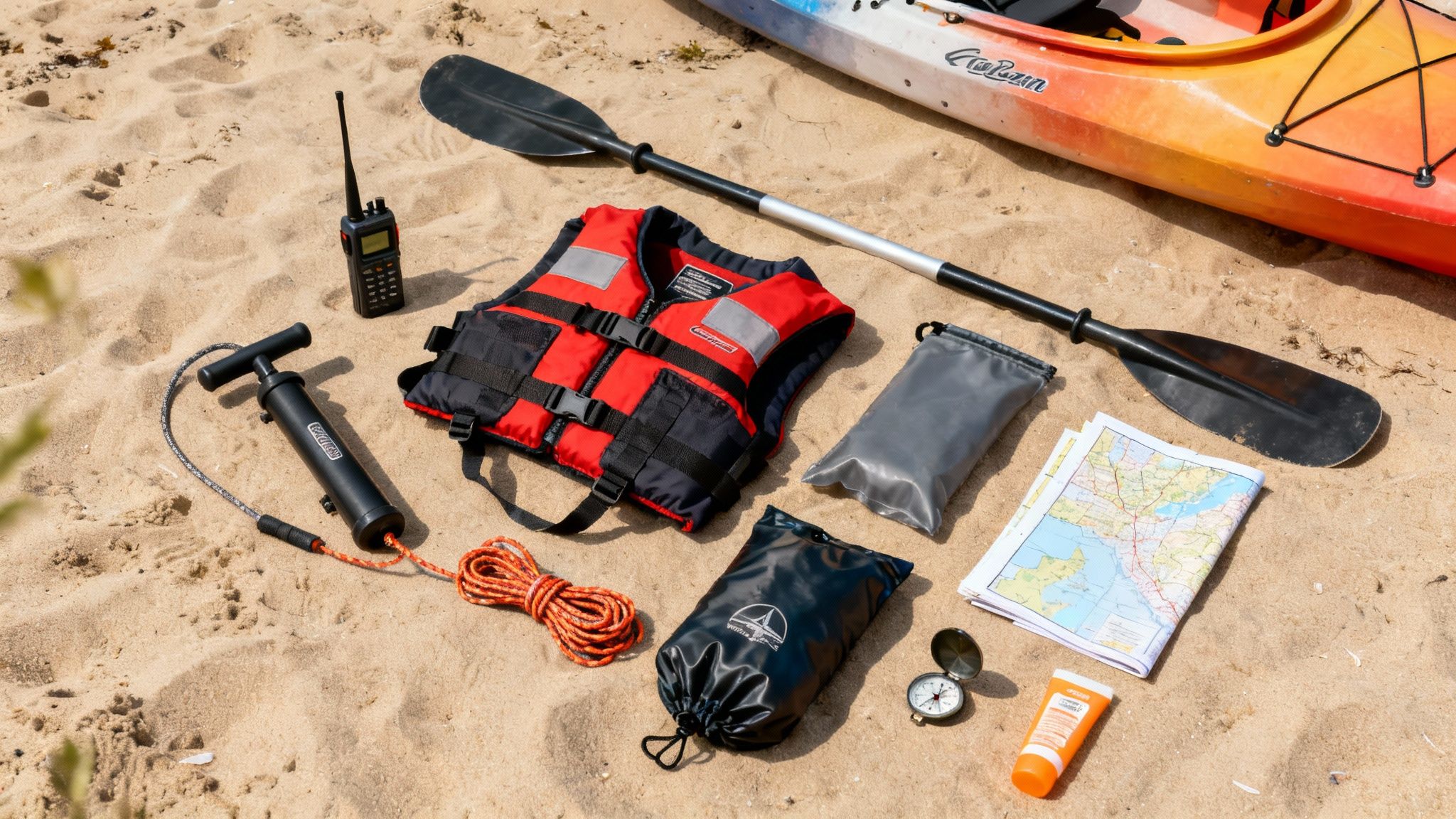
Real confidence on the open ocean comes from good preparation, not just good luck. While the right ocean kayak gives you a stable and capable platform, your true security is knowing you have the right gear and the skills to handle a sudden change in conditions. This isn’t about being fearful; it’s about being smart, so you can explore responsibly and always come home with great stories to tell.
Think of it in two parts: the gear you carry and the knowledge you have. Let’s start with the tangible stuff.
Before your kayak even gets wet, running through your gear is a must. Treat it like a pilot’s pre-flight check—it’s a simple, non-negotiable routine that prepares you for both the expected and the unexpected. This is the absolute minimum you should have with you on every single trip:
To keep your phone, keys, and a spare warm layer bone dry, it’s worth getting a few quality waterproof dry bags. They keep everything organised and completely protected from the elements.
Having all the gear is only half the story. Knowing how to use it—and how to read the water—is what truly keeps you safe. These foundational skills are your real life jacket, helping you make smart calls long before you even launch.
The ocean doesn’t care about your plans. Your safety depends on your ability to respect its power, read its cues, and adapt accordingly. Good preparation replaces fear with confidence.
One of the most vital skills is simply understanding the environment. Always, always check the weather forecast and tide charts before you go. The Australian coast is notorious for conditions that can turn on a dime, and getting caught out by a turning tide or an unexpected southerly is a recipe for exhaustion and danger.
Finally, get into the habit of leaving a “float plan.” It’s as simple as telling a friend or family member where you’re going, your route, and what time you expect to be back. This one small action is a massive safety net if you don’t return on time.
It’s also a huge confidence booster to practise self-rescue techniques, like getting back into your kayak from deep water. Get comfortable with this in calm, safe conditions until it feels like second nature. To make sure you’ve got all your bases covered, check out our complete guide to boating safety equipment to round out your kit.
Your sea kayak is your ticket to adventure, and a little TLC goes a long way in protecting that investment. A simple, practical maintenance routine isn’t a chore; think of it as part of the ritual of paddling, ensuring your boat is always ready for the water.
The single most important habit you can build is a quick post-paddle rinse, especially after a dip in saltwater. Salt is incredibly corrosive and, along with sand, can wreak havoc on your kayak’s components over time. A thorough freshwater rinse gets all that damaging grit out of the hull, deck lines, rudder systems, and any metal fittings. For inflatables, pay special attention to the valves to keep them clear.
How you store your kayak is just as crucial as cleaning it. Long-term exposure to Australia’s harsh sun is the number one enemy of any boat, as UV rays will degrade both plastic hulls and inflatable PVC fabric.
A consistent five-minute inspection before or after each paddle is the best way to catch small issues before they become major problems. It’s about building a connection with your gear and understanding its condition.
Create a simple mental checklist. For any ocean kayak, check that deck lines aren’t frayed and that hatches and their seals are in good shape. On an inflatable, double-check that the valves are clean and sealing properly.
Sometimes you need to move your kayak further than just to the water’s edge. For major repairs or a long-distance relocation, professional boat towing services can be a lifesaver.
By making these simple habits part of your routine, you’ll ensure your kayak remains a reliable and safe vessel for years of exploration. For a more detailed look at caring for specific models, our guide on inflatable boat maintenance made simple offers more great tips.
Jumping into the world of ocean kayak sea kayaks can feel a bit overwhelming at first. There are a lot of terms and options out there, but don’t worry. We’ve put together answers to the most common questions we get from paddlers across Australia to help clear things up.
This is a great question that many people ask when they start exploring their local waterways. The “best” inflatable boat depends on your specific needs, but for general recreational use—like a family outing or some casual fishing—models that prioritise stability and ease of use are ideal. An inflatable catamaran, for example, offers an incredibly stable platform that’s perfect for families. Our range at Easy Inflatables is designed for Australian conditions and can be shipped nationwide, bringing the best options directly to you, wherever you are.
While our business focuses on selling premium inflatable boats, many coastal towns and holiday spots across Australia have hire companies that offer various watercraft. Places like Noosa, the Gold Coast, and the waterways around Sydney are popular hubs. However, for the cost of just a few hires, you can often own a high-quality inflatable outright. Owning your boat means you have the freedom to explore any waterway you choose, on your own schedule, without being tied to a specific hire location.
When you compare prices and features of inflatable boats in your area, you’ll find that premium inflatable kayaks and inflatable catamarans offer incredible value. While the initial cost might be higher than a department store model, you’re paying for durability, performance, and safety features like high-pressure drop-stitch floors and multi-chamber construction. Compared to rigid kayaks, inflatables save you money on storage solutions and expensive roof racks, making the total cost of ownership much lower.
They’re not just good; they’re fantastic for beginners. Modern, high-quality inflatables have a natural buoyancy and wider profile that gives them incredible stability. This is a massive confidence-booster when you’re just starting out. Designs like our inflatable catamarans take this to another level, creating a rock-solid platform that’s incredibly difficult to tip over.
For anyone wanting to explore Australian bays, estuaries, or calmer coastal stretches, a well-made inflatable offers a forgiving and safe way to learn the ropes. The stability lets you focus on your paddling technique and simply enjoy being on the water.
The biggest fear for new paddlers is capsizing. The incredible stability of a premium inflatable kayak pretty much removes that anxiety, letting you relax and focus on the experience.
Great news here – generally, no. Across every Australian state and territory, you don’t need a boat licence or registration for a paddle-powered kayak. It’s one of the big attractions for people who want to get on the water without the extra paperwork and fees.
However, things change the second you strap a motor on it, even a small electric one. If you motorise your kayak, you absolutely must check with your state’s local maritime authority. Licensing and registration rules will almost certainly kick in, and they can differ from state to state.
This is where inflatable sea kayaks are a total game-changer, solving a problem that rigid kayaks simply can’t. A traditional hard-shell kayak is often 4 or 5 metres long, which means you need a garage, a big shed, or some serious wall racks to store it. For anyone in an apartment or a house with limited space, that’s a massive roadblock.
An inflatable ocean kayak, however, packs down into a bag about the size of a large duffel. You can easily tuck it away in a cupboard, on a balcony, or in the boot of your car. This convenience opens up the world of sea kayaking to just about anyone, getting rid of the single biggest logistical headache of owning a kayak.
Ready to find an ocean kayak that fits both your adventure and your storage space? The team at Easy Inflatables has a premium selection of high-performance inflatable kayaks and catamarans designed for Australian conditions. Explore our range and get on the water sooner. Visit us at https://easyinflatables.com.au.