
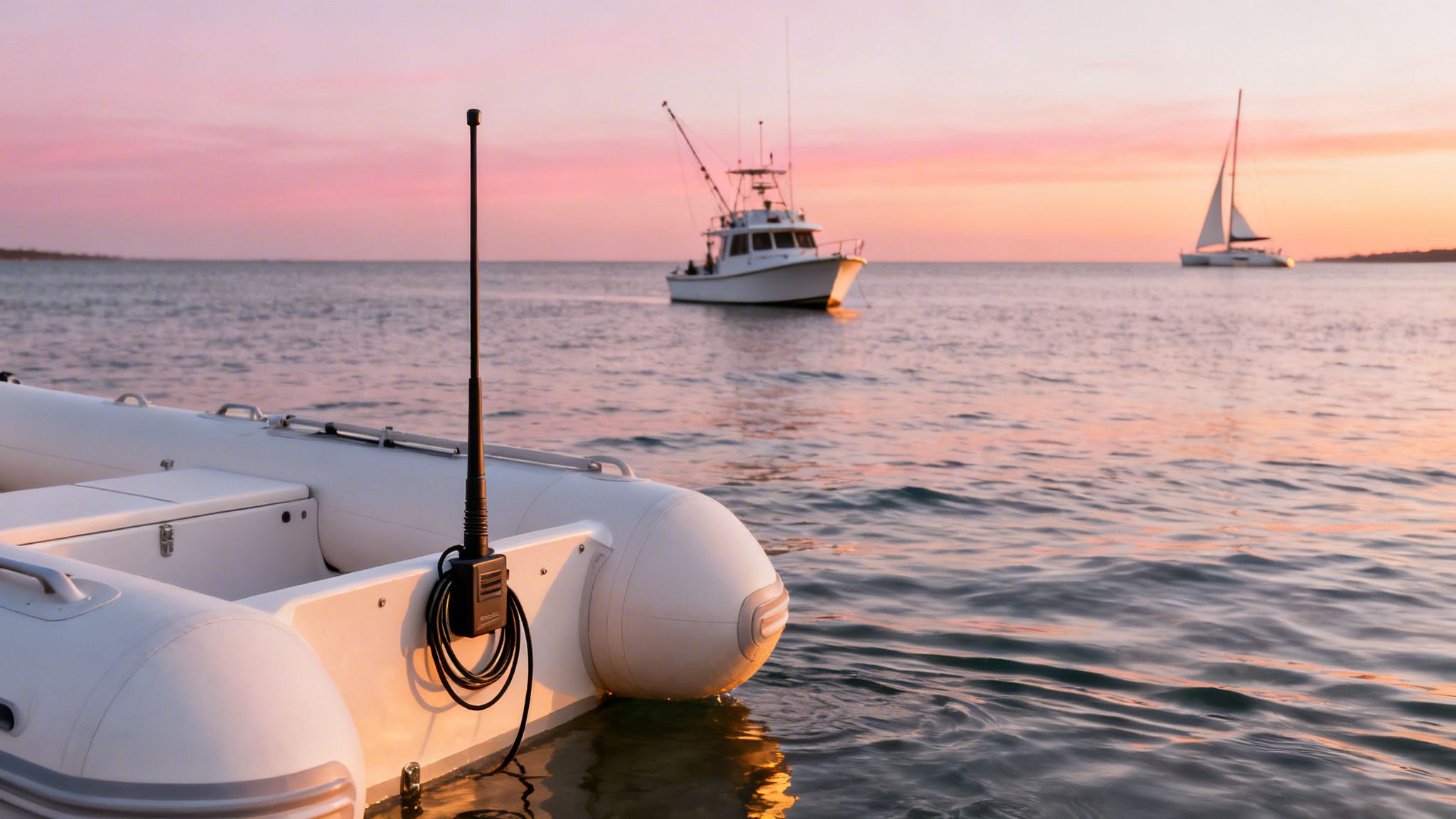
When it comes to essential gear, your VHF marine antenna is arguably the most important piece of communication equipment you’ll ever have on your boat. It’s your lifeline—the tool that connects you to safety services, weather updates, and other boats on the water. How well it performs directly impacts your ability to send and receive clear signals, which makes choosing the right one absolutely critical for any boater.

Think of your VHF marine antenna not as some optional extra, but as your direct connection to the world when you’re out on the water. It’s the quiet hero that ensures your radio calls are heard loud and clear, whether you’re miles offshore or trying to navigate a busy channel.
For Australian families enjoying a day out on one of the best inflatable boats for recreational use, dedicated anglers chasing the next big catch, or inflatable catamaran owners exploring the coast, this single piece of equipment is your most reliable link back to shore.
Reliable communication isn’t just nice to have; it’s non-negotiable for any boater. The ability to receive timely weather updates from the Bureau of Meteorology can be the difference between a great day and a genuinely dangerous situation.
Coordinating with other vessels, from passing ferries to fellow boaters at a busy ramp, prevents confusion and potential collisions. Most importantly, it’s your primary tool in an emergency. Unlike a mobile phone that relies on patchy network coverage, a VHF radio lets you speak directly with rescue services and any boats nearby that can offer immediate help.
A VHF radio call allows you to communicate directly with any “vessels of opportunity,” eliminating the need for a middleman in an emergency and potentially getting you help faster from a nearby good Samaritan.
This guide is designed to cut through the technical jargon and give you practical, real-world advice. Our goal is to help you choose the right antenna for your boat, whether you’re comparing prices and features of inflatable boats in your area or have a larger cruiser.
Understanding the fundamentals ensures you can navigate Australian waters with confidence, knowing your lifeline is ready when you need it most. And for those looking to build the ultimate safety kit, it’s also worth reading about personal locator beacons and how they complement your communication setup.
To get your head around how a VHF marine antenna works, picture two lighthouses on a perfectly clear day. For one to see the other’s light, there can’t be anything in the way. VHF radio waves travel on this exact same line-of-sight principle. This is why it’s the global standard for talking on the water; its reliability is all about that direct, unobstructed path.
Unlike a mobile phone that bounces signals off a whole network of towers to get around hills and buildings, your VHF radio is in a direct conversation with another radio. When you press that transmit button, your radio fires an electrical signal up to the antenna. The antenna’s job is to turn that signal into a radio wave and broadcast it out. On the other end, the receiving antenna catches that wave and converts it back into an electrical signal, which the radio then turns into the voice you hear.
Your antenna’s performance really comes down to two things that have to work together: height and gain. Nailing this balance is the key to clear communication and is way more important than just having the most powerful radio on the market.
Height is King: Since VHF signals travel in straight lines, the higher you can mount your antenna, the farther it can “see” over the curve of the Earth and past obstacles like big waves or other boats. Lifting an antenna just a few metres can make a massive difference to its effective range. On an inflatable boat, this means your number one priority is finding the highest, most practical spot to mount it.
Gain is Focus: Measured in decibels (dB), gain is all about the antenna’s ability to focus its signal. Think of it like the nozzle on a garden hose. A low-gain antenna is like the wide spray setting, sending the signal out in a broad, almost spherical pattern. A high-gain antenna, on the other hand, is like twisting the nozzle to a narrow jet, flattening that pattern into a disc and pushing all that energy out toward the horizon.
Understanding the relationship between height and gain is fundamental. It’s the difference between a clear call for help being heard miles away and a frustrating burst of static that reaches no one, especially in challenging conditions.
For anyone with an inflatable catamaran or a larger RIB, a taller, high-gain antenna could be a great fit because the stable platform keeps that focused signal aimed where it needs to go. But for a smaller tender that rocks and pitches in the chop, a shorter, lower-gain antenna is often the smarter, more reliable choice.
Ultimately, the best vhf marine antenna is the one that’s properly matched to your boat and the way you use it. Once you grasp these core ideas of line-of-sight, height, and gain, you’ve got the foundation you need to compare different models and make the right call for your setup.
Picking the right VHF marine antenna comes down to a crucial balancing act: height versus gain. Gain, measured in decibels (dB), and the antenna’s mounting height work together, and getting that relationship right is the secret to clear, reliable communication out on the water. It’s not about just grabbing the tallest antenna or the one with the highest gain; it’s about matching its performance to your specific boat and how it handles in the waves.
Think of the signal your antenna sends out as a doughnut. A high-gain antenna (like a 6dB or 9dB model) squashes that doughnut, making it flatter and wider. This flattened signal pattern pushes radio energy further out towards the horizon, which is absolutely perfect for a stable vessel like an inflatable catamaran that doesn’t rock and roll too much. The flat signal stays aimed where it needs to be.
But on a smaller inflatable boat or a tender that pitches around in the chop, that same flattened signal becomes a problem. As the boat rocks, the high-gain antenna starts pointing its focused energy at the sky one second and into the water the next. This creates patchy, unreliable communication just when you need it the most.
For tenders and most recreational inflatable boats, a shorter, lower-gain antenna—usually a 3dB model—is almost always the better choice. This type of antenna creates a rounder signal pattern, more like a fat, puffy doughnut. It might not reach quite as far on a perfectly calm day, but its broad signal stays on target even when the boat is bouncing around in choppy Australian waters.
The key takeaway is simple: for a boat that moves around a lot, a wider, less focused signal gives you far more consistent coverage than a narrow beam that’s constantly missing its mark. It’s all about reliability over maximum theoretical range.
This concept map breaks down how height and gain combine to affect your antenna’s real-world performance.

As you can see, hitting that sweet spot is about finding the right balance between how high you can mount the antenna and the gain that works best for your boat’s stability.
To make this even simpler, here’s a quick reference guide to help you choose the right setup based on your boat type.
Antenna Gain vs Height Recommendations by Boat Type
| Boat Type | Typical Mounting Height | Recommended Antenna Gain (dB) | Best Use Case |
|---|---|---|---|
| Inflatable Tenders & Small Boats (<4m) | Low (e.g., on a console or rail) | 3dB | Unmatched reliability in choppy conditions; consistent short-to-medium range communication. |
| Mid-Size RIBs & Runabouts (4-7m) | Medium (e.g., T-top, arch) | 3dB or 6dB | 3dB for rough water use, 6dB for more stable platforms or calmer coastal cruising. |
| Inflatable Catamarans & Large RIBs (>7m) | High (e.g., hardtop, radar arch) | 6dB | Maximises range by leveraging the boat’s stability and higher mounting point. |
| Large Powerboats & Cruisers | Very High (e.g., mast, flybridge) | 6dB or 9dB | Best for long-range offshore communication where the vessel is very stable. |
This table shows that as a boat gets bigger and more stable, you can take advantage of higher gain antennas to get more range. For the inflatables and tenders most of our customers use, however, a lower gain is almost always the more dependable option.
It’s clear that Aussie boaters are taking their on-water communication seriously. The Australian VHF antenna market has seen steady growth, with sales revenue tipped to climb from $7.966 million in 2021 to $9.162 million by 2025. This trend is driven by the growing number of boaters—especially those with smaller vessels—who rightly see reliable communication as essential safety gear. You can dig into more of the numbers on these VHF antenna market trends.
Ultimately, your choice boils down to your boat:
By prioritising a steady, dependable signal over sheer power, you’ll ensure your VHF marine antenna is a lifeline you can count on, no matter what the conditions are like.
An expensive, high-performance VHF marine antenna is only as good as the parts connecting it to your radio. It’s a classic rookie mistake to overlook the coaxial cable and its connectors, but they are absolutely critical links in your communication chain.
Ignoring them is like fitting a high-performance engine into a car with flat tyres—you simply won’t get the power where it’s needed.
The primary enemy here is signal loss. Think of your radio signal as water flowing through a garden hose. A cheap, thin, or damaged cable is like a leaky, pinched hose. No matter how much power your radio generates, a big chunk of that signal bleeds out before it ever reaches the antenna to be broadcast.
For most boaters, the decision comes down to two common types of marine-grade coaxial cable. The right one for you really just depends on the length of the cable run from your radio to your antenna.
While RG-8X is slightly more expensive and a bit less flexible to work with, the improvement in performance on longer runs is massive. For every metre of cable, a small amount of your radio’s power is lost. With a better-quality cable, you minimise this loss and make sure your signal gets out loud and clear.
Your antenna system is only ever as strong as its weakest link. A premium antenna paired with a poor-quality cable is a wasted investment. The cable is where performance is most often lost.
Connectors are where your system is most vulnerable to the harsh marine environment, especially in Australia’s saltwater conditions. A poorly installed or non-waterproofed connector will quickly fall victim to corrosion.
Corrosion creates resistance, which blocks your signal and can even reflect power back into your radio, potentially frying its sensitive internal components. It’s essential to use high-quality, marine-grade connectors (typically the PL-259 type) and make sure they are sealed up tight against moisture.
This usually involves using silicone grease, heat-shrink tubing, or high-quality electrical tape to create a watertight barrier. The health of your entire system relies on these small but vital components, right down to the power supplied by its battery. You can learn more about keeping your boat’s electricals in top shape by exploring our guide to the best marine battery and charger setups.

You can have the best VHF antenna in the world, but if it’s mounted poorly, it won’t perform. Getting the installation right is just as crucial as the antenna you choose. The goal is always the same: get it as high as you can, and as clear of obstructions as possible.
This golden rule applies to every boat out there, but inflatable boats throw a few unique challenges into the mix. Unlike a big fibreglass cruiser with plenty of solid surfaces, an inflatable requires a bit more thought to find a secure and effective spot for your antenna.
There’s a reason for this obsession with good communication. The global market for VHF antennas hit a staggering USD $1,772.8 million in 2024, and the marine sector is the biggest piece of that pie. Valued at USD $450 million in 2024, it’s expected to nearly double by 2035—a clear sign of just how vital this gear is for boaters everywhere. You can read more about the growth of the marine antenna market.
For owners of inflatable boats, there are several tried-and-true mounting options that deliver excellent performance without getting in the way. It’s all about finding what works for your specific boat, whether it’s a small tender or a bigger inflatable catamaran.
If you’re looking for a more integrated solution, especially on larger RIBs, a console is a total game-changer. It provides the perfect, elevated platform to mount your VHF antenna for maximum performance.
By mounting your antenna on a console, you not only raise its height for better range but also keep the delicate coaxial cable protected and neatly routed away from foot traffic and potential damage.
An integrated setup just looks cleaner and more professional, all while getting the absolute best out of your communication system. You can explore options like a boat centre console kit to see how it can transform your inflatable into an even more capable vessel.
No matter which method you go with, always remember the fundamentals. Make sure the antenna is perfectly vertical for the best signal pattern. Keep it at least one metre away from other antennas and large metal objects to avoid interference. And finally, do a quick visual check to ensure nothing is blocking its line-of-sight path to the horizon.

Getting the installation right from the start is the best thing you can do to make sure your VHF performs when you need it most. Once your antenna is mounted securely, the next job is running the cable properly.
Your aim is to route the coaxial cable from the antenna to the radio along the most protected path you can find. Avoid any sharp bends or kinks, as these can actually damage the delicate structure inside the cable and cause signal loss. It’s just as important to keep the cable well away from other electrical wiring to stop interference that creates that awful static on your transmissions.
Before you pat yourself on the back and call it a day, there’s one final, crucial check. This is where a simple tool called an SWR (Standing Wave Ratio) meter earns its keep. You can think of it as a report card for your antenna system.
The SWR meter measures how well the power is flowing from your radio, through the cable, and out of the antenna. A low reading is what you’re after—it means nearly all your power is being broadcasted exactly as it should be.
A high SWR reading is a red flag. It’s telling you there’s a problem, like a bad connection or a damaged cable. It means power is bouncing back into your radio instead of getting out, which will kill your range and can even damage your radio over time.
A little bit of regular maintenance is all it takes to keep your communication system reliable, season after season. A quick inspection a few times a year can catch small issues before they turn into big, frustrating problems out on the water.
Here’s a simple checklist to run through:
This kind of consistent upkeep means your gear will always be ready to go. For other essential maintenance tips, especially for your vessel, you might find our guide on inflatable boat repairs in Australia useful.
We get a lot of questions from boaters trying to dial in their VHF setup. Getting clear, straightforward answers is key to feeling confident before you head out on the water, so let’s tackle the most common ones we hear.
This section covers the queries that come up time and time again about using a VHF marine antenna in Australian waters, especially for those looking to hire inflatable boats for a family outing and need to understand the safety gear involved.
This is a big one, and the answer varies by state. Generally, for small recreational boats in enclosed or protected waters, you’re not legally required to carry a VHF radio. However, it’s strongly recommended by every single maritime safety authority as an essential piece of safety kit.
The rules change the moment you head into open or coastal waters. In many states, travelling more than two nautical miles from the coast makes a marine radio mandatory. The best advice? Always check with your local maritime authority for the specific rules in your area. You can find a good overview of what you’ll need in our guide to boating safety equipment.
This all comes down to your setup, and antenna height is king. A small handheld radio will probably get you 3-5 kilometres (about 2-3 nautical miles) of range to another small boat—enough for close-quarters communication but not much more.
Step up to a fixed-mount radio with a properly installed 1-metre antenna on your inflatable, and you’re looking at around 8-12 kilometres (5-7 nautical miles). A taller, 2.5-metre antenna on a bigger vessel could easily double that. The key takeaway is simple: height is the single biggest factor dictating how far your signal travels.
Absolutely. For most inflatable boat setups, installing a VHF marine antenna is a perfect DIY project. Mounting a bracket, running the cable neatly, and connecting it to the radio are all tasks that most boat owners can handle with basic tools and a bit of careful planning.
The global marine VHF radio market was valued at USD $303.2 million in 2024, showing just how vital this technology is for maritime safety worldwide. It’s so important that international regulations require it on commercial vessels—a best practice all recreational boaters should follow. You can learn more about the value of marine VHF communication.
The only time you might want to call in a professional is for really complex jobs, like routing cables through sealed bulkheads or integrating your VHF with other onboard electronics. Otherwise, it’s a job you can definitely tackle yourself.
At Easy Inflatables, we help Australian boaters find the perfect vessel and accessories for their adventures. Explore our range of high-performance inflatable boats and get expert advice to build your ideal setup. https://easyinflatables.com.au