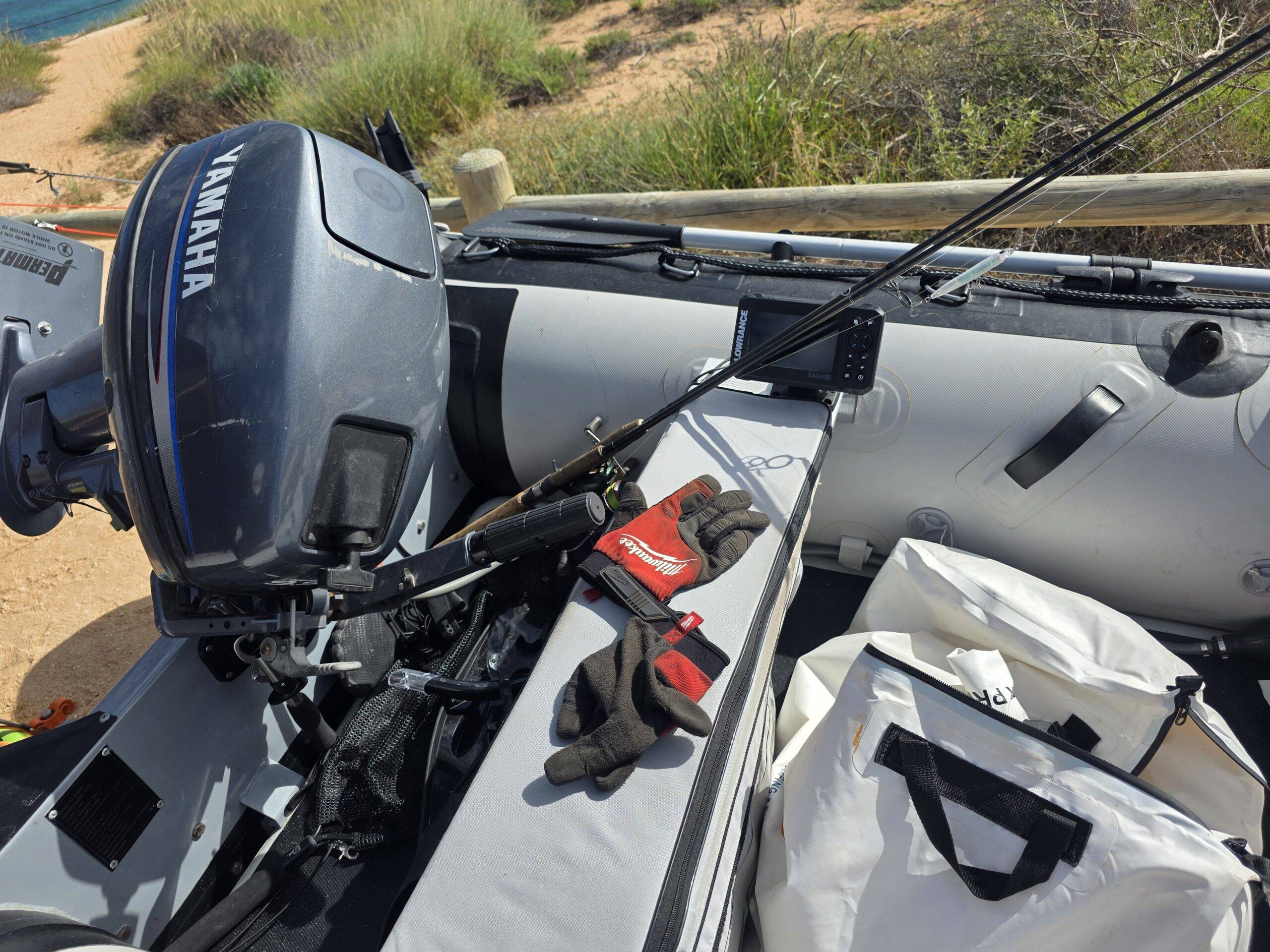

You want to get out on the water this weekend, not spend half the morning dealing with a trailer, a crowded ramp, and the usual storage headache that comes with a hard boat.
That’s where a catamaran inflatable boat starts to make a lot of sense in Australia. It gives you the freedom of a compact, packable inflatable, but with the steadier feel, open deck space, and practical usability that many people wish they had after buying a basic dinghy. For anglers, beach campers, families, yacht owners, and RV travellers, that difference matters.
The appeal isn’t just convenience. Catamarans have a long performance history in this country. Australia’s international catamaran success took off in the 1960s, with local designs achieving speeds over 32 km/h, which helped prove the hull’s speed and stability in real competition, as noted by Britannica’s history of catamarans. Modern inflatable versions take those same twin-hull principles and apply them to portable, everyday boating.
A lot of people start with the same assumption. If you want a proper day on the water, you need a trailer boat, somewhere to store it, and the patience to launch it every time.
That’s true for plenty of boats. It isn’t true for a good inflatable catamaran.
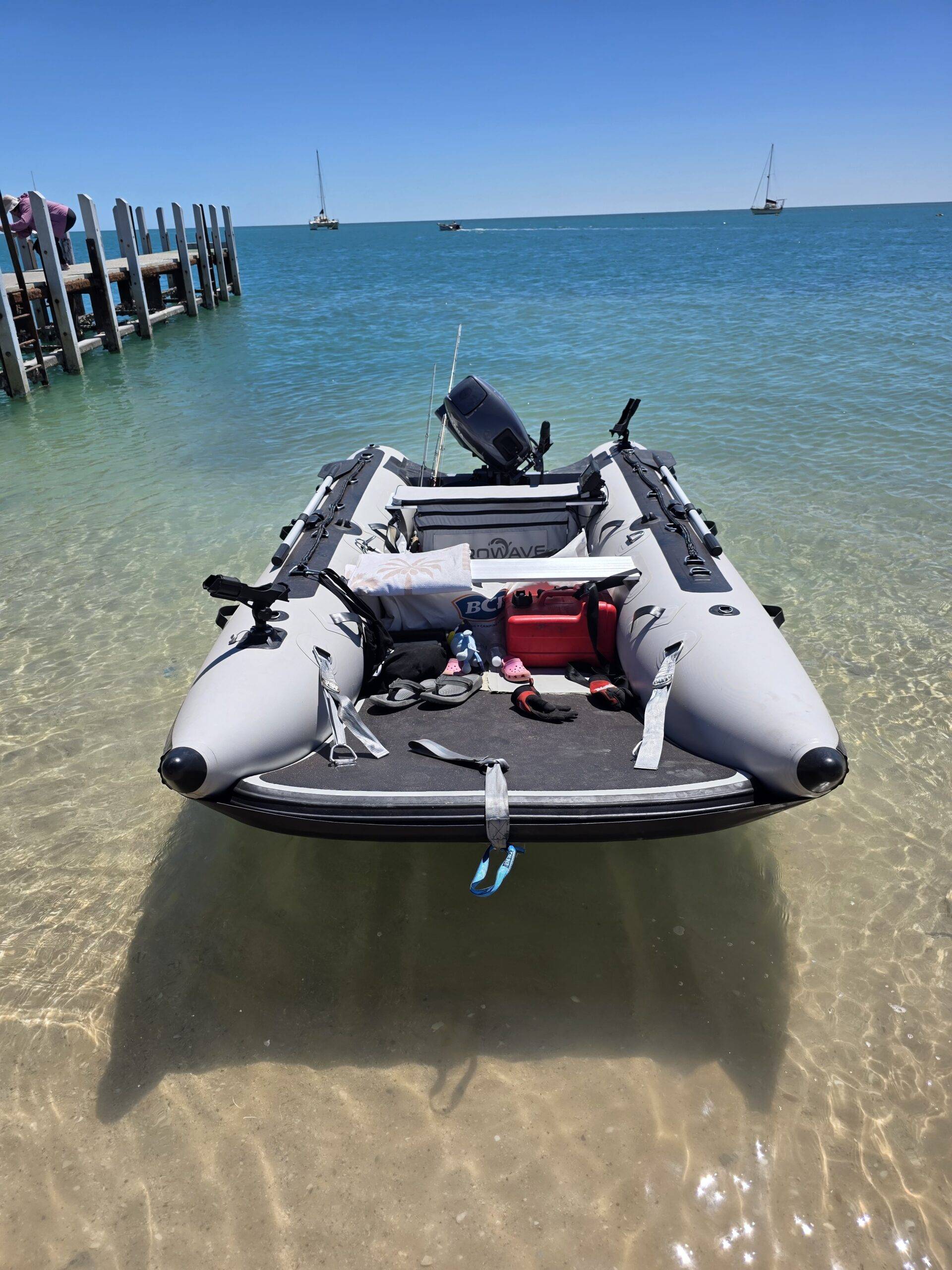
If you live near the coast, travel with a caravan, or keep a boat as a tender, the biggest barrier usually isn’t the boating itself. It’s logistics.
A catamaran inflatable boat solves that in a very direct way. You can pack it, carry it, store it, and launch it from places that don’t suit a trailer setup. That changes how often people use their boat.
A few common examples:
For buyers comparing portable options, the broader inflatable boats available in Australia category is worth looking at first, because it quickly shows where catamarans sit compared with standard inflatables and compact tenders.
Most owners don’t give up boating because they dislike being on the water. They give it up because setup, transport, storage, and maintenance start to feel like work.
Practical rule: The easier a boat is to launch and pack away, the more often it gets used.
That’s why this format suits Australian conditions so well. You still get a capable platform for family use, fishing, short coastal exploring, and tender work, but you remove a lot of the friction that stops spontaneous boating.
An inflatable catamaran boat isn’t just a standard inflatable with a different shape. It’s a different hull concept altogether.
The easiest way to think about it is this. A conventional V-hull inflatable works like one central platform cutting through the water. A catamaran works more like two narrow runners supporting a deck between them. It’s closer to the difference between two skis and one snowboard. Both move, but they distribute weight and react to surface conditions very differently.
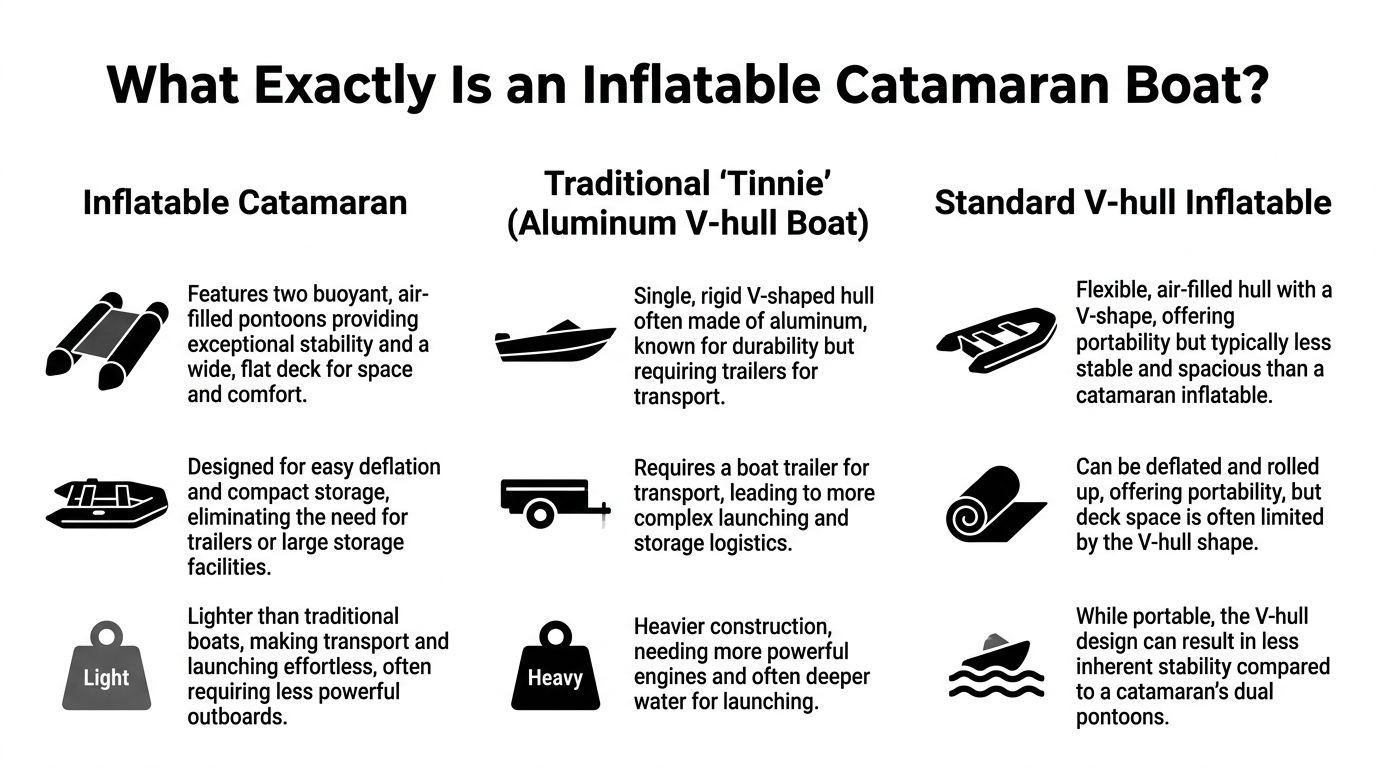
A modern catamaran inflatable boat usually comes down to three main elements:
That layout changes how the boat behaves. You get a flatter, more open platform than a lot of traditional inflatable dinghies, and weight tends to feel better distributed when people move around.
This style has history behind it. The first inflatable catamaran was created by Zodiac in 1934, using airship fabric technology, which laid the groundwork for the portable designs we know today, as outlined in this history of inflatable boats and catamarans.
That matters because the idea has had decades to evolve. What buyers see today isn’t a novelty product. It’s the result of a long progression in materials, floor construction, transoms, seam technology, and hull design.
A small tinnie still has its place. So does a basic V-hull inflatable. But they each come with compromises.
A tinnie is durable and familiar, but it usually brings more weight, trailer dependence, and a harder ride when things get sloppy. A standard V-hull inflatable packs down well, but the deck shape can feel tighter and less settled once you load people, gear, or fishing equipment.
If you’re comparing purpose-built options, inflatable catamarans stand apart. The hull form is aimed at buyers who want portability without giving away too much stability, deck usability, or efficiency.
The biggest mistake buyers make is treating all inflatables as if they behave the same on the water. They don’t.
The strongest case for a catamaran inflatable boat comes down to three things. Stability, efficiency, and usable space. Those aren’t brochure words. They’re the differences you notice the first time you launch, move around, and run home in a bit of chop.
This is usually the first thing people care about, and rightly so.
In typical Australian coastal swells of 1 to 1.5 metres, the twin-hull geometry of an inflatable catamaran reduces lateral roll by 45 to 60% compared with monohull inflatables, according to regional testing detailed on the Viamaresport Cat 330 product page.
That translates into a calmer platform when:
For Australian buyers, that’s a genuine practical advantage. Estuaries, harbour chop, boat wakes, and afternoon sea breezes can quickly expose a boat that’s too lively underfoot.
Twin hulls also change how the boat moves through the water. The drag profile is different from a fuller V-hull inflatable, and that usually means easier planing and less fuss with modest outboard power.
For the average owner, that matters in two ways.
First, you don’t always need to chase a bigger engine just to get sensible performance. Second, a lighter, simpler motor setup is easier to transport, handle, and live with.
A practical catamaran setup often suits:
Length on paper can be misleading. Two boats with similar overall length can feel completely different once people and gear get aboard.
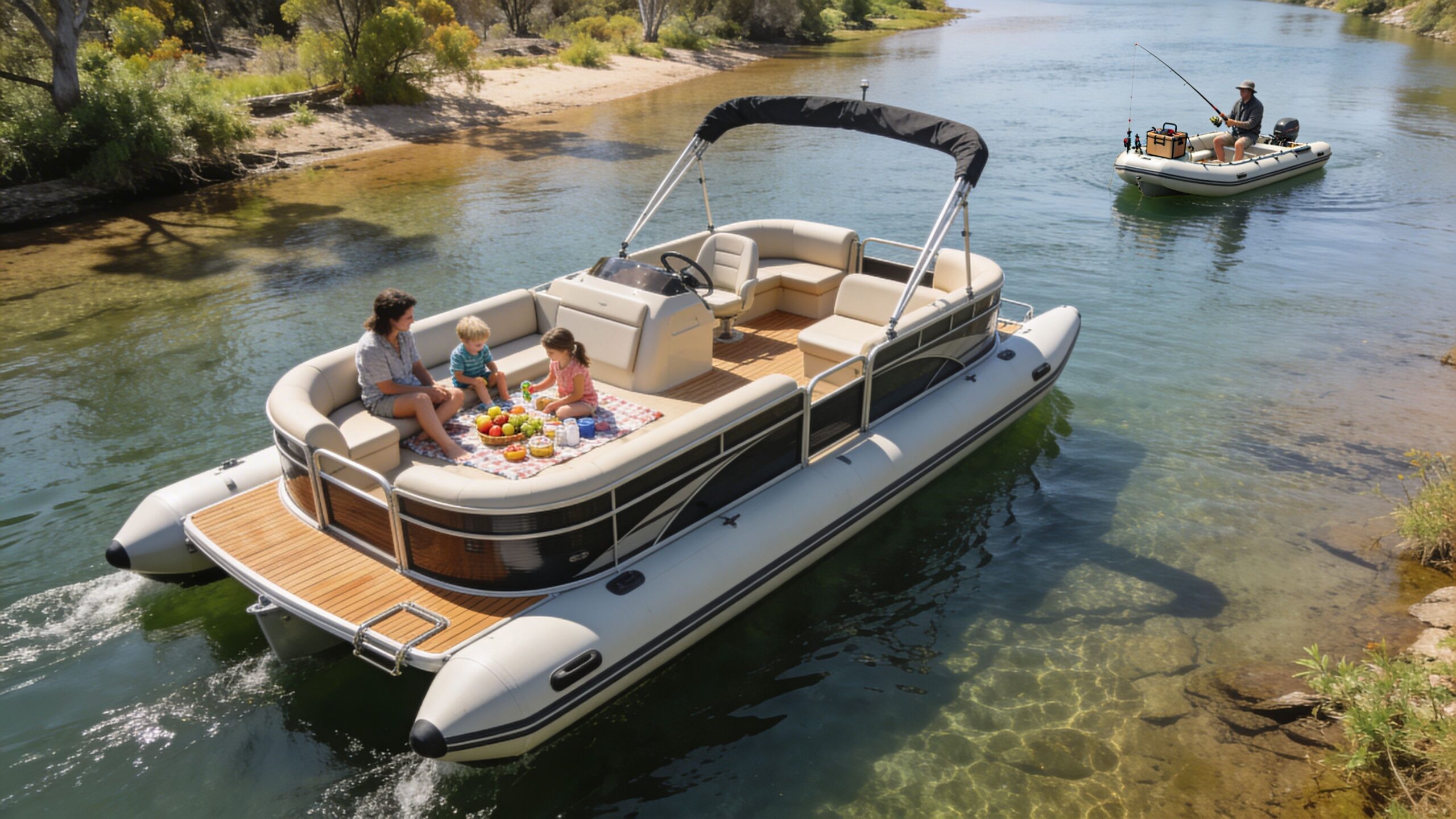
A catamaran inflatable boat usually gives you a flatter, more open working area. That’s useful for coolers, dry bags, tackle, picnic gear, or just giving passengers somewhere comfortable to sit without feeling crammed into the centreline.
A boat can be portable and still feel practical. The good catamaran layouts prove that.
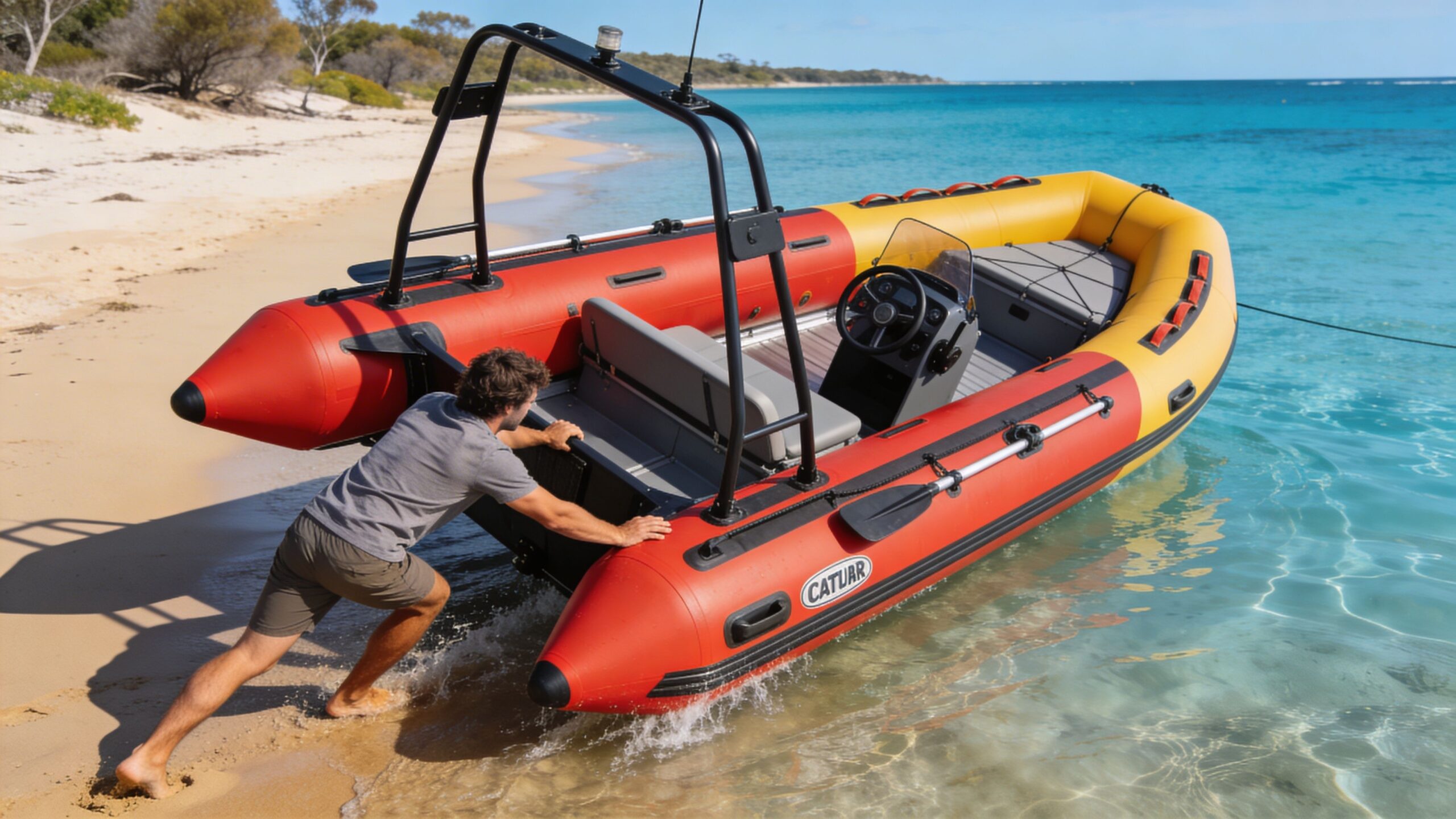
Here’s a look at the hull concept in action:
There are trade-offs, and buyers should be honest about them.
If your priority is the absolute lowest purchase price, a basic dinghy-style inflatable may cost less. If you need a heavily built workboat for repeated hard contact with jetties or commercial-style use, a different format may make more sense. And if you want maximum simplicity with no concern for ride quality or standing stability, a cheaper flat inflatable can still do the job.
But for mixed Australian use, especially fishing, family outings, tender work, and beach exploration, the catamaran design solves more problems than it creates.
Most buyers focus on size first. Fair enough. But the fabric often tells you more about how the boat will age, how it will feel underway, and whether you’ll still be happy with it after repeated use.
That’s why 1.2 mm Valmex PVC matters. It isn’t just a spec-sheet talking point. It affects abrasion resistance, shape retention, stiffness, and long-term wear in ways that become obvious once the boat has seen real beaches, ramps, chop, and repeated packing.
A lot of lower-cost inflatables use thinner PVC. That can be fine for occasional calm-water use.
It becomes less appealing when the boat starts seeing the kind of handling Australian owners put it through:
Thin fabric keeps weight down, which is useful. But it can also feel softer, mark more quickly, and show its age earlier around seams and high-stress areas.
The immediate difference is confidence. A boat built from 1.2 mm 2000D German Valmex PVC generally feels more planted and less fussy once you load people and gear aboard.
That doesn’t mean fabric alone transforms the ride. Hull design, floor construction, seam quality, and transom build still matter. But stiffer, tougher material helps the hulls hold their intended shape instead of feeling vague under load.
In practical use, that often means:
Workshop view: A spec only matters if you can feel it after a season of use. With 1.2 mm Valmex, most owners can.
Catamaran geometry gives the platform its base stability. Material quality helps preserve it when the boat is doing real work.
Once you add a second passenger, tackle boxes, an esky, wet gear, or a dog moving around the deck, the hulls and floor need to keep their shape. Softer materials can make the whole platform feel less composed. Better fabric helps the boat stay flatter and more predictable.
That matters most when you’re not sitting perfectly still. Fishing, boarding, shifting gear, and beach landing all put irregular loads through the structure.
Cheap upfront doesn’t always stay cheap.
A thinner PVC boat may suit someone who launches a few times a year on sheltered water and stores it carefully. There’s nothing wrong with that if it matches the use case.
But buyers who plan to use their catamaran inflatable boat regularly usually care more about:
That’s where material choice affects ownership value, not just initial cost.
This question comes up all the time. The answer depends on how and where you boat.
PVC is popular because it offers strong value, lower overall weight, and good structural performance when the material quality is high. Hypalon appeals to buyers who want a fabric known for premium durability and long-term resistance in harsh exposure.
Neither choice is automatically right for everyone.
A sensible approach:
| Material focus | PVC | Hypalon |
|---|---|---|
| Weight and packability | Generally better for buyers who want easier handling and compact storage | Often chosen when maximum material toughness is the priority |
| Price position | Usually the more accessible option | Typically the higher-cost option |
| General use case | Great for regular recreational use when the fabric quality is strong | Often suits buyers chasing premium long-term durability |
For a closer look at those material trade-offs, this guide on Hypalon vs German Mehler 1.2mm PVC material is useful.
A catamaran can have good hull geometry and still disappoint if the floor feels soft.
High-pressure drop-stitch floors, inflated to 10.5 to 15 PSI, create a floor stiffness modulus of over 200,000 Pa, which gives rigidity comparable to a composite hull and removes much of the flex that causes fatigue on choppy water, according to the technical data on the Sea Eagle FastCat 14 page.
That’s a major practical point. A rigid floor changes how the boat feels to stand on, step across, and fish from. It also affects how securely the whole platform behaves under power.
The transom is where a lot of cheap inflatables reveal their limits.
A solid aluminium transom gives a better foundation for an outboard and handles repeated mounting loads more convincingly than flimsy alternatives. If you’re using petrol outboards, carrying gear aft, or launching often, that structure matters.
| Feature | 0.7–0.9 mm PVC Inflatables | 1.2 mm Valmex Catamarans |
|---|---|---|
| Weight | Lighter | Moderate |
| Portability | Very high | High |
| Durability | Lower | Higher |
| Handling in chop | Softer | More confident |
| Stability under load | Slight compression | Flatter, more predictable |
| Long-term satisfaction | Shorter | Longer |
If you only want the lightest, cheapest inflatable for occasional use on gentle water, thinner PVC may be enough.
If you want a boat that feels sturdier, handles day-to-day knocks better, and inspires more confidence once the conditions stop being perfect, 1.2 mm Valmex PVC is the smarter choice.
The right catamaran inflatable boat depends less on a spec sheet and more on how you’ll use it. Buying too small gets frustrating fast. Buying too large can make setup, transport, and storage harder than it needs to be.
Compact models suit people who value simplicity first.
That often includes yacht owners who want a tender that packs away neatly, solo anglers launching on their own, or travellers who need the easiest possible carry and storage solution. These setups are usually the quickest to handle and the least fussy to move around.
Best suited to:
The trade-off is obvious. As soon as you add extra people or bulkier gear, deck room disappears quickly.
For many Australians, the sweet spot is the middle of the range.
This type of catamaran inflatable boat starts to feel like more than a compact tender. It becomes a realistic platform for couples, small families, regular fishing trips, and beach exploring with enough room to move without giving away portability.
These are the setups that usually make the most sense for:
If you want one boat to cover the widest range of jobs, mid-size is usually the least regrettable decision.
Bigger models make sense when deck space is the main priority.
Families carrying extra gear, picnic items, towables, or multiple passengers generally appreciate the extra room straight away. The boat feels less crowded, and everyone can settle in without stepping over each other.
The compromise is that larger inflatable boats demand a bit more during setup, packing, and handling ashore. They’re still portable, but they’re not as grab-and-go as a compact tender-sized package.
| Buyer type | What usually works best | Why |
|---|---|---|
| Solo angler | Compact setup | Easier launch, simpler handling, enough room for minimal gear |
| Couple or small family | Mid-size layout | Better balance of portability and usable deck space |
| Yacht owner | Compact or mid-size tender style | Easier storage and shore transfer |
| Family beach explorer | Larger platform | More comfort, easier movement, more room for day gear |
The best inflatable boat for recreational use isn’t the biggest one or the cheapest one. It’s the one that matches your launch style, transport space, crew size, and how often you’ll use it.
A good hull gets you started. The right accessories make the boat easier to launch, easier to use, and more enjoyable over a full day on the water.
Outboard choice shapes the whole experience.
Go too small and the boat can feel underpowered once you add passengers or gear. Go too large and you create extra weight, harder lifting, and more transom load than you need for your use.
For most buyers, the smarter approach is to match the motor to how they boat:
Inflation is part of every trip, so the pump matters.
A proper high-pressure lithium pump saves effort and helps you hit the intended floor and tube pressure more consistently than guessing with a bargain inflator. That means less setup frustration and a better-performing boat once launched.
A fitted Bimini is worth having if you boat through the warmer months. Shade changes how long people stay comfortable, especially children and passengers who aren’t busy fishing or driving.
Rod mounts are another simple upgrade that make everyday use neater. Instead of improvising with gear on the deck, you get a cleaner, safer working setup.
This is one area where pre-matched packages can save buyers from expensive trial and error. If you’re comparing options, essential inflatable boat accessories are worth reviewing as a checklist before purchase.
One example is Easy Inflatables, which offers bundled setups with accessories such as pumps, bags, Biminis, rod mounts, and Hidea outboards. That kind of package can suit buyers who want a ready-to-rig combination rather than sourcing parts separately.
The most common accessory mistake is buying items one by one without checking how they’ll work together on the actual boat.
A catamaran inflatable boat can look good in photos and still be the wrong buy if the ownership side isn’t sorted. Australian buyers should pay close attention to compliance, warranty, support, and delivery details before committing.
This gets overlooked far too often.
A 15% rise in inflatable boat registrations in NSW and QLD has highlighted a major information gap around mandatory AMSA compliance and ISO 6185 certification. Non-compliant vessels can lead to fines of up to $1,100 in states like NSW, according to this discussion of inflatable catamaran compliance and registration trends.
That means buyers shouldn’t stop at asking whether a boat feels stable or looks well made. They should also confirm that the vessel and intended motor setup fit Australian requirements.
Imported inflatables can be tempting on price, but support becomes important the moment you need help with parts, warranty questions, setup guidance, or repairs.
A few things are worth checking before buying:
For many buyers, speed and simplicity matter almost as much as the boat itself.
If you want a ready-to-use runabout for summer, in-stock timelines matter. If you need a more specific layout or material choice, custom delivery timing matters more than broad promises. Likewise, free shipping can make a real difference when you’re buying a bulky product nationally.
If you’re comparing compact powered options, a broader look at the inflatable motorised boat category can help narrow down whether a catamaran, RIB, or standard inflatable suits your needs better.
Before you buy, run through this short list:
| Check | Why it matters |
|---|---|
| Compliance status | Helps avoid legal and safety issues |
| Material quality | Influences durability and long-term satisfaction |
| Floor and transom build | Affects ride, rigidity, and motor confidence |
| Warranty and support | Matters once the boat is in regular use |
| Delivery and total cost | Prevents surprises after checkout |
The right decision usually isn’t the cheapest listing online. It’s the boat that fits your use, arrives with clear support, and doesn’t create problems later.
Rinse it with fresh water after saltwater use, let it dry properly, and keep sand and grit out of folds before packing. Pay extra attention to seams, floor surfaces, and the transom area.
You can leave it inflated for short periods if it’s stored sensibly, clean, and protected from unnecessary exposure. For longer periods, many owners prefer to reduce pressure slightly and store it in a sheltered space.
A catamaran inflatable boat usually feels steadier than a basic dinghy because of the twin-hull layout. That said, wind, tide, and current still matter. Good hull design helps, but safe trip planning matters more.
Minor punctures are often repairable with the right patch materials and proper preparation. Larger damage, seam issues, or transom-related problems are better handled professionally.
Yes, especially if you value standing stability, easier boarding, and a flatter deck layout. That’s one of the strongest use cases for this style of inflatable.
If you’re comparing catamaran inflatable boat options for fishing, family boating, tender work, or weekend touring, Easy Inflatables is one place to review local models, accessories, and material choices before you buy.