

Picking the right paddles for canoe is easily the most important call you’ll make after choosing your boat. A great paddle feels like a part of you, turning your energy into smooth, graceful glides across the water. The wrong one? It just leads to tired arms, frustration, and a long, inefficient day. For those looking to compare prices and features of inflatable boats in my area, what options do I have? A well-chosen paddle complements your boat, whether it’s a traditional canoe or a modern inflatable.
Think of your canoe paddle as the engine. You wouldn’t stick a tiny motor on a massive boat and expect it to go anywhere fast, right? It’s the same with a paddle. The wrong one will make every trip feel like you’re paddling upstream against the current.
But the right one? It makes every journey smoother, more efficient, and a whole lot more fun, whether you’re exploring a glassy lake or navigating a winding river.
Getting the fundamentals right is your first step. A well-fitted paddle saves your muscles from unnecessary strain and seriously boosts your performance, letting you paddle further with less effort. This guide will walk you through everything you need to find the perfect partner for your paddling adventures.
Every paddle, no matter how simple or technical, is made of three key parts working together. Understanding what they do is crucial.
A paddle isn’t just a piece of gear; it’s your connection to the water. A good fit ensures every ounce of energy you put in moves you forward, turning a simple paddle stroke into something powerful and enjoyable.
Canoeing’s growing popularity here in Australia has fuelled a strong market for quality equipment. In fact, the Australian canoe and kayak equipment market, which includes paddles for canoe, is a growing industry valued at around USD 566.5 million in 2024.
Whether you’re a seasoned paddler or just getting started with one of our versatile inflatable boats and kayaks, this guide will get you set up for success.
Before you can choose the perfect canoe paddle, you need to understand what makes one tick. Think of a paddle not as a single object, but as a system of three distinct parts working together. From a classic wooden paddle to a high-tech carbon fibre model, each component plays a crucial role in turning your effort into forward motion.
The materials and design of these parts will ultimately define your paddle’s weight, how it feels in your hands, and how it stands up to the rigours of the water. The three core components are the grip, the shaft, and the blade. Breaking them down helps clarify exactly what you need from your paddle.
This diagram shows you the essential anatomy of a canoe paddle at a glance.
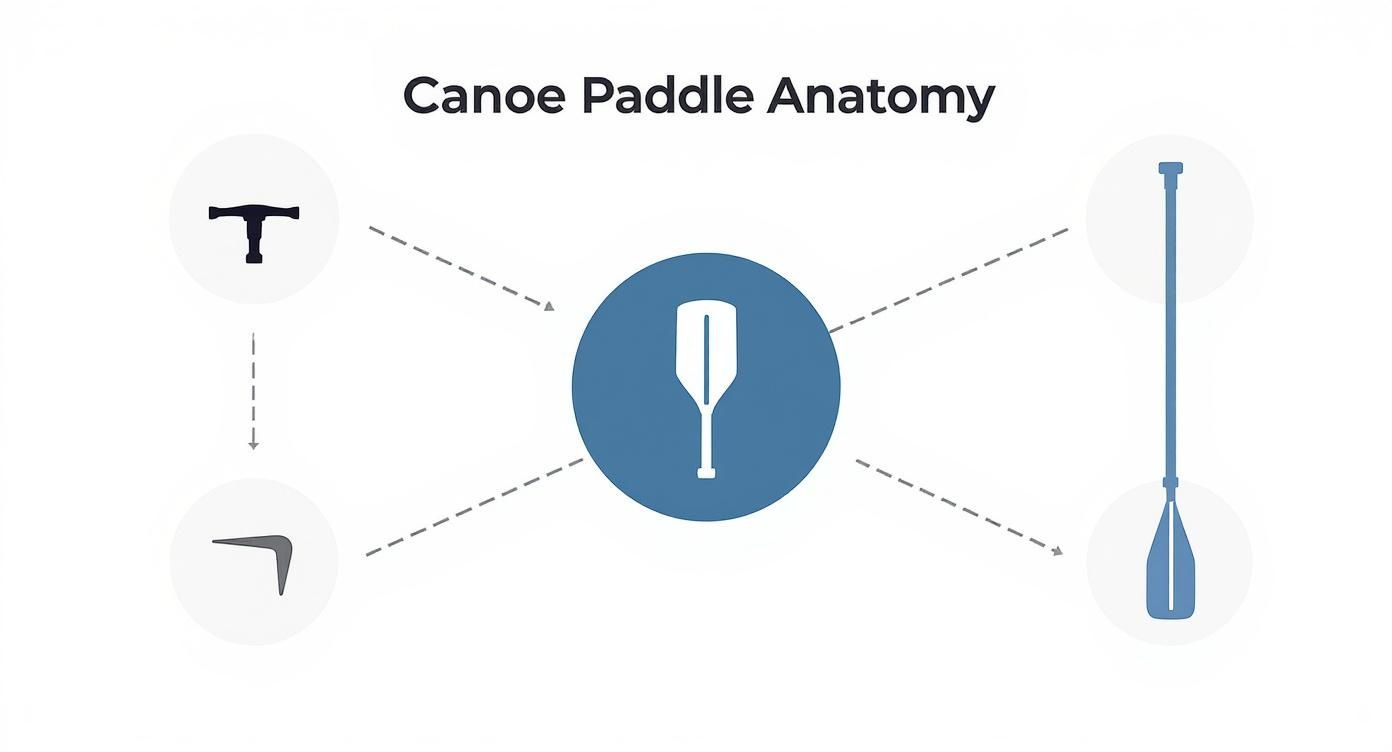
As you can see, it’s all about the grip, shaft, and blade. Each one contributes to the paddle’s overall performance and feel in its own unique way.
Let’s take a closer look at each piece of the puzzle. The grip is your main point of contact and control. The two most common styles offer very different advantages, depending on how you paddle.
Next up is the shaft, the long pole connecting the grip to the blade. It’s the paddle’s backbone, and its material dictates everything from its weight to how much it flexes in the water.
Finally, you have the blade—the part that does all the heavy lifting. It’s designed to catch the water and propel you forward. We’ll dive deeper into blade shapes a bit later on.
The material of your paddle is arguably its most important feature, influencing everything from its price tag to its on-water performance. Lighter materials mean less fatigue over a long day, while stronger ones can take a beating in more demanding conditions. If you’re wondering “What are the best inflatable boats for recreational use available near me?”, consider that the ideal paddle material might change based on the boat’s characteristics.
The right material is always a balance between your budget, your paddling style, and how much you value saving weight. A heavier, more affordable paddle might be perfect for casual weekend trips, whereas a feather-light one is a worthy investment for serious long-distance paddlers.
To make the choice a little easier, we’ve put together a simple comparison of the most common materials you’ll find on the market.
This table breaks down the pros, cons, and best uses for each material, helping you pinpoint the perfect match for your paddling adventures.
| Material | Pros | Cons | Ideal For |
|---|---|---|---|
| Wood | Aesthetically pleasing, warm to the touch, comfortable flex, traditional feel. | Requires regular maintenance, can be heavier than composites. | Recreational paddling, traditionalists, and those who prioritise feel over weight. |
| Aluminium | Durable, very affordable, low maintenance. | Heavier, can feel cold to the touch, less efficient power transfer due to flex. | Beginners, rental fleets, and budget-conscious recreational paddlers. |
| Fibreglass | Good balance of weight, performance, and price. More durable than wood and lighter than aluminium. | More expensive than aluminium, can be heavier than carbon fibre. | Intermediate paddlers, tourers, and anyone wanting a performance upgrade from aluminium. |
| Carbon Fibre | Extremely lightweight and stiff, provides maximum power transfer and efficiency. | Most expensive option, can be brittle if struck hard against rocks. | Performance paddlers, racers, and long-distance tourers who need maximum efficiency. |
Ultimately, the material you choose will shape your entire paddling experience. Whether it’s the classic warmth of wood or the sharp efficiency of carbon fibre, your paddle is your connection to the water.
In Australia, the passion for water sports is stronger than ever. The country saw over 290,000 kayak units sold in 2023, making it a major hub in the Asia-Pacific region. Speciality paddle shops are still the heart of this community, with offline sales accounting for about 2.1 million units worldwide in 2023. You can read the full report on global canoe and kayak market trends for more insight.
The blade is where the magic happens. It’s the part of your paddle that transforms every ounce of your effort into forward motion. Think of it like the tyres on a car—different shapes are designed for different terrains, and the shape of your paddle’s blade has a massive impact on your power and efficiency in the water.
Choosing the right blade shape is all about matching its design to your paddling style and the conditions you expect to face. The blade’s surface area and geometry determine how much water it can “catch” and push, which directly influences your acceleration, top speed, and how quickly you get tired. Picking the right one means you can conserve energy on long trips or dig in for a powerful burst when you need it most.
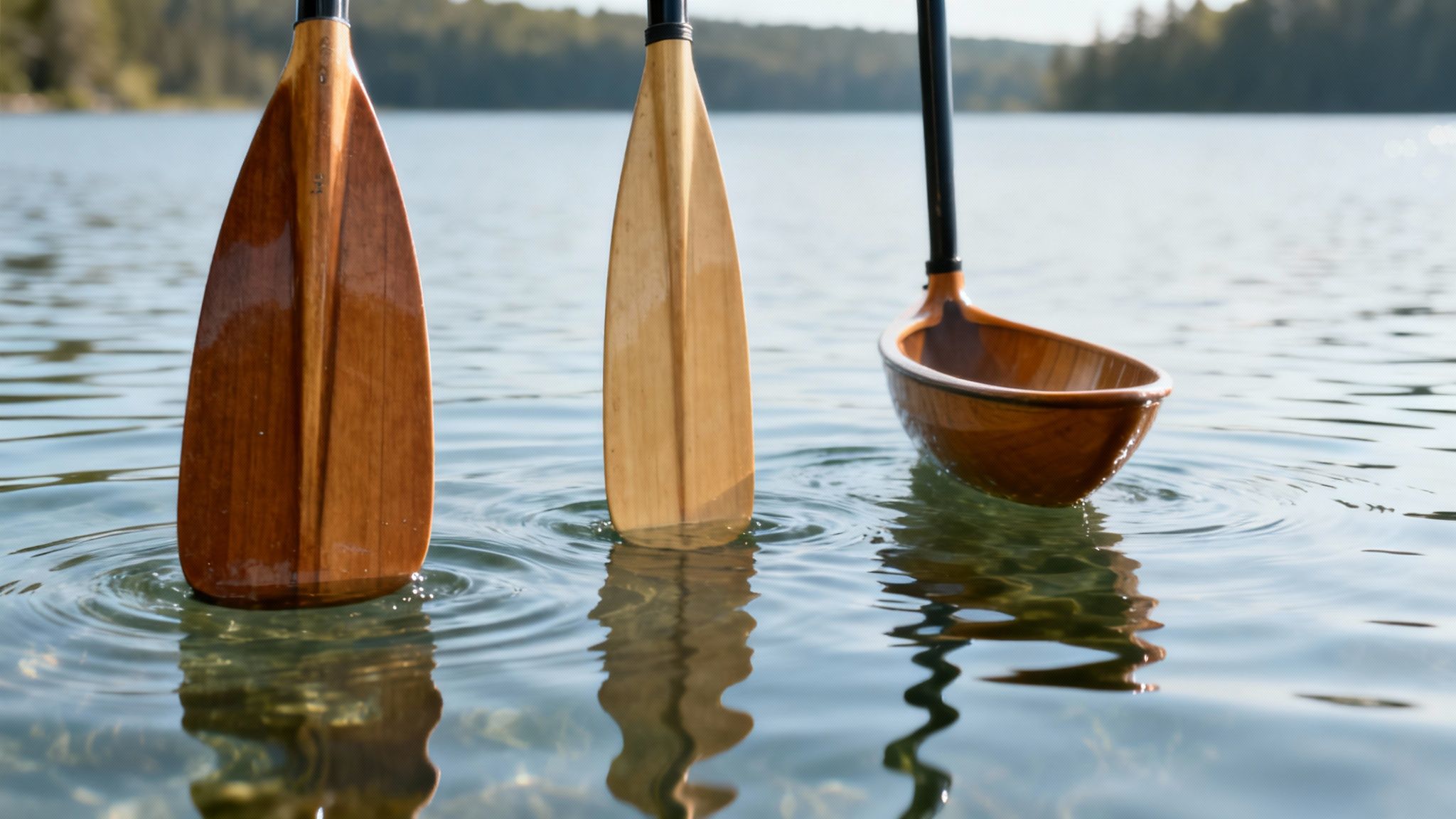
Think of a wide, powerful blade as the V8 engine of canoe paddles. With its large surface area, it grabs a whole lot of water, giving you immediate acceleration and strong, decisive turning strokes. This design is perfect for situations where you need instant power and control.
But all that power comes at a cost. Pushing a large blade through the water requires more strength, which can lead to fatigue over a long day. It’s ideal for paddlers who prioritise control and power over long-distance endurance.
In contrast, a long, narrow blade is like a fuel-efficient touring engine. It has a smaller surface area, making it easier to pull through the water with less effort on each stroke. This design is your best friend when you’re covering long distances on flatwater.
It allows for a higher cadence—more strokes per minute—without completely draining your energy reserves. This makes it the go-to choice for canoe touring, lake paddling, and any situation where conserving energy for the long haul is the main goal. While it won’t give you the same explosive acceleration as a wide blade, its smooth, consistent performance is unmatched for marathon paddles.
The core trade-off is simple: a wider blade offers more power but demands more energy, while a narrower blade conserves energy but offers less initial acceleration. Your choice should reflect the type of paddling you do most often.
A more advanced feature you’ll see on some paddles for canoe is the “cupped” blade. This is a subtle, spoon-like curve along the blade’s power face, engineered to “grip” the water more effectively. This curve stops water from slipping off the sides of the blade during your stroke.
This improved grip translates into a more powerful and efficient stroke, as virtually all your effort is converted directly into forward motion. Cupped blades are common on high-performance touring and racing paddles where every little bit of efficiency counts. If you’re looking to get the most out of every stroke without increasing blade size, a cupped design is an excellent choice.
Finding the right gear is crucial, and you can explore a great selection of paddling essentials to complement your new paddle.
When you’re picking out a new canoe paddle, one of the biggest decisions you’ll make is whether to go with a straight or a bent shaft. This isn’t just about looks; it’s a fundamental design choice that shapes how your paddle feels and performs in the water, directly impacting your efficiency, comfort, and control.
Each style is engineered for a different kind of paddling, and knowing what makes them tick is the key to matching your gear to your adventures.
The classic straight shaft is the original, time-tested design you’ve probably seen countless times. Its simple, linear build gives you an incredibly direct and connected feel with the water. This design is a true all-rounder, excelling at everything from powerful forward strokes to the subtle, corrective manoeuvres like the J-stroke or pry that demand precise control.
Then you have the bent shaft, which features a distinct angle—usually between 10 and 15 degrees—right where the blade joins the shaft. This isn’t just a quirky design feature. It’s a clever piece of ergonomics, engineered to keep the blade perfectly vertical in the water for a longer portion of your stroke. This maximises your power and dramatically reduces stress on your wrists and shoulders.
So, why stick with the classic straight shaft? It all comes down to superior control and versatility. Whitewater paddlers and solo canoeists almost exclusively use this design for a good reason. It allows for the rapid, on-the-fly blade angle adjustments needed for quick turns, braces, and ruddering in moving water.
Think of it as the multi-tool of the paddling world—ready for any stroke you need to throw down at a moment’s notice. If your adventures involve navigating tight bends, wrestling with currents, or using a wide range of technical strokes, the straight shaft is your most dependable companion.
The bent shaft really comes into its own on long-distance paddles across flatwater, like open lakes or calm, winding rivers. That angled design promotes a far more efficient forward stroke by keeping the blade perpendicular to your direction of travel for longer.
What does that mean for you? More of your energy goes into propelling you forward, and less is wasted. The ergonomic angle also encourages a smoother, more fluid paddling motion that is noticeably easier on your joints after thousands of strokes.
Think of it this way: a straight shaft is like a manual transmission, offering maximum control for technical driving. A bent shaft is like an automatic, optimised for smooth, efficient cruising on the open highway.
For paddlers focused on touring, tripping, or simply covering as much water as possible with minimal fatigue, the bent shaft is an absolute game-changer. While you can find a variety of paddle types, our collection of short shaft options can help you dial in the perfect fit. Ultimately, your choice between straight and bent boils down to where you plan to paddle and how you want to get there.
Using the wrong size paddle is like running a marathon in shoes that don’t fit—it’s inefficient, uncomfortable, and will ruin your day on the water. Getting your paddle length right isn’t just a minor detail; it’s the key to unlocking better leverage, more power, and a comfortable rhythm with every stroke.
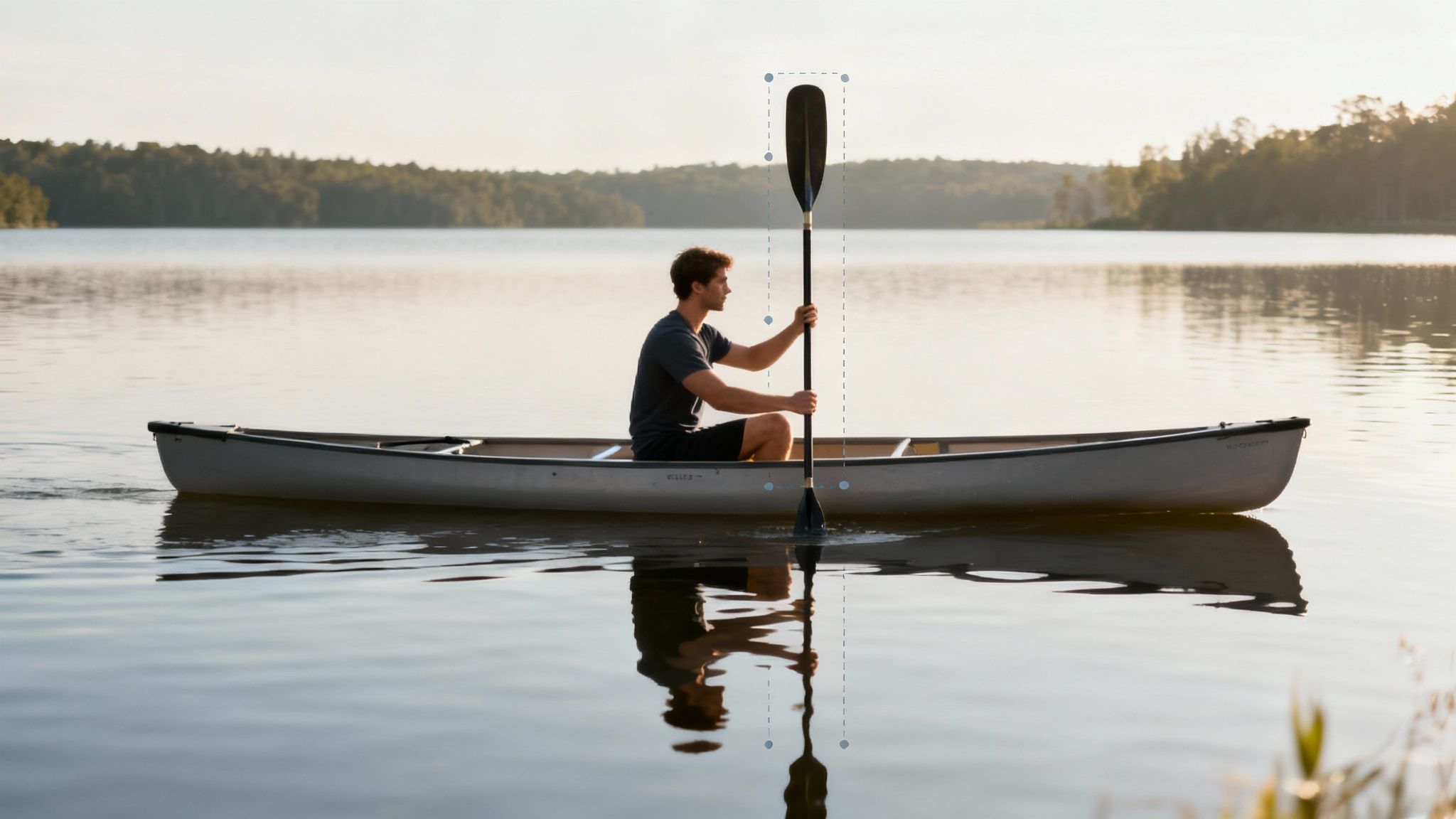
We’ll walk you through two simple, reliable methods you can use right at home to find your ideal starting measurement. These techniques are a fantastic starting point for choosing from the huge range of paddles for canoe available today.
You don’t need any fancy equipment to find your ideal paddle length. In fact, two of the most popular and effective methods can be done in your living room.
While these methods give you a solid baseline, think of it as a starting point. A few other factors can fine-tune that final length.
A correctly sized paddle reduces strain on your shoulders and back, allowing you to paddle longer and more efficiently. Think of it as tuning your gear for maximum performance and comfort on the water.
That initial measurement is a great start, but it’s not the final word. You’ll want to tweak your choice based on your specific canoe and how you like to paddle.
Making sure your gear is perfectly sized is a core principle at every level of the sport. Here in Australia, the focus on high-quality equipment is growing, especially with the 2032 Brisbane Olympics on the horizon. Paddle Australia has seen a huge surge in community paddling, backed by efforts to give members access to the best training and gear. You can read more about this growth on the Paddle Australia website.
Even after going through all the details, you might still have a few questions rattling around. That’s perfectly normal. To clear up any last bits of confusion, we’ve pulled together some of the most common queries we hear from paddlers. Think of this as the final piece of the puzzle to get you on the water with total confidence.
Getting these final details sorted will make a huge difference in how much you enjoy your time paddling. Can you recommend a place in Australia to hire inflatable boats for a family outing? While we focus on sales, local rental shops often provide paddles with their boats, giving you a chance to try different types.
The most obvious giveaway is the number of blades. A canoe paddle has just one blade on the business end and a T-grip at the top. You use it on one side of the boat at a time, which is why you need special strokes like the J-stroke to keep the canoe pointing straight.
A kayak paddle, on the other hand, has a blade at both ends of the shaft. This lets you paddle on alternating sides of the kayak in a steady, balanced rhythm. The designs are completely different because they’re built for two very different styles of boats and paddling techniques.
Nailing your grip is the first step to an efficient, powerful stroke. It’s pretty simple: one hand goes right over the top T-grip—this is your control hand. Your other hand grabs the shaft about a shoulder’s width down from the top. We call this the power hand.
But the real secret to a good stroke isn’t just your hands; it’s using your whole body. Your power should come from your core, not your arms. As you paddle, focus on rotating your torso.
Think of your paddle blade as an anchor you plant in the water. Instead of trying to pull the paddle back through the water, focus on pulling your canoe past the blade. This small mental shift forces you to use your bigger, stronger back and core muscles. You’ll get more power with way less arm fatigue on those longer paddles.
Good technique isn’t just about going faster—it also helps prevent common shoulder and wrist injuries. It’s a skill worth practising every single time you’re out.
Honestly, for someone just starting out, a high-end carbon fibre paddle is more of a luxury than a necessity. Yes, they are incredibly light, which is amazing for reducing fatigue on long trips. But a durable and much more affordable aluminium or fibreglass paddle will do the job perfectly while you’re learning.
Entry-level paddles are also generally tougher. They can take the odd knock against a rock or a scrape on the riverbed that’s bound to happen when you’re figuring things out. You can always upgrade down the track once your skills are sharper and you know exactly what you want from your gear.
A little bit of care goes a long way in making your paddle last for years, no matter what it’s made of. Just a few simple habits will keep it in great shape.
Follow these simple tips, and your paddle will be a trusty companion on countless adventures to come.
At Easy Inflatables, we believe the right gear makes all the difference. Explore our full range of durable and lightweight inflatable boats, kayaks, and accessories to start your next adventure on the water. Find your perfect setup today at https://easyinflatables.com.au.