
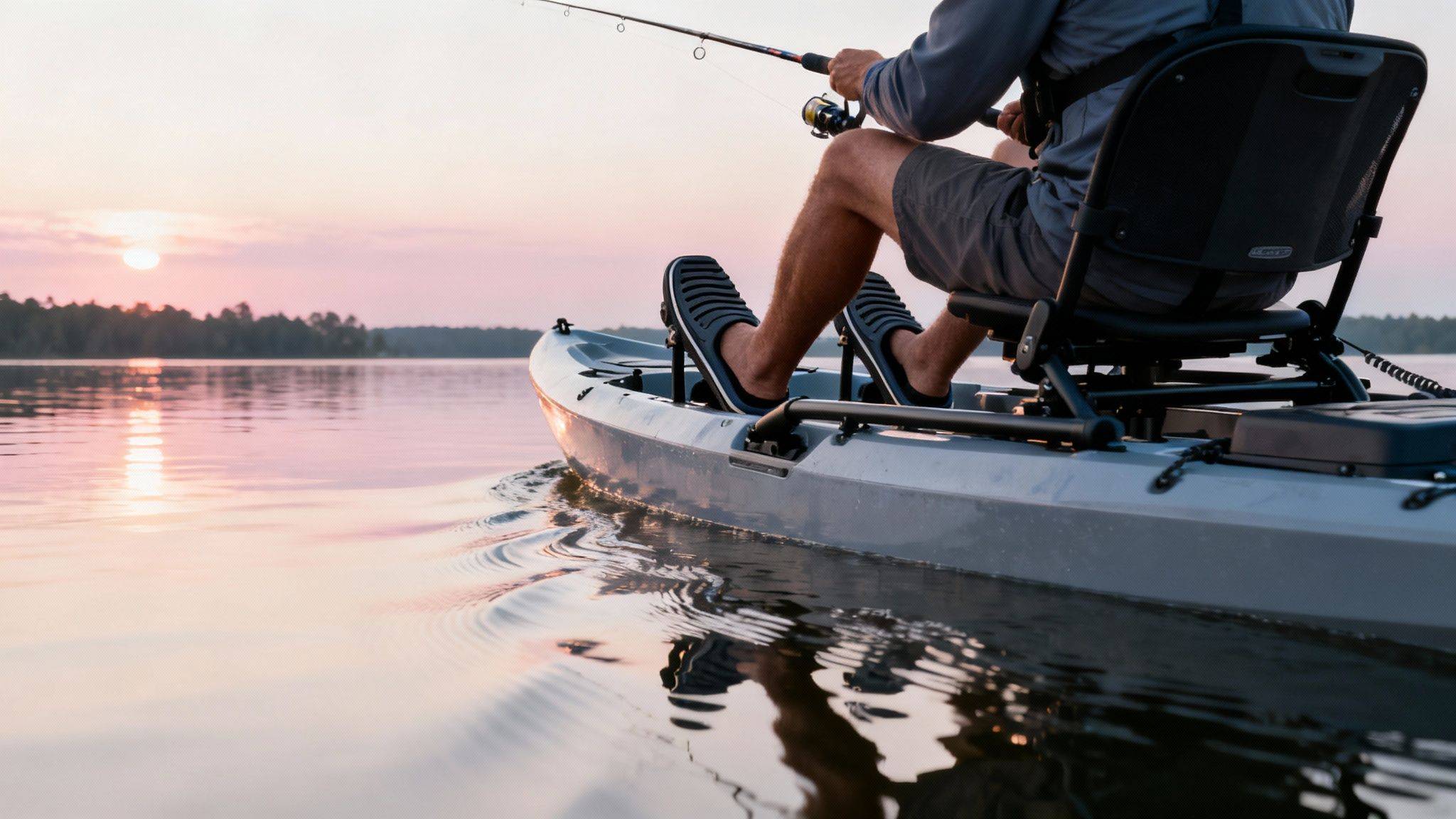
Imagine you’re trolling a lure along a perfect weed line, making precision casts, and fighting a big one—all without ever letting go of your rod. That’s exactly what a kayak with pedals for fishing makes possible. It’s a total game-changer, offering hands-free propulsion that completely transforms how you fish. This isn’t just a minor tweak; it’s a huge strategic advantage that gives you more control, efficiency, and stamina on the water.
Think about traditional kayak fishing. It’s a bit like trying to ride a bike while juggling—you’re constantly switching between paddling to get into position and fishing to land your catch. It can feel like a clumsy dance between your paddle and your rod.
A pedal-driven kayak completely gets rid of that awkward trade-off. It’s more like driving a car with cruise control, freeing up your hands to focus 100% on what you’re there to do: fish.
This leap forward changes your entire approach. Instead of drifting past a hot spot while you scramble to put down your paddle, you can use your feet to hold your position perfectly against the wind or current. That continuous control is massive for anglers who need to make pinpoint casts to structure or follow a specific depth contour.
The benefits of a pedal system go way beyond just being convenient. They bring a new level of efficiency that can directly impact how many fish you catch. Some of the key advantages include:
The ability to maintain speed and direction while your hands are busy with your rod and reel is perhaps the single greatest advantage. It allows an angler to troll lures effectively, a technique that is nearly impossible to manage with a paddle alone.
While the pedal drive is the star of the show, many anglers combine it with other tech to create the ultimate fishing machine. Of course, a solid understanding of general kayaking principles is always valuable for anyone on the water.
For those wanting even more power, our guide on electric trolling motors for kayaks explores how to complement a pedal system for the ultimate hands-free setup. This creates a versatile platform that’s ready for any condition.
At the heart of every pedal kayak is a clever bit of engineering designed to turn your leg power into forward motion. It’s the engine of your kayak, but one you power yourself with surprising efficiency, making hands-free fishing a reality for anyone.
The real magic here is getting your hands free. This one change is a massive advantage for any angler, leading to better boat control, more time with a line in the water, and the ability to cover more ground without getting exhausted.
This infographic breaks down the key benefits a pedal system brings to your fishing adventures.
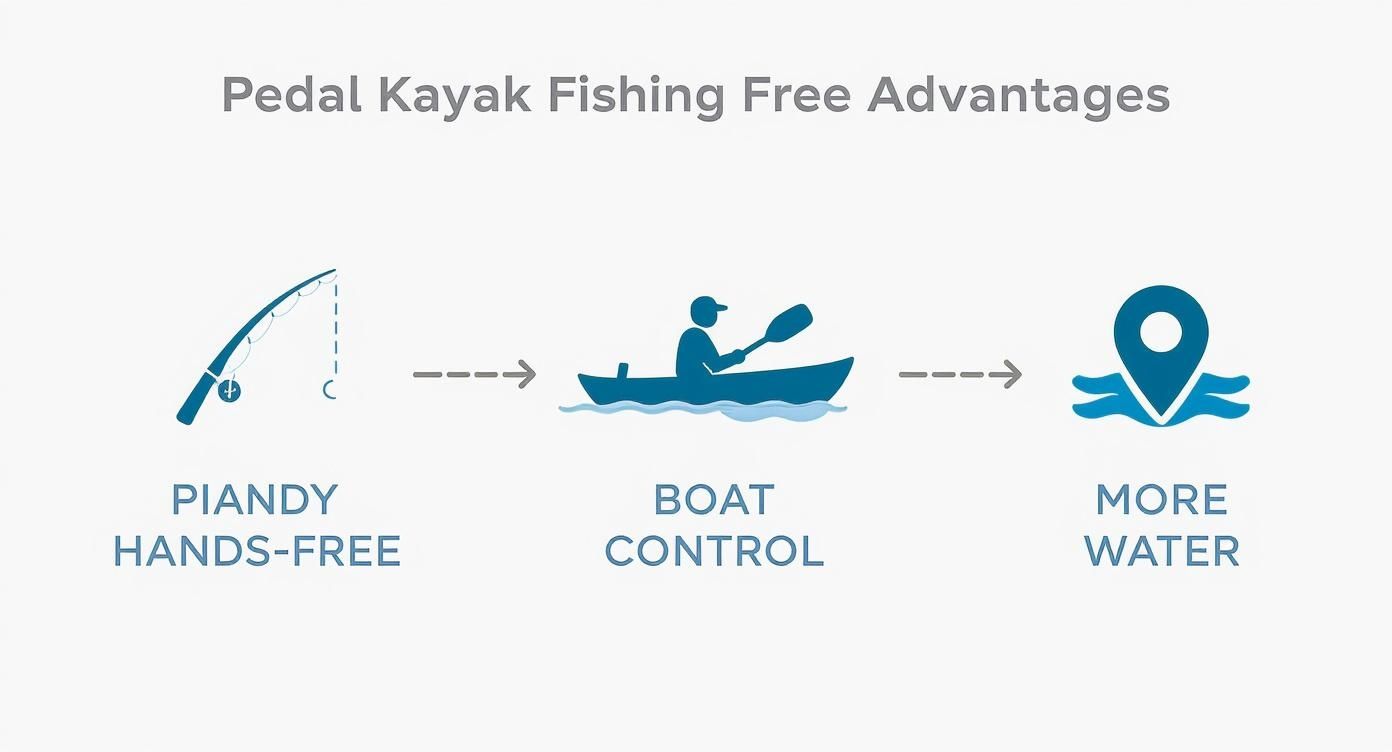
As you can see, the combination of hands-free operation, precise boat control, and extended range makes for a powerful fishing platform. All pedal drive systems are built around one of two core concepts, each with its own strengths out on the water.
The first and most common type is the rotational or propeller drive. The easiest way to picture it is a mini, human-powered outboard motor tucked right under your kayak. That’s pretty much how it works.
You pedal in a circular motion, just like riding a bike. This action spins a series of gears connected to a small propeller. As the prop spins, it pushes water backwards, creating thrust and moving your kayak forward with impressive speed.
Steering is usually handled by a lever near your seat, which controls a rudder at the back. This setup gives you immediate, responsive turning—perfect for making quick adjustments when you’re navigating around snags or fighting a fish.
The second major design is the push or fin drive system. This one takes its inspiration from nature, using a completely different mechanical principle.
Think of the powerful, efficient way a penguin or a dolphin moves through the water. The fin drive mimics this, using two underwater fins that sweep side-to-side as you push the pedals back and forth.
This scissoring motion generates powerful thrust with every push. A huge advantage of many fin-style drives is their ability to handle very shallow water. If a fin hits a log or rock, it can often just push up against the hull to avoid damage—a feature prized by anglers who love fishing the skinny stuff.
Like prop models, steering is also controlled by a rudder system. Of course, the drive is only part of the equation; the hull shape and features are just as important. You can learn more by exploring our detailed guide on choosing a sit-on-top kayak to understand the foundations of these fishing platforms.
So, which one is better? Honestly, neither. The right choice comes down to your fishing style and where you plan to be casting a line. They just excel in different situations. This table breaks down the main differences.
| Feature | Propeller Drive (Rotational) | Fin Drive (Push) | Best For |
|---|---|---|---|
| Motion | Circular, bicycle-style pedalling | Back-and-forth push motion | User preference |
| Top Speed | Generally faster in open water | Strong, efficient propulsion | Covering long distances in open lakes or coastal waters |
| Shallow Water | Prop can get snagged on weeds or hit bottom | Excellent; fins can flutter over obstacles | Weedy, rocky, or shallow flats (“skinny water”) |
| Reverse | Instant reverse by pedalling backwards (most models) | Available on some newer models; not universal | Quick stops and backing out of tight spots |
| Weeds | Can get fouled by thick vegetation | Less prone to getting tangled in weeds | Anglers fishing in heavy weed beds |
| Obstacles | Prone to damage if it strikes a hard object | Fins can often retract up against the hull to avoid damage | Navigating areas with submerged logs, rocks, or stumps |
At the end of the day, propeller drives often have an edge in top-end speed, making them brilliant for covering long distances on open lakes or coastal waters. On the other hand, fin drives are the undisputed champions of shallow, weedy environments where a prop would constantly get snagged.
Understanding these mechanical differences is the first step in deciding which pedal kayak is the right tool to help you find and catch more fish.
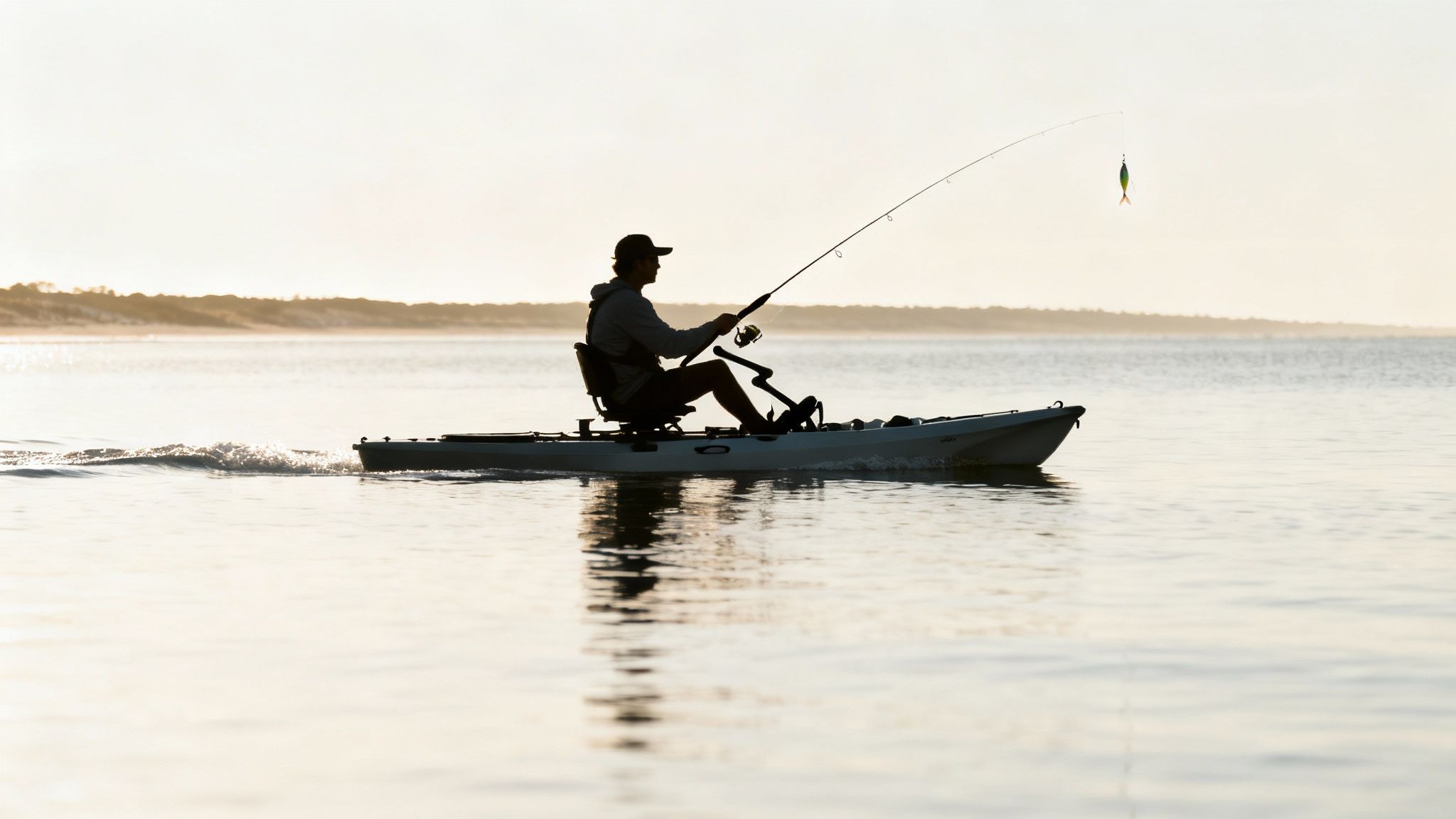
For a serious angler, every moment on the water is an opportunity. Choosing a kayak with pedals for fishing isn’t just about comfort; it’s about gaining a distinct tactical edge that flat-out leads to catching more fish. It completely changes how you interact with your environment, turning your vessel from a simple float into a precision fishing tool.
The most obvious advantage is the sheer efficiency and speed. Your legs are home to your body’s largest muscle groups, and a pedal drive puts them to work. This makes pedal power far more effective than paddling, meaning less energy is wasted on travel and more is saved for what really matters—casting, retrieving, and fighting fish.
This boost in efficiency lets you cover huge stretches of water that would be exhausting in a traditional kayak. You can reach those remote snags, distant weed beds, or that promising-looking point across the lake much faster, and arrive feeling fresh instead of worn out.
Getting from A to B is one thing, but the real art of fishing lies in perfect positioning. This is where a pedal kayak truly shines, offering a level of boat control that paddle-only anglers can only dream of.
Picture this: you’re drifting along a promising bank, but the wind keeps pushing you off course. With a paddle, you’re stuck in a constant dilemma: do I correct my position or make another cast? In a pedal kayak, that problem vanishes. You can make subtle, continuous adjustments with your feet to keep you perfectly aligned with the structure, allowing you to cast relentlessly into the strike zone.
This hands-free control opens up a whole new world of angling possibilities:
The ability to make micro-adjustments to your position without ever putting down your rod is the single biggest tactical benefit. It transforms you from a passive drifter into an active hunter who can control every aspect of the engagement.
That speed advantage isn’t trivial, either. Here in Australia, the efficiency of pedal systems is a huge reason for their popularity. Pedal kayaks can cruise at an average speed of about 18 kilometres per hour, which is a massive leap from the 3 kilometres per hour average of a paddle kayak. This enhanced mobility means you can cover large estuaries or lakes quickly, reaching prime spots with minimal disturbance.
Ultimately, the biggest win is having your hands completely free to fish. This simple fact unlocks techniques that are either difficult or impossible to pull off effectively with a paddle in hand.
Trolling, for instance, becomes a core strategy rather than a clumsy afterthought. You can set your lure at the perfect distance, use your feet to maintain a consistent speed, and keep your hands on the rod, ready to feel the slightest bite.
Casting on the move also becomes effortless. You can prospect new water with incredible efficiency, casting at shoreline structure as you pedal along and dramatically increasing the amount of water you cover. This freedom and control completely transform your approach to fishing, giving you a powerful, undeniable advantage.
For more ways to improve your setup, check out our guide on selecting the best fishing gear for your adventures.
Picking the right pedal kayak is a big decision and a serious investment in your fishing future. With so many options out there, it’s easy to get overwhelmed. But understanding the key differences will help you find the perfect kayak for your style and the Aussie waters you’ll be exploring.
Before diving into pedal-specific models, it’s worth getting a feel for the basics. A quick look at various kayak models and their core designs will give you the foundation you need to appreciate what makes a kayak with pedals for fishing so special.
The shape of your kayak’s hull is the single most important factor affecting its stability, and it’s always a trade-off. What you gain in one area, you usually give up in another. The two main designs you’ll come across are displacement hulls and planing hulls.
A wide, flat hull—common on planing-style kayaks—gives you incredible primary stability. This is that solid, steady feeling you get on calm water. For any angler who loves to stand up and cast, this design is an absolute game-changer. It feels less like a kayak and more like a small, stable boat under your feet.
On the other hand, a sleeker, V-shaped displacement hull is all about secondary stability and speed. It might feel a bit more wobbly when you’re sitting still, but it cuts through chop and waves like a knife and tracks dead straight over long distances. If you need to cover a lot of open water to get to the good spots, this is the design for you.
What your kayak is made of directly affects its toughness, weight, and price tag. The vast majority of pedal fishing kayaks are made from rotomoulded polyethylene—a tough, affordable plastic that can take a beating from bumps, scrapes, and being dragged over rocks.
But don’t overlook the practical side of things: weight and transport. A heavier kayak might be rock-solid on the water, but if you can’t get it from your garage to the water’s edge by yourself, it’ll quickly become a pain. Always check the kayak’s weight and think about how you’ll move it around—on a roof rack, in the back of a ute, or on a trailer.
If portability is your top priority, it’s worth knowing all your options. While we’re focused on pedal kayaks here, you might also be interested in the lightweight, compact nature of other vessels. You can check out our guide on the advantages of a fishing inflatable boat to see how they compare.
This is where a purpose-built fishing kayak really shines. Modern pedal kayaks aren’t just boats; they’re customisable fishing platforms, ready for you to rig up with all the gear you could possibly need.
Here are the must-have features to look for:
In Australia, the price of a pedal fishing kayak can range from budget-friendly to a serious investment, reflecting the quality of the drive system, features, and build. As a buyer’s guide from Fishing Mad highlights, you can find models starting around AUD 699, with high-end options soaring past AUD 3,395. A more specialised model like the Perception Crank 10.0 weighs about 36 kilograms and can support up to 181 kilograms, showing how robust construction and key accessories cater to serious anglers.
When you’re setting your budget, try to think about the total cost of ownership. A cheaper kayak might look like a great deal now, but if it’s missing the features you really need, you could end up spending a lot more on aftermarket add-ons later on.
Ultimately, choosing the right kayak is about finding the perfect balance between stability, portability, features, and your budget. By thinking through these key areas, you can make a smart investment that will lead to countless awesome days out on the water.
A kayak with pedals for fishing is a serious investment in your time on the water. Like any quality piece of gear, it needs a bit of care to keep performing at its peak. Getting the setup right from day one and sticking to a simple maintenance routine is the secret to a reliable, efficient craft that’s always ready for action.
If you neglect it, you’re asking for frustrating breakdowns out on the water. But a little proactive care protects your investment and keeps that pedal drive system spinning smoothly for years. It all starts before you even launch.
Before you even think about hitting the water, set aside some time to get your new kayak dialled in. The most important job is tuning the pedal drive and seat position to fit your body. You’re aiming for a slight bend in your knee when the pedal is at its furthest point—just like setting up a bicycle.
This isn’t just about comfort; a proper ergonomic setup prevents fatigue and lets you transfer maximum power into every pedal stroke. You’ll also want to get familiar with your rudder controls, making sure the cables are tensioned correctly so the rudder responds instantly to your commands.
A well-adjusted kayak should feel like an extension of your body. Spending 15-20 minutes on land making these adjustments ensures hours of comfortable, efficient propulsion on the water, preventing strain and boosting performance.
Every good angler has a routine. A quick pre-launch check is one of the best habits you can form. It takes less than a minute but can save you from a massive headache later on.
Before you shove off, run through this quick list:
This brief inspection gives you the confidence that your day of fishing will start without any nasty surprises.
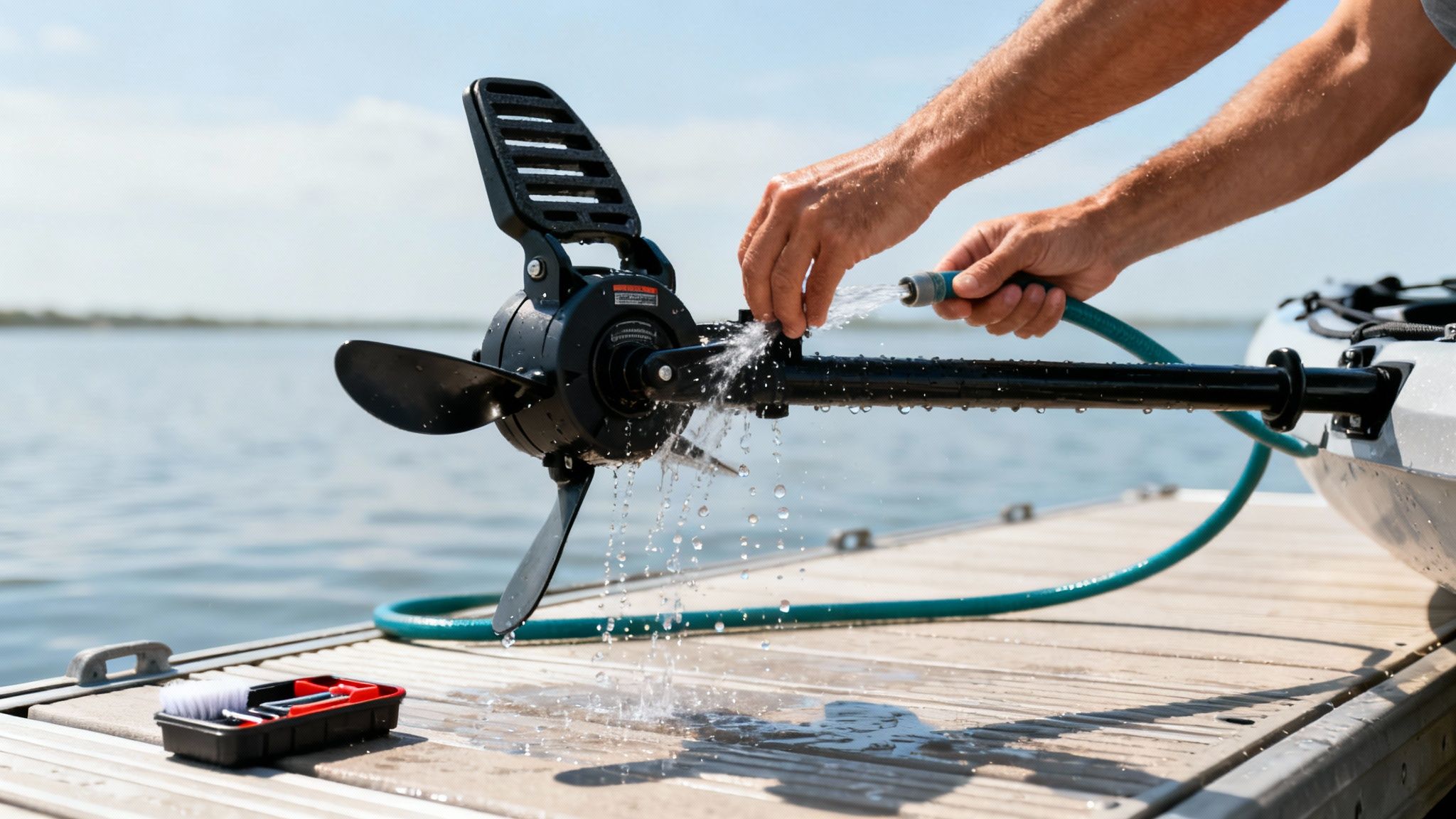
Consistent care after every trip is the secret to a long-lasting kayak, especially if you’ve been out in saltwater. That stuff is incredibly corrosive to the metal parts in your pedal drive, so a simple rinse with fresh water is non-negotiable.
Focus the hose right into the moving parts of the drive unit and the rudder assembly to flush out any salt, sand, or grit. This one step alone can dramatically extend the life of your system. It’s a core principle that applies to all watercraft, not just kayaks. For those who own other boats, our guide on inflatable boat maintenance made simple reinforces these exact same good habits.
Every so often, hit the moving components with a marine-grade lubricant as recommended by the manufacturer. And try to store your kayak out of direct sunlight to prevent UV rays from degrading the hull. By making these small tasks a regular part of your fishing routine, you’ll ensure your pedal kayak remains a trusty and effective tool for every adventure.
If you’ve spent any time on Australian waterways lately, you’ve probably noticed them: kayaks with pedals for fishing. They’re showing up everywhere, from northern mangroves to southern bays, and it’s no passing fad. This isn’t just a new toy; it’s a fundamental shift in how Aussies are getting out on the water to fish.
It’s all about efficiency, accessibility, and a better day out. This trend is backed by some serious growth in the market, particularly here in the Asia-Pacific. A perfect storm of rising incomes and a hunger for outdoor adventure is fuelling a boom in specialised watercraft like pedal kayaks.
Let’s face it, Australia is a paradise for kayak anglers. With a massive coastline, endless estuaries, and pristine rivers, it’s the perfect playground. Our deep-rooted fishing culture means we’re always looking for an edge, and pedal kayaks deliver exactly that.
Imagine being able to cast with pinpoint accuracy around a snag-filled creek up north, all while holding your position against the current with your feet. Or picture covering huge distances across a windswept bay down south without wrecking your arms. That’s the hands-free advantage, and it makes these kayaks incredibly versatile for our diverse fishing conditions.
Australia’s unique geography and passionate angling community create the perfect conditions for the pedal kayak to thrive. The ability to launch from almost anywhere and silently sneak into hard-to-reach spots is a massive draw for fishers wanting to escape crowded boat ramps and find their own piece of water.
This isn’t just a feeling; the market data tells a powerful story. The global pedal kayak market was valued at around USD 1.2 billion in 2023 and is on track to hit USD 2.5 billion by 2032.
Leading that charge is the Asia-Pacific region, which includes Australia, with a predicted growth rate of 10.2% CAGR. It’s a clear sign that anglers are moving towards more advanced, purpose-built fishing kayaks. You can dive deeper into these market trends and their drivers to see just how significant this shift is.
And it’s not just weekend warriors driving this growth. Professional fishing guides and hire companies are adding pedal kayaks to their fleets in droves. Their investment is a huge vote of confidence, proving the tech is reliable and has massive appeal. It’s introducing more people than ever to the benefits of hands-free fishing and cementing the pedal kayak’s place in Australia’s vibrant water sports scene.
Thinking about making the switch to a pedal-driven kayak? It’s a big step, and you probably have a few questions. Whether you’re a seasoned angler wanting an edge or just getting into the sport, getting the right info is key. Here are the answers to the most common queries we get about fishing from a kayak with pedals.
Not at all, but they do need a little more love than a standard paddle kayak. The trick is simple, regular care. After every trip—especially in saltwater—give the entire pedal drive unit and rudder system a good rinse with fresh water. This simple step stops corrosion in its tracks and washes away any sand or grit.
It only takes a few minutes, but this routine will seriously extend the life of your drive. Every now and then, it’s also a good idea to check the tension on any cables and add a bit of marine-grade lubricant to moving parts, just as the manufacturer suggests.
Absolutely, you just have to be smart about it. Modern pedal drive systems are built with shallow water in mind. Fin-style drives are designed to flatten against the hull if they bump a log or rock, which helps prevent any real damage.
Most propeller drives can be pulled straight up into a recess in the hull, getting them completely clear of the bottom. This means you can cruise through skinny water or weedy flats by just retracting the drive and grabbing your paddle for a few strokes. Keeping an eye on your depth is the best way to protect your gear.
A common myth is that pedal drives are only good for deep water. The truth is, their ability to retract makes them incredibly versatile. A good angler can easily switch between pedalling in deeper channels and paddling across shallow flats on the same trip.
For most dedicated anglers, the answer is a resounding yes. While the upfront cost is higher, the advantages you get on the water are massive. Imagine fishing completely hands-free, holding your position perfectly in the wind while you cast, and covering twice the distance with half the effort.
That’s what a pedal kayak gives you. It all adds up to a more effective and enjoyable day on the water. If you fish often and want to make the most of your time, the benefits of a pedal kayak will almost always outweigh the extra cost. Think of it as an investment in better fishing. Whether you’re comparing prices and features in your area or looking to hire one for a family outing in Australia, you’ll quickly see the value they offer.
At Easy Inflatables, we specialise in top-quality watercraft for Aussie adventurers. Explore our full range of innovative and durable inflatable boats and kayaks to find the perfect vessel for your next trip. Learn more about our products at https://easyinflatables.com.au.