Electric boat motor Australia: Top models &; buying guide

Picture this: you’re gliding across your favourite waterway, but something’s different. The only sounds are the gentle lapping of water against the hull and the distant call of birds. This isn’t some far-off fantasy; it’s the new reality for thousands of Aussie boaters making the switch to a quiet, clean electric boat motor in Australia.

This guide is here to cut through the noise of those old petrol engines and show you exactly why this quiet revolution is taking over our waters.

The Quiet Revolution on Australian Waters

From keen anglers sneaking up on fish in tranquil estuaries to families cruising Sydney Harbour, electric power is completely changing the boating experience down under. The appeal is dead simple: less noise, zero fumes, and next to no maintenance. It all adds up to a far more enjoyable and peaceful day on the water.

This isn’t just some niche trend for greenies, either. It’s a genuine movement towards cleaner, smarter, and more sustainable boating for everyone.

A person drives a small white boat with an outboard motor on a calm lake at sunset.

Think of this article as your ultimate resource for getting into the electric motor market in Australia. We’ll help you find that perfect sweet spot of power, peace, and performance for your vessel, whether it’s a zippy inflatable for weekend getaways or a sturdy tender for your yacht.

Understanding the Growth of Electric Boating

The shift to electric boat motors has been gathering serious steam, mostly driven by a growing desire to keep our amazing waterways pristine. The numbers don’t lie. The count of registered electric-powered recreational boats jumped from around 1,200 in 2015 to over 4,800 by 2023—that’s a growth rate of nearly 300%.

This trend shows a clear move towards cleaner marine power, with electric outboards making up an estimated 12% of all new outboard sales in 2023 alone.

This growth is all part of a bigger picture: a commitment to protecting our incredible marine environments. For boat owners, embracing smarter ways to get on the water is a huge part of that. You can learn more about reducing your impact by checking out our guide on sustainability tips for boating practices.

The real benefits driving this change are impossible to ignore. Electric motors deliver a serene experience, letting you properly connect with nature without the racket and vibration of a petrol engine. It’s not just about a new motor; it’s about making the whole boating lifestyle better.

This guide will give you all the info you need to make a smart choice. We’ll break down the leading models, demystify the tech specs, and give you practical advice to find an electric boat motor that perfectly suits your needs and your budget.

How Electric Boat Motors Actually Work

Ever used a high-performance cordless drill? An electric boat motor works on a surprisingly similar principle, just built for the water. Instead of a clunky, fuel-guzzling engine with hundreds of moving parts, you get a beautifully simple and robust system. This elegant design is a huge reason why electric boat motors are becoming the go-to choice for hassle-free boating across Australia.

At its heart, the entire system boils down to just three key components working in perfect sync.

Three electric boat components: a battery, a control unit, and a motor with propeller on a light surface.

The Three Core Components

  1. The Battery: Think of this as your fuel tank. It stores all the electrical energy you need for your day on the water. Modern lithium batteries are the real game-changers here—they’re light, pack a serious punch, and deliver consistent power right until they’re nearly empty.
  2. The Controller: This is the brains of the whole operation. When you twist the throttle, the controller acts like a smart valve, managing the flow of power from the battery to the motor. It ensures you get smooth acceleration and makes every amp count for maximum efficiency.
  3. The Motor: This is where the magic happens. The motor takes that electrical energy and converts it into quiet, rotational force. That force spins the propeller, giving you the thrust that moves you through the water.

This straightforward setup means there are far fewer things that can go wrong. Say goodbye to worrying about oil changes, spark plugs, or fuel stabilisers. It’s a system built for pure reliability, giving you more time enjoying the water and less time tinkering in a workshop. This simplicity and near-silent operation are also why they’re a perfect fit for smaller craft, which you can learn more about in our guide on electric trolling motors for kayaks.

Understanding Brushless DC Motors

Most modern electric boat motors, including all the popular brands, run on a brushless DC (BLDC) motor. Unlike older brushed motors that used physical contact points (brushes) that would inevitably wear out, brushless motors use a clever system of magnets and sensors. The advantage is massive: almost no moving parts ever touch.

This brilliant bit of engineering means there’s virtually no friction, which leads to some serious benefits:

  • Higher Efficiency: More power from your battery gets turned into actual thrust, which means you can stay out on the water for longer.
  • Greater Durability: With fewer parts grinding against each other, the motor lasts significantly longer and can handle the rough stuff.
  • Instant Torque: The moment you ask for power, you get it. This gives you incredible responsiveness and control, especially at low speeds.
  • Whisper-Quiet Operation: No friction and no combustion means the motor is incredibly quiet. You can hear the water, not the engine.

In essence, a brushless motor gives you a direct-drive system. The power flows straight from the battery, through the controller, to the motor, and into the water with minimal loss. This incredibly efficient transfer of energy is what makes electric boating so appealing, delivering powerful performance with unmatched simplicity. It’s this reliable, quiet power that has made them a favourite for boaties all over Australia.

Why Australian Boaters Are Switching to Electric

The choice to go electric often boils down to one simple thing: a better day on the water. While the environmental brownie points are a great bonus, what’s really pulling boaters across the line are the immediate, hands-on benefits that completely change the experience. It just makes boating quieter, cheaper, and a whole lot easier.

It all starts with the sound—or the blissful lack of it. An electric motor is whisper-quiet, swapping the roar of a petrol engine for a gentle hum. For anyone trying to sneak into a prime fishing spot without sending every fish for miles scattering, this is an absolute game-changer. It also means you can actually have a conversation with the person next to you without having to yell over the engine.

A man fishes from a small boat on a misty lake during a beautiful sunrise, with birds flying.

Unlocking Significant Cost Savings

Beyond the peace and quiet, the numbers just make sense. Many of the same arguments for electric cars apply here, and if you’ve looked into the real benefits of electric vehicles, you’ll see how perfectly they translate to the marine world. Fuel is a constant pain point for boat owners, but electricity? It’s cheap.

Think about it: chucking $30 of fuel in the tank might only get you a few hours of fun. Charging a typical electric motor battery overnight at home, on the other hand, might only add a couple of bucks to your power bill. Those savings add up fast, quickly offsetting the initial cost of the motor itself.

Reliability and Minimal Maintenance

Maybe the best part of switching is saying goodbye to the endless tinkering that comes with petrol engines. The beauty of a brushless electric motor lies in its simplicity. No more:

  • Messy oil changes
  • Fiddling with spark plugs
  • Yearly winterising rituals
  • Worrying about stale fuel clogging up the carburettor

This rock-solid reliability means less time working on your boat and more time actually using it. Modern options like the Mercury electric outboard really highlight this “set and forget” appeal. An electric motor is just ready to go when you are, every single time.

It’s not just a gut feeling; the environmental shift is real and measurable. A recent study found electric motors produce up to 90% less noise than their petrol counterparts, which is great news for marine wildlife. That same study showed that in 2023, over 35% of all new boats registered in Queensland’s reef areas were electric—a clear sign of where things are headed.

Finding the Best Value Electric Motor in Australia

Navigating the local market for an electric boat motor in Australia can feel daunting, but finding great value is simpler than you think. The key is to look beyond the upfront price and weigh up what you get for your money—performance, reliability, and long-term costs.

The Aussie market for electric outboards is booming, hitting AUD 85 million in 2023. This growth is fantastic news for buyers, as increased competition has driven the average price down by an impressive 18% since 2018, making powerful systems more accessible than ever.

Head-to-Head: The Haswing Ultima 3.0 on Price

The Haswing Ultima 3.0 has earned its reputation as a reliable all-in-one package. It delivers a 3HP equivalent motor with a built-in lithium battery, offering a simple, grab-and-go solution. Its popularity makes it a great benchmark for convenience and performance.

But is it the most affordable option? While its bundled approach is convenient, it comes with a price tag of around $2,600 AUD. For boaters focused on getting the best value, this is where the market gets interesting. By unbundling the motor and battery, you can often build a more powerful or more customised setup for less money.

With new dealerships for brands like Epropulsion electric boat motors popping up, it’s clear the market is expanding and giving us more choice than ever.

Uncovering High-Value Alternatives

When comparing models, think about the total package. An all-in-one unit like the Ultima is handy, but separate motor and battery systems can offer serious advantages in both cost and performance.

By unbundling the motor from the battery, you gain the freedom to choose a power source that perfectly matches your range requirements and budget. This approach often unlocks better value and a more customised setup.

Here are a few things to keep in mind when hunting for high-value alternatives that compete directly with the Haswing Ultima 3.0 on affordability:

  • Motor-Only Costs: Look at brands that sell powerful brushless motors as standalone units. You might find a 4HP or 5HP equivalent motor for less than the price of the 3HP all-in-one Ultima package.
  • Battery Flexibility: Sourcing your own lithium battery lets you shop around for the best price and capacity. You can pick a smaller, lighter battery for short trips or a bigger one for all-day adventures, tailoring the cost directly to your needs.
  • Long-Term Value: A modular system allows you to upgrade parts individually. If a better battery technology emerges, you can simply swap it out without needing to replace the entire motor.

Affordability Snapshot: Beating the Haswing on Price

While the Haswing Ultima 3.0 is a solid benchmark, a bit of shopping around reveals some seriously competitive packages. By pairing a standalone motor with a separate battery, you can often get more power for your dollar. Here’s a quick look at how some alternatives stack up on affordability.

Motor Model Equivalent HP Estimated Price (AUD) Battery Included? Key Affordability Feature
Haswing Ultima 3.0 3HP ~$2,600 Yes All-in-one convenience.
ePropulsion Spirit 1.0 Plus 3HP ~$3,300 Yes Premium integrated floating battery.
Watersnake Geo-Spot 65lb ~1.5HP ~$1,300 No GPS features at a low price point.
Newport Vessels NK180S ~2HP ~$1,500 No Excellent motor-only value; pair with your own battery.
Bixpy K-1 Motor ~1.5HP ~$2,000 Yes Ultra-portable, lightweight all-in-one kit.

This table shows that while the Haswing offers simplicity, budget-conscious buyers can find better value elsewhere. For instance, pairing a Newport Vessels NK180S motor with a quality 12V 50Ah lithium battery (approx. $400-$600) could deliver a complete 2HP setup for around $2,000, saving you hundreds compared to the Ultima.

This strategic approach helps you build a system that delivers exactly what you need without paying for bundled features you might not use. To dive deeper, check our guide on finding affordable outboard motors. The right electric boat motor in Australia is out there, and with smart comparison, you can find a powerful, reliable option that goes head-to-head with the best on performance, and beats them on price.

Matching Motor Power and Battery to Your Boat

Choosing the right electric boat motor isn’t about chasing the biggest horsepower number; it’s about finding the perfect dance partner for your boat. The goal is to create a balanced system where your motor and battery work in harmony, giving you the performance and range you need without wasting money on power you’ll never use.

Think of it like this: putting a massive V8 engine in a tiny hatchback would be pointless and inefficient. The same logic applies on the water. A small, lightweight inflatable boat used for calm river fishing needs a much different setup than a larger vessel tackling choppy coastal waters.

Calculating Your Power Needs

The first step is a simple one: add up your boat’s total weight. This includes the boat itself, all your gear, passengers, and of course, the motor and battery. A good rule of thumb is to aim for approximately 2 lbs of thrust for every 100 lbs (about 45 kg) of total weight.

For example, a 3-metre inflatable boat weighing 50 kg, carrying two adults (160 kg), fishing gear (20 kg), and a battery (20 kg) has a total weight of around 250 kg. This setup would perform beautifully with a 50-55 lb thrust motor, which is roughly equivalent to a 1.5 HP petrol outboard. This provides more than enough power for cruising and holding a position against a current.

Of course, other factors come into play:

  • Hull Design: A sleek, hydrodynamic hull will slice through the water far more easily than a wide, flat-bottomed boat, requiring less power to hit the same speed.
  • Typical Conditions: If you regularly boat in areas with strong winds or currents, it’s wise to add an extra 10-20% to your calculated thrust. Think of it as a safety buffer.

Decoding Battery Technology

Once you’ve settled on motor power, the next crucial decision is the battery. This is your fuel tank, and the choice between modern Lithium and traditional AGM (Absorbed Glass Mat) batteries will dramatically impact your experience. They each have their own strengths, so the “right” choice really depends on your priorities. For a detailed breakdown of options, our guide to choosing the right marine battery and charger is an excellent resource.

The battery choice is where you balance upfront cost against long-term performance and convenience. Lithium offers superior technology, but a well-maintained AGM can still be a cost-effective solution for casual boaters.

Let’s put the two main types head-to-head to help you decide.

Battery Type Comparison for Boating Needs

This table breaks down the key differences to help you match a battery to your specific needs on the water.

Battery Type Upfront Cost Weight Lifespan (Cycles) Best For
Lithium (LiFePo4) High Very Light 2,000 – 5,000+ Boaters who prioritise lightweight portability, long-term value, and consistent power delivery.
AGM Deep Cycle Low Heavy 400 – 800 Budget-conscious boaters who don’t need to carry their battery far and have shorter, less frequent trips.

As you can see, Lithium is a long-term investment that pays off in convenience and longevity, while AGM gets you on the water for less.

Ultimately, matching your motor and battery is about creating a smart, balanced system. By accurately assessing your weight, typical usage, and budget, you can build the perfect electric setup that delivers reliable performance every time you hit the water.

Common Questions About Electric Boating in Australia

Moving over to an electric motor is a bit of a shift from what most Aussie boaters are used to, so it’s natural to have a few questions. It’s a different way of thinking about power on the water, but thankfully, the answers are usually pretty simple. Let’s tackle some of the most common queries we hear.

Are There Government Rebates for Electric Boat Motors?

This is a big one. While there isn’t a single, nationwide rebate program specifically for electric outboards, some state and local governments do offer grants for adopting green technology. Your best bet is always to check directly with your state’s environmental or energy agency to see what’s on offer.

Sometimes, you’ll find that initiatives aimed at small businesses or eco-tourism operators might cover marine propulsion. A good trick is to search for terms like “clean energy grants” or “sustainability rebates” in your local area to see what pops up.

How Do I Charge an Electric Motor Battery?

Charging your battery is surprisingly easy and usually happens one of two ways. For smaller, portable batteries, you can just carry them off the boat and plug them into any standard 240V wall socket at home—just like you’d charge your phone. Simple and convenient.

For larger, built-in battery banks, more and more Australian marinas are installing dedicated shore power charging stations. These facilities are becoming much more common, especially at popular boating hubs, making it easy to top up between trips.

What Is the Real-World Range of an Electric Motor?

Okay, this is the “how long is a piece of string?” question. Your range really comes down to three things: your battery size, your speed, and the conditions (like wind and current). A small tinny with a 1kWh battery might get you several hours of slow trolling, but you might only get 45-60 minutes if you’re going flat out.

A smart and safe way to think about it is the “one-third rule.” Use one-third of your battery’s capacity to get to your spot, one-third to get back, and always keep that final third in reserve for safety or unexpected changes in conditions.

This diagram helps you see the key differences between the two most popular battery types for electric boat motors.

A flow diagram titled 'Choose Your Battery' outlining options for Lithium and AGM battery types.

It really just boils down to a trade-off. Lithium has a higher upfront cost but gives you lightweight, long-lasting performance. On the other hand, the heavier AGM option is more affordable and great for casual use.

Is an Electric Motor Powerful Enough for My Boat?

Absolutely. People are often surprised by the kick these motors have. Electric motors deliver instant torque, which gives them a really powerful and responsive feel right from a standstill. It’s a different sensation to a petrol engine, but it’s incredibly effective.

The secret is matching the motor’s power output (measured in kilowatts or pounds of thrust) to your boat’s size and weight. Most manufacturers provide a “petrol horsepower equivalent” to make this comparison simple. For most recreational boats under 6 metres, you can definitely find an affordable electric option in Australia that will give you fantastic performance for cruising, fishing, and family fun.


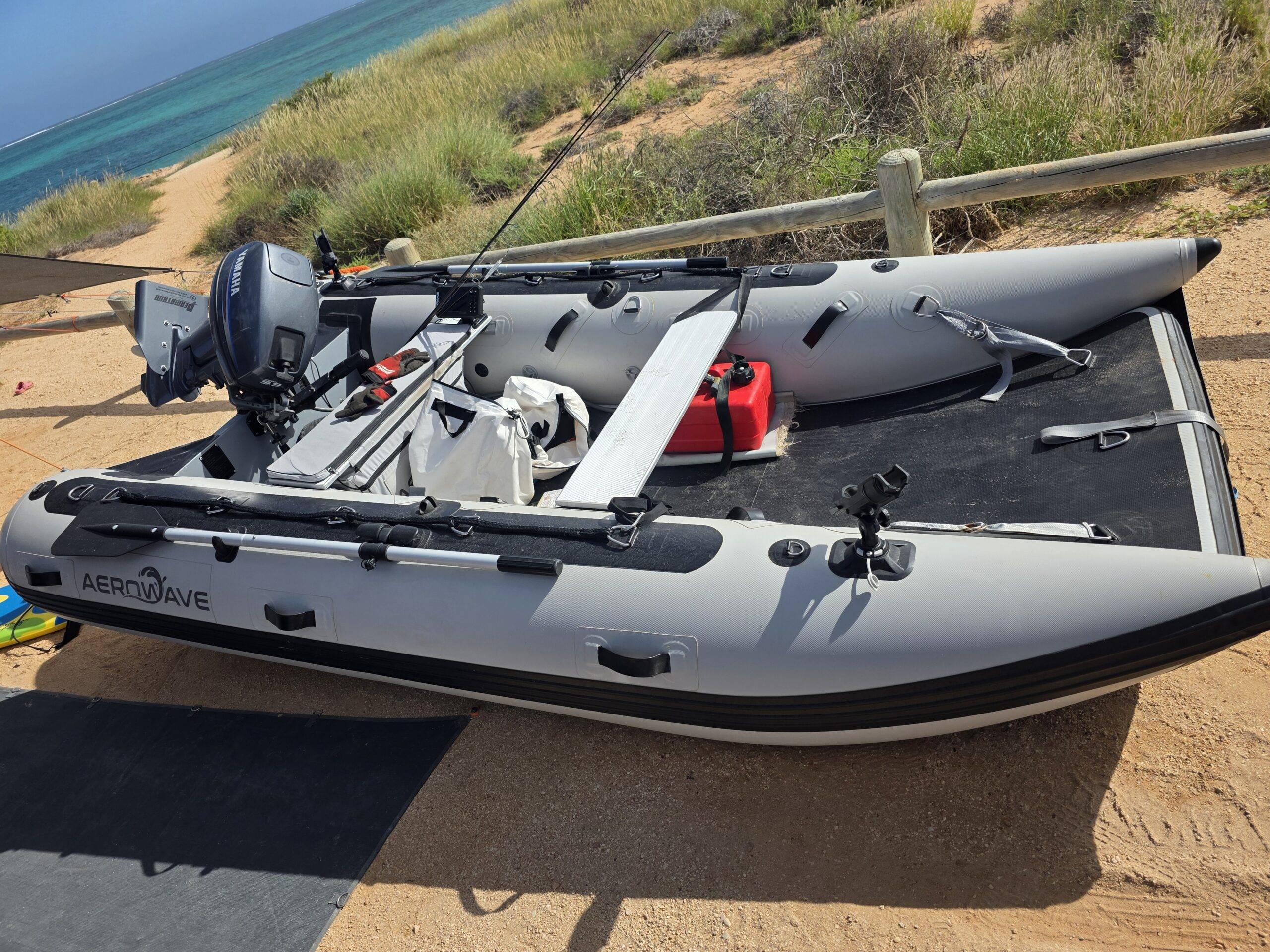
Ready to join the quiet revolution and find the perfect inflatable boat package for your adventures? At Easy Inflatables, we specialise in creating high-quality, durable, and affordable rigs tailored to your needs. Explore our range of Aerowave inflatable boats and create your ideal setup today. Visit us at https://easyinflatables.com.au to get started.

Facebook
Twitter
LinkedIn

Stay Connected

Join our community of water adventure enthusiasts! Sign up for Easy Inflatables' monthly newsletter for exclusive tips, product updates, and insights to make the most of your outdoor adventures.

At Easy Inflatables, we believe in empowering adventurers with high-quality inflatable solutions. Our commitment to durability and performance ensures that every product enhances your outdoor experiences.

Contact

Newsletter

Sign up for updates and get 5% off your first in-store purchase. Don’t miss out!

Credit Cards and Safe Check Out

Easy Inflatables © 2025. All rights reserved. ABN: 96856548613

Easy Inflatables Logo 1