

A boat motor trolley is a must-have piece of kit designed to help you move, store, and work on your outboard motor without breaking your back. Think of it as a personal valet for your engine. It turns what is often a heavy, awkward two-person lift into a simple, one-person job of rolling it from your car to your boat.
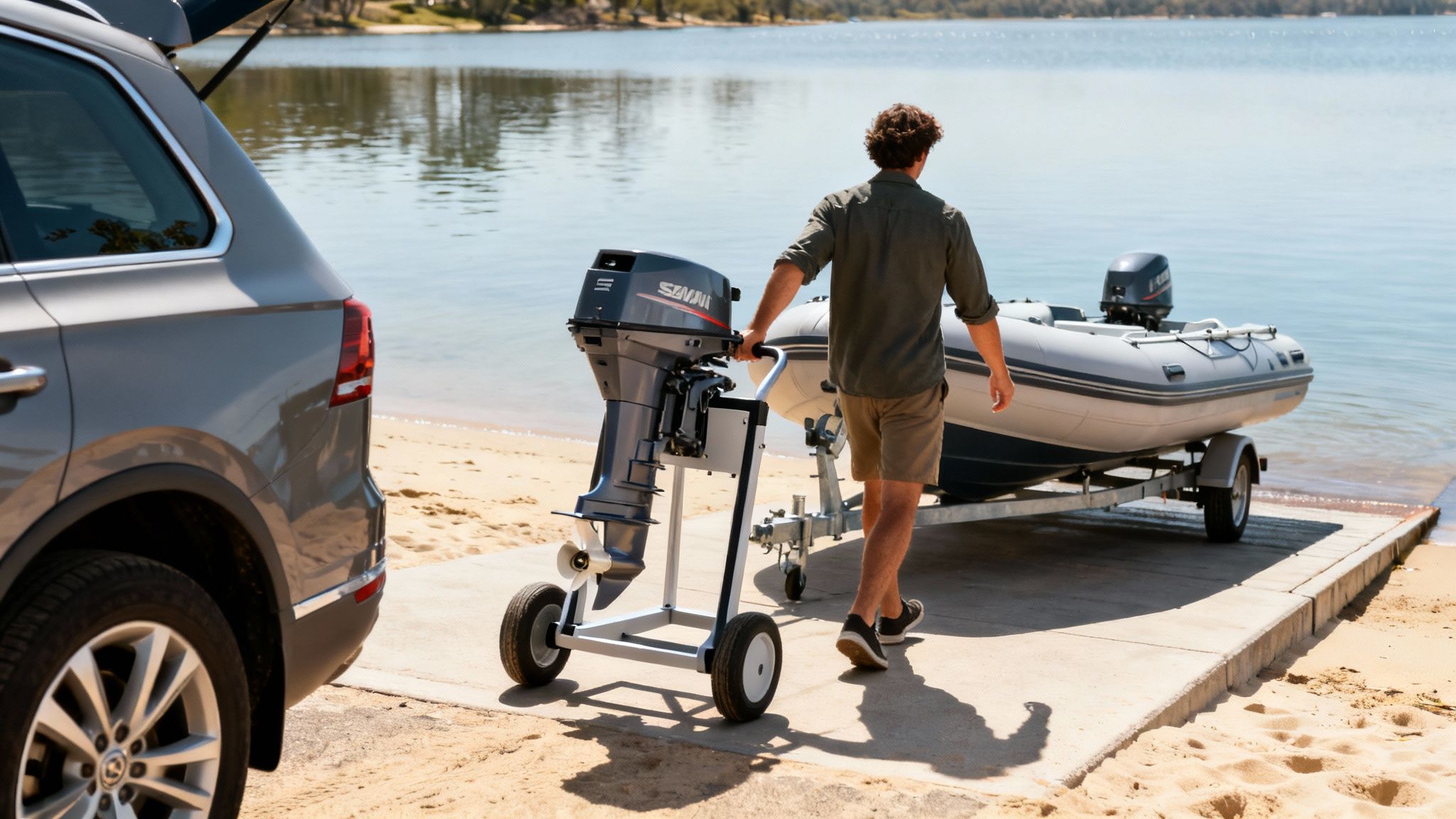
Anyone who’s ever had to lug a cumbersome outboard motor around knows the feeling. It’s a task that invites back strain, accidental drops, and expensive damage to your motor’s skeg or propeller. A dedicated boat motor trolley takes all that hassle away.
This simple but incredibly effective tool gives you a stable, wheeled frame that holds your motor securely. It lets a single person move the engine effortlessly over all sorts of surfaces, from the garage floor and car parks to grassy banks and boat ramps. This convenience alone completely changes the game.
To put it simply, here’s a quick look at why a trolley is such a valuable investment for any outboard owner.
| Benefit | What It Means For You | Why It Matters for Inflatable Boat Owners |
|---|---|---|
| Effortless Transport | Move your motor from car to boat with ease, no heavy lifting required. | Inflatable boat owners often attach/detach their motor for each trip. A trolley makes this routine painless. |
| Prevents Injury | Say goodbye to back strain and the risk of dropping a heavy, top-heavy engine. | Safety first! A trolley removes the physical struggle, so you can save your energy for the water. |
| Protects Your Motor | Keeps your motor upright and off abrasive surfaces, preventing scratches and damage. | No more laying your expensive outboard on gravel or concrete, risking damage to the cowling or prop. |
| Easy Maintenance Stand | Provides a stable, upright platform for flushing, oil changes, and inspections. | Regular maintenance is key for engine life. A trolley makes it so simple you’ll never skip it again. |
| Compact Storage | Stores your motor neatly upright in the garage, taking up minimal floor space. | Keeps your gear organised and your motor safe from being knocked over between trips. |
As you can see, it’s about more than just moving your motor—it’s about making your entire boating experience smoother, safer, and more enjoyable.
One of the best, and often overlooked, benefits of a motor trolley is that it doubles as a secure stand for maintenance. Instead of wrestling with an unstable engine on the ground, you can get all your essential tasks done with total ease.
By making maintenance this straightforward, a trolley encourages the kind of regular upkeep that extends the life and reliability of your outboard. It’s the perfect tool to complement other transport solutions, like the ones in our guide on finding the perfect foldable boat trailer for your setup.
Picking the right boat motor trolley isn’t a one-size-fits-all deal. The best choice comes down to your motor’s size, where you plan on using it, and your own boating habits. It’s a bit like choosing a vehicle: you wouldn’t take a little city car off-roading, and you definitely wouldn’t use a massive truck for a quick trip to the shops.
In the same way, a trolley built for a tiny 5 HP motor just won’t cut it for a heavy 25 HP four-stroke. To get it right, you need to understand the main types out there and how they’re designed for specific jobs. Each one offers a different mix of portability, strength, and convenience.
Let’s break down the three main types of boat motor trolleys so you can find the perfect match for your outboard and your lifestyle.
Picture this: you’re packing the SUV for a weekend camping trip with the family. Space is tight, and every bit of gear has to earn its spot. This is exactly where the lightweight folding trolley shines. Designed for pure portability, these are the perfect sidekicks for inflatable boat owners who are always on the move.
They’re usually made from lighter materials like tubular steel or aluminium and fold down into a surprisingly small package. This makes them a breeze to stash in the car boot, a caravan locker, or even inside your rolled-up inflatable boat bag.
Best for:
While they’re incredibly handy, the trade-off is raw strength. They might not be the best pick for really heavy motors or for permanent workshop storage where you need maximum stability.
Now, imagine a permanent setup in your home garage. You need a rock-solid stand that can hold your bigger outboard securely for months on end, making maintenance and engine flushing easy. This is the world of the heavy-duty workshop trolley.
These trolleys are built like tanks. They have thicker steel frames, wider wheelbases for better stability, and often feature larger, tougher wheels. They’re designed less for carting your motor around and more as a permanent storage and maintenance station. When looking at heavy-duty models, paying attention to their weight limits is non-negotiable. A good guide to understanding payload capacity can help you see why matching the trolley to your motor’s weight is so critical for safety.
A heavy-duty trolley gives you peace of mind, knowing your valuable motor is completely secure, whether you’re doing an oil change or storing it over the off-season.
They aren’t made to be folded or easily transported, which makes them less practical for taking down to the boat ramp. But for the home mechanic or someone with a dedicated storage spot, their stability is second to none.
So, what if you need a bit of both? You want something strong enough for garage storage and maintenance but still portable enough to take on trips. The versatile hybrid trolley neatly fills this gap, offering a fantastic balance of features.
These models often blend a strong frame with some kind of folding or quick-disassembly mechanism. They might use slightly larger, all-terrain wheels that can handle a smooth garage floor just as well as a bumpy track down to the beach. For many owners of inflatable boats, such as those looking for the best inflatable boats for recreational use, this type really hits the sweet spot. Whether you’re comparing prices of an inflatable catamaran or hiring a boat for a family outing in Australia, a hybrid trolley completes your portable setup. For more ideas on mobility, you can explore our range of boat accessory wheels to see how different bits of kit work together.
Choosing the right boat motor trolley isn’t just about picking one that looks tough. It’s about finding the perfect partner for your outboard—one that guarantees safety, stability, and zero headaches.
Get this decision right, and you’re set for years of easy transport and maintenance. Get it wrong, and you’re in for a world of frustration, or worse, a damaged motor.
To make the right call, you need to look past the shiny frame and get into the nitty-gritty. Five key things matter most: weight capacity, wheel type, frame material, transom fit, and portability. Let’s break down each one so you know exactly what to look for.
This decision tree helps you visualise which trolley type is best for how you plan to use your motor—whether that’s mostly for travel, workshop maintenance, or a bit of both.
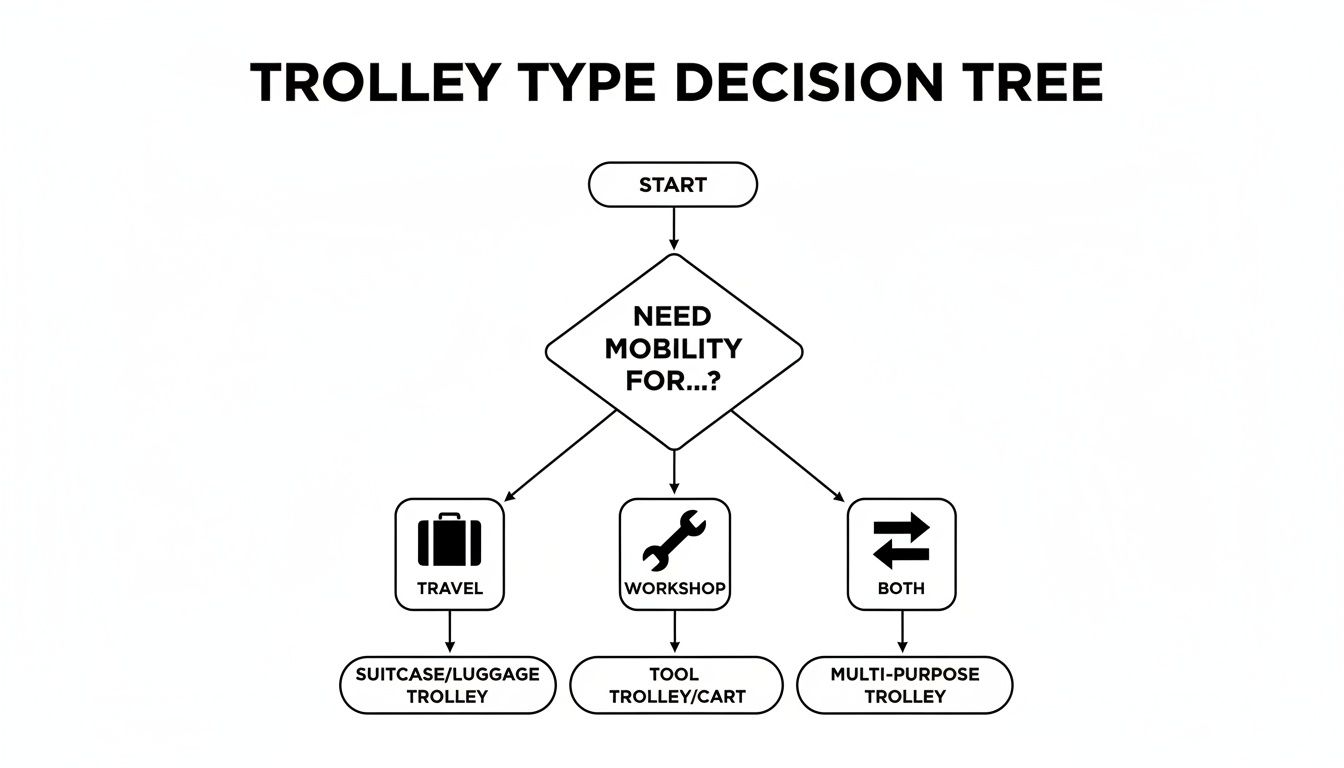
As you can see, lightweight, folding models are brilliant for travel. For workshop use, you can’t beat a heavy-duty, fixed frame. And for those who need both, a hybrid design is the way to go.
This is non-negotiable and the very first thing you need to check. Every single trolley has a maximum weight limit, often with a suggested horsepower (HP) rating to go with it. Pushing this limit is asking for trouble. A catastrophic failure could not only wreck your motor but also cause serious injury.
Always check your outboard’s dry weight in the owner’s manual. Don’t just go by the horsepower—a 15 HP 2-stroke can be a lot lighter than a 15 HP 4-stroke, and that’s a common mistake people make.
A good rule of thumb: Choose a trolley with a weight capacity that’s at least 15-20% higher than your motor’s actual weight. This safety buffer gives you extra stability and, more importantly, peace of mind.
The wheels are where the rubber literally meets the road. Their design dictates how easily you can move your outboard around, and the wrong ones can turn a simple task into a back-breaking struggle.
You’ll generally find three main types:
Bigger is almost always better. Larger diameter wheels make navigating obstacles and rough ground much easier. If you’ll be moving your motor across anything other than perfect concrete, go for the biggest wheels you can get.
The trolley’s frame is its backbone, giving it the strength to hold your outboard securely. The material it’s made from really impacts its durability, weight, and ability to stand up to the harsh marine environment.
Galvanised or Powder-Coated Steel is the most common choice because it’s strong and affordable. It’s incredibly robust, making it perfect for heavy-duty workshop models designed for bigger outboards. That coating is vital for protecting the steel from rust, so be aware that any deep scratches can leave it vulnerable.
Aluminium is the premium option. It’s prized for being lightweight and naturally resistant to corrosion. This makes it an excellent choice for those lightweight folding trolleys you’ll be lifting in and out of your car. It usually costs a bit more, but its longevity in salty air is a huge plus.
The transom mount is the wooden or composite block on the trolley where you clamp your outboard, just like you would on the back of your boat. The thickness and height of this block absolutely must work with your motor’s mounting brackets.
If the mount is too thin, the clamps won’t tighten securely, creating a dangerous wobble. Too thick, and you might not be able to get the clamps over it at all. Before you buy, check the maximum clamping width on your outboard and make sure the trolley’s transom block is a good fit. This is especially important as you start looking into the right engine for your inflatable boat, as different models have varied clamp designs.
Finally, think about where you’re going to keep the trolley. If space in your car, garage, or shed is tight, a model that folds down compactly is a clear winner. Always check the folded dimensions to be sure it will fit where you need it to.
Portability is a massive deal in the Aussie boating scene. Motor trolleys are essential, especially since 85% of the country’s nearly one million registered boats are compact vessels under 6 metres—a category dominated by inflatables and trailer boats. For owners in Queensland, NSW, and Victoria, a reliable trolley is the key to getting their outboard from the ute to the water’s edge.
Also, think about how easy it is to fold and unfold. A great design will use quick-release pins or simple locking mechanisms, letting you set it up or pack it away in seconds.
To help you keep track of everything, use this simple checklist when you’re comparing different models.
Use this checklist to compare different trolleys and decide which features are most important for your situation.
| Critical Feature | What to Look For | Best Suited For… |
|---|---|---|
| Weight Capacity | A rating at least 15-20% higher than your motor’s dry weight. Check both the kg rating and the recommended HP. | Everyone. This is the most crucial safety check. Never compromise here. |
| Wheel Type | Solid plastic for smooth surfaces, pneumatic for uneven ground, or puncture-proof for all-round convenience. | Pneumatic or Puncture-Proof for typical boat ramp, grass, and gravel conditions. Solid wheels are fine for pristine workshop floors. |
| Wheel Size | The largest diameter you can find for your needs. Bigger wheels roll over obstacles more easily. | Large-diameter wheels for anyone moving their motor over anything other than flat, paved surfaces. |
| Frame Material | Steel for heavy-duty strength and workshop use. Aluminium for lightweight portability and corrosion resistance. | Aluminium for travellers and those near saltwater. Steel for budget-conscious buyers or those needing maximum strength in a workshop setting. |
| Transom Mount | A mount block that is the correct thickness for your outboard’s clamps to tighten securely. | Everyone. Check your motor’s clamp range against the trolley’s specs before buying. |
| Portability & Storage | A folding design with compact dimensions if space is limited. Look for quick-release pins for easy setup. | Folding designs are essential for anyone transporting the trolley in a car, SUV, or RV. Fixed frames are fine for permanent garage storage. |
By ticking off these features, you can be confident you’re choosing a trolley that’s not just a good fit, but the right fit for your motor and your boating lifestyle.
Having the perfect boat motor trolley is one thing, but knowing how to use it safely is what really protects you and your valuable outboard. Proper technique turns this simple tool into a powerful ally, saving you from back strain and preventing accidental drops or damage.
A few straightforward steps will ensure every move you make is confident, controlled, and secure. Before you even think about lifting that motor, a quick pre-use check is non-negotiable. It only takes a minute but can save you from a major headache down the track.
A quick visual inspection before each use is the key to spotting trouble before it happens. Get into the habit of running your eyes over these critical points.
Once you’re confident the trolley is in good shape, you’re ready to get the motor mounted.
This is the most critical part of the process, where taking your time pays off. Rushing this step can lead to a nasty injury or a dropped motor, so focus and do it right.
Safety First: Never, ever try to lift an outboard that feels too heavy for you to manage alone. It’s always better to ask for a hand than to risk a serious back injury or a damaged motor.
With the motor mounted securely, moving it around should be a breeze. Of course, different surfaces present different challenges. Remember, keeping your setup safe is about more than just the trolley; for a complete overview, it’s worth reviewing this helpful boat safety equipment checklist to make sure all your bases are covered.
As a rule of thumb, always pull the trolley rather than pushing it. This gives you much better control and a clear view of the path ahead.
When tackling slopes, always position yourself uphill from the trolley—this lets you use your body weight to control its descent. Going up a ramp? Walk backwards, pulling it up behind you. For any tight corners, take them slowly and use a wide arc to keep the motor from getting tippy. This careful, deliberate approach ensures your outboard arrives safely at its destination, every single time.
Just like your outboard motor and your inflatable, your boat motor trolley isn’t something you can just set and forget. It needs a little care to keep it performing reliably, season after season. A few simple maintenance jobs can make all the difference, preventing rust, stiff joints, and those frustrating failures that always seem to happen at the worst possible time.
Think of it this way: a little proactive care ensures your trolley remains a trusty companion for every trip. If you neglect it, you’ll end up with seized wheels and a corroded frame, turning a handy tool into a headache right there at the boat ramp.
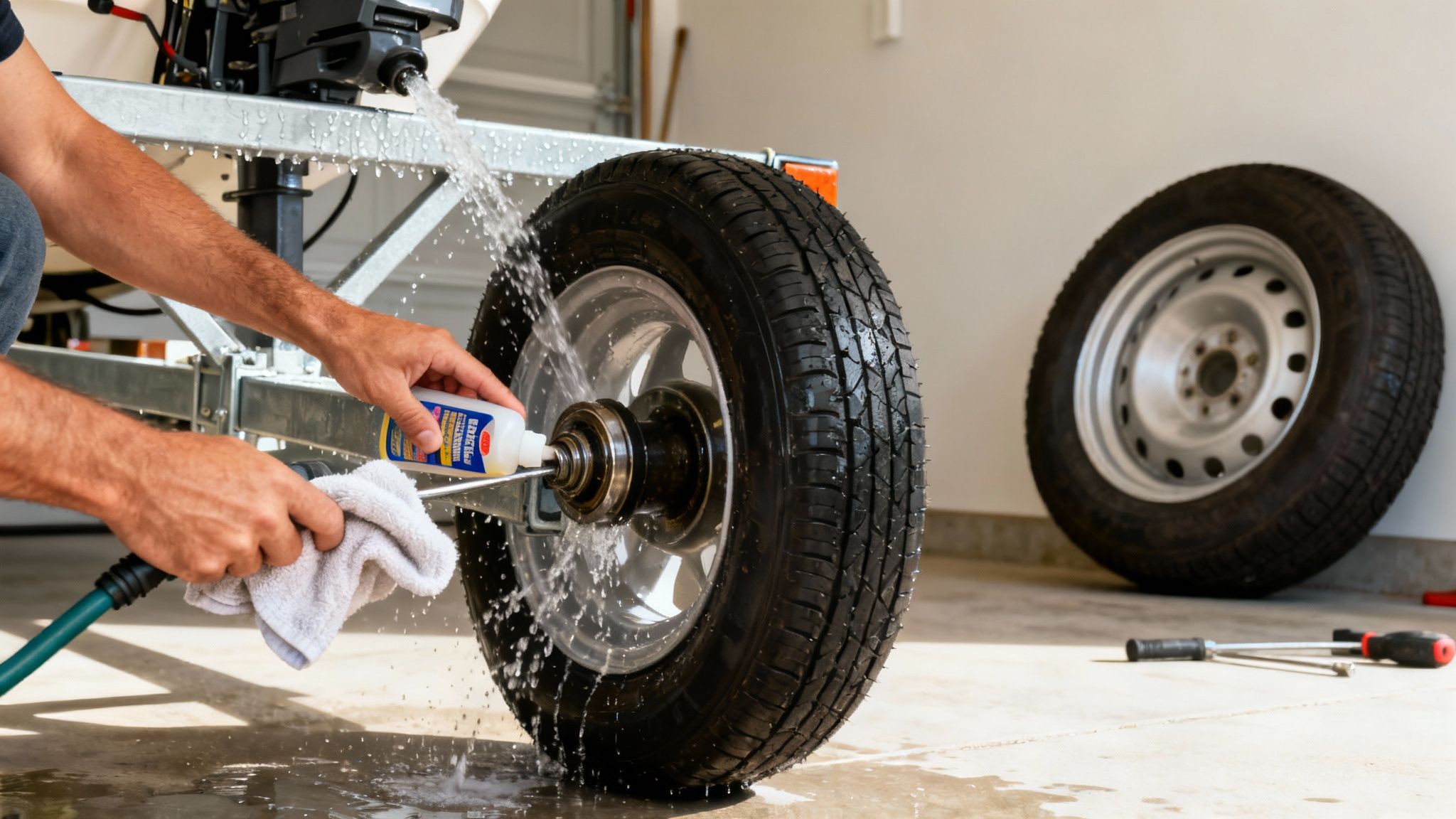
This is the single most important job you can do, especially if you’ve been anywhere near the coast. Saltwater is incredibly corrosive and will waste no time attacking any exposed metal on your trolley, kickstarting rust and decay.
After every single trip near saltwater, give the entire frame a good spray down with a hose. Pay close attention to the welds, joints, and any fasteners where salt loves to hide. It’s a simple five-minute task, but it’s your best defence against corrosion.
For your trolley to do its job smoothly, the moving parts need to be lubricated and the wheels need to be in good nick. A bit of attention here goes a very long way.
Of course, proper care isn’t just for the trolley. For a deeper dive into looking after your whole setup, check out our guide on inflatable boat maintenance made simple.
Even with the best care, you might run into the odd issue. Here’s a quick guide to fixing the most common problems before they turn into something serious.
| Problem | Likely Cause | Simple Fix |
|---|---|---|
| Wobbly Wheels | The axle nuts or retaining clips have worked themselves loose over time. | Tighten the nuts on the axle with a spanner or make sure the retaining clips are pushed all the way in. |
| Stiff Folding Joint | Dirt, grime, or corrosion is building up in the hinge. | Give the joint a good scrub with a stiff brush and fresh water, then apply a generous amount of lubricant. |
| Motor Sits Crooked | The outboard’s clamp screws weren’t tightened down evenly. | Loosen both clamp screws, re-centre the motor on the transom block, and tighten them down evenly until firm. |
Taking care of your trolley is all part of being a responsible boat owner. With 925,000 registered boats and 2.5 million licensed boaties in Australia, keeping gear in top shape is essential for the one in ten Aussies who enjoy this pastime.
Proper off-season care is just as crucial for your motor’s longevity. Storing your motor correctly prevents internal corrosion and fuel system problems.
Speaking of storage, what you do in the off-season is critical. You can find some excellent guidelines on long-term motor storage best practices to ensure your motor is ready to go for your next adventure.
Even after covering the basics, you probably still have a few questions rolling around. That’s perfectly normal. We get asked about the finer points of using a motor trolley all the time, so we’ve put together answers to the most common queries from boaties just like you.
Think of this as your quick-fire guide to clearing up any final doubts. Let’s get you using your new gear with total confidence.
Absolutely! In fact, this is one of the best hidden perks of owning a quality boat motor trolley. A solid, stable trolley isn’t just for moving your motor—it’s your personal, portable workshop stand. It makes routine jobs so much easier and a whole lot cleaner.
By holding your outboard upright and secure, a trolley lets you:
For this kind of work, a heavy-duty or a versatile hybrid trolley is your best bet. They have the extra stability you need to work on the motor safely and securely.
Using a trolley for off-season or long-term storage is a brilliant idea. It protects your motor from damage and frees up a ton of space in the shed or garage. But to keep your motor in top shape, you need to do it right.
First off, double-check that your trolley’s weight rating is well above what your motor actually weighs. It needs to handle that load for months on end. Always store the motor vertically, just as it sits on the boat. This stops any leftover oil from creeping into the cylinders, which can cause a real headache when you try to start it up after a long break.
Storing your motor on a trolley gets it off the cold, damp concrete floor—a simple move that goes a long way in preventing corrosion and other damage. Throw a proper outboard cover over it to shield it from dust, moisture, and any critters looking for a new home.
Finally, find a spot for it where it won’t get bumped or knocked about. If your trolley has brakes, make sure they’re locked on for that extra bit of security.
This is a great question, and it’s one you really need to get right. The short answer is yes, but it all comes down to the numbers. Modern 4-stroke outboards are definitely heavier than the old 2-strokes of the same horsepower, but plenty of high-quality folding trolleys are built to handle the extra muscle.
The golden rule is to always check the maximum weight capacity specified by the manufacturer. Don’t ever guess based on the horsepower rating alone. A well-built folding trolley with a solid steel frame and a high payload capacity (say, 60 kg or more) is more than capable of handling a mid-sized 4-stroke.
However, once you get into the big leagues with seriously heavy outboards—usually 20 HP and up—a non-folding, heavy-duty workshop trolley is almost always the safer choice. They’re built with thicker frames and a wider wheelbase for a reason: to manage the serious weight and higher centre of gravity of those bigger motors. Always put the weight rating first to keep things safe and secure.
At Easy Inflatables, we know that enjoying your time on the water is all about having gear that’s convenient and reliable. A good boat motor trolley is an essential bit of kit for any inflatable boat owner. Explore our full range of boats and accessories designed for Australian adventurers at Easy Inflatables.