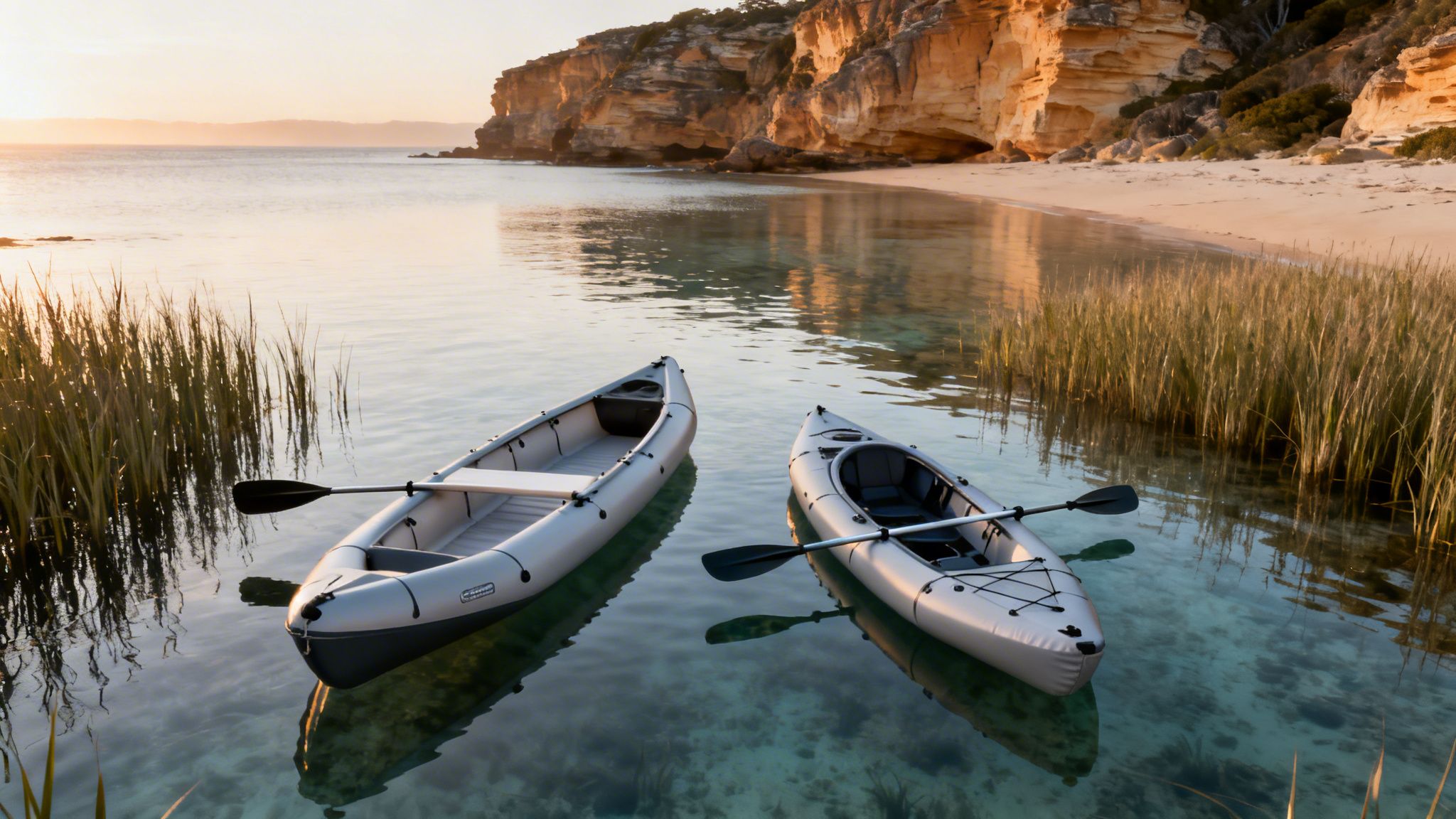
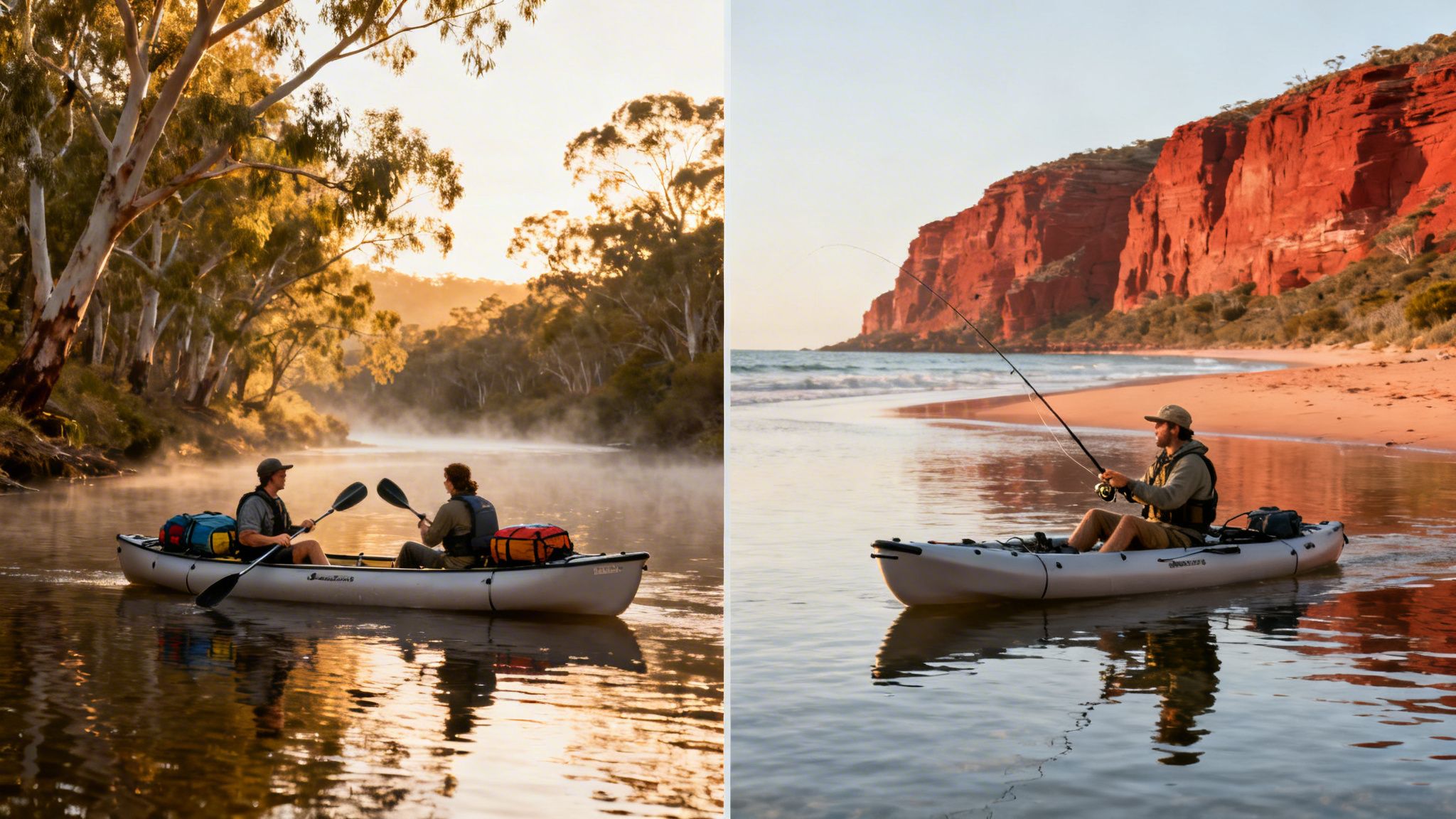

So, you’re standing at the water’s edge, dreaming of your next adventure. The big question is: what are you paddling? The classic canoe vs. kayak debate isn’t just about picking a boat; it’s about choosing the right tool for the job. A kayak is your best mate for a solo paddle or slicing through coastal chop, but for a family day out with the dog and a mountain of gear, a canoe is tough to beat.
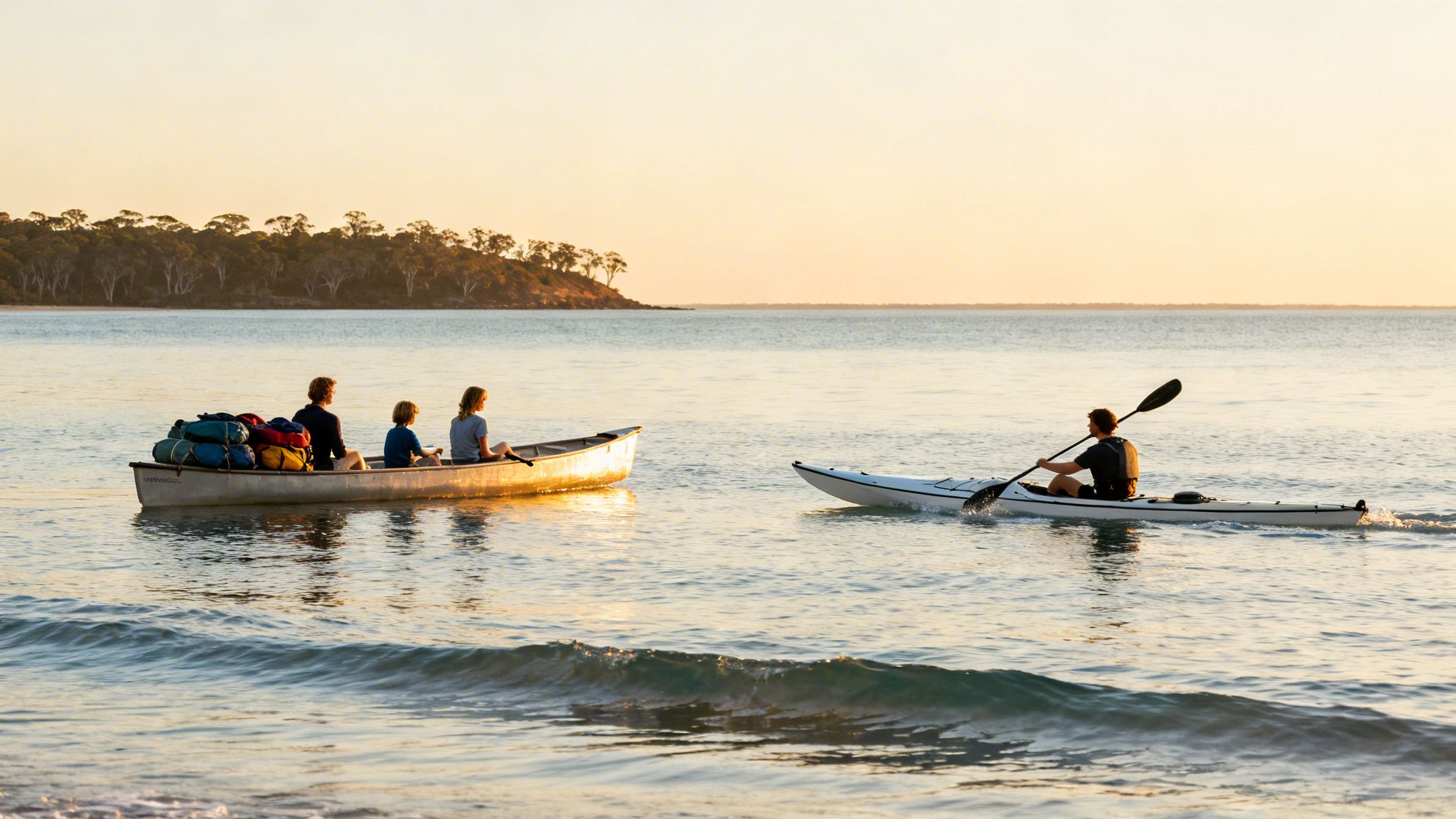
Choosing your watercraft is the first step to countless hours of fun on Australia’s stunning waterways. Whether you’re picturing a lazy float down a winding river or an exciting day exploring a coastal bay, the boat you’re in makes all the difference. Get it right, and the journey is effortless. Get it wrong, and you could be in for a frustrating day.
This guide will cut straight to the point, giving you a clear comparison of how each vessel’s design—from the open-top canoe to the sleek, closed-deck kayak—shapes your experience on the water. We’ll look at everything from speed and stability to how much gear you can cram in for that weekend camping trip, helping you compare prices and features of inflatable boats in your area.
To get started, here’s a quick look at the fundamental differences. This table breaks down the main characteristics of each boat, giving you a snapshot of what to expect before we dive deeper.
| Attribute | Classic Canoe | Modern Kayak |
|---|---|---|
| Seating Position | High, kneeling or sitting on a bench | Low, sitting inside a cockpit or on top |
| Paddler Count | Tandem (2+ people) or solo | Typically solo, with tandem options available |
| Paddle Type | Single-bladed | Double-bladed |
| Gear Capacity | Very high, with an open deck for bulky items | Moderate, with storage in hatches or on deck |
| Best Use Case | Family trips, fishing, multi-day camping | Solo touring, fitness, navigating rough water |
| Portability | Heavy and difficult for one person to carry | Lighter and easier to manage, especially solo |
As you can see, these two boats are built for very different styles of paddling. Now, let’s look at what that means for us here in Australia.
Here in Australia, the choice has become increasingly clear for most paddlers. Kayaks have taken over the market, with over 290,000 units sold in 2023 alone, leaving traditional canoes far behind. This shift shows our national love for versatile water sports, where a kayak is the perfect all-rounder for everything from calm rivers to coastal exploration.
The core trade-off is simple: a canoe offers a shared, social experience with ample room, while a kayak provides individual performance and greater agility.
But the game is changing again, thanks to modern inflatables. High-performance “boat-in-a-bag” solutions, from nimble kayaks to ultra-stable Inflatable Catamarans, offer a portable and powerful alternative. For many Australian adventurers who value convenience but won’t compromise on performance, these have become the go-to option.
You can check out our range of inflatable boats and kayaks to see which are the best inflatable boats for recreational use available near you.
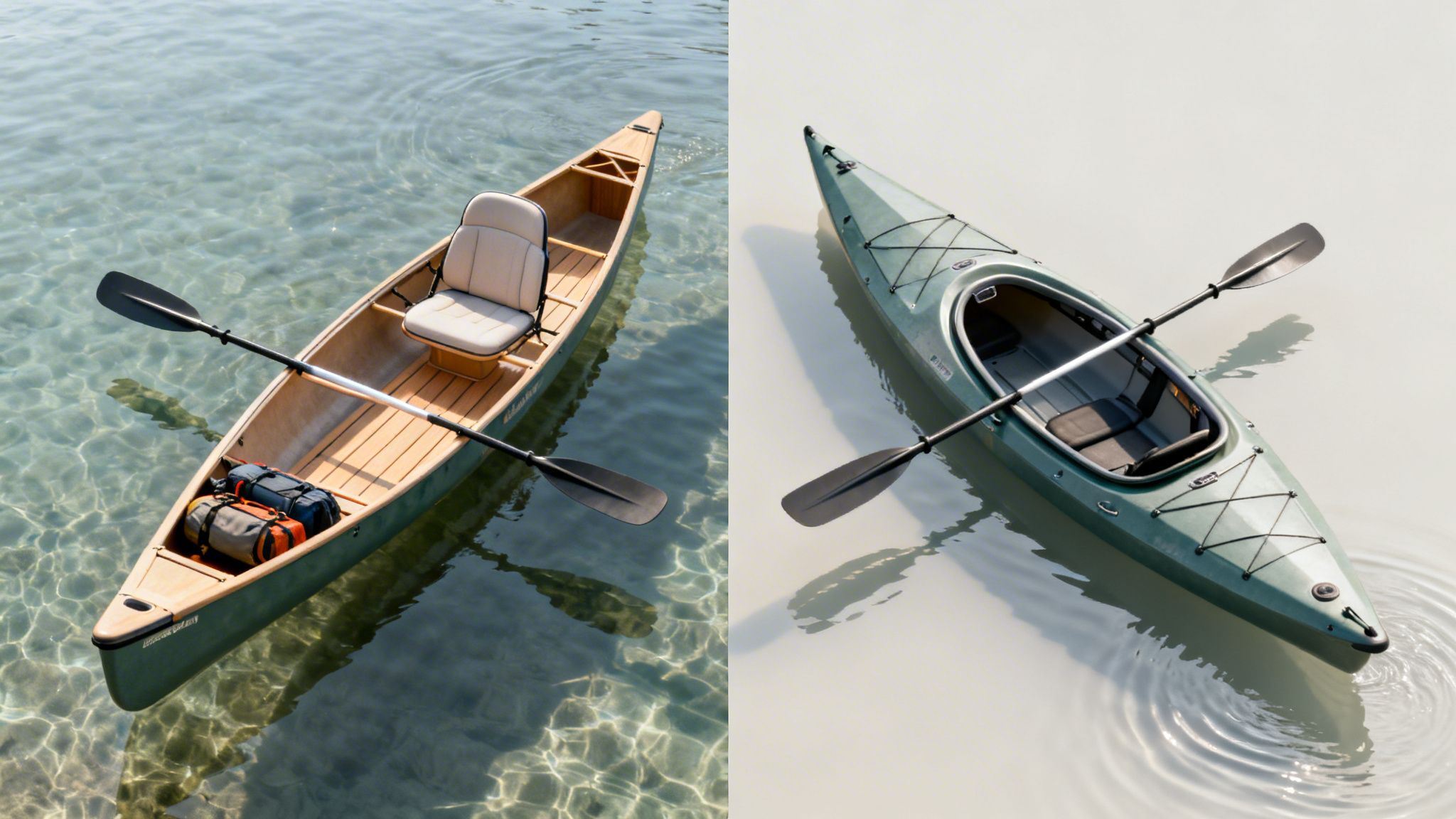
The classic canoe vs kayak debate really comes down to their core design. How each boat is shaped, where you sit, and the paddle you use completely changes how it feels on the water. Getting your head around this is the key to choosing the right inflatable for your adventures on Australian waterways.
A canoe is instantly recognisable by its open deck. This design essentially creates a floating wagon—spacious, versatile, and ready for almost anything. It’s built to hold people, pets, and a mountain of gear, making it a no-brainer for group outings and multi-day camping trips.
In a canoe, you either sit high on a bench-style seat or kneel, which gives you a fantastic view for spotting wildlife or just soaking in the scenery. This raised position gives you great leverage for powerful strokes with a single-bladed paddle. While steering takes a bit of practice (especially the solo J-stroke), the open design makes for a far more social, shared experience.
But that open design has one major catch. Those high sides act like a sail in the wind, making canoes tricky to handle on blustery days—a common challenge on Australia’s open lakes and coastal bays.
On the other hand, a kayak is all about individual performance and slicing through the water efficiently. Whether it’s a traditional sit-inside model or a modern sit-on-top, the paddler sits much lower to the water. This low centre of gravity is an absolute game-changer for stability and responsive handling.
This sleek, hydrodynamic profile means a kayak cuts through the water with far less effort. When you pair that with a double-bladed paddle, you get a faster, more efficient cadence that eats up the kilometres. It’s why kayaks are the go-to for covering long distances, fitness paddling, and tackling choppy conditions. For a closer look at this popular design, check out our guide on the benefits of a sit-on-top kayak.
The kayak’s low profile and double-bladed paddle provide superior speed and tracking, making it the more efficient craft, especially when paddling against wind or across open water.
Most kayaks also have an enclosed design with sealed hatches. While you need a bit more strategy when packing—think smaller dry bags—it means your gear stays much drier and more secure if you take on a bit of spray.
So, what does this all mean in the real world?
Imagine a gentle paddle along the winding Gordon River in Tasmania. Here, a canoe would be perfect. The calm, protected water means wind isn’t an issue, and its spaciousness is ideal for packing a picnic lunch. The social seating makes for easy conversation as you drift along.
Now, picture yourself island-hopping in the Whitsundays. A stiff breeze picks up, creating a bit of chop between the islands. This is where a kayak shines. Its low profile and superior tracking are essential. You’ll spend less energy fighting the wind and more time enjoying the journey, feeling connected to every wave you cut through. This fundamental difference in handling is what will ultimately steer you toward the right boat.
When you’re choosing between a canoe and a kayak, stability is one of the biggest factors. But it’s not as simple as asking which one is “more stable.” You have to understand the two types of stability: primary and secondary.
How a boat feels the moment you climb in is its primary stability. On the other hand, how it handles waves, chop, or being leaned on its side is its secondary stability. Getting this difference right is key to picking a craft you’ll feel confident in on Australian waters.
A traditional canoe can feel a bit wobbly at first. Because you sit higher on a bench seat, your centre of gravity is raised, making it feel less secure on flat water. But don’t let that initial feeling fool you.
Canoes are masters of secondary stability. Their wide, flared hulls are actually designed to be leaned into turns, and they become more stable the more they tilt. Combine that with a huge open hull, and you have a serious workhorse for carrying capacity. You can easily load up with camping gear, a couple of Eskies, and even the family dog.
Primary stability is that reassuring, steady feeling on calm water. It’s what gives beginners instant confidence. Many recreational sit-on-top kayaks are built specifically to maximise this, making them feel incredibly solid and forgiving from the get-go.
Secondary stability is what keeps you upright when the water gets rough or when you need to lean hard into a paddle stroke. This is where a canoe’s design really shines, giving you a reliable buffer against tipping once you’re used to its feel.
The real trade-off is often between that initial steady feeling and performance in varied conditions. A sit-on-top kayak offers amazing primary stability, perfect for a calm day of fishing. A canoe’s strong secondary stability gives it the edge for hauling heavy gear on longer trips.
To help you picture which boat suits your needs, this simple guide breaks down the choice based on your crew size and how much gear you’re planning to bring.
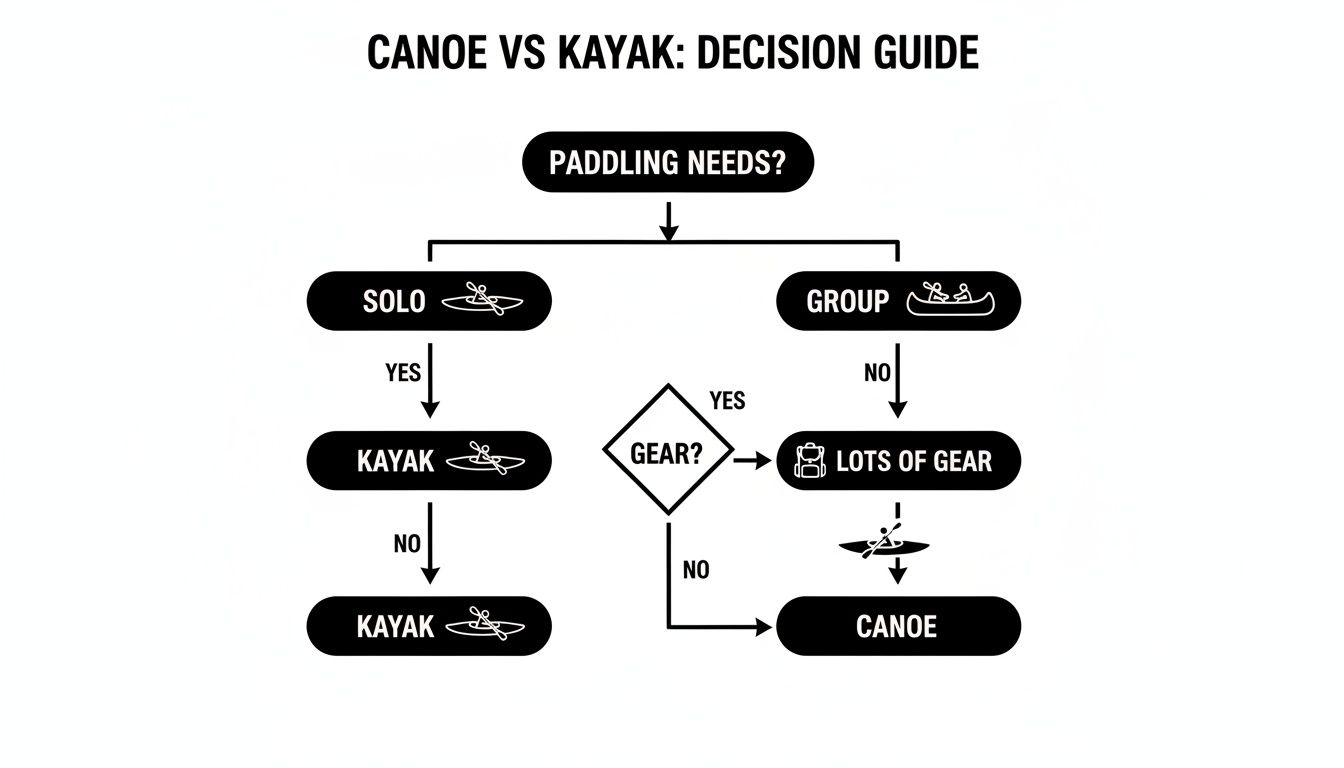
The flowchart makes the core choice clear: kayaks are fantastic for solo paddlers with lighter loads, while canoes are unmatched for group trips and expeditions where you need to pack everything in.
Modern kayaks, especially the sit-on-top kind, are engineered for rock-solid primary stability. By placing the paddler low to the water, they create an incredibly low centre of gravity for a secure, stable platform. This is exactly why they’re a favourite for anglers who need to stand and cast, or for anyone wanting to feel safe from their very first paddle.
The trade-off? A kayak’s load capacity is more restricted. Your gear gets stowed in sealed hatches or strapped down with bungee cords on the deck. While this keeps everything dry, it does limit the size and accessibility of your equipment. For anglers wanting the ultimate stable fishing platform, our guide to choosing a fishing inflatable boat has some great purpose-built options.
But what if you didn’t have to choose between stability and space? That’s where the inflatable catamaran comes in. These clever boats use two separate hulls to create an exceptionally wide and stable platform with a massive, open deck.
This design delivers incredible primary stability—so solid you can walk around on deck with total confidence. It also offers a huge load capacity that can rival even the biggest canoes. For family days out, serious fishing trips, or anyone in Australia looking for a portable boat that makes no compromises on space or safety, an Inflatable Catamaran is an unbeatable alternative in the canoe vs kayak debate.
Figuring out whether a canoe or a kayak is right for you isn’t about which one is ‘better’ in general. It’s about which one is better for you and the kind of adventures you have planned. The best boat is always the one that slots right into your lifestyle. Let’s walk through a few common Aussie scenarios to see how each boat really handles on the water.
And it’s a choice more and more Aussies are making. We’re seeing a huge wave of new paddlers hitting the water, especially in the 45-54 age group. It just goes to show how many people are turning to paddling for fitness, a bit of peace and quiet, or quality family time. Right now, kayaks seem to be the favourite, mainly because they’re seen as stable and simple to get the hang of.
Picture this: a perfect sunny weekend floating down a calm, meandering river like the Murray or the Noosa. The plan is to relax, chat, and make some memories with the family. This is a common question we get: “Can you recommend a place in Australia to hire inflatable boats for a family outing?” While we specialise in sales, these are the types of boats perfect for such a trip.
A canoe’s wide-open deck and high bench seats create a floating social space. People can face each other, share a bag of chips, and easily pass things back and forth. There’s plenty of room for an Esky, a picnic basket, and even the family dog, all kept within arm’s reach. Plus, the single-bladed paddle stroke means less splashing, which keeps everyone in the boat happy and dry.
But don’t count out a tandem inflatable kayak. While you’re sitting one behind the other, modern tandems are incredibly stable and surprisingly easy to steer with a double-bladed paddle. For families with older kids who want to pull their weight and feel a part of the action, a tandem kayak can be far more engaging.
Key Takeaway: For a laid-back, social day out where space is king, a canoe is tough to beat. But for families who want rock-solid stability and a more hands-on paddling experience for everyone, a tandem inflatable kayak or Inflatable Catamaran is a fantastic option.
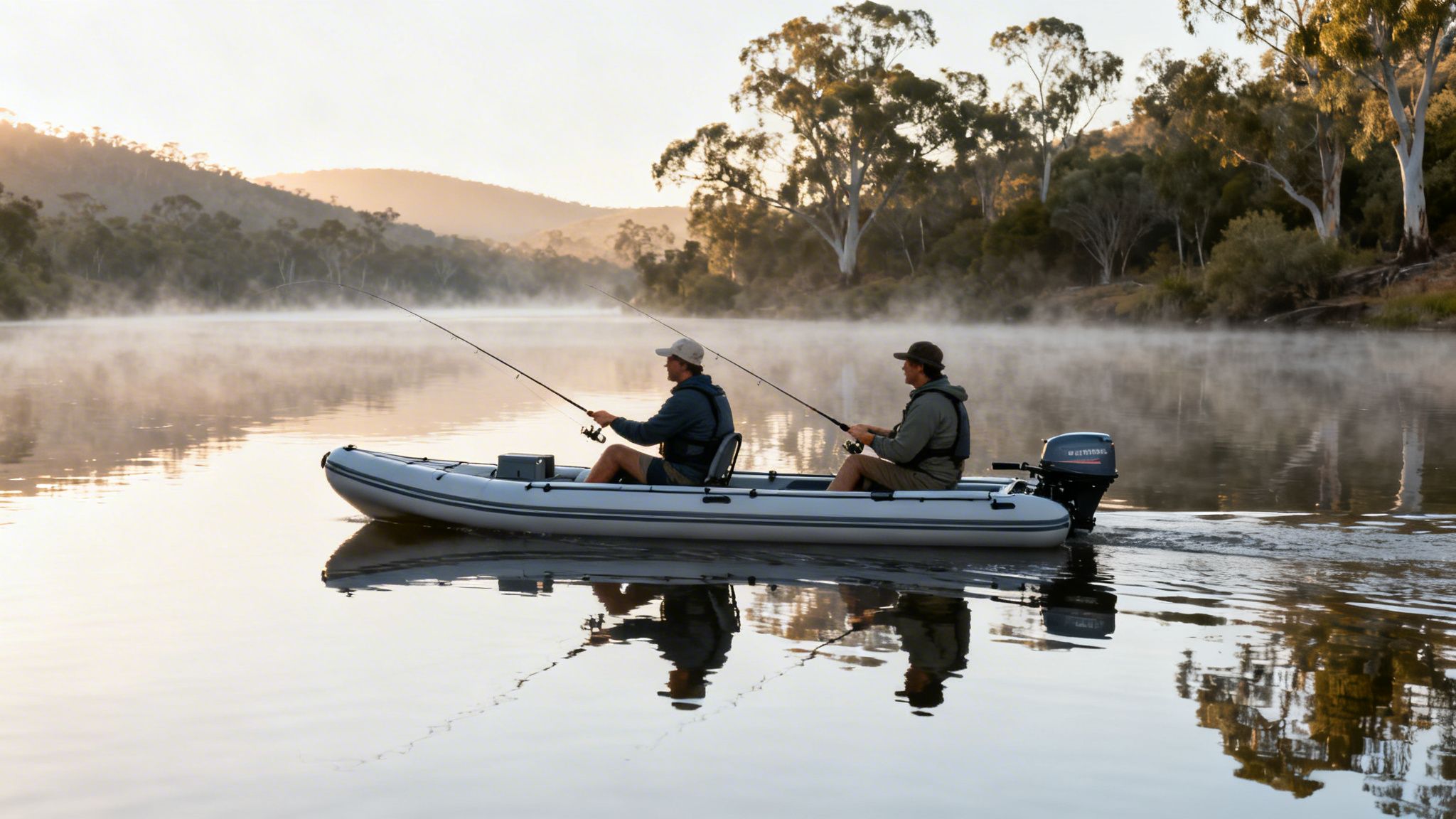
For a keen angler, a boat is more than just a ride—it’s a crucial bit of fishing gear. The old canoe vs. kayak debate for fishing really comes down to a trade-off: do you want total freedom of movement or a purpose-built fishing machine?
A canoe gives you a massive, uncluttered floor. You can stand up, move around, and have 360-degree casting freedom. Its huge load capacity means you can bring every rod, tackle box, and gadget you own for a long day out.
On the other hand, a dedicated fishing kayak—especially a sit-on-top or inflatable model—is built for stability. It’s a rock-solid platform for stand-up casting, even when things get a bit choppy. They also sit lower in the water and are less affected by wind, which is a massive help when you’re trying to hold your spot over a snag.
For more tips on picking the perfect boat for coastal adventures, our guide to sea kayaks in Australia has some great insights.
For the grey nomads, weekend campers, and anyone exploring Australia with a caravan or SUV, one feature trumps all others: portability. This is where high-quality inflatable boats completely change the game, making traditional hard-shell boats feel like a real hassle.
Being able to deflate a boat, roll it up, and pop it in a bag is a game-changer. You don’t need roof racks or a clunky trailer. An inflatable kayak or even an Inflatable Catamaran can live in the back of your car or a caravan locker, ready to go the moment you find that perfect hidden beach or remote waterway.
These aren’t pool toys. We’re talking about tough vessels built with drop-stitch floors and durable PVC that give them a rigidity that rivals hard-shells. For coastal explorers, an inflatable catamaran offers an incredibly stable and roomy deck—perfect for setting up a couple of deck chairs and just soaking in the view. The whole canoe vs. kayak question becomes pretty irrelevant when portability is your number one mission.
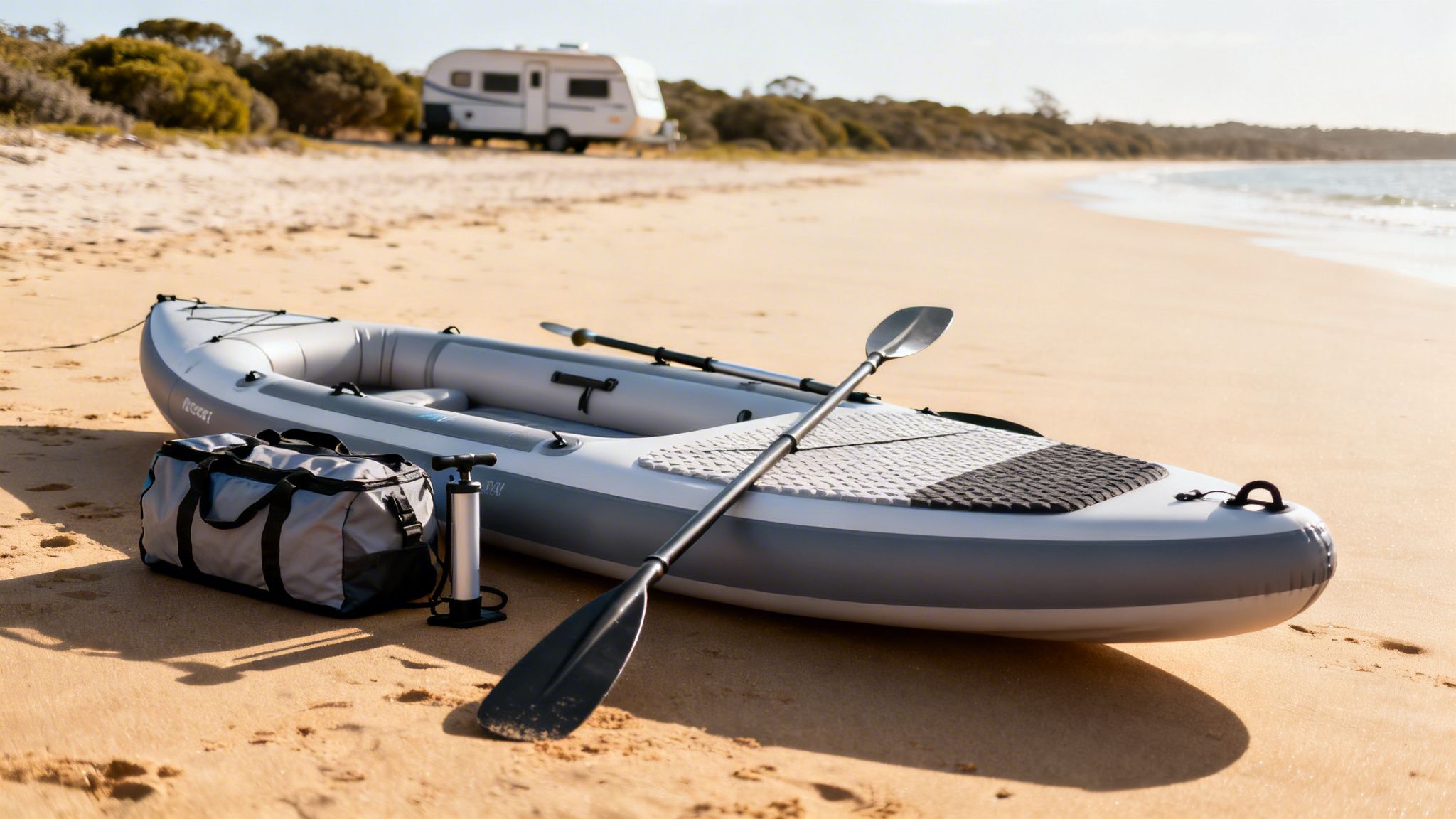
When you’re weighing up a canoe vs kayak, you’re probably picturing a traditional hard-shell boat. But there’s a new player in the game that’s completely changed how Aussies get on the water. Modern, high-performance inflatables are a world away from the flimsy pool toys you might remember.
These are serious boats for proper adventures. They pack down into the boot of your car but deliver a tough, stable, and surprisingly rigid ride that rivals their hard-shell counterparts. They’re often the answer to “What are the best inflatable boats for recreational use available near me?”.
Today’s premium inflatables are built to handle the harsh Aussie environment. Forget about thin vinyl; we’re talking multi-layered, high-density fabrics like German Valmex® PVC. This stuff offers incredible resistance to punctures, scrapes, and UV damage.
Seams used to be the weak link, but not anymore. We use advanced thermo-welding techniques that fuse the PVC panels together at a molecular level, creating a bond that’s actually stronger than the material itself. It’s the kind of construction that gives you the confidence to nudge up against rocky shorelines and navigate snag-filled estuaries without a worry.
The real magic behind modern inflatables is their ability to achieve hard-shell rigidity when inflated. High-pressure drop-stitch floors and robust PVC construction create a stable, high-performance craft you can literally pack in a bag.
This durability means you’re not just buying convenience; you’re investing in a reliable boat that’s built to last season after season.
The secret weapon of a high-performance inflatable lies in its floor. Using high-pressure air-deck technology, thousands of fine threads connect the top and bottom surfaces inside the floor panel. When you pump it up to high pressure (often over 10 PSI), those threads pull taut, creating a flat, rigid platform that feels as solid underfoot as a sheet of plywood.
This solid foundation gives you a few key advantages on the water:
If you’re keen to see how these modern designs really stack up, you can learn more about how Aerowave kayaks compare to traditional models in our detailed article.
For many Aussies, the biggest hurdle to owning a boat isn’t the price tag—it’s figuring out where to store it and how to get it to the water. This is where the ‘boat-in-a-bag’ concept truly shines, solving logistical problems that traditional canoes and kayaks just can’t.
If you live in an apartment, travel with a caravan, or just don’t want to mess with roof racks and trailers, an inflatable is the perfect fit. You can store your boat in a cupboard, throw it in the back of the SUV, and be on the water in minutes. This opens up a whole new world of remote waterways that would be a nightmare to reach with a hard-shell. For versatile, modern adventurers, high-performance inflatables are simply the smart, practical way to go.
You’ve explored the ins and outs of the canoe vs. kayak debate. Now, let’s turn that knowledge into the right boat for your adventures on Australian waters. Choosing the perfect craft isn’t about finding a single best answer; it’s about matching the boat to your lifestyle.
This final checklist is designed to cut through the noise. It will help you connect your personal paddling style directly to the boat that’s waiting to get you out on the water, whether that’s a nimble inflatable kayak or a stable, spacious Inflatable Catamaran. If you’re looking to compare prices and features of inflatable boats in my area, what options do I have? This section will guide you.
Answering these questions honestly is the quickest way to find your perfect match and avoid ending up with a boat that just gathers dust.
1. Who will I be paddling with?
2. Where will I launch and paddle?
3. How much storage space do I have?
Your answers are your roadmap. If your adventures are family-focused, need plenty of space, and demand top-tier stability, an inflatable catamaran is your best bet. If you’re all about solo exploration, pack-and-go portability, and efficient paddling, an inflatable kayak is the clear winner.
Once you know what you need, where you buy from matters just as much. The Australian canoe and kayak market is changing. While hands-on shopping at offline outlets accounted for 62.1% of revenue in 2023, the convenience of online is surging ahead. Online sales have grown by 22%, with 39% of those purchases being bundled packages, showing a clear demand for all-in-one solutions delivered right to your door. You can explore more on these market trends and their impact on Aussie paddlers.
Choosing a local, Australian-owned business like Easy Inflatables gives you real advantages that go far beyond the initial purchase:
Making a confident purchase means investing in a high-quality boat from a supplier you can count on. It’s about making sure your new boat will give you years of safe, reliable, and unforgettable adventures on the water.
Still weighing up a few things in the canoe vs. kayak debate? It’s completely normal. We’ve put together answers to the most common questions we hear from fellow Aussie paddlers to help you iron out those final details and choose with confidence.
Absolutely. Forget those cheap pool toys – a quality inflatable kayak is in a completely different league. They’re built with incredibly tough, military-grade materials like 1.2mm German Valmex® PVC and put together with advanced methods like thermo-welded seams.
This construction makes them seriously resistant to punctures, UV damage, and scrapes from rocks or oyster beds. These boats are genuinely tough enough for our diverse Aussie waterways, offering durability that easily rivals many hard-shell options.
When you choose a premium inflatable, you’re not trading toughness for convenience. Our boats are backed by multi-year warranties for a simple reason: they’re built to handle real-world Australian adventures, from rugged coastlines to snag-filled rivers.
For most fishing situations here in Australia, a purpose-built kayak is going to serve you better. Modern fishing kayaks, especially the sit-on-top and inflatable models, offer fantastic stability, letting you stand and cast without that wobbly feeling.
They also tend to handle wind better and often come ready with integrated gear tracks. These are perfect for mounting your rod holders, fish finders, and other gear. While a canoe gives you plenty of open space, a dedicated fishing kayak is a more efficient and specialised platform for most anglers.
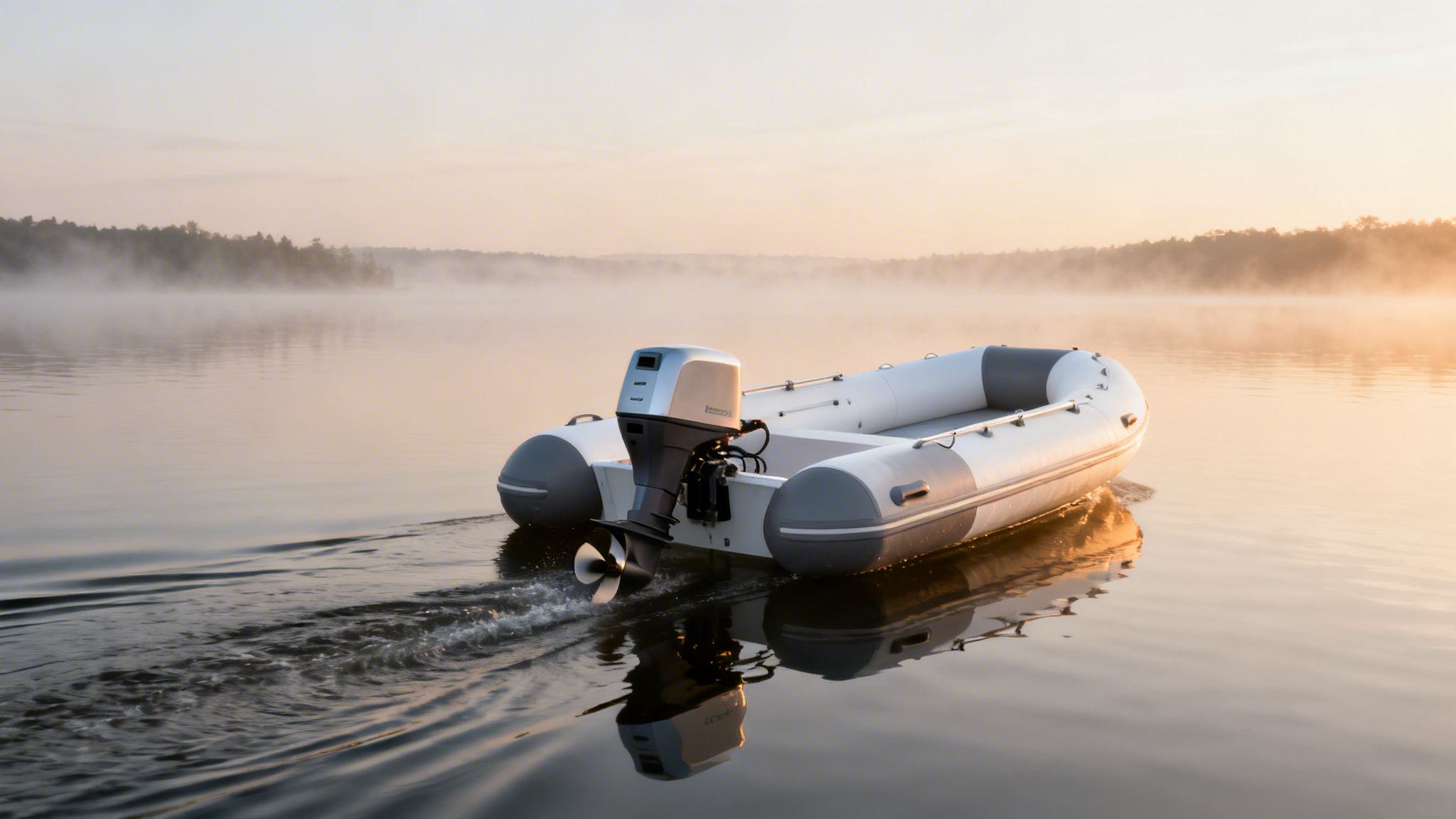
You sure can. Many of today’s inflatable kayaks and our Inflatable Catamarans are designed specifically with motorisation in mind. Our models feature properly reinforced transoms built to handle the weight and thrust of an outboard motor.
This is a massive advantage for covering more water, trolling for fish, or just getting back to the boat ramp quickly when the weather turns. It transforms your boat from a simple paddle craft into something far more versatile, opening up a whole new world of possibilities for your trips.
Ready to find the perfect inflatable boat for your next trip? Explore the full range of durable and versatile options at Easy Inflatables and get free, Australia-wide delivery. Find your adventure today.