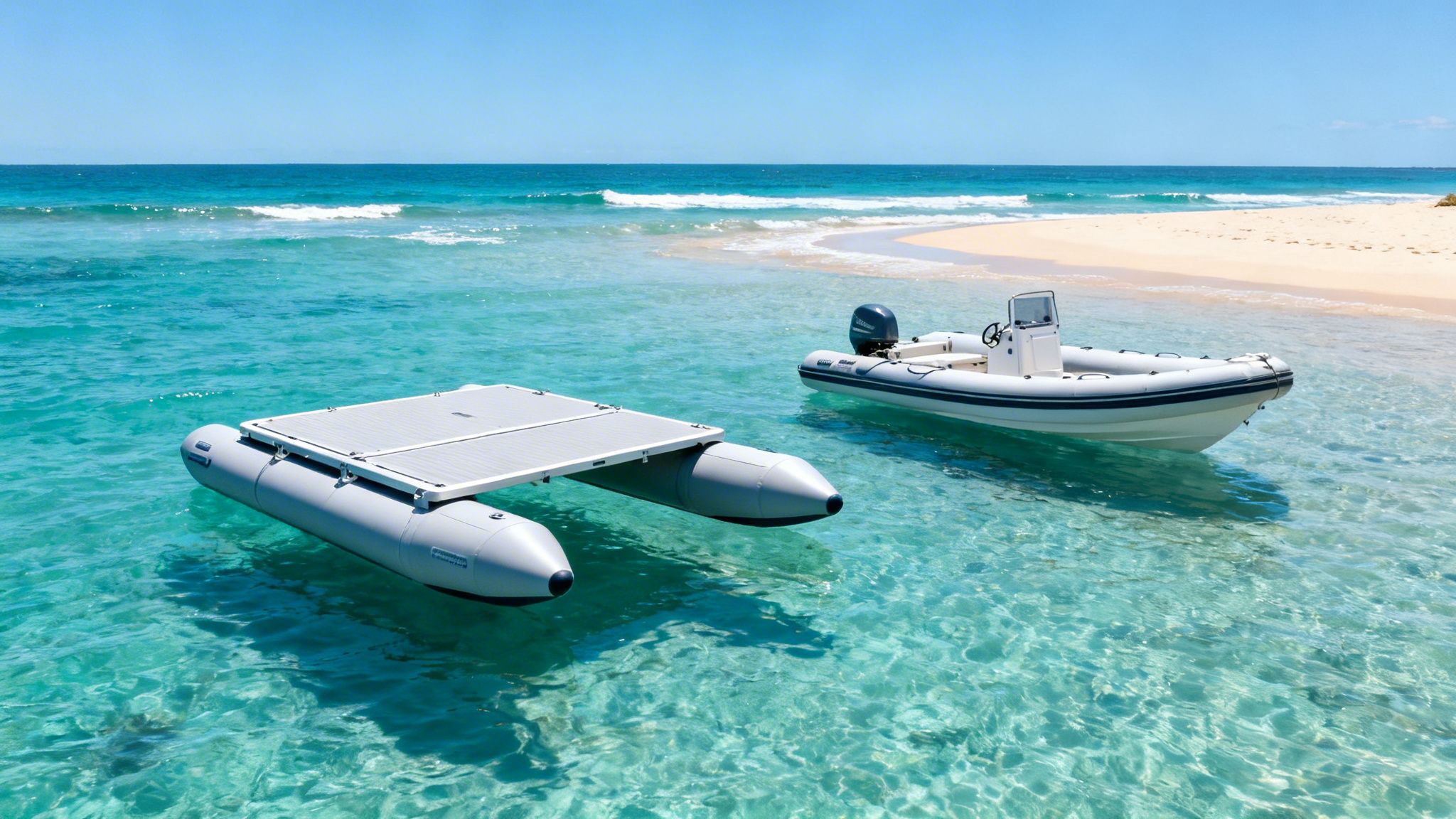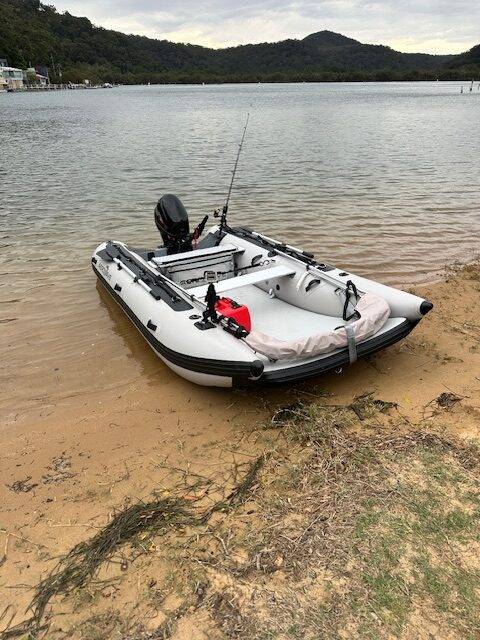
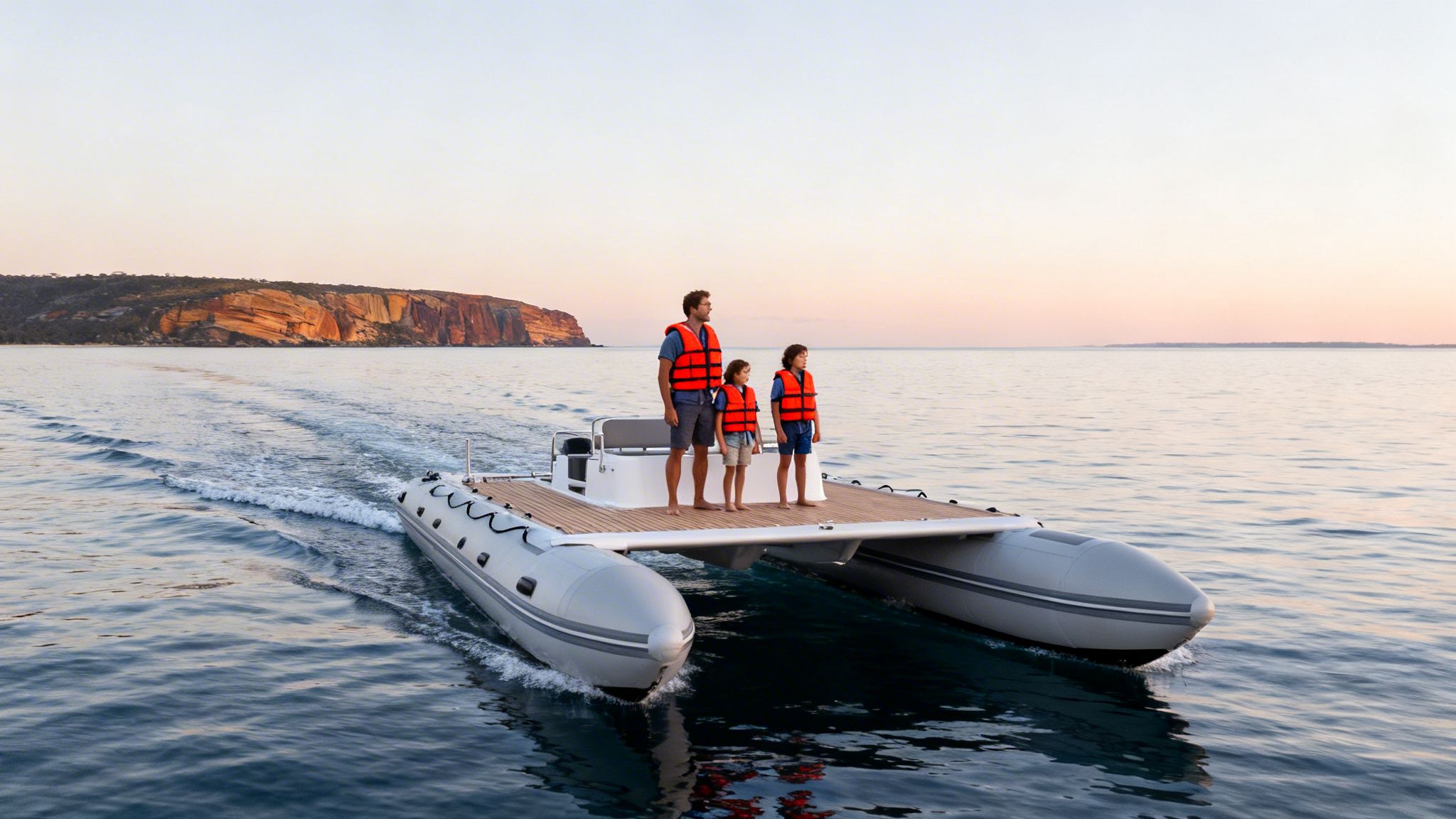

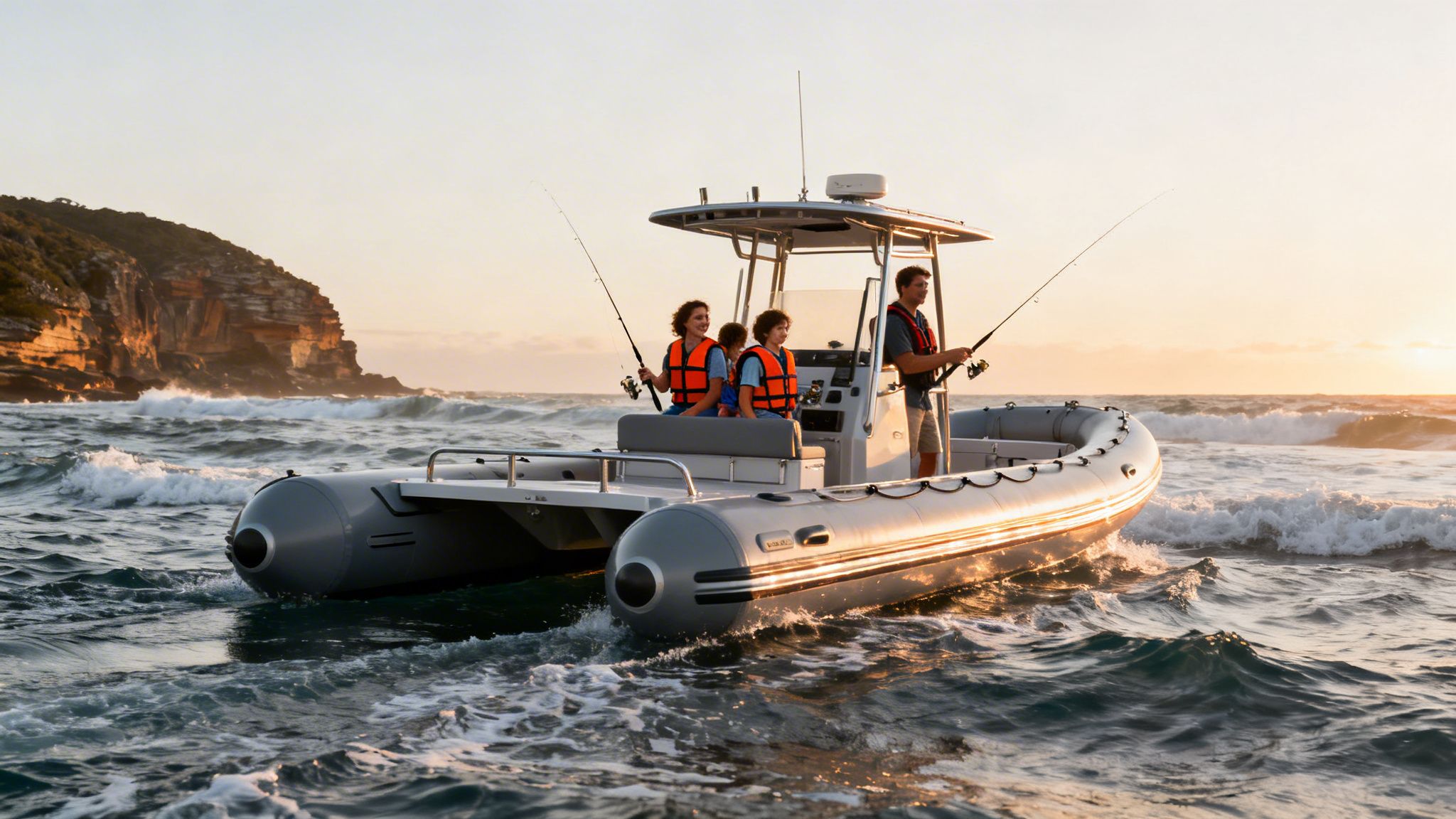
Are inflatable catamarans truly safe for offshore adventures in Australian waters? It's a question we hear a lot from people considering buying one of the best inflatable boats for recreational use available near me, and the answer is a definitive yes. In fact, their unique design is precisely what makes Inflatable Catamarans so capable out on the open water. These aren't the pool toys you might be picturing; they're impressively engineered boats built for families and serious adventurers alike.

The idea of taking any inflatable boat into open water understandably gives people pause. If you've got your family on board, you're rightly concerned about stability in waves, the boat's overall strength, and how it will handle itself when the wind picks up and the water gets choppy. These are all valid concerns that deserve a straight answer.
The truth is, a catamaran inflatable boat is built from the ground up to tackle these exact issues. Its safety isn't some happy accident—it’s a core feature born directly from its twin-hull architecture, making it a top contender when people compare prices and features of inflatable boats in their area.
When you imagine a safe boat, you probably picture something with a wide, stable base that doesn’t rock or tip easily. You also want a vessel made from tough, reliable materials that can handle real-world use. And, of course, you need a boat that gives you a smooth, predictable ride instead of slamming into every wave.
A modern inflatable catamaran delivers on all fronts. Its design methodically addresses the most common worries:
This innovative design is what makes an inflatable catamaran so well-suited to our varied and sometimes challenging Australian waters.
To put it all into perspective, here’s a quick summary of how the catamaran design directly addresses common safety concerns you might have when boating in Australia.
| Safety Concern | Catamaran Design Solution | Benefit for Australian Waters |
|---|---|---|
| Tipping & Instability | Twin hulls create an exceptionally wide and stable platform. | Provides confidence in coastal swells and choppy conditions, making it safer for families. |
| Rough, Uncomfortable Ride | The air tunnel between the hulls cushions the impact of waves, reducing "hull slap." | Delivers a smoother, drier ride, which is crucial for comfort on longer trips along the coast. |
| Durability & Punctures | Built with multiple air chambers and high-pressure, military-grade PVC or Hypalon fabric. | Ensures the boat remains buoyant and operational even in the rare event of a puncture. |
| Handling & Control | Less water resistance means the boat gets on a plane faster and handles more predictably. | Offers better fuel efficiency and easier manoeuvrability in tight spots or around reefs. |
As you can see, the features that make a catamaran look different are the very things that make it so safe, comfortable, and reliable.
The key takeaway is that the catamaran design inherently turns common boating anxieties into strengths. Its unique characteristics are what make it such a confident performer in Australian conditions.
If you're curious to see these principles in action, you can learn more about the Australian-designed Aerowave inflatable catamaran. Its design embodies everything we've talked about, creating a secure platform for everything from coastal fishing to family days out on the water. This innovative vessel might just be the perfect choice for your next adventure.

When it comes to offshore safety, one design feature stands above all others on a catamaran inflatable boat: its wide beam. This simply means the boat’s width, and it’s the secret to unlocking a level of stability that traditional monohull boats just can't match. For anyone who worries about tipping or excessive rocking in the waves, this wide beam benefit is your answer.
Think about standing on a moving bus. If your feet are close together, a sudden turn or bump will easily throw you off balance. But if you stand with your feet wide apart, you create a broader, more secure base that absorbs the movement. You’re instantly more stable.
A catamaran inflatable applies this exact same principle to the water. Instead of balancing on a single point like a V-hull boat, it rests on two widely spaced hulls. This creates a remarkably stable platform that fights back against rocking and rolling, even in the choppy conditions you'll find along the Australian coast.
The stability isn't just about being wide; it's about how that width provides superior load distribution. On a catamaran, everything from passengers and fishing gear to the outboard motor is spread across two distinct points of contact with the water.
This makes a huge difference to how the boat feels and performs:
This inherent stability is why an inflatable catamaran is such a hit for everything from serious angling trips to fun family days out. If you're comparing different types of boats, you'll quickly see how this design stands out.
The wide beam isn't just a feature; it's a fundamental safety system. By distributing weight and resisting roll, it creates a stable foundation that provides peace of mind in conditions where a monohull might feel unsteady.
This design is a perfect match for the Aussie boating lifestyle, which is growing bigger every year. The marine sector hit a massive $10.12 billion turnover in 2023-24, proving just how many of us are getting out on the water.
With 85% of Australia's 925,000 registered boats measuring under 6 metres, there's a huge demand for portable, capable vessels. An inflatable catamaran fits this need perfectly, offering the stability to handle choppy bays from Sydney Harbour to the waters off the Great Barrier Reef. For those looking to hire inflatable boats for a family outing in Australia, this stability is a key reason they are a preferred choice.
Whether you're fishing offshore from Perth or exploring the coastline near Melbourne, you know you'll run into unpredictable chop. The wide, stable platform of a catamaran inflatable boat means you spend less time bracing against the waves and more time enjoying the journey. It's simply a superior choice for real-world Australian conditions.
The word "inflatable" often brings to mind flimsy pool toys or party balloons—things that are anything but strong. It’s a common thought, but it couldn't be further from the truth when you're talking about a modern catamaran inflatable boat. These aren't your average blow-up toys; they're sophisticated marine craft built with surprising toughness.
The real key to their strength isn't just the material, but the pressure inside. Think about a car tyre. When it's flat, it’s just a floppy piece of rubber. But pump it up to the right pressure, and it suddenly becomes a rigid structure capable of supporting a multi-tonne vehicle at high speed. The air transforms it, giving it immense structural integrity.
That exact same principle applies to our high-pressure inflatable boats. By pumping air into the tubes and floor to a specific PSI (pounds per square inch), the entire vessel becomes incredibly stiff and robust. It goes from a foldable bundle of fabric into a solid, dependable platform that’s ready for the water.
PSI is simply the measurement of air pressure inside the boat's chambers, and this PSI pressure explanation is crucial for understanding the boat’s strength. For an inflatable boat, higher PSI directly translates to more rigidity. A low-pressure, poorly inflated boat will feel soft and sluggish, flexing uncomfortably in the waves and creating a real sense of instability. It's that "pool toy" feeling everyone wants to avoid.
In contrast, a high-quality catamaran inflatable boat is engineered to operate at much higher pressures.
This high-pressure system is what ensures the boat holds its shape and doesn't bend or warp when you're punching through chop. It gives you a solid foundation that feels just as secure as a traditional hard-hulled boat, putting to rest any fears about the vessel feeling flimsy or unsafe offshore.
When fully inflated, the combination of high-pressure tubes and a rigid air deck creates a unified structure. This system delivers the strength needed to cut through chop, support passengers and gear, and provide a stable platform for fishing or family fun.
Of course, all that pressure demands materials that can handle the stress. Premium inflatable boats are built from advanced fabrics that are a world away from simple plastics. They use multi-layered materials like heavy-duty 1.2mm PVC with a dense polyester core, giving them exceptional resistance to punctures, abrasions, and UV damage. You can get a deeper dive into how these fabrics stack up by reading our guide on the benefits of Hypalon vs German Mehler 1.2mm PVC material.
Just as important is how these materials are joined together. Instead of relying on glue, which can degrade over time with exposure to sun and salt, our top-tier boats use a technique called thermo-welding. This process uses heat to literally fuse the fabric panels together, creating a permanent, airtight bond that is actually stronger than the material itself.
This combination of high-pressure design, advanced fabrics, and robust construction results in a catamaran inflatable boat that is anything but fragile. It is specifically engineered to be tough, durable, and ready to handle the demanding conditions of Australian waterways, giving you complete peace of mind on your adventures.
The true test of any boat isn’t how it sits at the dock, but how it handles things when the water gets messy. For an inflatable catamaran, that twin-hull design is the secret ingredient for turning a bumpy ride into a smooth, dry, and comfortable day out, especially in the short, sharp chop we see all along the Aussie coast.
Unlike a standard V-hull boat that has to slice and push its way through every wave, an inflatable catamaran is built to glide right over the top. This is all thanks to the tunnel created between its two hulls. As the boat powers forward, this tunnel traps a cushion of air, which massively softens the impact when you meet oncoming waves.
That air-cushion effect is what gets rid of the jarring ‘slamming’ that can send shudders right through a traditional boat. It’s almost like having a built-in suspension system, giving everyone on board a much more enjoyable and less tiring trip. This superior safety in chop is a primary reason for their growing popularity.
It’s not just the air tunnel doing the work. The inflatable tubes themselves play a huge part in ride comfort. Even at high pressure, the PVC or Hypalon material is still pliable enough to act as a natural shock absorber, soaking up vibrations and softening every little bump. Think of it like swapping hard-soled dress shoes for a pair of cushioned runners—the impact is just so much less intense.
This one-two punch of air-cushioning and tube shock absorption gives you two massive wins, especially when you have the family on board:
This diagram shows exactly how we turn soft, flexible materials into a tough, rigid hull capable of this kind of performance.

It’s the combination of the fabric's strength and the high PSI that creates a solid, wave-taming platform ready for anything.
This amazing ride quality isn't just a luxury; it’s a massive practical advantage for so many iconic Aussie boating spots. Places like Melbourne's Port Phillip Bay, Sydney's Botany Bay, or Brisbane's Moreton Bay are all notorious for kicking up a short, steep, and unpredictable chop the second the wind gets up.
In those conditions, a normal monohull can get really uncomfortable, really fast. The constant slamming makes for a wet, miserable trip home. An inflatable catamaran, on the other hand, is right in its element. Its ability to skim across the top of that chop makes it a far more capable and enjoyable boat for these specific environments.
The twin-hull design effectively turns the ocean's messy surface chop into a much smaller problem. It gives you a stable, dry, and comfortable platform that inspires confidence, making it the perfect choice for family adventures all around Australia's coastline.
The growing number of these boats on the water proves just how well they suit our conditions. Australia is a nation of boaties, with 925,000 registered vessels and 75% of them being motorboats—perfect for powering these stable platforms. Sales of inflatables have jumped 15% over the past 24 months, fitting right into a national fleet where 85% of boats measure under 6m, the ideal size for our portable Aerowave models. You can read more about the rise of the inflatable catamaran boat and why it’s making such a splash in the local market.
Whether you're navigating the wind-whipped waves of a big bay or dealing with coastal swell, the design of a catamaran inflatable gives you a critical safety and comfort advantage. It's what makes it such a brilliant choice for families and adventurers who want to get out on the water with confidence, no matter what the day throws at them.
A boat’s specs on paper are one thing, but how does it really handle when the water gets choppy or you’re out with the family? This is where an inflatable catamaran’s smart design truly proves its worth. These real-world use cases demonstrate why so many Australians choose this type of vessel.
These aren't just hypotheticals. They’re the exact situations that show why so many fishos, families, and explorers are choosing these boats for their stability, safety, and go-anywhere spirit.
Imagine you’re out for a day of fishing off the NSW coast with the family. The kids are excited, everyone’s moving around, and you’re trying to land a fish. On a typical tinnie, every shift in weight means the boat rocks, and you're constantly telling everyone to sit still.
An inflatable catamaran completely changes the game. Its incredibly wide beam and twin-hull design create a super-stable platform, almost like a floating pontoon. The kids can stand up to reel in their catch, and you can walk from bow to stern to help out, all without the boat dipping and swaying.
This isn't just about comfort—it's a massive safety upgrade.
Now, picture yourself cruising the crystal-clear waters of the Whitsundays. It’s a paradise of stunning coral reefs and secluded beaches, but many of the best spots are in shallow water, off-limits to boats with deep hulls.
This is where the shallow draft of an inflatable catamaran is a huge advantage. While other boats have to anchor way offshore, you can glide right over shallow reefs and gently nose your bow onto the sand. The tough PVC or Hypalon tubes are built to handle it, giving you access that others only dream of.
The ability to explore shallow areas and land directly on remote beaches opens up a world of adventure that is simply out of reach for many other boat owners. It transforms your vessel from a simple boat into a true exploration tool.
This freedom lets you have a picnic on a deserted beach or snorkel in a quiet cove that no one else can get to. It’s what boating is all about.
It’s the situation every boater prepares for but hopes to avoid. The weather turns without warning. You're a few kilometres from the ramp when the wind picks up and the bay turns to whitecaps. In a small boat, this can be genuinely frightening.
An inflatable catamaran is built for this. As waves crash over the bow, the water doesn’t pool inside and swamp the boat. The self-bailing design, with its large scuppers or open transom, drains water out almost as fast as it comes in.
On top of that, the boat's incredible buoyancy is your ultimate safety net. With multiple independent air chambers, the boat stays afloat and stable even if it takes on a lot of water. The twin hulls also help it track straight and true in a following sea, cutting down the risk of broaching (turning dangerously sideways to a wave).
These features give you the confidence to navigate safely back to shore. Of course, being prepared is key, which is why we always recommend reviewing a complete boat safety equipment checklist before every trip.
As you can see, the safety of an inflatable catamaran isn’t just marketing talk. It’s proven where it counts—in calm waters, shallow coves, and even when the weather turns nasty. This is why it’s become such a trusted choice for so many Australian adventurers.
Even after seeing all the benefits, it's completely normal to have a few nagging "what-if" questions about safety. After all, when you're heading out on the water, peace of mind is everything.
Let's tackle the most common safety queries we hear from Aussie boaties head-on. These are the real-world concerns that matter, and by answering them directly, we can show you why an inflatable catamaran is one of the most secure and reliable boats you can choose.
This is the number one question we get, and it’s a smart one to ask. The short answer is: you’ll be perfectly fine. Premium inflatable catamarans are designed with multiple independent air chambers.
Think of it like the separate watertight sections in a big ship. If one chamber gets a hole and deflates, the others stay firm and fully inflated. This design guarantees the boat keeps more than enough buoyancy to hold you, your gear, and your family safely afloat while you head back to shore.
On top of that, the materials are incredibly tough. Our boats use military-grade 1.2mm PVC, which is highly resistant to punctures and scrapes. A catastrophic failure is extremely unlikely, and with a simple patch kit on board, you can make a quick repair on the water for total peace of mind.
Both an inflatable cat and a standard Rigid Inflatable Boat (RIB) are very safe, but they shine in different situations. A heavy RIB with a fibreglass V-hull is great for punching through huge, open-ocean swells at speed.
But for the conditions most of us enjoy in Australian bays, estuaries, and coastal waters, the inflatable catamaran’s stability is a massive advantage.
The most obvious difference is stability at rest. When you stop to fish, dive, or just relax, a catamaran’s wide stance dramatically reduces the side-to-side rocking that makes other boats feel tippy.
A RIB can feel unsteady when you’re not moving, but a catamaran feels more like a stable pontoon. They also tend to be lighter with a shallower draft, giving you the versatility to explore skinny water and beach your boat in spots a heavier RIB simply can’t reach.
Absolutely. In fact, many families choose inflatable catamarans specifically because of their outstanding safety features. That incredible stability we just talked about is the biggest reason.
The wide, almost-flat platform gives kids a secure space to move around without causing the boat to rock and roll like a traditional tinnie. It minimises the risk of anyone losing their footing. The soft, rounded tubes also act as a natural, cushioned barrier around the boat—far more forgiving than hard fibreglass or aluminium edges if someone takes a tumble.
Combine these brilliant design features with good boating sense—like checking the weather, wearing life jackets, and keeping your outboard maintained—and an inflatable catamaran is one of the safest and most enjoyable ways to get your family out on the water.
This always depends on the boat's size and, most importantly, the skipper's experience. But this is where the catamaran design truly separates itself from a standard monohull.
The tunnel between the twin hulls traps a cushion of air as you move, which softens the ride and gets rid of the jarring slams you feel in other boats. This also helps the boat track straight and true in a following sea, making it much less likely to broach (turn dangerously side-on to a wave).
As a general guide, a quality 3.5m to 4.5m model can safely handle winds up to 20 knots and waves of 1-1.5 metres. This covers the vast majority of conditions you’ll find on a great day of boating around the Australian coast. Always operate within the boat's limits, and more importantly, your own.
Ready to experience this unmatched stability and safety for yourself? Explore the full range of Australian-designed boats from Easy Inflatables. Discover custom-built packages perfect for fishing, family adventures, or as the ultimate yacht tender, and find out how easy it is to get on the water with confidence.