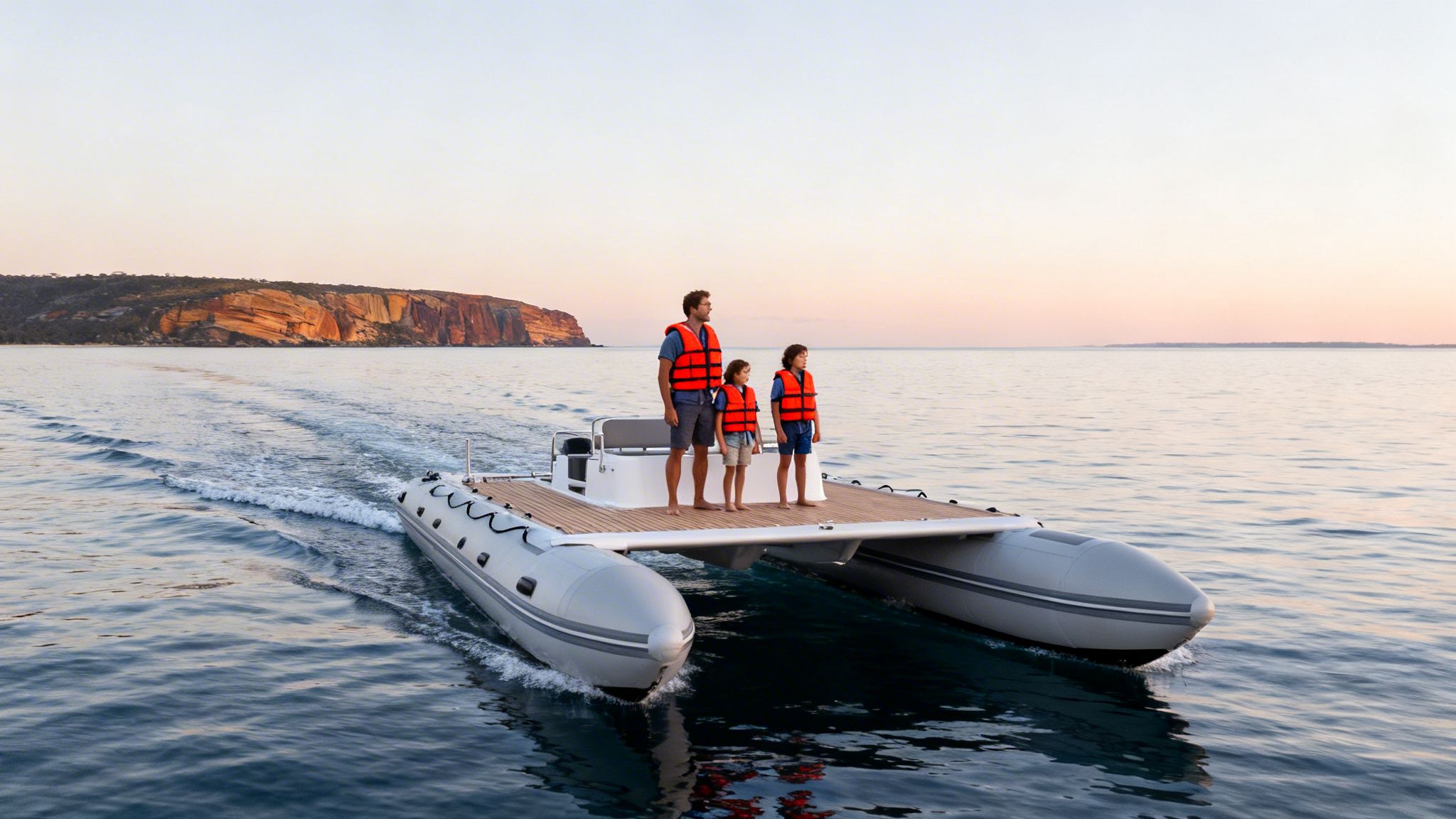

It's the first question on every boater's mind when they see a catamaran inflatable boat: is it really safe for open water? Especially here in Australia, where conditions can turn in a heartbeat, boaters rightly question stability, strength, and safety—particularly when family is on board.
The simple answer? Absolutely. A modern catamaran inflatable boat, also known as an inflatable catamaran, isn’t just safe for offshore use; its superior design makes it one of the best inflatable boats for recreational use in challenging conditions.
Let’s dive into how these boats address every common safety concern, giving you real-world confidence on the water.

When people picture an inflatable, they often think of a small dinghy getting tossed around in the surf. But an inflatable catamaran is a completely different beast, engineered specifically to tackle the common fears people have about heading offshore.
Here’s how an inflatable catamaran's design directly answers your concerns:
Objection: "It looks unstable. Will it tip over in rough seas?"
Answer: The twin-hull design and wide beam create a remarkably stable platform that dramatically reduces side-to-side rocking. It’s far more stable than a conventional V-hull boat.
Objection: "Can an 'inflatable' really be strong enough for waves and a powerful motor?"
Answer: Yes. Using commercial-grade materials and inflating the hulls and air deck to high PSI (pounds per square inch) pressure creates a rock-solid, rigid structure that doesn’t flex or twist.
Objection: "What happens in choppy water? Is it safe?"
Answer: The twin hulls are designed to slice through chop rather than bouncing over it. The tunnel between the hulls traps a cushion of air, softening the ride and keeping you dry and secure.
Objection: "Is it really a safe boat for my family and kids?"
Answer: The exceptional stability, even weight distribution, and spacious, flat deck make it an incredibly secure platform for family use. Kids can move around and re-board from the water without making the boat feel tippy.
Of course, true safety is always a partnership between a well-designed boat and a smart skipper. To back up your vessel's built-in features, you always need the right gear on board. You might want to check out our complete boat safety equipment checklist to make sure you’re set for every trip.
Ever been on a boat that rolls and pitches with every little wave? It’s an unsettling feeling, especially in the choppy seas common along the Australian coast. This is where a catamaran inflatable boat completely changes the game. Its legendary stability isn’t magic—it’s just brilliant design, starting with its two distinct hulls.
Think of it this way: a traditional monohull boat sits on the water like a balancing act on a single point. A catamaran, however, rests on two separate pontoons. This creates an incredibly wide and stable footprint, much like how a tripod is always steadier than a monopod. This fundamental difference is the secret to taming that unnerving side-to-side rocking motion.
The distance between the outer edges of a boat's hulls is called the "beam," and on a catamaran, this is where the magic happens. The exceptionally wide stance gives it what we call the “wide beam advantage,” allowing it to actively fight back against wave energy.
When a wave hits, instead of lifting one side and causing the whole boat to roll, the force is spread across both hulls. One hull might lift on the crest of a wave, but the other, sitting in the trough, acts as a powerful counterbalance. This drastically dampens the rolling motion, making the boat feel incredibly solid and planted, even when you’re just sitting still in a swell.

Here’s another huge win for the twin-hull design: its amazing ability to distribute weight. On a monohull, you have to be mindful of where people and gear are placed. Too much weight on one side can make the boat feel dangerously tippy.
An inflatable catamaran naturally spreads that load across its two massive, buoyant pontoons. This means you, your family, and all your fishing or beach gear are supported evenly across the entire platform. The result is a boat that stays balanced and predictable, whether you're cruising at speed or everyone is moving around at anchor. This is especially vital when you’ve got kids on board or are helping someone back into the boat after a swim.
To really see the difference, let’s put them head-to-head. Here’s how a twin-hull inflatable catamaran and a traditional V-hull inflatable perform in the kind of conditions you’d find offshore around Australia. The advantages of the cat design become crystal clear.
| Feature | Catamaran Inflatable Boat (Twin Hull) | Monohull Inflatable Boat (V-Hull) |
|---|---|---|
| Stability at Rest | Exceptional. The wide beam creates a solid platform, ideal for fishing or family activities. | Moderate. Prone to side-to-side rocking when weight shifts or in a swell. |
| Ride in Chop | Smooth and dry. Hulls slice through waves, and the air tunnel softens impacts. | Bouncy and wet. Tends to "slap" down on waves, creating a jarring ride and spray. |
| Turning | Stable and flat. The boat "banks" minimally, providing a secure feeling in turns. | Leans heavily into turns, which can feel unstable for inexperienced passengers. |
| Load Sensitivity | Low. Weight is distributed evenly, making it less sensitive to passenger movement. | High. Requires careful weight management to maintain balance and avoid feeling tippy. |
| Deck Space | Maximised. The rectangular shape between the hulls creates more usable, open deck area. | Limited. The V-shape narrows towards the bow, reducing functional space. |
At the end of the day, the physics behind the twin-hull design directly tackles the main safety and comfort worries of boating offshore. It delivers a stable, forgiving, and comfortable platform that inspires confidence, letting you and your crew focus on simply enjoying your time on the water.
When you hear “inflatable,” it’s easy to picture a flimsy pool toy that wouldn't stand a chance against a real wave. Let's get that image out of our heads for good. A modern catamaran inflatable boat is a different beast altogether. These are seriously robust vessels, engineered with advanced materials and smart construction that create a surprisingly rigid and durable platform.
A huge part of their strength comes from high-pressure inflation. We’re not just talking about pumping them full of air; we’re talking about pressurising the hulls and air deck to a specific PSI (pounds per square inch). When inflated correctly, the flexible fabric becomes as firm and solid as a traditional hard-hulled boat.
This clever design turns a boat that fits in your car boot into a rock-solid platform. You can stand, cast, and move around with total confidence, even when the water gets a bit choppy. The high pressure creates an unyielding structure that resists twisting, which is absolutely critical for safe, predictable handling offshore.
The real test of an inflatable boat's durability is how it stands up to Australia’s harsh sun and saltwater. Flimsy fabrics just won't cut it. That's why premium boats are built from heavy-duty, commercial-grade materials made specifically for the marine world.
We use materials like German-made Valmex® PVC. This isn't the kind of PVC you find in a hardware store; it's a specialised, multi-layered fabric famous for its toughness.
If you want to get into the nitty-gritty, you can find out more about the differences between high-grade PVC and other materials in our article on Hypalon vs German Mehler PVC.
What a boat is made from is only half the story; how it’s held together is just as important. In the past, glued seams were the norm, but adhesives are a notorious weak point. In a climate like Australia’s, the constant heat and humidity can cause glue to soften, break down, and eventually fail.
The superior method by a long shot is thermo-welding. This process uses heat to fuse the PVC panels together at a molecular level. It creates a seamless bond that is just as strong—if not stronger—than the material itself. Thermo-welded seams are bulletproof and require no maintenance, giving you total confidence in your boat's long-term structural integrity.
All the theory and design specs are great, but how does a catamaran inflatable boat really handle things when the wind kicks up and you're miles from the ramp? This is where clever engineering becomes real-world confidence on the water. Here are some real-world use cases every Aussie boater will recognise.

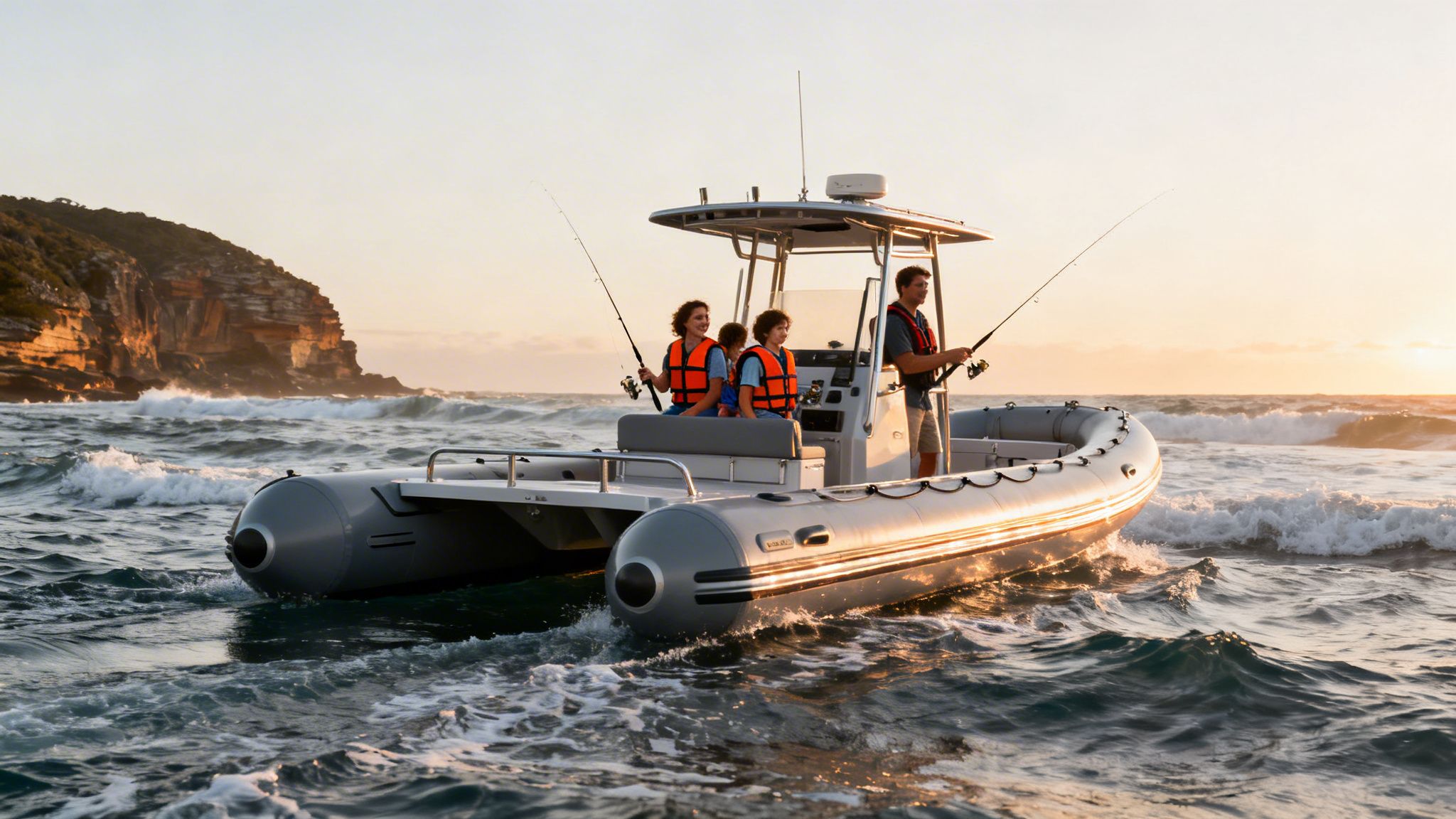
You’ve launched from a quiet beach, easily navigating the small shore break thanks to the boat’s stability. As you head offshore, a 15-knot sea breeze picks up, creating a classic Aussie chop. Instead of a bone-jarring, wet ride, your inflatable catamaran slices cleanly through the waves. The air tunnel cushions the impact, keeping the ride smooth and dry. At your fishing spot, the wide, stable platform allows you to stand, cast, and fight a big fish with complete confidence, without the boat rocking precariously.
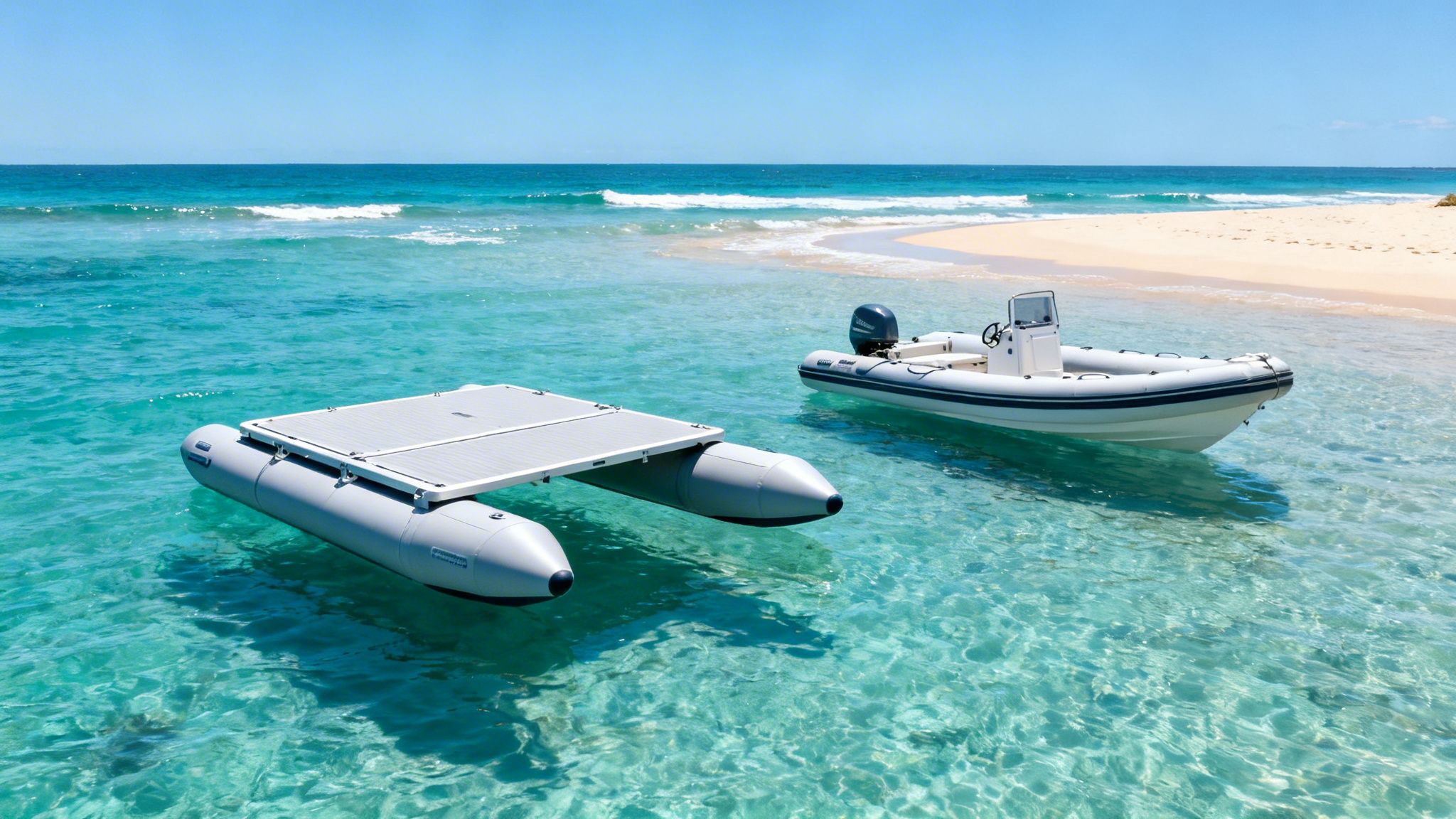
You're taking the family across the bay to a secluded island. The boat is loaded with an esky, beach gear, and excited kids. The spacious deck means no one feels cramped. You beach the boat right on the sand, and as the kids spend the afternoon jumping in and out of the water, the boat’s stability is a game-changer. The low-profile tubes and rock-solid platform make it incredibly easy for them to climb back aboard without the boat dangerously tilting—a common issue with monohulls. It’s the ideal platform if you’re looking to hire inflatable boats for a family outing in Australia.
Key benefits for family trips include:
If you’re trying to compare prices and features of inflatable boats in your area, or figure out which is right for your crew, have a look at our guide on the best inflatable boats Australia has to offer for a detailed comparison.
For yacht owners, a tender needs to be a reliable workhorse. When the wind picks up and your anchorage gets choppy, the stability of an inflatable catamaran ensures you can transfer guests and supplies between the yacht and the beach without drama. Its impressive load capacity means you can haul heavy gear like fuel cans, water jugs, and a week's worth of groceries in a single, stable trip.
A truly safe boat isn’t just about its hull design; it’s about a whole system of features working together. While the twin hulls give our catamarans incredible stability, the other safety elements we build in are just as crucial for giving you total confidence on the water.
One of the most important, but often overlooked, features is the use of multiple, independent air chambers. Think of it this way: a quality inflatable catamaran doesn’t just have two big pontoons. Each of those pontoons is divided into separate, airtight compartments.
This gives you massive peace of mind. If one chamber ever gets punctured—say, by a sharp reef or some floating debris—the other chambers stay fully inflated. The boat won’t sink. It stays afloat and surprisingly stable, giving you more than enough time and buoyancy to get back to shore safely.
At the end of the day, even the best-designed boat is only as safe as its skipper. Your knowledge, preparation, and decision-making are what turn a capable boat into an exceptionally safe one.
Before any trip, every good skipper runs through a mental checklist:
Ultimately, the combination of smart design—like multiple air chambers—and a diligent skipper creates the safest possible environment. The boat provides the platform, but you provide the judgement.
For offshore adventures, carrying a personal locator beacon is another vital safety measure. In a true emergency, it could be the most important piece of gear you have. You can learn more about the life-saving capabilities of an ACR Rescue Beacon in our detailed guide. By pairing a well-built inflatable catamaran with responsible seamanship, you can confidently and safely explore Australia’s stunning coastline.
It’s smart to look at a new boat from every angle before you commit. Even with all the benefits laid out, you’re bound to have a few final questions. Here, we tackle some of the most common things boaters ask when considering a catamaran inflatable boat for Australian waters.
This is a great question. Because they’re lightweight, they will feel the wind more than a heavy fibreglass boat. However, that’s where the catamaran design becomes your biggest advantage. The exceptional stability from the wide beam and twin hulls firmly resists the wind's push, keeping you on course.
In a strong crosswind, it really comes down to good seamanship. By maintaining consistent power and anticipating the gusts, you can easily manage any drift. The trick is to stay proactive, not reactive. Of course, checking the marine forecast is non-negotiable for any trip offshore, and you should always stay within your skill level and the boat’s limits.
With the right care, a premium catamaran inflatable boat made from high-quality, UV-resistant materials like German Valmex® PVC can easily last 10-15 years, and often much longer. The single biggest factor here is simple, regular maintenance.
To get the most out of your boat, just stick to these three golden rules:
Applying a marine-grade UV protectant spray a few times a year is the best insurance policy for your boat’s longevity. Think of it as sunscreen for your vessel—a simple step that’s critical for protecting the material against our harsh Aussie sun.
Absolutely. In fact, this is one of the biggest reasons people choose a catamaran inflatable boat. Most models are designed to be light enough for one or two people to carry easily when packed down in their bags.
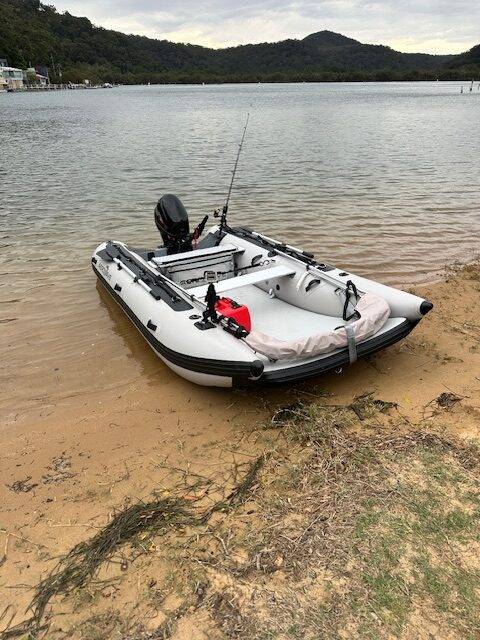
Once it’s inflated, a set of transom-mounted launch wheels makes solo missions a breeze. A single person can effortlessly roll the fully set-up boat across sand, grass, or gravel right to the water's edge. This completely frees you from the weekend chaos at crowded boat ramps and opens up countless launch spots that are impossible for heavier, trailer-bound boats to get to. Getting it out of the water is just as easy, making solo fishing trips a genuinely practical and enjoyable reality.
Thermo-welded seams are hands-down the superior choice for Australian conditions, and the reason is simple: they are virtually maintenance-free. The thermo-welding process uses intense heat to molecularly fuse the PVC panels together, creating a single, unbroken piece of material. This bond is just as strong as the fabric itself, if not stronger.
Glued seams, on the other hand, are a ticking clock. They rely on an adhesive that will inevitably break down in Australia's climate of intense heat, humidity, and constant UV exposure. The glue softens, weakens, and eventually fails, leading to ongoing headaches and costly repairs.
Choosing a boat with thermo-welded seams gives you complete peace of mind. It’s the gold standard for long-term, hassle-free durability, ensuring your inflatable catamaran is a reliable vessel you can trust, trip after trip.
Ready to experience the stability, portability, and safety of a next-generation inflatable boat? Explore the full range of customisable options and adventure-ready packages at Easy Inflatables and discover why more Aussie boaters are choosing the catamaran advantage. Find your perfect setup today at https://easyinflatables.com.au.