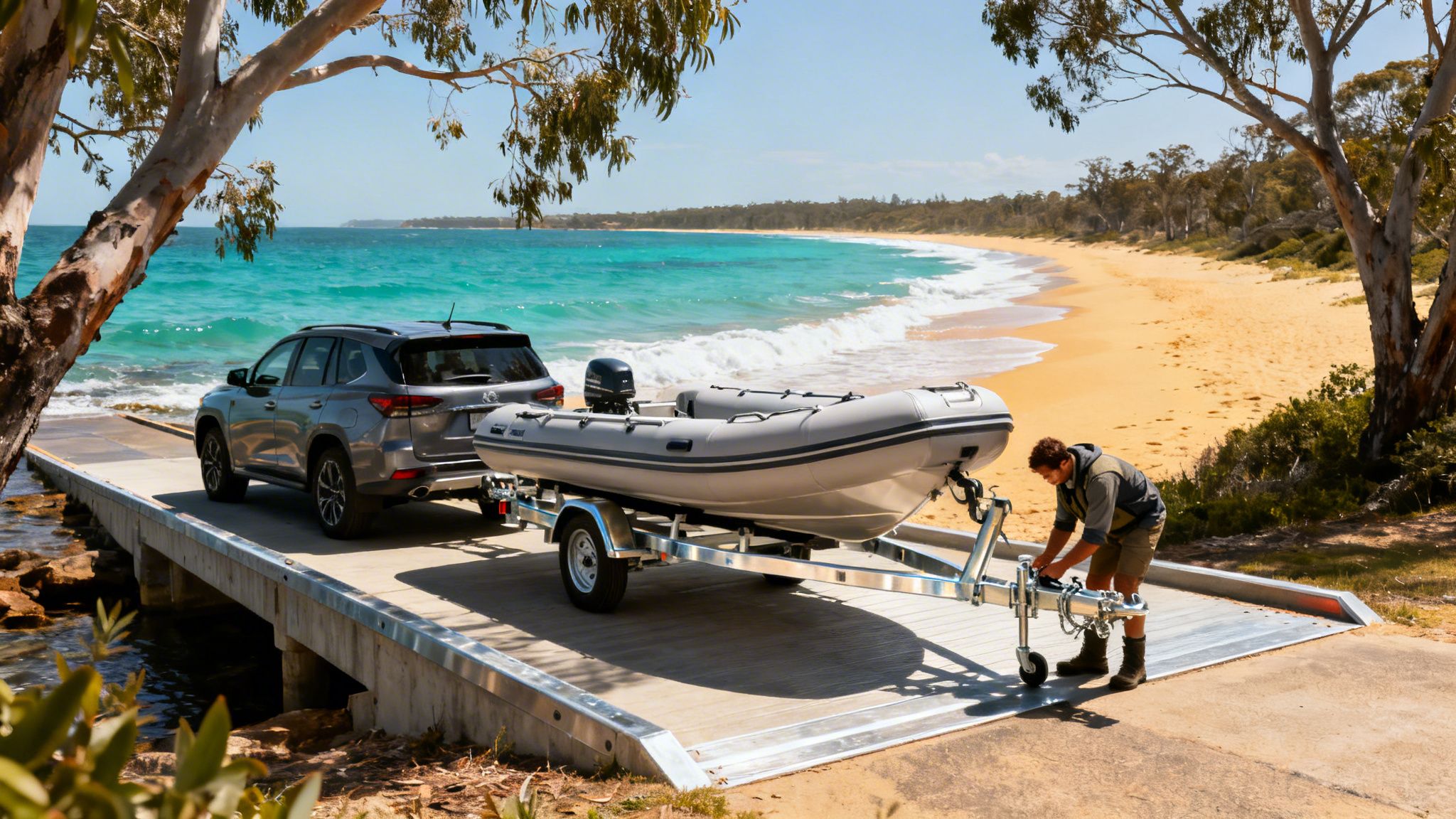
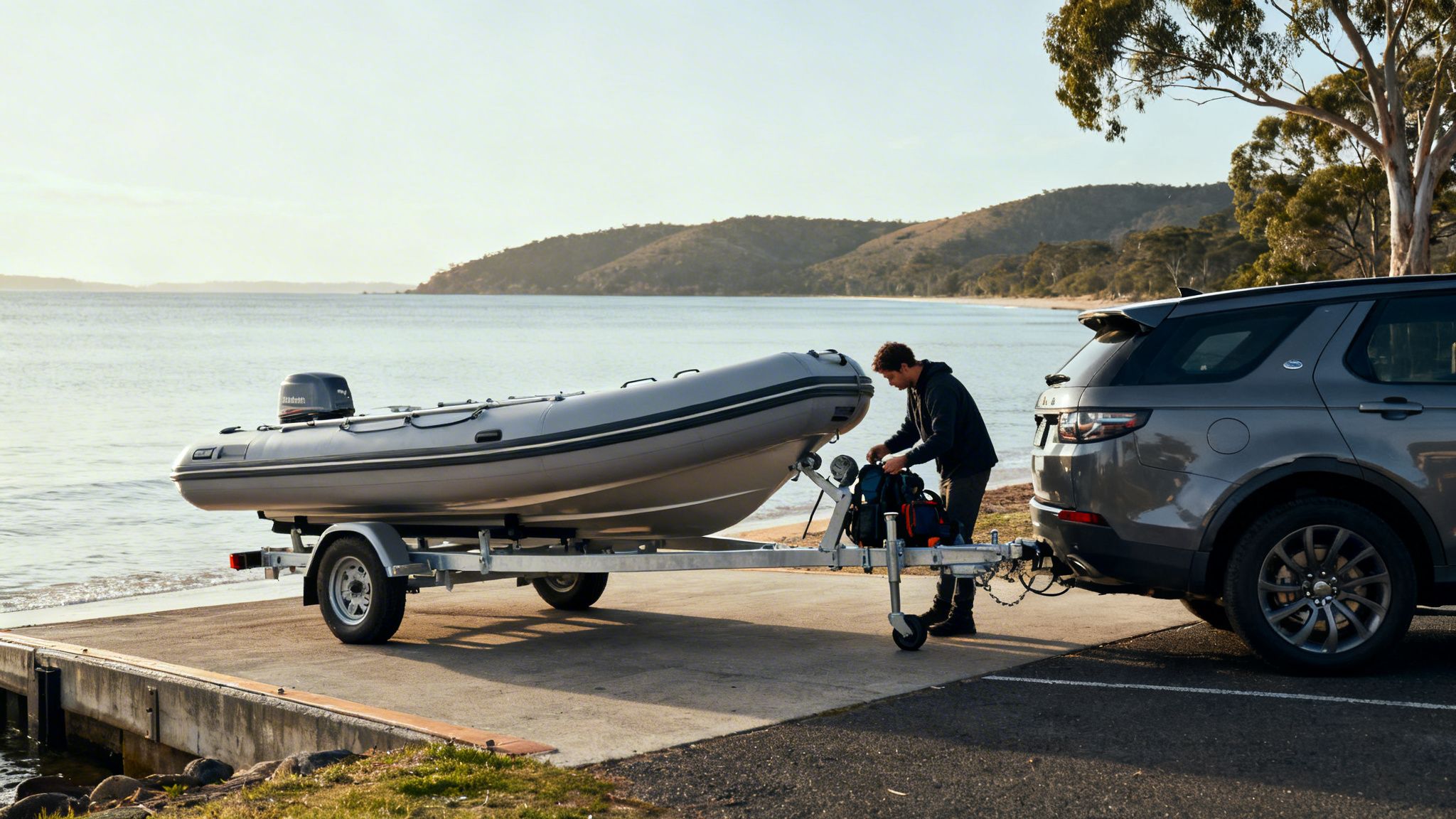

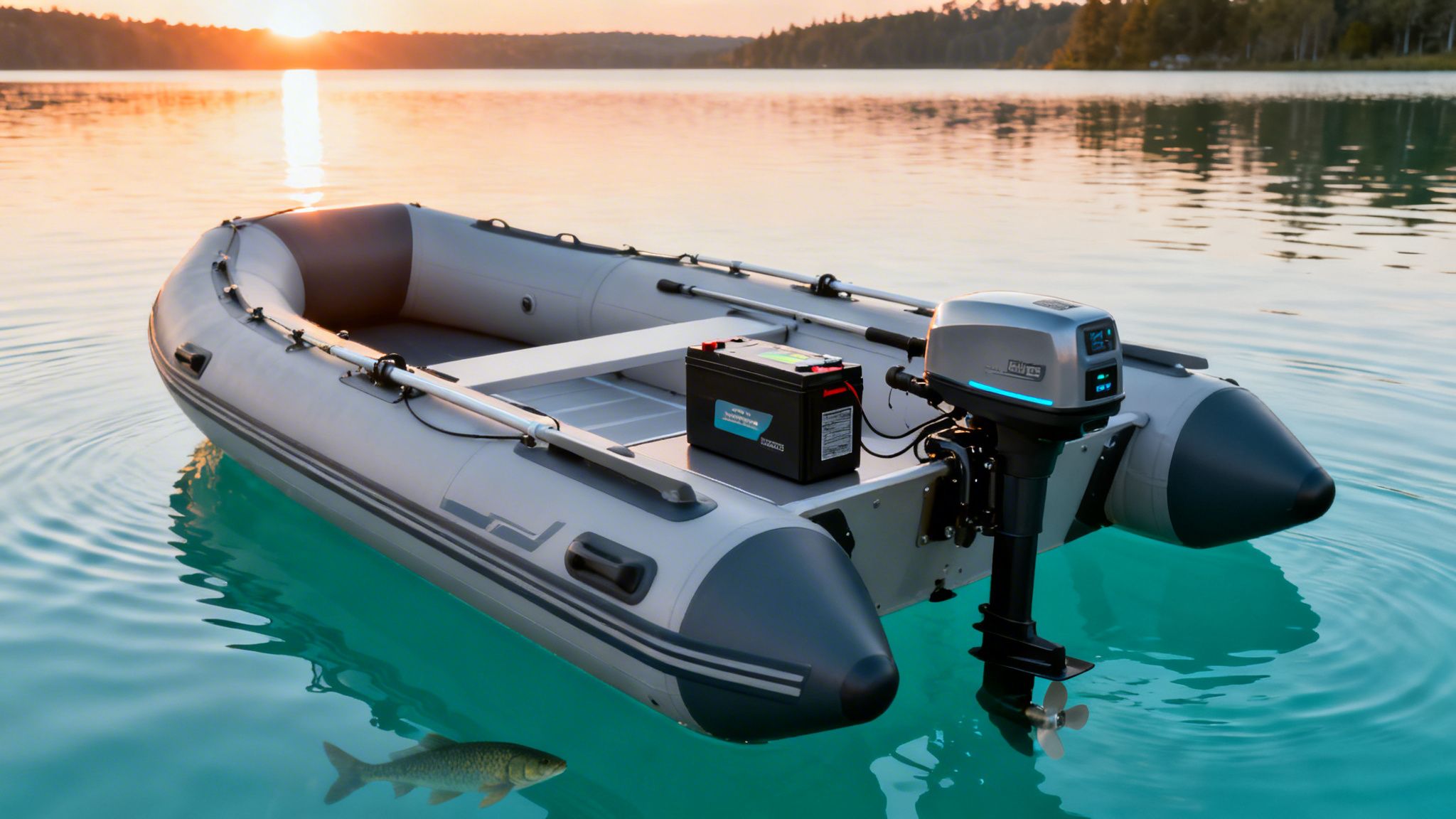
Pairing an electric motor with an inflatable boat is one of the smartest moves you can make for your days on the water. It’s a simple upgrade that delivers a quiet, clean, and hassle-free experience, turning a standard boating trip into something truly special. This isn’t just about a new motor; it’s about a better way to boat.
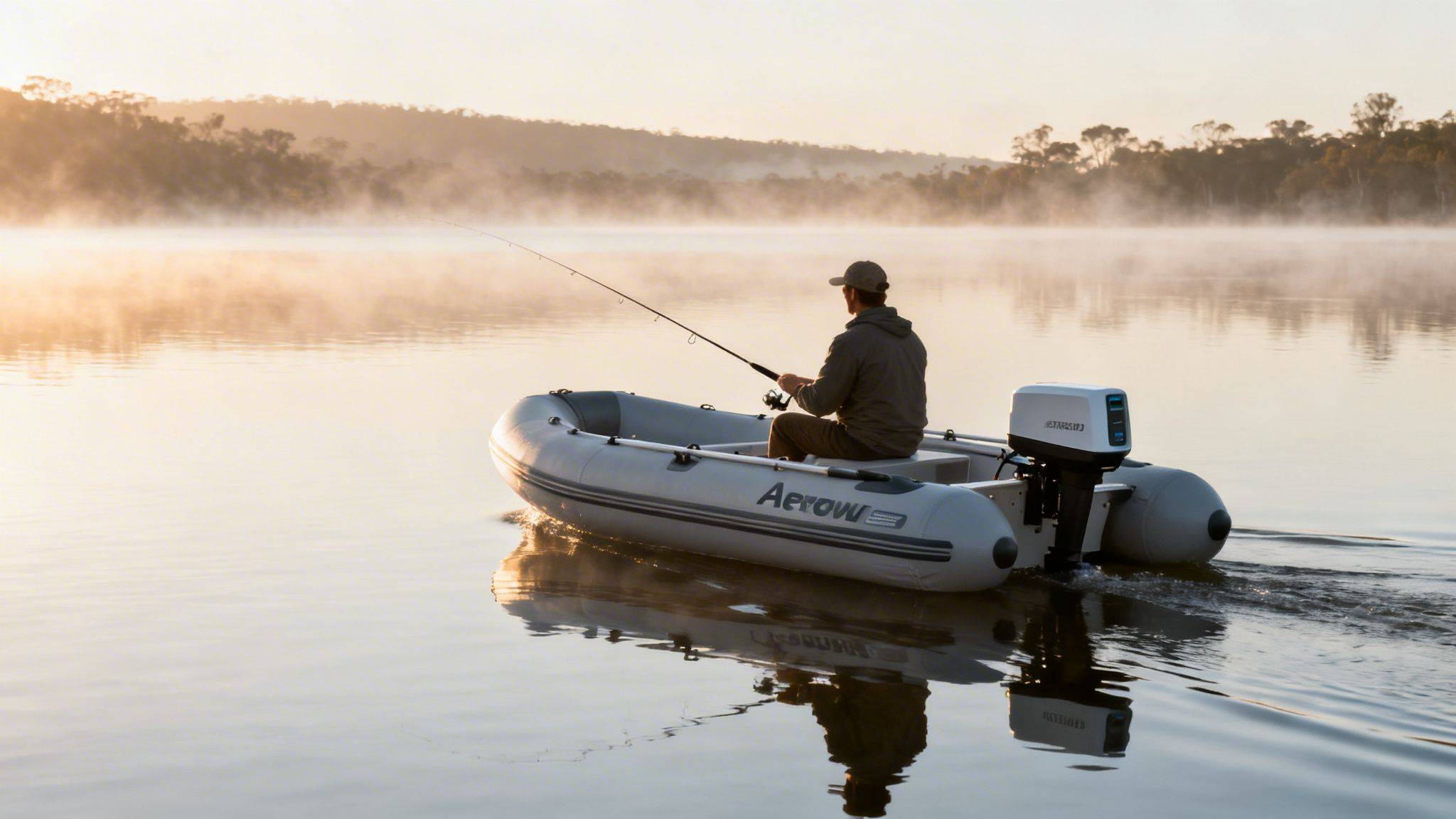
Picture yourself gliding across a glassy lake or exploring a quiet inlet, with the only sound being the gentle lap of water against your boat. That’s the reality thousands of Australian boaters are now enjoying after switching to an electric motor for an inflatable boat. It’s a trend that’s picking up serious momentum, and for good reason.
In fact, electric outboards are making a huge splash in the inflatable boating scene here in Australia. Sales shot up by 45% in 2023 alone, as more of the nation’s 5 million annual recreational boaters opted for a greener, quieter alternative. With global forecasts showing an 8.5% CAGR through 2033 thanks to growing environmental awareness, it’s clear this shift is here for the long haul.
The benefits of going electric go far beyond just a quiet ride. For anglers, the near-silent operation gives you a “stealth mode,” letting you sneak up on prime fishing spots without spooking the catch. For families and nature lovers, it means you can enjoy the serenity of the outdoors without the smell and racket of a petrol engine. If you’re looking for the best inflatable boats for recreational use available near you, pairing one with an electric motor is the ultimate setup for a peaceful family outing.
This change brings a whole host of practical wins:
By matching the right motor to your boat—from thrust to shaft length—you set yourself up for completely hassle-free adventures. The whole point is to spend more time enjoying the water, not wrestling with your gear.
Pairing an inflatable catamaran with a modern electric motor, for example, creates a setup that is incredibly stable, efficient, and a joy to use. These inflatable catamarans are one of the smartest choices for recreational boaters looking to modernise their gear without the complexity or high cost.
If you want to dive deeper into the specifics, our guide on electric outboard motors in Australia has all the details. It’s time to experience boating in its purest form.
Let’s get past the technical specs for a moment and talk about what an electric motor actually feels like on the water. Choosing an electric motor for your inflatable boat isn’t just a practical decision; it completely changes the way you experience your day out.
The first thing that hits you is the sound—or rather, the lack of it. Petrol motors are noisy, smelly, and can completely shatter the peace of a beautiful Aussie waterway. An electric motor swaps that constant drone for a quiet hum, meaning you can actually talk to the person next to you without shouting, hear the bird calls, and just soak in the serenity.
For anyone who loves fishing, this quiet performance is a massive win. It’s a genuine ‘stealth advantage,’ letting you glide right into your favourite fishing spots without sending every fish for a hundred metres scattering. Imagine silently creeping up on a school of bream or flathead that a roaring two-stroke would have scared off long ago. This is how you get an edge.
It’s not just about fishing, either. This near-silence opens up whole new territories. Many of Australia’s most pristine and sensitive places—from inland rivers to protected marine parks—have tough restrictions on petrol motors. For those seeking to hire inflatable boats for a family outing in Australia, choosing an electric option often grants access to these exclusive, beautiful locations.
An eco-friendly electric motor is often your golden ticket into these zones, giving you access to secluded beaches and hidden gems that boaties with petrol engines can only look at from a distance.
The practical benefits of going electric are just as good. You can forget about the messy and time-consuming jobs that come with petrol engines. With an electric motor, getting ready to launch is almost laughably simple.
This blend of convenience and portability is a perfect fit for the way Aussies are boating today. Inflatable boat sales have surged by 15% in the last two years, reflecting a huge shift towards easier, more accessible setups. With 85% of all boats in the country being under 6 metres long, it’s clear that compact, user-friendly packages are what families and anglers are looking for. You can read more on these boating industry trends in Australia.
Jumping into the world of electric motors can feel like learning a new language. You’ll hear “thrust” instead of “horsepower,” but don’t let the new term intimidate you. Think of thrust as the raw muscle of your electric motor for inflatable boat.
Getting this right is one of the most important decisions you’ll make. It’s the key to a great day on the water, ensuring you have enough grunt to get where you’re going without wasting money on a motor that’s overkill for your boat.
One of the most common mistakes we see is people under-powering their inflatable. A motor that’s too weak will struggle against a headwind, fail to get you planing, or worse, won’t have the guts to get you home safely if the weather turns nasty. It’s just not worth the risk.
To avoid this, here’s a reliable rule of thumb we’ve used for years: make sure you have at least 2 lbs of thrust for every 45 kg (roughly 100 lbs) of your boat’s total loaded weight.
Don’t forget, “total loaded weight” isn’t just the boat. It’s absolutely everything you plan to carry on board:
So, if your boat, passengers, and gear all add up to 450 kg (about 1,000 lbs), you’d want a motor with at least 40 lbs of thrust. This simple calculation gives you a solid starting point for calm conditions on a lake or quiet river.
This simple guide helps you match your inflatable’s size and weight to the right amount of electric motor thrust. Remember, it’s always better to have a little more power in reserve than not enough when you need it.
| Boat Length (m) | Fully Loaded Weight (kg) | Recommended Thrust (lbs) | Typical Use Case |
|---|---|---|---|
| 2.0 – 2.7 | Up to 250 kg | 30 – 40 lbs | Solo fishing in calm creeks, tender to a larger boat |
| 2.7 – 3.3 | Up to 450 kg | 40 – 55 lbs | Cruising with a partner, exploring rivers and bays |
| 3.3 – 4.0 | Up to 650 kg | 55 – 80 lbs | Family fun, carrying more gear, light coastal use |
| 4.0+ | 650 kg + | 80+ lbs | Serious fishing, handling currents and choppy water |
This table is a great starting point, but always think about where you’ll be boating. Your needs will be very different on a calm estuary compared to open coastal waters.
Having that extra power ensures your inflatable performs at its best, especially in a stable boat like an inflatable catamaran that can handle more varied conditions.
If you’re coming from the world of petrol outboards, it really helps to understand how horsepower (HP) stacks up against electric power. There isn’t a perfect 1-to-1 conversion because they deliver power differently, but this is a great general guide to bridge the gap.
This translation is so important. It shows you that a modern 3 HP electric motor, for example, delivers performance that feels very similar to a 3 HP petrol motor but with all the incredible benefits of going electric—the silence, the instant response, and no smelly fumes. Understanding this allows you to confidently choose an electric motor for inflatable boat setups without any fear of being underpowered.
Choosing the right thrust isn’t just about speed; it’s about control and safety. Having enough power on reserve means you can navigate confidently through choppy water, hold your position against a current while fishing, or power through an unexpected afternoon breeze.
This infographic breaks down how your main reason for getting on the water can point you to the right choice, highlighting the core strengths of electric power.
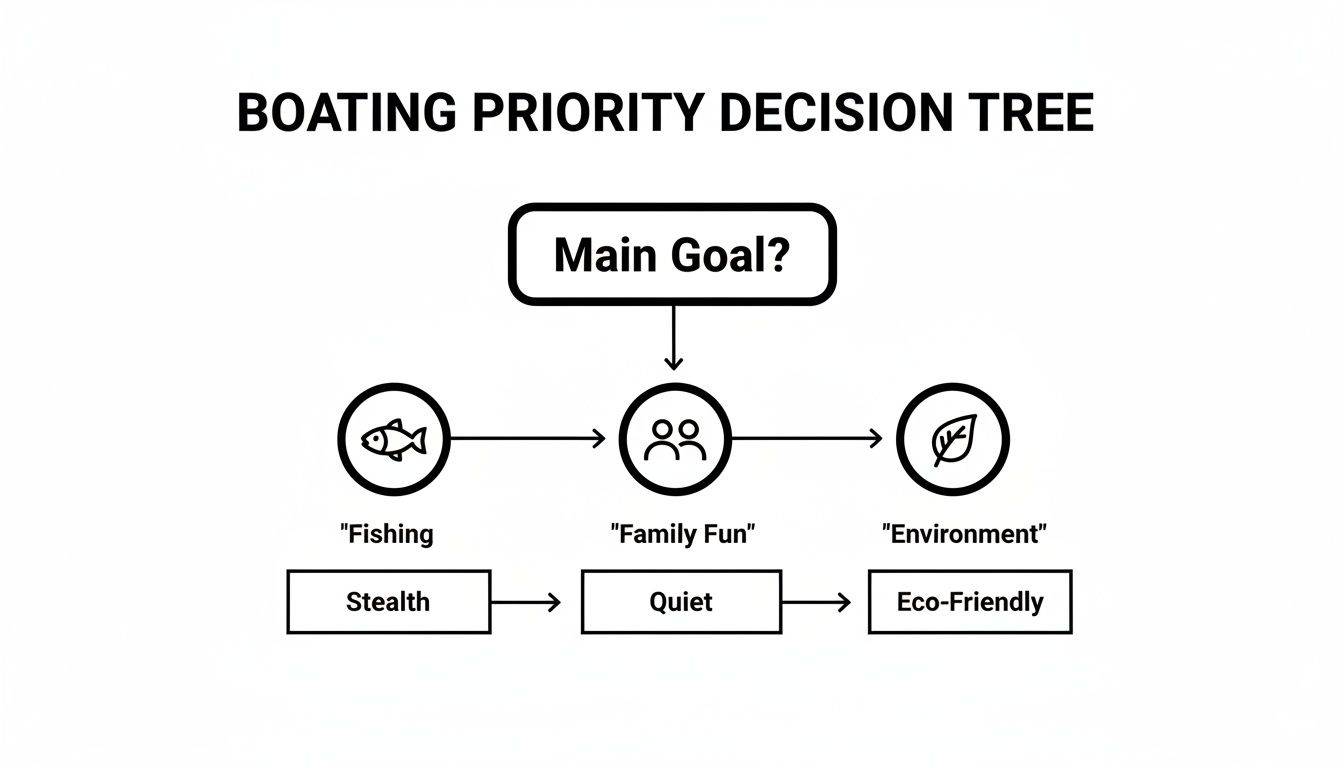
As you can see, the decision becomes much clearer when you connect your passion—be it stealthy fishing or quiet family outings—to the specific advantages an electric motor provides.
By weighing up your boat’s total load and where you’ll be exploring, you can pick an electric motor that gives you reliable performance every single time. For a closer look at specific boat and motor packages we recommend, you can explore our full range of inflatable boats and motors to find the perfect setup for your adventures.
When you’re looking to compare prices and features of inflatable boats in your area, it’s easy to get caught up in the idea that a bigger price tag means better quality. This often leads people to automatically look at premium brands, assuming they’re the only way to get real performance from an electric motor for an inflatable boat. But do you really need to spend top dollar for a reliable motor that will do the job?
Let’s talk about what really matters: getting the best bang for your buck. The truth is, you don’t always need the flashiest, most expensive gear to have a brilliant time exploring Australia’s waterways. We’re going to put a popular, high-value powerhouse, the Haswing Ultima 3.0, head-to-head with its pricier competitors to see where your money is best spent. The Haswing is cheaper, but is the quality there? Let’s find out.
The Haswing Ultima 3.0 is a 3 HP equivalent electric outboard that packs a serious punch, generating an impressive 110 lbs of thrust. That’s a huge amount of power for an inflatable, putting it right alongside models that cost significantly more. This kind of thrust is more than enough to push a fully loaded 3.6m inflatable catamaran or a larger inflatable boat against a stiff wind and current, making it a seriously capable choice for Aussie conditions.
What makes this possible? A high-efficiency, brushless DC motor and a design focused on quality where it counts. Unlike older brushed motors that waste energy through friction and heat, a brushless design sends more of the battery’s power straight to the propeller. This translates into stronger propulsion and a longer runtime from every charge—a critical factor for any boater.
The real takeaway here is that the Haswing Ultima 3.0 delivers all the power you need for recreational boating. It’s perfect for everything from small inflatable tenders to larger inflatable catamarans, without the premium brand markup. It’s simply the smart choice for boaters who value practical performance and proven quality.
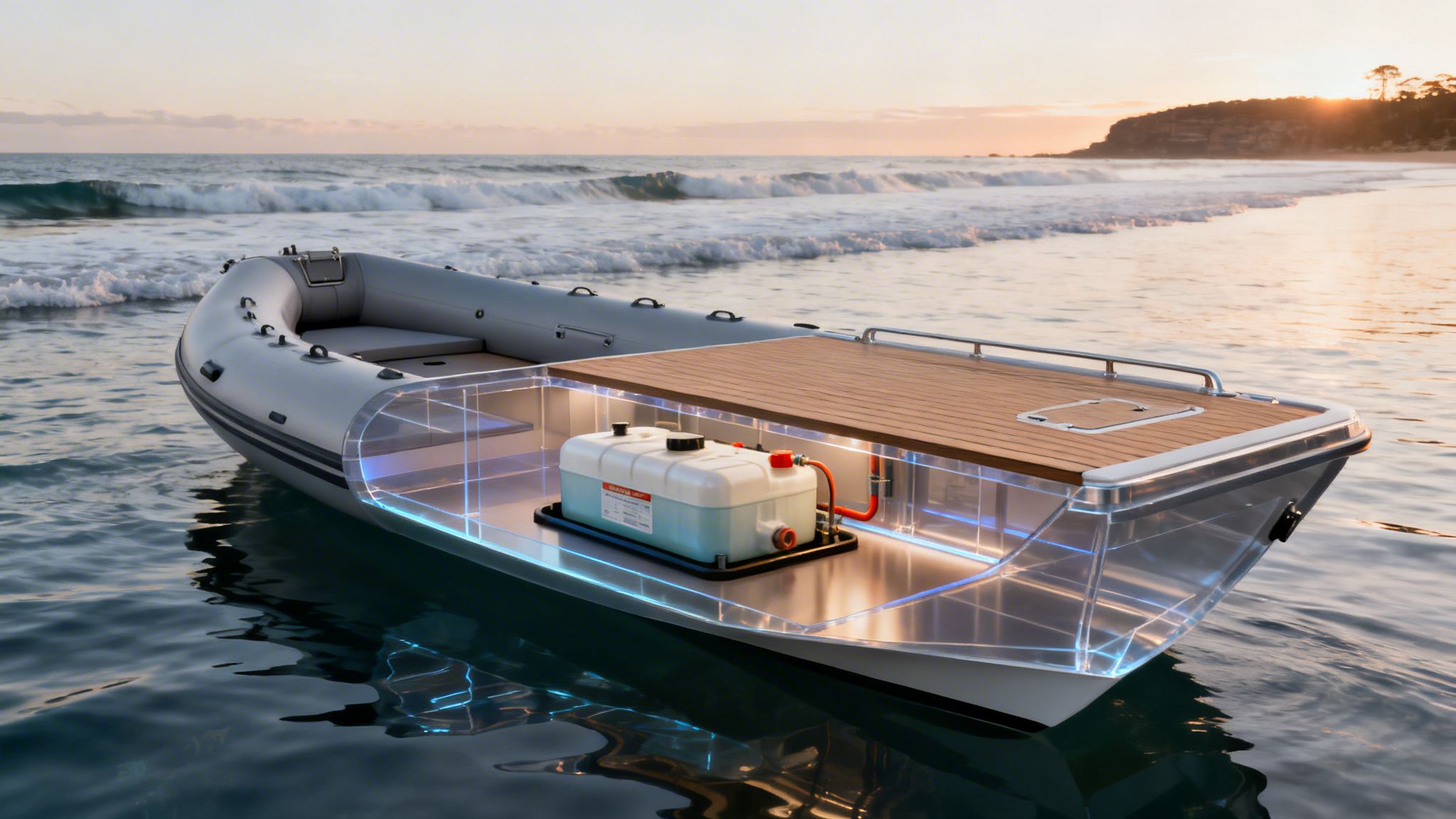
One of the best features of the Haswing Ultima 3.0 is its integrated 29.6V 30Ah rechargeable lithium-ion battery. For inflatable boat owners who value simplicity and portability, this all-in-one design is an absolute game-changer. You no longer have to worry about buying a separate, heavy battery and then trying to find a safe spot for it on your boat.
Here are the real-world advantages:
This integrated system is where the Ultima 3.0 truly shines, especially when compared to competitors who sell their motors and batteries separately, often pushing the total cost to more than double that of the Haswing. For anyone wanting a closer look, you can check out all the specs on the Haswing Ultima 3HP electric outboard right here in Australia.
Power is one thing, but how long will it keep you out on the water? The Haswing Ultima 3.0’s integrated battery offers a surprisingly long runtime. At a slow trolling speed, you can expect up to 9 hours of use. Even when you open it up to half throttle, it delivers around 3 hours of continuous operation—plenty for a great day exploring a bay or fishing your favourite spots.
While the Haswing Ultima 3.0 offers fantastic value, it’s fair to see how it stacks up against premium electric boat motors from brands like Epropulsion, which often add extra bells and whistles for a higher-end market. However, the Ultima 3.0 comes packed with all the essential modern features you’d expect from a quality electric outboard.
Essential Feature Comparison
| Feature | Haswing Ultima 3.0 | Premium Competitors |
|---|---|---|
| Price | Highly competitive | Often 2x-3x higher |
| Motor Type | High-Efficiency Brushless | High-Efficiency Brushless |
| Battery | Integrated Lithium-Ion | Often sold separately |
| Throttle Control | Variable Speed (Forward/Reverse) | Variable Speed (Forward/Reverse) |
| Display | Digital Battery Level Indicator | Often includes GPS, range, etc. |
The variable speed control on the Ultima 3.0 is another brilliant feature. It lets you dial in your exact speed with a simple twist of the tiller, giving you precise control whether you’re trolling for fish or coming in to dock. This is a massive improvement over older motors with fixed speed settings that lock you into “too fast” or “too slow.”
Ultimately, when you look at the complete package—power, integrated battery, and essential features—the Haswing Ultima 3.0 makes an incredibly strong case for itself. It delivers the performance and quality that the vast majority of inflatable boat owners need, making it a smarter, more cost-effective investment that will do the job reliably.
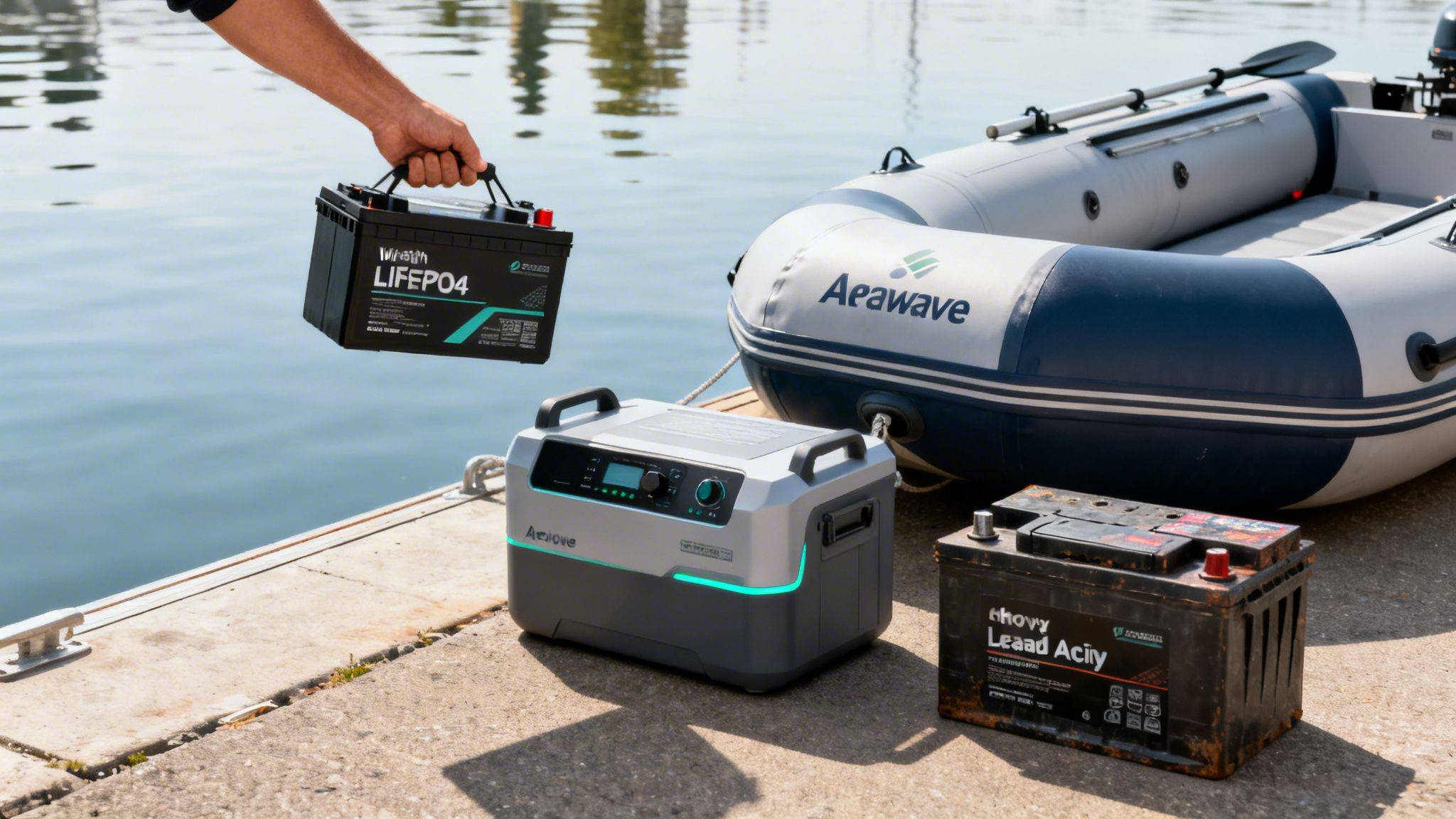
Your electric motor for an inflatable boat is only as reliable as its power source. Think of the battery as its fuel tank. Picking the right one is the difference between a full day of adventure and being forced to head back to shore early.
It’s the single most important choice you’ll make for your electric setup. The old world of boating was full of heavy, cumbersome deep-cycle lead-acid batteries. They worked, but they were far from perfect, especially for inflatable boats where every kilo counts. Thankfully, modern tech has delivered a much better way forward.
The biggest leap forward has been the arrival of Lithium Iron Phosphate (LiFePO4) batteries. For an inflatable boat owner, they are a total game-changer. They are the sleek, high-performance fuel tank compared to the clunky, old-school jerry can.
When space and weight are your biggest considerations, the benefits are impossible to ignore.
Yes, the initial cost is higher. But when you factor in the superior performance, easy portability, and incredible lifespan, a LiFePO4 battery is easily the smarter, more cost-effective choice for powering any electric motor for inflatable boat adventures.
“How far can I actually go?” It’s the number one question we hear, and the answer comes down to two key things: your battery’s capacity (measured in Amp-hours or Ah) and your motor’s power draw at different speeds.
Think of Amp-hours as the size of your fuel tank. A 100Ah battery holds double the energy of a 50Ah battery. The motor’s power draw, measured in Amps, is your fuel consumption. Idling along at a slow troll might only draw 10 Amps, but going flat out could pull 50 Amps or more.
To get a rough idea of your runtime, just divide the battery’s Amp-hour rating by the motor’s Amp draw. For example, a 100Ah battery powering a motor that draws 20 Amps at a nice cruising speed will last about 5 hours (100Ah / 20A = 5 hours).
Of course, this is just an estimate. Real-world factors like wind, currents, and the total weight in your boat will always play a part. That’s why we always recommend the classic ⅓ rule: use one-third of your battery to get out, one-third to get back, and keep one-third in reserve just in case. For a complete rundown on power setups, have a look at our guide to the perfect marine battery and charger for your boat.
Keeping your battery juiced up is easier than ever with today’s flexible charging options. Whether you’re at home, on the road, or out in the bush, there’s a solution to fit your needs.
Common Charging Methods:
Proper care is also key to getting the most out of your investment. The same core principles apply to safely storing lithium batteries, which is essential knowledge for anyone with an electric setup. By building a reliable power system, you’ll ensure your electric motor for inflatable boat is always ready when you are.
You’ve picked out the perfect electric motor for inflatable boat adventures, so now it’s time to get it set up and ready to hit the water. Getting the installation right and knowing the local rules are just as important as choosing the right amount of thrust. This is your no-fuss guide to getting set up correctly so you can boat with total confidence.
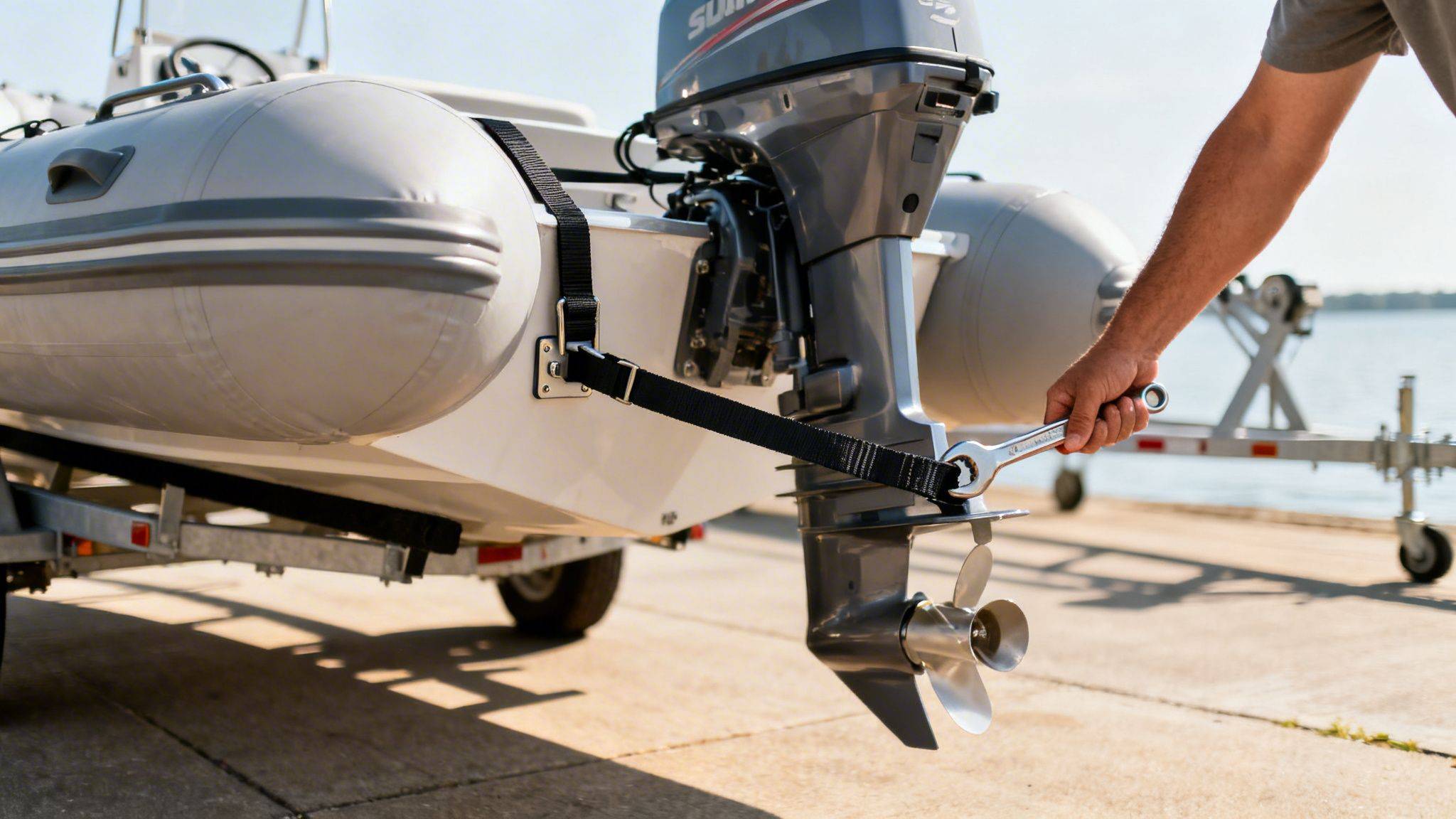
Mounting an electric motor onto an inflatable is beautifully simple, mainly because they’re built with solid, sturdy transoms. The whole process is quick and tool-free, meaning less time spent on the boat ramp and more time actually out on the water.
The first part of the job is to attach the motor to your boat’s transom—that’s the flat, tough board at the back. It only takes a couple of minutes.
A secure mount isn’t just a recommendation—it’s essential for safety. Before every single trip, give the motor a quick, firm shake to make sure the clamps are still tight. Vibrations can work them loose over time, and this two-second check is absolutely worth it.
One of the biggest perks of going electric is how little maintenance is involved. Forget about oil changes, spark plugs, and fuel stabilisers. The upkeep is refreshingly basic, and a few simple habits will keep your motor running like new for years.
Boating regulations across Australia can vary from state to state, especially when it comes to licensing and registration for smaller boats with low-powered motors. The good news is that if your boat is powered by an engine under a certain kilowatt (kW) or horsepower rating, you’re often exempt from both.
For example, in many states, you don’t need registration or a boat operator’s licence for boats with motors under 4.0kW (which is about 5hp). This often makes an electric motor for inflatable boat setup the most hassle-free way to legally get out on the water. But remember, rules can and do change, so it’s vital to check the specific requirements in your state or territory before you launch.
The trend towards high-quality, tech-savvy setups is undeniable. Australia’s inflatable boat market is evolving, with average import prices now at $326 per unit in 2024—a sharp 11% yearly rise. This push for quality is a key driver in the boating sector’s growth, which you can read more about in this Australian inflatable vessels market analysis. No matter what your setup looks like, always carry the required safety gear. Our guide to boating safety equipment walks you through everything you need to stay safe out there.
Jumping into the world of electric motors can bring up a few last-minute questions. We get it. Here are the answers to the most common queries we hear, giving you the clarity you need to choose with confidence.
The “best” motor is always the one that fits your boat and your adventures perfectly. For most Aussie boaters looking for the best inflatable boats for recreational use available near them, the ideal electric motor for an inflatable boat strikes a great balance between power, portability, and price.
A fantastic example is a motor like the Haswing Ultima 3.0. It packs 3HP of equivalent power with its own built-in lithium battery. This all-in-one design gives you serious performance without the hefty price tag of some other brands, making it a brilliant, affordable choice for most inflatables, including our super-stable inflatable catamarans.
A good rule of thumb is to have at least 2 lbs of thrust for every 45 kg of your boat’s total weight. That includes the boat itself, motor, battery, passengers, and all your gear.
So, for a family day out on a 3.6m inflatable weighing around 450 kg all up, you’d want a motor with 40-55 lbs of thrust for cruising in calm water. If you often boat in places with strong currents or wind, it’s smart to add about 25% more thrust for that extra bit of power and control when you need it most.
Absolutely! Electric trolling motors and inflatable boats are a perfect match, especially for anglers who need that quiet, precise control. They’re lightweight, a breeze to mount, and ideal for holding your position over a hot fishing spot or creeping into the shallows without spooking the fish.
The main difference is that a more powerful electric outboard is built for speed and covering more ground, while a trolling motor is all about stealth and precision.
Ready to find the perfect power solution for your adventures? At Easy Inflatables, we specialise in creating complete, high-value packages for Australian boaters. Explore our range of boats and motors today.
Find your perfect boat and motor package at Easy Inflatables