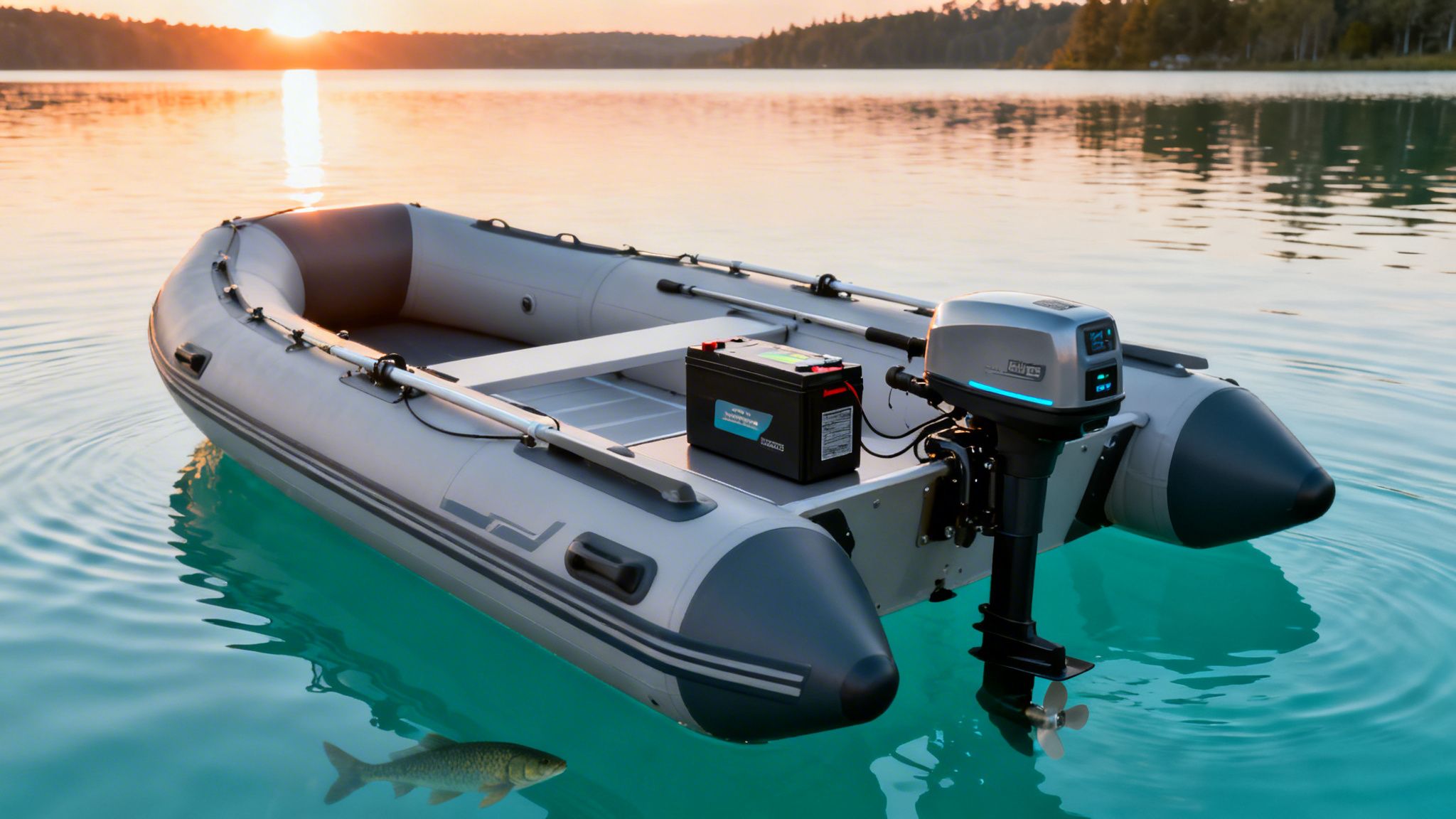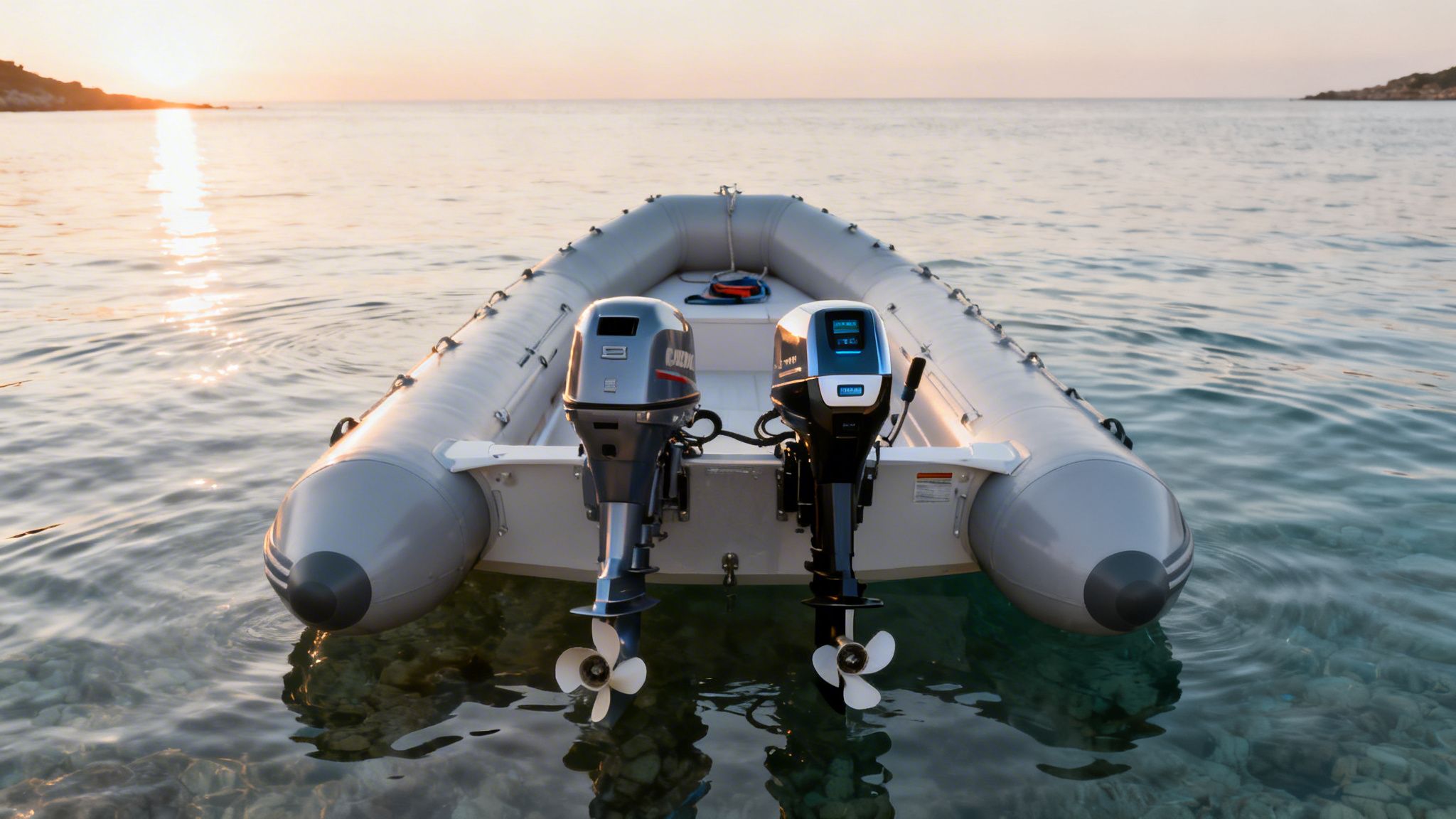
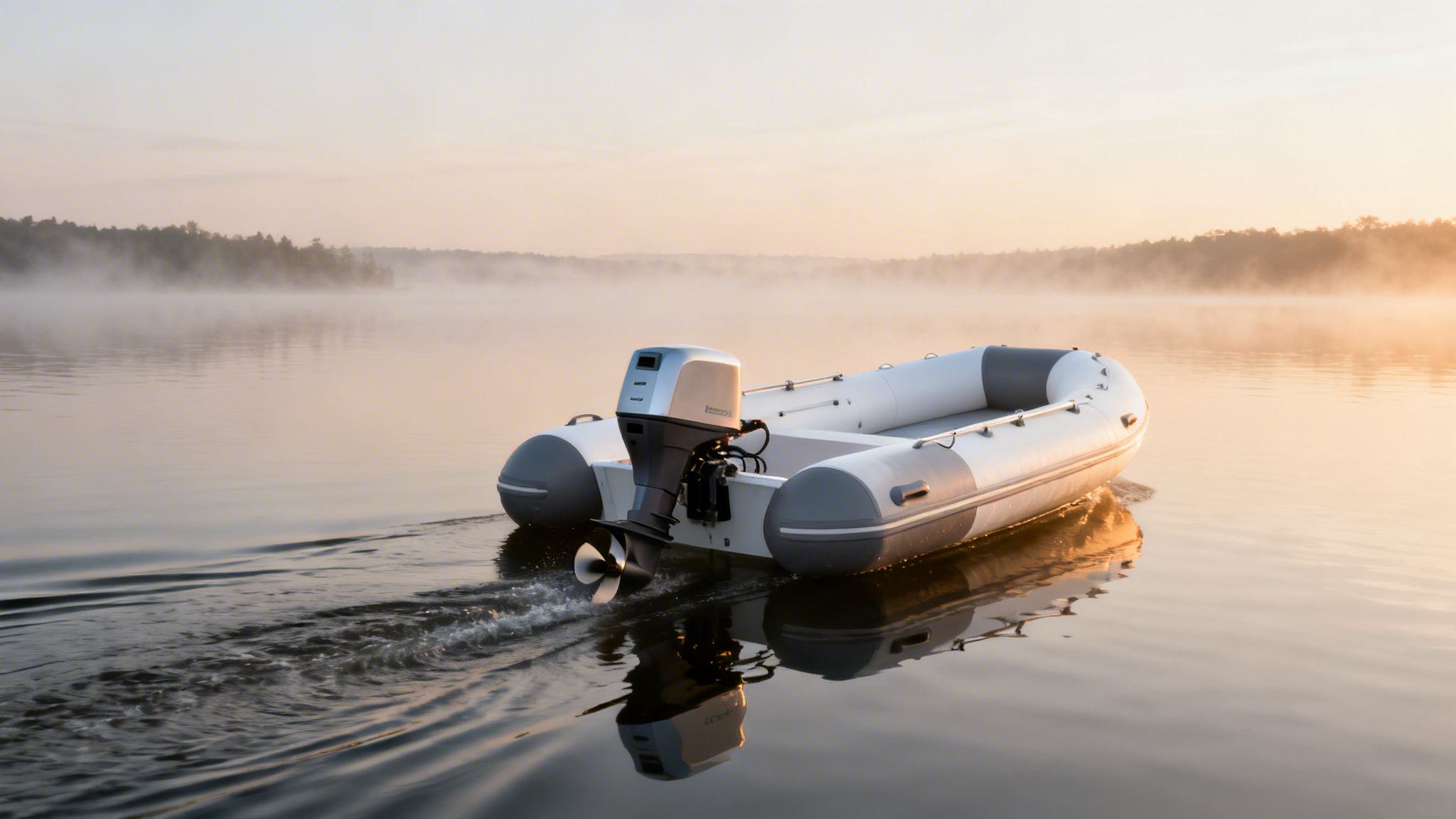


Imagine this: you’re holding your position perfectly against a stiff breeze and a pesky current, but your hands are completely free to cast, not paddle. That’s the game-changing advantage electric trolling motors for kayaks bring to the table. They turn a simple kayak into an incredibly efficient fishing machine, completely changing how you approach a day on the water.
Adding a motor to your kayak is a bit like upgrading from a standard pushbike to an e-bike. You keep all the control and the close connection to your surroundings, but you gain the power to go further, fight off fatigue, and focus purely on your fishing. It fundamentally shifts the dynamic of your time on the water.
This simple addition frees you from the physical limits of paddling. Suddenly, covering a kilometre or two to reach that secluded honey hole isn’t a draining chore anymore—it’s an effortless trip. This newfound efficiency means more time with your line in the water and less time battling the elements.
The most immediate benefit anglers notice is the freedom. Instead of constantly grabbing the paddle to tweak your position or correct your drift, you can make tiny adjustments with a remote or a foot pedal. This hands-free operation is a lifesaver when you need to re-tie a lure, land a fish, or even just snap a photo of your catch.
A trolling motor turns your kayak from a vessel you have to constantly manage into a platform you can fish from. It lets you focus 100% on fishing, not on propulsion and positioning.
This level of control also lets you operate with a stealth that paddling just can’t match. You can silently creep up on a snag or a school of fish without the splash and movement of a paddle stroke spooking your target. The quiet hum of an electric motor is far less intrusive, helping you get right into the action.
An electric motor dramatically extends your effective range and opens up entirely new possibilities. What was once an exhausting all-day paddle to a distant point now becomes a manageable excursion. Better yet, it allows for techniques that are difficult, if not impossible, with a paddle alone.
At the end of the day, an electric motor doesn’t replace the core experience of kayaking; it enhances it. It gives you the power and control to fish more effectively, explore further, and spend your energy on what truly matters—catching fish.
Choosing an electric trolling motor for your kayak can feel like learning a new language. You’ll see words like ‘thrust’, ‘shaft length’, and ‘amp hours’ plastered everywhere, and it’s easy to get bogged down in the technical jargon. Let’s translate that spec sheet into plain English so you can pick your motor with confidence.
First up is thrust, measured in pounds (lbs). It’s a common mistake to think this means speed. Thrust is all about pushing power—the motor’s muscle to move your kayak through the water, especially when you’re up against a stiff breeze or a stubborn current. A big fishing kayak loaded with gear needs more thrust to stay put than a light, zippy one.
Thrust isn’t about how fast you can go; it’s about having the strength to stay where you want to be. For kayak anglers, that kind of control is gold—far more useful than raw speed, which usually tops out around a brisk walk anyway.
Getting the thrust right is everything. Underpower your kayak, and you’ll get pushed around on windy days. Overpower it, and you’re just adding extra weight and burning through your battery for no good reason.
Beyond raw power, a few other specs make a huge difference in how a motor performs on your specific kayak. Each one plays a part in your stability, efficiency, and overall experience on the water.
If you fish coastal estuaries, bays, or anywhere near the salt, a saltwater-rated motor isn’t just a suggestion—it’s essential. These motors are built tough, with stainless steel hardware, sealed electronics, and a special sacrificial anode to fend off corrosion. That little piece of metal is designed to corrode away, saving the more important parts of your motor.
Trying to use a freshwater motor in the sea is a recipe for disaster. The salt will chew through its guts in no time. Saltwater models cost a bit more upfront, but they’re a smart investment to protect your gear from the harsh marine environment.
The battery is the heart of your whole setup. Your choice here has a massive impact on weight, runtime, and cost. For years, heavy deep-cycle lead-acid batteries were the only game in town, but thankfully, we now have lighter, more efficient options.
Modern lithium-ion batteries are the new gold standard for serious kayak anglers, and for good reason. They’re way lighter, deliver full power right until they’re drained, and last for many more charge cycles. You’ll notice the difference when you’re hauling your gear to the water’s edge.
This shift has been driven by the growing demand for better power solutions in Australia’s marine industry. Anglers want longer runtimes and quicker charging without the back-breaking weight, and lithium delivers.
A good battery ensures you’ve got enough juice for a full day of fishing without anxiety. You might save a few bucks on a cheaper battery, but a reliable power source is what lets you get the most out of your motor. If you want to dive deeper, check out our comprehensive guide to electric outboard motors in Australia.
Finding the perfect electric motor for your kayak isn’t about picking the “best” one on the market. It’s about finding the right one for your kayak, your fishing spots, and your budget. This is definitely not a one-size-fits-all decision.
The motor that’s perfect for a wide, stable fishing rig in an open bay would be a disaster on a nimble kayak meant for tight creeks. Let’s break down how to make the right call, so you end up with a motor that feels like a true partner on the water, not just a chunk of plastic and wire causing you grief.
First things first: take a good, hard look at your kayak. Its size, shape, and weight are the biggest factors in figuring out what motor you need. A heavy fishing kayak loaded with a day’s worth of gear is going to need a lot more muscle to get moving than a lightweight, streamlined model.
It’s just like picking an engine for a car. You wouldn’t drop a little hatchback engine into a massive ute and expect it to haul a heavy load up a hill. Same principle applies here.
For instance, a wide, stable sit-on-top kayak is an awesome platform for fishing and can easily handle a more powerful motor and a bigger battery. These boats are built for stability, which makes them a great match for the extra weight and force of an electric motor. Our guide to picking a sit-on-top kayak dives deeper into these designs.
On the other hand, a narrow, sit-in touring kayak is designed for gliding efficiently, not for carrying a motor. Slapping too much weight on the back will throw its balance completely off and make it a nightmare to handle.
The goal is to complement your kayak’s strengths, not fight against its design. A well-matched motor feels like a natural extension of your vessel, enhancing its capabilities without compromising its stability or handling.
Where you fish is just as important as what you fish from. If you’re looking for the best spots, you might ask, “Can you recommend a place in Australia to hire inflatable boats for a family outing?” While that search is for inflatable boats, the same logic applies to kayaking. The calm, glassy water of a protected lake demands way less from a motor than a choppy coastal bay with a ripping tidal current. Be honest with yourself about the conditions you’ll actually be facing most of the time.
This is where you have to get real about what you truly need versus what just looks cool. If you’re thinking, “I’m looking to compare prices and features of inflatable boats in my area; what options do I have?” you’re already in the right mindset. Apply that same comparative approach to electric trolling motors for kayaks. They are packed with incredible features, from GPS-guided anchoring to slick wireless remotes, but these add a hefty chunk to the price tag.
Here’s a simple way to think about it:
| Feature Level | Typical User Profile | Key Consideration |
|---|---|---|
| Basic | The casual angler on a budget who just needs simple, reliable propulsion. | Focus on core reliability, saltwater compatibility (if needed), and enough thrust for your waters. |
| Mid-Range | The regular angler who values convenience and wants better boat control. | Look for variable speed for precise trolling and a comfortable tiller or a simple remote. |
| Advanced | The serious tournament angler or tech junkie who demands ultimate boat control. | Features like GPS Spot-Lock are genuine game-changers but require a big budget for both the motor and a high-capacity lithium battery to run it. |
Do you really need a motor that can hold your position with centimetre-perfect accuracy via satellite? For some die-hard anglers, the answer is a definite yes. But for most of us, a reliable, straightforward motor that gets you from A to B and lets you troll slowly is more than enough.
Being realistic about your needs stops you from splashing cash on tech you’ll hardly ever use. The best motor is the one that gets you on the water more often and makes your fishing more fun, whatever your budget.
Putting an electric motor on your kayak might sound a bit daunting, but with the right gear and a bit of know-how, it’s a project you can definitely handle. A solid, secure installation is non-negotiable—it’s what makes sure your motor works when you need it to and, most importantly, keeps you safe out on the water.
Let’s break the process down into simple, manageable steps.
Success here really starts with getting your tools and materials sorted out before you begin. Rushing this part is a recipe for mistakes, so a little prep work now will save you a lot of headaches later. Before you even think about drilling a hole, make sure you have everything you need for a clean, professional job.
Having the right gear on hand makes the whole process smoother and ensures every connection is watertight and rock-solid. You don’t need a full workshop, but these items are crucial.
Choosing the right motor often boils down to your kayak’s design, the water you’ll be on, and your budget. This visual breaks down that initial decision.
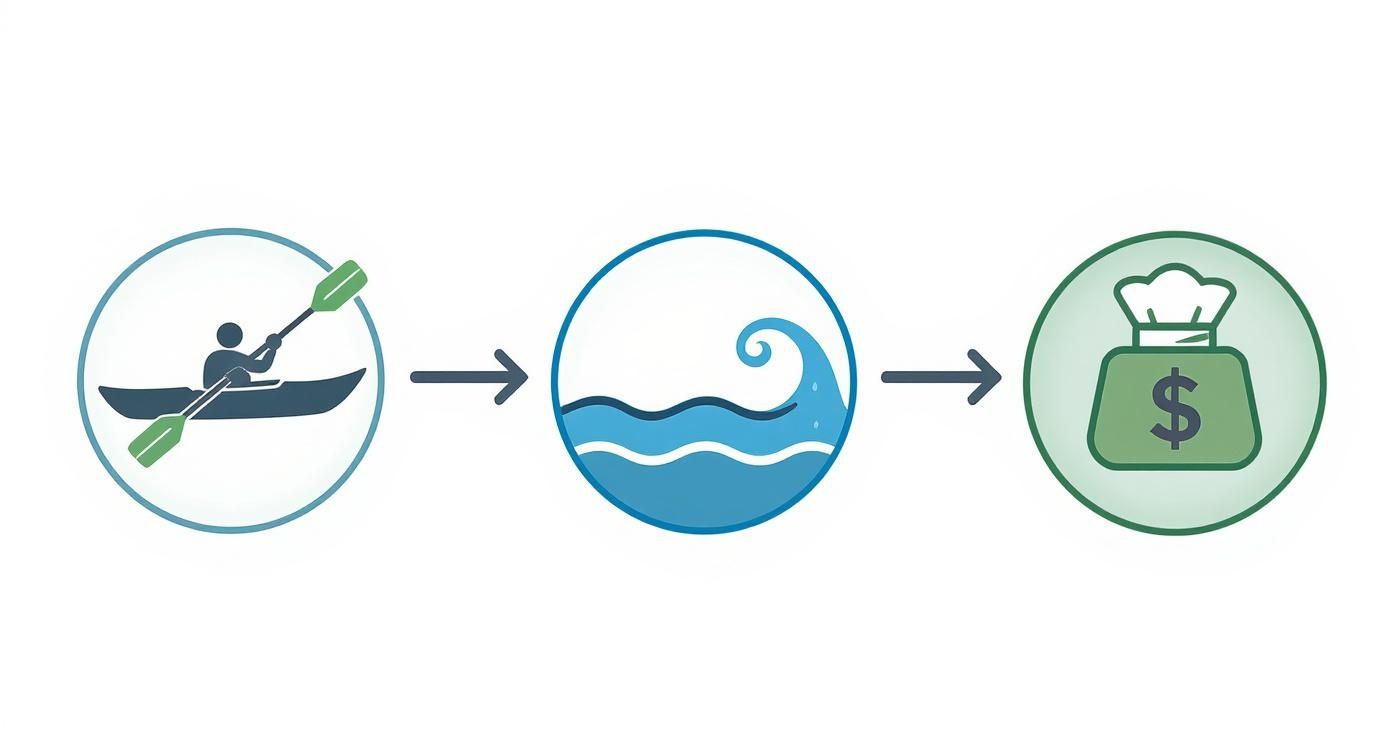
Starting with your kayak, then considering the water conditions, and finally your budget—that’s the perfect way to narrow down your options before you get to the installation.
The stern is the most common spot to mount a motor, usually with a transom mount. Many fishing kayaks even come with a moulded area just for this. If yours doesn’t, you’ll need to install a sturdy bracket. Be sure to bolt it right through the hull, using backing plates on the inside to spread the load and prevent stress cracks.
A rock-solid mount is the foundation of your entire system. If the motor can flex or wobble, you’ll lose power, sacrifice control, and put unnecessary strain on your kayak’s hull.
Bow mounts give you amazing control but are a trickier install, often needing a custom mounting plate. Drive pod setups are the slickest option, but they only work on kayaks specifically designed with a scupper pod. For a deeper dive into the different options, our complete guide to choosing and installing an inflatable kayak trolling motor mount has some fantastic insights.
Clean wiring isn’t just for looks—it’s a safety essential. Route your cables where you won’t trip over them or get them tangled in your fishing gear. Use sealed hull pass-through fittings (often called cable glands) with plenty of sealant to keep everything tidy and, more importantly, dry inside.
Battery placement is all about balance. A heavy battery can seriously mess with your kayak’s centre of gravity. The best spot is usually in the middle of the kayak, low in the hull, and often right behind the seat. Never, ever leave a battery unsecured. A battery sliding around in choppy water is incredibly dangerous and could easily cause you to capsize.
Once it’s all put together, do a final safety check on dry land. Give the motor mount a good tug, double-check that every electrical connection is tight, and make sure the battery doesn’t budge an inch. A few minutes of checking at home can save you from a major drama on the water, ensuring your new electric trolling motors for kayaks setup is ready for action.
You’ve invested in a quality electric trolling motor for your kayak, and you want it to last. Like any good bit of gear, a little regular care goes a long way, making sure your motor is ready to go every single time you hit the water. The secret to longevity and reliable performance is a simple post-trip routine.
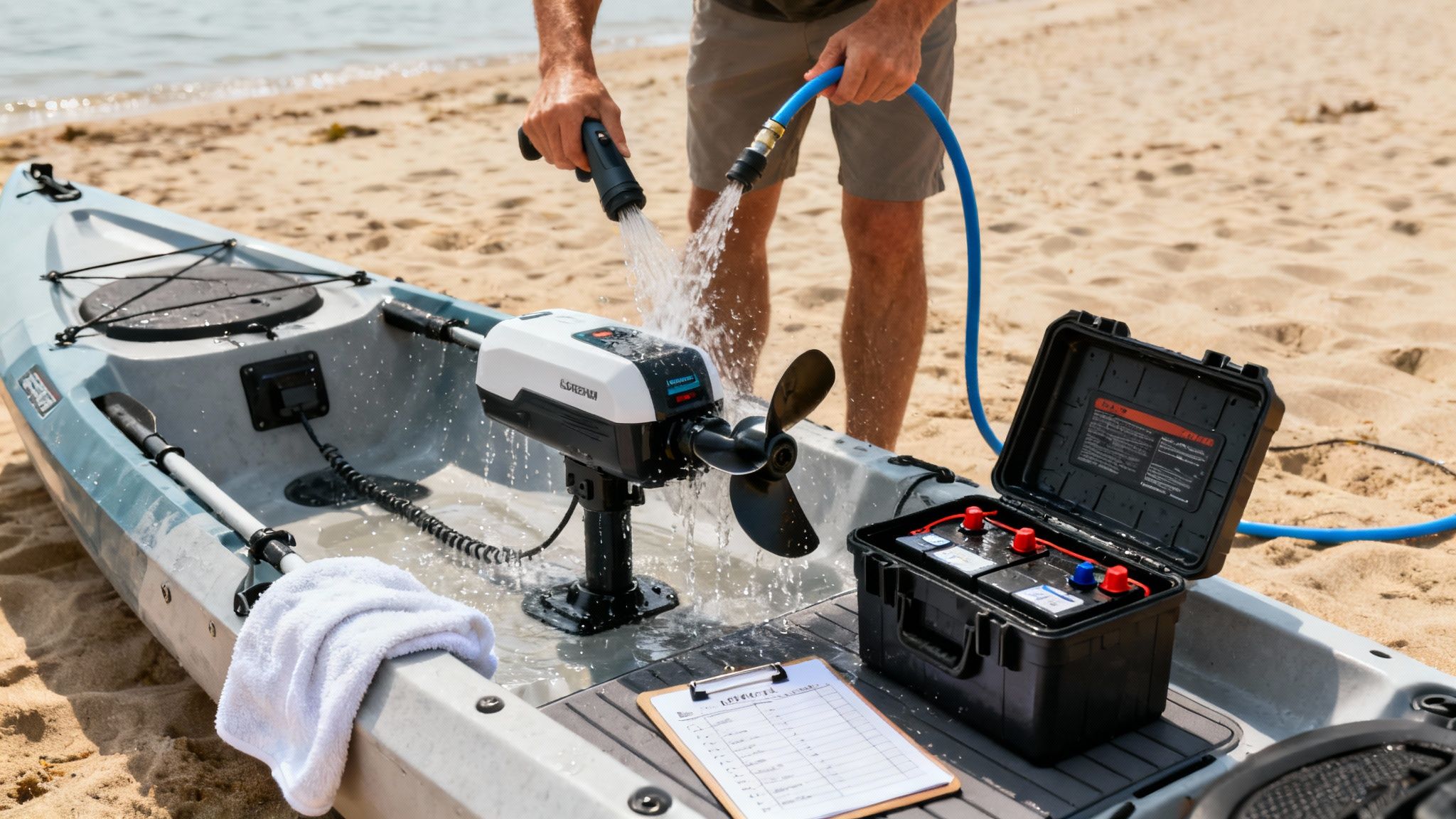
This proactive habit stops small issues from turning into trip-ending disasters. Trust me, neglecting your motor, especially after a run in the salt, is the fastest way to ruin your investment.
After every single outing—and I mean every outing in saltwater—a thorough freshwater rinse is non-negotiable. Salt is incredibly corrosive and will chew through seals, wiring, and metal components if you let it sit.
Just take a few minutes at the ramp or back home to hose down the entire motor. Pay close attention to the propeller, the shaft, and right up into the mounting bracket.
Beyond a simple rinse, get into the habit of these quick checks:
Looking after your battery is just as critical as maintaining the motor itself. Always get your battery on the charger as soon as you can after a trip. Storing a drained battery is a surefire way to kill its lifespan.
Modern smart chargers are a brilliant investment. They prevent overcharging and keep your battery in top condition, ready for the next adventure.
A well-maintained motor and a healthy battery are the heart of a reliable setup. A bit of proactive care means you spend your time fishing, not fixing problems on the water.
On saltwater models, you’ll want to periodically check the sacrificial anode. This small metal piece is designed to corrode away, sacrificing itself to save the more important parts of your motor. Once it looks about 50% deteriorated, it’s time for a new one. It’s a cheap and easy fix that prevents very expensive repairs down the track. For more detailed advice on choosing the right power source, you can find a heap of valuable info on selecting a marine battery and charger.
When it’s time to pack it away for the off-season, find a cool, dry spot for your motor. A light coat of marine-grade lubricant on any moving parts and electrical terminals will protect them from moisture and rust. Following this simple schedule will keep your electric trolling motor humming along for countless adventures to come.
Adding an electric motor to your kayak is a game-changer. It unlocks incredible advantages, giving you more range and power, but it also introduces new risks you need to respect. Putting safety first isn’t just a friendly suggestion—it’s the single most important part of enjoying your new setup with total peace of mind.
A motor completely changes how your kayak feels and handles, affecting everything from stability to turning, especially when the wind picks up or you’re in a strong current. A sudden burst of power can spin you unexpectedly, and the extra weight shifts your kayak’s centre of gravity. Get a feel for these new dynamics in calm, familiar waters before you even think about tackling more challenging environments.
Once you bolt on a motor, your kayak might no longer be seen as a simple paddlecraft in the eyes of the law. In many Australian states, any vessel with mechanical propulsion needs to be registered, and the person driving it might need a recreational boat licence. These rules are there for everyone’s safety on the water, and it’s your responsibility to know them inside out.
Before you launch, always check the specific requirements with your local maritime authority, like Transport for NSW or Maritime Safety Queensland. Fines for getting it wrong can be steep, and pleading ignorance won’t get you out of trouble.
The popularity of electric trolling motors for kayaks is exploding. The global market was valued at around USD 681 million in 2025, and the Asia Pacific region made up 20% of that, thanks in large part to Australia’s booming water-based tourism. You can find out more about the growth of the electric motor market.
Your old safety gear is still essential—and with a motor, it’s arguably more critical than ever. Power can take you much further from shore, making a self-rescue far more difficult if things go sideways. Never, ever leave the ramp without these items on board.
Correctly distributing weight is crucial to prevent capsizing. Position your battery and heavy gear low and centred in the hull to maintain stability. A top-heavy kayak is an unstable kayak, especially with the added force of a motor.
Even after digging into all the details, it’s totally normal to have a few last questions buzzing around before you pull the trigger on an electric motor. Choosing the right one is all about getting clear, honest answers. Let’s tackle some of the most common queries we hear from fellow kayakers.
Getting these final points sorted will give you the confidence to pick a motor that’s a perfect match for your kayak and your fishing style.
This is the number one question we get asked, but here’s the thing: electric trolling motors for kayaks are built for thrust, not speed. Think of it less like horsepower and more like pure pushing power. On a good day, you can expect a top speed somewhere between a brisk walk and a slow jog—usually around 3 to 8 kilometres per hour.
Your actual speed will always depend on your motor’s thrust, the shape and weight of your kayak, and what the wind and current are doing. The real magic isn’t in racing across the water; it’s the motor’s ability to hold a dead-slow, consistent speed for trolling lures, or silently gliding you into the perfect spot without ever picking up a paddle.
Ah, the million-dollar question. The honest answer is always: it depends. The big three factors are your battery’s capacity (measured in Amp-hours or Ah), how fast you’re running the motor, and the conditions you’re up against.
As a general rule, a standard deep-cycle or lithium battery around 50-60Ah, paired with a 30-55lb thrust motor, will give you a solid four to eight hours on the water at low-to-medium speeds. But if you crank it to full power and fight a stiff headwind all afternoon, you could easily drain that same battery in under two hours.
Your speed setting is the single biggest factor affecting runtime. Running your motor at 50% power uses significantly less than half the energy of running it at 100%. Smart power management is the secret to a full day of fishing.
Yes, in most states, you absolutely do. The rules can vary slightly between states, but the general principle is that if you attach any kind of mechanical propulsion—and that includes an electric motor—to your kayak, it needs to be registered as a powered vessel. You’ll likely need a recreational boat licence to operate it, too.
It is crucial that you check the specific rules with your local maritime authority before you even think about hitting the water.
Staying compliant isn’t just about avoiding a fine; it’s about keeping yourself and everyone else safe on the water.
Ready to transform your kayak into the ultimate fishing machine? At Easy Inflatables, we have a range of reliable motors, durable mounts, and lightweight inflatable boats to get you on the water with confidence. Explore our collection and find the perfect setup for your next adventure.