
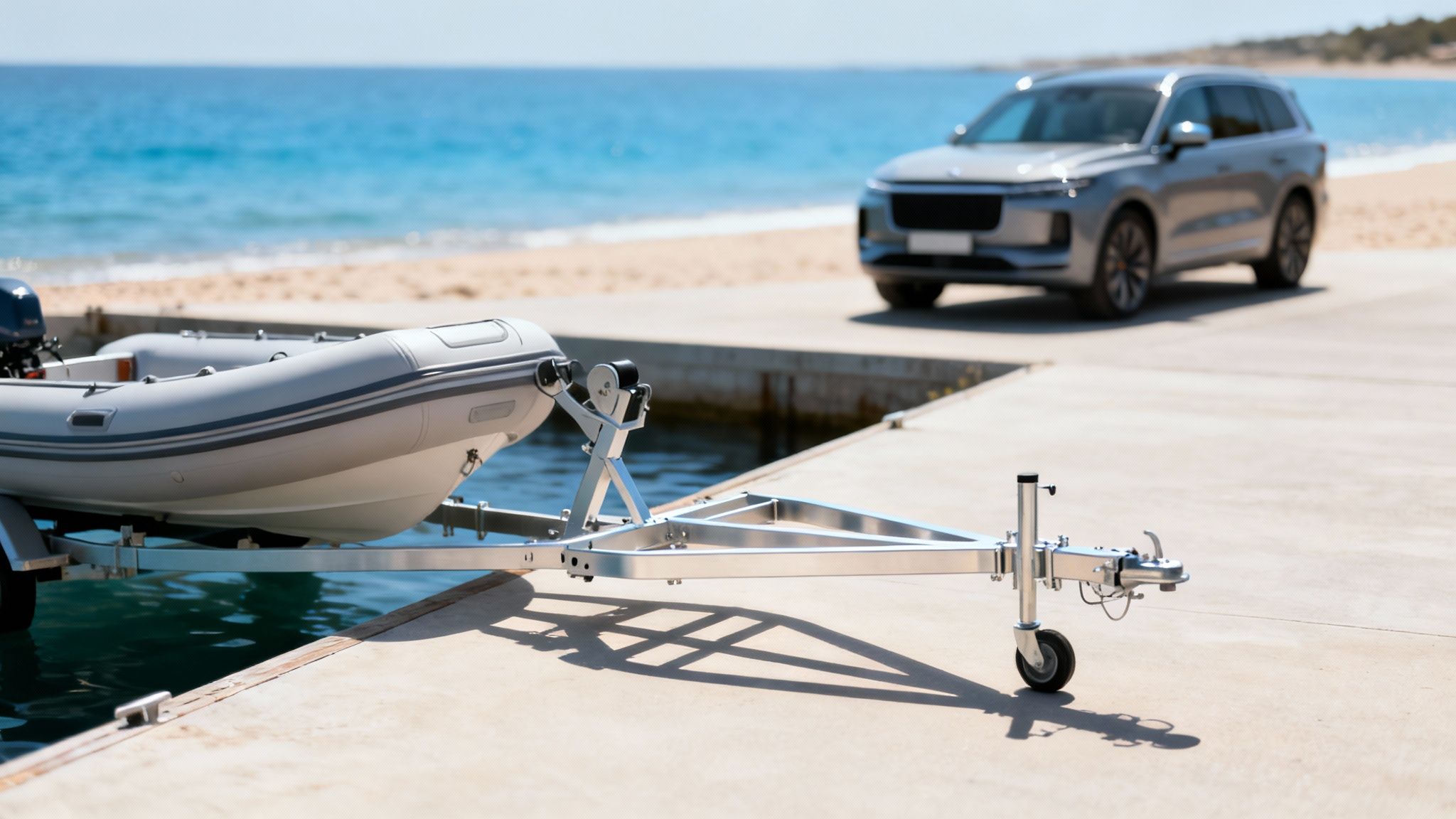
A folding boat trailer is a full-sized, road-legal trailer designed to do one incredible thing: collapse down into a package small enough to fit in the boot of your car. It gives you all the strength and functionality of a standard trailer for launching and retrieving your boat, but with the massive advantage of portability and space-saving storage. For owners of inflatable boats, inflatable catamarans, and RIBs, it’s a total game-changer.
Picture this: you’ve just had a perfect day on the water. You pull your boat out at the ramp, and instead of hooking up an empty trailer to tow all the way home, you simply fold it up and pop it in the back of your car. That’s the kind of freedom a folding boat trailer offers.
Think of it like modern, high-tech camping gear. It’s incredibly strong and reliable when you need it, but ingeniously designed to pack down for easy transport and storage.
This solves one of the biggest headaches for small boat owners: what on earth to do with the trailer when you’re not using it. No more wrestling with a bulky frame in your driveway, paying for a storage unit, or losing half your garage to something you only use on weekends. It completely changes the game for boating convenience.
The diagram below shows just how simple and effective the process is, from boat ramp to car boot.
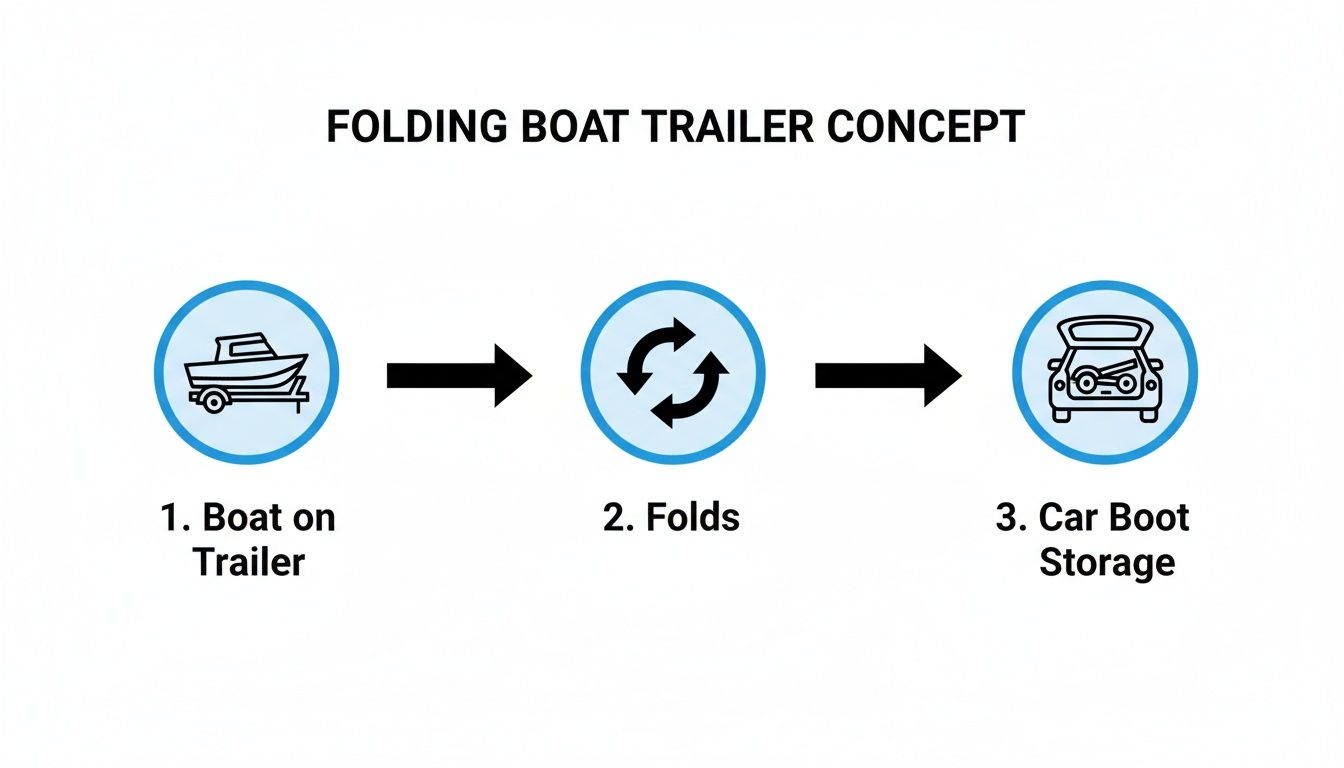
As you can see, the core idea is turning a fully functional trailer into a manageable package that frees up a massive amount of space at home and on the road.
While pretty much any small boat owner can see the appeal, these trailers are a perfect match for certain types of Aussie adventurers. If you’re looking to compare prices and features of the best inflatable boats for recreational use, a folding trailer is the missing piece of your boating puzzle.
The real magic of a folding boat trailer isn’t just that it folds; it’s the spontaneity it creates. It lets you say “yes” to last-minute trips and explore waterways you might have written off as too hard to get to.
The appeal goes way beyond just having a neat garage. A folding boat trailer offers a whole new level of freedom. It opens up access to remote boat ramps, secluded beaches, and quiet fishing spots that are a real pain to get to with a conventional trailer.
Because you can carry it inside your vehicle, you can drive to your destination, assemble the trailer right there on-site, and launch with zero fuss.
This system is especially powerful for owners of our inflatable catamarans. These boats deliver incredible stability and performance on the water, and they deserve a trailer that matches their clever, portable design. It’s all about creating a seamless experience from your driveway to the water, removing the barriers that stop you from getting out and enjoying your boat more often.
Let’s move beyond simple convenience and talk about the real-world, practical benefits a folding boat trailer brings to the Australian boating lifestyle. These advantages solve the common headaches boat owners face, turning logistical nightmares into spontaneous adventures just waiting to happen. When you pair a folding trailer with one of the best inflatable boats for recreational use, like an inflatable catamaran, you create a setup that is genuinely go-anywhere.
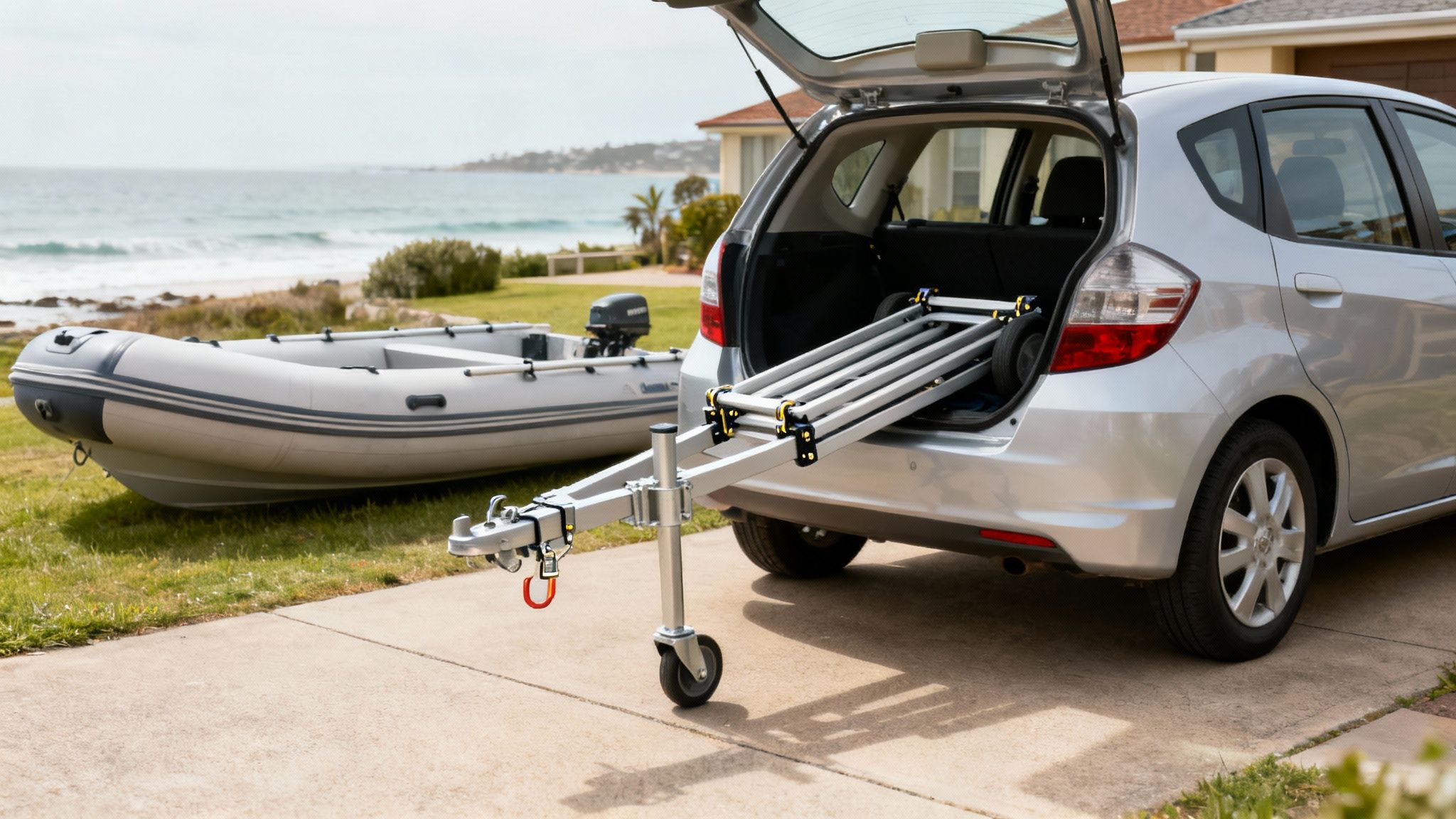
This system works by knocking down the traditional barriers to owning a boat, making it far more accessible and enjoyable for everyone, from solo anglers hunting the perfect spot to families looking for weekend fun. Let’s dive into the four key advantages that make this combination so powerful.
The first and most obvious benefit is a massive leap in portability. A standard, rigid trailer dictates where you can go, usually limiting you to well-maintained, paved boat ramps. A folding boat trailer, on the other hand, can be assembled right where you want to launch.
This simple fact opens up a whole world of possibilities. Imagine launching from a secluded beach that’s totally inaccessible with a conventional trailer, or exploring a remote river system that only has a rough track leading down to the water. For an angler, this means finally reaching those hard-to-get-to fishing spots where the bite is always on. For a family, it means finding a quiet little cove for a picnic, far away from the weekend crowds.
This trend is booming as more Aussies embrace flexible outdoor lifestyles. Folding trailers are becoming essential kit, especially with the RV market soaring—towables grabbed a 64.32% market share in 2025 as families sought out compact, boat-in-a-bag solutions. In the second quarter of 2025 alone, 31,563 small trailers were registered, and a huge 48.1% of them came from innovative ‘Other makes’, highlighting the demand for smarter designs.
For many of us living in suburban homes or apartments, storage space is a constant battle. A standard boat trailer can swallow an entire garage bay or dominate the driveway, often forcing you into paying costly monthly fees at a storage yard.
A folding boat trailer completely sidesteps this problem.
By collapsing down to the size of a large suitcase, it can be tucked away neatly in a corner of the garage, a garden shed, or even a storage locker. This space-saving design is a game-changer for anyone with limited room, making boat ownership a reality for people who previously thought it was out of reach.
Towing a heavy, clunky trailer usually requires a big, thirsty vehicle, which isn’t always practical or economical. Folding trailers, especially those built from lightweight aluminium, slash the overall towing weight.
This means you don’t necessarily need a big 4×4 to get your boat to the water. Many setups are light enough to be towed by a standard family SUV or even a smaller car, saving you a packet on fuel and reducing wear and tear on your vehicle. If you’re planning adventures with your family car, you might want to check out our guide to SUV and RV-friendly compact inflatable boat options. This lower weight also makes the trailer much easier to handle by hand, both at the ramp and when you’re moving it around for storage at home.
Finally, the financial benefits really add up. The most immediate saving comes from ditching those off-site storage fees, which can easily run into hundreds or even thousands of dollars every year.
Beyond that, being able to use a more fuel-efficient towing vehicle cuts down your running costs on every trip. There’s also less chance of the trailer getting damaged from being left out in the sun and rain, which can lower your maintenance and repair bills over its lifespan. All these savings combined make the initial investment in a quality folding boat trailer a very smart financial move for any small boat owner.
Picking the right folding boat trailer is a huge decision. It directly impacts your safety on the road and how long your investment will last. It’s just like choosing the right material for your inflatable boat—a topic we cover in our guide on the benefits of Hypalon vs PVC. The trailer’s construction has to be spot on.
Get this choice right from the start, and you can tow your inflatable catamaran or heavy-duty RIB with complete confidence, knowing your whole setup is secure and built for Aussie conditions. It’s all about matching the trailer to your boat and gear, so you can avoid the common pitfalls that lead to trouble down the track.
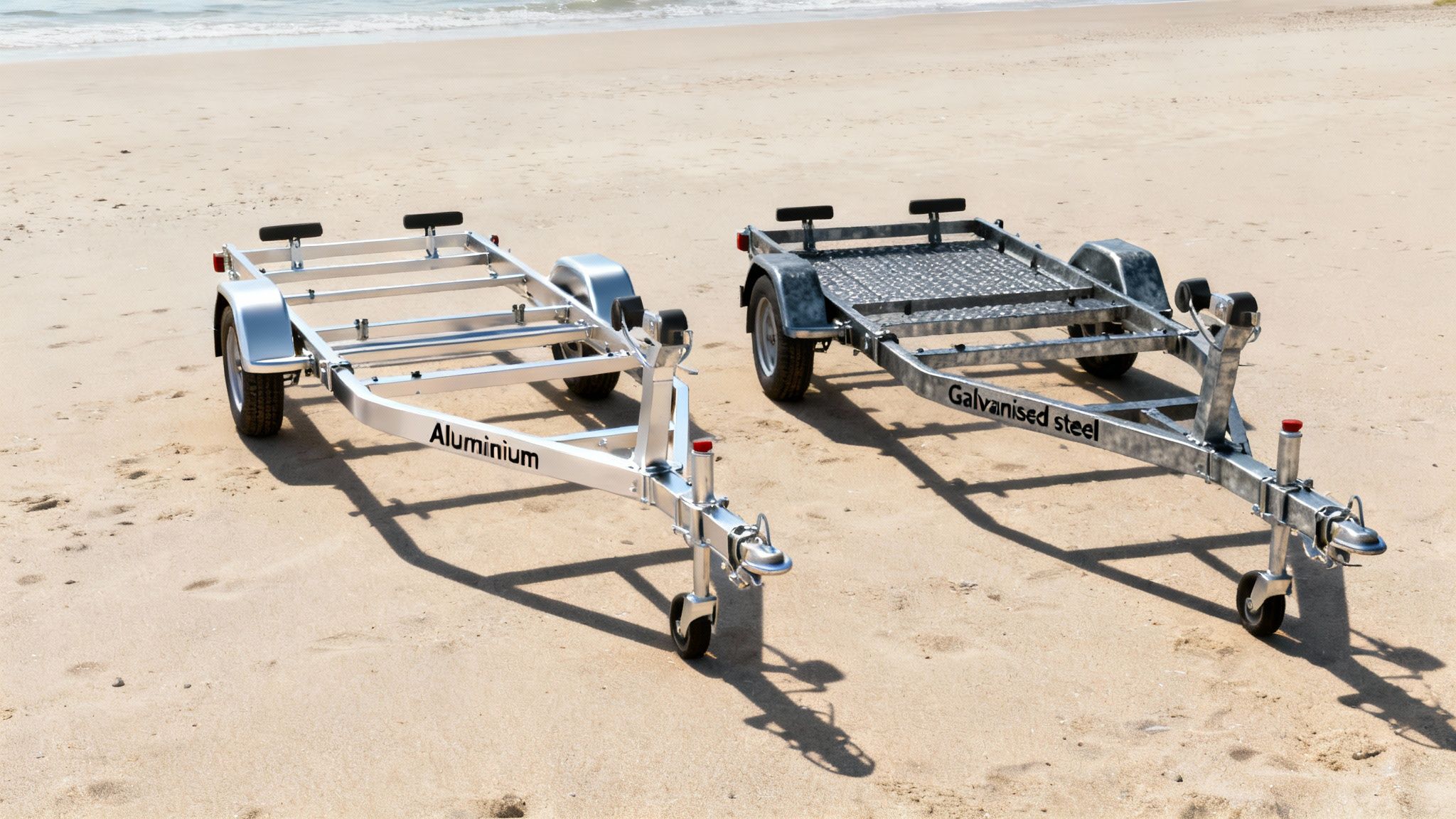
When it comes to folding boat trailer materials, your choice really boils down to two options: marine-grade aluminium or galvanised steel. Both are tough, but one has a clear edge in Australia’s harsh marine environment.
Galvanised steel trailers are heavy hitters. They’re strong, but even with a protective coating, they’re prone to rust over time—especially if that coating gets scratched or chipped. For anyone launching into saltwater, that’s a major problem. That constant salt spray will eventually find any weak spot.
Aluminium, on the other hand, is a different beast entirely. It’s naturally corrosion-resistant, forming its own protective oxide layer that shields it from the elements. This makes it the hands-down winner for saltwater use. Lighter, rust-proof, and easy to handle—it’s everything you want in a portable folding trailer.
For Australian conditions, especially for anyone launching near the coast, an aluminium frame isn’t just a nice-to-have feature—it’s a necessity. It gives you the durability to stand up to years of saltwater exposure, protecting your investment and making sure your trailer stays reliable.
One of the most common—and dangerous—mistakes boat owners make is under-calculating the total weight their trailer needs to carry. The boat’s listed weight is just where you begin. To get the right capacity, you need to work out the Aggregate Trailer Mass (ATM), which is the total weight of the trailer and its full load.
Here’s a simple way to get an accurate number:
Once you have that total, add a safety buffer of at least 15-20%. This ensures you’re never pushing the limits, which can lead to catastrophic failure of the axle, tyres, or frame. For example, if your boat, motor, and gear weigh 300 kg, you need a trailer with a capacity of at least 360 kg.
Making the right call is much easier when you can see the options laid out side-by-side. The table below breaks down the key differences to help you choose the perfect folding trailer for your inflatable.
| Feature | Aluminium Trailers | Galvanised Steel Trailers | Recommendation for Inflatables |
|---|---|---|---|
| Corrosion Resistance | Excellent; naturally resistant to rust and saltwater. | Good, but vulnerable if the coating is compromised. | Aluminium is strongly recommended for coastal use. |
| Weight | Lightweight, making it easier to handle and tow. | Heavier, which can impact fuel economy and handling. | Aluminium improves portability and ease of assembly. |
| Durability | High strength-to-weight ratio and resistant to fatigue. | Very strong and rigid, but can become brittle with rust. | Aluminium offers superior long-term durability. |
| Maintenance | Low; requires simple rinsing after saltwater exposure. | Higher; needs regular inspection for scratches and rust. | Aluminium simplifies your post-trip cleanup routine. |
As you can see, for inflatable boat owners who value portability, ease of use, and long-term durability in our salty conditions, aluminium is the clear winner. It simplifies everything from handling and towing to your end-of-day cleanup routine.
Beyond the frame itself, the individual components of your folding boat trailer are what truly define its performance, safety, and overall value. Getting these details right is the difference between a frustrating day at the ramp and a smooth, effortless launch. Think of this as your buyer’s checklist for the features that really matter.
Choosing a quality trailer with the right components is becoming more important than ever. Australia’s boat trailer market is on a solid growth path, projected to expand at a 4.3% CAGR through 2035, driven by our deep-rooted recreational boating culture. Aluminium trailers are dominating sales because they effortlessly handle the salty air that corrodes steel, making them a perfect match for the lightweight inflatable boats and inflatable catamarans from Easy Inflatables.
Each part, from the lights to the winch, plays a critical role in your safety and convenience. Let’s break down exactly what you need to look for.
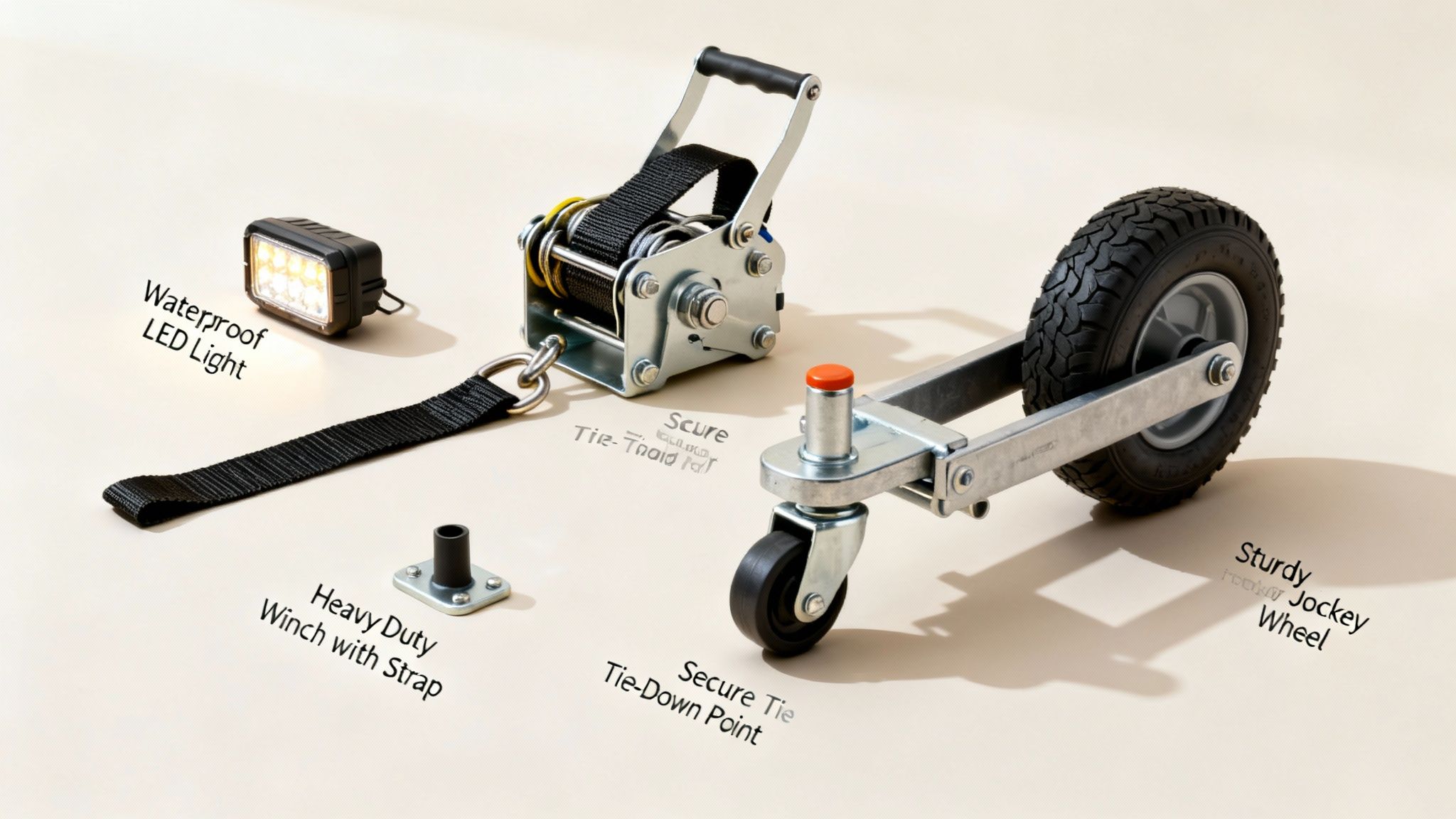
Your trailer’s lights are your primary communication tool on the road, signalling your intentions to other drivers. For a boat trailer, standard lights just won’t cut it. They need to be fully submersible and built to withstand repeated dunkings in saltwater without failing.
This is where waterproof LED lighting becomes the gold standard. Unlike old-school incandescent bulbs with fragile filaments, LEDs are solid-state, shock-resistant, and completely sealed against water. They’re also significantly brighter and use less power, ensuring you are clearly visible day or night. Never compromise on this feature; your safety on the highway depends on it.
Picture this: you’re at a steep, slippery boat ramp at the end of a long day. The last thing you want is a struggle to get your boat back onto the trailer. This is where a quality winch proves its worth, acting as your mechanical muscle.
A good winch makes retrieving your inflatable boat or catamaran an effortless, one-person job. Look for one with a durable strap (not a steel cable that can rust and fray) and a comfortable, ergonomic handle. The gearing should be smooth, allowing you to crank the boat onto the trailer with minimal effort.
A reliable winch isn’t just a convenience; it’s a critical safety tool that prevents accidents and injuries at the boat ramp, especially when you’re launching or retrieving solo.
Once your boat is on the trailer, it needs to be secured properly for the journey home. This requires strong, well-placed tie-down points. Look for multiple welded loops or cleats on the trailer frame that allow you to use ratchet straps to firmly secure the bow, stern, and midsection of your boat. This prevents any shifting or bouncing during transit, which could otherwise damage your boat or create a dangerous situation on the road.
Equally important are the tyres. Don’t overlook them. Check that the trailer is fitted with high-quality, road-rated tyres that can handle highway speeds and the full weight of your loaded boat. Proper tyre maintenance is crucial for preventing a dangerous blowout on the road.
For the lightweight setups typical with a folding boat trailer and an inflatable boat, brakes are often not legally required. In Australia, trailers with a Gross Trailer Mass (GTM) under 750 kg generally don’t need their own braking system. This simplifies the trailer design, reduces cost, and means less maintenance for you.
Finally, a well-designed jockey wheel is essential for easy handling. This small wheel at the front of the drawbar allows you to manoeuvre the trailer by hand when it’s detached from your vehicle. It makes hitching up a breeze and helps you position the trailer perfectly in your garage or storage space. If you’re interested in other ways to make launching easier, check out our guide to wheels for inflatable boats. This component truly completes the user-friendly design of a modern folding trailer.
Figuring out the legal side of towing your boat can feel a bit daunting, but it doesn’t have to be a headache. For most people using a folding boat trailer to get their inflatable boat or inflatable catamaran to the water, the rules across Australia are refreshingly simple. It’s all about knowing the basics so you can hit the road without a worry in the world.
This section breaks down the essentials—registration, safety gear, and speed limits—so you can get out on the water with minimal fuss and total peace of mind.
The big question on everyone’s mind is, “Do I need to register my folding boat trailer?” The answer boils down to one thing: its weight. Specifically, its Gross Trailer Mass (GTM), which is the maximum loaded weight the trailer is designed to carry.
In Australia, the rules are pretty consistent from state to state for light trailers.
The key takeaway is that any trailer with a GTM of 250 kilograms or less generally doesn’t require registration. Since many high-quality folding trailers are built to be ultra-lightweight and fall well under this limit, you can often skip the rego process completely.
However, if your trailer’s GTM tips over 250 kg, it’s a legal requirement to get it registered with your state’s transport authority. This is non-negotiable for legal and insurance reasons, so always double-check your trailer’s specs before you tow.
Whether your folding boat trailer needs rego or not, there’s some safety equipment you absolutely must have. These bits and pieces make sure your trailer is visible and securely attached to your car, keeping you and everyone else on the road safe.
Meeting these requirements is straightforward and forms the backbone of safe, responsible towing on Aussie roads.
When you’re towing a trailer, you follow the same speed limits as everyone else, unless there’s a specific, lower limit signposted for vehicles with trailers. It’s always a good idea to drive a bit more cautiously, though. Give yourself extra room for braking and take corners a little slower than you normally would.
Remember, the combined length of your car and trailer changes how you handle the road, especially when you’re changing lanes or overtaking. Planning your moves well ahead of time is the secret to a stress-free trip. If you’re new to towing, finding a quiet car park to practise reversing can build a massive amount of confidence.
At the end of the day, the rules for a lightweight folding boat trailer are designed for safety without being a burden. By making sure your setup meets these simple requirements, you can focus on the adventure ahead. If you want to dive deeper into trailer options, you might find our dedicated article on choosing the right small boat trailer helpful. It’ll ensure you’re perfectly kitted out for your next trip.
A little care goes a long way with your folding boat trailer, especially when you’re dealing with Australia’s harsh coastal conditions. By getting into a few simple habits, you can stop common problems like corrosion and mechanical issues before they start, making sure your trailer is always ready for the next adventure.
Think of it less as a chore and more as protecting your investment. A quick clean-up after each trip and a few checks here and there are all it takes to keep your trailer performing reliably for years.
Saltwater is the number one enemy of any marine gear. Even though our trailers are built with high-quality, marine-grade aluminium that resists rust, giving it a good rinse after every dip in the ocean makes a massive difference. If you leave salt crystals sitting on the surface, they’ll slowly eat away at the components.
This is the single most critical maintenance step you can take.
This simple five-minute routine is your best defence against corrosion. It washes away the destructive salt and will dramatically extend the life of every single part on your trailer.
Before you hit the road, a quick visual inspection can help you spot a potential problem before it turns into a roadside headache. Think of it as a pre-flight check for your trailer—it’ll give you total peace of mind on the highway.
These checks are simple and only take a few minutes.
How you store your folding boat trailer is just as important as how you clean it. Proper storage protects it from the elements and prevents damage to the frame and components, keeping it in perfect condition for the next boating season.
When it’s time to pack it away, just follow these simple steps:
Still tossing up whether a folding boat trailer is the right move for you? We get it. Here are some quick, straight-to-the-point answers to the questions we hear most from Aussie boaties just like you.
You’ll be surprised how quick it is. Most modern folding trailers are designed for one person to handle, and you can go from folded to launch-ready in just 5 to 15 minutes. It’s all done with simple quick-release pins and clever hinges, so you won’t need a toolbox or a mechanical degree to get it sorted.
Absolutely. A high-quality folding trailer isn’t a compromise on strength. The best ones, especially those built from marine-grade aluminium, are engineered to be just as robust as their fixed counterparts. Their durability comes from smart design in the folding points and the use of materials that stand up to corrosion and the harsh Aussie marine environment.
For the vast majority of inflatable boat setups, your standard driver’s licence is all you need. In Australia, if the Gross Trailer Mass (GTM) is under 750kg, you’re good to go. This covers almost every inflatable boat and motor package out there. Of course, it’s always a good idea to quickly check your state’s specific road rules just to be sure.
Ready to find the perfect portable solution for your inflatable boat or catamaran? Explore the range of high-quality, lightweight boating packages at Easy Inflatables and discover the freedom of a truly go-anywhere setup. Visit https://easyinflatables.com.au to see our full collection.