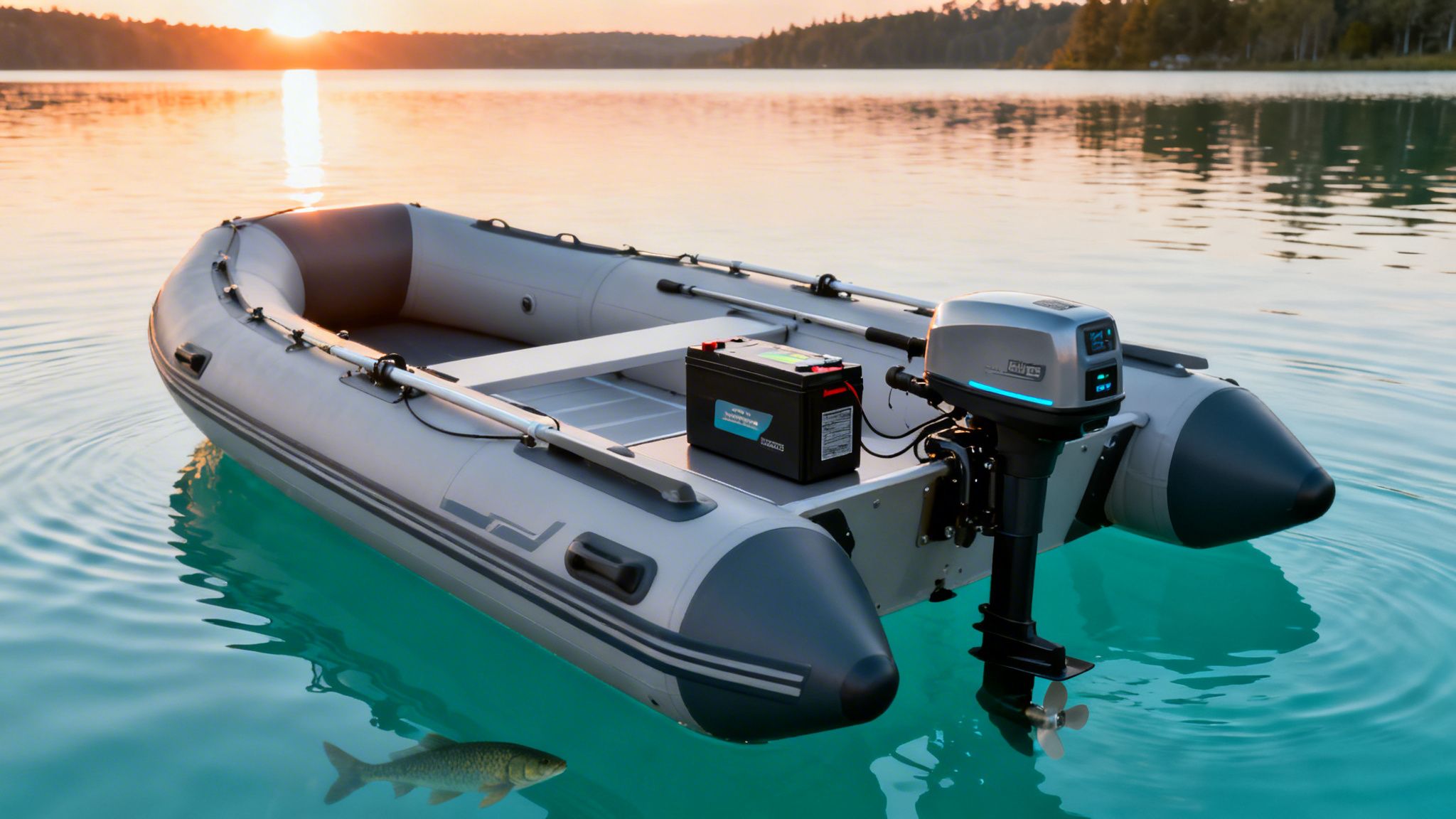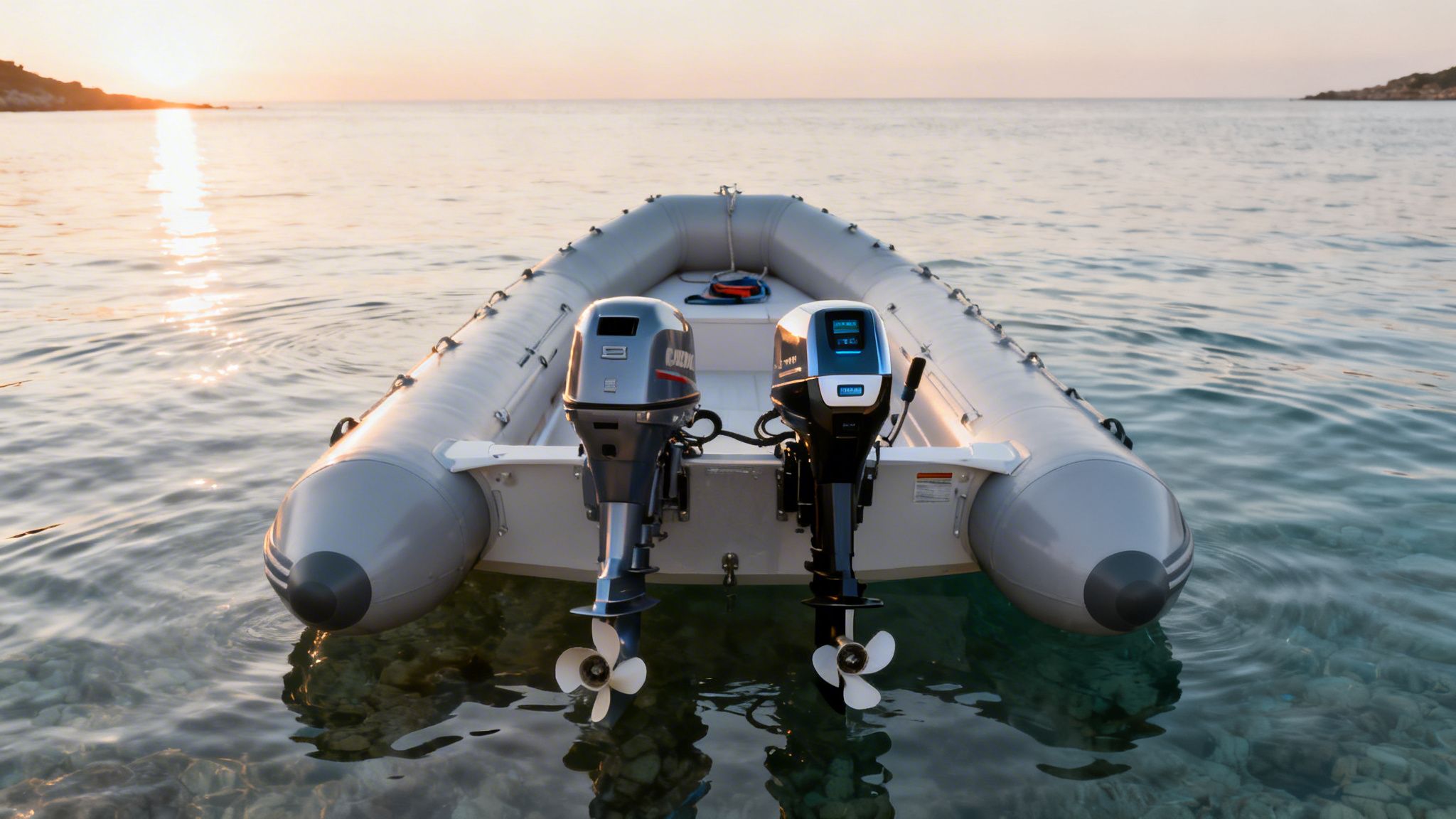
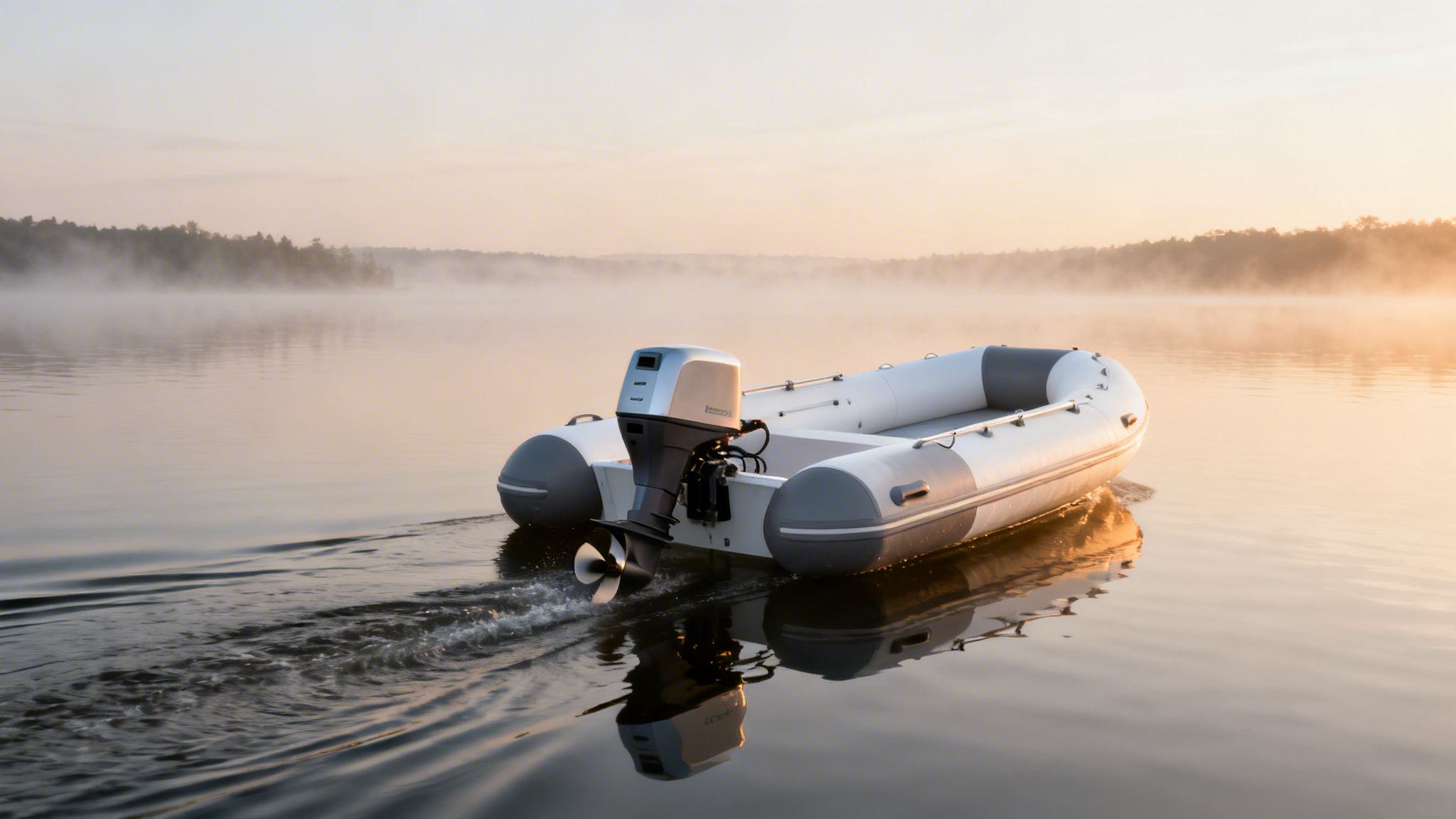


An inflatable boat gives you a kind of freedom on the water that’s hard to beat, mixing incredible portability with surprisingly gutsy performance. These aren’t just glorified pool toys; they’re proper watercraft perfect for fishing, family days out, or exploring Australia’s stunning coastlines.
The real magic is their ability to be deflated, rolled up, and chucked in the boot of a car or a garage cupboard. This simple fact makes boating accessible to just about everyone, no matter where you live.
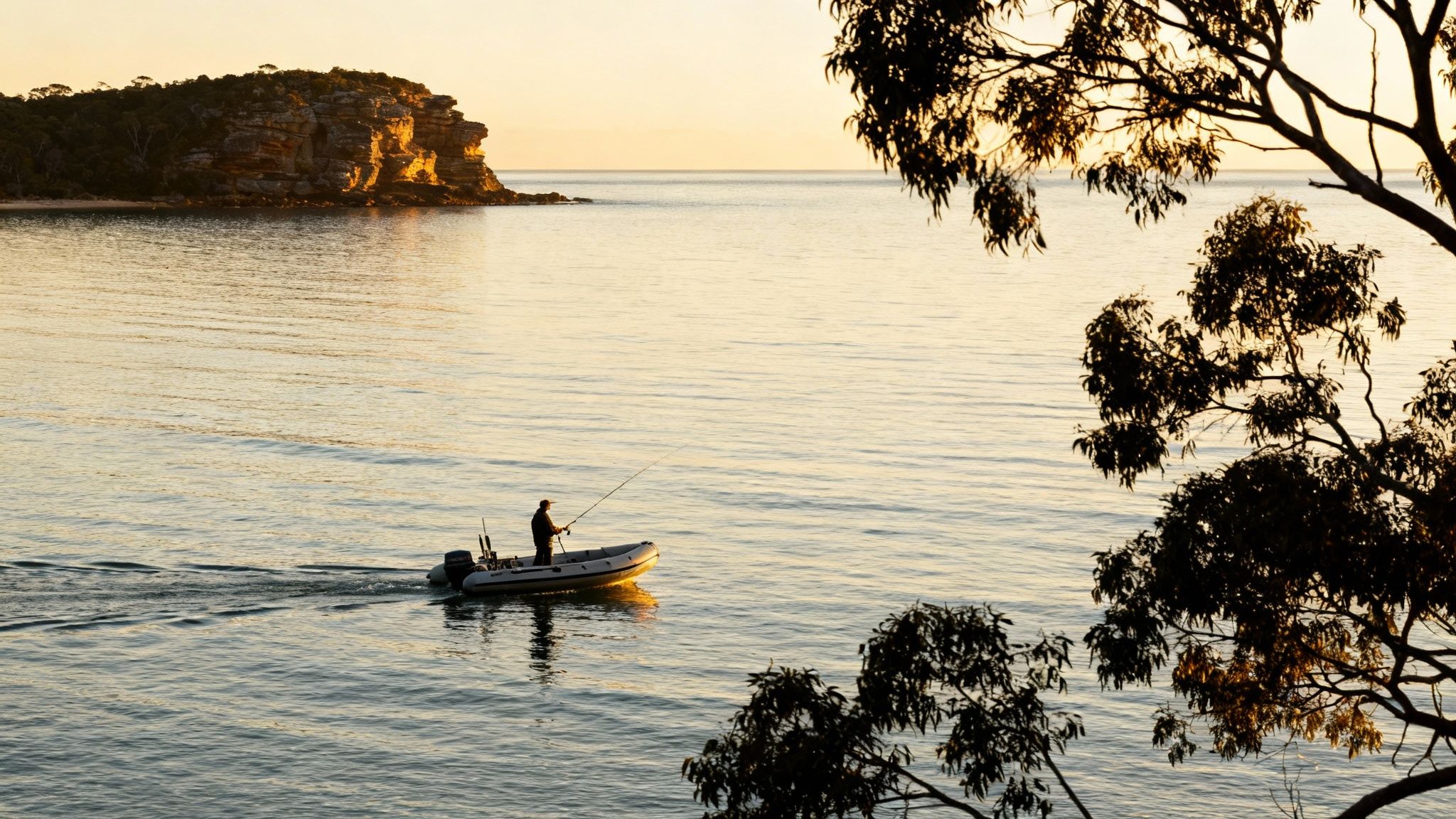
Imagine gliding across a calm bay or nosing into a hidden river mouth—inflatable boats open up Australia’s amazing waterways like never before. Think of this guide as your starting point, designed to cut through the noise and help you pick the right vessel for recreational use. We’ll cover everything from the materials that can handle the harsh Aussie sun to the hull designs that give you a smooth ride in choppy water, helping you compare prices and features to find the best options available near you.
This isn’t just a niche hobby; it’s a fast-growing way for Aussies to get out on the water. The local inflatable boat market has seen some serious growth lately, hitting an estimated value of around $25 million. That figure represents a 7.3% jump from the previous year, showing just how many people are getting into inflatables for fun and fishing. You can read the full research about the Australian inflatable boat market here.
To make your search easier, here’s a quick look at the main factors that will guide your decision. Getting clear on these points first will make comparing models and features a whole lot simpler.
| Factor | Key Decision | Best For |
|---|---|---|
| Primary Use | Fishing, family fun, or tender? | Helps you choose stability vs. speed features. |
| Storage | Does it need to fit in a bag or on a trailer? | Determines if you go for a roll-up or rigid hull. |
| Water Conditions | Calm lakes or coastal chop? | Narrows down your hull type and size options. |
| Material | PVC or Hypalon? | Balances your budget against long-term durability. |
| Motor | Petrol or electric? Small or powerful? | Matches the boat’s capacity to your adventure plans. |
Thinking through these points will set you on the right path to finding the perfect inflatable boat for your needs.
Choosing the right inflatable boat is all about matching its design to your adventure. A lightweight, roll-up model is perfect for spontaneous trips, while a rigid-hulled boat offers the stability and performance needed for more demanding conditions.
We’ll also get into motor options and the essential maintenance needed to protect your investment. Whether you’re a keen angler or planning your next family adventure, this guide will give you the clarity you need to make a confident choice. Let’s dive in.
When you’re looking at inflatable boats, the material it’s made from is one of the biggest decisions you’ll face. Think of it like choosing between a high-tech rain jacket and a rugged, expedition-grade parka. One is perfect for casual weekend outings, while the other is built for bombproof durability and serious, long-term use.
The two main players in the inflatable boat world are PVC (Polyvinyl Chloride) and Hypalon. Both materials make fantastic, air-tight boats, but they have key differences in their chemical makeup, how they’re built, and how they perform—especially under the harsh Australian sun. Getting your head around these differences is the best way to match the right boat to your adventures, your budget, and how you plan to use it.
PVC is a type of plastic, and it’s easily the most common material you’ll find in recreational inflatable boats. Why? Because it’s affordable, versatile, and modern manufacturing has made it incredibly tough. High-quality PVC boats are built using a technique called thermo-welding (or high-frequency welding), where heat is used to fuse the material panels together.
This process creates a molecular bond—an airtight seam that’s actually stronger than the original material itself. This is what makes a well-made PVC boat so reliable for most recreational boaties.
Key benefits of PVC include:
But PVC does have its limits. It’s not as resistant to UV radiation, extreme heat, and certain chemicals like fuel or oil. For the weekend warrior who keeps their boat in a garage and gives it a good wash after each trip, a quality PVC inflatable is often the perfect, practical choice.
Hypalon isn’t a single material. It’s a synthetic rubber coating (chlorosulfonated polyethylene) layered over a super-strong neoprene fabric. This combo makes it exceptionally tough and resilient. Unlike PVC boats where the seams are welded, Hypalon seams are meticulously glued by hand—a labour-intensive process that adds to the higher price tag.
These glued seams are incredibly robust and flexible. But Hypalon’s real superpower is its incredible resistance to the harsh environmental factors that wear other materials down.
Hypalon is the undisputed champion for commercial and heavy-duty use. Its ability to stand up to constant UV exposure, extreme temperatures, and chemical spills makes it the go-to material for rescue services, military operations, and serious adventurers whose boats live in the elements.
This superior resilience is why you’ll see Hypalon used for tenders on larger yachts, boats that live on a mooring, or vessels that are constantly sitting on a trailer in the sun. If your inflatable is going to face relentless, tough conditions, the long-term durability of Hypalon is a very smart investment.
So, how do you make the call? It really comes down to balancing how you’ll use the boat, where you’ll store it, and your budget.
To make it simple, let’s look at a few common scenarios for recreational use:
| Scenario | Best Material | Why It’s a Good Fit |
|---|---|---|
| The Weekend Explorer | PVC | You use your boat on weekends, keep it in the garage, and clean it after each use. PVC gives you fantastic value and performance for this kind of recreational boating. |
| The Liveaboard Yachtie | Hypalon | Your boat is your tender, constantly exposed to sun and salt on the deck or in the water. Hypalon’s UV and chemical resistance will give it a much longer life. |
| The Tropical Adventurer | Hypalon | You do a lot of boating in hot, sunny climates like North Queensland. Hypalon’s superior heat and UV resistance stops the material from getting sticky or breaking down over time. |
| The Budget-Conscious Family | PVC | You want a reliable boat for family fun on lakes and calm coastal bays without a huge upfront cost. A high-quality PVC inflatable is a safe and affordable option. |
At the end of the day, both materials can give you years of great service if you look after them properly. A top-tier PVC boat will easily outperform a poorly made Hypalon one. The key is to be realistic about your needs to ensure you get the best possible boat for your adventures.
The hull is the heart and soul of an inflatable boat. It’s what dictates how it feels, handles, and performs on the water. Think of it like the suspension on a 4WD—some are built for cruising smooth highways, while others are engineered to tackle rugged off-road tracks. The right hull turns a simple inflatable into a seriously capable vessel, giving you a stable, responsive connection to the water.
Getting your head around the main hull types is the key to matching a boat to your kind of adventure. We’ll break down the three most common designs: the super-portable roll-up slat floor, the versatile high-pressure air floor, and the performance-focused Rigid Inflatable Boat (RIB). Each offers a unique mix of portability, stability, and on-water punch.
For pure, undiluted convenience, nothing beats the slat floor. This design uses a series of wooden or aluminium slats that you simply unroll along with the boat, creating a basic, semi-rigid floor. Its biggest drawcard is incredible portability and a ridiculously fast setup time.
You can go from having the boat packed in its bag to being out on the water in just a few minutes. This makes it a fantastic choice for those spontaneous trips to calm lakes, quiet rivers, or sheltered bays where you want zero fuss.
A high-pressure air floor, often called a drop-stitch floor, strikes a brilliant balance between portability and proper performance. This isn’t your average pool toy; it’s made from thousands of fine threads connecting the top and bottom surfaces. When you pump it up to a high pressure (often over 10 PSI), it becomes amazingly rigid—almost like a solid fibreglass board.
This stiffness gives you far better stability and handling than a slat floor, letting the boat plane properly and tackle small waves with confidence. But when the day is done, it deflates and rolls up into a neat package, keeping that easy-to-store advantage that makes inflatables so great.
An air floor hull really does give you the best of both worlds. You get a solid, confidence-inspiring ride that can handle a decent motor, but it still packs away neatly into the car boot at the end of the day.
This all-round capability makes it one of the most popular choices for Aussie boaters who need a vessel that can do a bit of everything, from family days out to more serious fishing trips.
When performance and stability are non-negotiable, the Rigid Inflatable Boat (RIB) is in a league of its own. A RIB is a hybrid, combining the best bits of a traditional boat with an inflatable: it has a solid fibreglass or aluminium V-hull paired with inflatable tubes for buoyancy and shock absorption. This design is the pinnacle of inflatable boat engineering.
That solid V-hull slices through chop and waves, delivering a smooth, dry ride that other inflatables just can’t match. This makes RIBs exceptionally safe and capable in open coastal waters or rough conditions. On that note, if you’re curious about how different hulls affect comfort, it’s worth understanding the best boat types for seasickness for a deeper dive into vessel stability.
The infographic below gives you a quick visual comparison of the two main materials used to make the inflatable tubes on these boats.
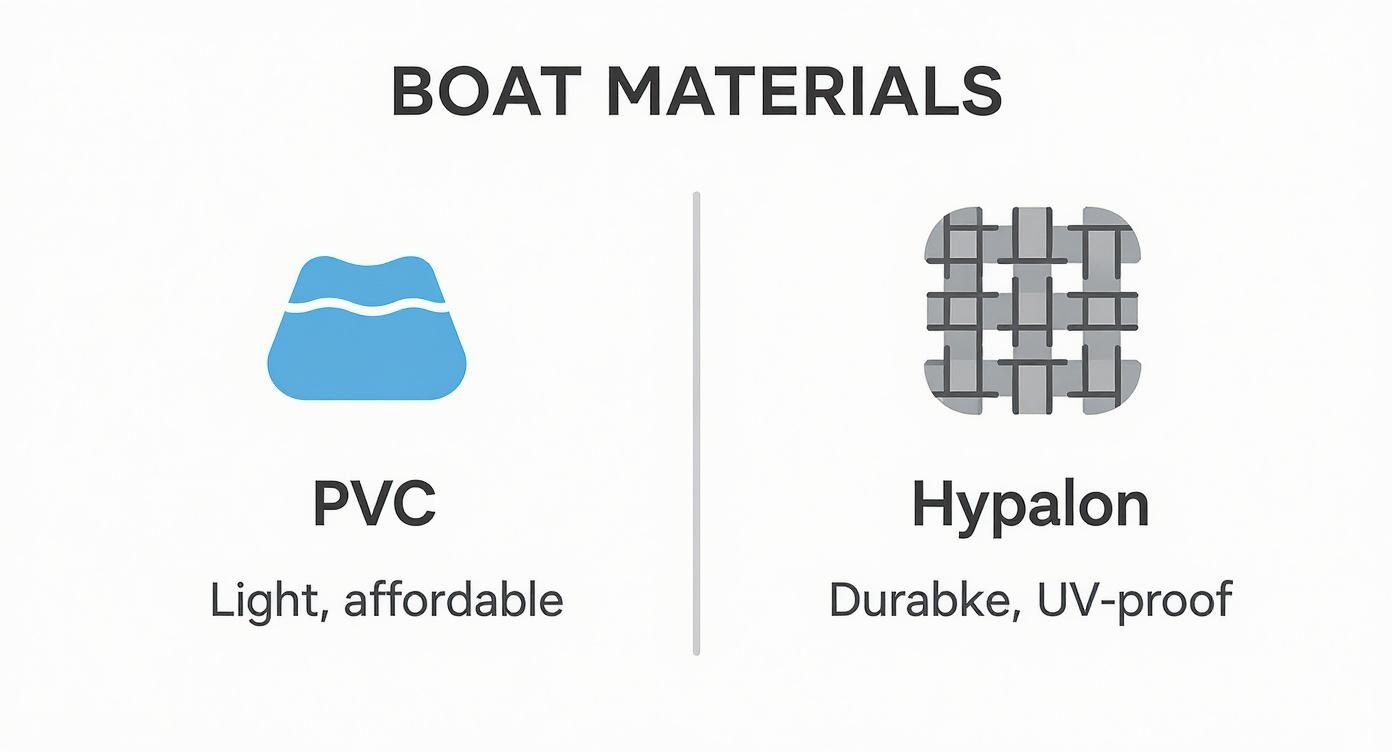
As you can see, lightweight and affordable PVC is common for recreational boats, while the tough, UV-proof Hypalon is the go-to for heavy-duty applications like RIBs that are constantly exposed to the elements.
This robust, go-anywhere design is why the RIB market is booming. In fact, it’s projected to grow from $1.46 billion to $2.07 billion by 2029, proving just how popular they’ve become for everything from defence and rescue operations to serious recreational boating.
Choosing a motor for your inflatable boat isn’t just a technical decision—it’s the choice that defines your whole experience on the water. It’s about finding that perfect sweet spot between power, portability, and what you actually plan to do out there. Will you be quietly exploring calm creeks or powering across a windswept bay? Your answer points you toward one of two main options: a traditional petrol outboard or a modern electric motor.
Getting this right is about more than just speed. You need to match the motor’s horsepower (HP) and weight to your boat’s specific limits, which you’ll usually find printed on the transom plate. Underpowering is frustrating—it’ll leave you struggling against wind and tide. But overpowering is flat-out dangerous, putting immense strain on the transom and making the boat unstable.
There’s a reason petrol outboards have been the go-to for so long. They offer an unbeatable power-to-weight ratio, giving you the grunt needed to get your boat up on a plane and the range to explore for hours without worrying about a battery dying on you.
For bigger inflatables, especially RIBs heading into open water, or for anyone planning long day trips, a petrol motor is almost always the most practical choice. They’re robust, reliable, and refuelling is as simple as carrying a spare jerry can.
On the other side of the coin are electric motors. Once just for small tenders or slow trolling, modern electric outboards have made massive leaps in power and battery life. Their biggest drawcard? They’re almost completely silent. This makes them the top choice for anglers who don’t want to spook the fish, or for anyone who just wants a peaceful day on the water.
They’re also incredibly eco-friendly, with zero emissions. This is becoming a huge deal in sensitive estuaries and freshwater lakes where petrol motors are often restricted.
An electric motor completely changes the nature of a boating trip. The silence allows you to hear the sound of the water and get closer to wildlife, creating a more immersive and relaxing experience.
This shift to cleaner, quieter power is undeniable. For a deep dive into the best options on the market, check out our complete guide on electric outboard motors in Australia.
So, how do you decide? The best way is to be honest about your typical boating style. Run through this simple checklist to weigh up what really matters for your adventures.
Your Motor Selection Checklist:
Thinking through these points will give you the confidence to compare models and find the motor that perfectly complements your inflatable boat and the adventures you have planned.
Knowing what you want in an inflatable boat is the first step. The next exciting part is actually finding the perfect one here in Australia. Navigating the local market is pretty straightforward once you know where to look, and it involves more than just a few quick online searches—it’s about engaging with the boating community and getting a real feel for different models.
The best approach when looking to compare prices and features of inflatable boats in your area is a mix of online homework and real-world experience. This way, you’re not just comparing price tags; you’re feeling the quality and seeing the features for yourself.
Your hunt for the ideal inflatable should start with a bit of digital and physical legwork. Online marketplaces and dealer websites are great for getting a baseline on prices and features, but nothing, and I mean nothing, beats seeing a boat in person.
A fantastic place to start is a local boat show. These events pull countless brands and models into one spot, letting you hop inside different boats, feel the materials, and chat directly with dealers and the people who make them. It’s a super-efficient way to get a solid feel for what’s out there.
Another goldmine is your local boating club. The members often have years of hands-on experience and are usually more than happy to give you the unfiltered truth about what works and what doesn’t in your local waters. Their insights can be priceless, helping you sidestep common mistakes and pointing you towards brands with a solid reputation.
Honestly, one of the smartest moves you can make is to hire an inflatable boat for a family day out or a fishing trip. This ‘try before you buy’ approach is your real-world test drive. It’s the best way to understand how a certain size or hull type actually handles on the water with your family or gear on board.
When looking for a place in Australia to hire inflatable boats, track down businesses with great reviews and a well-kept fleet. A quality rental should always include:
This isn’t just about having fun; it’s a crucial bit of research. It will give you the confidence that the boat you’re leaning towards is genuinely the right fit for you.
Hiring a boat for a day can tell you more than weeks of scrolling online. It brings all the small but vital details to the surface—like storage space, comfort on the water, and how easy it is to handle—that truly make or break your enjoyment.
Once you’ve got a shortlist, it’s time to dig into the details. The price is just one piece of the puzzle. A proper comparison ensures you’re getting the best long-term value, not just the cheapest deal today.
To make a truly informed choice, use this checklist when you’re weighing up different inflatable boat packages.
What to Compare Side-by-Side:
By carefully considering these points, you can see past the marketing fluff and choose a boat that will give you years of safe, fun adventures. For a curated list of top performers, check out our guide to the best inflatable boats in Australia, where we break down the models best suited for our local conditions.
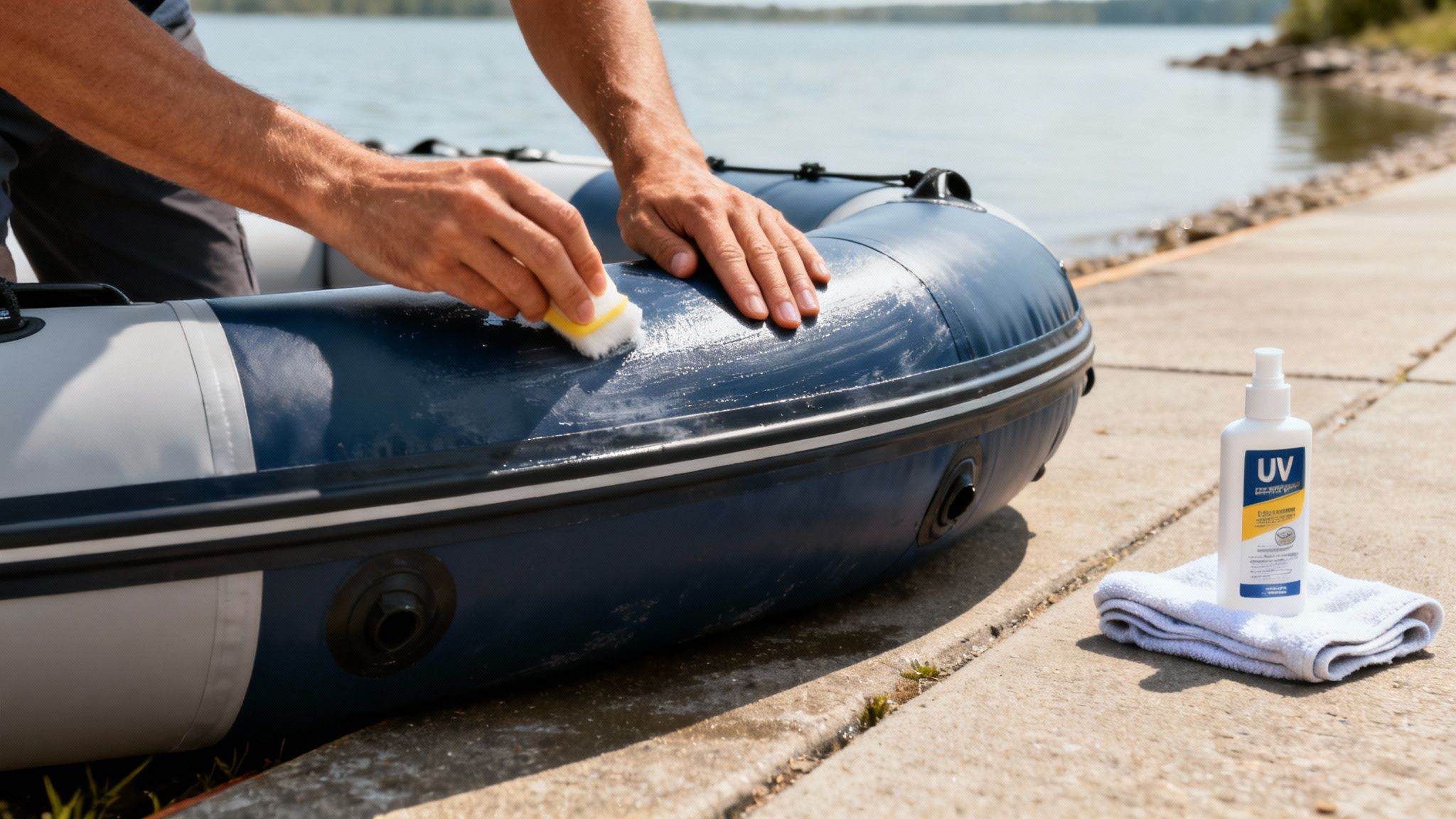
Proper care is the secret ingredient to making your inflatable boat last for years of adventure. Protecting your investment from Australia’s harsh conditions is simpler than you might think, and a little effort after each trip goes a very long way.
A good maintenance routine isn’t complicated, but it is crucial. It’s the difference between a boat that performs flawlessly for a decade and one that shows its age after just a few seasons. Consistency is key—it prevents small issues from turning into costly headaches.
Your first job after every single trip is a thorough freshwater rinse. Saltwater is incredibly corrosive and, if left to sit, will slowly eat away at your boat’s material, seams, and transom.
Pay close attention to the transom, valves, and any D-rings or attachments where salt can crystallise and hide. A gentle scrub with a mild, marine-safe soap will lift any grime, sand, or fish scales without damaging the fabric.
A quick word of warning: stay away from harsh, abrasive cleaners or citrus-based products. They can weaken the material and break down the adhesives over time. Once clean, let your inflatable dry completely in the shade before packing it away to stop mould and mildew in their tracks.
Protecting your boat from the sun is just as crucial as washing off the salt. The intense UV radiation in Australia is the single biggest factor in the ageing of an inflatable boat’s material, whether it’s PVC or Hypalon.
Think of a high-quality UV protectant spray as sunscreen for your boat. Applying it every few months creates a barrier that shields the fabric from sun damage, helping to prevent the fading, cracking, and premature wear that sends too many boats to an early grave. This is arguably the most important preventative measure you can take.
How you store your boat matters immensely. If you’re deflating it, take a moment to learn the correct folding technique from the manufacturer. Avoid sharp creases and tight folds, as these can create weak spots in the fabric over time. A loose, gentle roll is always best.
Knowing how to patch a small puncture will give you massive confidence on the water. It’s surprisingly easy with a quality repair kit. The process usually just involves cleaning the area, applying adhesive to both the patch and the boat, and pressing them firmly together. For a detailed walkthrough, check out our guide to inflatable boat maintenance made simple.
A simple seasonal check-up is also a fantastic habit to get into.
This small amount of effort ensures your inflatable boat stays in peak condition, always ready for your next trip to the water.
Jumping into the world of inflatable boats is exciting, but it naturally comes with a few questions. From getting it registered to keeping it in top shape, sorting out the basics means you can hit the water with confidence. Here are the answers to some of the most common queries we hear from Aussie boaties.
Whether you need to register your inflatable boat in Australia comes down to your state rules and, most importantly, the size of your motor. As a general guide, if you’re powering your boat with a motor of 4.0 kilowatts (around 5hp) or more, you’ll almost certainly need to register it with your local maritime authority, like Transport for NSW or Maritime Safety Queensland.
Before you even think about launching, your first stop should be their official website. You’ll find the exact requirements, forms, and fees for your area. A quick check will keep you on the right side of the law and save you from any nasty fines.
The specific safety gear you have to carry depends on your state’s regulations and where you’re boating—calm, enclosed waters have different rules than the open sea. But some items are simply non-negotiable for every inflatable boat in Australia.
Every boatie should have these essentials on board:
And if you’re running a petrol motor, a fire extinguisher is mandatory. Always grab your state’s maritime safety guide for the full, up-to-date checklist.
Yes, you can absolutely leave a quality inflatable inflated for a whole season, especially a tough Hypalon model, but you have to protect it. The harsh Aussie sun is your boat’s number one enemy, so a snug-fitting, UV-resistant boat cover isn’t just a good idea—it’s essential for preventing fabric damage.
Keep in mind that air pressure changes with the temperature. On a scorcher of a day, the air inside your boat’s tubes will expand. You’ll need to check the pressure and let a little air out to stop it from over-inflating and stressing the seams.
While it’s convenient to keep it ready to go, the best thing for your boat’s longevity is to clean it, dry it completely, and deflate it for long-term or off-season storage. That simple routine will add years to its life and keep it primed for your next adventure.
Ready to find the perfect inflatable boat package for your Australian adventures? At Easy Inflatables, we specialise in high-quality, durable boats designed for our unique conditions. Explore our full range and get expert advice today.