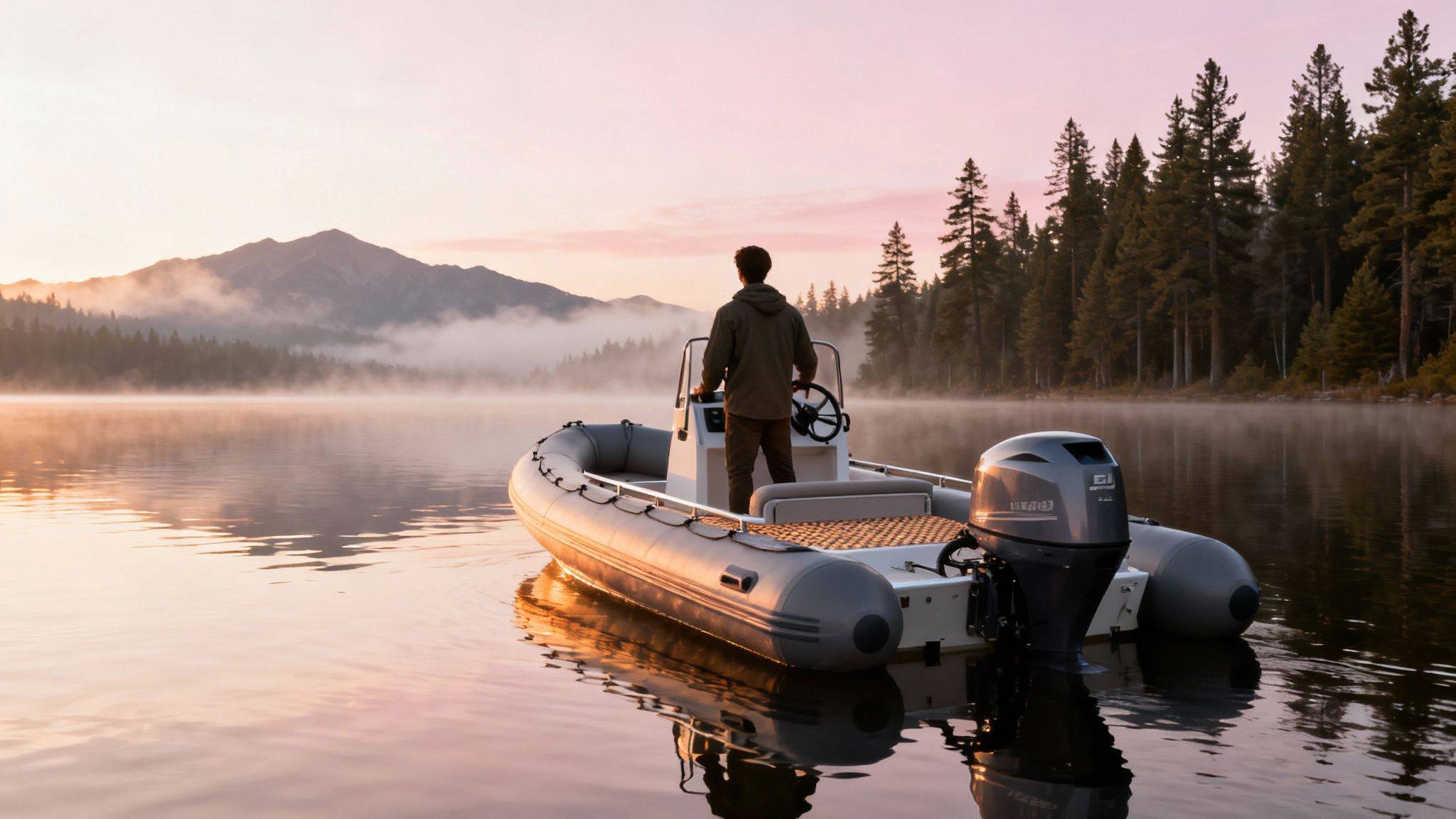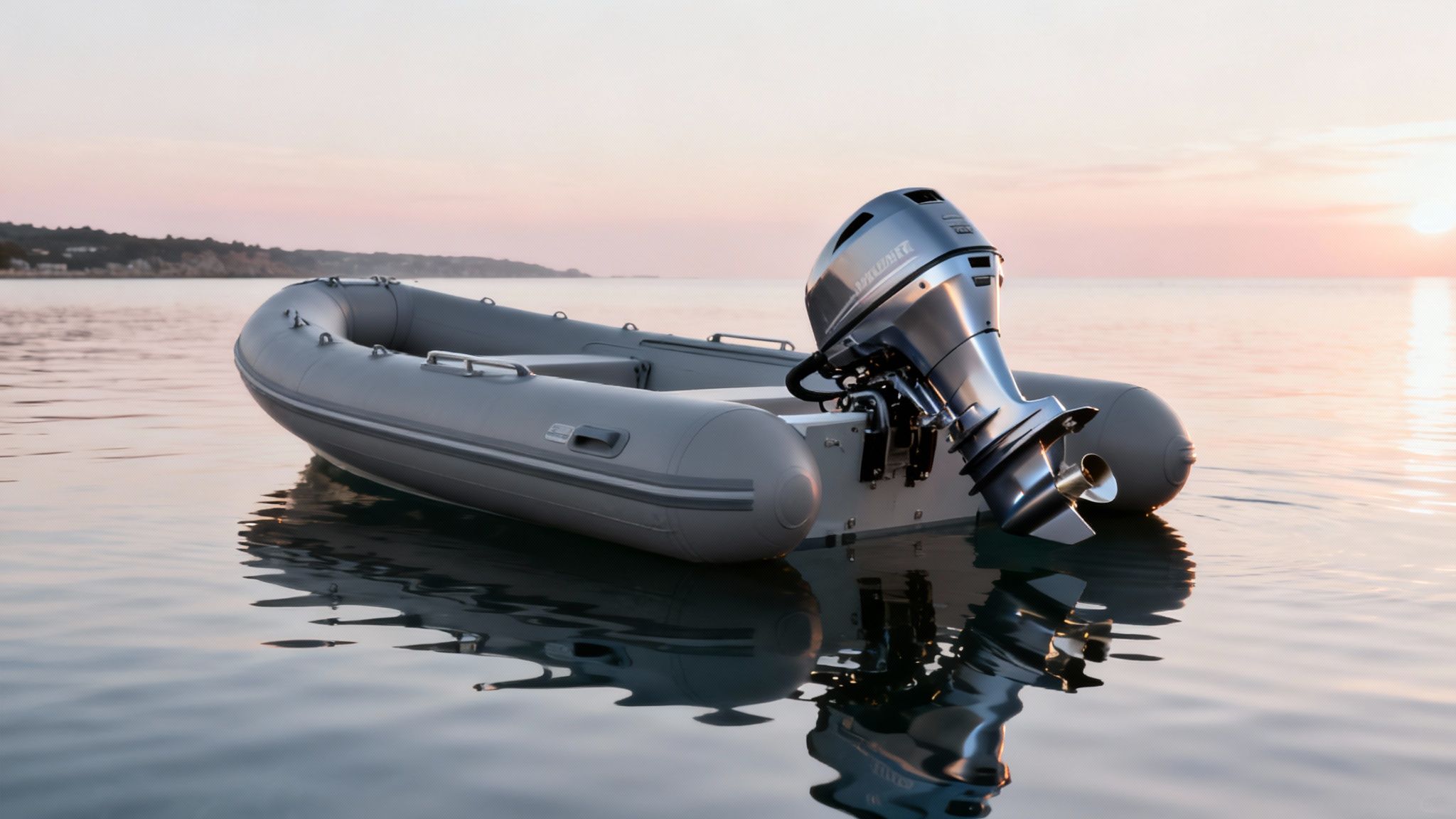
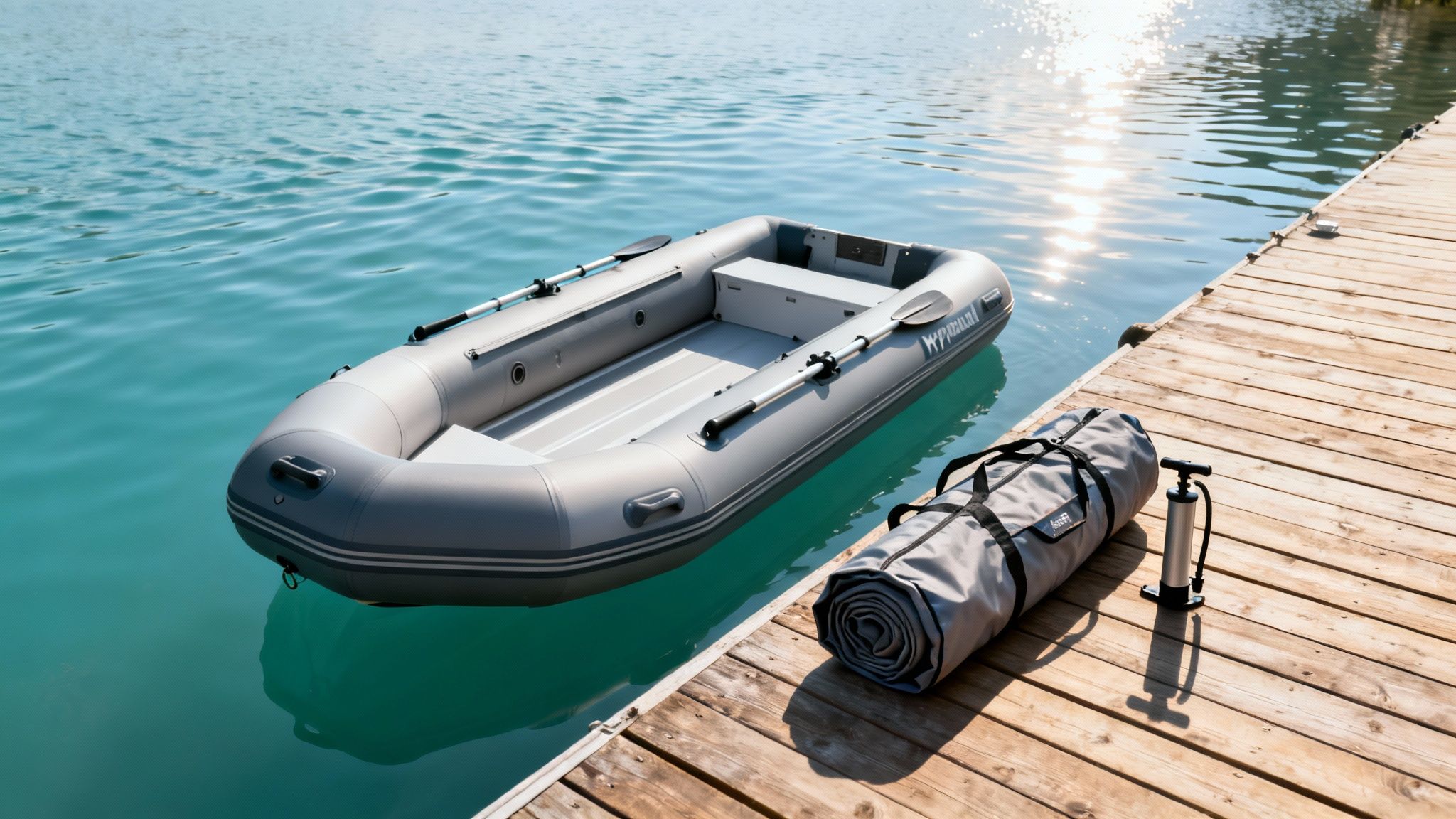

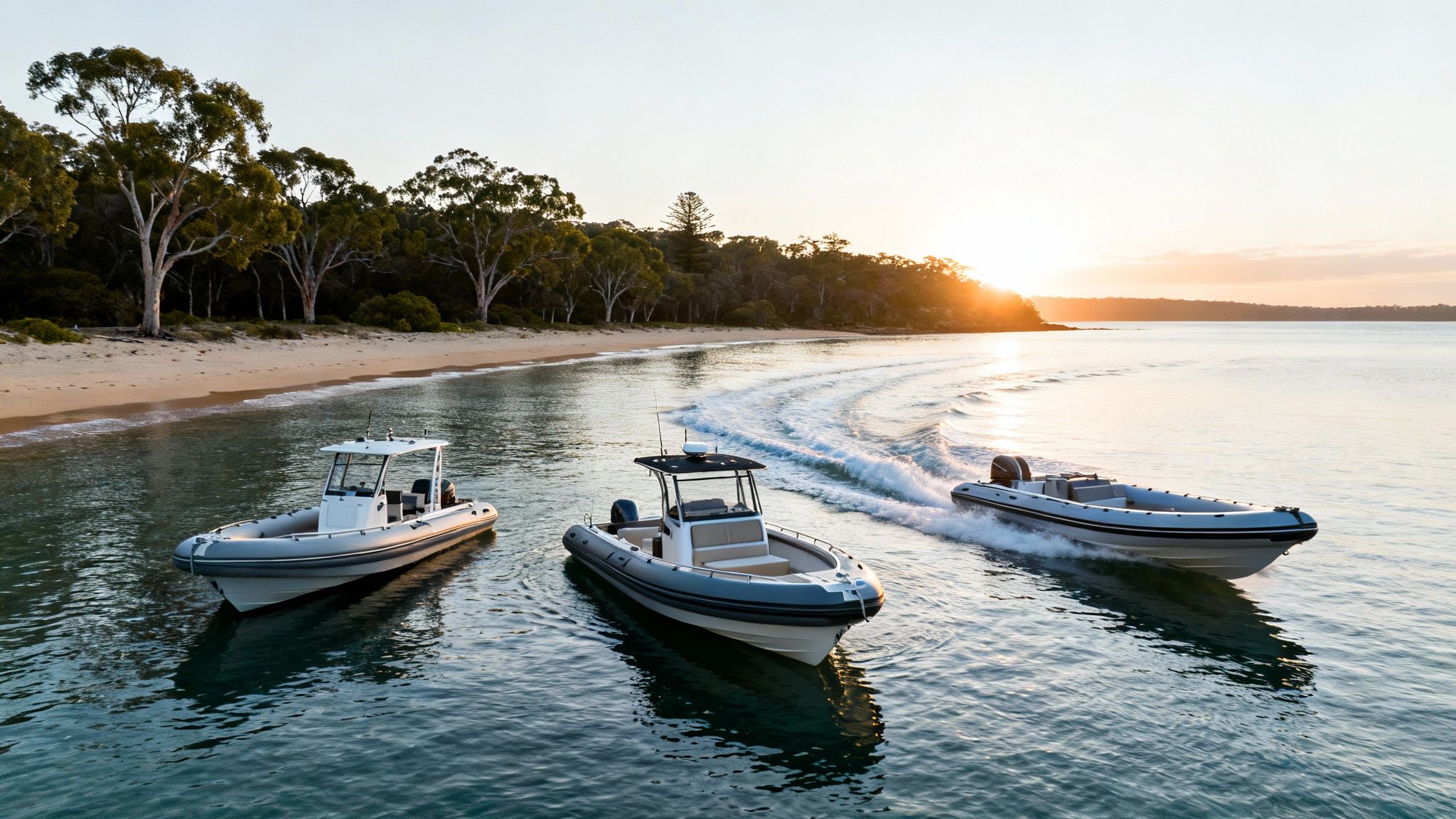
Welcome to your complete guide to inflatable boats in Australia. If you’re looking to get out on the water, you’ve come to the right place. This resource is designed to walk you through everything you need to know, whether you’re searching for the best inflatable boats for recreational use near you, comparing prices and features in your area, or wanting to hire one for a family outing.
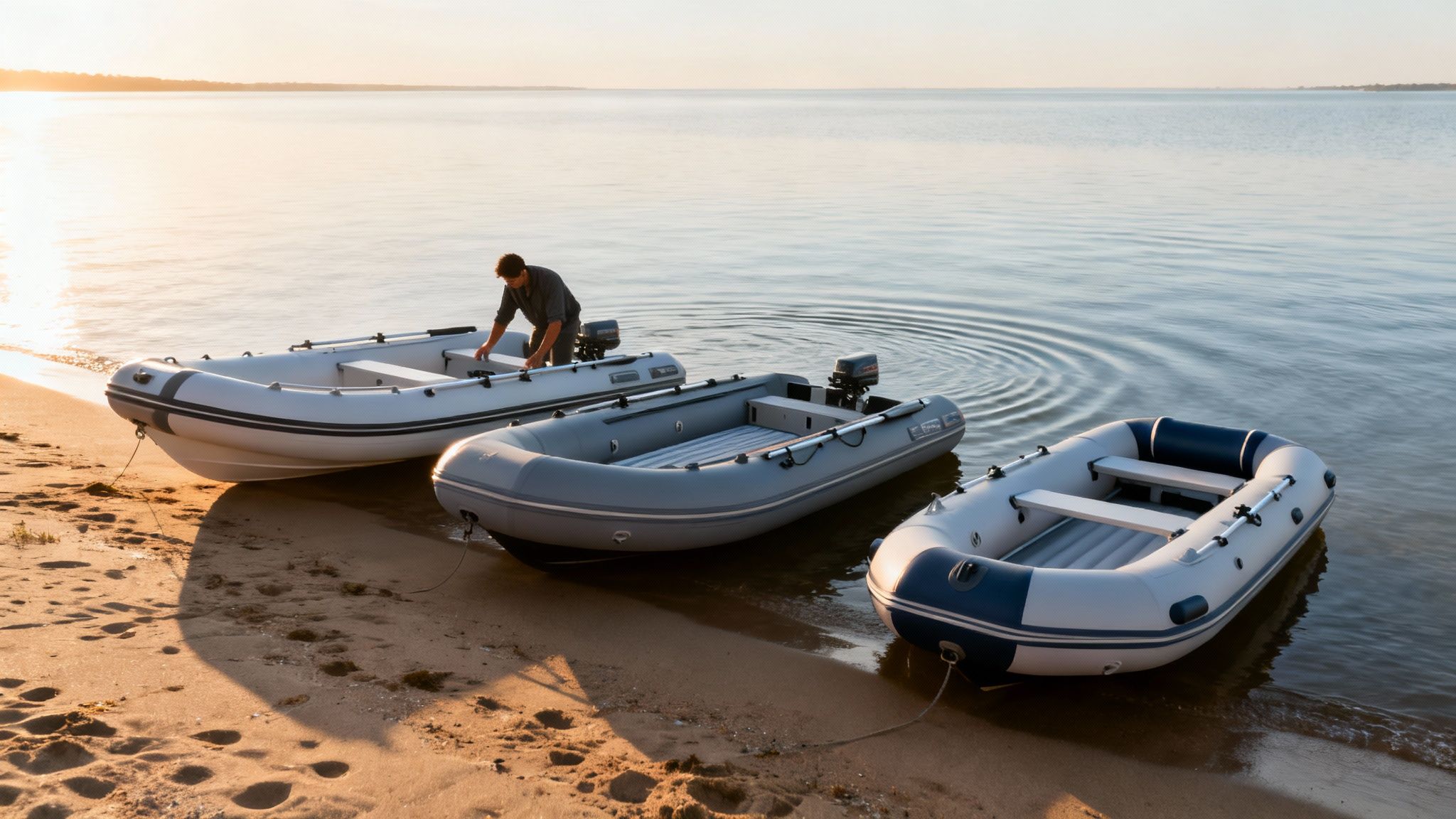
Inflatable boats deliver a brilliant mix of convenience, performance, and value, which is why they’re such a popular choice for Aussies keen to explore our stunning coastlines and waterways. From compact models you can toss in the car boot to high-performance vessels that can handle the open sea, there really is an inflatable boat for every kind of adventure.
And their popularity isn’t just a feeling. The Australian market for inflatable vessels has seen some serious growth, hitting a value of $25 million in 2024 — that’s a 7.3% jump from the year before. This boom is all thanks to our growing love for getting out on the water, with over 120,000 soft hull inflatable boats sold here in 2023 alone. You can learn more about what’s driving the growing Australian market for inflatable boats.
To find the right boat, you first need to get your head around the main categories. Each type is built for specific activities and environments, which affects everything from how stable it feels to how fast it can go. Our goal is to give you that foundational knowledge so you can make a choice you feel good about.
Here’s a quick rundown of what you’ll find:
Here’s a simple way to think about it: a soft-hull is like a versatile hatchback—perfect for city trips and easy to park. A RHIB, on the other hand, is like a tough 4×4, built to handle rough terrain with power and confidence. Both get you from A to B, but they shine in very different conditions.
To give you a clearer picture, the table below breaks down the options at a glance. We’ll dive deeper into the unique advantages and specific benefits of buying an inflatable boat as we go through this guide.
Here’s a straightforward comparison to help you see the key differences between the main types of inflatable boats available in Australia. This table sums up what they’re best for, their standout feature, and what you can expect to pay.
| Boat Type | Primary Use | Key Advantage | Average Price (AUD) |
|---|---|---|---|
| Soft-Hull Inflatable | Fishing, tenders, family fun | Ultimate portability and storage | $500 – $3,500 |
| Air Deck Boat | Portable performance, tenders | Lightweight with a rigid feel | $1,000 – $4,500 |
| Rigid Hull (RHIB) | Ocean cruising, watersports | Superior stability and speed | $5,000 – $50,000+ |
| Inflatable Kayak | Solo exploring, fishing | Easy transport and access | $300 – $2,000 |
As you can see, there’s a huge range in both function and price. The right choice really comes down to how you plan to use it and what your budget looks like.
If you’re asking, “what are the best inflatable boats for recreational use available near me?”, you’re focused on the right thing: matching a boat to your specific adventures. How you plan to enjoy Australia’s magnificent waterways will steer your decision, whether you’re casting a line in a quiet estuary or cruising the coast with the family. The real secret is matching the boat’s features to your favourite activities.
It’s a simple approach that’s catching on everywhere. The recreational market is the engine driving Australia’s inflatable boat scene, with over 120,000 soft hull units sold in 2023 alone. This boom is all thanks to a growing love for watersports and family outings across our 10,000+ beaches, making Australia a standout market in the Asia-Pacific. If you’re interested in the numbers, you can read the full research about the inflatable boats market.
Let’s look at a few practical scenarios to help you pinpoint the perfect inflatable for your adventures.
If your idea of a perfect day involves a fishing rod and calm waters, stability is your number one priority. A great fishing inflatable needs to be a steady, reliable platform for casting, reeling, and moving about without that tippy feeling. For this, you’ll want to look for models with wider beams and a solid floor.
A high-pressure air floor, often called a drop-stitch floor, is a brilliant choice for anglers. It inflates to become surprisingly firm, giving you a solid surface to stand on while still being lightweight and easy to pack away. It’s the perfect setup for a portable fishing tender you can take anywhere.
Another fantastic option is a sectional aluminium floor. It’s a bit heavier, but it delivers maximum rigidity and can take a beating from dropped tackle, anchors, or the occasional sharp fin. For those who often fish with a mate, the solid footing of an aluminium floor is pretty hard to top. Check out our detailed guide on the versatility of an inflatable boat to see how different floor types measure up.
When the whole family is coming along for the ride, your focus naturally shifts to space, safety, and comfort. Ample seating and high buoyancy tubes are non-negotiable for a family-friendly inflatable. These big tubes not only provide excellent stability but also double as comfortable, secure backrests for the kids.
Look for boats with a generous maximum person capacity and plenty of internal space for eskies, beach bags, and all the other gear a family day out requires. A larger boat, maybe 3.6 metres or more, will give everyone enough room to stretch out and relax without feeling cramped.
A boat with a deep V-keel is also a huge advantage for family outings. Think of the keel as the boat’s spine—it helps the vessel cut through waves smoothly rather than slapping against them. This results in a much drier, more comfortable ride, which is essential for keeping everyone happy on longer trips.
If you’re looking to inject a bit of adrenaline into your weekends with some tubing or waterskiing, your attention needs to be on power and structural strength. The heart of any watersports-capable inflatable is its transom—the flat, reinforced panel at the back where you mount the outboard motor.
A seriously robust transom, usually made from solid marine-grade plywood or aluminium, is absolutely critical. It has to be tough enough to handle the torque and thrust from a more powerful engine, often 15 HP or more. Without a properly reinforced transom, the force from the motor could cause some real damage.
On top of that, boats with rigid floor systems, like aluminium or fibreglass, provide the stiffness needed to get on a plane quickly and tow a rider effectively. It’s this combination of a strong transom and a rigid floor that transforms your inflatable from a simple cruiser into a proper watersports machine.
When you need raw power and rock-solid stability, you’re looking for a Rigid Hull Inflatable Boat, better known as a RHIB. These boats are a unique hybrid, blending the best bits of a traditional hard-shelled boat with the incredible buoyancy and shock-absorbing ride of an inflatable. They are the undisputed workhorses of the inflatable world.
At its heart, a RHIB has a solid, V-shaped hull, usually built from tough fibreglass or lightweight aluminium. This rigid foundation is then ringed by large, heavy-duty inflatable tubes, often called pontoons or sponsons. It’s this combination that gives RHIBs their legendary performance.
The solid hull lets the boat slice cleanly through choppy water and handle powerful outboard motors with ease. At the same time, the inflatable tubes provide unbelievable stability, making it extremely difficult to capsize. This dual-natured design is why they’re the go-to choice for serious adventurers, rescue services, and even military forces across Australia.
The secret to a RHIB’s superior handling is all about how its two main parts work together. The deep V-hull gives you a smooth ride by cutting through waves instead of bouncing over them like a flat-bottomed boat would. This design also allows for higher speeds and sharper cornering, making RHIBs feel incredibly responsive and secure, even in rough seas.
Meanwhile, the inflatable tubes act like giant shock absorbers, softening the impact from waves and creating a much more comfortable trip for everyone on board. They also add a massive amount of buoyancy, allowing RHIBs to carry heavier loads of people and equipment compared to soft-hull inflatables of a similar size. You can take a closer look at specific models in our guide to the rigid hull inflatable.
RHIBs are engineered to last, especially in harsh environments like the Australian coast. The materials are chosen specifically for their strength and ability to stand up to sun, salt, and the occasional knock.
This robust construction has cemented the RHIB’s dominant position in Australia’s inflatable boat market, a sector valued at an impressive USD 18.0 million for 2025. This growth is largely driven by strong demand from marine patrol and defence. On the recreational side, their stability makes them a favourite for adventure tourism, particularly in Queensland and New South Wales.
This decision tree can help you visualise which type of inflatable boat might best suit what you want to do, whether it’s fishing, family fun, or watersports.
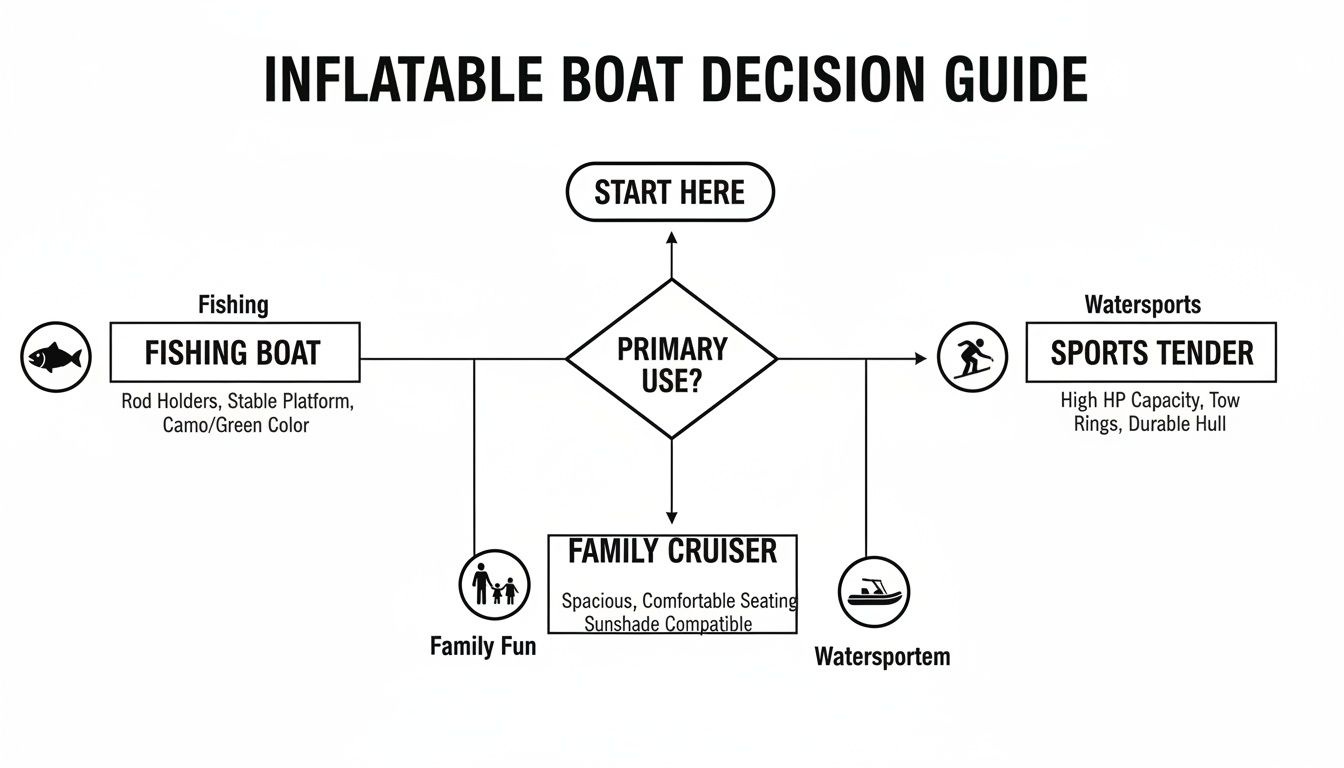
As the flowchart shows, when your needs lean towards high performance, the path often leads to more robust models like RHIBs.
In essence, choosing a RHIB is an investment in capability. While they come with a higher price tag and require more space for storage and transport, their payoff is unmatched performance, safety, and versatility for anyone serious about exploring the water without limitations.
If you’re looking to compare prices and features of inflatable boats in your area, you’ve come to the right place. With so many models, materials, and brands out there, it’s easy to get lost. But if you know what to look for, you can compare your options like a pro and find the perfect boat for your budget.
The sticker price is influenced by a handful of key factors. Once you understand these, you’re empowered to look beyond the initial cost and see the real, long-term value of your investment. Let’s break it down.
The biggest drivers of cost are the materials used, the type of floor, the boat’s size, and the brand behind it. Each one plays a huge role in how the boat performs, how long it lasts, and ultimately, what it’s worth.
A good way to think of it is like the foundation of a house. An air deck is like a relocatable home—light and easy to move. An aluminium floor is like a concrete slab—it’s heavier but gives you a super stable base for more serious activities.
It’s tempting to just grab the cheapest model you can find, but it’s so important to think about the total cost of ownership. That less expensive PVC boat might seem like a bargain, but if you’re up in sunny North Queensland, that intense UV exposure could break down the material faster than you’d like.
In that situation, a pricier Hypalon boat suddenly becomes a much smarter long-term investment. Its ability to handle the sun and saltwater means it will last longer and hold its value better, saving you cash on repairs or a premature replacement. To get a better handle on these details, it’s worth reading about the different options you have when comparing prices and features of inflatable boats in your area. It’ll help you make a choice that’s right for your local conditions.
To really put all this into perspective, let’s look at some common setups you’ll find around Australia. This table breaks down how different models stack up, helping you connect their features directly to the price tag.
An analysis of different inflatable boat models available in Australia, comparing their key specifications and typical retail prices.
| Model Type | Material | Length (m) | Max Persons | Floor Type | Approx. Price (AUD) |
|---|---|---|---|---|---|
| Small Tender | PVC | 2.4 | 2 | Air Deck | $800 – $1,500 |
| Fishing Boat | PVC | 3.2 | 4 | Aluminium | $1,800 – $3,500 |
| Family Cruiser | PVC | 3.8 | 6 | Air Deck | $2,500 – $4,500 |
| Heavy-Duty RHIB | Hypalon | 4.2 | 7 | Fibreglass | $7,000 – $20,000+ |
As you can see, a small PVC tender is an awesome, accessible way to get on the water. At the other end, a big Hypalon RHIB represents a serious investment in performance and durability that will last for years.
Ultimately, comparing inflatable boats properly is all about matching your needs and local conditions to the right mix of features. That way, you know every dollar you spend is going toward a better, safer, and more enjoyable time on the water.
Hiring an inflatable boat is a fantastic way to organise a family outing on Australia’s incredible waterways without the long-term cost and hassle of ownership. It’s all about freedom—crafting your own adventure, whether that’s a chilled-out day on the river or coastal exploring. Finding a recommended place to hire inflatable boats is key to a great day, ensuring the company puts your family’s safety first.
This guide will recommend some of the best places in Australia to hire an inflatable for a family outing. We’ll also cover what to look for in a rental company to make sure your day on the water is smooth sailing from start to finish.
Australia is spoiled for choice with thousands of kilometres of coastline and countless inland rivers and lakes, making it a boater’s paradise. Naturally, some regions have become hubs for boat hire, thanks to their stunning scenery and calm, easy-to-navigate waters perfect for a family outing.
Here are a few top-tier destinations worth checking out:
Choosing the right hire company is just as important as picking the right spot. A professional, safety-conscious operator will make sure you have everything you need for a stress-free day.
A tell-tale sign of a quality hire company is how thorough their safety briefing is. They shouldn’t just toss you the keys. They should walk you through how the boat works, point out all the safety gear, and explain the local waterway rules and any potential hazards.
Before you lock anything in, double-check that the hire service provides:
A little bit of planning goes a long way in making sure your day is a roaring success. During peak holiday seasons or on those perfect sunny weekends, inflatable boats get snapped up fast, so it’s always a good idea to book in advance.
When you call to book, have a few questions ready to make sure the boat is a good fit for your group. Ask about the boat’s maximum person and weight capacity, its engine size (which affects speed and how much fuel you’ll use), and exactly what’s included in the hire fee. Getting this clarity upfront helps avoid any surprises and ensures the boat is perfectly matched to your plans for the day.
Owning an inflatable boat is all about freedom and simplicity, but a little bit of care goes a long way in protecting your investment. Think of maintenance not as a chore, but as the secret to keeping your boat safe, reliable, and ready for adventure year after year. By building a few simple habits, you’ll ensure your vessel stays in top nick.
The single most important thing you can do is clean your boat after every single use, especially after being in saltwater. Salt is brutally corrosive and will eat away at both the fabric and the glues holding your boat together if left unchecked. A quick rinse with fresh water and a wash-down with a mild, boat-friendly soap is all it takes to get rid of damaging salt, sand, and grime.
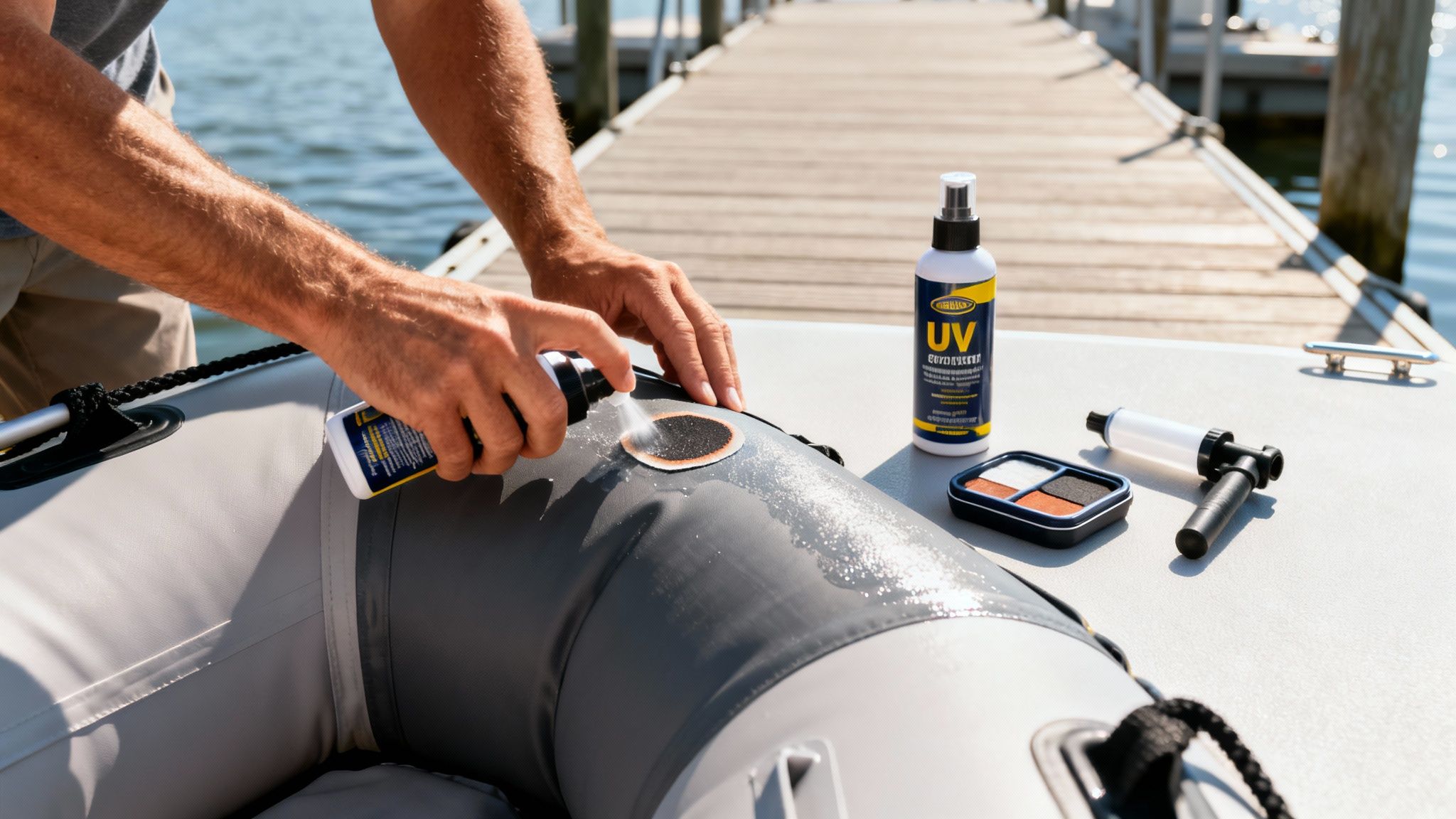
Here in Australia, the sun is relentless, and it’s one of the biggest enemies of an inflatable boat. Over time, ultraviolet (UV) radiation breaks down both PVC and Hypalon, causing the material to fade, turn brittle, and eventually fail. This is where a quality UV protectant spray becomes your absolute best mate.
Regularly applying a specialised protectant is like putting sunscreen on your boat. It forms a barrier that shields the fabric from the sun’s harsh rays, dramatically extending its lifespan. For a deeper look into simple upkeep routines, have a read of this guide to inflatable boat maintenance made simple.
Getting the inflation right is crucial for performance and safety. Always, always use a pressure gauge and inflate your boat’s chambers to the manufacturer’s recommended PSI. It’s easy to over-inflate, especially on a hot day when the air inside expands, putting massive stress on the seams that can lead to a dangerous rupture.
Even if you’re careful, small punctures can happen. Knowing how to patch a hole is an essential skill every inflatable owner should have.
Good maintenance all comes down to regular checks. Before you head out, take five minutes to inspect the valves, seams, and floor for any signs of wear or damage. Catching a small issue on the driveway is always better than discovering it out on the water.
Of course, a well-maintained boat is only one part of the equation. Having the right safety gear on board is non-negotiable. This essential boat safety equipment checklist is an excellent resource that every Aussie boater should run through before hitting the water.
Jumping into the world of inflatable boats is exciting, but it naturally comes with a few questions about rules, safety, and keeping your boat in top shape. Getting the right answers is the key to enjoying your time on the water with total confidence.
Here, we tackle the most common queries we hear from Aussie boaters, giving you straightforward advice to help you get out there and explore.
This is one of the first and most important questions people ask, and the answer comes down to where you are and what motor you’re running. In Australia, licencing rules are handled by each state, and they’re almost always based on your engine’s power or the boat’s potential speed.
For instance, in New South Wales, you’ll need a boat driving licence if your vessel can hit 10 knots (that’s about 18.5 km/h) or more. Over in Queensland, the rule is different: a licence is required if your boat has a motor stronger than 4.5 kW (roughly 6 HP). It is absolutely essential to check the specific regulations with your local maritime authority before you even think about hitting the water.
Absolutely. Many modern inflatables are built for the ocean, with Rigid Hull Inflatable Boats (RHIBs) being especially suited for coastal conditions. Their big inflatable tubes aren’t just for show—they provide incredible buoyancy and act like natural shock absorbers, making for a ridiculously stable ride that’s often less likely to capsize than a traditional hard-sided boat.
But safety is never just about the boat. It always comes down to good preparation and even better judgement. That means choosing the right model for the conditions, packing all the required safety gear like life jackets and flares, checking the weather forecast like your life depends on it (because it does), and never pushing your boat, or your own skills, past their limits.
Think of it like this: a well-built inflatable is a very capable vessel, but the skipper is always the most important safety feature on board. Your decisions are what guarantee a great day at sea.
Proper storage is the secret to making your inflatable last for years. Your main goals are simple: protect it from moisture, sunlight, and physical damage. First things first, always give it a good clean and make sure it’s completely dry after every use to stop mould and mildew from moving in.
If you’ve got the room, the ideal way to store it is partially inflated in a cool, dry spot away from direct sunlight. If you need to pack it down, avoid folding it into sharp creases, which can weaken the material over time. Instead, roll it up loosely before putting it in its storage bag. A protective cover is always a good idea, and remember to never stack heavy items on top of it.
Ready to find the perfect vessel for your next adventure? Easy Inflatables offers a premium range of Aerowave inflatable boats, catamarans, and RIBs designed for Australian conditions. Explore our customisable, high-performance models and find your ideal setup today. Visit us at https://easyinflatables.com.au.