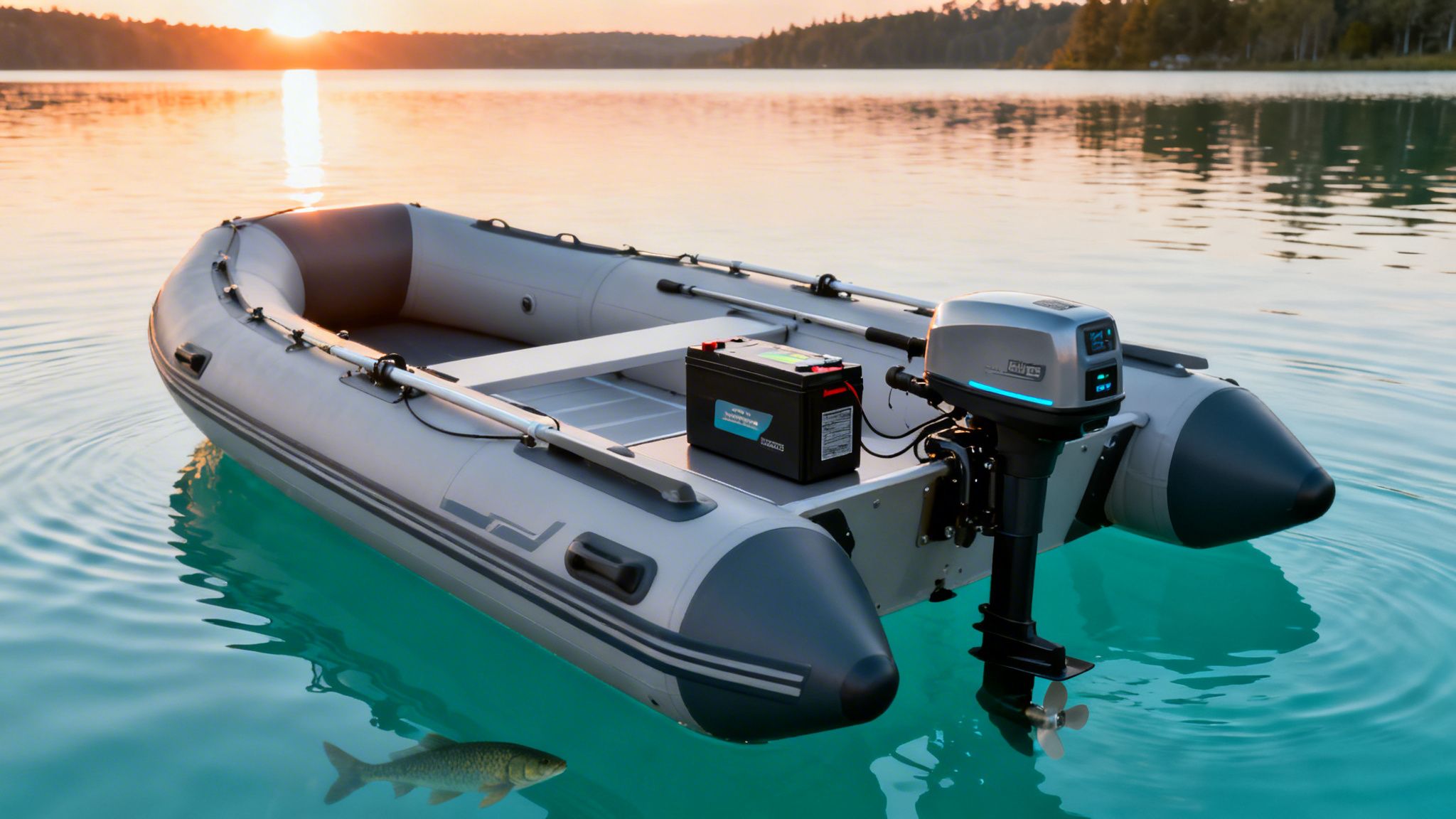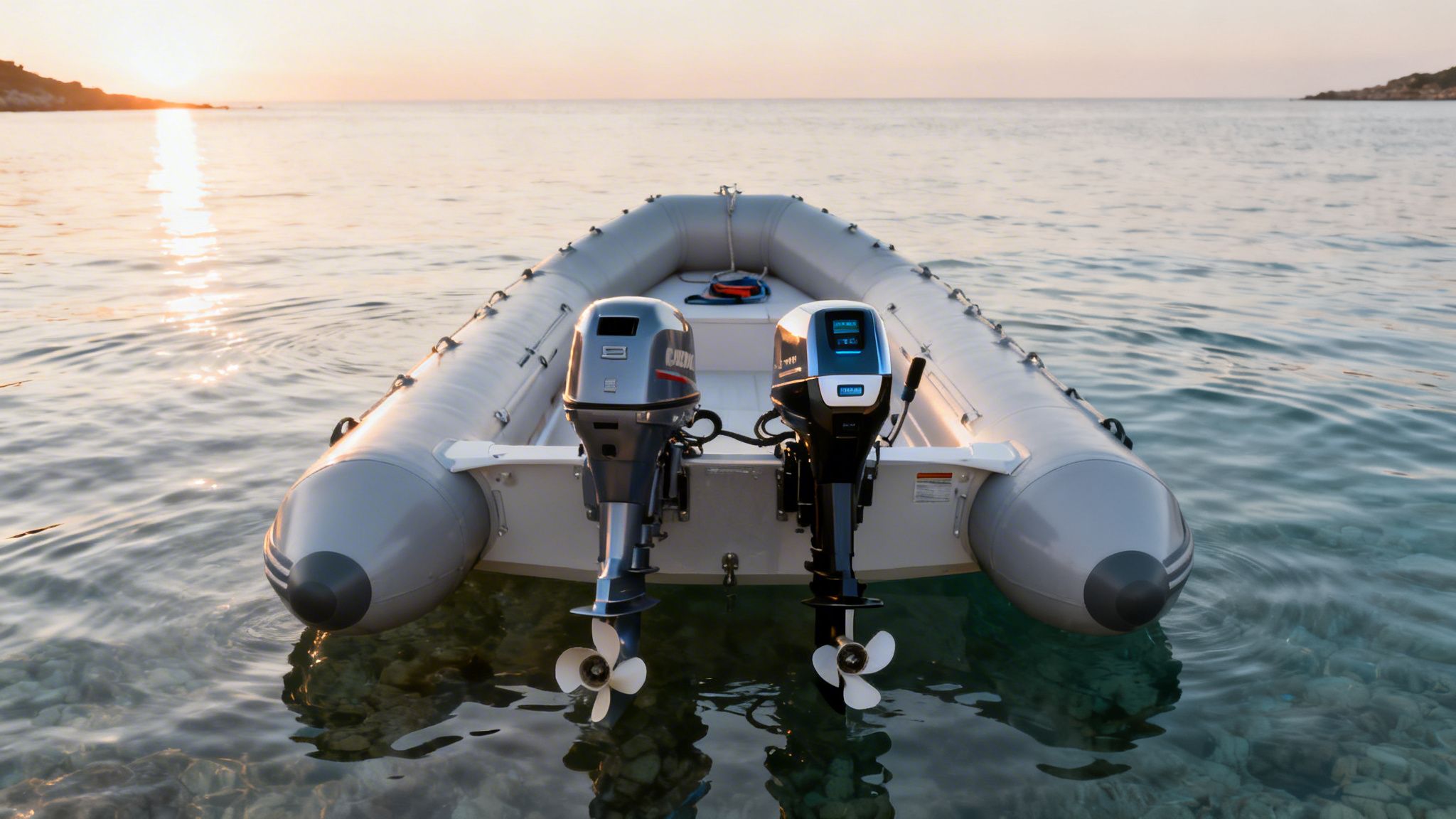
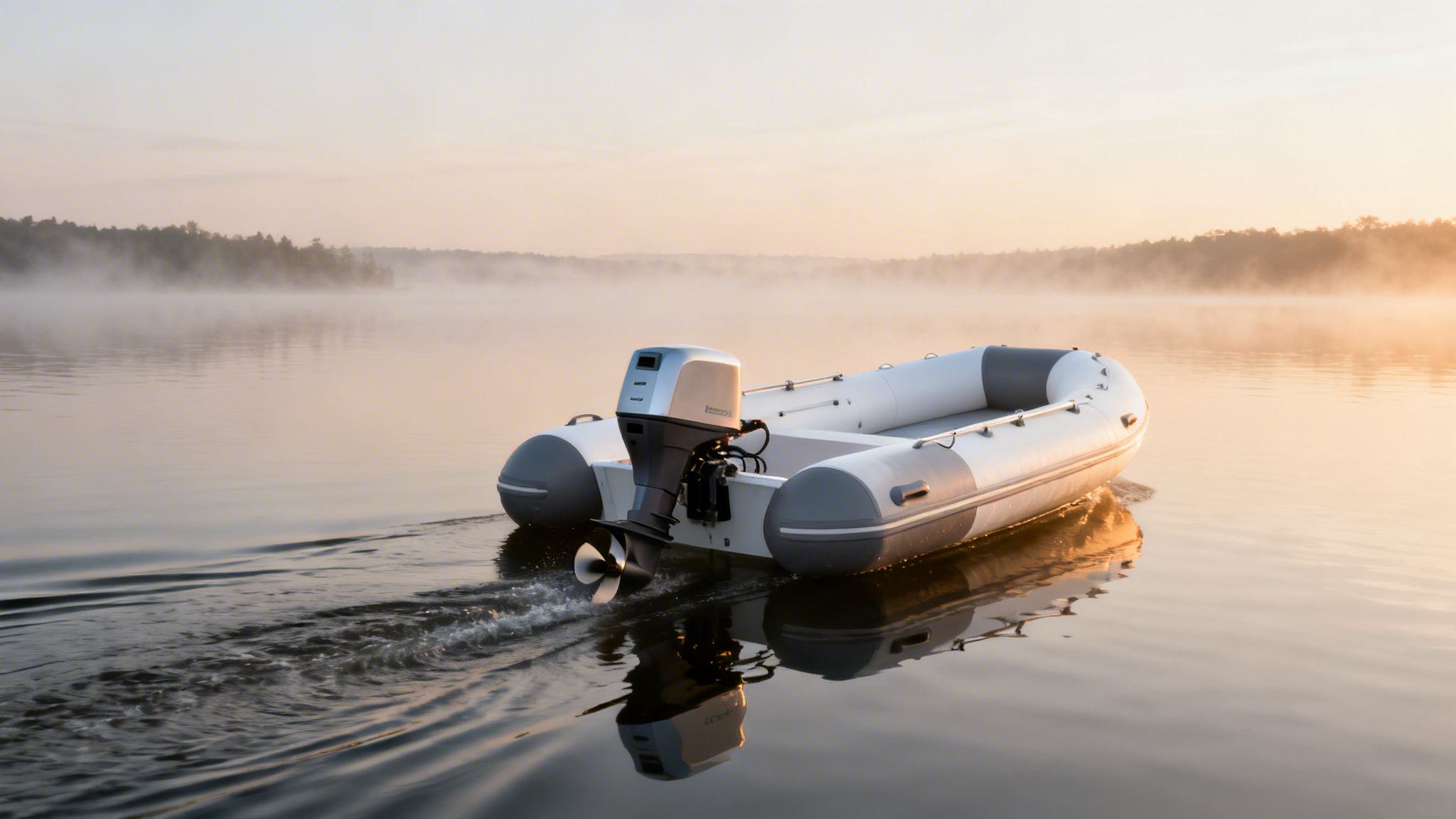

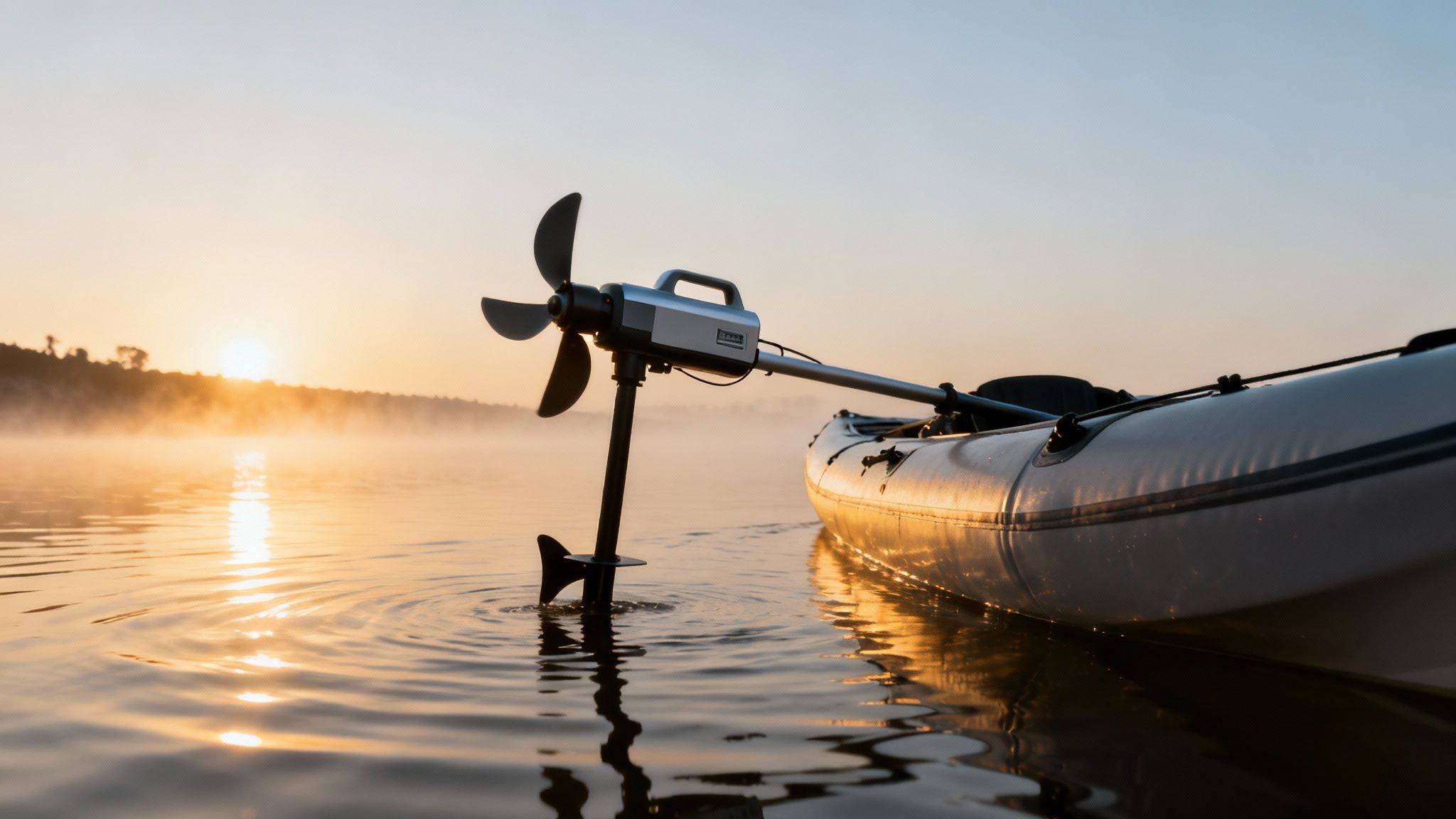
Think of a kayak trolling motor as a small, quiet electric motor that gives you hands-free power on the water. It’s the ultimate upgrade for anglers and explorers who want to spend more time fishing and less time paddling.
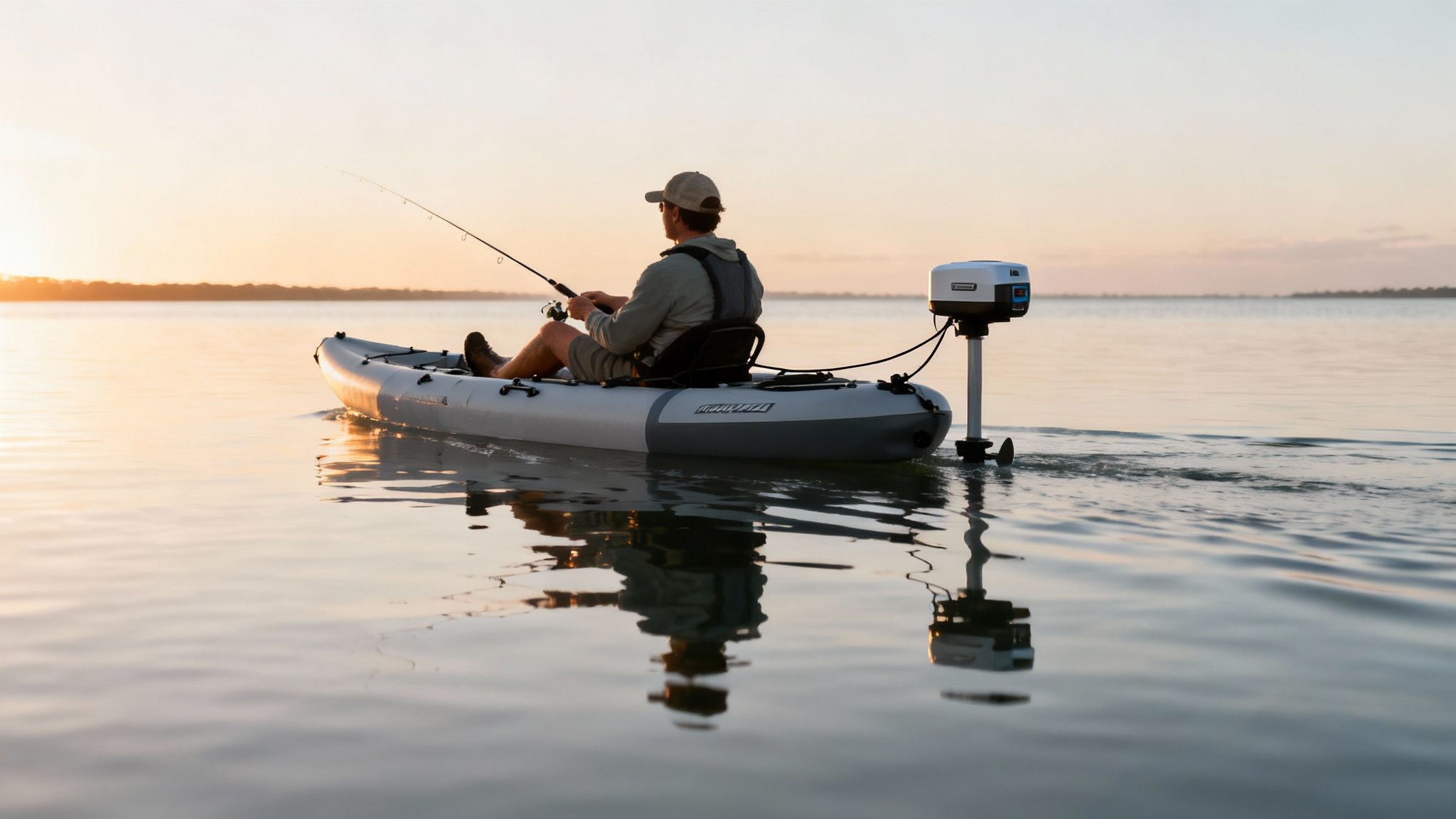
Paddling is a great workout, but it has its limits. Ever tried to hold your position over a perfect fishing spot while fighting a stiff breeze? It can turn a relaxing day into a real battle. This is where a kayak trolling motor becomes an absolute game-changer, especially for inflatable boats.
Imagine gliding across your favourite estuary or holding steady in a current—all without picking up a paddle. That’s the freedom a trolling motor gives you. It transforms your kayak from a purely manual craft into a quiet, efficient little vessel ready for bigger adventures.
The idea of adding a motor isn’t new, but the technology has come a long way. The days of clunky, noisy petrol motors are being left behind for lightweight, silent, and eco-friendly electric options. This is a huge trend right across Australian boating.
In fact, the number of registered electric-powered recreational boats—including inflatables and kayaks—has shot up by nearly 300% in just eight years. We went from around 1,200 in 2015 to over 4,800 by 2023. This boom is happening because prices are dropping and there’s a much wider selection, making electric power more accessible than ever for Aussie families and anglers looking to hire or compare prices and features of inflatable boats for a family outing.
For the modern adventurer, a trolling motor isn’t just an accessory; it’s a fundamental upgrade that unlocks new possibilities on the water. It provides stealth for fishing, efficiency for exploring, and convenience for simply enjoying your time.
Modern inflatable boats are built with this evolution in mind. Many, like our Aerowave series, come standard with a sturdy transom mount specifically designed for attaching a motor. This integrated design means you get a stable, secure, and ready-to-go platform from day one. All you need to do is pair it with the right battery and mounting hardware, which is simple when you explore the available kayak accessories in Australia.
This guide is your complete roadmap to confidently choosing, installing, and maintaining the perfect kayak trolling motor for your inflatable boat. Let’s get started.
Before we start talking about power ratings and battery chemistry, let’s get the basics down. Think of a kayak trolling motor less like a roaring speedboat engine and more like a silent, precision tool for navigating the water. Its real job isn’t about breakneck speed; it’s all about controlled, quiet movement.
This control is what makes it such a game-changer. For an angler, it means hands-free fishing while the motor quietly holds you steady against the wind or current. For someone exploring a calm lake, it’s about covering more ground with less paddle-power, saving your energy for the destination itself.
Trolling motors generally come in two main flavours, depending on where they attach to your boat:
For inflatable boats and kayaks, the transom mount is the go-to choice, hands down. Their design is a perfect match for the solid transoms found on models like our Aerowave series. They are incredibly easy to clamp on and take off, which is ideal for a portable setup you can pack in the car.
This is one of the most important distinctions to get right, especially here in Australia. It might seem like a small detail, but picking the wrong one is a fast track to a dead motor and a costly mistake.
Using a freshwater motor in a coastal estuary or out on the bay is a recipe for disaster. The salty, humid air will get to work corroding the internal electronics and any unprotected metal parts with surprising speed.
A dedicated saltwater trolling motor isn’t a luxury—it’s a non-negotiable for coastal Australian waters. It’s built with corrosion-resistant materials like stainless steel, has special protective coatings, and features sealed electronics to shield it from the harsh marine environment.
Saltwater models are engineered to last in these tough conditions. They use higher-grade materials and often have sacrificial anodes—small metal blocks designed to corrode away first, protecting the more critical (and expensive) parts of your motor. They might cost a little more upfront, but they’ll save you a whole lot in repairs and replacements down the line. You can check out a great range of these tough models in our guide to electric trolling motors for kayaks.
Nailing these fundamentals—sticking with transom mounts for inflatables and always choosing saltwater-rated gear for coastal use—sets you up for a hassle-free experience. It ensures the motor you choose is compatible, durable, and ready for whatever adventure you have planned. To see just how far the technology has come, it’s worth looking at innovations from companies like Epropulsion UK’s marine electric propulsion systems, which really highlight the advancements in the field.
With this foundation sorted, we can confidently move on to the next critical question: figuring out exactly how much power you’re going to need.
Picking the right power level for your kayak trolling motor is easily the single most important decision you’ll make. It’s not about grabbing the biggest, most powerful motor you can find; it’s about finding that perfect balance. Too little power, and you’ll find yourself fighting against a light breeze. Too much, and you’re just hauling around unnecessary weight and spending more on a bigger battery than you need to.
Think of motor power, or thrust, as the raw pushing force your motor delivers. It’s measured in pounds (lbs), and the amount you need is directly tied to the total weight of your boat—that’s not just the boat itself, but you, your mates, your fishing gear, and that esky full of cold ones.
A solid starting point is a simple rule of thumb: for every 45 kg of total loaded weight, you need about 2 lbs of thrust. This is a great baseline for calm conditions, like a glassy lake at dawn or a protected estuary on a still day.
Let’s put this into practice with a couple of real-world examples from our Aerowave range:
In both of these scenarios, a motor in the 20-30 lbs thrust range would be a comfortable and efficient choice for calm water. It gives you plenty of power in reserve without being complete overkill.
Of course, we don’t always get to boat in perfect, flat-calm conditions. Wind, waves, and strong currents are like a constant headwind for your motor, forcing it to work harder just to maintain speed and direction. If you frequently head out into choppy bays, windy lakes, or rivers with a noticeable current, you’ll need to adjust your thinking.
A good practice is to figure out your baseline thrust and then add a 20-25% buffer for those less-than-perfect days. This ensures your motor has enough grunt to push through a headwind or hold its position in a current without running flat out, which absolutely drains your battery.
This chart offers a simple visual guide to help you choose the right motor based on where you’ll be boating and what you’re putting it on.
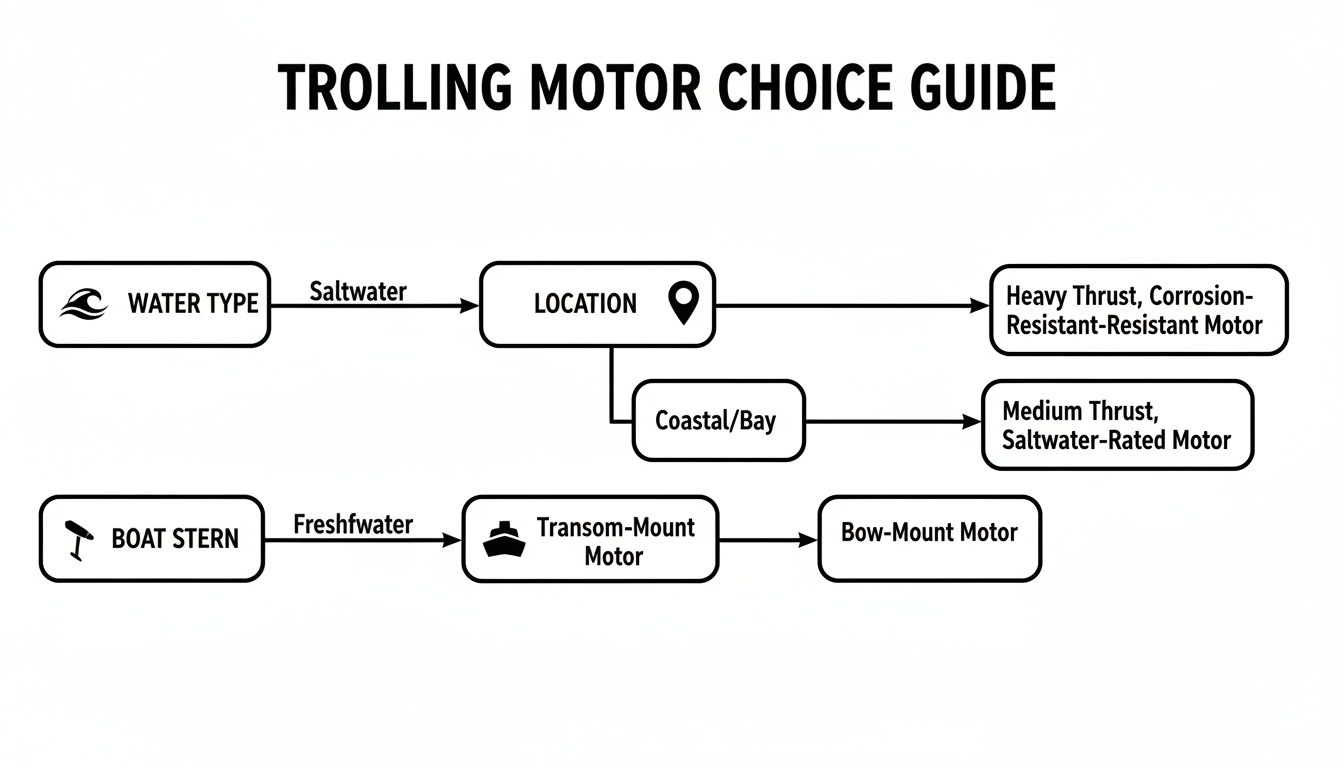
The key takeaway here is that your boating environment is just as crucial as your boat’s weight when dialling in the right amount of power.
To make things even clearer, here’s a quick reference table to help you match your boat to the right motor thrust.
This table provides a quick reference to help you match your inflatable boat’s total weight and length to the appropriate trolling motor thrust (lbs) for optimal performance.
| Boat Length (Metres) | Max Loaded Weight (kg) | Recommended Thrust (lbs) – Calm Water | Recommended Thrust (lbs) – Moderate Conditions |
|---|---|---|---|
| Up to 2.5m | Up to 225 kg | 20 – 30 lbs | 30 – 40 lbs |
| 2.5m – 3.5m | 225 – 450 kg | 30 – 40 lbs | 40 – 55 lbs |
| 3.5m – 4.5m | 450 – 680 kg | 40 – 55 lbs | 55 – 70 lbs |
| Over 4.5m | Over 680 kg | 55 lbs+ | 70 lbs+ |
Remember, these are guidelines. If you regularly carry heavy loads or face strong winds, it’s always better to have a bit more power than you think you’ll need.
While the weight calculation is vital, the actual shape and design of your boat also play a big part. A sleek, hydrodynamic inflatable kayak will slice through the water with far less resistance than a wider, boxier inflatable dinghy, even if they weigh the same.
Our Aerowave inflatable catamarans, for instance, have twin hulls that create an air cushion between them, which significantly reduces drag on the water. This clever design means they can often get fantastic performance with a slightly lower thrust motor compared to a conventional V-hull boat of the same weight. An inflatable catamaran offers stability and efficiency, making it one of the best inflatable boats for recreational use.
Ultimately, choosing the right thrust is all about matching the motor to your specific boat and how you plan to use it. To see how different motors pair with various boat sizes, explore our complete packages of inflatable boats and motors to find a setup that’s perfectly balanced. Getting this right from the start ensures you have an efficient, capable, and enjoyable experience on the water, every single time.
You’ve found the perfect trolling motor with just the right amount of thrust. That’s a great start, but without a good power source, your motor is nothing more than a high-tech anchor. Picking the right battery is every bit as critical as choosing the motor itself. It’s what decides how long you can stay out, how much weight you’re carrying, and ultimately, how much fun you’ll have.
Your choice really boils down to two main technologies: traditional lead-acid batteries and modern lithium options. While both will get the job done, they offer completely different experiences, especially for a portable and lightweight setup like an inflatable boat.
For decades, deep-cycle lead-acid batteries were the standard for boating. They’re affordable and generally reliable, but they have one massive drawback that’s impossible to ignore on a small boat: they are incredibly heavy. A typical lead-acid battery suitable for a trolling motor can easily weigh 20-30 kg, which is a huge amount of extra weight to lug around in an inflatable.
This is where lithium batteries, specifically Lithium Iron Phosphate (LiFePO4), have completely changed the game.
Lithium (LiFePO4) batteries are the superior choice for most inflatable boat and kayak trolling motor setups. Their dramatic weight savings, consistent power delivery, and much longer lifespan make them a worthwhile investment for performance and convenience.
A LiFePO4 battery with the same usable capacity can be up to 70% lighter than its lead-acid cousin. That’s a massive difference you’ll feel every single time you load your gear into the car or carry your boat down to the water’s edge.
The benefits of going with lithium extend far beyond just the weight savings. Here’s why they are so perfectly suited for a portable trolling motor system:
To find a power source that complements these advantages, check out our handpicked selection of high-performance marine batteries and chargers designed for tough Australian conditions.
Now for the million-dollar question: “How long will my battery last?” Thankfully, you don’t need an engineering degree to figure this out. There’s a simple formula that gives you a surprisingly accurate estimate of your time on the water.
(Battery Amp-Hours ÷ Motor Amp Draw) = Hours of Use
Let’s put this into a real-world example. Say you have a 50 Amp-Hour (Ah) LiFePO4 battery. Your trolling motor pulls a maximum of 40 amps at full speed but only sips 10 amps at a gentle cruising speed.
This simple calculation shows just how much your speed affects your time on the water. Backing off the throttle from flat-out to a moderate speed can easily triple or quadruple your endurance. This knowledge is key to building a perfectly balanced system that meets your needs—without weighing you down with a battery that’s bigger and heavier than you actually need.
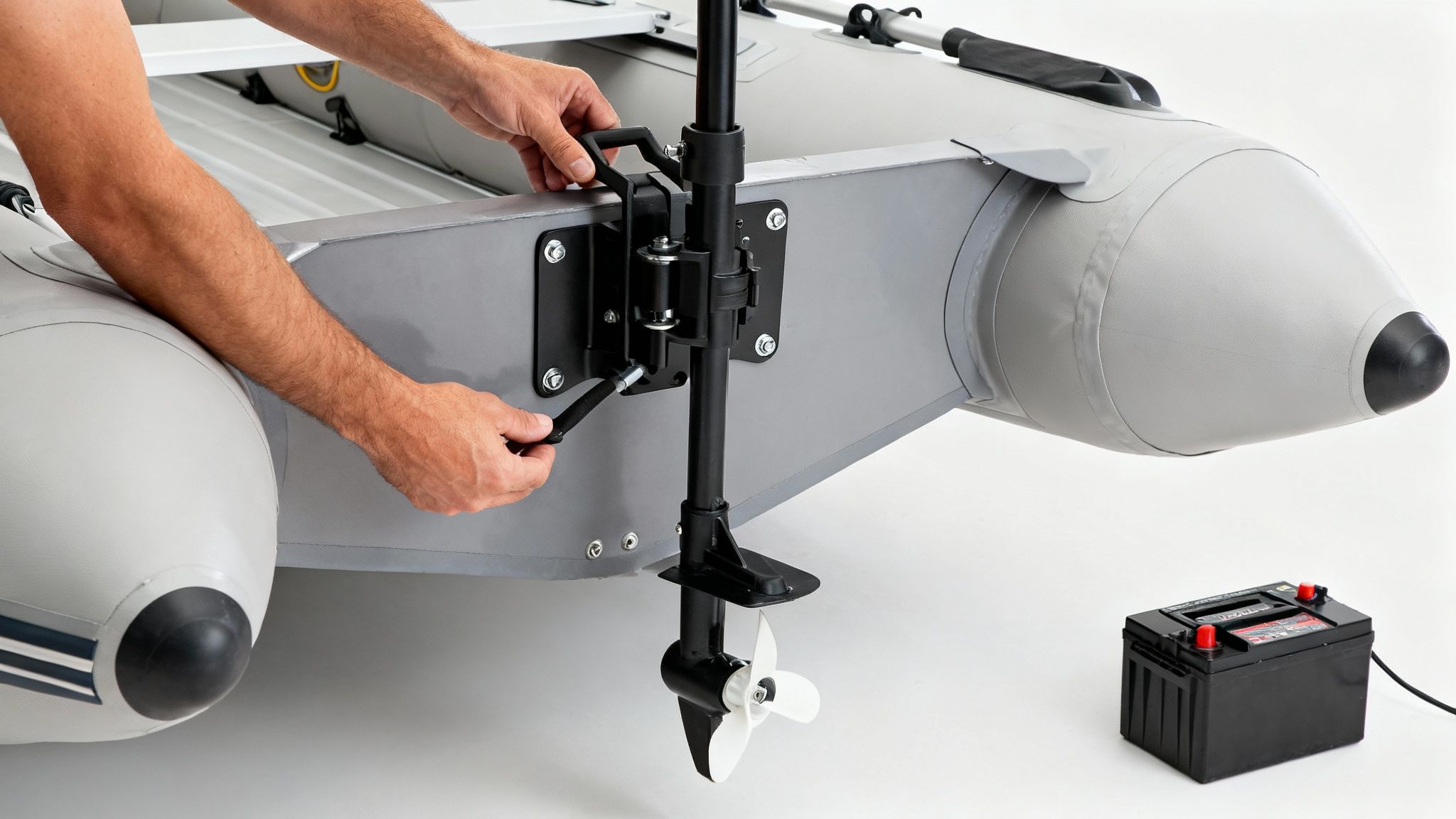
You’ve got the perfect motor and battery picked out—now for the fun part. It’s time to get it fitted to your boat and hit the water. This is where an inflatable boat with a built-in transom, like our Aerowave models, really comes into its own. The whole process is incredibly straightforward, needing just a few basic tools and a bit of care to get everything solid and secure.
This simple, hands-on job is what turns your paddlecraft into a proper powered vessel. It’s a trend that’s absolutely taking off across Australia as more people discover just how easy it is. The global market is set to explode, projected to hit over USD 830 million by 2032, and Australia is right at the heart of that growth. With our strong kayak fishing culture, it’s no surprise that more adventurers are planning to motorise their setup from day one.
Let’s get down to brass tacks. Fitting a transom-mount motor is a quick job you can easily knock over in under 30 minutes.
Having a few decent tools on hand definitely makes life easier. A good quality Impact driver for motor installation can be a massive help for tightening any extra hardware or mounts you might be using.
Getting the motor depth right is key. It’s a balancing act—the prop needs to be deep enough to get a good grip on the water, but not so low that you’re at risk of smacking it on the bottom in the shallows.
As a rule of thumb, aim to have the top of the propeller at least 15 cm (about 6 inches) below the waterline. This ensures it gets a clean “bite” of water, giving you proper thrust without a heap of splashing and noise.
Nearly all trolling motors have an adjustable collar on the shaft, which makes this dead easy. Just loosen the collar, slide the motor shaft to the right depth, and lock it back in place.
The last piece of the puzzle is hooking up the power. Find a stable spot for your battery box inside the boat—somewhere near the centre is usually best to keep the boat balanced. Run the power cables neatly along the inside of the boat, tucking them away so they don’t become a trip hazard or get tangled up in your gear.
A tidy setup makes for a much better day out. For a deeper dive into different mounting options, have a look at our complete guide to choosing and installing a kayak trolling motor mount.
Owning a kayak trolling motor is about more than just the initial thrill of setup. To keep your motor running smoothly for years of adventures, a little bit of care goes a long way. This simple upkeep, combined with a good handle on local Australian boating rules, will protect your investment and ensure you’re safe and legal out on the water.
After every single trip—especially if you’ve been in saltwater—give your motor a good rinse with fresh water. This is your number one defence against salt’s corrosive power, stopping it from eating away at seals and metal parts. Think of it as a five-minute job that adds years to your motor’s life.
Keeping your motor in top shape is pretty straightforward. A quick once-over will help you catch small issues before they turn into trip-ruining problems.
Proactive maintenance isn’t just about avoiding a breakdown. It’s about making sure your motor gives you its best performance every time you launch. A well-looked-after motor is a reliable mate for all your adventures.
Once you add a motor to your inflatable boat or kayak, you might find the rules of the game change a bit. These regulations are all about keeping everyone safe on the water, and they can vary slightly from state to state.
In most parts of Australia, like New South Wales and Queensland, strapping on any kind of motor—even a small electric one—often means your boat needs to be registered. This usually applies no matter how small your boat is. Once it’s motorised, you’ll likely need to carry specific safety gear that wasn’t required when you were just paddling.
Mandatory Safety Gear Often Includes:
Before you even think about hitting the water, it’s absolutely crucial to check with your local state maritime authority, like Transport for NSW or Maritime Safety Queensland. Their websites have the most up-to-date and specific rules for your area. A quick check will make sure you’re fully compliant, so you can relax and enjoy your time on the water with total peace of mind.
Even after covering all the details, a few key questions always seem to pop up right when you’re ready to pull the trigger on a trolling motor. Getting these last few points cleared up will give you the confidence to choose the perfect setup for your inflatable. We’ve pulled together the most common queries to give you clear, straight-to-the-point answers.
Let’s tackle these questions head-on and get you one step closer to powering up your adventures.
This is a big one, and the short answer is: it depends on your state. In most Australian states, like New South Wales and Queensland, the moment you fit any kind of motor to your boat—even a small, quiet electric one—it needs to be registered.
However, there can be exceptions for very small boats or low-powered motors. The only way to know for sure is to always check with your local maritime authority before hitting the water. A quick call to Transport for NSW or Maritime Safety Queensland will keep you compliant and save you from any nasty fines down the track.
You can, but it’s a really bad idea. Freshwater motors just aren’t built to survive the harsh, corrosive environment of saltwater. They lack the specialised coatings, stainless steel components, and sealed electronics needed to fend off rust and electrical damage.
Using a freshwater model in the ocean will cause it to corrode from the inside out, leading to a very short lifespan. More importantly, it will instantly void your manufacturer’s warranty. If you plan on exploring coastal estuaries, bays, or the open ocean, investing in a proper saltwater-rated motor is the only smart move.
Think of it this way: a saltwater motor is a small upfront investment to protect a much larger one. It’s the only sensible choice for anyone boating in Australia’s beautiful coastal waters.
It’s important to set the right expectations here. Trolling motors are designed for stealth, control, and efficiency—not for speed. They’re perfect for holding your position against the current, quietly sneaking up on fish, or cruising along the shoreline.
Most trolling motors will push an inflatable boat or kayak along at a brisk walking pace, typically somewhere between 3 and 8 km/h. Your actual speed will depend on your motor’s thrust, the total weight of your boat (including you and your gear), and conditions like wind and current. They’re brilliant for moving between fishing spots, but they won’t get your boat planing like a petrol outboard.
Ready to find the perfect power solution for your inflatable adventure? The team at Easy Inflatables has everything you need, from high-quality inflatable boats and catamarans to the ideal trolling motor and battery packages. Whether you’re looking for the best inflatable boats for recreational use available near you or want to hire inflatable boats in Australia, our experts can help you compare prices and features to build your ultimate on-water setup. Visit us at https://easyinflatables.com.au to get started.