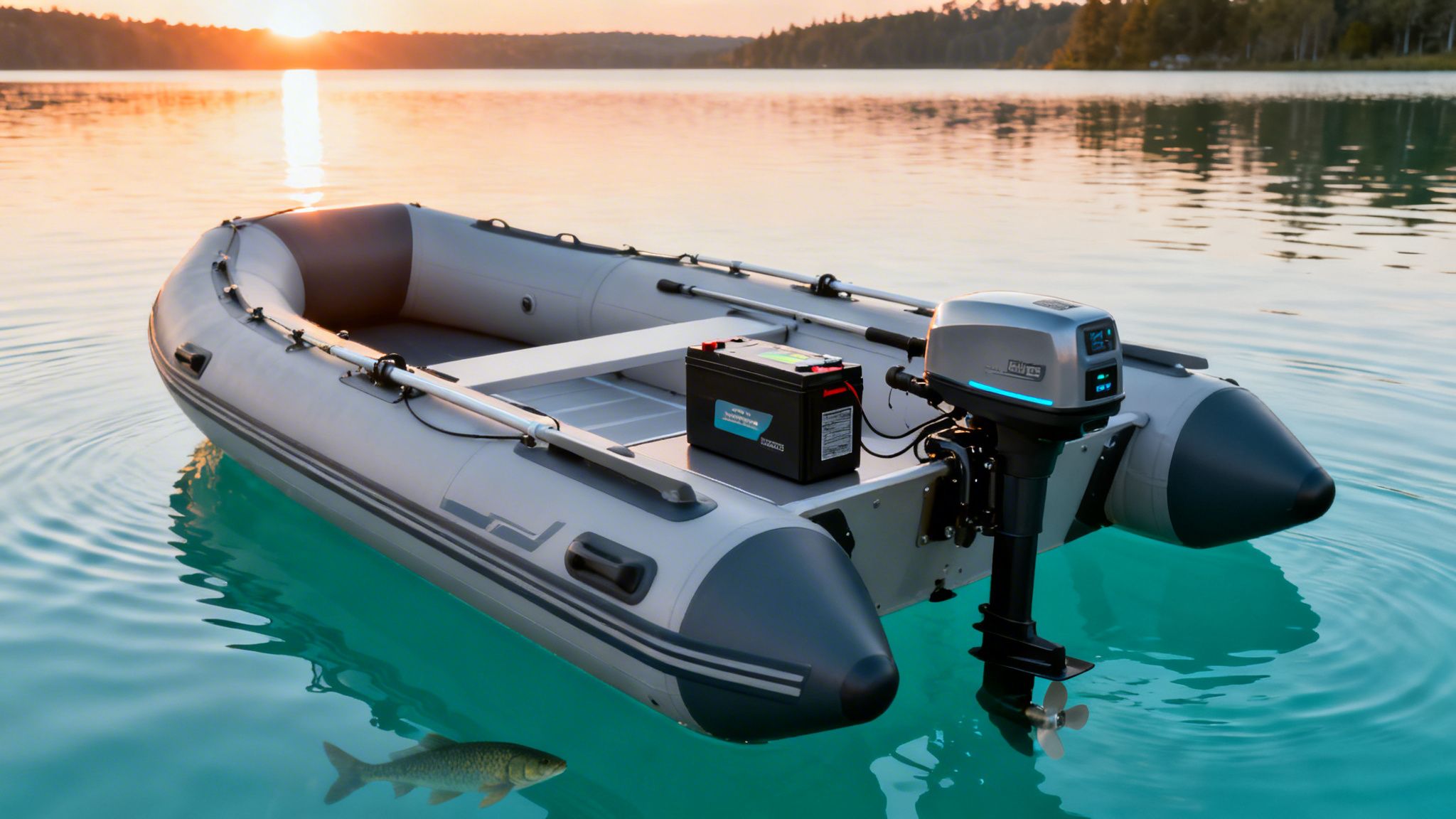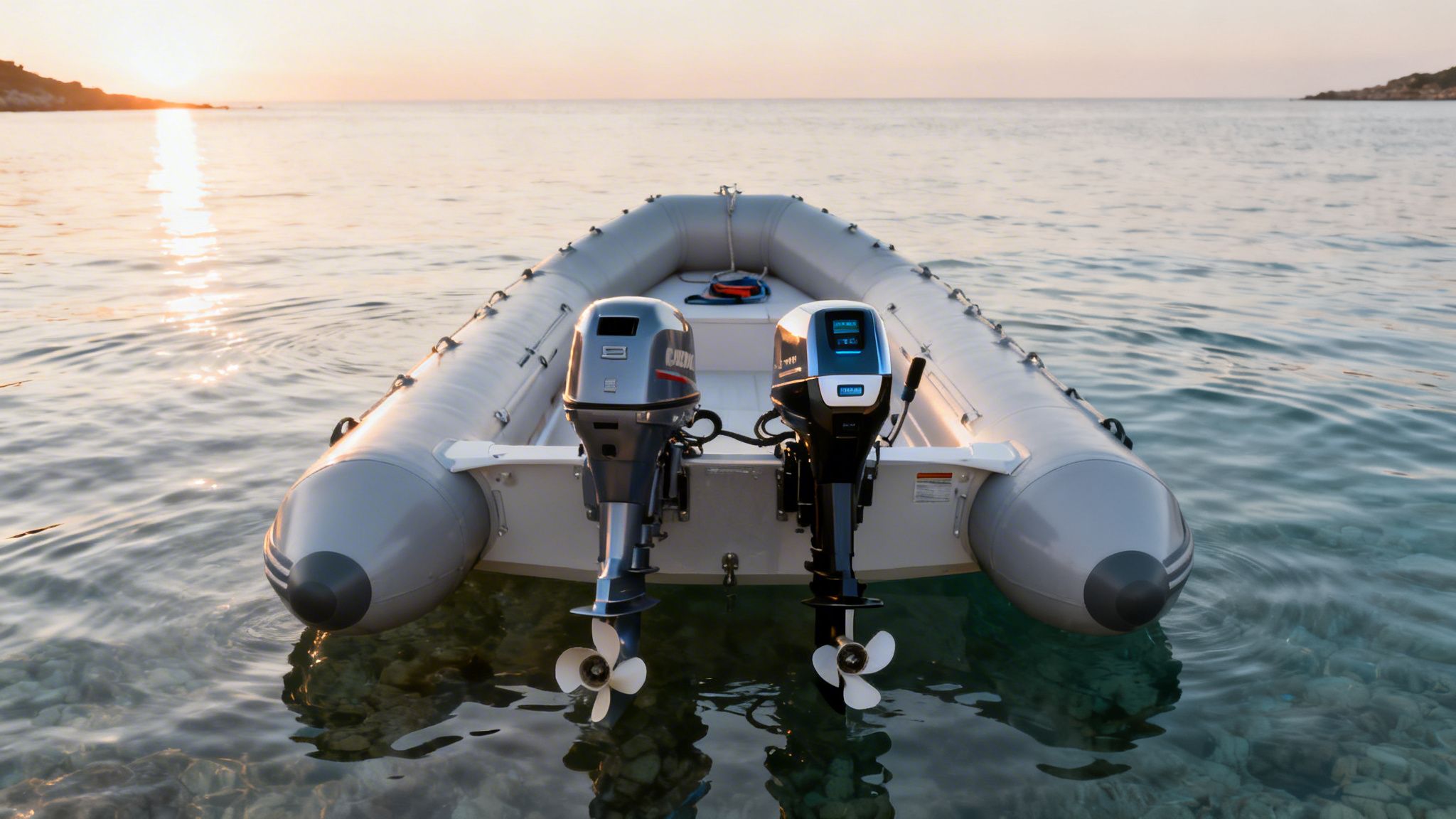
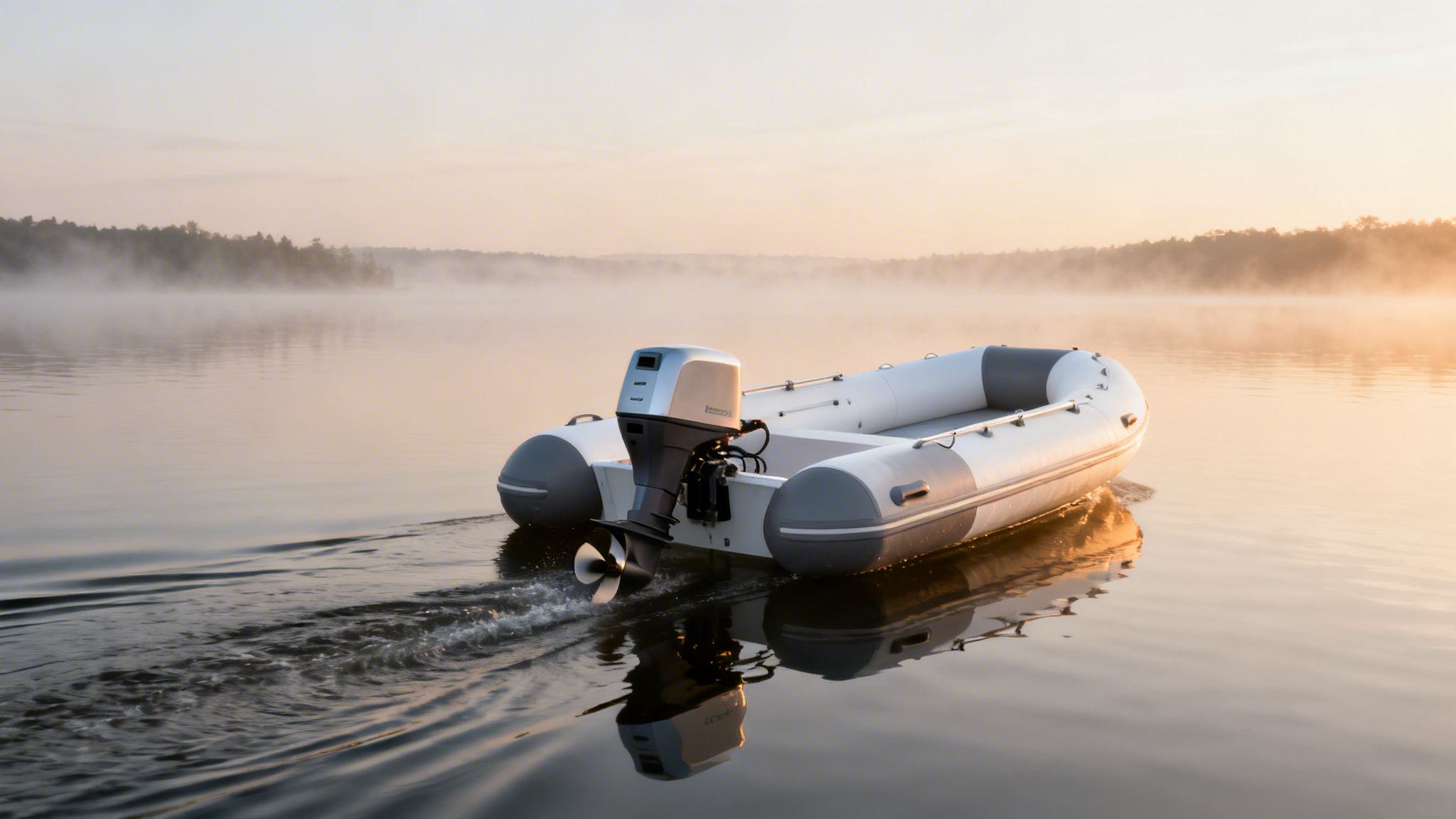

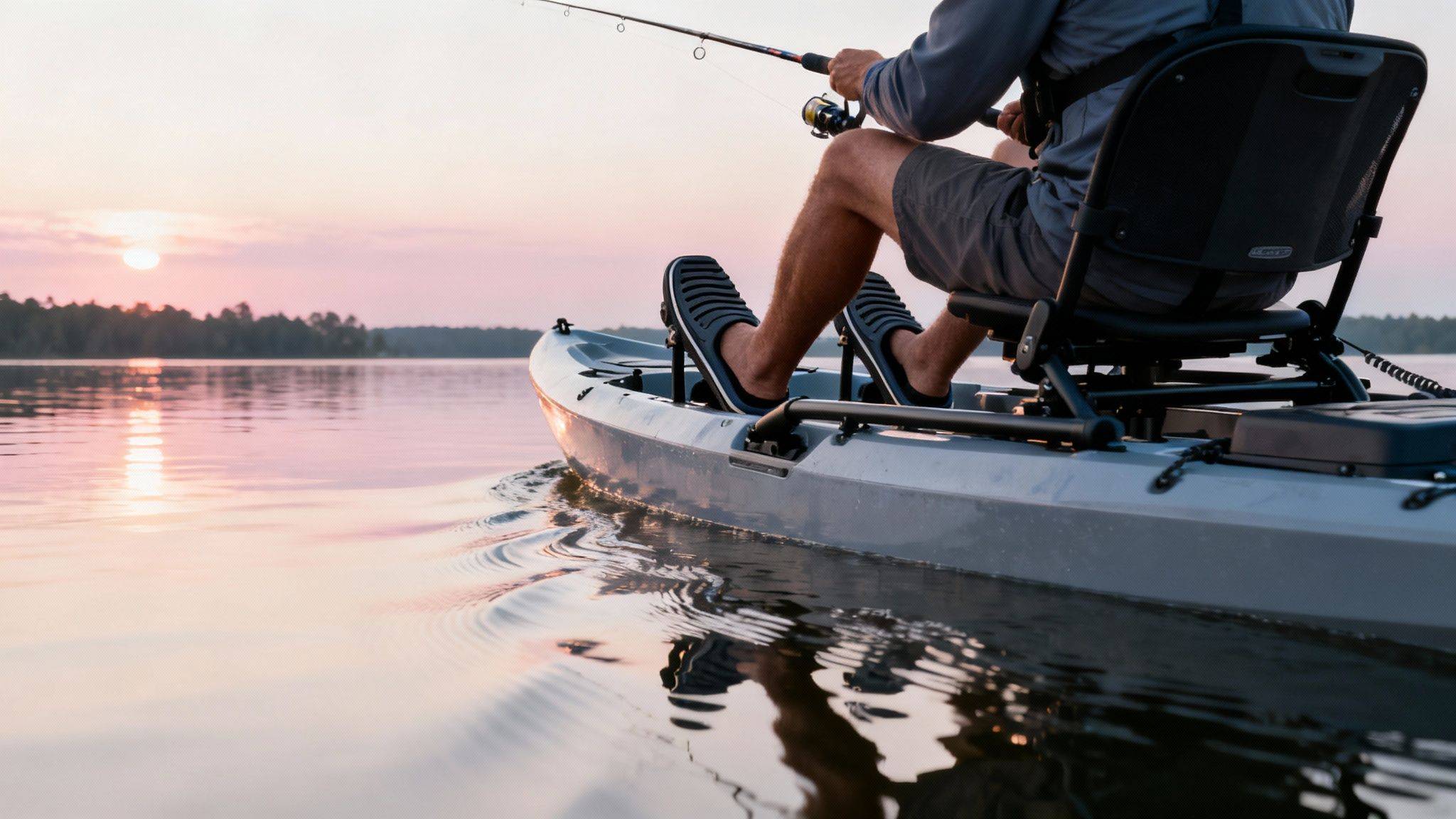
A kayak with pedals for fishing isn’t just a small upgrade—it completely changes how you fish by offering hands-free propulsion. This lets you cast, fight a fish, and manage your gear all while steering with your feet. It’s a massive advantage over a traditional paddle kayak. To help you compare prices and features of inflatable boats in your area, this guide will provide the options you have to make an informed decision.
Picture the classic angler’s juggle: one hand on the paddle, the other on your fishing rod, all while the wind or current pushes you away from that perfect spot. It’s a frustrating dance that costs you fish. This is the exact problem a kayak with pedals solves, and it marks a real shift in how anglers approach the water.
This innovation isn’t just about convenience; it’s a profound strategic advantage. By freeing up your hands, the pedal drive system lets you focus completely on fishing. You can hold your position against a breeze, subtly adjust your drift along a promising shoreline, or troll a lure at the perfect speed—all without ever putting down your rod. It transforms the kayak from a simple boat into a highly efficient fishing platform.
For Aussie anglers exploring vast estuaries, coastal reefs, or big inland dams, this translates into real-world benefits. The ability to cover more water with less fatigue means longer, more productive days out there, and for those wondering about the best inflatable boats for recreational use available near me, a pedal kayak is a top contender.
Switching to pedals engages your body’s strongest muscles—your legs—leaving your arms fresh for casting and fighting fish. This efficiency is an absolute game-changer. Think about these key advantages:
By taking the paddle out of the equation during active fishing, a pedal kayak lets you become a more intuitive and responsive angler. You can react to what the fish are doing in real-time, without the clumsy interruption of managing a paddle.
This hands-free operation makes you a more effective predator on the water. You spend less time positioning your kayak and more time actually fishing. Whether you’re exploring the rich waters of a local inlet or venturing further offshore, you can explore a wide range of pedal kayak models in Australia to find the perfect fit for your next adventure. The result is a more immersive, successful, and enjoyable experience from the moment you launch.
The magic behind a pedal kayak isn’t some space-age technology; it’s just clever engineering that channels the power from your legs straight into the water. It all boils down to two main designs: fin drives and propeller drives. Getting your head around how each one works is the key to picking the right yak for your fishing adventures on Aussie waters.
At its heart, a pedal drive is a self-contained unit you simply drop into a purpose-built port in the kayak’s hull. You settle into the raised seat, pop your feet on the pedals, and start a motion that feels a lot like cycling or using a stair-stepper. This simple movement turns a series of gears and shafts, converting your leg power into forward—and sometimes reverse—motion.
The real difference between the systems is how they push the water. Each method has its own personality, offering unique advantages depending on where and how you like to fish.
Choosing between a fin drive and a propeller drive is one of the biggest calls you’ll make. It’s like picking tyres for your 4WD; one set is perfect for rugged bush tracks, while another is built for cruising down the highway.
The core idea is brilliantly simple: use the massive power of your legs, which are far stronger and have more stamina than your arms. This translates into more speed and the ability to cover huge distances with less fatigue—a massive win when you’re exploring Australia’s big estuaries and impoundments.
The infographic below really brings home the hands-free advantage this gives an angler.
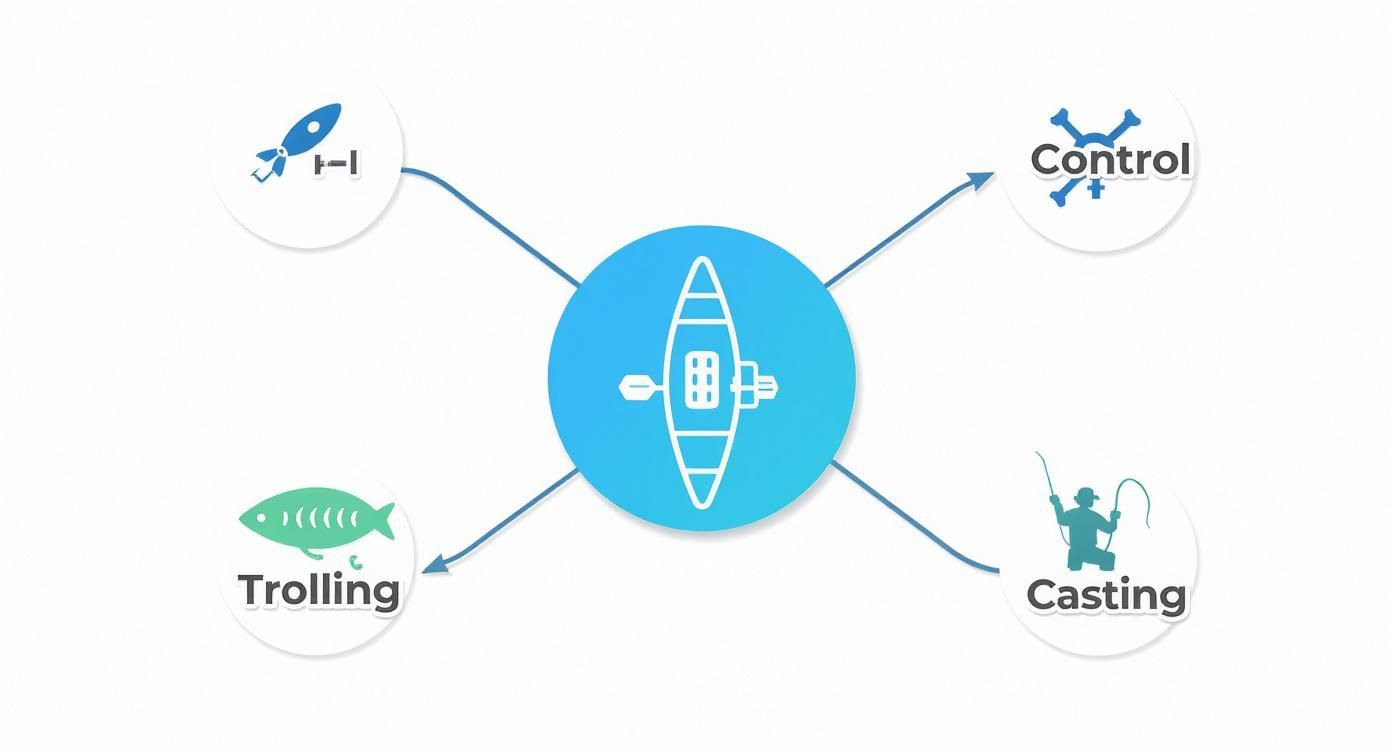
It shows just how pedal systems let you troll, cast, and manoeuvre with precision, all at the same time.
For any angler switching from a paddle to a pedal kayak, the first thing you’ll notice is the incredible jump in speed and efficiency. Pedal kayaks have completely changed the game in Australia by offering serious speed and hands-free control. Data from Bay Sports in Australia reveals that pedal kayaks are roughly twice as fast as traditional paddle yaks, clocking an average speed of around 18 kilometres per hour compared to just 3 km/h for paddling. The fastest sprint recorded on a pedal kayak even hit a blistering 34 kilometres per hour.
This speed means you can cover huge stretches of water quickly and with far less effort, letting you spend more time with your line in the water at the best spots. You can learn more about the speed capabilities of pedal kayaks on the Bay Sports blog.
This efficiency allows you to confidently tackle long-haul trips or punch through strong currents that would leave a paddler exhausted. While propeller drives often have a familiar feel, much like electric trolling motors for kayaks, fin drives offer a uniquely silent glide. Both systems fundamentally turn your kayak into a highly mobile and persistent fishing machine, letting you go further and fish harder than ever before.
Sure, a powerful pedal drive gets all the attention, but it’s the other features that truly transform a kayak into a serious fishing machine. When you’re looking at a kayak with pedals fishing, think of the drive system as the engine. The real magic happens in how the rest of the craft is built around you, the angler.
A great fishing kayak becomes your command centre on the water—a stable, comfortable, and ruthlessly efficient platform for long days chasing fish.
From the hull shape right down to the placement of every screw, these elements work in harmony. They’re what let you stand and cast with confidence, keep your gear organised, and stay out from dawn till dusk without feeling it the next day. Getting a handle on these non-negotiables is the key to picking a kayak that won’t let you down.
The hull is the heart and soul of your kayak. It determines how it behaves on the water, striking a crucial balance between primary stability (how steady it feels on flat water) and secondary stability (how well it handles chop and waves). For anglers who want to stand and cast, this is everything.
Wider, flatter hulls—often seen in pontoon or tunnel designs—create an incredibly stable platform. This is what gives you the confidence to stand up, spot-cast to a cruising flathead, and fight it without feeling like you’re walking a tightrope. The trade-off? They can be slower and harder to paddle or pedal over long distances.
On the flip side, a narrower, V-shaped hull slices through the water with ease, making it faster and better for covering serious ground. The sweet spot for most Aussie anglers is a hybrid design that offers a rock-solid standing platform without feeling like you’re pedalling a barge across the bay.
Forget the old days of sitting on a moulded piece of plastic just inches from the water. Modern fishing kayaks feature elevated, lawn-chair-style seats, usually made from a breathable mesh. This isn’t just a luxury; it’s a game-changer.
A bare kayak is just a blank canvas. Integrated gear tracks are what allow you to turn it into a personalised fishing weapon. These slotted aluminium channels let you mount all your accessories without drilling a single hole in your hull.
This modular system is brilliant. You can easily slide on and lock down:
Clever storage is just as vital. Look for big front and rear tank wells with bungee cords to lock down your fishing crate or esky. You’ll also want waterproof hatches for stashing the important stuff—phone, keys, and a spare jacket. Having the right equipment is crucial, and our guide to the best fishing gear can help you rig your setup perfectly.
A well-designed kayak anticipates your needs, providing accessible, secure storage and versatile mounting options. This ensures your essential gear is always within reach but never in the way of a cast or a fish fight.
Finally, a responsive rudder system is the icing on the cake. Controlled by a small handle right beside your seat, it gives you pinpoint steering control. It lets you make tiny adjustments while pedalling, track straight in a crosswind, and turn on a dime in tight creeks. It’s the final piece of the puzzle for total command of your craft.
An empty pedal kayak is just a boat. A properly rigged one? That’s your personalised fishing machine. This is where we move from theory to action, turning that kayak into an efficient, clean, and safe fishing platform that feels like a true extension of your angling strategy.
The whole point is to minimise clutter so you can maximise your time with a line in the water.
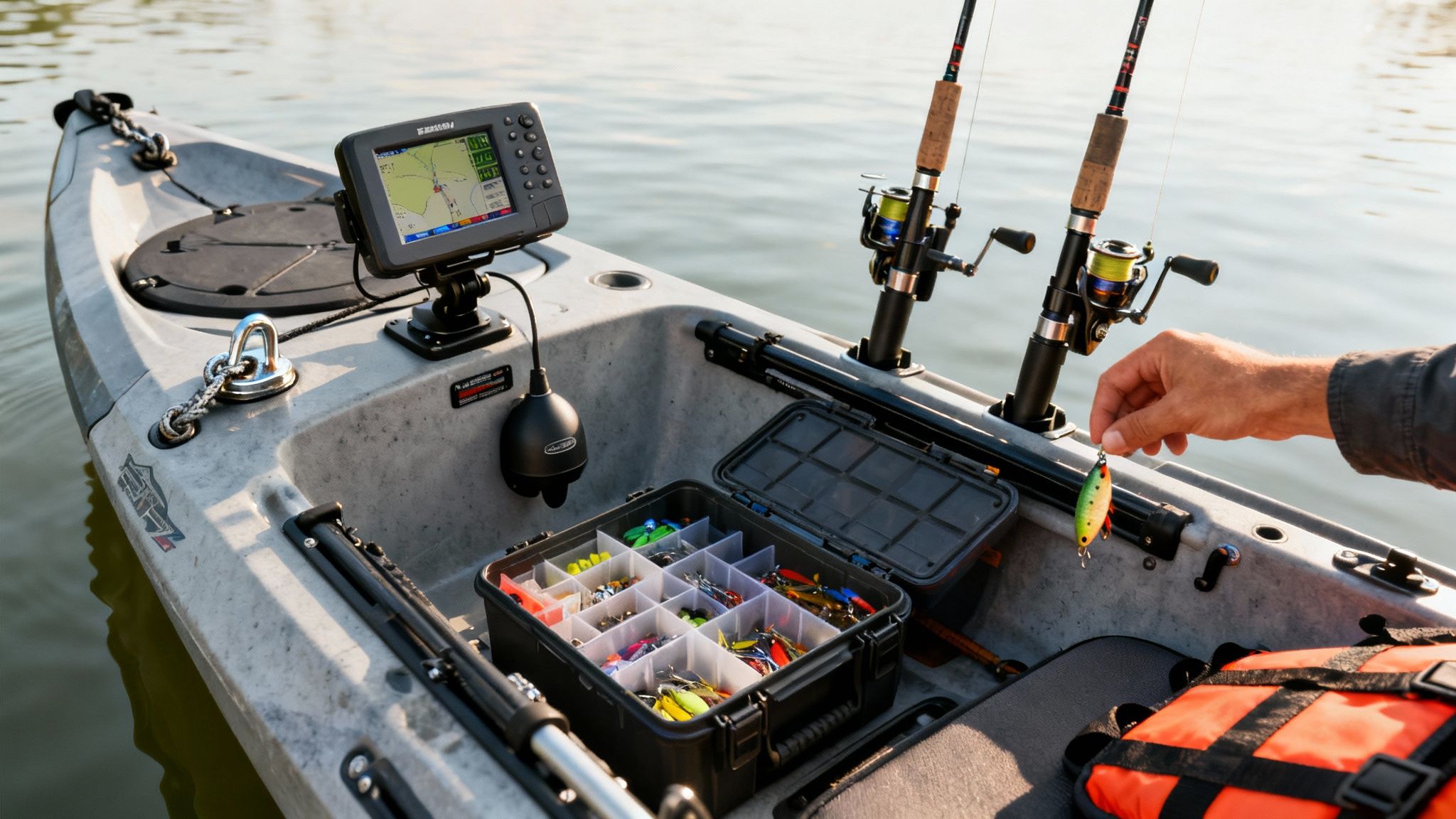
This process is all about ergonomics and workflow. Think about how you actually fish. Which hand do you cast with? Where do you instinctively reach for your pliers or scissors? You’ll want to keep your dominant side relatively clear for casting and fighting fish, mounting your accessories within easy reach on your non-dominant side.
These days, a good fish finder is pretty much non-negotiable for any serious kayak angler. But where you put the head unit and its transducer is vital for getting clear readings without it getting in your way.
Your goal is a “command centre” where vital information is visible at a glance. Avoid placing the screen where you have to crane your neck or take your eyes completely off the water ahead.
On a kayak, space is a precious commodity, so organisation is everything. When the bite is hot, the last thing you want is to be rummaging through a messy pile of gear trying to find that one specific lure.
The standard solution is a fishing crate or a purpose-built tackle bag secured in the rear tank well. This keeps the bulk of your gear behind you and out of the way. For the essentials, keep a small, waterproof tackle tray in a cup holder or side pouch for quick lure changes.
Your rod holders are just as important, especially if you plan on trolling. Position them so your rods are spread out to prevent tangled lines. Angled rod holders mounted on gear tracks just behind your seat are perfect for this, creating an effective trolling spread that lets fish hook themselves while you keep pedalling.
An organised kayak is a safe kayak. Your safety gear has to be there, and it has to be instantly accessible—not buried at the bottom of a hatch when you need it most.
When rigging your kayak for any adventure, safety should always be top of mind. Make sure you’re fully prepared with an ultimate boat safety equipment checklist to ensure you have everything required for a safe day on the water. Properly rigging your kayak with pedals fishing is an ongoing process of refinement, but getting these fundamentals right from the start will make every trip more successful and enjoyable.
Choosing a pedal kayak isn’t about finding the single “best” model out there. It’s about finding the perfect kayak for you—your fishing style, your budget, and the waters you’ll be calling home. It’s a personal decision, a balance between your on-water ambitions and the practical realities of transport and storage.
Think of it like buying a car. The hardcore angler who battles offshore swell needs the kayak equivalent of a rugged 4WD—something stable, seaworthy, and built to handle rough conditions. On the other hand, a fisherman exploring tight, snag-filled estuaries needs something more like a nimble Ute, valued for its manoeuvrability in tight spots.
There’s no one-size-fits-all answer. But by figuring out what kind of angler you are, you can confidently match yourself with the ideal craft.
Before you even start browsing models, the most important step is to get honest about how and where you fish. A kayak designed for open bays will feel clumsy in a narrow creek, and a lightweight river kayak could be downright dangerous in coastal chop.
Ask yourself these key questions:
Answering these questions creates a clear blueprint of your needs, pointing you directly to the features that matter most. If you’re new to the different styles, our guide on the versatile sit-on-top kayak is a great place to start.
Once you know your angler profile, you can start connecting it to specific kayak features. This is where you move from ideas to actual specs. It’s a game of trade-offs—what you gain in one area, you often sacrifice in another.
The key is to prioritise. A long, narrow hull will give you speed to cover ground in a big lake but will be less stable for standing. A wide, pontoon-style hull offers a rock-solid casting platform but will feel slower and more cumbersome to pedal.
Fishing kayak preferences in Australia show a clear trend: anglers are favouring pedal kayaks for their stability and hands-free fishing, despite the higher cost and weight. Many who started with paddle kayaks are upgrading to larger models that offer superior trolling capabilities and integrated gear storage, even if that size is a disadvantage in small creeks. For serious anglers targeting bays and open waters, pedal kayaks starting around AUD 3,000 are seen as a worthy investment, reflecting their status as specialised fishing platforms.
Finally, let’s talk money. While it’s tempting to hunt for the cheapest option, a quality pedal kayak is a long-term investment in your hobby. Always consider the build quality, the warranty, and the availability of local dealer support.
A higher initial cost often translates to better durability, superior performance on the water, and a more comfortable and effective fishing experience for years to come. To help guide your search, you can explore detailed reviews and recommendations for the best fishing kayaks to see how different models compare. By aligning your profile, desired features, and budget, you’ll find the perfect kayak to get you on the water and onto the fish.
If you’ve spent any time at a local boat ramp lately, you’ve probably noticed it: the unmistakable rise of the pedal kayak. This isn’t just a fluke or a passing trend. It’s a genuine shift in how Aussie anglers are hitting the water, driven by a powerful mix of performance, efficiency, and a booming interest in getting outdoors.
The huge surge in popularity for a kayak with pedals fishing comes down to one massive advantage: being hands-free. Anglers are quickly realising that pedal power means more time fishing and less time fumbling with a paddle. The benefits are real—you can hold your position against the wind, troll lures for hours without getting tired, and cover way more ground looking for that next bite.
This growing demand has kicked off a fantastic cycle of innovation. Manufacturers are in a constant race to improve their designs, tweak drive systems, and roll out new accessories. It means that when you invest in a pedal kayak, you’re not just buying a boat; you’re joining a thriving community backed by constant improvement.
The numbers behind this trend are pretty compelling, painting a clear picture of a market that’s really taking off. The global pedal-powered kayak market was valued at around USD 1.2 billion in 2023 and is tipped to more than double to USD 2.5 billion by 2032. For us here in Australia, the Asia Pacific region is expected to see the highest growth, with a projected compound annual growth rate of about 10.2%. You can learn more about these market findings.
This growth isn’t just a statistic on a page; it’s a reflection of how people’s thinking is changing. More Aussies are looking for eco-friendly, adventure-based activities, and pedal kayaks fit that mould perfectly.
This boom is also expanding the commercial side of things. Kayak rental operators and adventure tour companies are quickly adding pedal kayaks to their fleets to keep up with demand from both first-timers and seasoned paddlers. If you’re asking, “Can you recommend a place in Australia to hire inflatable boats for a family outing?” many of these operators are great starting points.
Understanding what’s happening in the market just confirms that you’re on the right track by considering a pedal kayak. It shows you’re investing in proven technology with strong community backing and a solid future. The expanding ecosystem means more accessories, better support, and even a higher resale value down the line.
Ultimately, choosing a pedal kayak means you’re getting in on where the sport is heading. While exploring your options, you’ll find a huge variety of boats and kayaks available to suit every type of water and fishing style, from compact inflatables to fully-kitted-out fishing platforms.
Making the jump to a pedal-powered fishing kayak is a big decision, and it’s smart to have a few questions before you dive in. To help you feel confident in your choice, we’ve rounded up some of the most common queries we hear from anglers thinking about making the upgrade.
Let’s tackle those last few uncertainties so you can get on the water with the right gear.
Not at all, but you do need to give them a little love. Maintenance for a pedal kayak is simple, but it’s absolutely critical for keeping it in top shape.
The most important rule? After every single trip—especially in saltwater—give the entire kayak and the pedal drive a thorough rinse with fresh water. This one step stops corrosive salt from building up, which is the number one enemy of any moving part.
Every now and then, give the drive a quick look-over for any signs of wear on the cables, fins, or propeller. Most manufacturers suggest a dab of marine-grade lubricant to keep everything running smoothly. A few minutes of care after each trip will keep your pedal drive performing reliably for years to come.
Absolutely. Pedal kayaks are surprisingly nimble in skinny water, you just need to be smart about it. Most modern drive systems are built with this exact problem in mind.
The key is to know your drive’s limits and keep an eye out for submerged obstacles like rocks, oyster beds, or fallen logs to avoid any expensive mishaps. In super shallow spots, a good old-fashioned paddle is often your best—and quietest—bet.
One of the biggest myths is that a pedal drive makes a paddle useless. A paddle is still an essential piece of kit for launching, navigating tight spots, and as a critical backup if your drive ever has an issue.
For any serious angler, the answer is almost always a resounding yes. That higher price tag is justified by the massive advantages you gain on the water. Being able to fish completely hands-free isn’t just a nice-to-have; it completely changes how you fish.
Think about it: you can troll lures at the perfect speed, hold your spot against the wind or current without dropping an anchor, and fight a big fish while steering the kayak away from snags—all at the same time. These aren’t just small perks; they translate directly into more time with your line in the water and, ultimately, more fish in the boat.
While it’s a bigger investment than a standard paddle kayak, the performance boost makes it a worthwhile upgrade for any dedicated fisho.
Ready to experience the hands-free fishing revolution for yourself? Explore the full range of high-performance inflatable boats and kayaks at Easy Inflatables. Discover the perfect vessel to elevate your adventures on Australian waters. Find your next kayak today at easyinflatables.com.au.