
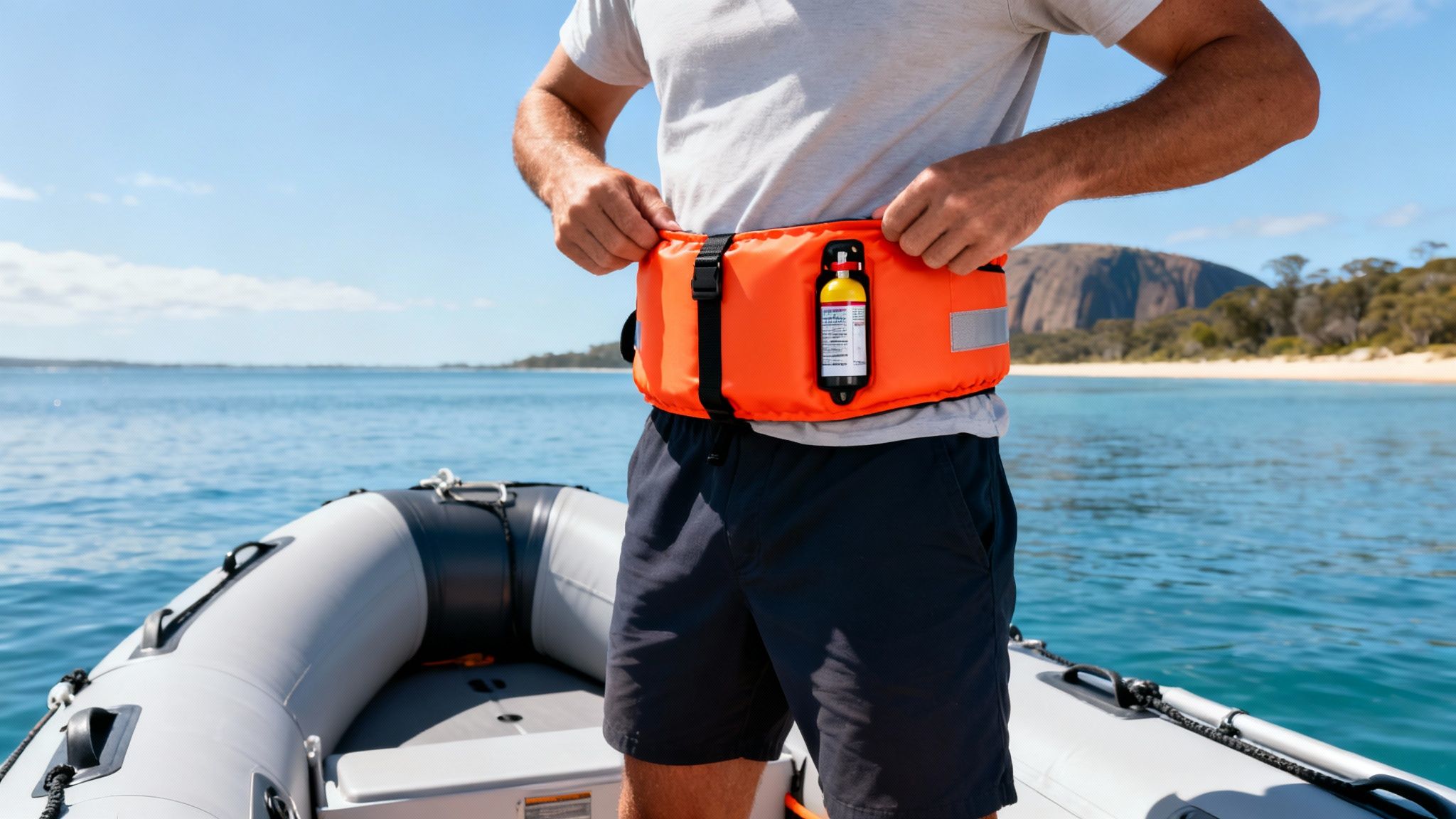
A life preserver belt is exactly what it sounds like: a compact, wearable safety device that provides buoyancy in the water. Whilst these types of belt life jackets are not widely seen in Australia just yet, they will gain momentum soon with AMSA. BCF and some other larger leading retailers are now stocking these Life Belts in the level 100 range mostly. Most inflate automatically the second they hit the water, but they can also be inflated manually by pulling a cord. Unlike those bulky, old-school life jackets, these sleek belts offer incredible comfort and complete freedom of movement, making them an essential safety partner for any modern boater looking to compare prices and features of the best options available.
Picture this: it’s a perfect day on the water in your inflatable catamaran, the sun is out, and you’re cruising along the Australian coastline. But as any experienced skipper knows, conditions can change in an instant, turning a perfect day into a dangerous emergency without any warning. This is where a reliable life preserver belt becomes your most critical piece of equipment—it’s just as vital as a seatbelt in a car.
Forget the restrictive, uncomfortable life jackets of the past. Modern safety gear has come a long way. Today’s inflatable belts are designed for efficiency and comfort, letting you move freely whether you’re casting a fishing line from one of the best recreational inflatable boats, managing sails, or just kicking back with the family. They give you serious protection without ever getting in your way.
A personal flotation device (PFD) is so much more than just a box to tick for the authorities; it’s your lifeline. Imagine you’re enjoying a family outing off the Sydney coast, perhaps after finding a place in Australia to hire inflatable boats, when a sudden capsize flips you into the water.
Australian boating safety stats paint a pretty stark picture. Hundreds of drownings and serious accidents every year are directly linked to people not wearing a life jacket or preserver belt. In fact, between 2010 and 2020, over 70% of the 1,800 recorded boating fatalities nationwide involved victims who were not wearing a PFD.
This guide will walk you through everything you need to know. We’ll cover:
The different types of life preserver belts available.
Australian safety standards and what they mean for you.
How to choose the perfect belt for your specific activities.
Proper fitting, use, and maintenance to ensure it works when you need it most.
To ensure every trip is a safe and enjoyable one, always put safety first. You can find more essential snorkeling safety tips to round out your water safety knowledge. And for an added layer of security, especially in remote areas, you might be interested in our guide to the ACR Rescue Beacon.
Ultimately, our goal is to give you the knowledge to stay safe and feel confident every time you head out on the water.
When you start shopping for a life preserver belt, you’ll quickly realise it’s not a one-size-fits-all deal. Not all personal flotation devices (PFDs) are made equal, and the biggest difference comes down to one thing: how they inflate. Getting your head around the tech behind these belts is the key to picking one that’s a perfect match for your time on the water, whether you’re fishing from an inflatable catamaran or just enjoying a family day out near the coast.
Inflatable models are massively popular for their slim, unobtrusive design, and they generally work on one of three core inflation systems. Each is designed for a specific job and comes with its own set of pros and cons. Think of them like different safety systems in a car—they all work, but you choose based on your driving habits and needs.
This infographic breaks down how the right life preserver belt supports on-water safety by giving you both freedom and comfort.
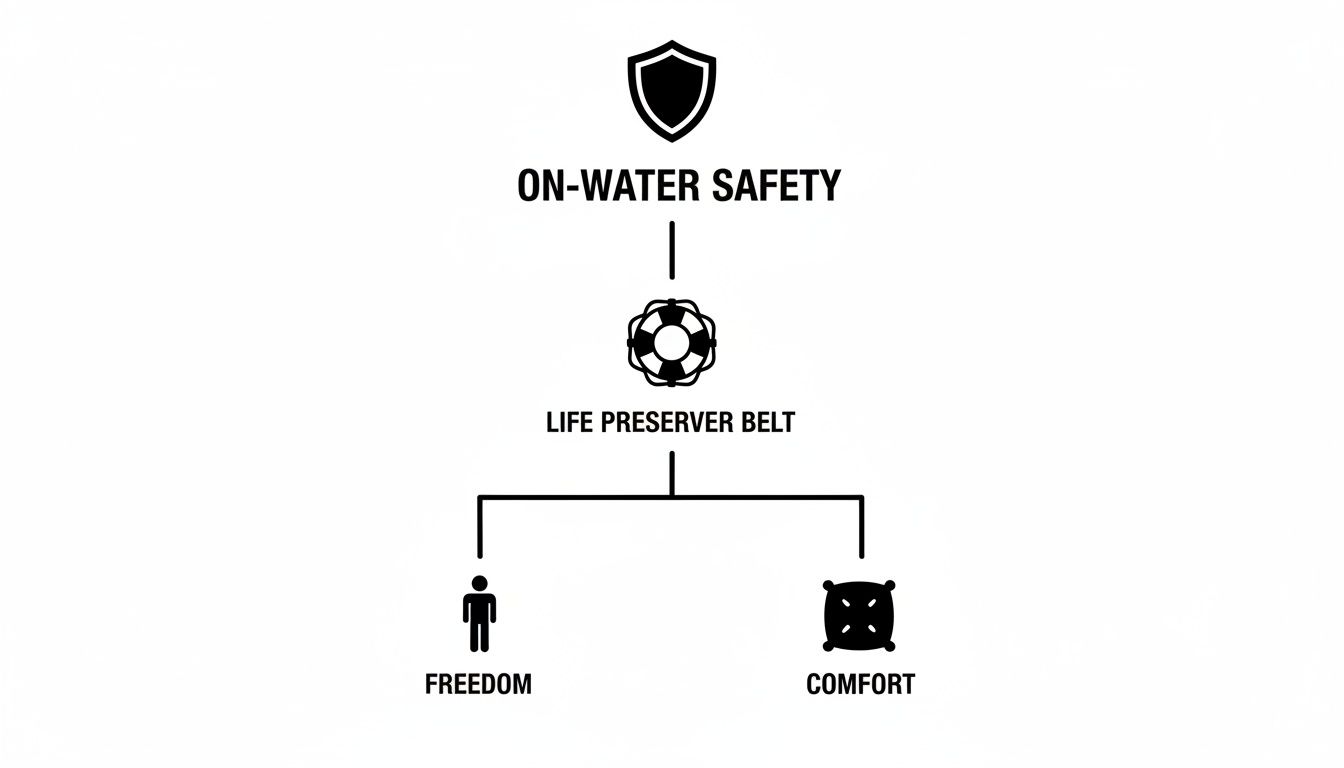
True on-water safety isn’t just about having a PFD; it’s about wearing it. A belt that delivers freedom of movement and all-day comfort is one you’ll actually keep on.
The simplest system is manual inflation. A manually inflatable life preserver belt will only activate when you physically pull a toggle or cord. This action punctures a small CO2 cylinder, which instantly fills the bladder with air and gives you buoyancy.
It’s like the emergency brake in your car. It’s a powerful safety feature, but it won’t do a thing unless you decide to pull the lever. This puts you in complete control, which is a massive advantage for certain activities. Anglers, kayakers, and stand-up paddleboarders often go for this type because it stops the belt from accidentally inflating from a bit of rain, wave spray, or a splash.
The key takeaway for manual belts is control. You decide when it inflates, eliminating the risk of it going off when you’re just getting wet and don’t need immediate help.
The big trade-off, however, is that you have to be conscious and able to pull that cord. If you fall overboard and are knocked unconscious, a manual belt offers no protection.
Next up is automatic inflation, which is the most common type you’ll see for general recreational boating. These belts have a small, water-soluble component inside, often called a bobbin or cartridge. When this little piece gets submerged in water, it dissolves almost instantly, triggering a spring-loaded pin to puncture the CO2 cylinder.
This is the airbag of the PFD world. Just like an airbag deploys on impact without you doing anything, an automatic life preserver belt inflates on contact with water. This provides a crucial fail-safe if the wearer is incapacitated or can’t activate the PFD themselves.
For family boating or if you’re often out on the water alone, the automatic system offers real peace of mind. Its main drawback used to be accidental inflation in heavy rain or from big waves, though modern designs have gotten much better at preventing this. Anyone looking for reliable safety gear can find excellent options among our range of high-quality kayak accessories in Australia.
Finally, we have hydrostatic inflation, the most advanced activation tech out there. A hydrostatic inflator, also known as a HAMMAR system, is also automatic but works based on water pressure instead of just contact. The unit won’t activate from rain or spray; it needs to be submerged a few inches underwater before the pressure triggers the inflation mechanism.
This system is like a sophisticated submarine sensor. It doesn’t react to surface moisture but waits for the clear signal of being properly underwater. This makes it the top choice for offshore sailors, commercial fishermen, and anyone working in extremely wet conditions where accidental inflation is a constant risk. They are incredibly reliable but are usually the most expensive option and need more specific servicing.
Choosing the right inflation system is a critical step in finding the perfect life preserver belt. Each type—manual, automatic, and hydrostatic—offers a different balance of control, convenience, and cost. This table breaks down the key differences to help you decide.
| Activation Type | How It Works | Best For | Potential Downsides |
|---|---|---|---|
| Manual | User pulls a cord to puncture a CO2 cylinder and inflate the bladder. | Anglers, kayakers, paddleboarders, and activities where you expect to get wet. | Requires the wearer to be conscious and able to pull the cord. |
| Automatic | A water-soluble bobbin dissolves on contact with water, triggering inflation. | General boating, family outings, and solo boaters who need a fail-safe. | Can accidentally inflate in heavy rain or from large waves (though less common now). |
| Hydrostatic | Activates based on water pressure when submerged a few inches underwater. | Offshore sailing, commercial fishing, and extremely wet conditions. | Higher cost and requires more specialised maintenance. |
Ultimately, the best choice depends entirely on how you use your boat and your personal comfort level with the technology. Whether you prioritise absolute control or a hands-off safety net, understanding these systems ensures you’ll be safe and comfortable on every trip.
Knowing the rules of the water isn’t just about dodging a fine—it’s a fundamental part of being a responsible boater. In Australia, Personal Flotation Devices (PFDs), including modern life preserver belts, are governed by strict standards to make sure they work when you need them most. Think of these regulations as your guarantee that the gear you’re wearing has been rigorously tested and proven to save lives.
The main standard you’ll come across is AS 4758, which covers the general requirements for personal flotation devices. It classifies PFDs into different levels, each one designed for specific water conditions. It’s a bit like a rating system for tyres—you wouldn’t put city tyres on a 4WD heading into the outback, and the same logic applies to your safety gear. Choosing a belt that meets AS 4758 means it’s built to handle Australian conditions.
The PFD “Level” is the single most important factor to get your head around. It tells you exactly how much buoyancy the device offers and where it’s safe to use it. The numbers might seem a bit abstract, but they directly relate to real-world situations you could face out on your inflatable boat. When you’re looking for the best inflatable boats for recreational use available near you, having the right PFD is a top priority.
Here’s a simple breakdown of the most common levels:
Level 150: This offers the highest level of buoyancy and is built for offshore conditions where help might be a long way off. Critically, it has enough flotation to turn an unconscious person face-up in the water, which is a lifesaver in rough seas.
Level 100: This is the minimum you’ll need for most boating in partially smooth or open waters. It also provides enough buoyancy to keep an unconscious person’s head above water.
Level 50: These are designed for smooth, enclosed waters where help is always nearby. They have less buoyancy and won’t turn an unconscious person over, making them suitable for things like kayaking or sailing on a calm lake.
Level 50S: The ‘S’ stands for ‘Special Purpose’. These PFDs offer the same buoyancy as a Level 50 but are designed for activities like water skiing or wakeboarding where you need maximum freedom of movement.
For most people using an inflatable catamaran or tender in bays and coastal areas, a Level 100 or 150 inflatable life preserver belt is the go-to standard.
While AS 4758 is a national standard, the actual laws on when and where you have to wear a PFD change from state to state. It’s a bit of a patchwork quilt of rules. For instance, some states require you to wear a PFD at all times in boats under a certain size. Others only mandate it during times of heightened risk, like crossing a coastal bar or when you’re out on the water at night.
It’s crucial to check your local maritime authority’s regulations before heading out. A PFD stowed away in a locker is useless in a sudden emergency. The rules are designed to make wearing one a habit, not an afterthought.
You simply can’t overstate the importance of wearing your PFD. Picture this: a family of RV travellers unpacks their compact Easy Inflatables catamaran at a secluded WA beach, ready for a day of fishing. Their boat is stable, but a life preserver belt is their best defence against a rogue wave. The statistics in Australia are sobering. Non-wear of flotation devices is a relentless factor in boating fatalities. Approximately 20% of the 150 boating deaths nationally each year involve people who were known not to be wearing a PFD—it’s the marine equivalent of not wearing a seatbelt.
To put it in perspective, the 28% of Queensland road fatalities in 2010 where victims weren’t wearing a seatbelt is tragically similar to the boating statistics. Even with a high 95%+ wear rate, there’s a vulnerable group of non-wearers (often men aged 30-39) who face an 806% higher fatality risk. Compliance isn’t just about the law; it’s about survival.
By understanding and following these standards, you’re taking the most important step to ensure you and your family come home safely after every adventure. For a complete overview of all the gear you’ll need, check out our guide on boating safety equipment to make sure you’re fully prepared.
The perfect life preserver belt isn’t a one-size-fits-all solution; it really depends on how you spend your time on the water. A belt that’s ideal for a quiet day of fishing might not be the right fit for a family cruising the coast. This guide breaks down the choice into real-world scenarios, helping you find the features that matter most for your specific adventure.
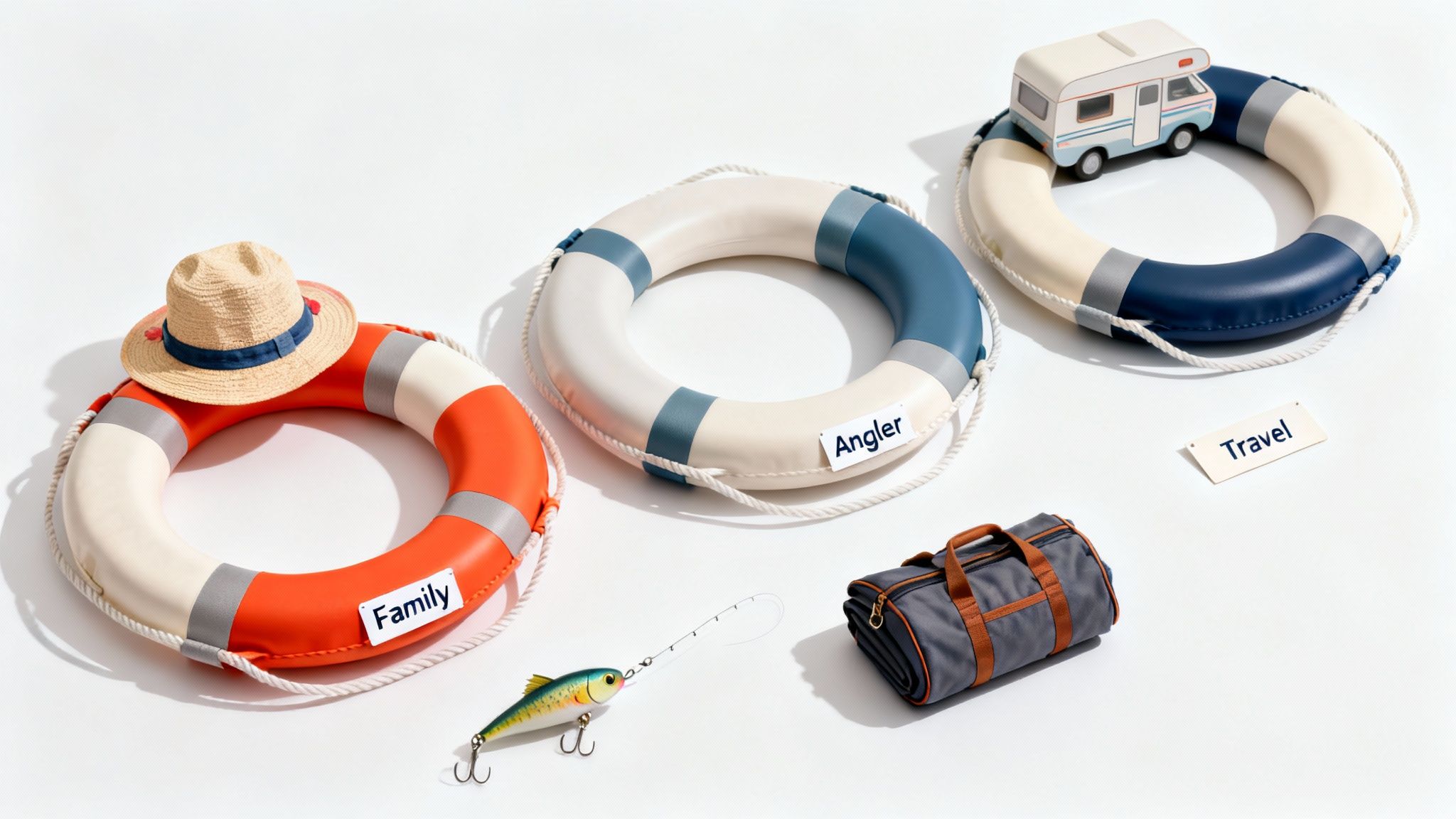
Think of it like choosing shoes. You wouldn’t wear hiking boots to the beach or sandals on a mountain trail. In the same way, your boating style dictates the features you need in a PFD, ensuring you get the right balance of safety, comfort, and functionality.
When you have family on board, especially kids, safety is everything. For casual cruises in your inflatable boat, comfort is just as important—because a PFD that gets in the way is one that might not get worn. The goal is a “wear it and forget it” experience. If you’re looking to compare prices and features of inflatable boats in your area for a family outing, remember to budget for top-quality safety gear too.
For this scenario, an automatic inflation life preserver belt is the clear winner. It provides a crucial fail-safe, inflating the moment someone hits the water, which is essential if a person is disoriented or unable to pull the manual cord. Look for belts with a soft, fleece-lined collar to prevent chafing and a lightweight design that doesn’t restrict movement.
Key features to look for:
Automatic Inflation: Gives you peace of mind and provides immediate support in the water.
High Visibility Colour: A bright bladder, like yellow or fluorescent orange, makes the wearer much easier to spot.
Comfort Features: Padded collars and breathable mesh linings make all-day wear enjoyable.
Anglers need freedom of movement. Whether you’re casting from an inflatable catamaran or leaning over the side to land a fish, you can’t be tangled up in bulky gear. A life preserver belt is the ideal solution, but the right one has to be snag-free and durable.
Many anglers prefer a manual inflation belt. This gives you full control, preventing accidental inflation from wave spray or rain while you’re focused on fishing. Look for a streamlined design with minimal external straps or buckles that could catch on fishing lines, rods, or nets. A tough outer shell is also a plus to resist hooks and abrasion. It’s also worth noting that when gearing up for specific water sports, other specialised gear like dive weight belts serve a completely different but equally important purpose.
A key consideration for anglers is a snag-free profile. Every strap and buckle is a potential point of failure when you’re actively fishing, so a minimalist design is often the safest and most practical choice.
For those who travel Australia by caravan or SUV, space is always at a premium. An inflatable boat in a bag is the perfect companion, and your safety gear should be just as compact and portable. In this regard, a life preserver belt is far superior to a bulky foam PFD.
Durability is also critical. Your gear will be packed, unpacked, and exposed to all sorts of elements. Look for a belt with a rugged, protective outer cover and high-quality webbing and buckles that can withstand the rigours of life on the road. Both manual and automatic inflation models work well here, so the choice really comes down to personal preference and your planned activities.
When you’re using an inflatable RIB as a tender for a larger yacht, you need a PFD that is reliable, quick to put on, and highly visible. Trips to and from shore can expose you to chop, other boat traffic, and changing conditions, making safety non-negotiable.
An automatic inflation belt with a Level 150 rating is often the best choice here, offering maximum buoyancy for open water. Features like an integrated harness and D-ring are valuable, allowing you to clip onto a safety line. A built-in crotch strap is also essential; it stops the PFD from riding up over your head in the water, ensuring it keeps your airway clear. High-visibility and UV-resistant materials will ensure the belt lasts longer and is easy to spot. You can find more helpful items in our guide to essential inflatable boat accessories.
By matching the features of a life preserver belt to your main boating activity, you can make a confident and informed purchase. This ensures you’re not just compliant with regulations, but truly equipped for a safe and enjoyable time on the water.
A high-quality life preserver belt is a remarkable piece of safety engineering, but it’s only as good as the person wearing it. Just having one on board isn’t enough. If you want it to perform its life-saving function when you need it most, you have to treat your PFD with the same care and attention you give your boat.
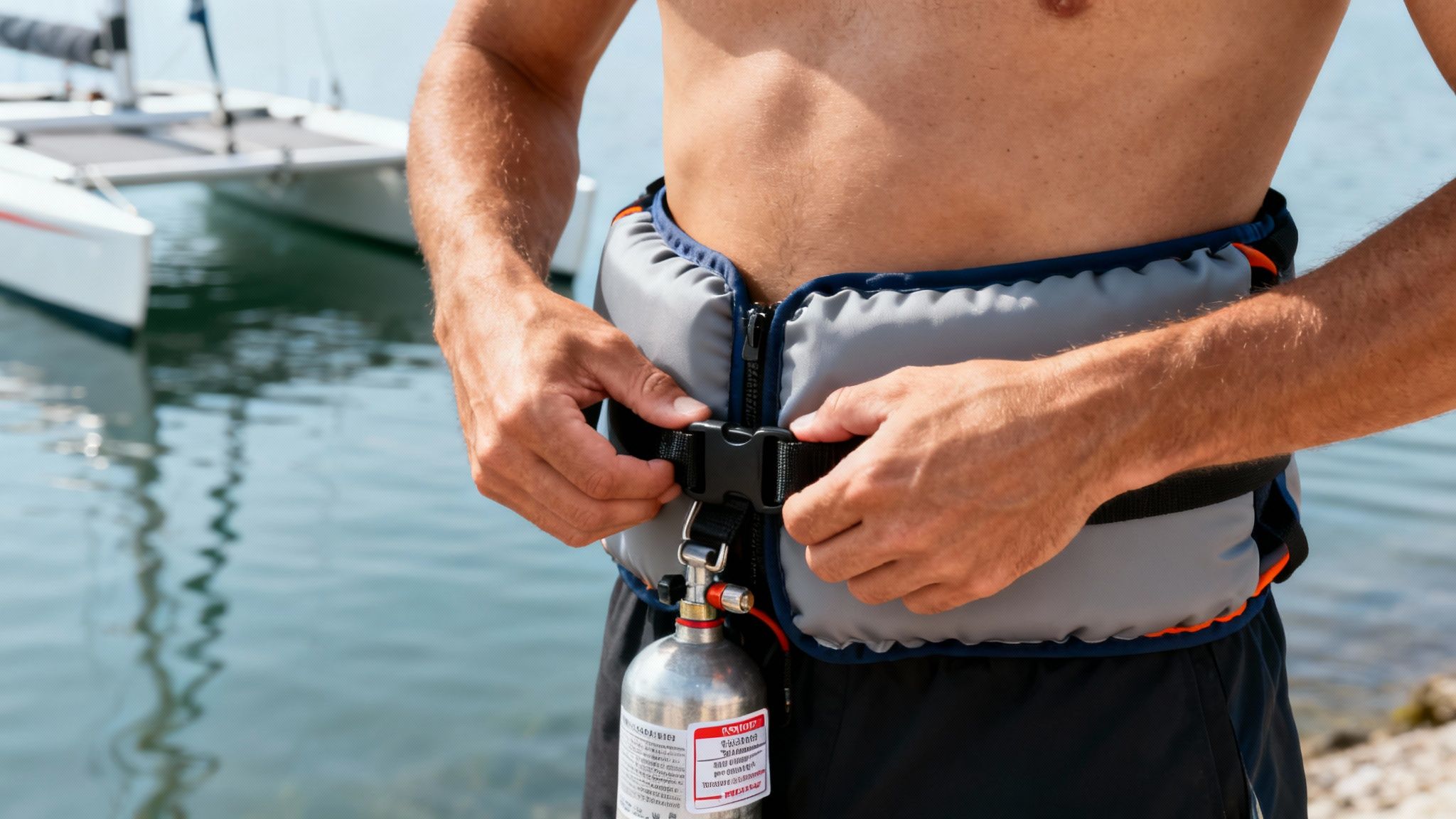
This process starts before you even leave the dock, with a perfect fit and a quick inspection. A PFD that’s too loose can simply float up over your head in the water, making it useless. One that’s too tight is just plain uncomfortable and gets in the way of your movement.
Getting the fit right is dead simple, but absolutely critical. You’re aiming for a snug, secure feel around your natural waist—not your hips. Once you’ve buckled the belt and adjusted the straps, it’s time for the ‘Snug Test’.
Fasten the Belt: Put the belt on and click the buckle until it’s secure.
Tighten the Straps: Pull the webbing straps so the belt fits snugly against your body. It shouldn’t be restrictive, but it also shouldn’t be loose enough to spin around your waist.
Perform the Lift: Grab the belt pack with both hands and give it a sharp pull upwards. If it rides up past your chest or towards your chin, it’s too loose. Cinch the straps down a bit more and test it again.
A properly fitted life preserver belt will stay locked in place around your waist. This ensures that if it inflates, it will support you correctly under your arms and keep your head well above the water.
Just like you check your fuel and engine before heading out, a quick PFD check should become second nature. This two-minute routine gives you the confidence that your most important piece of safety gear is ready for action.
Check the CO2 Cylinder: Make sure the CO2 cylinder is screwed in firmly and doesn’t show any signs of rust or damage. Most automatic inflators have a green indicator showing the cylinder is armed and ready. If it’s showing red, the cylinder might be loose or has already been discharged.
Inspect the Inflation Mechanism: Take a look at the automatic inflation cartridge or bobbin. It should be in good nick with a valid expiry date. If it’s past its use-by date, it needs to be replaced—no excuses.
Examine the Pull Cord: For manual activation, check that the pull cord is accessible and not tangled up.
Inspect Fabric and Straps: Give the belt’s outer cover, webbing, and buckles a quick once-over. You’re looking for any rips, fraying, or signs of sun damage.
This simple ritual is your first line of defence. It transforms your life preserver belt from a piece of gear you hope works into a reliable safety tool you know is ready.
This level of diligence is especially important for Aussie boaters, including yacht owners with custom RIB tenders from Easy Inflatables, where a life preserver belt is non-negotiable. Australian road safety statistics provide a chilling parallel. While 97.5% of vehicle occupants wear seatbelts, the tiny 2.5% who don’t account for a shocking 35.4% of fatal or serious injuries. This makes not wearing a seatbelt an astonishing 806% deadlier—a ratio that transfers directly to the water where hundreds of drownings occur annually due to people not wearing PFDs. You can explore more about these powerful safety findings on Drive.com.au.
Looking after your PFD properly extends its life and guarantees it will work when called upon. After a day on the water, especially in saltwater, it’s vital to give your belt a little TLC.
Rinse the belt with fresh water and let it air dry completely, but keep it out of direct sunlight. This simple step prevents salt crystals from damaging the fabric and stops corrosion from forming on any metal parts. Never use harsh detergents or chuck it in a washing machine.
Store your PFD in a cool, dry, and well-ventilated area. Avoid stuffing it into a damp locker or boat compartment where mould and mildew can grow and degrade the materials over time. For more tips on keeping your gear in top shape, check out our guide on inflatable boat maintenance made simple.
By mastering the fit, use, and maintenance, you turn your life preserver belt into the most dependable safety partner on your boat.
Choosing the right safety gear always comes with a few questions. It’s a good thing—it means you’re taking safety seriously. Here are the answers to some of the most common queries we get from boaters about life preserver belts.
The short answer is no. Inflatable life preserver belts aren’t designed to handle the high-impact forces that come with water sports like skiing or wakeboarding.
Hitting the water at speed can cause the belt to inflate unexpectedly, or worse, cause an injury. For these activities, you need an inherently buoyant, impact-rated life jacket, typically a Level 50S PFD, which is specifically designed for the job. Always double-check the manufacturer’s label and your local maritime rules to be sure.
This is a really common point of confusion. The CO2 cylinder itself doesn’t expire as long as it’s unused, unpunctured, and hasn’t developed any rust. It only needs replacing after the belt has been inflated.
The part you really need to watch is the automatic inflation mechanism’s bobbin or cartridge. This little component is water-sensitive and does have an expiry date, usually every 3-5 years. This is the trigger for your PFD, so it’s critical to replace it on schedule. Make checking it a non-negotiable part of your annual gear service.
Inflatable belts are generally not recommended or certified for children. They’re designed and calibrated for adult body weights and shapes to work correctly and provide the right support if you end up in the water.
Children should always wear a properly fitted, inherently buoyant life jacket. Depending on where you’re boating, this should be a PFD Level 100 or higher. Look for essential features like a crotch strap and head support, which help keep them floating face-up. Most importantly, always choose a PFD that’s specifically rated for your child’s weight.
Yes, you can, but there are a few rules you’ll need to follow. Most Australian airlines allow one inflatable PFD per person, sometimes with one or two spare CO2 cartridges.
You’ll have to declare it at check-in, and it’s usually required to be in your carry-on luggage, not checked bags. Policies can differ slightly between airlines, so always confirm with your specific airline before heading to the airport. A quick phone call or website check can save you a lot of hassle.
Ready to find the perfect safety solution for your adventures? Explore the full range of durable and reliable inflatable boats and accessories at Easy Inflatables and gear up for your next trip with confidence. Find your ideal setup at https://easyinflatables.com.au.