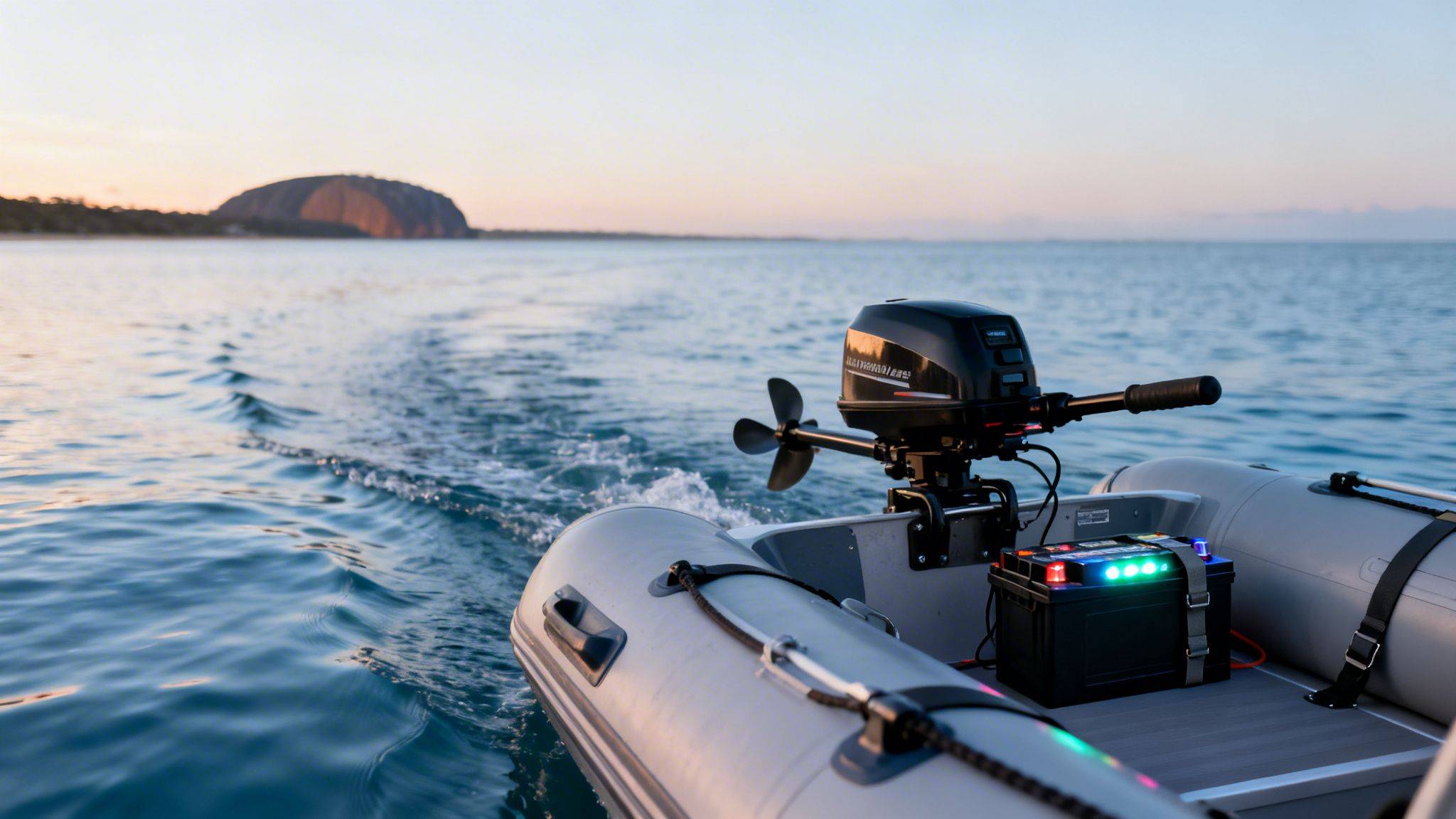
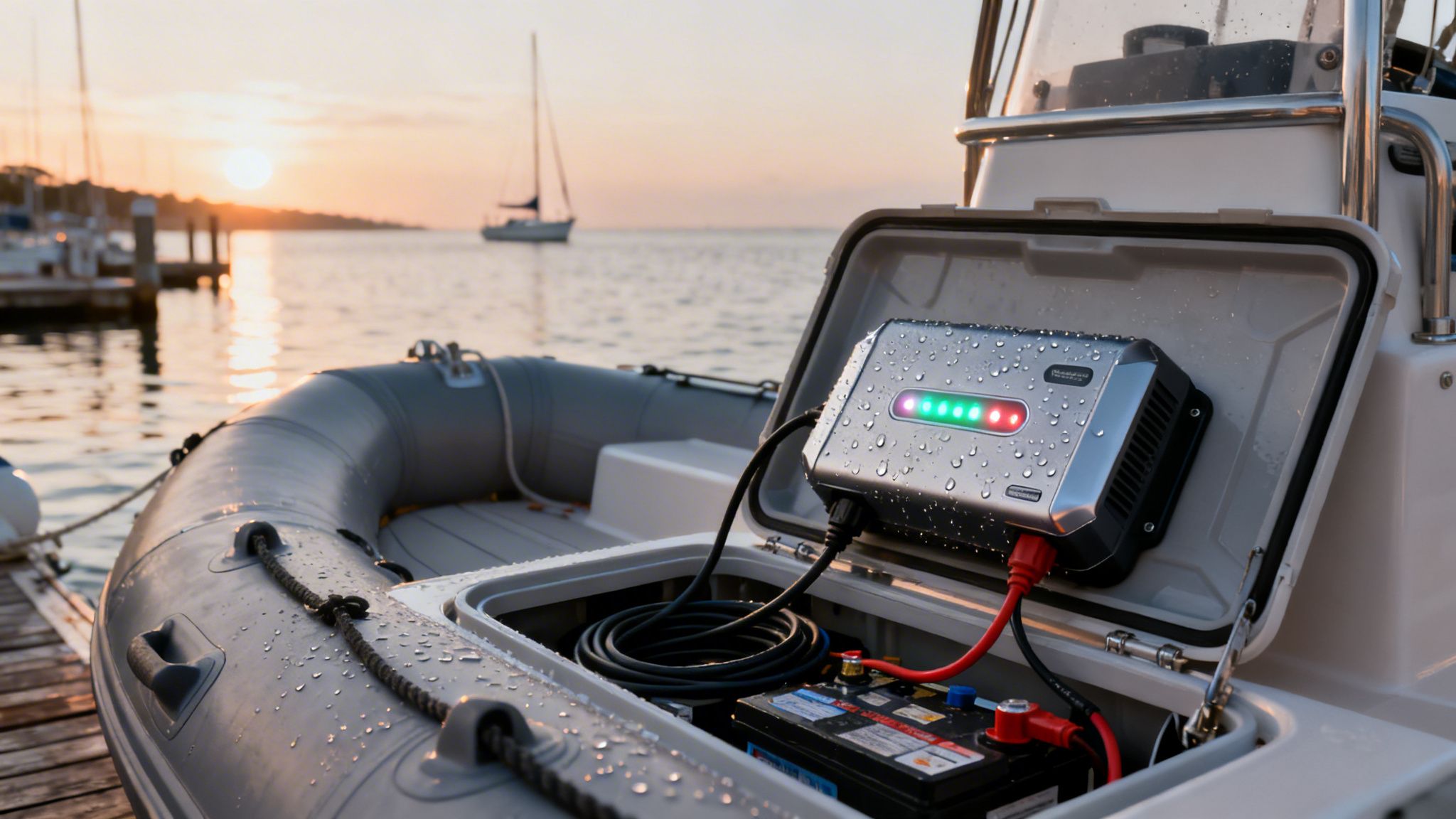

A marine battery charger is more than just a way to top up your boat’s power. It’s a specialised piece of equipment engineered to work safely and reliably in the harsh marine environment. Unlike the charger in your garage, it’s built to handle moisture, salt spray, and corrosion. Most importantly, it’s ignition-protected, a critical safety feature that prevents stray sparks from igniting fuel vapours.
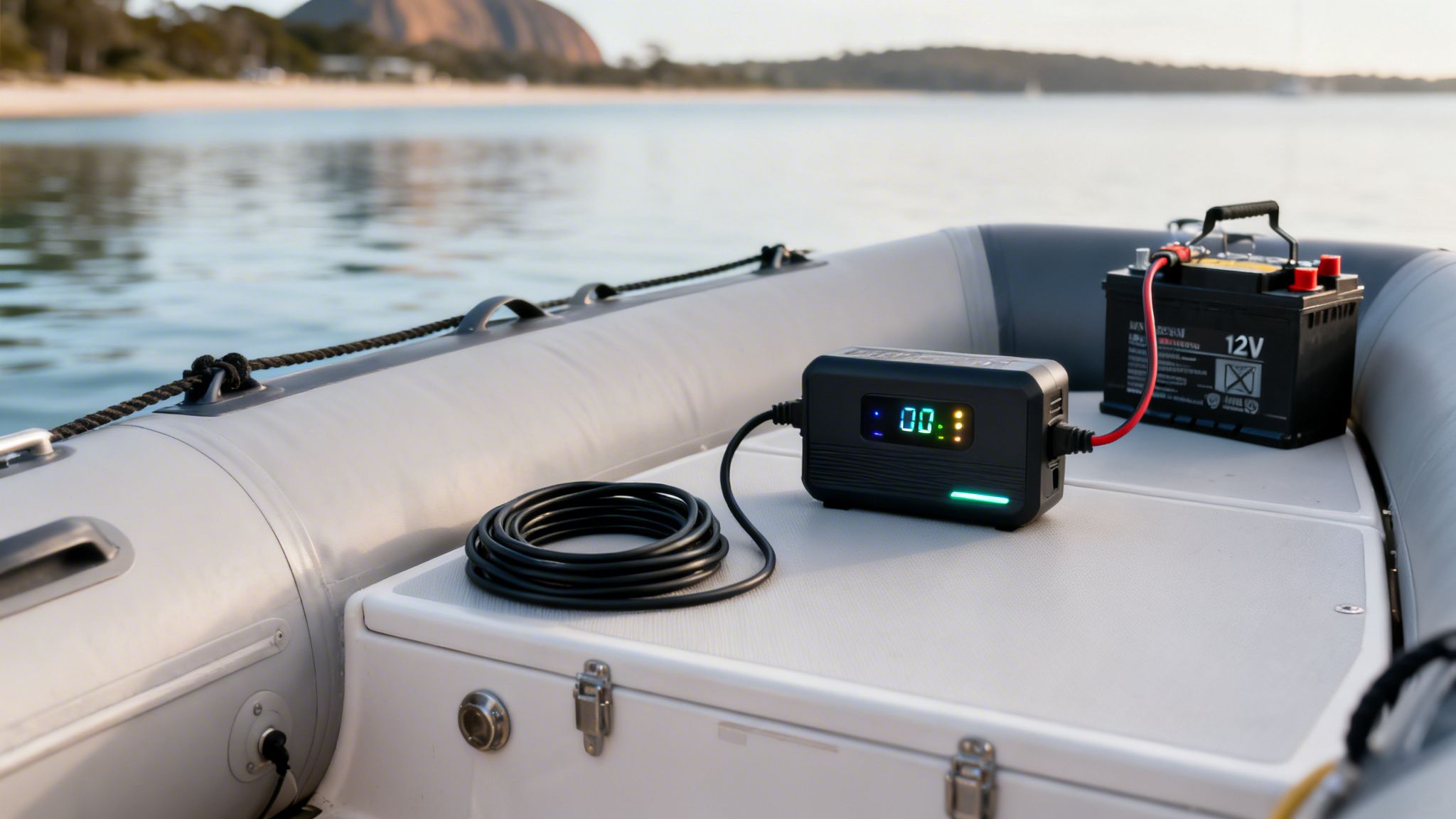
Welcome to our ultimate guide on marine battery chargers, written for Australian boaters by people who live and breathe life on the water. A dependable charger is the unsung hero of every great day out, quietly ensuring your electronics run without a hitch and your engine kicks over every single time. It’s the critical link keeping your adventures powered and safe.
First up, let’s talk about why your standard car charger is a serious hazard on a boat. Bringing one aboard isn’t just a bad idea; it’s a risk you can’t afford to take.
This quick comparison shows exactly why a specialised marine charger is non-negotiable for safety and performance.
| Feature | Marine Battery Charger | Standard Car Charger |
|---|---|---|
| Ignition Protection | Yes – Sealed to prevent sparks. | No – Can ignite fuel vapours. |
| Moisture/Corrosion Resistance | Yes – Coated electronics, sealed casings. | No – Prone to failure in a damp, salty environment. |
| Charging Profile | Multi-stage – Optimised for deep-cycle batteries. | Basic – Designed for shallow-cycle car batteries. |
| Durability | Built to withstand shock and vibration. | Not designed for constant movement. |
| Safety Certifications | Marine-specific (e.g., ISO 8846). | Automotive-specific only. |
The takeaway is clear: a car charger lacks the construction, safety features, and smarts needed for a marine setting. A proper marine charger, on the other hand, is built from the ground up to protect both you and your battery investment.
Whether you’re looking for the best inflatable boats for recreational use available near you, comparing prices and features, or just getting ready for a weekend getaway on an inflatable catamaran, this guide will give you the clarity you need to power your vessel. We’ll show you how to choose a charger perfectly matched to your boat and the unique demands of Australia’s marine conditions.
This focus on quality power solutions is a big deal. Australia’s boating scene is booming, and the marine battery charger market is part of a larger sector that hit USD 538.0 million in 2026 and is forecast to climb to USD 785.9 million by 2033. This growth is supercharged by our love for renewable energy, pushing demand for robust battery storage and smart chargers—perfect for powering up the best inflatable boats for recreational use available near you from brands sold right here at Easy Inflatables. You can explore more on the Australian battery charger market growth to see the trend for yourself.
Key Takeaway: Choosing the right marine battery charger isn’t just about convenience; it’s about safety, performance, and protecting your battery investment for years of uninterrupted adventures.
This guide will set you up for safe, worry-free time on the water, no matter where your journey takes you.
Choosing the right marine battery charger isn’t just about matching plugs and cables. It’s about understanding the technology inside—the very thing that determines your battery’s lifespan, its performance, and your safety out on the water.
Let’s cut through the jargon and look at what really matters, so you can make a smart choice for your boat.
The most basic option you’ll come across is a trickle charger. Think of it as a garden hose left on a slow drip to keep a bucket full. It feeds a constant, low-amperage current to stop a battery from going flat, but it’s not very clever. It can easily overcharge and damage your battery over time.
On the other hand, modern multi-stage smart chargers are like a personal trainer for your battery. They analyse your battery’s health and deliver a tailored charging program, giving you a fast, safe, and complete charge every single time. This is the only way to go if you want to get the most out of today’s advanced marine batteries.
A smart marine charger doesn’t just blast power into your battery. It uses a precise, multi-stage process to restore and maintain its health, protecting your investment for the long haul.
Bulk Stage: This is the heavy lifting. The charger pushes the maximum safe current into the battery, getting it up to around 80% capacity quickly and efficiently.
Absorption Stage: As the battery gets close to full, the charger gets smarter. It slows down the current and raises the voltage, allowing the battery to “absorb” that final 20% of charge without overheating or stressing the cells.
Float/Maintenance Stage: Once your battery hits 100%, the charger switches to a low-voltage “float” mode. It just provides a tiny bit of power to counteract the battery’s natural self-discharge, keeping it topped up and ready to go for weeks or even months without any risk of overcharging.
This intelligent process is exactly why a smart charger can extend your battery’s life by up to 25% compared to a basic trickle charger.
Your next decision is whether to get a charger that’s permanently installed or one you can carry around. This really comes down to your boat and how you use it.
Onboard (Fixed) Chargers:
These are bolted right into your boat, usually in a dry, ventilated spot. They’re wired directly to your batteries and plug into shore power through a dedicated inlet.
Ideal for:
Larger inflatable RIBs, inflatable catamarans, and yacht tenders with separate batteries for starting, electronics, and trolling motors. They’re the perfect “set-and-forget” solution if you keep your boat at a marina or on a trailer at home.
Portable Chargers:
These are standalone units you can bring on and off the boat as needed. They’re fantastic for our “boat-in-a-bag” customers, who might store their battery at home between trips. Many owners of smaller inflatables and kayaks love this flexibility. To explore power options for these setups, check out our guide on selecting a lithium marine battery.
When you see a code like “IP67” on a marine battery charger, pay attention. It’s a crucial rating that tells you how well the unit is protected from dust and water. The marine environment is unforgiving, so this rating tells you exactly what your gear can handle.
The “IP” stands for Ingress Protection. The first number rates its defence against solids (like dust), and the second rates its defence against liquids.
IP65: The charger is protected from low-pressure water jets, like light spray. It’s okay for spots that get a bit wet, but not soaked.
IP67: This is a much tougher standard. It means the unit is totally dust-tight and can be submerged in up to one metre of water for 30 minutes without failing. This is really the gold standard for gear in exposed areas of a boat.
IP68: This is the highest rating you’ll typically find. It means the charger is protected against being continuously underwater, under conditions set by the manufacturer.
For any boat—but especially for an open inflatable where spray is a given—an IP67 or IP68 rating is a must. It’s the peace of mind you need to know your charger will survive a real day on the water.
Picking the right marine battery charger is about more than just amps and waterproof ratings. The single most important decision you’ll make is matching the charger to your battery’s chemistry. Think of it like this: using the wrong charger is like putting diesel in a petrol car. It might seem to work for a moment, but you’re setting yourself up for serious, expensive damage down the track.
A smart charger with selectable modes is non-negotiable because different batteries have completely different “appetites” for power. Let’s break down the two main battery families and what they need to thrive on your boat.
This simple guide helps you decide whether a fixed, permanently installed charger or a flexible, portable unit is the right call for your boat and how you use it.
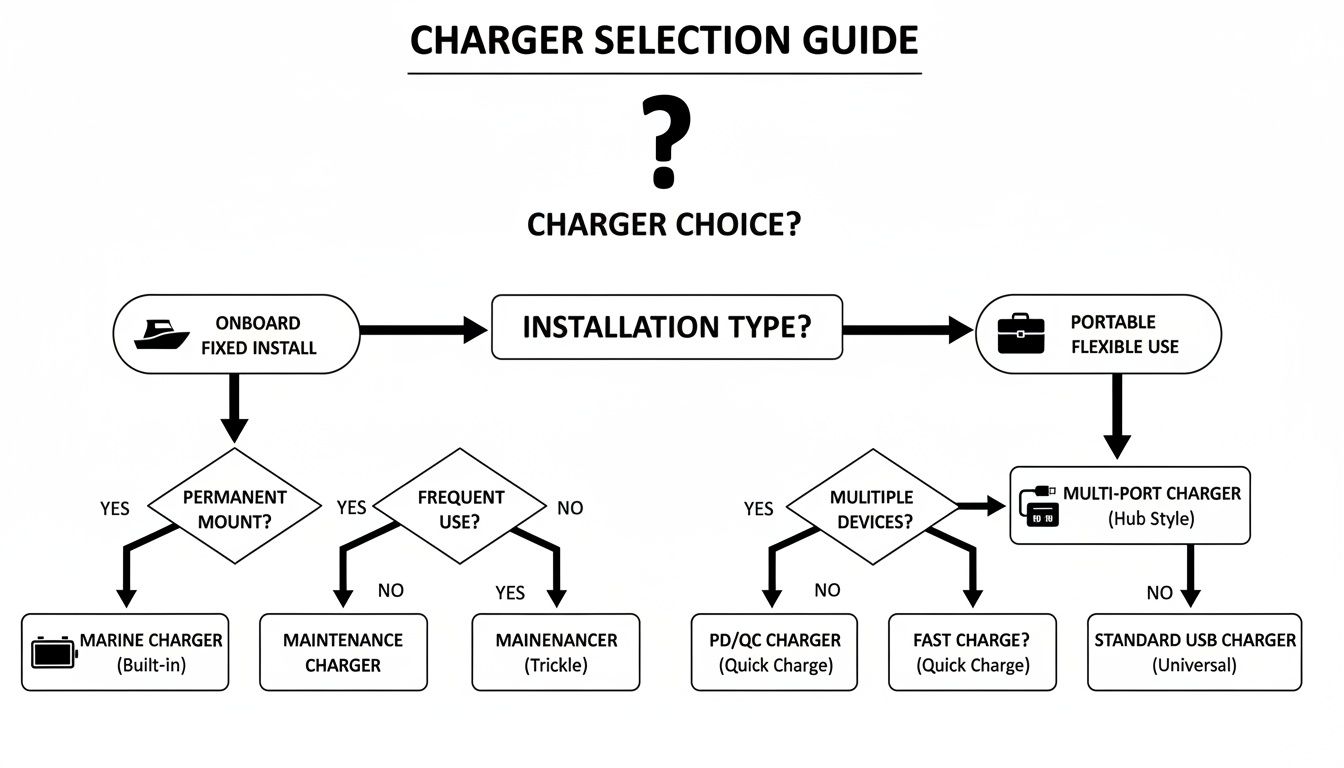
Ultimately, the choice between an onboard and portable charger comes down to your boat’s size, your power demands, and how you store and use your vessel.
Lead-acid batteries are the classic, reliable power source you’ll find in countless boats all over Australia. They are dependable and get the job done without breaking the bank, but they come in a few different flavours. A quality marine charger will have dedicated settings for each one.
Flooded (or Wet Cell): These are the old-school “top-up” batteries. They’re robust and affordable but need regular maintenance, like adding distilled water. They require a charger that won’t aggressively boil off their electrolyte.
AGM (Absorbent Glass Mat): These are sealed, maintenance-free powerhouses. The electrolyte is held in a fibreglass mat, which makes them spill-proof and fantastic at handling vibrations. AGM batteries can also take a charge much faster than flooded types but need a specific charging algorithm to avoid damage.
Gel: In a Gel battery, the electrolyte is mixed into a thick, silica-based gel. This makes them extremely rugged and perfect for deep-cycle use, but they are incredibly sensitive to charging voltage. Overcharging them can create permanent pockets or voids in the gel, which will kill the battery for good.
Critical Tip: Never, ever use a generic “Lead-Acid” setting if your charger offers specific modes for AGM or Gel. Those slight differences in voltage during the absorption and float stages are the key to getting a long, reliable life out of your battery.
Lithium Iron Phosphate (LiFePO4) batteries are completely changing the game for modern boating, especially for us inflatable boat, catamaran, and kayak owners. They are incredibly lightweight and pack a massive power punch, making them perfect for running gear like trolling motors or high-pressure pumps without weighing your boat down. Our guide on electric outboard motors in Australia dives into how these modern systems are revolutionising small boat performance.
But when it comes to charging, lithium batteries are a totally different beast. They demand a very specific charging profile known as CC/CV (Constant Current/Constant Voltage). A lead-acid charger’s profile, particularly its “float” or “equalisation” stages, can be fatal for a lithium battery.
Here’s why you must use a lithium-compatible charger:
The switch to lithium is happening fast. The global marine power battery systems market is booming, and right here in Australia, lithium-ion technology is leading the charge. It’s set for a massive 19.5% CAGR within the country’s USD 6.73 billion battery market by 2026. This trend is a massive win for those looking to compare prices and features of inflatable boats in their area, as more people adopt lightweight, powerful lithium batteries that need these specialised chargers.
At the end of the day, matching your charger to your battery isn’t just a recommendation—it’s a necessity. It’s what keeps you safe, protects your investment in expensive batteries, and guarantees you have reliable power when you’re miles from shore.
Choosing the right size marine battery charger might sound a bit technical, but it’s actually pretty straightforward once you get the main principle. Getting this right is the key to charging your batteries efficiently without damaging them, which means less time waiting and more time back on the water.
Think of it like this: using a charger that’s too small is like trying to fill a bucket with a dripping tap—it’ll get there eventually, but it’s painfully slow. Go too big, and you risk cooking your batteries and shortening their life.
The secret is matching your charger’s amperage to a percentage of your total battery bank capacity, which is measured in Amp-hours (Ah). This ensures a charge rate that’s both safe and effective.
The Rule of Thumb for Sizing: Your charger’s amperage should be between 10% and 25% of your total battery bank’s Amp-hour (Ah) capacity.
This range is the sweet spot. A charger that’s below 10% will still work, but you’ll be waiting around forever for a full charge. Pushing beyond 25%, especially with traditional lead-acid batteries, can generate way too much heat and do some serious long-term damage.
Let’s put this rule into practice with a couple of common setups you’d find on inflatables and tenders across Australia.
Scenario 1: Small Fishing Inflatable
You’ve got a single 100Ah AGM battery to power your fish finder and a small trolling motor. It’s a classic, simple setup.
Scenario 2: Inflatable Catamaran or RIB Tender
Your setup is a bit more involved: a dedicated 80Ah starting battery plus a 120Ah deep-cycle house battery for your electronics. That’s a total of 200Ah.
Getting a handle on power needs is vital, especially for running electric motors. For a deeper dive, check out our guide on sizing your power system for a trolling motor.
It’s tempting to save a few bucks on a smaller charger, but opting for one closer to that 25% mark gives you one massive advantage: speed.
Let’s say you’ve used half the juice in your 100Ah battery, so you need to put 50Ah back in. The difference is huge:
For weekend warriors or anyone who needs a quick turnaround between adventures, a more powerful charger is an absolute game-changer. It means less time stuck at the dock and more time doing what you love.
To take the guesswork out of it, here’s a quick reference table to help you match your battery bank to the right charger size.
| Total Battery Capacity (Ah) | Recommended Charger Size (Amps) |
|---|---|
| 50Ah – 80Ah | 5 – 10 Amps |
| 80Ah – 120Ah | 10 – 20 Amps |
| 120Ah – 200Ah | 15 – 40 Amps |
| 200Ah – 400Ah | 25 – 60 Amps |
| 400Ah+ | 60+ Amps |
Ultimately, sizing your marine charger correctly is about finding that perfect balance between charging speed and looking after your batteries. Stick within that 10-25% range, and you’ll have a reliable system that’s safe, efficient, and ready for your next trip out on the water.
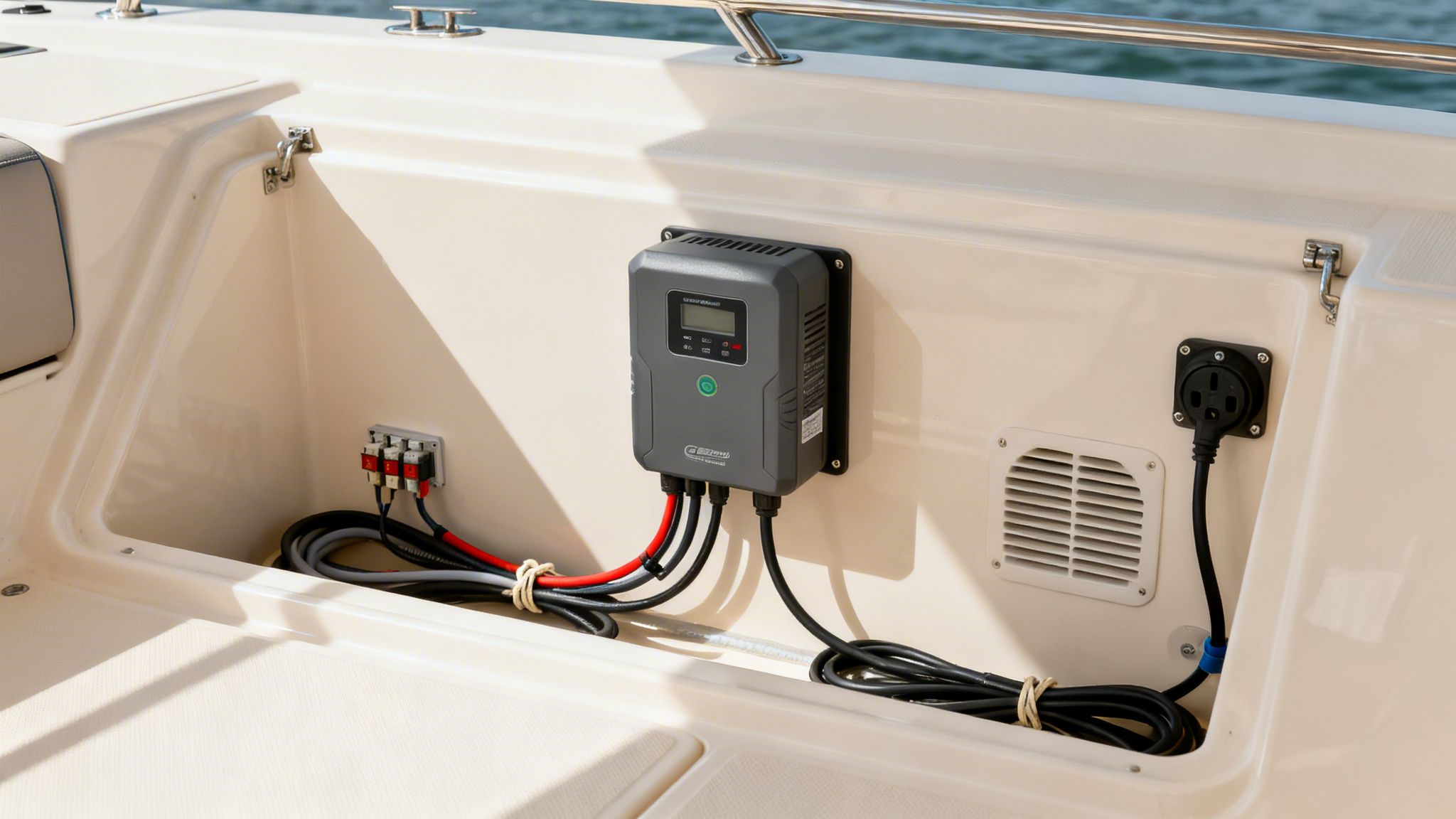
Choosing the right marine battery charger is only half the battle. How you install it is just as crucial. A shoddy installation isn’t just inefficient; it can be a serious safety risk on the water. This isn’t just about connecting a few wires—it’s about building a safe, tough, and reliable power system for your boat.
Here, we’ll walk you through the essentials of a professional-grade installation. Every step matters, from giving your charger room to breathe to choosing the right wires and fuses. We’ll also dive into how to smoothly integrate your charger with other power sources like solar panels and your engine’s alternator.
Before you even think about touching a wire, a bit of planning goes a long way. A safe setup protects your gear, your boat, and most importantly, you. Treat these checks as non-negotiable first steps.
Secure Mounting: Your boat moves, vibrates, and bounces through chop. That constant motion is a silent killer for electronics. Always mount your marine battery charger securely to a solid surface where it won’t shake loose, especially in rough conditions.
Ventilation is Vital: Chargers work hard and generate heat, particularly during the main charging phase. Installing your unit in a dry, well-ventilated compartment prevents it from overheating, which can sap its efficiency and shorten its life. Never cover the charger or block its cooling fins.
Correct Wire Gauge: Using wires that are too thin is a common and dangerous mistake. Undersized wires can get hot, cause a big voltage drop (making your charger less effective), and even create a fire hazard. Always check the charger’s manual for the right wire gauge based on how far it is from your batteries.
Fuse Protection: This one is critical. Every positive wire running from your charger to a battery must have a correctly sized fuse or circuit breaker. Install it as close to the battery as possible. This is your number one defence against short circuits.
These days, modern boats often have several ways to make power. At the marina, you’ve got shore power. Out at anchor, solar panels are your best friend. And when you’re on the move, your engine’s alternator is a powerhouse. A well-designed system juggles all these sources without you having to think about it.
The push for greener waters in Australia is driving new innovations in marine chargers, tying into a global marine battery market expected to hit USD 2.7 billion in 2026. High rooftop solar adoption at home is inspiring boaters to add solar charging to everything from custom yacht tenders to family catamarans. If you are looking for a place in Australia to hire inflatable boats for a family outing, you’ll find that many now use these advanced, eco-friendly systems. You can find more on these marine battery market insights from Research Nester.
Adding solar is a fantastic way to keep your batteries topped up without running your engine. Our guide on solar panels for boats is the perfect place to start learning how to harness the sun’s power.
For any boat with a starting battery for the engine and a separate “house” battery bank for your electronics, managing power from the alternator is key. You need to charge both battery banks when the engine is running but keep them separate when it’s off—otherwise, you could easily drain your starter battery and get stranded.
That’s where an Automatic Charging Relay (ACR) comes in.
An ACR, sometimes called a Voltage Sensitive Relay (VSR), is a smart switch. It automatically connects your battery banks together when it senses a charging voltage (like from your alternator) and disconnects them when the engine is off.
This simple bit of gear ensures your alternator charges your starting battery first. Once that’s full, it automatically diverts the spare power over to your house batteries. It’s a true “fit-and-forget” solution that intelligently manages power distribution and prevents that horrible feeling of a dead starter battery. It’s a must-have for any boat running more than one battery.
Your marine battery charger is a tough, hard-working piece of kit, but its long-term reliability is built on a foundation of safety and consistent upkeep. Investing in a quality charger with robust safety features is the first and most important step in protecting your boat, your batteries, and yourself.
Think of these features as your silent guardian on the water. For anyone running a petrol outboard, ignition protection is an absolute must. This means the charger is completely sealed to prevent any internal sparks from igniting dangerous fuel vapours in your bilge—a critical safety standard that typical car chargers just don’t have.
Just as crucial are the features that protect against simple human error. Reverse polarity protection saves the day if you accidentally hook the clamps to the wrong battery terminals, preventing a costly mistake. Over-temperature safeguards act like a smart thermostat, automatically cutting back power or shutting the unit down if it gets too hot, protecting its internal electronics from burnout.
A few minutes of inspection every month or so will keep your marine charger running safely and efficiently for years to come. This simple checklist covers the essentials for keeping your charging system in top shape.
When you’re doing any maintenance on your boat’s electrical system, it pays to be vigilant about identifying potential hazards to stay safe. A little awareness goes a long way. And since you’re protecting your charger, don’t forget the batteries; check out our guide on finding the right battery box for your boat for an extra layer of security.
Even the best gear can have an off day. If your charger isn’t behaving as expected, don’t panic. These simple troubleshooting steps can often solve the most common issues without a trip back to the shop.
Problem: Charger Won’t Turn On
First, check the obvious. Is the AC power cord securely plugged into a working outlet? Check the shore power breaker on your boat and at the dock to ensure they haven’t tripped. A tripped GFCI (Ground Fault Circuit Interrupter) outlet is an incredibly common culprit here.
Problem: Battery Isn’t Fully Charging
If the charger seems to be working but your battery never quite reaches 100%, start with the connections again. A corroded or loose terminal can create enough resistance to fool the charger into thinking the battery is full when it isn’t. Also, double-check that you’ve selected the right charging profile (e.g., AGM, Gel, or Lithium) to match your battery type. Using the wrong setting is one of the most frequent causes of undercharging.
When it comes to your boat’s power system, a little bit of knowledge goes a long way. We get a lot of questions about marine chargers, so we’ve put together straight-to-the-point answers to help you choose and use your gear with confidence.
In a word: no. You should never use a regular car battery charger on your boat, and the reason is simple—safety. Marine battery chargers are built differently, designed to survive in a wet, high-vibration, and salty environment.
Most importantly, they are ignition-protected. This means they’re completely sealed to stop any internal sparks from escaping and igniting dangerous fuel fumes that can build up in a boat’s hull. A car charger offers zero protection against this, making it a serious fire hazard on the water.
The simple answer is after every single trip. Leaving lead-acid batteries even partially discharged is the fastest way to kill them. This causes a damaging process called sulfation, which builds up on the battery plates and permanently reduces their lifespan and performance.
The best habit to get into is plugging your boat into a smart charger the moment you’re back at the dock or have it trailered at home. Modern chargers can be left connected 24/7, as they automatically look after your batteries without any risk of overcharging.
This “plug-and-forget” approach is the secret to getting years of reliable service and ensuring you’re always ready for your next outing.
Think of a multi-stage smart charger as a personal trainer for your battery. Instead of just dumping power in, it uses a precise, three-phase process to charge faster, more thoroughly, and much more safely.
This intelligent charging is miles ahead of what a basic trickle charger can do and will dramatically extend the life of your batteries.
Yes, absolutely. Lithium (LiFePO4) batteries are a different beast and need their own specific charging profile. Using a charger designed for lead-acid batteries on a lithium one is a recipe for disaster—it can cause permanent damage, slash its lifespan, and even create a dangerous safety situation.
You must use a marine battery charger that has a specific, user-selectable mode for lithium batteries. This ensures the charger “talks” to the battery’s built-in Battery Management System (BMS), delivering the right voltage and current for a safe, efficient, and healthy charge every time.
At Easy Inflatables, we believe in arming you with the right gear and the right knowledge. From picking the perfect charger to finding your ideal inflatable boat package, we’re here to help you get out on the water with total confidence.
Explore our full range of high-performance inflatable boats and accessories at https://easyinflatables.com.au.