

Picking the right motor for your inflatable boat isn’t just a small detail—it’s the single most important decision you’ll make to unlock its true potential. It’s what separates a simple paddle from a real adventure, turning your boat into a serious machine for fishing, family fun, or exploring hidden coastlines. This guide is built from the ground up for Australian boating enthusiasts looking to compare prices and features of the best inflatable boats available near them.
We’ll be focusing on what works best for owners of premium inflatables, like the Aerowave range, which feature tough aluminium transoms designed for reliable outboard power. This guide will cut through the jargon around horsepower ratings, shaft lengths, and the big question: petrol or electric? Of course, a great day on the water isn’t just about the motor; equipping yourself with other essential camping gadgets can make your trips even more comfortable and memorable.
By the end of this, you’ll have the confidence to choose a motor that perfectly matches your boat and how you plan to use it. That means countless safe, fun-filled hours on Australian waterways, whether you’re looking for an inflatable catamaran or just want to get your family out on the local lake.
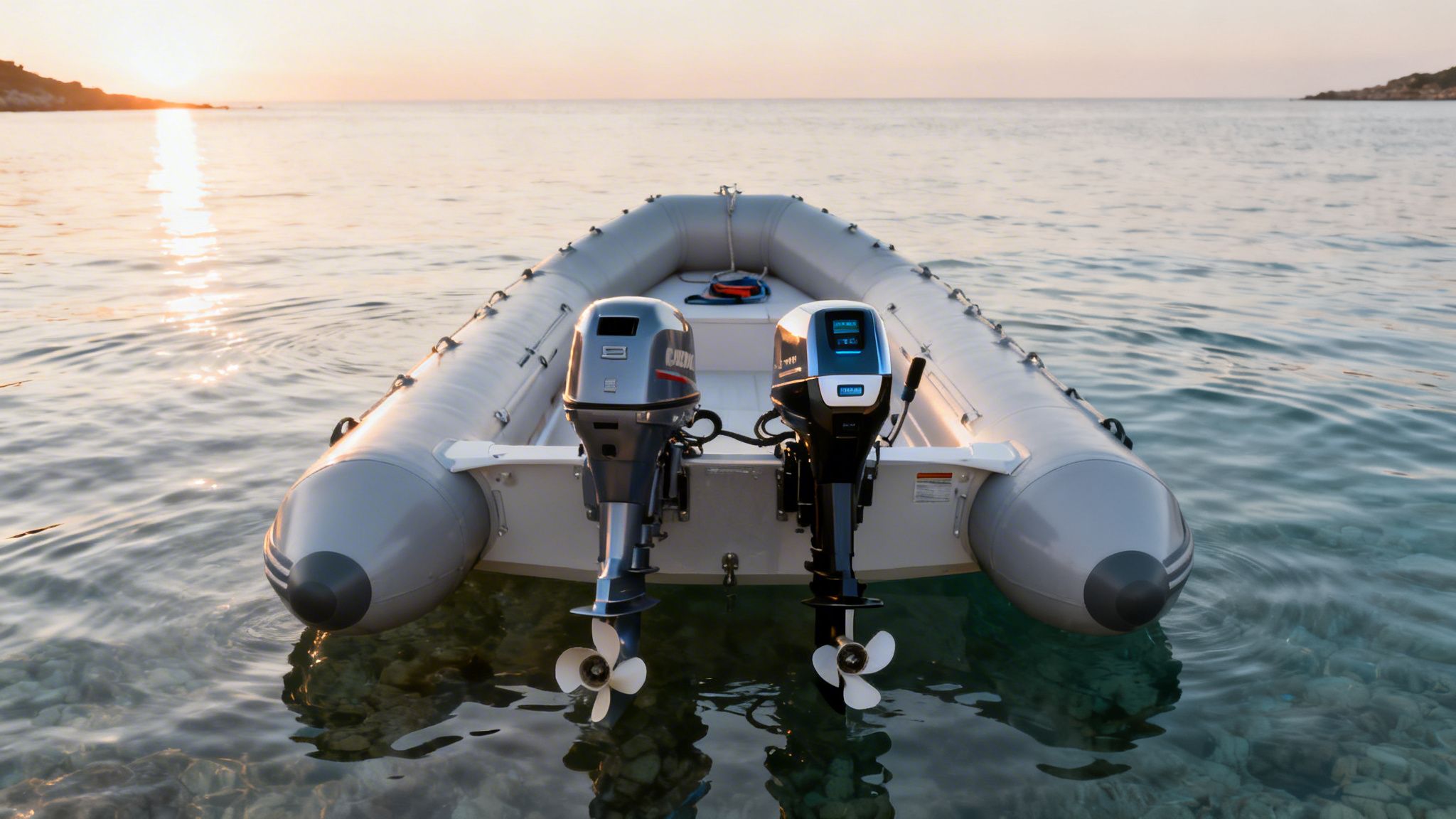
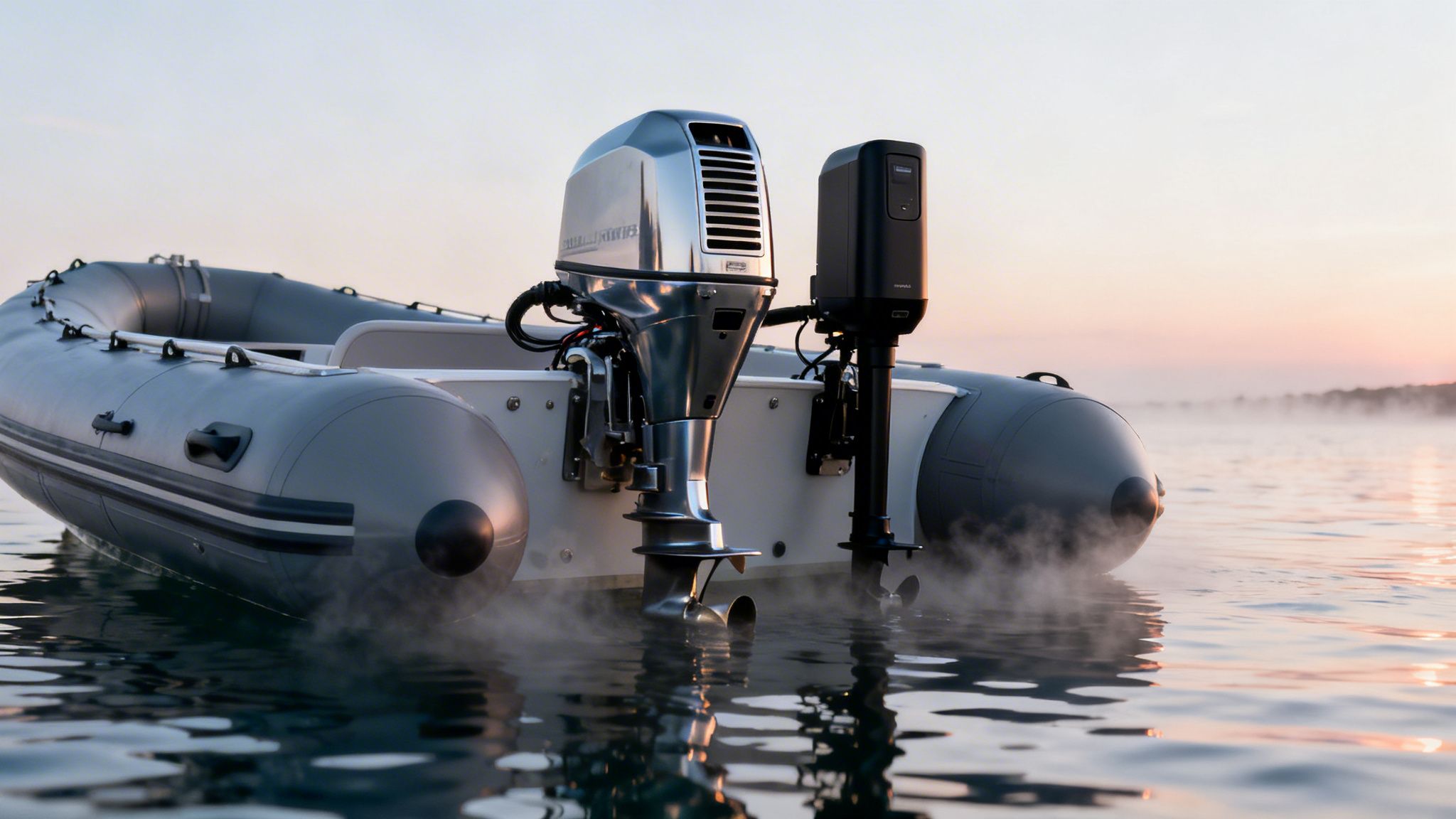
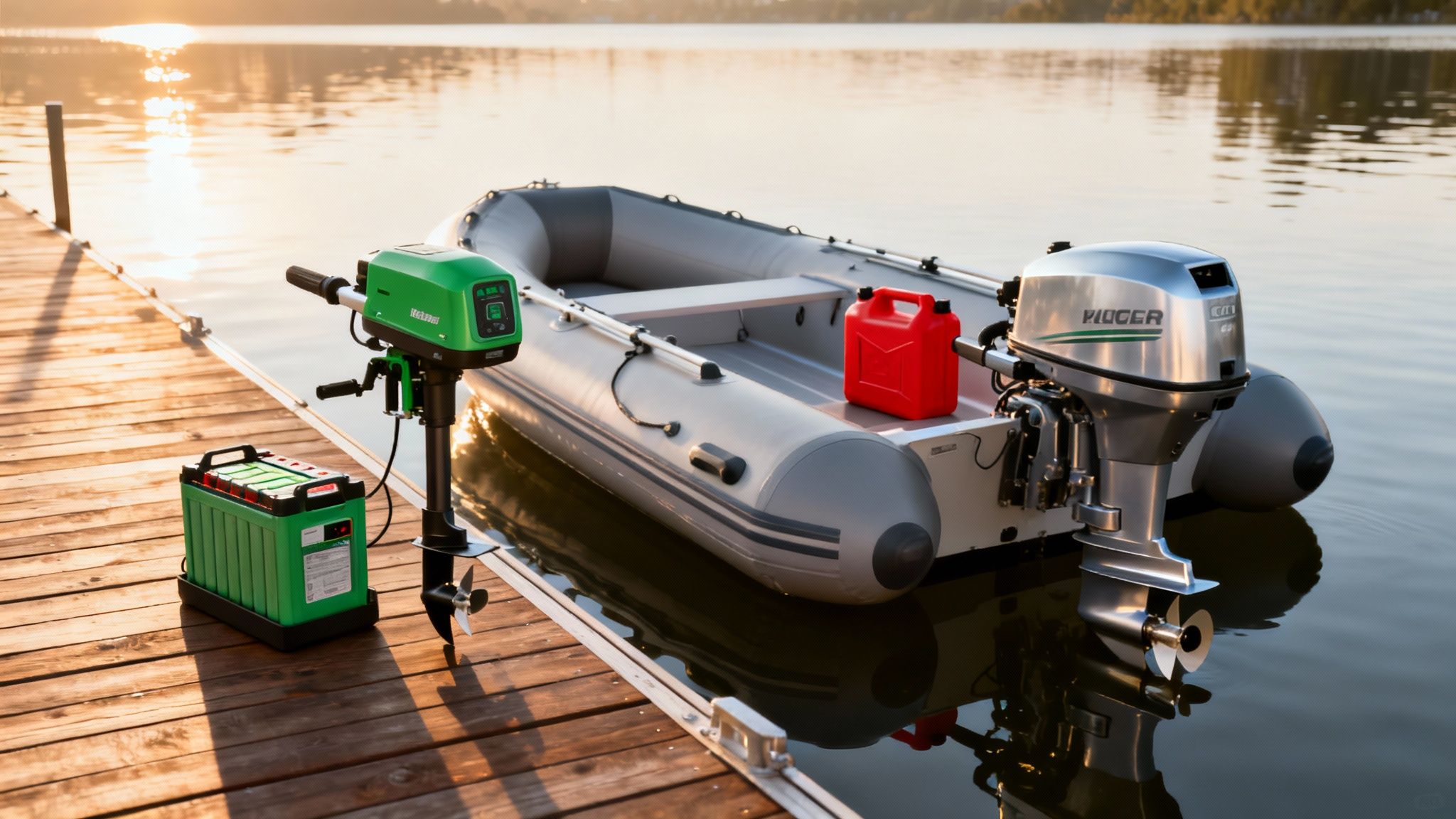
Choosing the right motor for your inflatable is the first big decision you’ll make, and it’s one that will shape every trip you take on the water. The debate between a classic petrol outboard and a modern electric motor is a bit like choosing between a powerful V8 ute and a sleek EV. Each has its place, and the best choice really depends on what you plan to do with it and the options available in your area.
A petrol outboard, like a trusty Hidea motor, is the undisputed workhorse of the water. It gives you raw power and an almost unlimited range, perfect for punching through currents or getting a fully loaded boat up on the plane. For long days exploring the coast or heading upriver where you need absolute certainty you can get home against the wind and tide, petrol is still king. The convenience of a quick refuel at any marina makes it the go-to for serious adventurers.
On the other hand, an electric outboard offers a completely different, yet equally compelling, experience. It’s the silent, eco-friendly option that lets you glide through the water with barely a whisper. This makes it the perfect motor for inflatable boats used for stealthy fishing in quiet estuaries or on the growing number of Australian dams and lakes with emission restrictions. Plus, with hardly any moving parts, the maintenance is refreshingly simple.
So, what’s it going to be? Your choice really boils down to how you plan to use your boat. Are you chasing speed and distance for a fun family outing, or is silence and simplicity your top priority?
Petrol Power Is Ideal For:
Electric Power Shines When:
The Australian market really reflects this split. While there was a recent dip in small boat imports, it’s shown a shift towards trusted local retailers like Easy Inflatables who bundle reliable Hidea outboards with popular boats like the Aerowave. With Aussies’ love for boating soaring post-COVID, over 120,000 soft hull inflatables have been sold in recent years, many set up for fishing and family fun. For a deeper dive into the numbers, you can explore the full Australian small boats market report.
To make the decision a bit easier, it helps to see the key differences side-by-side. Here’s a simple table to help you weigh the pros and cons based on what matters most to you as you compare features and prices.
| Feature | Petrol Outboard (e.g., Hidea) | Electric Outboard (e.g., Trolling Motor) |
|---|---|---|
| Performance & Range | Unbeatable power-to-weight ratio. Virtually unlimited range with a few extra fuel cans on board. | Limited by battery capacity. Best for shorter trips or as a handy auxiliary motor. |
| Noise Level | Noticeably loud, especially at higher speeds. Can impact conversations and spook wildlife. | Almost completely silent. Delivers a peaceful boating experience and gives anglers a serious edge. |
| Maintenance | Requires regular servicing: oil changes, spark plug checks, fuel filters, and winterisation. | Extremely low maintenance. There are very few moving parts to ever worry about servicing or replacing. |
| Upfront Cost | Generally a lower initial purchase price for the amount of power you get. | Often higher upfront, especially once you factor in the cost of high-capacity lithium batteries. |
| Running Costs | Ongoing fuel costs add up, and prices can fluctuate wildly. | Very cheap to run. Recharging a battery at home costs just a fraction of a tank of petrol. |
Ultimately, choosing the best motor for your inflatable is about matching it to your lifestyle. If you value raw power and the freedom to roam as far as you want, petrol is your ally. But if you crave tranquillity, simplicity, and a hassle-free day on the water, you’ll find a perfect partner in an electric motor.
For those leaning towards the quiet revolution of electric power, it pays to understand the differences between models and battery setups. To dive deeper, check out our complete guide to electric outboard motors in Australia. It will help you make sense of thrust ratings, battery types, and what to expect in terms of real-world performance.
Picking the right motor for your inflatable is a bit like choosing hiking boots for a long trek. Get the size and fit wrong, and you’re in for poor performance, discomfort, and maybe even a bit of danger. The two most critical things to nail are horsepower (HP) and shaft length. Get these right, and you’ll have a perfectly balanced setup ready for anything.
First up, let’s talk power. Every inflatable with a rigid transom has a capacity plate, usually fixed right onto the transom itself. This little plaque is your golden rule—it clearly states the maximum horsepower the boat is designed to handle safely. Never exceed this rating. That limit is set by engineers to guarantee the boat’s stability and structural integrity.
While the max HP rating is a hard ceiling, the ideal motor size really comes down to how you plan to use your boat. A small, lightweight tender just for zipping from a yacht to the shore might only need a tiny 2.5HP motor. It’s light, a breeze to handle, and gives you enough push for simple trips.
But if you’re planning family outings with a few passengers and gear, you’ll definitely need more grunt. The extra weight from people, an esky, fishing rods, and fuel is like strapping on a heavy backpack for a hike; you need more muscle to move. For a 3-4 metre inflatable carrying two or three people, a motor in the 9.9HP to 15HP range is usually the sweet spot for the best recreational use.
When you want to get your boat “on plane”—that thrilling moment it lifts and glides on top of the water instead of ploughing through it—you’ll need even more oomph. For a family-sized RIB or a larger inflatable catamaran, a 20HP motor provides the thrust you need to make this happen, even with a decent load. If you’re thinking about this level of power, you can learn more about the capabilities of a 20 HP outboard engine to see if it’s the right fit for your adventures.
This flowchart can help you decide between the long-range convenience of petrol and the quiet stealth of an electric motor.
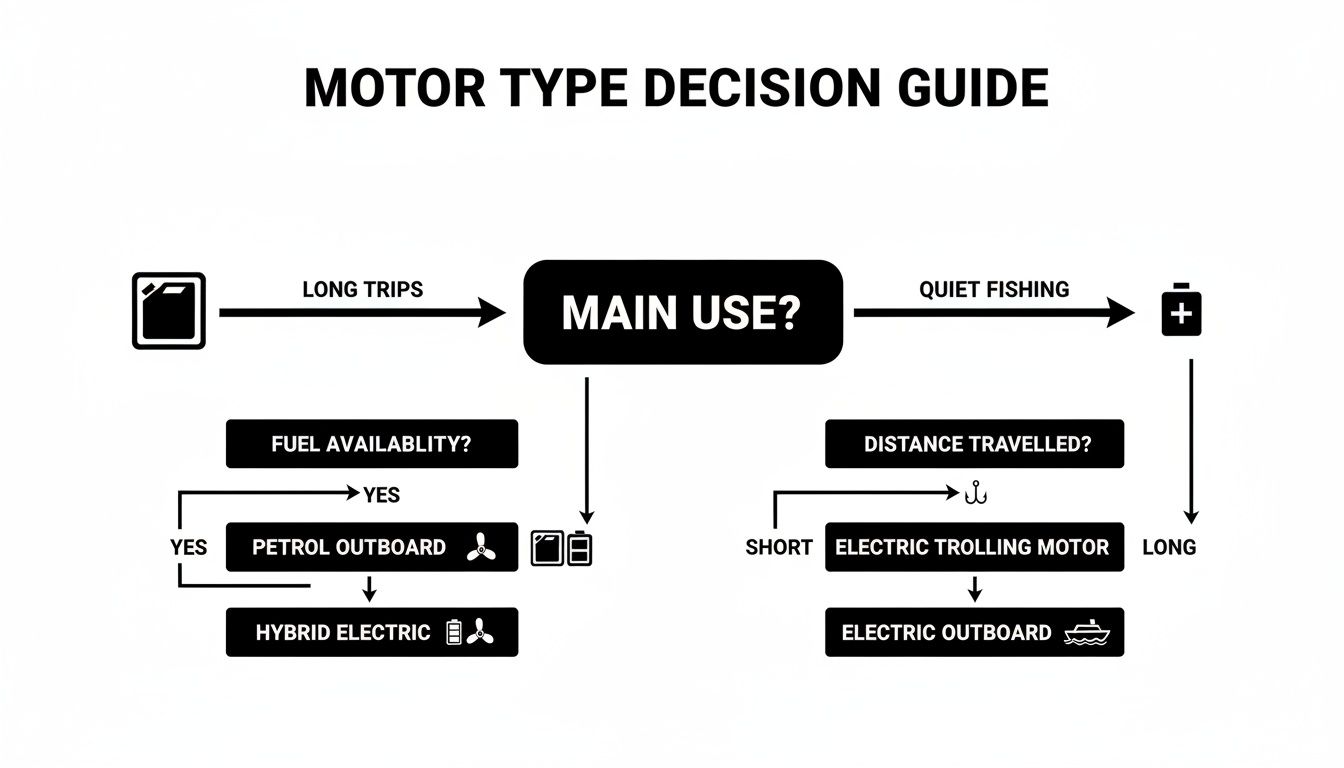
As you can see, for longer trips where you can refuel, petrol is the most practical choice. For sneaking up on fish or exploring environmentally sensitive spots, electric is king.
Once you’ve sorted out your horsepower, the next critical piece of the puzzle is the motor’s shaft length. Imagine trying to row a boat with oars that are too short—you’d just splash around on the surface without getting any real bite. The exact same principle applies to an outboard motor.
The outboard’s shaft length must match your boat’s transom height to put the propeller in the perfect spot in the water.
The anti-cavitation plate—that flat plate just above the propeller—should sit roughly level with or slightly below the bottom of the boat’s hull. This positioning ensures the propeller gets a clean, powerful bite of undisturbed water for maximum thrust and efficiency.
If the shaft is too short, the propeller rides too high. It will suck in air from the surface, a problem called ventilation or cavitation. This makes the engine scream without pushing you forward, wastes fuel, and can even damage the motor.
On the flip side, if the shaft is too long, the prop sits way too deep. This creates a ton of drag, slowing you down, killing your fuel economy, and making it much more likely you’ll hit a log or a rock underwater.
Thankfully, matching the shaft length is dead simple. You just need one measurement from your boat: the transom height.
Always measure your boat before you go shopping for a motor. Getting this right is fundamental to how your boat performs and handles, ensuring every trip is smooth, efficient, and safe.
Getting your motor mounted securely is the single most important job before hitting the water. A solid connection means a safe and enjoyable day out. Thankfully, it’s a pretty straightforward process, especially with the tough aluminium transoms on Aerowave boats, which are built specifically for stability and strength.
This guide will walk you through the proper way to install your outboard so it stays exactly where it’s meant to.
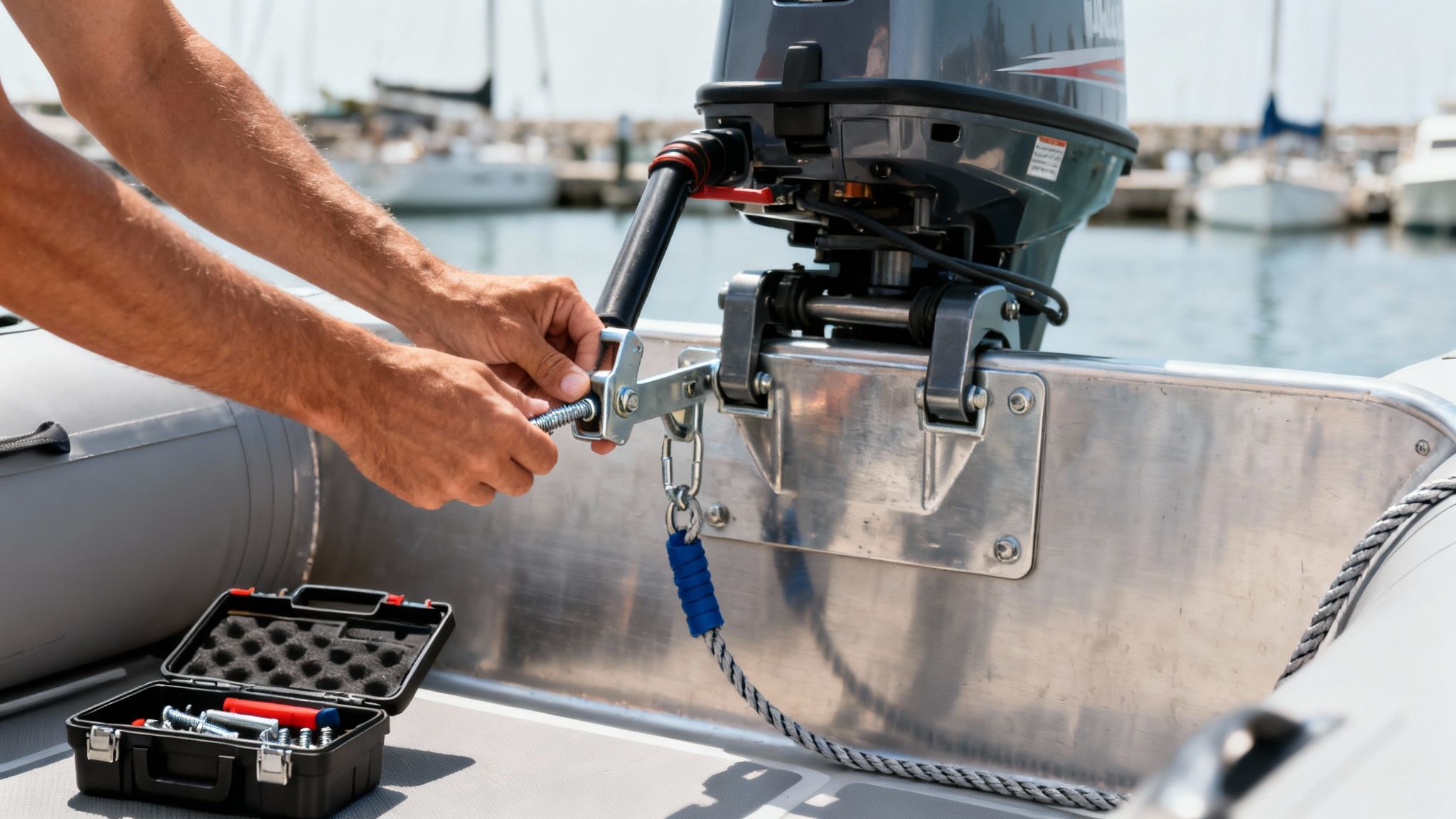
The whole point is to create a rock-solid link between your motor and your boat. With a few clear steps and some pro tips, you’ll be confident your setup is ready for any adventure.
First things first: get the motor lifted and positioned right in the centre of your boat’s transom. Make sure your boat is stable—either on a trailer or on flat, level ground—before you even think about lifting the motor.
This snug fit is what makes a motor for inflatable boats such a reliable powerhouse. From a small tender to a big inflatable catamaran, a stable mount is non-negotiable.
Think of a safety cable or chain as a seatbelt for your outboard. It’s a simple, essential backup that prevents your expensive motor from taking a dive if the clamp screws ever vibrate loose.
A safety cable is a small investment that protects a very large one. It provides absolute peace of mind, ensuring that even if the primary mounting fails, your motor won’t end up at the bottom of the ocean.
Attaching it couldn’t be easier. Just secure one end to a dedicated point on the motor and the other end to a solid point on the boat’s transom. Always use a marine-grade stainless steel cable and shackle to keep rust at bay.
Motorised setups for fishing, cruising, and family fun have absolutely exploded in Australia. In fact, recreational boating participation has jumped 15% since 2020, making reliable outboards more essential than ever for coastal adventurers. You can learn more about the inflatable boat market trends that show just how popular they’ve become.
For smaller, tiller-steer motors, you’re all done. But if you’ve got an electric-start model, there are a couple more quick steps to wire up the battery.
This simple wiring will power your starter and any other electronics you have. If you’re using a smaller electric trolling motor, our complete guide to choosing and installing an inflatable kayak trolling motor mount has some extra tips just for that.
Finally, get into the habit of giving your clamp screws a quick check for tightness before every single launch. It’s the best five seconds you can spend to prevent problems before they start.
Running out of power miles from the boat ramp is a scenario every boater dreads. But with a little bit of smart planning, it’s a situation you can completely avoid. Whether you’re running a petrol or an electric motor for an inflatable boat, knowing how to manage your power source is the secret to a safe and stress-free day on the water. It’s what turns a good trip into a great one, replacing uncertainty with total confidence.
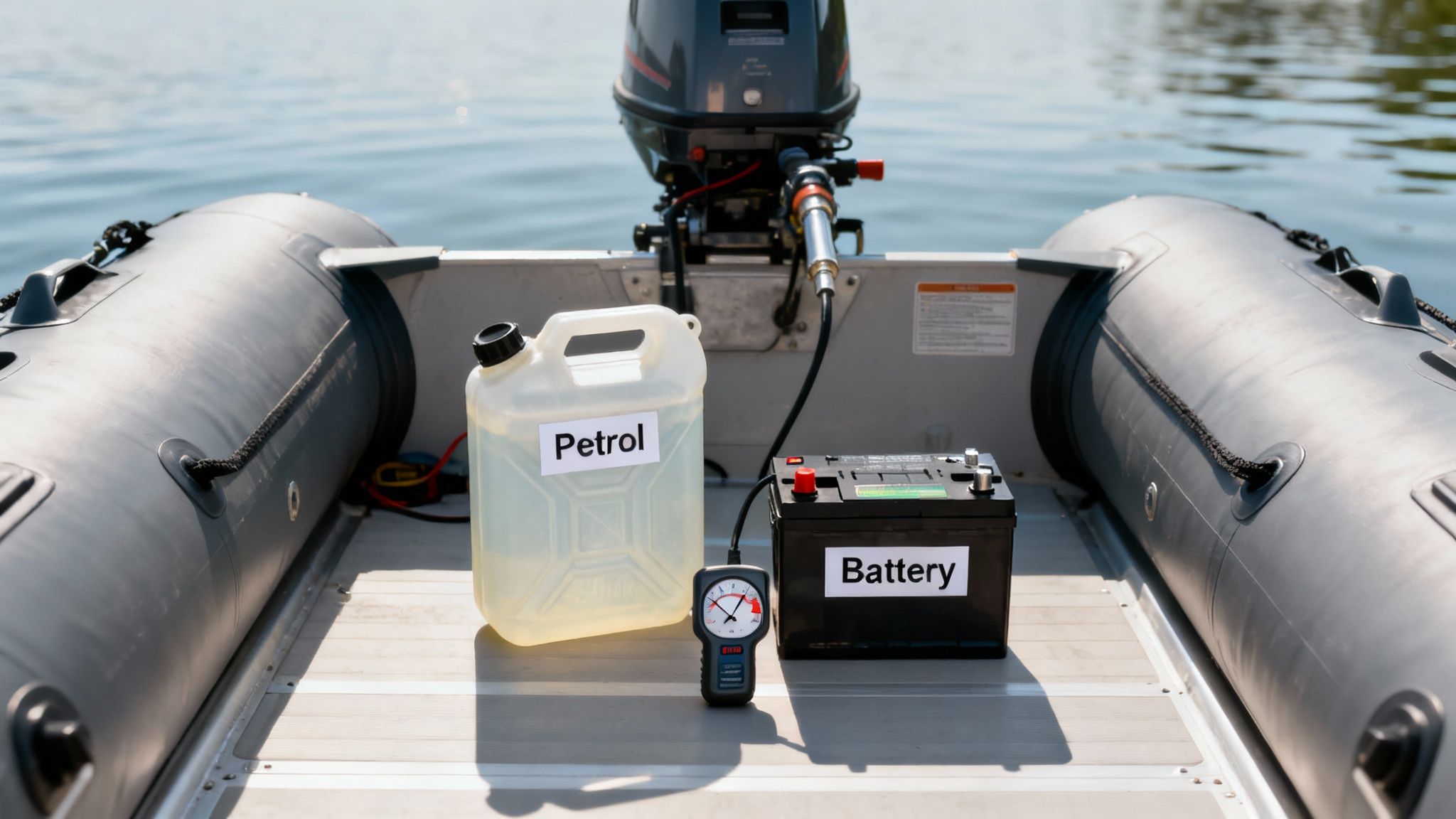
This is where a few minutes of preparation pays off big time, ensuring you have more than enough juice to get home even if the wind picks up or the tide turns against you. Let’s break down the simple rules for both fuel and battery power.
For petrol outboards, there’s a simple, time-tested principle that experienced boaties live by: the ‘rule of thirds’. Think of it as your ultimate safety buffer.
It works like this:
That last third is non-negotiable. It’s your safety net for those unexpected moments, like fighting a strong headwind, dealing with a surprise current, or even helping another boater in trouble. Sticking to this rule means you’ll never have to sweat over the fuel gauge on the ride home.
To give you a head start on planning, here’s a rough idea of how much fuel you can expect to use with some of our popular Hidea motor sizes.
The table below provides a ballpark estimate of fuel consumption at a comfortable cruising speed. Remember, punching the throttle or carrying a heavy load will increase your usage.
| Motor HP | Approx. Litres per Hour (Cruising) | Estimated Range with 12L Tank (km) |
|---|---|---|
| 5 HP | 1.5 – 2.0 L/hr | 70 – 90 km |
| 9.9 HP | 3.0 – 4.0 L/hr | 35 – 45 km |
| 15 HP | 4.5 – 5.5 L/hr | 25 – 35 km |
| 20 HP | 6.0 – 7.5 L/hr | 20 – 28 km |
Note: These are estimates. Your actual consumption will vary based on boat load, water conditions, and how you use the throttle.
These numbers are a great starting point for figuring out how much fuel to bring for the day’s adventure.
With an electric motor, the game shifts from litres of fuel to Amp-hours (Ah) of battery capacity. The easiest way to think about it is that your battery’s Ah rating is the size of its fuel tank—the bigger the number, the longer you can stay out on the water.
Figuring out your runtime is surprisingly straightforward. You just need to know two things: your motor’s power draw in Amps and your battery’s Ah capacity.
For example, if you have a 100Ah battery and your motor draws 25 Amps at a medium cruising speed, you can calculate your approximate runtime: 100Ah / 25A = 4 hours.
Modern lithium batteries are a game-changer for electric setups. While they cost a bit more upfront, they are far lighter than old-school lead-acid batteries and can be discharged more deeply without causing damage. This means you get more usable power from a smaller, lighter package—a massive plus on an inflatable boat where every kilo counts.
If you’re thinking of going electric or upgrading your current system, our guide on choosing the right marine battery and charger can help you find the perfect match.
By applying these simple rules, you can plan every trip with confidence. You’ll know exactly how far you can go and for how long, letting you focus on what really matters—enjoying your time on the water.
Owning an outboard motor is your ticket to hassle-free adventures, but just like a car, it needs a little TLC to keep running smoothly. Couple that with a clear understanding of the local rules, and you’re set for years of safe, enjoyable boating. It’s not just about choosing the right horsepower; it’s about the simple, regular upkeep and knowing your responsibilities on Australian waterways.
Let’s walk through the basics of keeping your motor in top shape and navigating the key regulations for motorised inflatables. This way, every trip you take is both safe and legal.
Think of motor maintenance like looking after your car—a little bit of regular care goes a long way in preventing a breakdown when you’re miles from shore. The good news is, you don’t need to be a mechanic to handle the basics.
The single most important job is flushing the engine with fresh water after every single saltwater trip. Salt is incredibly corrosive, and leaving it to fester inside your motor’s cooling system is the fastest way to cause expensive, irreversible damage. It’s like forgetting to wash salt off your car after a beach trip, but much, much worse for your engine’s insides.
Here’s a simple checklist to get into the habit of following:
Even with the best maintenance, things can go wrong. For bigger issues beyond a simple service, our guide on inflatable boat repairs in Australia has some practical advice to keep your vessel in top shape.
Knowing the rules of the water is every bit as important as maintaining your motor. The specifics can vary a little from state to state, but the core principles of safety and registration are pretty consistent across Australia.
First up, boat registration. As a general rule, if you strap a motor onto your inflatable boat, you’ll probably need to register it. In places like New South Wales and Queensland, for example, any boat with a motor of 4kW (around 5.4HP) or more must be registered.
Always double-check with your local state maritime authority, like Transport for NSW or Maritime Safety Queensland, for the exact rules. Don’t just assume you’re okay—getting caught out can lead to some hefty fines.
Next is getting your licence. To operate a registered, motorised boat at planing speed, you’ll need a recreational boat licence. This usually involves passing a theory test on the “rules of the road,” safety gear, and local waterway navigation. It’s a crucial step that gives you the knowledge to handle your boat safely and confidently.
Finally, carrying the right safety gear isn’t just a legal requirement—it’s just plain common sense. For a small motorised inflatable, your kit should always include:
By blending regular motor maintenance with a solid grasp of these rules, you’re setting yourself up for countless good times on the water. It’s a small investment of your time that pays off big in confidence and peace of mind.
Choosing the right motor can feel like a big decision, and it’s natural to have questions. From Aussie legal requirements to the specifics of our inflatable catamarans, getting it right is key. Here are some of the most common queries we get from customers looking for the best inflatable boats for recreational use available near them.
Yes, in almost all cases, you will. Key boating states like New South Wales, Queensland, and Victoria require a recreational boat licence to operate any vessel with a motor, no matter how small the boat is.
While there might be the odd exemption for tiny motors (think under 5HP in some places), the rules change between states. The smartest and safest approach is to just get licensed. As a solid rule of thumb, if your motor is 5HP or more, you absolutely need a licence before you head out. It’s not just about being legal; it’s about knowing the rules of the road on the water.
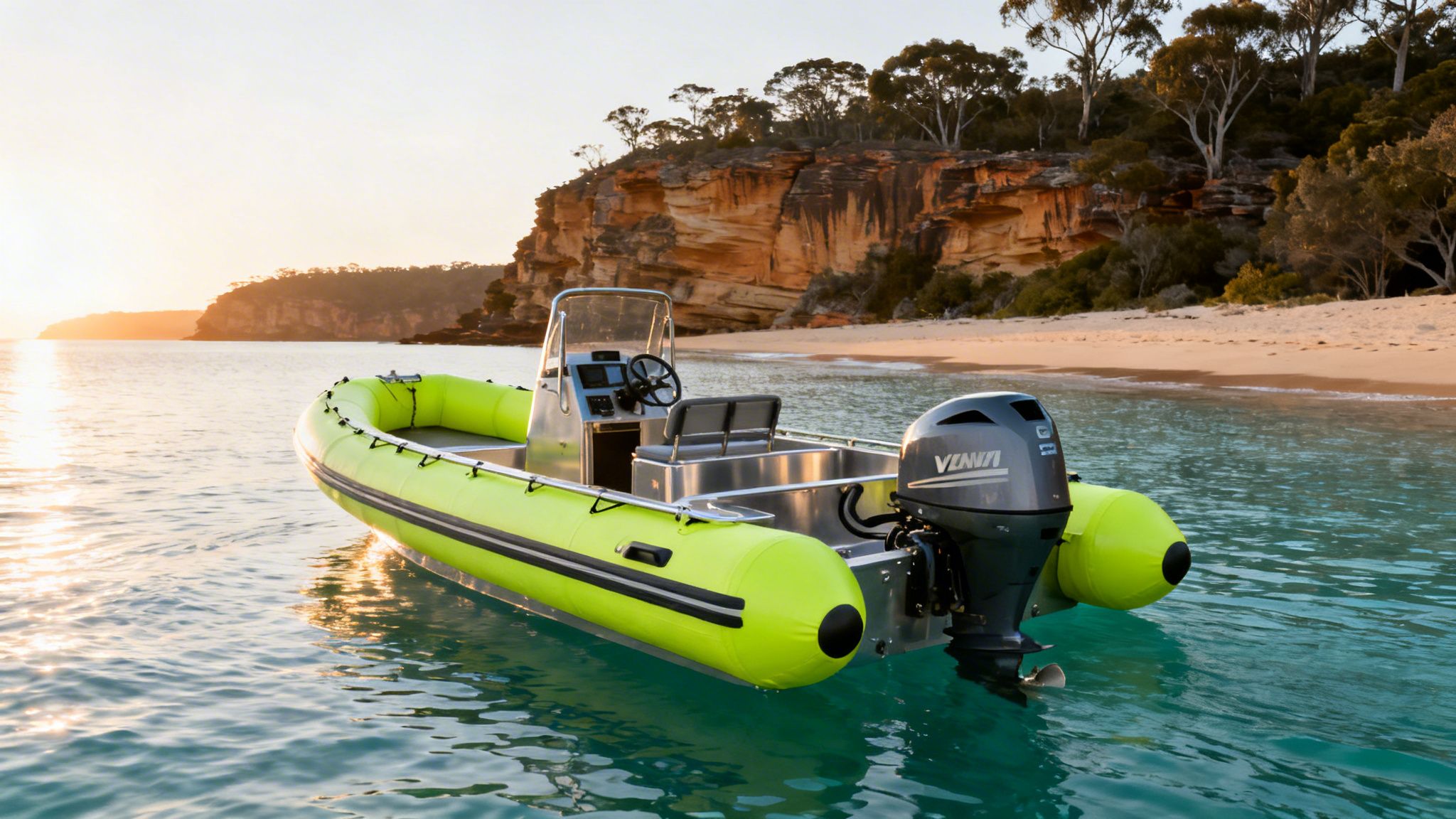
Inflatable catamarans, like our popular Aerowave models, are amazing machines. Their twin-hull design is incredibly efficient and stable, letting them get up on the plane with less grunt than a traditional monohull boat. This makes them a fantastic choice for everything from fishing to a family outing.
For a 3-4 metre inflatable catamaran, a 9.9HP to 20HP motor is the absolute sweet spot. A 15HP outboard, for example, delivers a thrilling ride and great fuel economy, making it perfect for most outings.
If you’re looking at a larger catamaran or know you’ll be carrying heavy loads with plenty of people and gear, bumping up to a 25-30HP motor is a great move. The most critical thing, however, is to always check the maximum HP rating on your boat’s transom plate. Sticking to that limit is essential for safety, performance, and keeping your boat within its design limits.
This is single-handedly the most important bit of maintenance you can do. Salt is relentless and will eat away at the internal cooling passages of your engine if you let it. A quick flush after every single trip in saltwater is non-negotiable.
Thankfully, it’s a simple job that only takes a few minutes. Here’s how you do it:
Making this a habit will dramatically extend the life of your motor and save you a fortune in future repairs.
At Easy Inflatables, we live and breathe this stuff. We’re here to help you put together the perfect package for your adventures. Whether you need a simple setup for weekend fishing or a complete rig for the whole family, we’ve got the expertise and the gear to make it happen. Explore our full range of boats and Hidea motors today.