
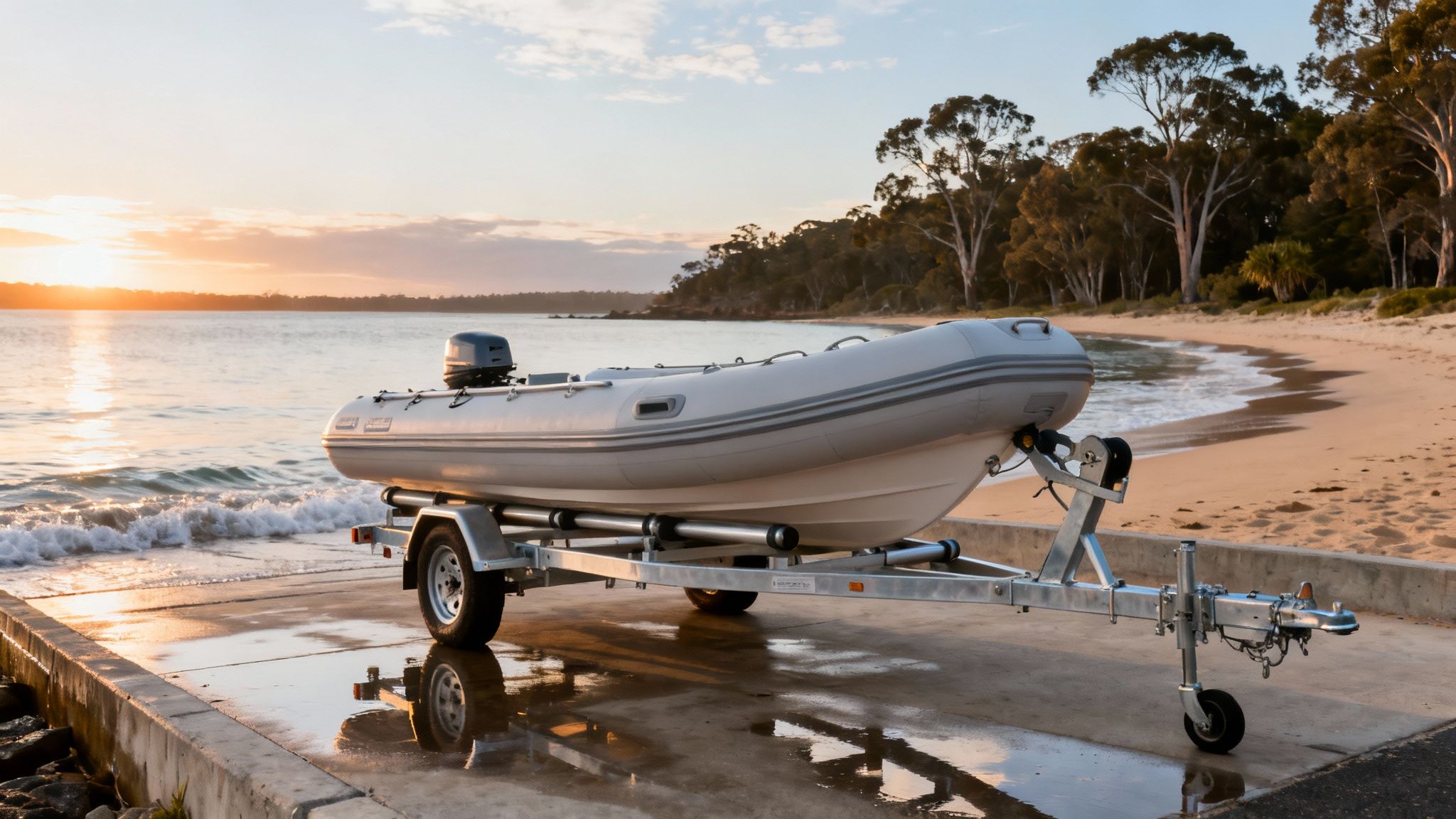
A reliable small boat trailer is the key that unlocks true boating freedom. It’s what transforms your vessel from a backyard fixture into a passport for adventure, connecting you to countless Australian waterways, from secluded coastal beaches to your favourite fishing spot. Honestly, choosing the right one is the single most important decision you’ll make after buying your boat.
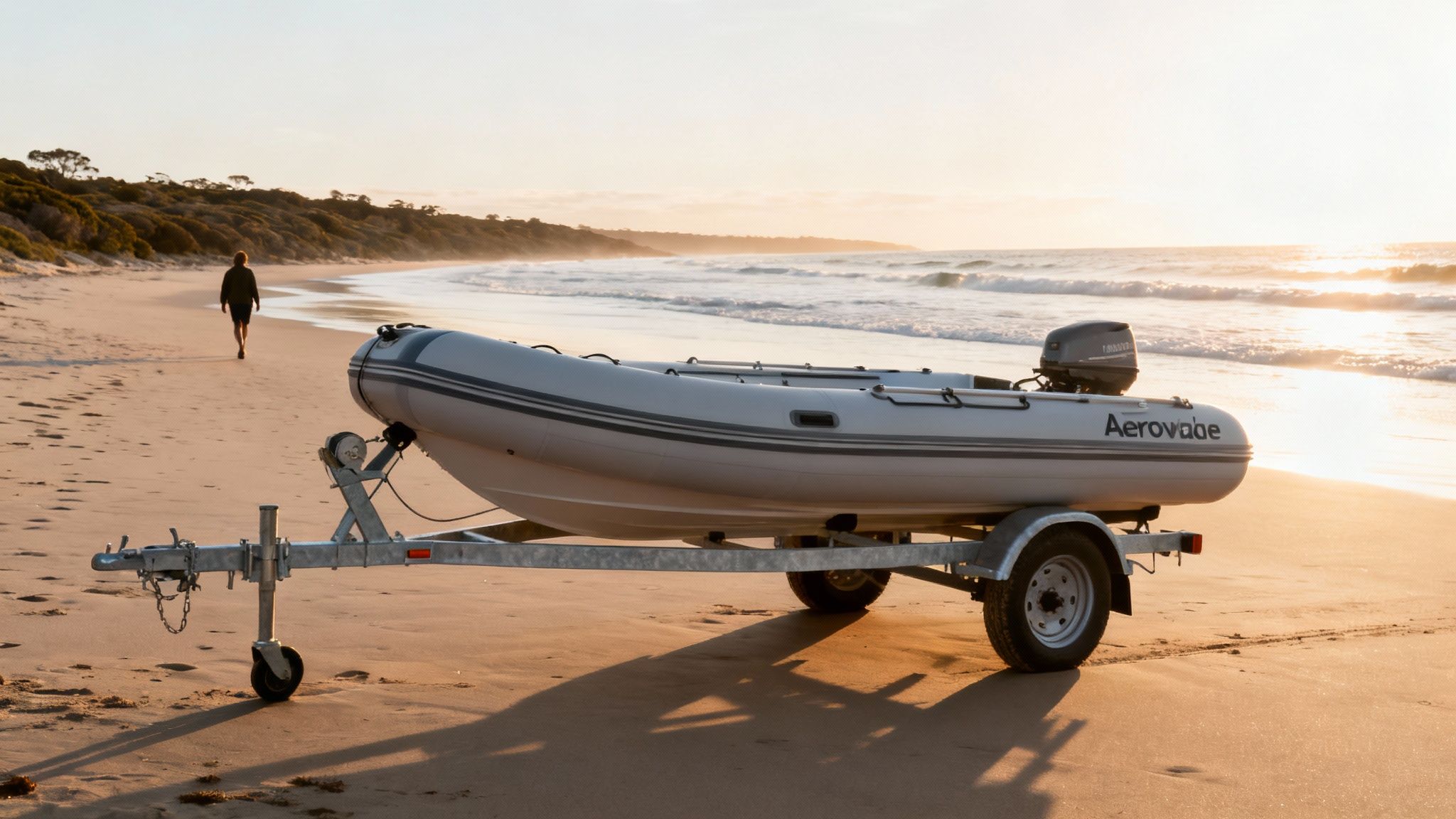
Just imagine the ease of hitching up your inflatable boat on a sunny Saturday morning and heading wherever the mood takes you. That’s the dream, right? But that convenience hinges entirely on having a trailer that is perfectly matched to your vessel, your vehicle, and your plans. For many new boat owners, this is where the uncertainty kicks in.
Too often, a trailer is seen as just an accessory—a simple set of wheels to get from A to B. This way of thinking can lead to some seriously costly mistakes. The right trailer is a critical piece of equipment that ensures the safety of your investment on the road, keeps your setup legal, and protects your boat’s hull for the long haul. This is especially true for lightweight vessels like our inflatable boats and inflatable catamarans, which need specific support to prevent damage during transit. If you’re looking to compare prices and features of inflatable boats in your area, understanding the trailer is a crucial part of the equation.
We’ve put together this comprehensive guide to demystify the process of picking, using, and looking after a small boat trailer in Australia. Think of it as a clear, step-by-step journey to help you make a confident and informed decision. Whether you’re trying to find the best inflatable boats for recreational use available near you or planning to hire inflatable boats for a family outing in Australia, understanding the trailer is paramount.
Here’s what you can expect to learn:
By the end of this guide, you’ll have the knowledge to choose the perfect small boat trailer, ensuring every trip to the water is as smooth and stress-free as possible.
A boat trailer might look like a simple bit of kit, but knowing its core components is the first step toward making a smart purchase. Think of it as the skeleton that supports and protects your boat on land. Getting familiar with the anatomy helps you cut through the jargon and spot quality features when you see them.
Every trailer is built around a few key parts working together. The frame is the main chassis, the backbone that gives it strength. Connected to that is the axle and suspension system, which soaks up bumps on the road for a smooth ride. Up front, the coupler latches onto your vehicle’s tow ball, while the winch and winch post provide the muscle to get your boat onto the trailer at the ramp. Finally, the lighting system makes sure you’re visible and legal on Australian roads.
The frame is arguably the most critical component, especially in Australia’s coastal environments where saltwater corrosion is a constant battle. You’ll find two main materials used for small boat trailer frames: galvanised steel and aluminium.
There’s a clear trend towards materials that can stand up to our salty conditions. Market analysts project that Australia’s boat trailer market will keep growing steadily, with small boat trailers and aluminium frames leading the charge. In fact, Future Market Insights estimates the market will grow at a compound annual growth rate (CAGR) of about 4.3% through 2035, with aluminium trailers dominating sales thanks to how well they handle saltwater.
Once you’ve got the basic anatomy down, the next step is picking a style that properly supports your boat’s hull. This is non-negotiable for inflatable boats and RIBs, as the wrong support can cause damage over time. There are three main types to consider.
Key Takeaway: The goal is to provide wide, even support that distributes the boat’s weight without creating pressure points. This is particularly crucial for the softer materials of inflatable boats.
To help you decide, here’s a quick breakdown of how each trailer type stacks up for inflatables and RIBs.
| Trailer Type | Best For | Pros | Cons |
|---|---|---|---|
| Bunk Trailers | Soft-hulled inflatable boats and smaller RIBs. | Provides continuous, even support along the tubes and keel, spreading the load perfectly. | Can be slightly harder to launch and retrieve, especially on shallow ramps. |
| Roller Trailers | Rigid Inflatable Boats (RIBs) with solid fibreglass or aluminium hulls. | Makes launching and retrieving incredibly easy—the boat just rolls on and off. | Can create pressure points on soft hulls if not set up perfectly. |
| Hybrid Trailers | Inflatable boats and RIBs where easier launching is a priority. | A great compromise—bunks for support and rollers to guide the boat on and off. | Can be more expensive and require more adjustment to get right. |
Ultimately, the best choice comes down to your specific boat and how you use it. Let’s dig a little deeper into each one.
These trailers use long, carpeted boards (bunks) that run parallel to the boat’s hull. For most inflatable boats, especially those with soft hulls, bunk trailers are the go-to choice. They offer continuous support along the length of the tubes and keel, spreading the load exactly where it needs to be. No pressure points, no worries.
Just as the name suggests, these trailers use a series of rollers to support the boat. They make launching and retrieving an absolute breeze—the boat literally rolls on and off with minimal effort. While fantastic for the solid fibreglass hulls on more robust Rigid Inflatable Boats (RIBs), they must be set up perfectly for a soft-hulled inflatable to avoid creating dents or stress points.
A hybrid trailer offers the best of both worlds. It typically uses bunks to support the main weight of the hull and keel, while adding rollers at the rear to help guide the boat on and off more easily. This can be a brilliant compromise, giving you both solid support and easier handling at the ramp.
For some owners, a lightweight and easily stored solution is also a top priority. In that case, it’s worth looking into how a foldable boat trailer can combine convenience with practical support for smaller inflatables.
Picking a trailer isn’t like grabbing an accessory off the shelf; it’s more like finding the perfect dance partner for your boat. A mismatched pair makes for an awkward, unsafe journey, but the right combination guarantees a smooth ride every time you head to the ramp. Getting this right is the single most important step in protecting your investment and ensuring your trips to the water are completely hassle-free.
It all boils down to what I call ‘The Big Three’ of trailer matching: total weight, overall length, and maximum width (beam). Nail these three, and your inflatable will be perfectly supported, legally compliant, and safe to tow anywhere in Australia.
This is where most new boat owners trip up. They think about the boat’s weight, but forget everything else. You have to account for every single thing that will be on that trailer when you hit the road. This grand total is what determines the capacity you need, known in the industry as the Aggregate Trailer Mass (ATM).
Put simply, ATM is the maximum legal weight of the trailer and its entire payload combined. To figure out what you need, it’s time for some simple maths.
Let’s walk through a real-world example with one of our Aerowave inflatables:
Calculation Example: 85kg (boat) + 51kg (motor) + 25kg (fuel) + 40kg (gear) + 150kg (trailer) = 351 kg Total Towing Weight.
In this case, you’d need a trailer with an ATM of at least 351 kg. I always tell people to aim for a trailer with a capacity 15-20% higher than their calculation. It gives you a safe buffer and peace of mind.
Once you’ve got the weight sorted, the next job is making sure the trailer actually fits your boat properly. The trailer’s length needs to support your inflatable from bow to stern, but the most crucial spot is the transom where that heavy outboard motor hangs.
A trailer that’s too short is a recipe for disaster. It leaves the transom hanging in mid-air, putting immense stress on the hull and seams with every bump in the road. Over time, that leads to serious, costly damage. The rearmost support—whether it’s a roller or the end of a bunk—should always sit directly under the transom.
Just as important is the beam, which is just a fancy word for the widest point of your boat. The trailer frame needs to be wide enough to cradle the tubes securely. This is especially true for boats like an inflatable catamaran, which has a much wider stance and needs specific support under its twin hulls.
This little flowchart breaks down the very first decision you need to make, based on your boat’s hull.
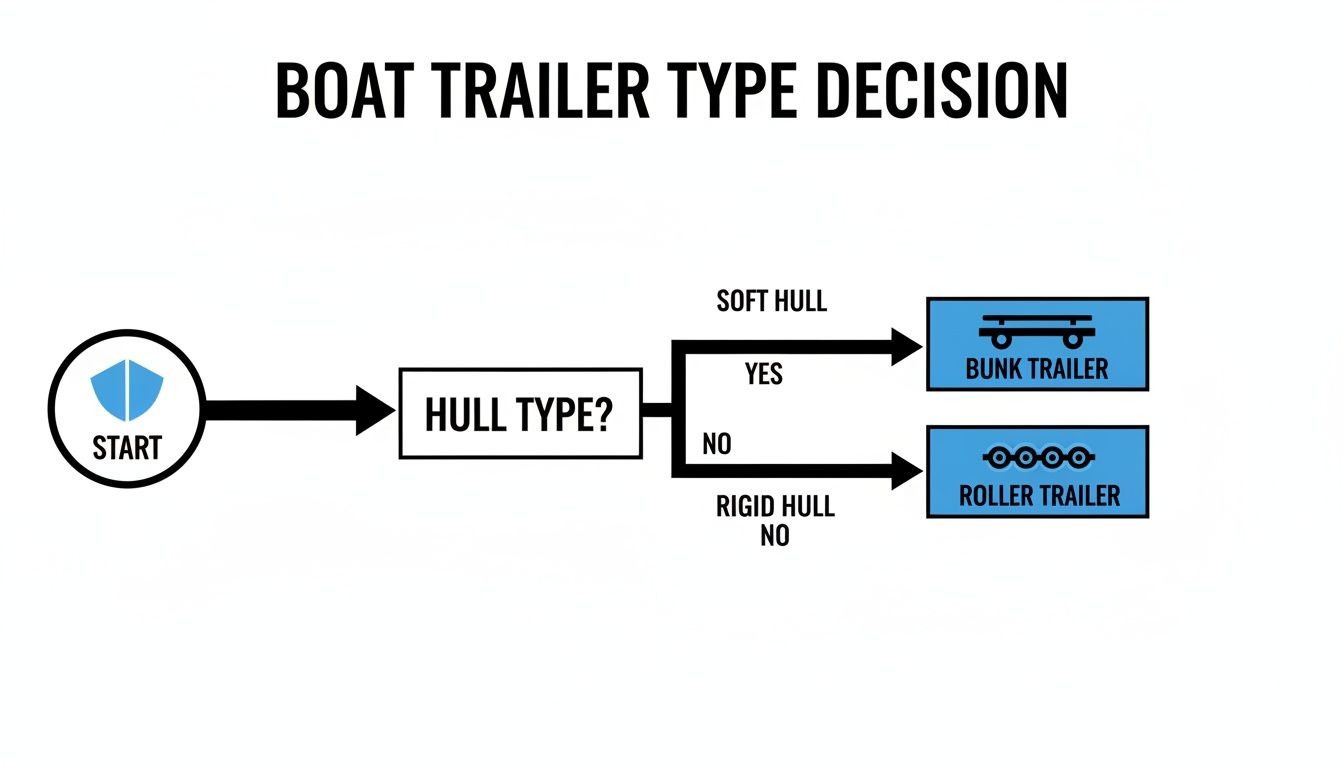
As you can see, bunk trailers are the go-to for soft-hulled inflatables because they provide the continuous, even support these boats need.
The final piece of the puzzle is your tow vehicle. It doesn’t matter how perfect the trailer is if your car, ute, or SUV can’t legally and safely pull it. Every vehicle has a manufacturer-specified maximum towing capacity—you can find it in your owner’s manual or on a placard inside the driver’s side door.
Another number to watch is the Tow Ball Mass (TBM). This is the maximum downward weight your vehicle’s tow ball can handle. A well-balanced trailer should put about 7-10% of its total weight (ATM) onto the tow ball. Too little TBM and the trailer will sway dangerously; too much, and it will mess with your car’s steering and braking.
This is a big deal in Australia, where trailering is just part of the boating lifestyle. In fact, data from the Boating Industry Association shows that around 85% of all registered boats are under 6 metres long—the perfect size for towing behind a standard family vehicle. If you want to dive deeper, you can find more statistics on the nation’s recreational fleet here.
And for those smaller boats that don’t need a trailer at all? Our guide to the car topper tinny is a great read on another fantastic way to get out on the water.
Once you’ve picked out the perfect trailer for your inflatable, the next big step is getting it road-legal and safe. It might sound like a hassle, but sorting out the registration and safety rules in Australia is actually pretty straightforward. Getting this right isn’t just about ticking boxes—it’s about making sure every trip to the boat ramp is a safe one.
Trailer registration is handled by each state and territory, so the exact rules can differ slightly between places like New South Wales, Queensland, and Victoria. But the main idea is the same everywhere. Generally, if your trailer’s Gross Trailer Mass (GTM) is over 250kg, it needs to be registered. Since pretty much every small boat trailer will be heavier than that once loaded, you can count on registration being a must-do.
The Aussie market for small trailers is massive, driven by people like us who love getting out on the water. In the second quarter of 2025 alone, 31,563 small trailers were added to the federal Register of Approved Vehicles. Interestingly, the “Other makes” category made up 48.1% of those, which shows just how many specialist builders and marine dealers are out there making trailers for inflatables and tinnies.
Before you can register your trailer and hit the road, it has to pass a safety check. Think of it as a pre-flight inspection for your rig. A roadworthy trailer isn’t just about avoiding a fine; it’s about protecting yourself, your boat, and everyone else on the road.
Here are the non-negotiable safety features your trailer needs to have:
A question we get all the time is about brakes. In Australia, trailers with a GTM under 750kg generally don’t need their own braking system. Most small inflatable boat packages fit comfortably in this category, which keeps things simple. However, if your fully loaded trailer tips the scales over 750kg, you’re legally required to have an independent braking system fitted.
Being legal is one thing, but being safe is what really matters. Towing changes how your vehicle feels and responds, so learning a few key techniques will make your journey to the boat ramp a lot less stressful.
Getting the trailer attached correctly is job number one. Make sure the coupler is locked securely onto the tow ball, cross the safety chains underneath (this creates a cradle to catch the hitch if it detaches), and plug in the electricals for the lights. Give the lights a quick test before you go. For a deeper dive, these essential towing tips for trailers are a fantastic resource for building confidence.
Getting your weight distribution right is also key to preventing trailer sway—a scary and dangerous situation where the trailer fishtails behind you. A good rule of thumb is to have about 60% of your boat and gear’s weight in the front half of the trailer, ahead of the axle. This creates the ideal 7-10% tow ball weight that keeps everything stable and true.
Finally, just give yourself more time and space for everything. Your car will take longer to get up to speed and even longer to stop. When reversing, especially at a busy boat ramp, slow everything down. Small, gentle turns of the steering wheel are all you need—remember, turning the wheel left makes the trailer go right, and vice versa. The best way to get the hang of it is to practice in an empty car park until it becomes second nature.
And for when you get to the water, our boat safety equipment checklist will make sure you’re fully prepared before you launch.
Think of your small boat trailer as the unsung hero of your adventures. It handles rough roads, gets dunked at the boat ramp, and bears the weight of your prized inflatable. But that life can be tough, and regular maintenance isn’t just another chore—it’s the single best way to protect your investment and prevent a frustrating breakdown from ruining a perfect day on the water.
Here in Australia, our coastal lifestyle means trailers are constantly exposed to a brutal combination of salt water and sun. Without a bit of proactive care, rust and mechanical failures are almost guaranteed.
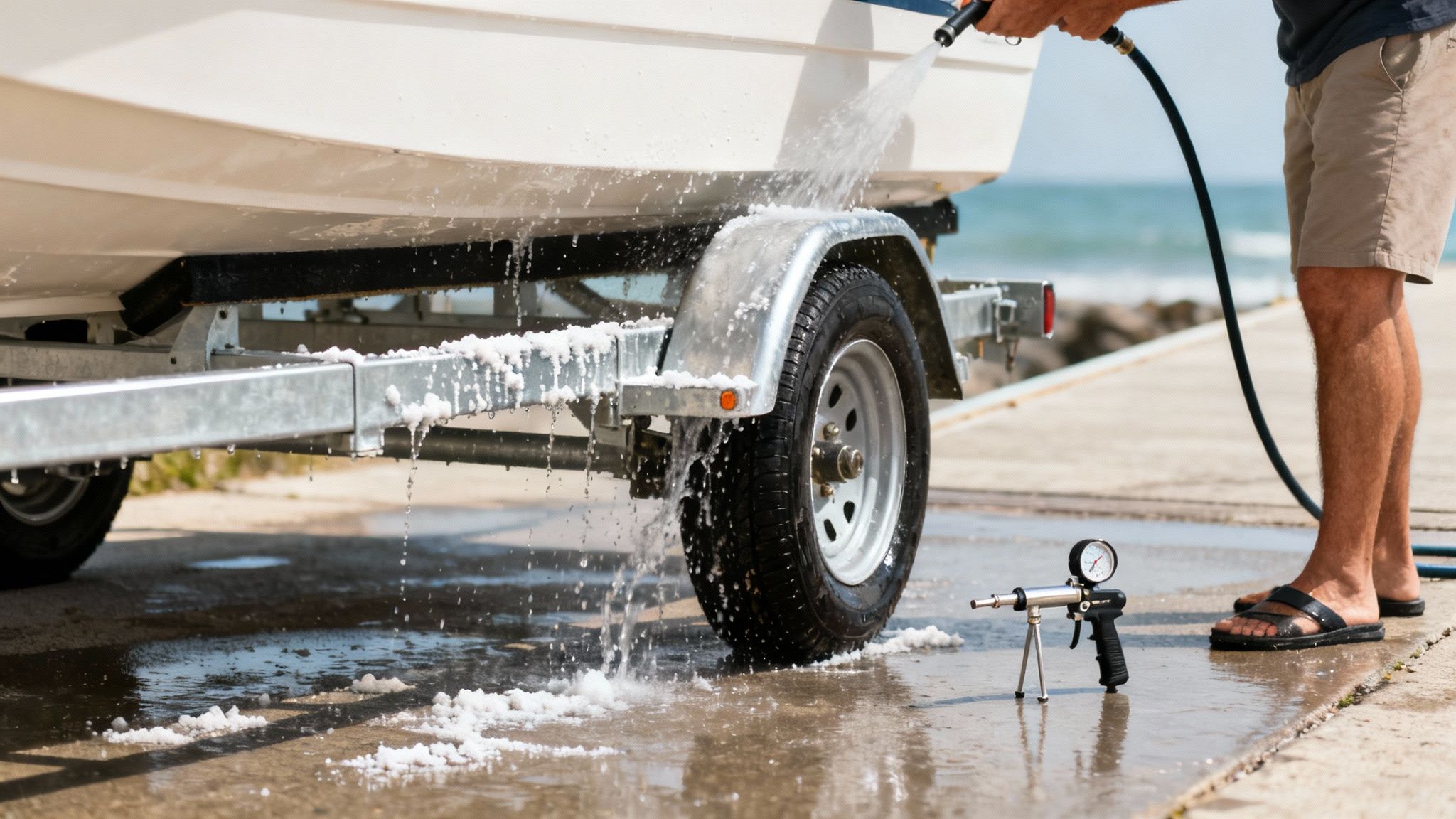
The good news? A simple checklist can turn maintenance from a daunting task into a quick, easy habit. A few minutes of prevention will keep your trailer reliable for years of hassle-free launching.
If there’s one thing that will destroy a trailer faster than anything else, it’s salt water. After every single trip to the ocean or a salty estuary, giving your trailer a thorough freshwater rinse is non-negotiable.
Once salt dries, it gets to work eating away at the galvanised frame, axle, springs, and brake components. This doesn’t need to be a major job—just grab a garden hose and give every part of the trailer a good spray down. Pay extra attention to U-bolts, the suspension, and inside the frame channels where salt loves to hide. This five-minute task is your number one defence against rust.
Beyond the rinse, a few key mechanical checks will keep your trailer rolling safely. It’s a great habit to run through this list every few months, and it’s an absolute must before you head off on a long-haul trip.
A well-maintained trailer is a reliable trailer. Spending 30 minutes on a seasonal check-up can save you from being stranded on the side of the road with a seized bearing or a flat tyre, turning a great day on the water into a sour memory.
If you’re parking your trailer for the off-season, a few extra steps will protect it from the harsh Australian elements. The sun’s UV rays can be just as damaging as salt over the long run.
First, try to store the trailer under cover if you can—a carport, garage, or even a quality trailer cover makes a huge difference. This protects the tyres and any plastic bits from UV rot.
Second, to stop flat spots from developing on the tyres, use jack stands to take most of the weight off the wheels. It’s a small effort that ensures your tyres are round and ready to go when boating season rolls back around. For more expert advice, you can find a wealth of information in our guides to maintenance and care for your boating gear.
Deciding between a new or used small boat trailer is one of the biggest choices you’ll make when finalising your boat package. Both paths have their perks, but the key is knowing what to look for—and what to look out for. This checklist will help you make a smart, confident decision, ensuring your trailer is a reliable partner for all your inflatable boat adventures.
A new trailer offers the ultimate peace of mind. It comes with a manufacturer’s warranty, which is your guarantee that you’re covered if any defects pop up. Most importantly, it will have an Australian compliance plate, confirming it meets all national standards for safety and construction right out of the gate.
When looking at a new trailer, pay close attention to the quality of the materials. A hot-dip galvanised steel frame provides robust protection against rust, while an aluminium frame offers superior corrosion resistance and a lighter towing weight. Check the welds for consistency and make sure all the components feel solid and well-built.
Buying a used trailer can be a fantastic way to save a bit of cash, but it demands a careful and thorough inspection. What looks like a bargain can quickly become a costly project if you don’t spot the red flags. Take your time and check every component methodically.
Use this checklist as your guide:
A used trailer’s history is written all over its frame. Don’t be afraid to poke and prod—a little diligence before you buy can save you from major headaches and expenses down the road. For many, a lightweight and hassle-free option is the priority; our guide to the collapsible boat trailer explores a great alternative for smaller inflatables.
Thinking through a second-hand purchase can be a lot to juggle. To make it easier, we’ve put together a simple table to guide you during your inspection.
| Component to Check | What to Look For (Green Flags) | Warning Signs (Red Flags) |
|---|---|---|
| Frame & Welds | Solid, even welds. Minimal surface rust. Straight lines, no bends. | Deep, flaky rust. Cracked welds. Bent or twisted frame sections. |
| Axle & Suspension | Straight axle. Leaf springs are intact with only light rust. | Bent axle. Cracked or broken leaf springs. Excessive rust on springs. |
| Wheels & Tyres | Wheels spin freely. Good tread depth. No cracks on tyre sidewalls. | Grinding or wobbling wheels. Bald tyres or uneven wear. Cracks in the rubber. |
| Hubs & Bearings | Cool to the touch after spinning. No unusual noises. | Hubs feel hot after a short spin. Grinding, clicking, or squealing sounds. |
| Coupler & Latch | Latch mechanism is smooth and locks securely. | Worn, loose, or difficult-to-operate latch. Visible cracks or damage. |
| Lights & Wiring | All lights work (brake, tail, indicators). Wiring is intact and flexible. | Flickering or dead lights. Cracked, brittle, or patched-up wiring. |
| Bunks & Rollers | Carpet or rubber is in good shape. Rollers spin freely. | Worn, torn, or missing bunk carpet. Seized or cracked rollers. |
| Compliance Plate | Clearly visible and legible VIN and specs. | Missing, damaged, or unreadable compliance plate. |
This checklist isn’t exhaustive, but it covers the big-ticket items that can turn a bargain into a money pit. If you spot multiple red flags, it’s often best to walk away and keep looking.
The price for a small boat trailer can vary significantly based on its age, material, and features.
When you’re thinking about repairs or upgrades on any trailer, understanding OEM vs. aftermarket parts can help you make smart decisions about cost and quality. This knowledge is valuable whether you’re fixing up a used find or just maintaining a brand-new one.
Stepping into the world of boat trailers can feel a bit overwhelming at first. It’s totally normal to have questions! We’ve put together the most common queries we hear from inflatable boat owners to give you clear, practical answers and get you towing with confidence.
This is a big one, and thankfully, the answer is usually simple. In Australia, the rules are all about weight. If your trailer’s Gross Trailer Mass (GTM) is 750kg or less, you don’t legally need its own braking system.
The good news? Most small inflatable boat packages—even with the motor, fuel, and a day’s worth of gear—fall comfortably under this threshold. This makes your setup much simpler and more affordable.
However, if your fully loaded trailer tips the scales over 750kg GTM, you absolutely must have an independent braking system fitted. Always give your state’s road authority regulations a quick check, as rules can vary slightly.
While you can technically use either, bunks are definitely the recommended choice for most inflatable boats. Think of it this way: long, carpeted bunks are like a custom-fit mattress for your boat, spreading its weight evenly across the tubes and hull. This prevents pressure points that can cause damage or distortion over time.
Rollers, on the other hand, concentrate all that weight onto a few small points. While they can make launching a little quicker, they can also leave dents in the softer hull material of an inflatable if they aren’t positioned perfectly. For the long-term health of your boat, a well-adjusted bunk trailer is the safest bet.
Your trailer’s wheel bearings live a tough life, constantly getting dunked in water and then asked to spin at high speed. It’s critical to check them regularly—at a minimum, once every six months and always before a long road trip.
Here’s a pro tip: After each trip, carefully feel the wheel hub. If it’s too hot to comfortably touch for more than a second, that’s a classic sign your bearings are crying out for help. They’ll need immediate attention, which usually means a re-grease or a full replacement.
A set of bearing protectors is a cheap and brilliant investment. They help force out any water that gets in and make it super easy to top up with fresh grease, which can massively extend the life of your bearings.
Yes, absolutely! Storing your inflatable on its trailer is perfectly fine, as long as you do it right. The key is to make sure the boat is properly supported by the bunks, distributing its weight evenly to avoid creating any saggy spots on the hull or tubes.
It’s also a good idea to let a little air out of the tubes, especially during hot weather when the air inside expands. To protect it from the harsh Aussie sun, a quality boat cover is a must. For really long-term storage, popping the trailer on jack stands takes the weight off the tyres and stops them from developing flat spots.
Ready to find the perfect inflatable boat for your trailer? At Easy Inflatables, we offer a wide range of high-quality, lightweight inflatable boats and catamarans designed for Australian adventurers. Explore our collection today!