
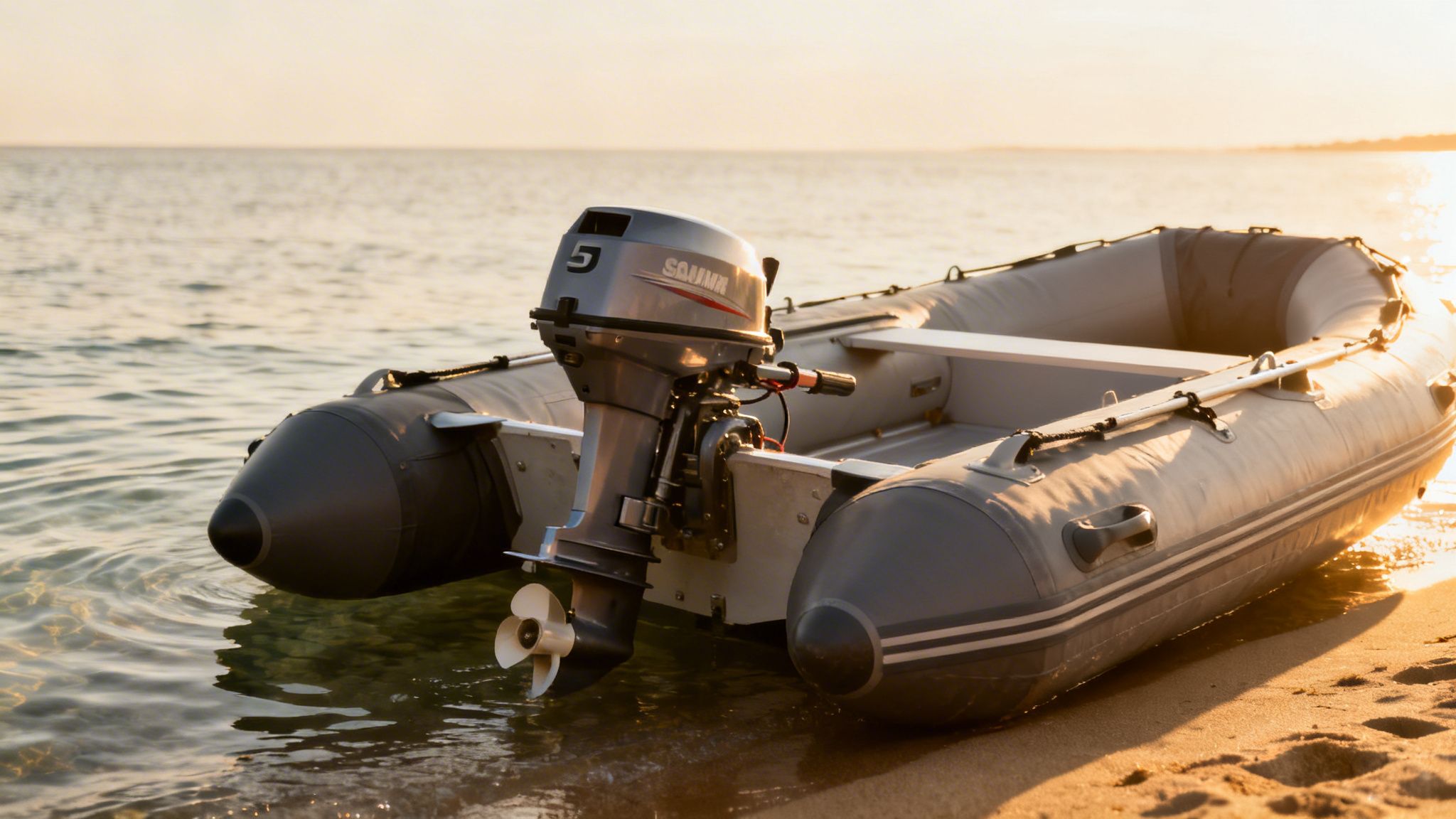
For anyone with a small tender, tinnie, or inflatable boat, the 5hp outboard engine often hits that perfect sweet spot between power and portability. It’s got enough grunt to get you moving but is still light enough for one person to carry and mount. It’s this versatility that makes it such a popular choice for Aussie boaters looking for the best inflatable boats for recreational use.

Think of a 5hp outboard as the ultimate multi-tool for the water. It’s that one piece of gear you can always rely on, whether you’re exploring a hidden cove, fishing a quiet estuary, or just zipping from your yacht to the shore. For Australian adventurers, this engine class strikes the ideal balance between usable power and genuine portability.
Unlike bigger, heavier motors that need a trailer and a permanent spot on your transom, a 5hp outboard is all about flexibility. It’s light enough for one person to comfortably lift from the car, carry down to the beach, and clamp onto an inflatable boat without breaking a sweat. Yet, it still packs enough punch to turn your boat into a capable vessel for a day of fun.
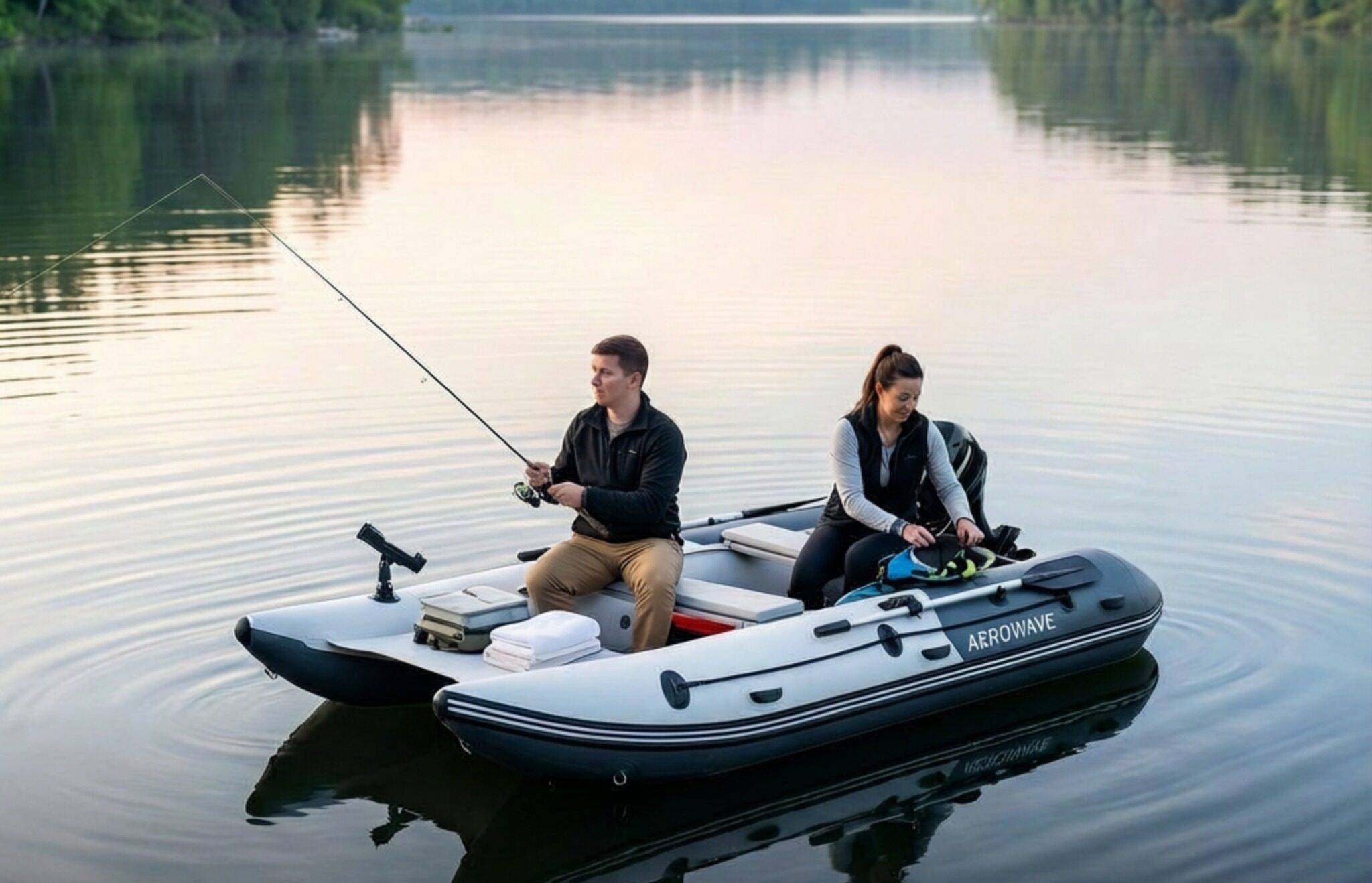
The real magic of a 5hp outboard is its exceptional balance. It’s powerful enough to get a small inflatable boat—like one from our Aerowave range—up on a plane with a light load. This means you can travel faster and more efficiently than you could with smaller 2.5hp or 3.5hp motors, which often just push water and struggle to overcome drag.
At the same time, it’s incredibly manageable. A modern 4-stroke 5hp engine typically weighs around 25-27 kg, a weight most adults can handle. This makes it ideal for:
This blend of power and portability is no accident; it’s a direct response to what boaters actually need. In fact, engines under 15hp made up 35% of all outboard sales in Australia in recent years, showing just how popular this category is.
To give you a clearer picture, let’s look at some typical performance specs for a modern 5hp four-stroke engine.
The table below gives you a quick summary of what to expect when you pair a 5hp outboard with a small inflatable boat.
| Performance Metric | Typical Value |
|---|---|
| Boat Size (Ideal) | 2.5m – 3.5m |
| Top Speed (Light Load) | 18-22 km/h |
| Fuel Consumption (Cruising) | ~1.5 Litres/Hour |
| Engine Weight (4-Stroke) | 25-27 kg |
These numbers highlight just how efficient these motors are. That fuel consumption can save you up to 40% on fuel compared to running an oversized, thirsty engine on a small boat. It’s smart, practical boating.
It’s easy to think that only the big, premium brands deliver the goods. But a Hidea 5hp outboard engine is a fantastic alternative, offering robust performance and reliability without the eye-watering price tag. This makes it a serious competitor for those looking to compare prices and features of inflatable boats and engines in Australia.
As an authorised Hidea dealer, we confidently bundle these motors with our inflatable boat packages because we know they offer incredible value. They are modern, clean-burning four-strokes that meet Australia’s strict emissions standards, and they’re backed by solid 3–5 year warranties and local support.
This combination of affordability, performance, and peace of mind is central to the benefits of buying an inflatable boat setup that’s ready for adventure right out of the box.

A 5hp outboard engine isn’t just a piece of machinery; it’s the key that unlocks a whole world of on-water experiences. Its real value comes to life when you pair it with the right vessel. Moving beyond the technical specs, let’s look at the real-world situations where this little powerhouse truly shines.
For many Aussie boaters, this engine is the heart of their setup. Think of the grey nomad with a “boat-in-a-bag” tucked away, ready to explore a remote river system in the Kimberley. Or a family on the Gold Coast, using their tender to zip from their anchored cruiser to a secluded beach for a picnic. In these moments, the 5hp delivers just the right amount of punch without the hassle and weight of a bigger, bulkier engine.
The primary playground for a 5hp outboard engine is on the transom of an inflatable boat. Its relatively low weight (around 25-27 kg) is a huge deal—it preserves the portability and performance that make inflatables so popular in the first place. A heavier motor can easily bog down a smaller SIB (Soft Inflatable Boat), making it a pain to handle and even harder to transport.
With a 5hp outboard, boats in the 2.5 to 3.5-metre range really come alive. This includes:
The synergy between a lightweight inflatable boat and a 5hp motor is undeniable. This combination lets you launch from almost anywhere—a boat ramp, a sandy beach, or even a rocky shoreline—giving you unparalleled access to Australia’s stunning waterways.
While inflatables are a perfect match, the versatility of a 5hp outboard extends to other small vessels. It’s the go-to choice for yacht owners needing a reliable tender to get them to and from shore. A 5hp provides enough grunt to cut through chop and carry a few passengers and supplies, a task where smaller 2.5hp motors often struggle.
Small aluminium boats, or “tinnies,” also benefit greatly from this engine size. It’s more than enough power for calm estuaries and rivers, offering a quiet and fuel-efficient way to enjoy a day on the water. Even the world of kayak fishing has embraced this setup. For anglers with larger, purpose-built fishing kayaks, a 5hp outboard lets them cover huge distances and fight currents effortlessly, turning a paddle into a serious fishing expedition. You can find more details by exploring our guide on selecting the perfect engine for your inflatable boat.
When pairing your boat with a motor, it’s easy to assume you need a premium brand name. But here’s the thing: a Hidea 5hp outboard delivers robust performance and modern four-stroke efficiency at a much more accessible price. For those comparing inflatable boat options, the Hidea presents a compelling, affordable package.
This makes it an ideal partner for the practical, value-driven spirit of the inflatable boating community. It proves you don’t need to overspend to get a reliable engine that will power years of adventures, whether for a family outing or solo fishing trip.
Picking the right 5hp outboard engine can feel like a minefield of technical specs and confusing numbers. But it doesn’t have to be. Getting this choice right boils down to a few practical questions that ensure your motor is a perfect match for your boat, giving you the best performance, safety, and fun on the water.
Forget getting bogged down in jargon. Think of it like this: Will it fit my boat? Is it light enough for me to handle? And is it modern and efficient? Answering these three simple questions will point you straight to the perfect motor for your adventures.
Of all the specs, shaft length is arguably the most critical. Choosing the wrong length is like wearing boots that are two sizes too big—it’s clumsy, inefficient, and just won’t work properly. The whole idea is to get the propeller and the cavitation plate (the flat plate just above the prop) sitting just below the water’s surface when you’re underway.
For most tenders, small tinnies, and inflatable boats like ours, a short shaft (15 inches) is the go-to standard. To be absolutely sure, just grab a tape measure. Measure the height of your boat’s transom from the top where the engine clamps on, straight down to the bottom of the hull. That number tells you exactly which shaft length you need.
The weight of your 5hp outboard engine is more than just a figure on a spec sheet—it’s all about portability and your boat’s balance. A modern 4-stroke 5hp motor usually lands somewhere between 25 kg and 27 kg. This is a manageable weight for one person to lift and clamp onto the transom, which is perfect for portable setups like our Aerowave inflatable boats.
If an engine is too heavy, it can make an inflatable boat ‘stern-heavy’, causing the back end to sag into the water. This messes with its handling and makes it harder to get up on a plane. Always double-check your boat’s maximum engine weight, which you’ll find stamped on the manufacturer’s compliance plate.
Choosing an engine within your boat’s weight limit isn’t just a suggestion; it’s a non-negotiable safety rule. It guarantees your vessel stays stable, predictable, and safe, even when conditions get a bit choppy.
The old two-stroke versus four-stroke debate used to be a hot topic around the boat ramp. These days, the choice is pretty clear-cut. Since Australia banned the sale of new high-emission two-strokes back in 2018, modern four-stroke engines have rightly become the standard.
Four-strokes are simply better in all the ways that count for recreational boaters:
Sure, the old two-strokes were a touch lighter, but the overwhelming benefits of a modern 5hp outboard engine with four-stroke technology make the small weight difference a no-brainer.
When you start shopping around, you’ll quickly notice some big price gaps between brands. But does paying more always get you more? Let’s put a value-driven motor like the Hidea 5hp head-to-head with a typical premium brand to see where your money really goes. As a more affordable option, the Hidea stands up strong against the competition.
| Feature | Hidea 5hp 4-Stroke | Example Premium 5hp 4-Stroke |
|---|---|---|
| Engine Weight | ~26 kg | ~27 kg |
| Shaft Options | Short (15″) & Long (20″) | Short (15″) & Long (20″) |
| Warranty | 3-5 Years (with local support) | 3-6 Years (varies) |
| Average Price | Significantly more affordable | Premium price point |
As you can see, the Hidea 5hp delivers comparable specs, the same shaft options, and a solid warranty, but at a much friendlier price point. For Aussie boaters looking for reliable power without the premium price tag, Hidea offers outstanding value.
It proves that a dependable 5hp outboard engine doesn’t have to break the bank. It’s the smart, practical choice for recreational boaters, anglers, and families who just want to get out on the water and have fun.
So, you’ve picked out the perfect 5hp outboard engine. Great choice. Now for the fun part: getting it mounted on your boat and ready to hit the water.
Don’t worry about those confusing manuals filled with baffling diagrams. This is a practical, hands-on guide to show you exactly how to get your motor installed safely and securely. It’s easier than you think, and doing it right the first time will give you the confidence that your setup is rock-solid for countless Aussie adventures.
Before you even touch the motor, let’s do a quick “pre-flight” check of your boat. The most critical part here is the transom—that’s the flat, reinforced section at the back of your boat where the engine clamps on.
A healthy transom is the foundation of a safe setup. If you find any issues, it’s absolutely vital to get them sorted out by a professional before you even think about mounting an engine.
This quick flowchart sums up the key decisions you should have already made before you get to the installation stage.

It boils the process down to three simple checks: making sure the motor fits, your boat can handle the weight, and you’re getting the best bang for your buck.
Once you’ve confirmed your transom is in good nick, you’re ready to mount the engine. A modern 5hp motor weighs around 25 kg. That’s manageable for one person, but remember to lift with your legs, not your back!
A correctly mounted engine should feel like it’s part of the boat. Give the motor a good wiggle from side to side. There should be zero play or movement between the engine bracket and the transom.
With the engine locked down tight, there are a couple of final tweaks that make a huge difference to your boat’s handling and efficiency.
The most important one is the trim angle. Getting this right helps your inflatable get up on the plane faster and sip less fuel. Most 5hp outboards have a trim pin that you can move between several different holes on the bracket.
For most inflatable boats, starting with the pin in the second or third hole from the transom is a fantastic baseline. This sets the engine nearly vertical in the water, giving you balanced, all-around performance.
While you’re at it, it’s a good time to double-check your fuel setup. We cover this in more detail in our guide on choosing the right petrol tank for your outboard engine. And since outboards live in a wet, salty world, learning how to waterproof electrical connections is a skill that will pay dividends in reliability for years to come.
Owning a 5hp outboard engine is your ticket to countless adventures, but just like any reliable partner, it needs a little TLC to perform at its best. Thankfully, keeping your motor in top shape is surprisingly straightforward and doesn’t require a full-blown mechanic’s workshop.
A few simple, routine habits are all it takes to prevent common problems and make sure your engine roars to life every time you’re ready to hit the water. Think of it as a small investment of time that pays huge dividends in on-water enjoyment and peace of mind.
If you take your boat out in saltwater, there’s one non-negotiable task you must do after every single trip: freshwater flushing. Salt is incredibly corrosive. If left unchecked, it will eat away at the internal cooling passages, clog up your engine, and eventually lead to overheating and permanent damage.
The process is dead simple. Most modern 5hp outboards, including the Hidea 5hp, have a dedicated flushing port. You just connect a standard garden hose, turn on the tap (without starting the engine!), and let fresh water run through the system for about 5-10 minutes.
This simple 10-minute flush is the single best thing you can do for your outboard’s longevity. It’s the difference between an engine that lasts for decades and one that succumbs to corrosion in just a few seasons.
Before you launch, get into the habit of running through a quick pre-start checklist. This takes less than two minutes and can prevent a world of headaches out on the water.
Making these checks second nature ensures you catch small issues on land before they become big problems on the water.
Modern petrol can start to go bad in as little as 30 days, leaving behind gummy deposits that clog the tiny passages in your carburettor. This is especially true for engines that sit in storage for weeks or months between uses.
The solution is twofold. First, always try to use fresh petrol. If you know you won’t be using the boat for a while, add a fuel stabiliser to the tank. This chemical additive keeps the petrol fresh for up to a year, preventing varnish build-up and ensuring your engine fires up easily next season.
For an even more robust setup, you might be interested in our guide on the ideal outboard engine fuel line, which can further improve reliability.
Even with perfect maintenance, you might one day face an engine that just won’t start. Don’t panic. The cause is almost always something simple.
If your motor won’t start, run through the “F.A.S.T.” check:
Following these simple maintenance and troubleshooting steps will empower you to keep your Hidea 5hp outboard—or any other brand—running like a dream, maximising your precious time on the water.
Trying to get your head around boating regulations can feel like a real headache, but it’s actually more straightforward than you might think, especially when you’re dealing with a portable 5hp outboard engine. We’re here to cut through the jargon and give you the clear, simple guidance you need to boat legally and safely anywhere in Australia.
The first question we always get is, “Do I need a boat licence for a 5hp engine?” The answer isn’t a simple yes or no—it all comes down to where you are, as the rules change quite a bit from state to state. For those looking to hire inflatable boats in Australia for a family outing, understanding these local rules is key.
Most Australian states have a power or speed limit that dictates whether you need a marine licence. A 5hp outboard engine often sits right on the edge of these rules, which is why it’s so important to know what applies in your local area.
Queensland (QLD): Good news for Queenslanders! You don’t need a boat licence if your boat is powered by an engine of 4.5 kW (which is 6hp) or less. Your boat doesn’t need to be registered under this power limit either. This makes a 5hp outboard a fantastic licence-free choice for getting out on the water in QLD.
New South Wales (NSW): If your boat can travel at 10 knots (around 18.5 km/h) or more, you must have a boat driving licence. Since a 5hp motor can easily push a small inflatable to this speed, it’s very likely you’ll need a licence in NSW. Most powered vessels also require boat registration.
Victoria (VIC): In Victoria, the rules are simple: a marine licence is required to operate any vessel with an engine, no matter its size. If you’re using a 5hp outboard, you will need a licence. Registration is also mandatory for any boat with a motor.
It’s worth remembering that these rules can and do change. Before you head out, always double-check the latest regulations with your local maritime authority, like Maritime Safety Queensland, Transport for NSW, or Safe Transport Victoria.
Licensing is one thing, but boat registration is another key detail to sort out. As you can see, the need to register a boat with a 5hp motor varies. In states like Victoria, it’s a must-do, while in Queensland, you’re in the clear. These rules are in place to make sure all vessels are traceable and meet safety standards.
But regardless of any licence or registration rules, carrying the right safety gear is completely non-negotiable. Being properly kitted out is the single most important thing for staying safe on the water. For a complete rundown, you can learn more about essential boating safety equipment in our dedicated guide.
Even after getting the rundown, you probably still have a few questions rolling around in your head about what it’s really like to own a 5hp outboard. It’s a big decision, so let’s tackle the most common queries with some straight-up, practical answers to help you feel confident about your choice.
This is the big one, isn’t it? On a typical 3-metre inflatable boat with one person aboard and calm waters, you can expect a 5hp outboard to get you zipping along at around 18-22 km/h. It’s got enough grunt to get a light inflatable “on the plane,” which makes for a really fun and efficient ride.
Of course, this all depends on the load. Throw another person and some fishing gear into the mix, and your speed will likely settle into the 10-15 km/h range. It’s the perfect balance of power and portability for small boats.
Absolutely. We wouldn’t be an authorised Australian dealer if we didn’t stand behind them 100%. Hidea has made a name for itself by building modern, reliable four-stroke engines that don’t break the bank, positioning itself as a top affordable option when you compare prices and features of inflatable boats.
We confidently recommend the Hidea 5hp outboard because it delivers consistent performance day in and day out, meets Australia’s strict emissions standards, and is backed by a solid 3–5 year warranty with local parts ready to go. It’s simply incredible value and a trusted choice for savvy Aussie boaters.
Think of Hidea as the smart alternative. You get all the essential performance and modern tech you’d find in the big-name brands, but without the premium price tag. It’s the perfect match for the practical boater.
You’ll be pleasantly surprised. A modern 4-stroke 5hp motor is incredibly fuel-efficient. When you’re cruising along at a comfortable speed, you can expect it to sip around 1.5 litres of petrol per hour.
What does that mean in real terms? The standard built-in fuel tank (usually about 1.1 litres) will give you close to an hour of run time. If you plan on being out all day, hooking up a small external tank will keep you exploring for hours on end.
Yes, but you have to do it the right way. This is a crucial one! A 4-stroke engine keeps its oil in a sump at the bottom, just like your car. If you lay it on the wrong side, oil can leak into the cylinder or all over your boot, creating a smoky mess when you start it up and potentially causing damage.
Every motor has a specific side it needs to lie on. This is usually marked by small resting pads or a sticker on the engine cowl itself. Always double-check your owner’s manual and make sure you’re laying it on the designated side only.
Ready to power your adventures with a reliable and affordable motor? The team at Easy Inflatables can bundle a powerful Hidea 5hp outboard with the perfect inflatable boat to create your ultimate turnkey package. Explore our options and get on the water today by visiting https://easyinflatables.com.au.