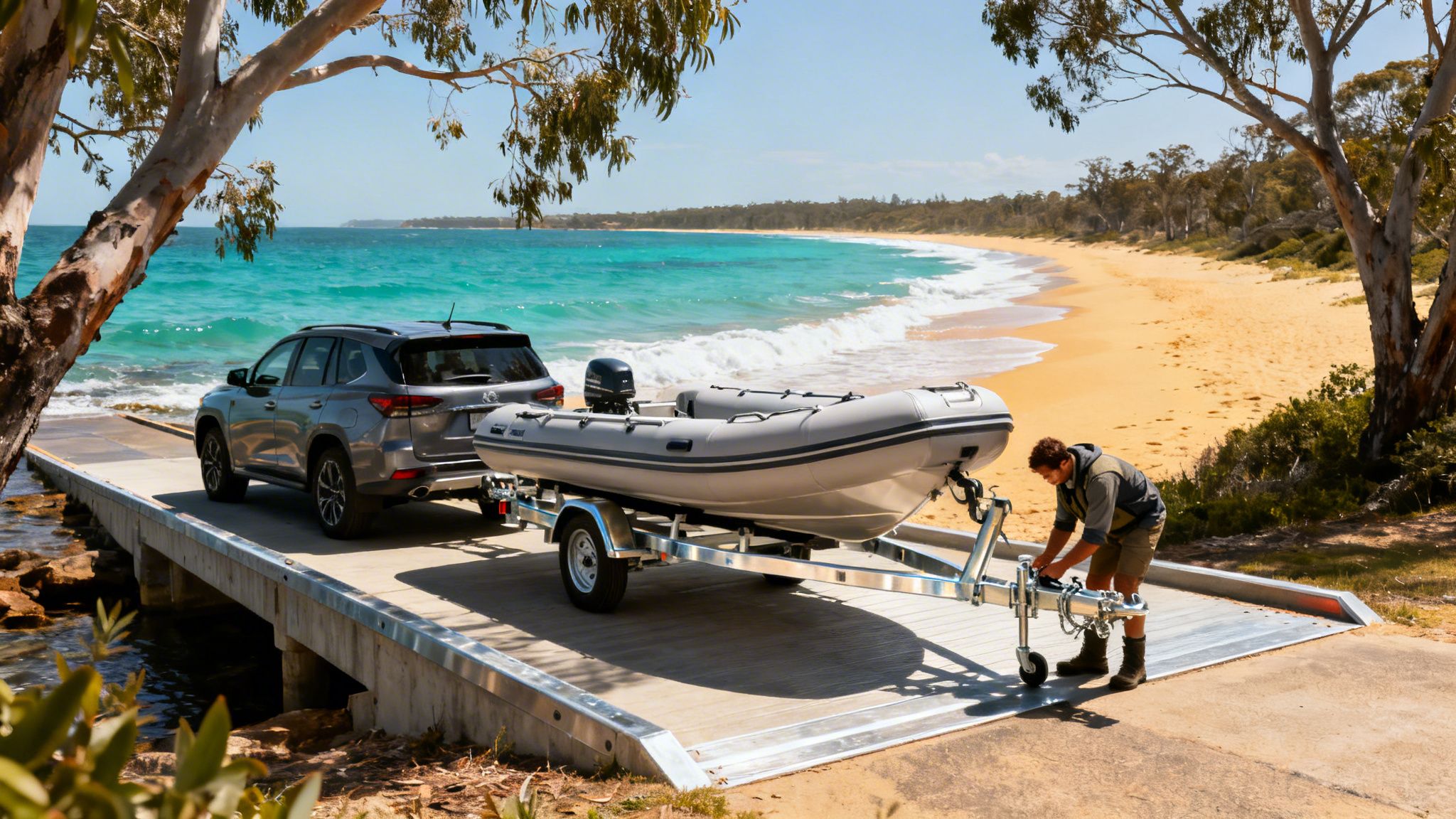

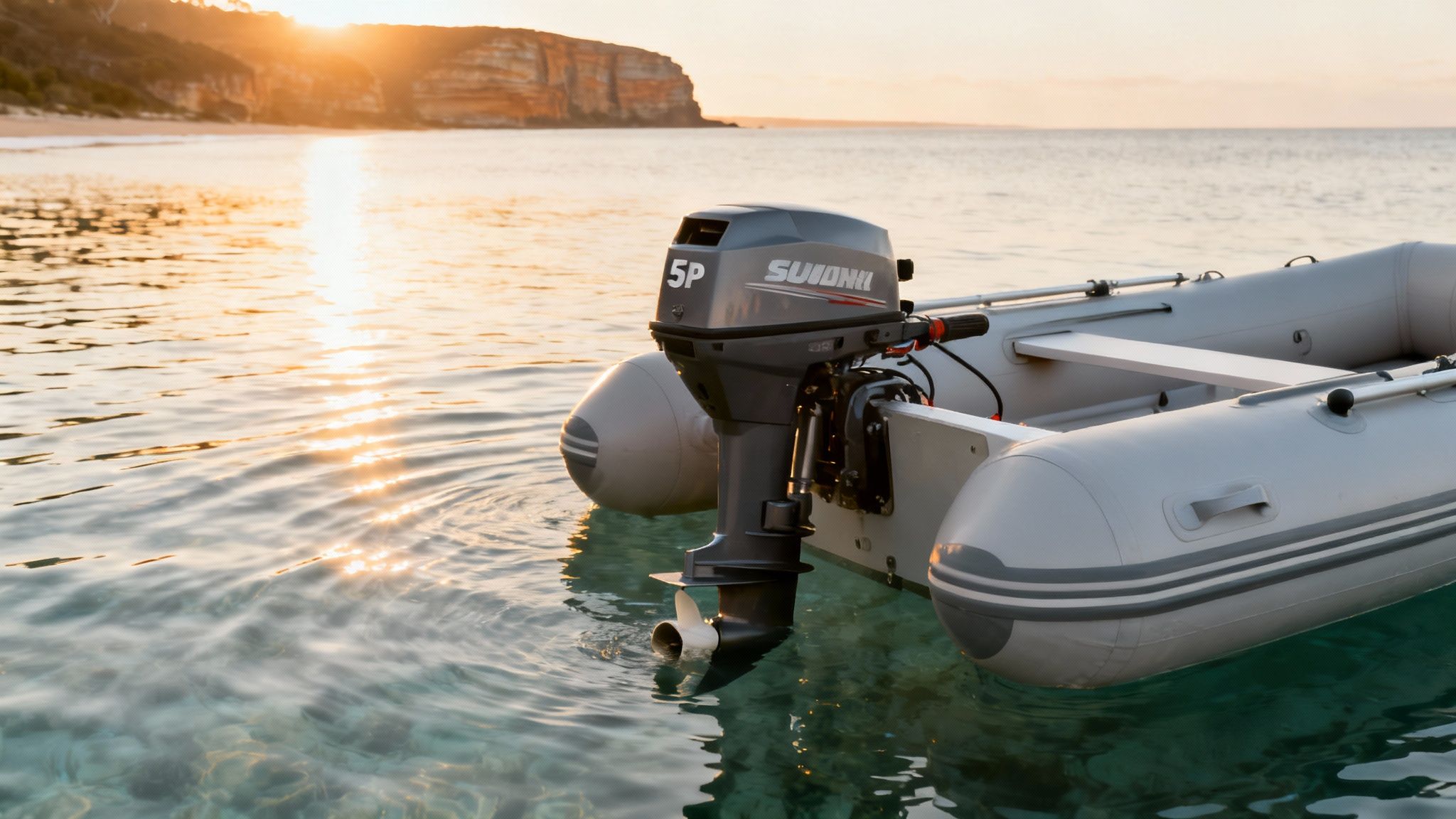
A 5hp outboard motor is the ultimate multitool for the water, striking that perfect balance between power, portability, and practicality for countless Australian adventures. It’s got enough grunt for a thrilling day out on an inflatable boat or small tinny, yet it’s light enough for one person to comfortably carry from the car to the water’s edge.
Think of the 5hp outboard as the quiet workhorse behind your most memorable weekends. It’s the ideal companion whether you’re an angler exploring a quiet estuary, a family enjoying a coastal trip, or a yacht owner needing a reliable tender to get to shore.
This power rating hits a unique sweet spot, making it one of the most popular choices for recreational boaters. You get enough thrust to move a small vessel efficiently without the weight, fuel consumption, or higher price tag of bigger engines. It’s this perfect blend that makes it the go-to for so many boaters looking to explore Australia’s beautiful waterways without the fuss.
Before we dive deeper, here’s a quick snapshot of what you can expect from a typical 5hp outboard.
This table summarises the key specifications, typical uses, and legal considerations for a standard 5hp outboard motor in Australia, giving you a quick reference for what this versatile engine offers.
| Attribute | Typical Specification or Detail |
|---|---|
| Average Dry Weight | 22-27 kg |
| Fuel Type | Unleaded Petrol (4-Stroke) |
| Fuel System | Internal Tank (~1.1L) with external tank option |
| Ideal Boat Match | Inflatable boats up to 4m, small tinnies, tenders |
| Typical Use | Fishing, exploring estuaries, ship-to-shore tender |
| Australian Registration | Often not required (check your state’s regulations) |
| Australian Licensing | Generally not required (check your state’s regulations) |
As you can see, the 5hp outboard is designed for maximum convenience and accessibility, making it an excellent entry point into boating.
So, what really makes the 5hp outboard motor so special? It all comes down to accessible performance. These motors are designed for easy handling from start to finish.
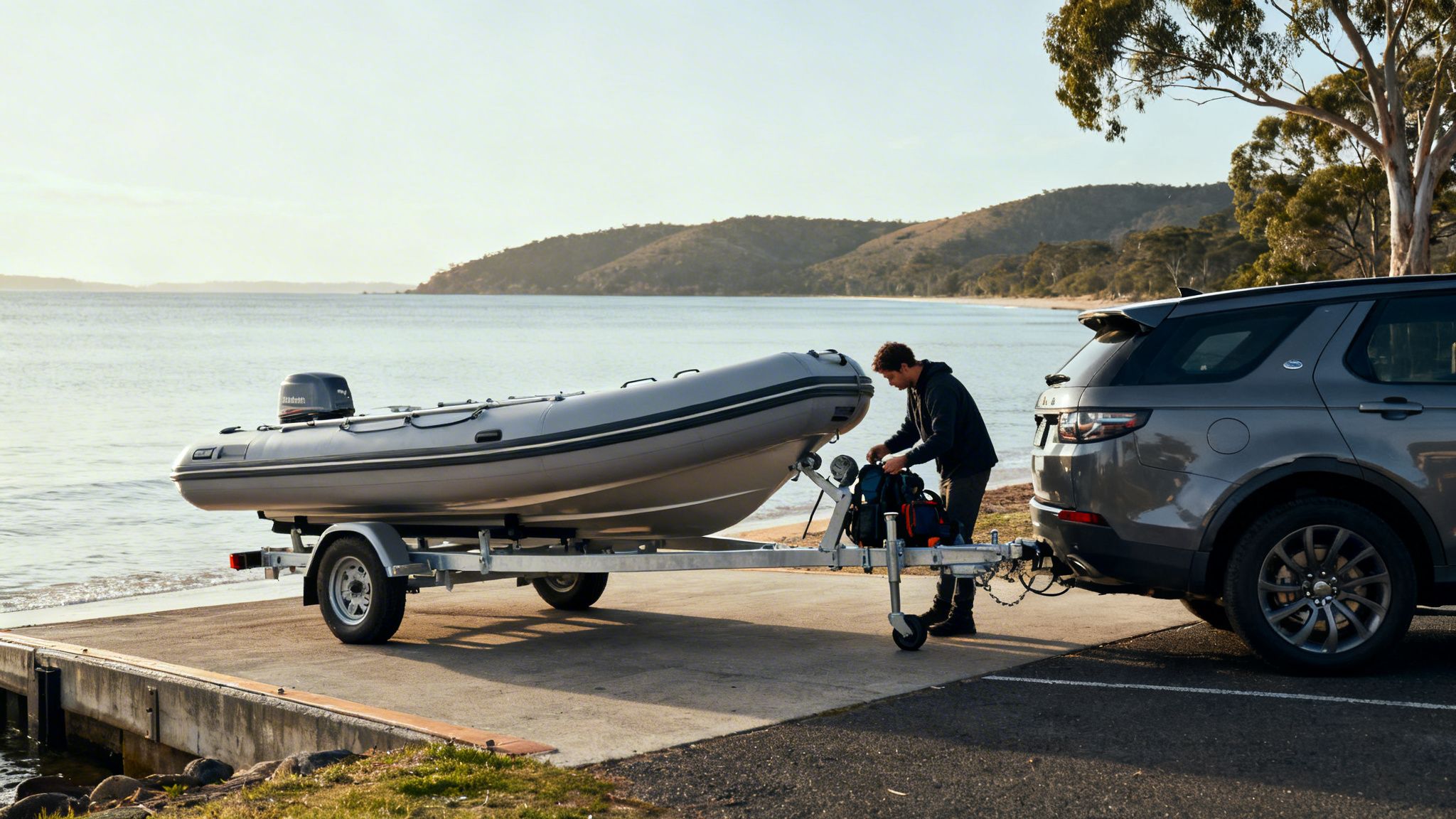
They’re light enough to be mounted and removed by one person and fit neatly into a car boot or ute tray. That’s a massive advantage for anyone who doesn’t store their boat on a trailer and embraces the “boat-in-a-bag” lifestyle. This incredible convenience is one of the key benefits of buying an inflatable boat.
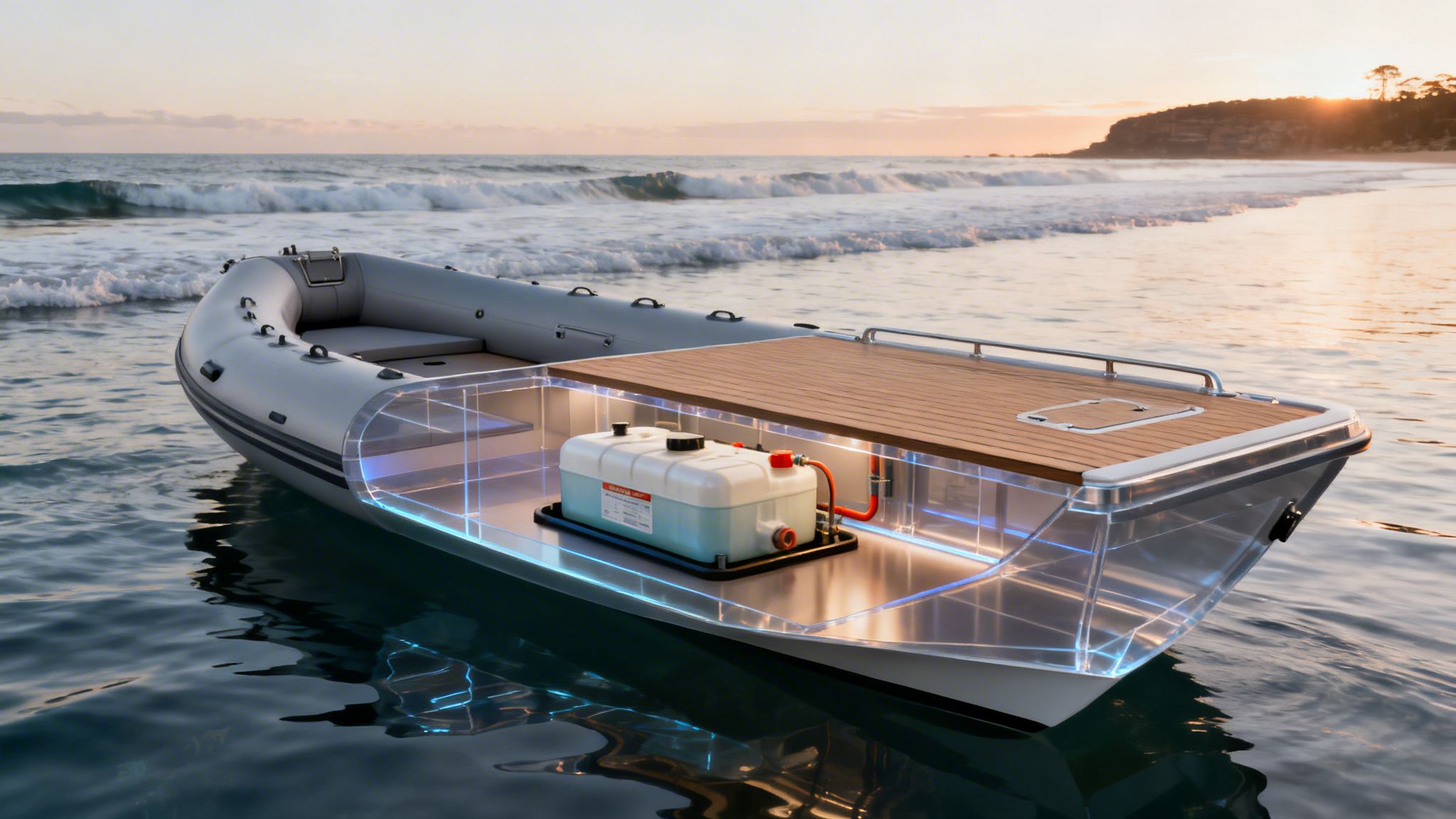
On the water, a 5hp motor is incredibly nimble. A typical model features a 1.1-litre internal fuel tank plus the ability to switch over to an external tank for those longer trips. A 2.08:1 gear ratio provides excellent control and responsiveness, while full 180° steering makes tight manoeuvres a breeze – perfect for navigating crowded marinas or tricky fishing spots.
For many Australian boaters, the 5hp rating is also a regulatory sweet spot. While rules vary by state, this power level often falls just below the threshold requiring boat registration and licensing, saving you both time and money.
The true magic of a 5hp outboard motor is unlocked when it’s paired with the right vessel. It’s the engine of choice for a huge range of small watercraft, including:
This guide will walk you through everything you need to know, from performance expectations to a practical look at the popular Hidea 5hp outboard motor, ensuring you find the perfect setup for your next adventure.
A 5hp outboard motor hits the sweet spot for portable power, but it’s important to know what that feels like on the water. Think of it less like a sprinter and more like a strong, dependable workhorse. It’s built for reliable, efficient pushing power, not for breaking speed records across the bay.
The actual speed you’ll get is always changing, depending heavily on your boat and the day’s conditions. A 5hp motor will feel completely different on a lightweight inflatable catamaran compared to a heavier aluminium tinny. On average, you can expect speeds somewhere between 10 to 15 kilometres per hour, but that’s just a starting point.
This simple breakdown shows why the 5hp is such a popular choice: it’s the perfect blend of power, portability, and practicality.
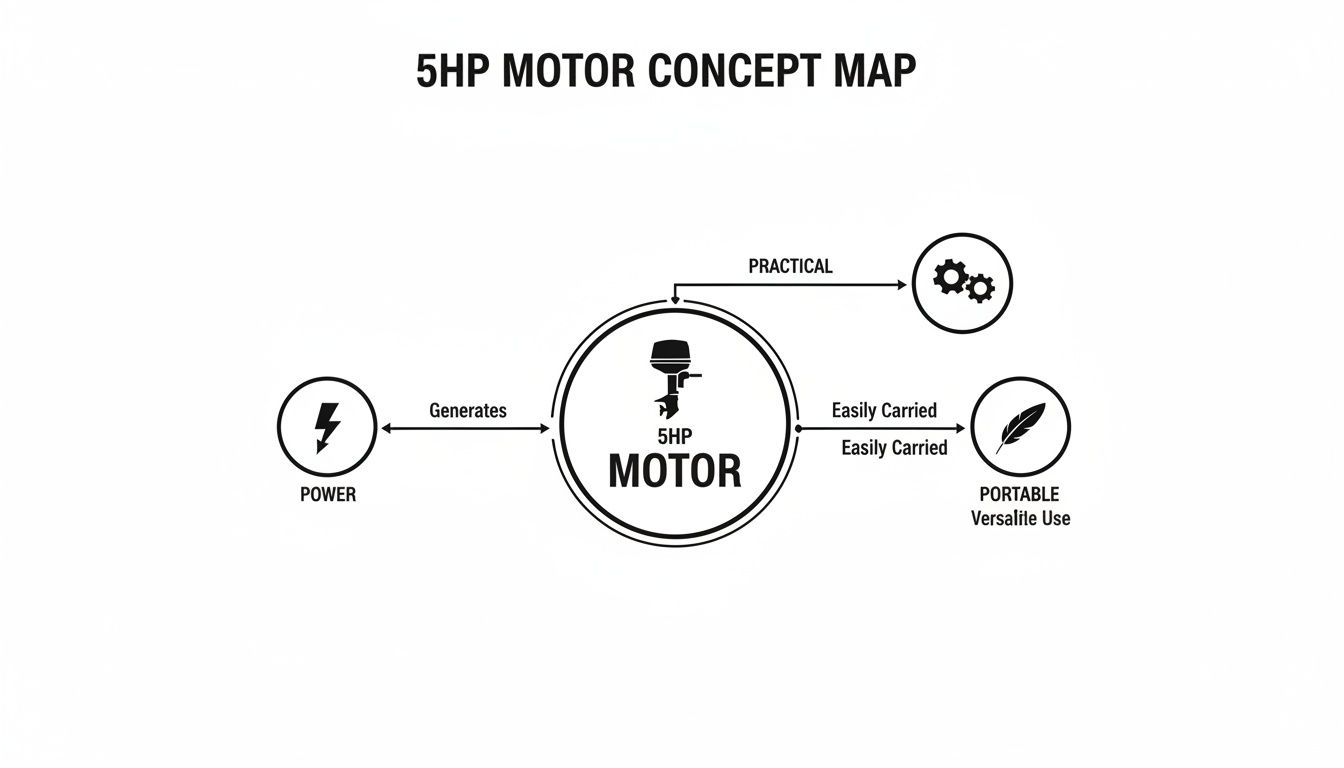
As you can see, these three elements work together to create an engine that’s easy to handle out of the water and more than capable for a huge range of activities once you launch.
Your boat doesn’t operate in a bubble, and several variables can dramatically change how your 5hp outboard motor performs on any given trip. Getting a handle on these factors will help you plan better and get the most out of your engine.
Here are the key things that will affect your performance:
If you’re thinking about an even lighter setup and wondering about a bit less power, it’s worth checking out our guide on the performance of a 4hp outboard motor to see how they stack up.
While speed is easy to measure, it’s really thrust and torque that define what your motor can do. Think of thrust as the raw pushing force that gets your boat moving. A 5hp motor provides plenty of it to propel small boats effectively, even against a light current or breeze.
Torque, on the other hand, is the twisting force that turns the propeller. Good torque is what helps the motor keep its grunt under load, preventing it from bogging down when you hit a wave or add extra weight. A well-designed 5hp engine delivers its power smoothly right through the rev range.
Fuel consumption is another massive part of the performance picture. A typical 5hp four-stroke motor with its 1.1-litre internal tank will run for about an hour at or near full throttle.
But here’s the key: drop back to a more relaxed cruising speed, and you can often double that runtime. This efficiency is what makes the 5hp outboard such a practical choice for long days exploring estuaries or fishing your favourite spots without constantly worrying about fuel.
For longer journeys, the ability to connect an external fuel tank gives you fantastic peace of mind, letting you extend your adventures without heading back to shore. This mix of a convenient internal tank and the option for an external one offers the best of both worlds.
Pairing your 5hp outboard motor with the right boat is a bit like finding the perfect dance partner—it’s all about balance and compatibility. The engine brings the muscle, but it’s the boat’s design that turns that power into speed, stability, and a whole lot of fun. The goal is a setup that’s efficient, safe, and just right for the adventures you have in mind.
A lightweight yet sturdy boat is always the best match. It lets the motor work its magic without any unnecessary strain, which means better speed and fuel economy. This is exactly why inflatable boats have become such a massive hit with Aussie boaters running a 5hp outboard.
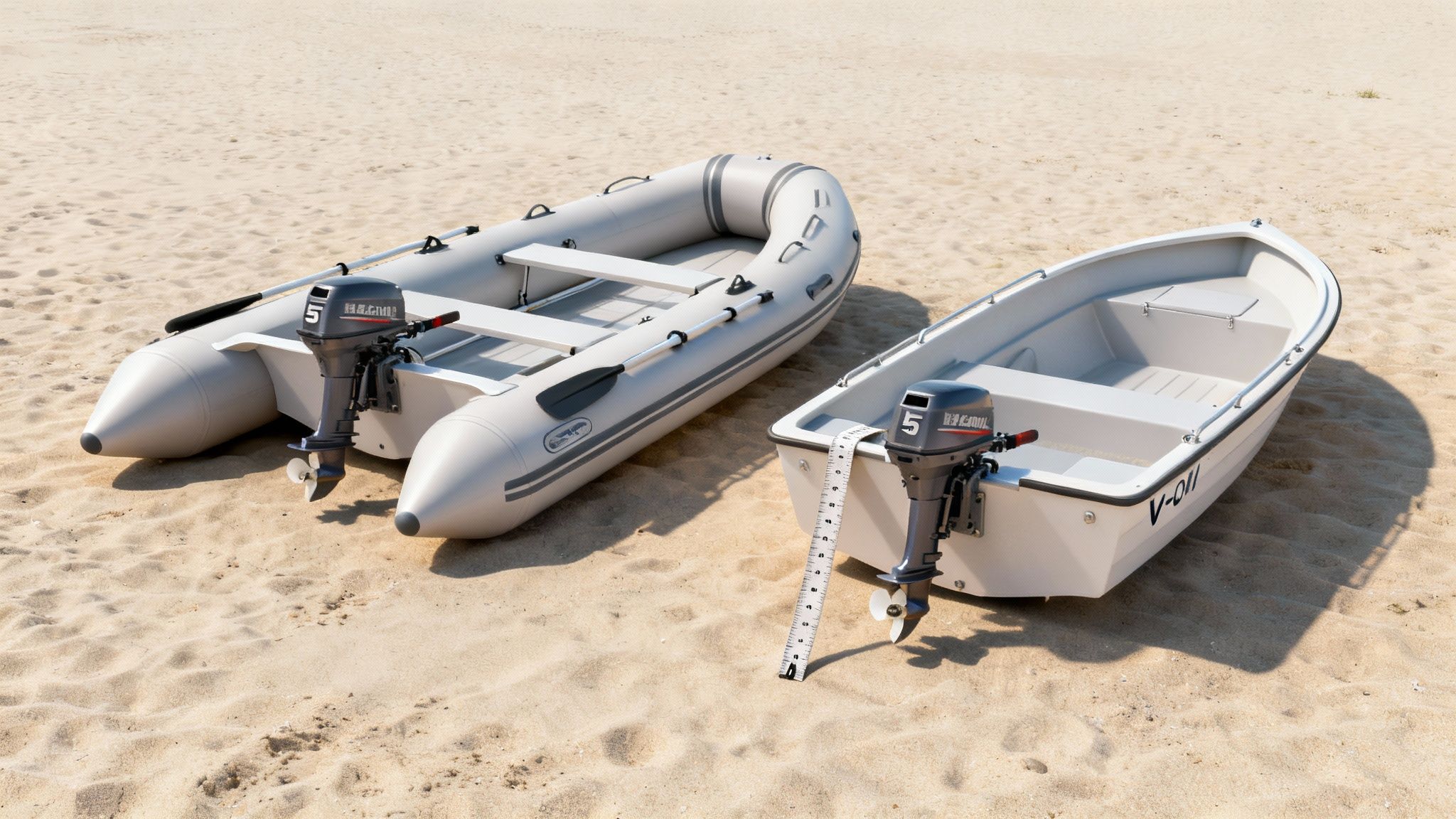
Modern inflatables, especially designs like V-hulls and inflatable catamarans, hit the sweet spot between low weight and incredible stability. Being so light means your 5hp outboard has less mass to push through the water. The result? Quicker acceleration and a higher top speed than you’d ever get with a heavier fibreglass or aluminium boat of the same size.
Inflatable catamarans are particularly clever. Their twin-hull design traps a cushion of air underneath, creating lift that cuts down on drag and lets the boat skim across the water. This means your motor can get the boat on a plane with less effort, making for a thrilling and super-efficient ride.
Beyond performance, the portability of inflatables is a game-changer. Most can be deflated, rolled up, and packed into a bag that fits in a car boot or caravan. This whole “boat-in-a-bag” idea opens up a world of possibilities for exploring remote waterways without ever needing a trailer or a proper boat ramp. If you want to dive deeper, check out our guide on choosing the best motor for an inflatable boat to make sure you get the pairing just right.
One of the most critical details in matching a motor to a boat is the transom height. The transom is the flat section at the back of the boat where the outboard clamps on. Getting this measurement right is crucial because it ensures the propeller sits at the perfect depth in the water.
Outboard motors generally come in two shaft lengths:
To check your boat, just measure from the top of the transom down to the bottom of the hull. A 5hp outboard is almost always a short shaft model, but it pays to measure and be 100% sure to avoid headaches later.
An incorrectly matched shaft length can cause serious problems. If the shaft is too long, it creates a heap of drag, slowing you down and wasting fuel. If it’s too short, the prop can suck in air from the surface—called ventilation—which leads to a loss of power and can even damage your engine.
While inflatables are a fantastic choice, they aren’t your only option. A 5hp outboard is a versatile little workhorse that can happily power a range of other small craft.
Here are a few other great matches:
And if you’re still weighing up your options beyond buying, it can be useful to know what else is out there. This guide on how much to rent a boat gives a good perspective on different ways to get on the water. Whatever boat you choose, the most important final check is making sure it’s officially rated for a 5hp motor. That’s the key to safe and enjoyable boating.
When you’re searching for the best 5hp outboard motor in Australia, it’s easy to get lost comparing prices and features. While established brands have long dominated the market, challenger brands like Hidea are offering a compelling alternative with robust performance and an unbeatable price point. For many recreational boaters, the Hidea 5hp motor isn’t just an option; it’s the smartest choice.
Let’s put the Hidea 5hp outboard head-to-head with its pricier rivals to see how its benefits and features stack up, and what that means for your wallet and your time on the water.
At its core, the Hidea 5hp is a modern four-stroke powerhouse. It uses a single-cylinder, OHV (Overhead Valve) design—the same technology found in leading brands—known for its clean-burning efficiency, smooth power delivery, and long-term reliability. Its power output is perfectly matched for small tinnies, tenders, and especially high-performance vessels like an inflatable catamaran.
Hidea’s advantage lies in delivering this proven engineering without the premium price tag. The build quality is solid, using marine-grade alloys and corrosion-resistant coatings to withstand harsh Australian saltwater conditions. From the ergonomic tiller handle to the sturdy propeller, it’s built for regular, hassle-free use.
A portable motor needs to be practical. The Hidea 5hp excels with features designed for real-world convenience. It comes standard with a 1.1-litre internal fuel tank for quick trips, plus an external fuel connector for all-day adventures, offering you the best of both worlds.
Weighing in at a manageable 24.5 kg, it’s light enough for one person to carry and mount. The large, comfortable carry handle is strategically placed for balance, and the tiller arm folds down for compact storage—perfect for stowing in the car boot or on board a larger vessel.
This is where the Hidea 5hp truly shines. With a retail price often hundreds of dollars less than comparable models from legacy brands, it presents a clear value proposition. For instance, the Hidea 5HP 4-Stroke Short Shaft is priced at just $1,449.00, while similar models from competitors can easily exceed $2,000.
This significant price difference allows boaters to get a brand-new, reliable four-stroke motor with a full warranty for less than the cost of a used engine from a competitor. It makes boating more accessible and removes the risk of buying second-hand. You can see the full specs and current pricing for the Hidea 5hp 4-Stroke at Easy Inflatables.
This table clearly outlines how the Hidea 5hp stacks up against a typical major competitor, highlighting its key advantages in price and features.
| Feature | Hidea 5hp 4-Stroke | Leading Competitor (e.g., Yamaha F5) |
|---|---|---|
| Engine Type | 4-Stroke, 1-Cylinder, OHV | 4-Stroke, 1-Cylinder, OHV |
| Approximate Weight | 24.5 kg | ~27 kg |
| Fuel System | Internal Tank (1.1L) + External Connection | Internal Tank (1.1L) + External Connection |
| Gear Shift | Forward-Neutral-Reverse | Forward-Neutral-Reverse |
| Warranty | 3 Years Recreational | Typically 3+1 Years Recreational |
| Price Point | $1,449.00 | ~$2,000+ |
| Value Proposition | Exceptional features and performance for the price | Brand reputation and larger service network |
Ultimately, the Hidea 5hp outboard motor makes a powerful argument for smart buyers. It delivers the reliable performance and modern features you need at a price point that competitors can’t match, backed by authorised Australian dealers.
Keeping your 5hp outboard motor in top shape is the secret to making it last. Thankfully, it’s a lot easier than you might think. A little care goes a long way, ensuring your motor fires up first go and runs smoothly for years of adventures on the water.
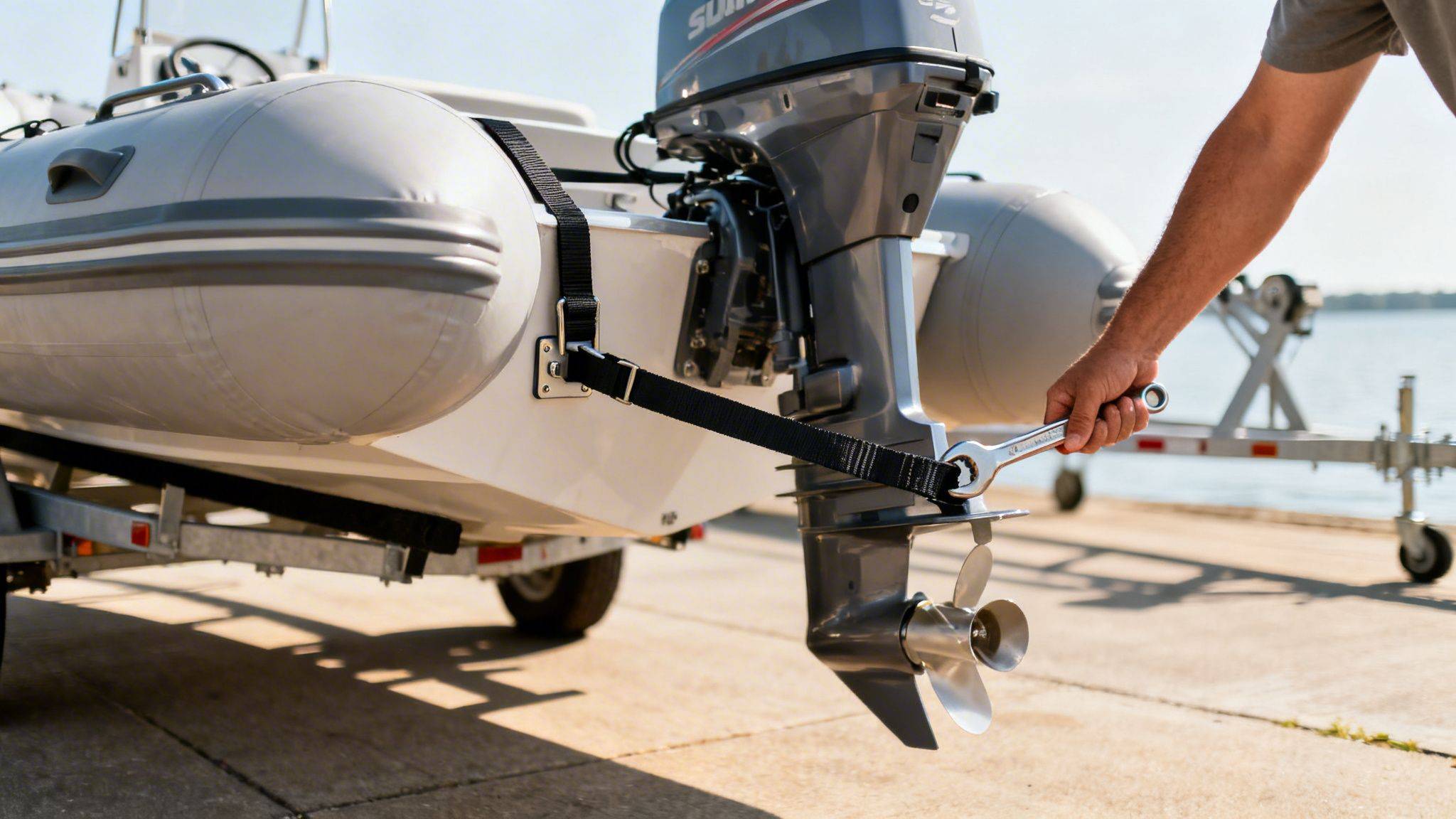
Proper setup is the very first step to getting peak performance. If your motor is mounted too high or too low, it can create drag, kill your speed, and even make the boat handle poorly. The goal is simple: get the anti-ventilation plate (that’s the flat plate just above the propeller) sitting level with the bottom of your boat’s hull.
Getting your motor mounted just right is a quick job, but it makes a world of difference. It’s all about making sure it operates efficiently and safely.
A simple, consistent maintenance routine is your best defence against future problems. These checks are quick, easy, and should become second nature before and after every trip.
When it comes to the 5hp outboard motor in Australia, they’re the unsung heroes for weekend warriors, pairing perfectly with portable RIBs and tenders. Their fuel efficiency, often thanks to a high-combustion OHV design, stretches that small 1.1L tank further—a vital feature on our vast coastlines. While Australia’s outboard sector is a significant $122 million market, it’s the portable segment under 25hp that is seeing impressive growth. Globally, petrol engines still hold a commanding 80.74% of the market, with many owners upgrading every 7-10 years.
Even with perfect maintenance, you might occasionally run into a snag. The good news is that most issues with a 5hp outboard motor are simple to diagnose and fix right there at the boat ramp.
If your motor won’t start, just run through the “F-A-S-T” check:
Nine times out of ten, one of these simple checks will get you going. If you’ve run through them and the motor is still giving you grief, it might be time to have a chat with a professional marine mechanic. Regular servicing, combined with your own diligent care, will ensure your motor is always ready for your next trip.
So, you’re looking at a 5hp outboard motor. It’s a brilliant choice, and a massive favourite among Aussie boaters for good reason. But before you commit, you’ve probably got a few questions floating around. We get it. Knowing the nuts and bolts helps you get the most out of your time on the water.
We’ve pulled together the most common questions we hear from customers and laid out some clear, straight-up answers. Whether you’re wondering about speed, fuel, or the rules of the water, you’ll find it here. Let’s get you feeling confident about your new motor.
This is the big one, the question everyone asks first. The honest answer? It depends. On a good day, with the right setup, a 5hp outboard will push a small boat along at 10 to 20 kilometres per hour. But that number isn’t set in stone; it’s a moving target that changes with your boat, the load, and the conditions.
Think of it like riding a bike. Jump on a lightweight racing bike on a flat, smooth road, and you’ll fly. Now try to grind a heavy mountain bike uphill into a headwind—you’ll be crawling. It’s the same deal here. A lightweight inflatable catamaran with just you on board will likely get you closer to that 20 km/h mark. Load up a heavier tinny with three people and a day’s worth of fishing gear, and you’ll be cruising closer to 10 km/h.
Modern four-stroke 5hp outboards are ridiculously good on fuel. Most come with a built-in 1.1-litre fuel tank, which is usually enough for about an hour of run time if you’re going flat-out.
But here’s the secret: you’ll rarely be running at wide-open throttle. Ease back to a comfortable cruising speed—around half to three-quarters throttle—and you can easily stretch that little tank to two hours or even more. This incredible efficiency is what makes a 5hp outboard perfect for a full day of exploring without lugging around heaps of extra fuel. And for those longer trips, you can always connect an external tank for total peace of mind.
The petrol versus electric debate for a 5hp outboard motor really boils down to what you value most. Each has its own strengths, and the best choice depends entirely on how and where you plan to go boating.
A traditional petrol motor is all about range and convenience. You can refuel from a jerry can in minutes and cover serious distance without a second thought. They give you consistent, reliable power and can be serviced just about anywhere in Australia.
Electric motors, on the other hand, offer a totally different vibe. They’re whisper-quiet, produce zero emissions, and need next to no maintenance. If you’re an angler who loves a stealthy approach or you’re boating on sensitive waterways, this is a game-changer. The trade-off is battery life. Recharging can take hours, so they’re best suited for shorter, quieter trips where you know you can plug in afterwards.
The electric outboard scene is evolving fast. New models like the Momentum U2 are really pushing what’s possible, delivering true 5hp equivalent power in a portable package. While they still can’t match the range of petrol, the performance gap is definitely closing, making them a more serious option than ever before.
Trying to figure out boating regulations can feel like a headache, because the rules are different in every state. But here’s the good news: in most parts of Australia, you do not need a boat licence to operate a boat with a 5hp outboard, provided you stay under a certain speed (usually 10 knots, or about 18.5 km/h).
Registration is a similar story. Many states draw the line for registration just above the 5hp mark. In NSW, for example, you only need to register a motor over 4.0kW (which is about 5.4hp). But—and this is important—you absolutely must check the specific rules for your state. Regulations can and do change, so always get the latest info from your local maritime authority before you hit the water.
Yes, it absolutely can! Under the right conditions, a 5hp outboard motor can get a small, light boat up on plane. “Planing” is that awesome moment when the hull lifts up and skims across the top of the water, giving you a serious boost in speed and fuel efficiency.
To make it happen, you need the right recipe:
Getting on plane with just 5hp is a real thrill. It’s a perfect example of the incredible power-to-weight ratio these brilliant little engines deliver.
Ready to power your next adventure? At Easy Inflatables, we offer a fantastic range of inflatable boats and are an authorised Australian dealer for Hidea outboard motors. Explore our boat and motor packages today and find the perfect setup for your needs. Visit us at https://easyinflatables.com.au to get started.