
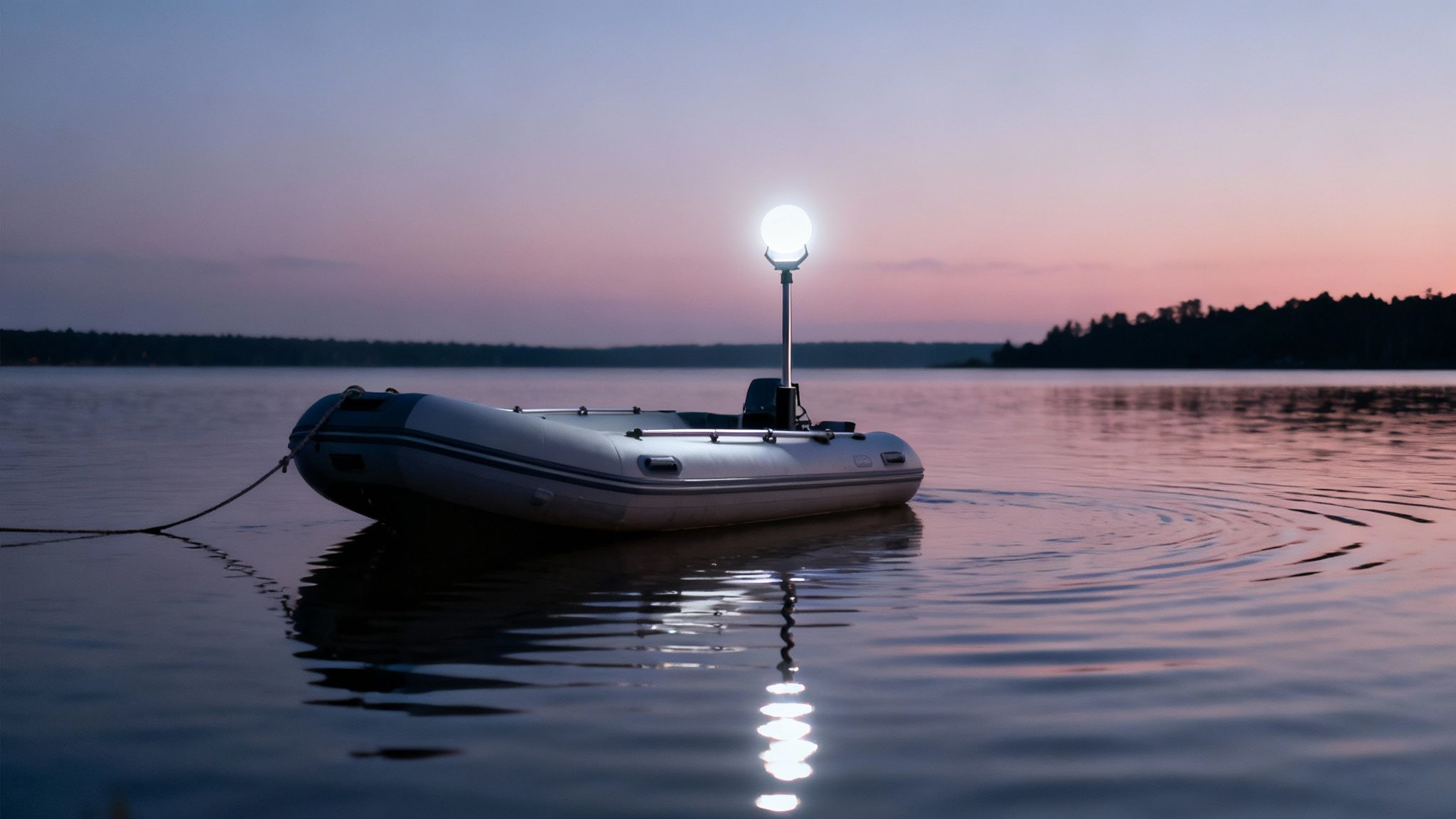
When your boat is anchored for the night, it needs to be seen. That’s the job of an anchor light: a mandatory all-round white light that must be on from sunset to sunrise whenever you’re not underway.
Think of it as your boat’s personal lighthouse. It’s a 360-degree beacon telling other boaters, “Hey, I’m right here!” This simple bit of gear is one of the most important safety items you can have, especially when darkness falls. Whether you’re comparing prices and features of inflatable boats in your area or already own one, understanding this essential accessory is crucial.
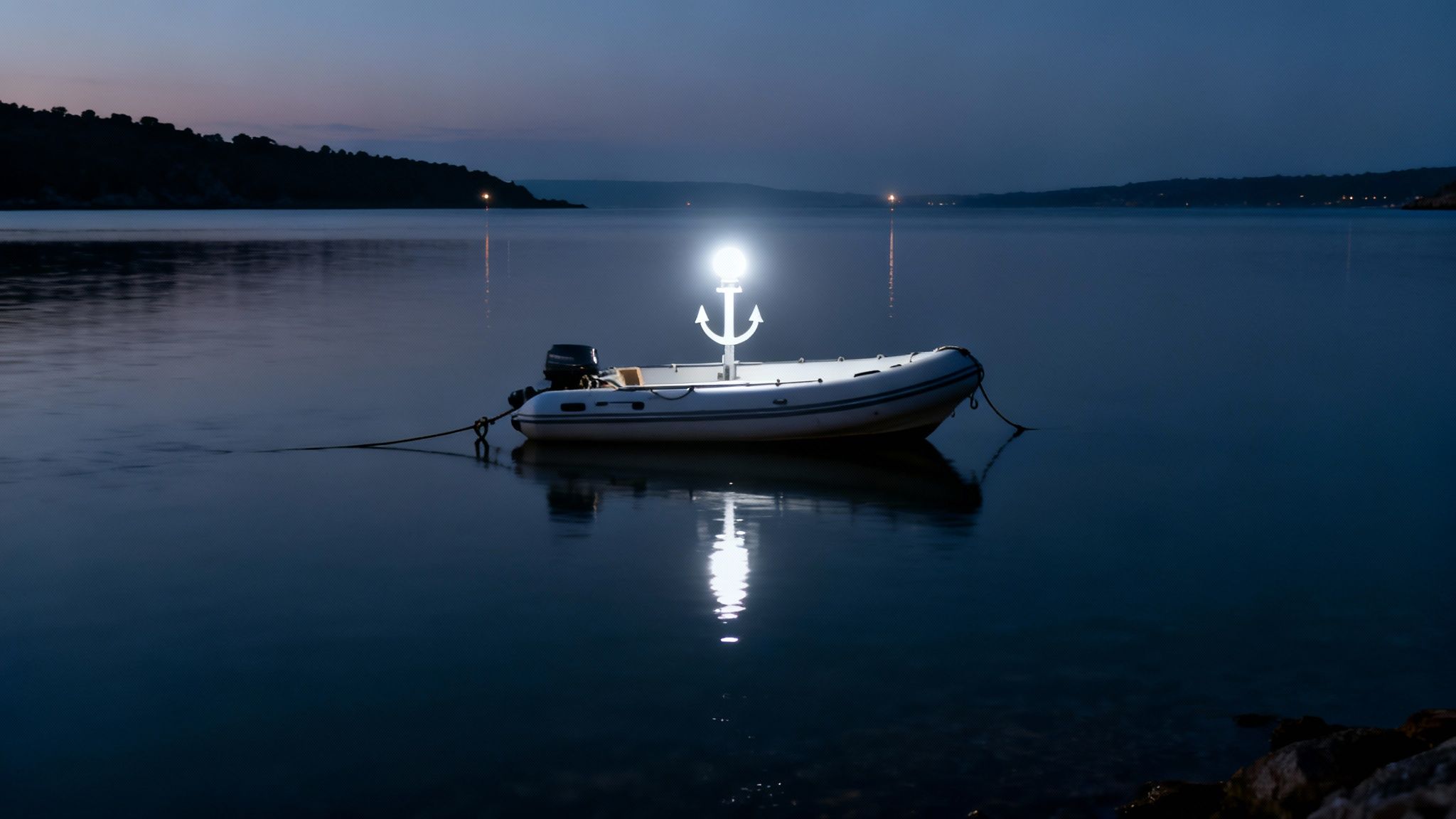
Picture this: you’ve dropped anchor in a quiet, beautiful bay, the stars are out, and all is calm. Without a light, your boat is just a dark, invisible shape on the water—a serious hazard for any other vessel moving through the area. A proper anchor light transforms your boat from a potential danger into a clearly marked object, keeping everyone safe.
This isn’t just good advice; it’s the law right across Australia. If you plan to hire inflatable boats for a family outing in Australia, you need to know these rules. Maritime regulations are there to protect you, your crew, and every other boater on the water. Skipping this simple step can lead to hefty fines, but more importantly, it puts lives at risk.
Even having a light isn’t enough if it’s not working properly. Marine incident investigations in Australia constantly point back to the critical role of light visibility. Salt, moisture, and time are the enemies of all marine gear, and navigation lights are no exception. Burnt-out bulbs, corroded connections, and frayed wires are all too common.
A reliable anchor light does more than just tick a legal box. It gives you peace of mind, letting you relax and enjoy your time at anchor without constantly worrying if you’re visible to others.
Getting these basics right is the first step to responsible boating after dark. This guide will walk you through everything you need to know, from the specific Australian regulations to picking and installing the best light for an inflatable boat. It’s a non-negotiable part of any solid safety plan, something we cover in detail in our boat safety equipment checklist.
Figuring out maritime rules in Australia can feel a bit daunting, but the regulations for anchor lights are actually pretty simple once you get the hang of them. The main idea is to make sure your boat is clearly visible to others from sunset to sunrise. It’s all about preventing collisions and keeping everyone safe out on the water.
At its heart, the standard across Australia is straightforward. When you’re at anchor, your boat must show an all-round white light. This means it has to be visible from every direction—a full 360 degrees. It also needs to be bright enough for other boats to see from at least 2 nautical miles away, acting as a clear, unmistakable signal of where you are.
This isn’t just a friendly suggestion; it’s a legal requirement. Think of it as the bare minimum for staying visible and safe after dark.
While the core rule is the same everywhere, you’ll find minor differences and a few specific exemptions depending on which state you’re in. It’s always a good idea to know the local rules for the waters you boat in most often.
To help clear things up, here’s a quick rundown of the anchor light rules for smaller recreational boats in a few key states.
| State/Territory | General Requirement | Common Exemptions (If Applicable) |
|---|---|---|
| Queensland (QLD) | All vessels at anchor must display an all-round white light. | No general exemptions based on size. The rule applies to all boats. |
| New South Wales (NSW) | Vessels under 50m need an all-round white light. | Boats under 7m are exempt if not in a channel, fairway, or anchorage. |
| Victoria (VIC) | Vessels under 50m need an all-round white light. | Boats under 7m are exempt if not in a narrow channel or high-traffic area. |
| South Australia (SA) | Vessels under 50m need an all-round white light. | Boats under 7m are exempt if not in a narrow channel, fairway, or busy area. |
| Western Australia (WA) | Vessels under 50m need an all-round white light. | Boats under 7m are exempt unless anchored in a narrow channel or where other vessels normally navigate. |
As you can see, while there are some exemptions for smaller boats, they almost always come with a catch—like where you’re anchored. The safest bet is to just use a light.
Key Takeaway: The golden rule is simple: always display an all-round white light. If you’re ever unsure about a local exemption, just switch your light on. It’s the safest and most responsible thing to do.
Knowing these rules helps you steer clear of fines and ensures your inflatable is fully compliant. It’s a crucial part of being prepared on the water, just like having reliable emergency gear. For that extra layer of security, especially in remote spots, it’s worth learning more about how a personal rescue beacon can be a lifesaver.
For those of us with the best inflatable boats for recreational use, particularly models like an Inflatable Catamaran, the rules are generally much less complicated. The focus is always on making sure other boaters know you’re there.
An inflatable boat’s best features are its portability and simplicity, and your anchor light should match that spirit. Unlike a traditional fibreglass or aluminium boat with a fixed battery system and rigid mounting points, an inflatable requires a more flexible approach. Your choice will come down to balancing compliance, convenience, and how you actually use your boat.
For most inflatable boat owners, the ideal solution is a portable, battery-operated anchor light. These units are designed for the pack-down, grab-and-go nature of inflatables. They skip the need for complex wiring or drilling into your transom, keeping your boat’s integrity intact and making setup a breeze. This is a huge factor when you’re looking at all the essential inflatable boat accessories on the market.
This decision tree shows the basic logic for figuring out if you need an anchor light based on Australian regulations.
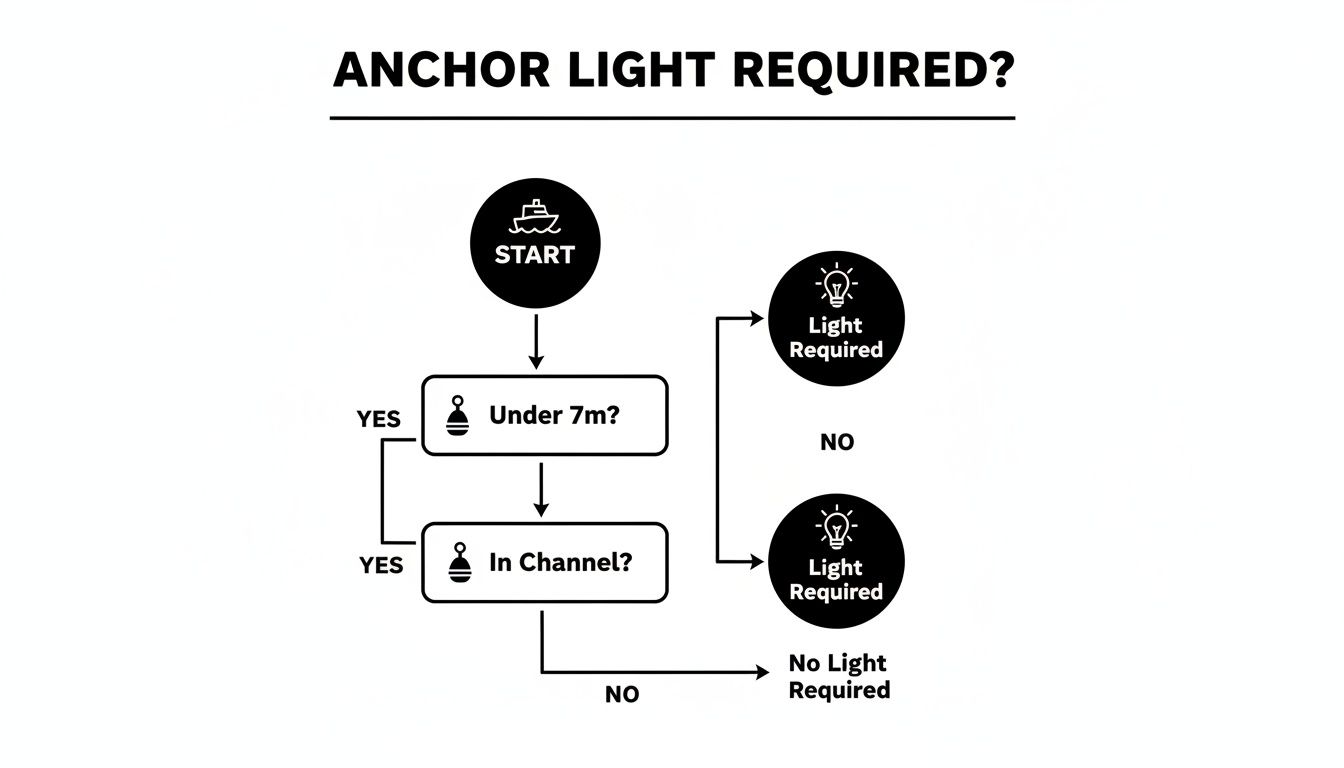
As you can see, even if your boat is under 7 metres, dropping anchor in a channel or a busy area means you legally need to show a light. It’s all about being seen.
The first big decision is whether to go for a fixed or portable light. A fixed, hardwired light is a great “set and forget” option for larger RIBs or tenders that live on a trailer or in the water. But for a true portable like an inflatable catamaran that gets packed away in a bag, a portable light is almost always the smarter choice.
Let’s break down the two main styles suitable for inflatables:
For the typical Easy Inflatables owner who values a quick setup and even quicker pack-down, a high-quality, water-resistant portable LED anchor light offers the perfect blend of performance and practicality.
How you power your light is another critical piece of the puzzle. While hardwired systems are reliable, they add weight and complexity—and that can defeat the whole purpose of having a lightweight, portable boat in the first place.
Battery-powered options give you fantastic versatility:
Ultimately, the best anchor light for your boat is one that you will actually use. For inflatable boats, that usually means a bright, tough, and portable LED unit that is as easy to pack as the boat itself.
When you’re trying to pick the right anchor light for your boat, it’s easy to get bogged down in technical specs. But honestly, it all comes down to a few key features that separate a reliable, long-lasting light from one that’s going to fail you when you need it most. Get these right, and your investment will keep you safe and compliant for years.
The first and most critical thing to look for is how well it stands up to the elements. The marine environment is famously harsh—we’re talking constant saltwater spray, rain, and humidity. A quality anchor light has to be built to handle these conditions without giving up the ghost.
The best way to judge this is by looking for its Ingress Protection (IP) rating. This two-digit number isn’t just jargon; it tells you exactly how well the light is sealed against solids (like dust) and liquids.
A light rated at IP67 or higher gives you peace of mind that a rogue wave or a torrential downpour won’t leave you in the dark. It’s a clear sign of quality construction.
A truly waterproof anchor light isn’t just a convenience; it’s a fundamental safety feature. It means the internal electronics are completely sealed off from corrosion, which is the number one enemy of marine equipment.
For inflatable boat owners, how you power your light is a massive consideration. You’ve basically got two options, each with its own pros and cons.
Hardwired 12V Systems are for those with a more permanent setup, like larger inflatables or RIBs that already have a dedicated battery. You wire it directly into your boat’s electrical system for an unwavering source of power. It takes a bit of installation, but it’s a robust, set-and-forget solution. To learn more about setting up a reliable power system, check out our guide on choosing a marine battery and charger.
Battery-Powered and Rechargeable Lights, on the other hand, are a perfect match for portable boats. They give you incredible flexibility without needing any complex wiring. Modern rechargeable models can run for dozens of hours on a single charge, making them ideal for weekend trips. This grab-and-go convenience makes them a top choice for owners who value a quick and simple setup.
The technology inside the bulb matters just as much. Modern LED (Light Emitting Diode) tech has made old-school incandescent bulbs totally obsolete. LEDs use a tiny fraction of the power, shine much brighter with a cleaner light, and can last for over 50,000 hours. This incredible efficiency is a game-changer for battery-powered units, ensuring your light stays on all night without draining your power source.
To make things clearer, let’s break down the common types you’ll find for inflatables.
Choosing the right style of anchor light depends entirely on your boat, your setup, and how you plan to use it. Here’s a quick comparison to help you figure out what’s best for your inflatable.
| Light Type | Best For | Pros | Cons |
|---|---|---|---|
| Fixed/Pole-Mounted | Larger RIBs or inflatables with a console or solid transom. | Very secure and reliable; sits high for excellent visibility. | Requires permanent installation and wiring. |
| Portable Suction Cup | Smaller tenders and inflatables without a battery system. | Super easy to attach and remove; no drilling required. | Suction can fail in rough conditions or on dirty surfaces. |
| LED Stick-On/Adhesive | Any inflatable where a temporary, low-profile light is needed. | Ultra-flexible mounting; lightweight and compact. | Adhesive may weaken over time with sun and salt exposure. |
| Clamp-On | Inflatables with a solid transom, seat, or rail to clamp onto. | Secure and versatile; can be moved easily. | Can be bulkier; may not fit all boat designs. |
Ultimately, the best light for your inflatable boat is one that you’ll actually use consistently. For most of our customers with portable tenders, a high-quality, IP67-rated rechargeable or battery-powered light offers the perfect blend of convenience, performance, and safety.
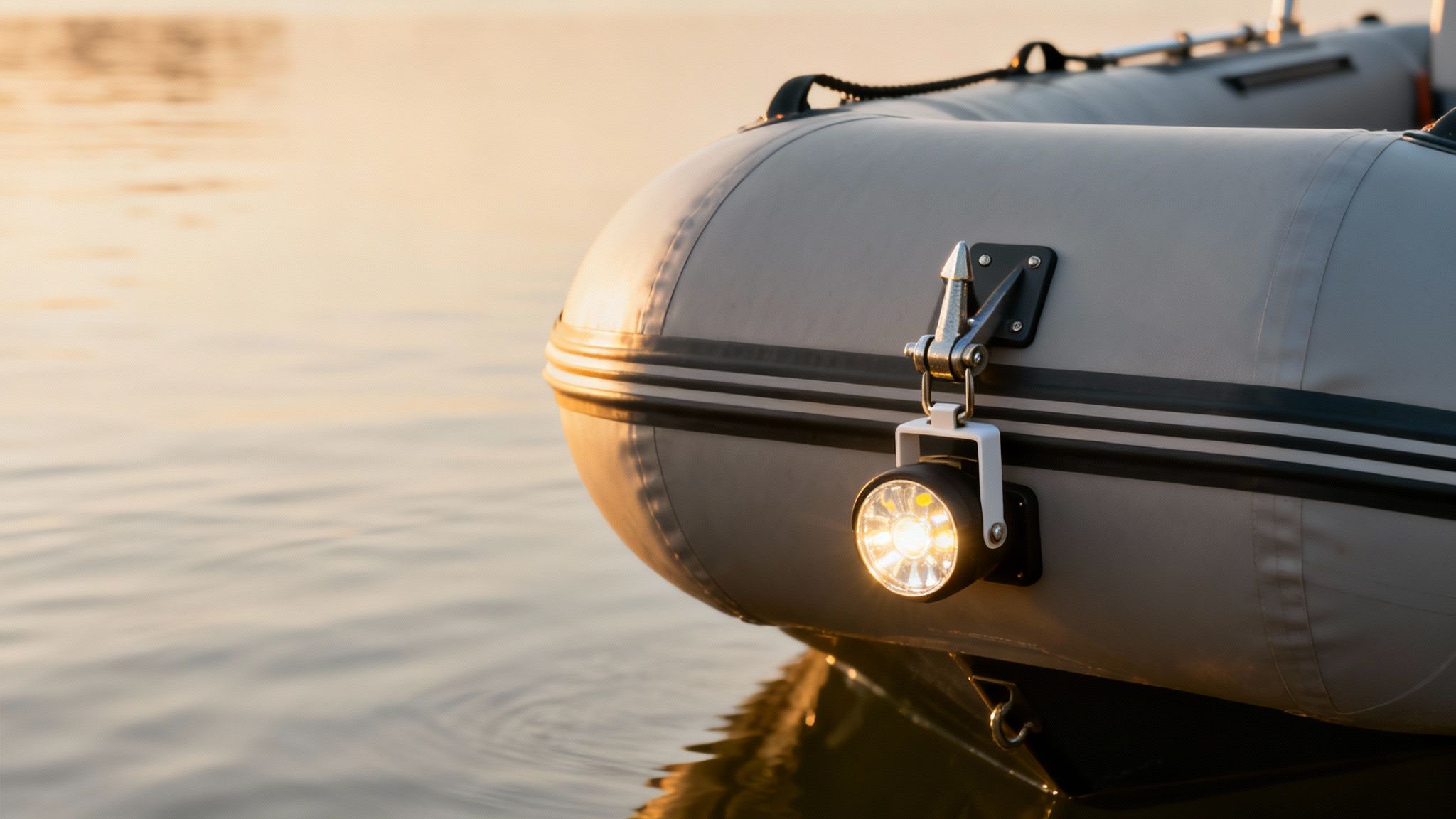
Mounting a light on an inflatable might sound complicated, but it’s actually much simpler than you think. You don’t need to drill a single hole. The whole game is about finding a secure, clever solution that gets the light high enough to be seen from every direction.
Your goal is to achieve unobstructed 360-degree visibility. This ensures any other vessel on the water can see you, no matter which way they’re approaching.
For inflatable boat owners, convenience is everything. The best mounting options are the ones you can pop on and off in minutes, which is perfect for boats that get packed away after a day out. These smart setups keep your boat in top condition while making sure you’re safe and compliant on the water.
Forget about drills, screws, and permanent fixtures. Modern mounting gear is designed specifically for the soft tubes and solid transoms of inflatables. These options are tough, reliable, and best of all, completely reversible.
Here are a few of the most popular and effective ways to get it done:
Your primary objective is elevation. The anchor light must be the highest point on your boat to guarantee it’s visible from all directions, without being blocked by canopies, passengers, or your outboard motor.
Where you place the light is just as important as how you mount it. The light needs to be high enough to shine over everything and everyone on your boat.
For many inflatable setups, a telescopic pole is a brilliant investment. It lets you adjust the height on the fly for perfect visibility. This practical approach is a core part of responsible boating, and you can explore more tips in our guide to inflatable boat setup tips for safety.
No matter which method you choose, always give the light a firm shake before you head out to make sure it’s secure. A well-mounted anchor light for your boat ensures you’re not just compliant, but clearly and safely visible to everyone else enjoying the water.
The best anchor light isn’t the fanciest one—it’s the one that works flawlessly every single time you flick the switch. Like any bit of gear you take out on the water, a little care goes a long way, especially when you’re dealing with the harsh realities of saltwater.
Think of it as a quick pre-launch check. A few minutes spent looking over your light before you head out is one of the smartest things you can do to avoid a serious safety headache later on. Building these simple habits into your routine is easy and pays off big time.
Before you launch and after you return, especially after a run in saltwater, give your light a quick once-over. This is all about catching small problems before they turn into big ones.
A well-maintained light is a dependable one. Spending just five minutes on these checks before you leave the shore is one of the smartest safety investments you can make.
If your anchor light is playing up, don’t panic. The fix is usually surprisingly simple. Before you start thinking about a replacement, run through these quick diagnostics.
Is the light refusing to turn on at all? Start with the obvious: the power source. For portable models, that means swapping in a fresh set of batteries. If it’s a rechargeable unit, double-check that it’s actually fully charged. For a hardwired system, check your boat’s main battery and the switch for the light itself.
If the light is flickering or intermittent, it’s almost always a bad connection. Re-check those battery contacts for any sneaky corrosion, make sure the bulb is screwed in tight, and give any plugs or wire connectors a little wiggle to ensure they’re seated properly. More often than not, a quick tighten is all it takes to solve the problem.
We get asked a lot about choosing the right anchor light, especially for our inflatable boats. To clear things up, here are some straight answers to the most common questions we hear from boaters around Australia.
In most cases, yes, it absolutely does.
Some states have exemptions for boats under 7 metres in specific, designated anchorages, but don’t count on that rule applying in a busy channel or main fairway. If you’re boating in Queensland, for example, the rules require an anchor light for all boats, no matter the size.
The safest bet is to always use one. It’s the best way to guarantee you’re seen and avoid a nasty collision in the dark.
For an inflatable boat that gets packed away after each trip, a battery-powered, portable LED anchor light is the perfect choice. These units are all about convenience.
Look for models with flexible mounting options like heavy-duty suction cups, clamps, or even magnetic bases. They don’t need any permanent wiring, so they’re easy to pop on, secure firmly, and take off when you’re done for the day. If you’re looking for the best inflatable boats for recreational use available near me, this is an accessory you can’t overlook.
The light absolutely must be at the highest point of your boat to give it a completely unobstructed 360-degree view. This is non-negotiable for both safety and legal compliance.
For inflatables, a few common solutions work really well:
The main goal is simple: get the light high enough so it can be seen from every direction, without being blocked by passengers, biminis, or gear.
At Easy Inflatables, we specialise in practical, high-quality gear that makes your time on the water safer and more enjoyable. Explore our full range of inflatable boats and essential accessories at https://easyinflatables.com.au.