
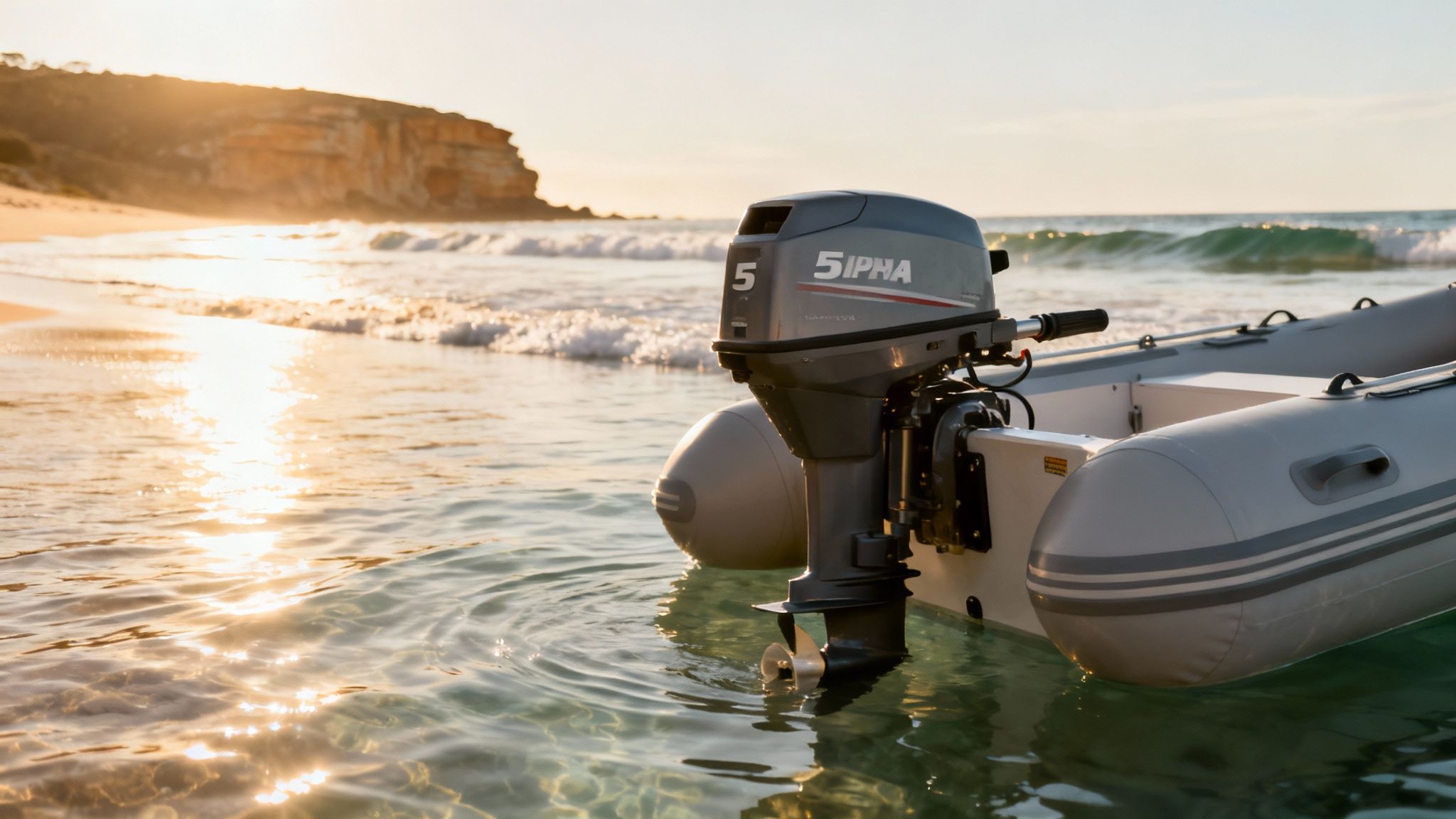
If you’re after the perfect blend of power, portability, and efficiency for your small boat, you’ve landed in the right spot. The 5hp outboard motor is the undisputed champion in the portable boating world. It’s got enough kick to get tenders, inflatables, and dinghies moving at a decent clip, but it’s still light enough for one person to carry down to the water and clamp on without breaking a sweat.
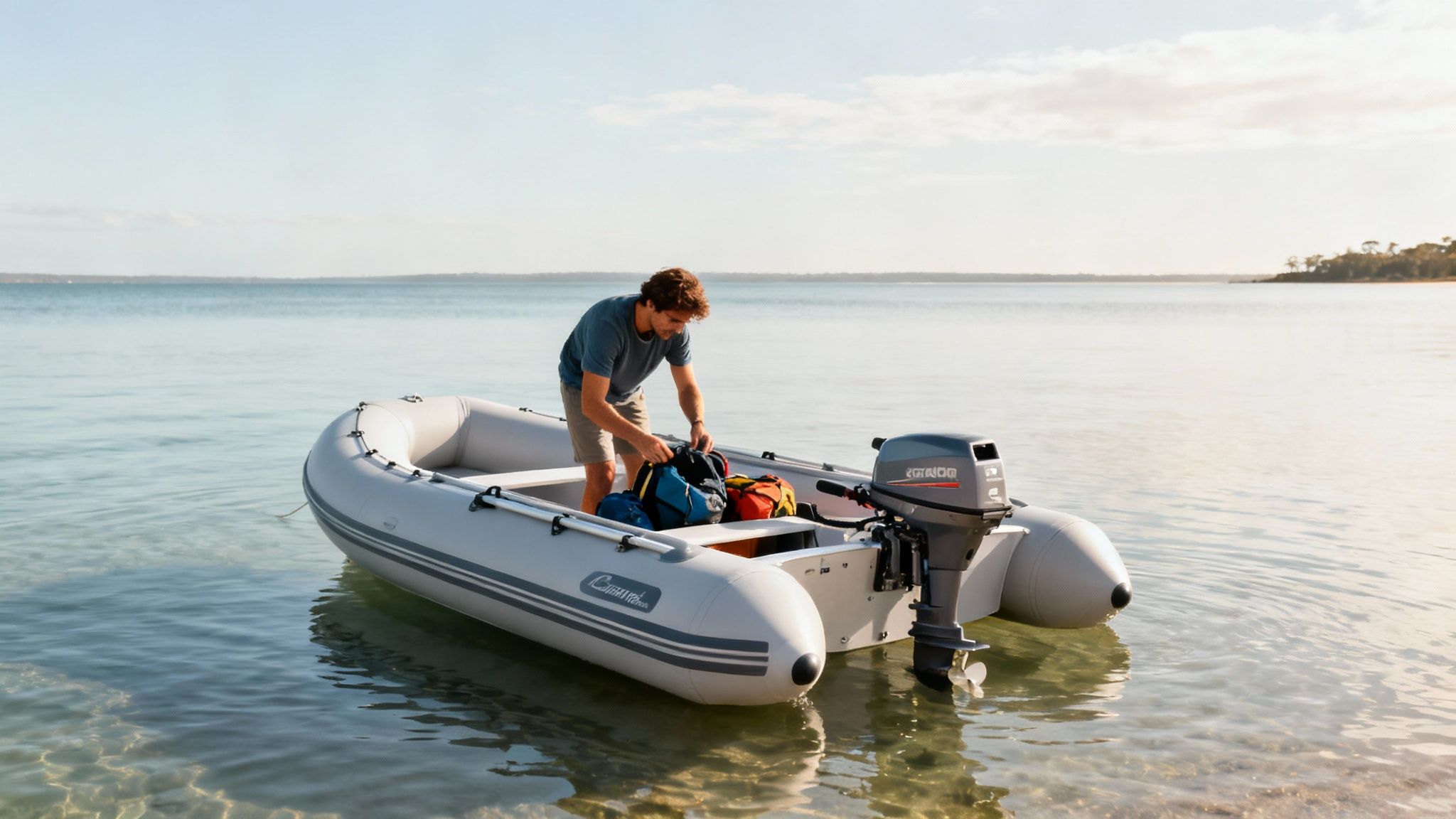
So, let’s get into it. This is your complete guide to the 5hp outboard, the real workhorse for portable boating here in Australia. This class of motor hits that perfect sweet spot for so many boaties, from families planning a day out on an inflatable to anglers who need a reliable motor for their fishing tender.
Its popularity is no accident. The 5hp outboard is the default choice for yachties, RV travellers, and anyone who wants convenience without giving up on performance. Think of it as the ultimate entry point into boating—powerful enough to be genuinely fun, but simple enough that you won’t get bogged down in complexity.
What makes the 5hp category so damn good is its incredible versatility. It gives you enough grunt to push a 3-metre inflatable with a couple of adults and their gear, yet the motor itself usually weighs only around 25-27 kilograms. That means you can easily lift it out of the car boot, carry it down the beach, and clamp it onto your boat’s transom all by yourself.
This mix of features makes it a perfect match for the Aussie lifestyle:
If you’re just starting out, getting your head around the specs is the first step. Below is a quick rundown of what you can expect from a typical 5hp motor and, more importantly, what it all means for your time on the water. You can also learn more in our detailed guide on finding affordable outboard motors.
This table breaks down the typical specs of a 5hp motor and explains why they matter for the average Aussie boater. It’s a great way to quickly understand what you’re looking at.
| Specification | Typical Range or Type | Why It Matters for You |
|---|---|---|
| Engine Type | 4-Stroke, Single Cylinder | Quiet, fuel-efficient, and cleaner than old 2-strokes. Best of all, no messy pre-mixing of oil and fuel is needed. |
| Weight | 25-28 kg (Dry) | Light enough for one person to carry and mount. This is the key to its grab-and-go convenience. |
| Fuel Tank | ~1.1 Litre Internal Tank | Gives you hours of runtime at trolling or slow cruising speeds. Most also have a connection for an external tank if you need a longer range. |
| Shaft Length | Short (15″) or Long (20″) | This has to match your boat’s transom height. Nearly all inflatable boats need a short shaft for the best performance and safety. |
| Control | Tiller Handle | Simple, direct steering and throttle control. It’s intuitive to learn and the handle often folds away for easy storage. |
| Starting | Manual (Pull-Start) | Reliable and dead simple. With no battery or complex electrics, it adds to the motor’s portability and makes maintenance a breeze. |
Basically, every feature of a 5hp motor is geared towards making your boating experience as easy and enjoyable as possible, getting you on the water with minimum fuss.
Let’s cut through the technical jargon and talk about what really matters out on the water. When you see numbers like ‘139cc displacement’, it’s easy to get lost. What you actually want to know is what a 5hp outboard motor delivers in speed, thrust, and the overall experience.
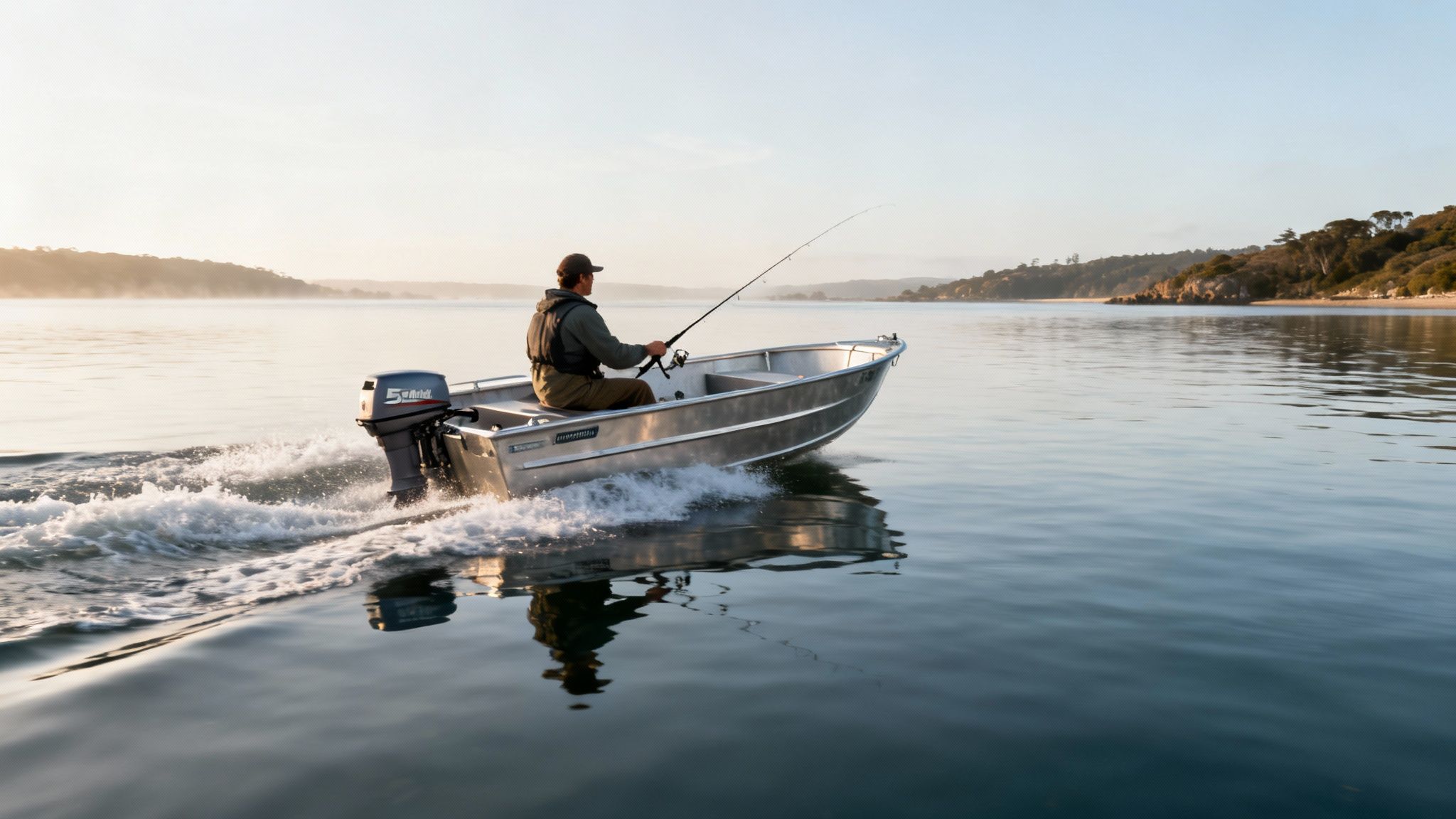
A 5hp motor isn’t about breaking speed records; it’s all about reliable, efficient power. For most small inflatable boats, tenders, or aluminium tinnies, you can expect a comfortable cruising speed of around 10-15 km/h. If you’re a solo angler in a lightweight canoe, you might even nudge 20 km/h on a glassy day.
Of course, your load is the game-changer. Add another person and a bit of fishing gear, and your speed will naturally drop. This motor has plenty of grunt to push a fully loaded small boat safely and efficiently, but knowing its limits is the key to a great day out.
Think of your boat moving in two ways. At low speeds, it’s in displacement mode, pushing water aside like a barge. This is super stable and fuel-efficient, perfect for trolling or a leisurely cruise up the creek.
Planing is when the boat lifts up and skims across the water’s surface, which takes a serious kick of power. While a 5hp can get a very light, flat-bottomed boat “on the plane” with just one person, that’s not really its main job. Most of your time will be spent enjoying those smooth, efficient displacement speeds.
“The magic of a 5hp outboard isn’t its top speed, but its incredible efficiency at cruising and trolling speeds. It delivers hours of enjoyment from a tiny amount of fuel, making it the perfect companion for relaxed exploration.”
This is where quality brands really show their worth. A great example is the Yamaha F5, which weighs just 27kg for the short shaft version, making it one of the lightest in its class. Its compact 139cc single-cylinder four-stroke engine delivers smooth power and sips fuel from its 1.1-litre tank, giving you hours of trolling without needing a top-up. It’s an ideal match for portable rigs like those in our Aerowave range.
One of the biggest wins with a modern 5hp four-stroke is its incredible fuel economy. That little 1.1-litre internal fuel tank might look small, but you’ll be amazed at how far it takes you.
This makes it perfect for exploring local estuaries, hitting your favourite fishing spots, or running gear from a larger boat to the shore. If you’re planning a bigger day out, most 5hp models also have a connection for an external fuel tank, giving you the freedom to seriously extend your range. It’s always useful to see how this compares to slightly bigger engines, and you can check out our guide on the 6 HP Yamaha outboard to get a better picture.
Modern four-stroke 5hp motors are a world away from the loud, smoky two-strokes of the past. They’re engineered to run quietly with minimal vibration, which makes a massive difference to your comfort on the water.
At idle or trolling speeds, the sound is often just a gentle purr. You can have a normal conversation without shouting and actually enjoy the peace and quiet. While the noise and vibration will pick up at full throttle, quality motors manage it well, keeping your journey pleasant from start to finish. This quiet operation is a huge plus for anglers who don’t want to spook the fish and for families who just want a relaxing day out.
A great motor is only half the story. To unlock its true potential, you need to pair it with the right boat. Getting this match right is everything—it affects performance, safety, and how much fun you’ll have out on the water. This is especially true for a versatile 5hp outboard, which really comes alive when it’s fitted to the perfect vessel.
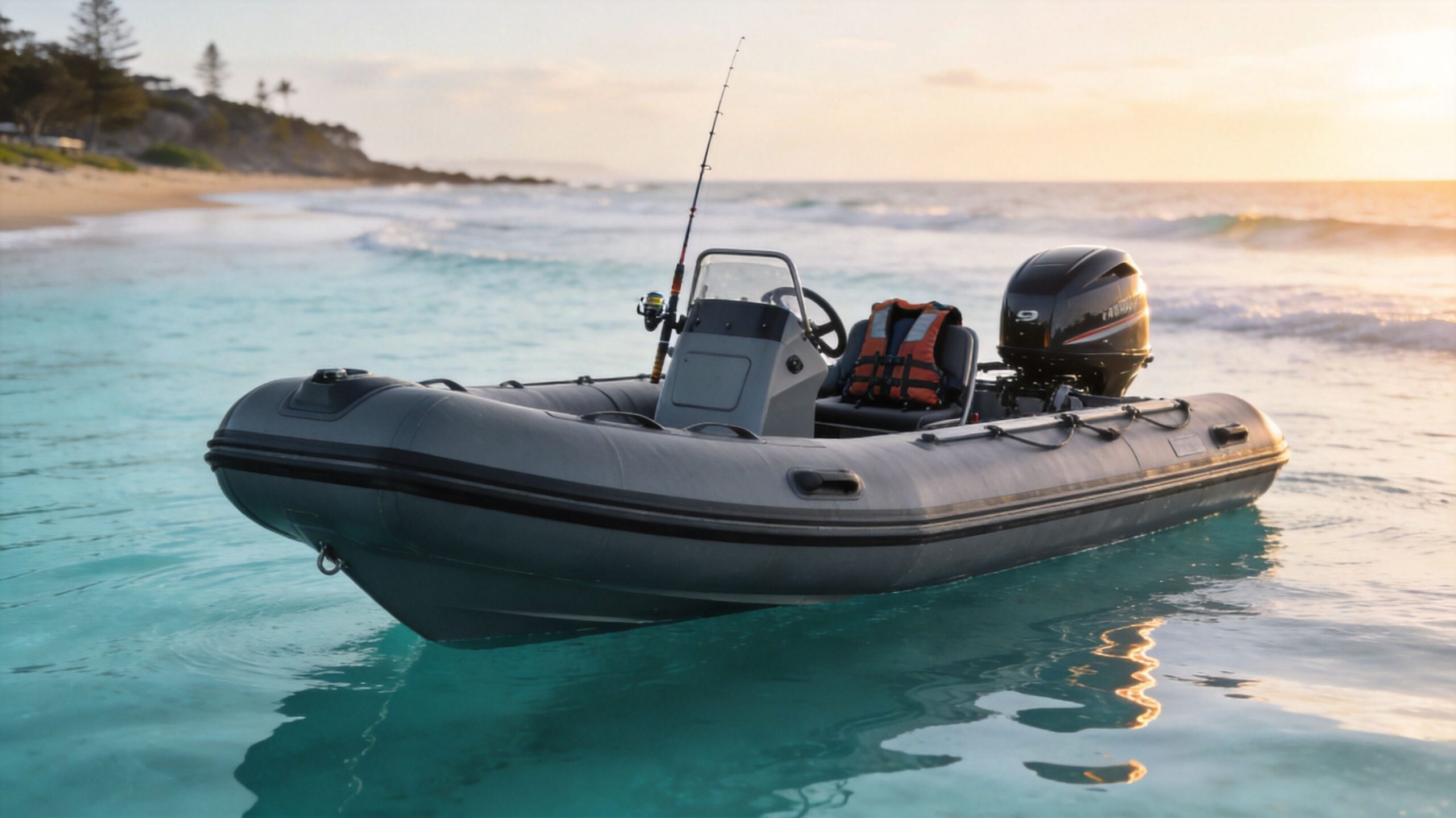
Inflatable boats are a natural partner for these lightweight powerhouses. Whether you’re looking at a rigid inflatable boat (RIB), an agile inflatable catamaran, or a super-portable air-deck model, the principles of a good match stay the same. Get this combination right, and you’ll get the most out of your setup every single time.
This all starts with a couple of key technical details that are much simpler than they sound. Once you get your head around these, you’ll be able to choose a boat with complete confidence, knowing it’s the ideal platform for your motor.
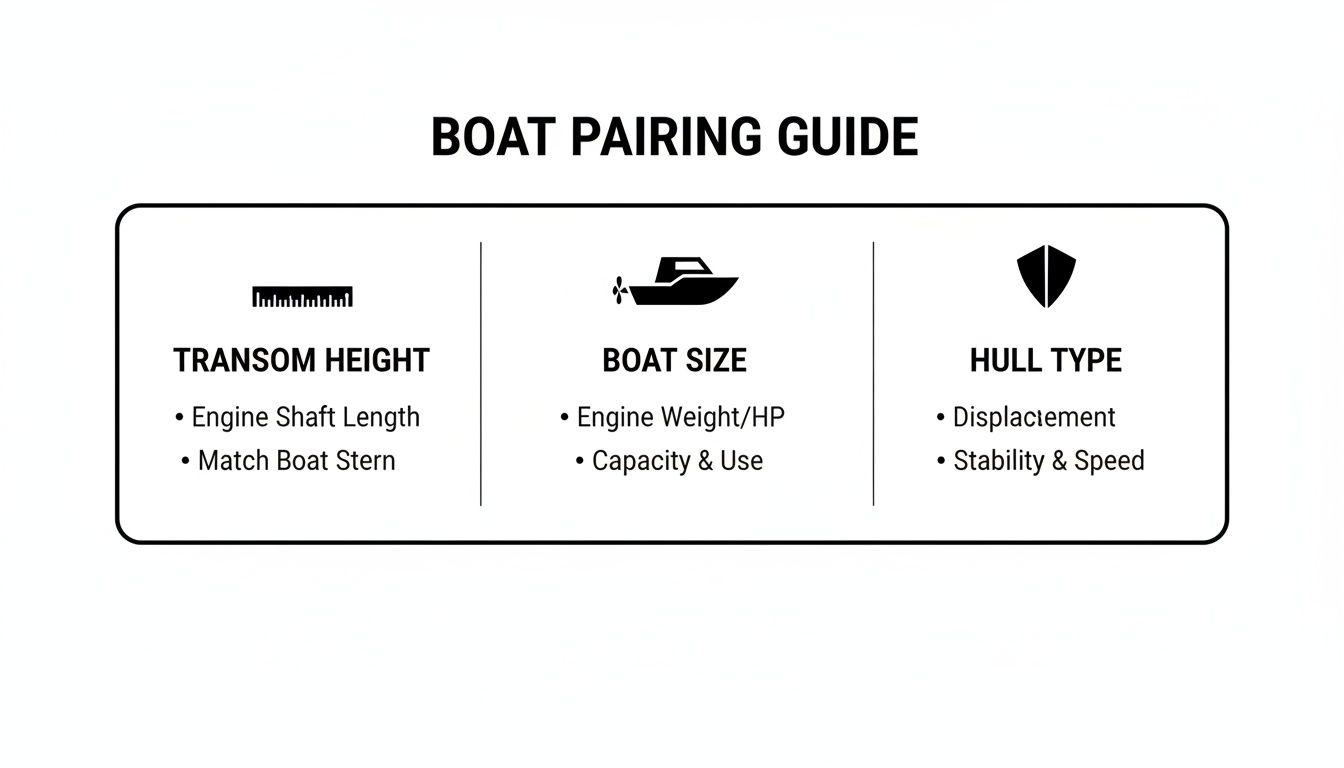
One of the most critical factors is transom height. The transom is that flat, reinforced panel at the back of your boat where the outboard clamps on. Its height determines whether you need a short shaft or a long shaft motor.
Mess this up, and you’ll seriously compromise performance—it can even be dangerous.
For almost every “boat-in-a-bag” inflatable on the market, including our entire Aerowave range, a short shaft 5hp outboard motor is the one and only choice. Always double-check your boat’s specs, but for portable boating, short shaft is king.
Your boat’s compliance plate or manufacturer’s manual will tell you the required shaft length and maximum horsepower rating. Never guess, and never go over the stated horsepower—it’s a non-negotiable safety rule designed to prevent the transom from being overpowered and to keep the boat stable.
A 5hp motor has a definite sweet spot when it comes to boat size. It’s got enough grunt for a range of vessels, but it works best with lighter, more portable options. This is where the synergy with inflatable boats becomes so obvious.
The ideal pairing is usually a boat between 2.5 metres and 3.8 metres in length. In this range, the motor gives you excellent control and efficient cruising speeds without being pushed to its limits. For example, a 5hp motor on a 3.2m inflatable catamaran creates a wonderfully stable and surprisingly quick platform for fishing or exploring. For a deeper dive, you can learn more about choosing the right engine for an inflatable boat in our comprehensive guide.
Combine a lightweight 5hp outboard with a modern inflatable boat, and you’ve got the ultimate portable adventure package. This ‘boat-in-a-bag’ setup is a total game-changer for anyone who doesn’t have the space or budget for a traditional trailer boat.
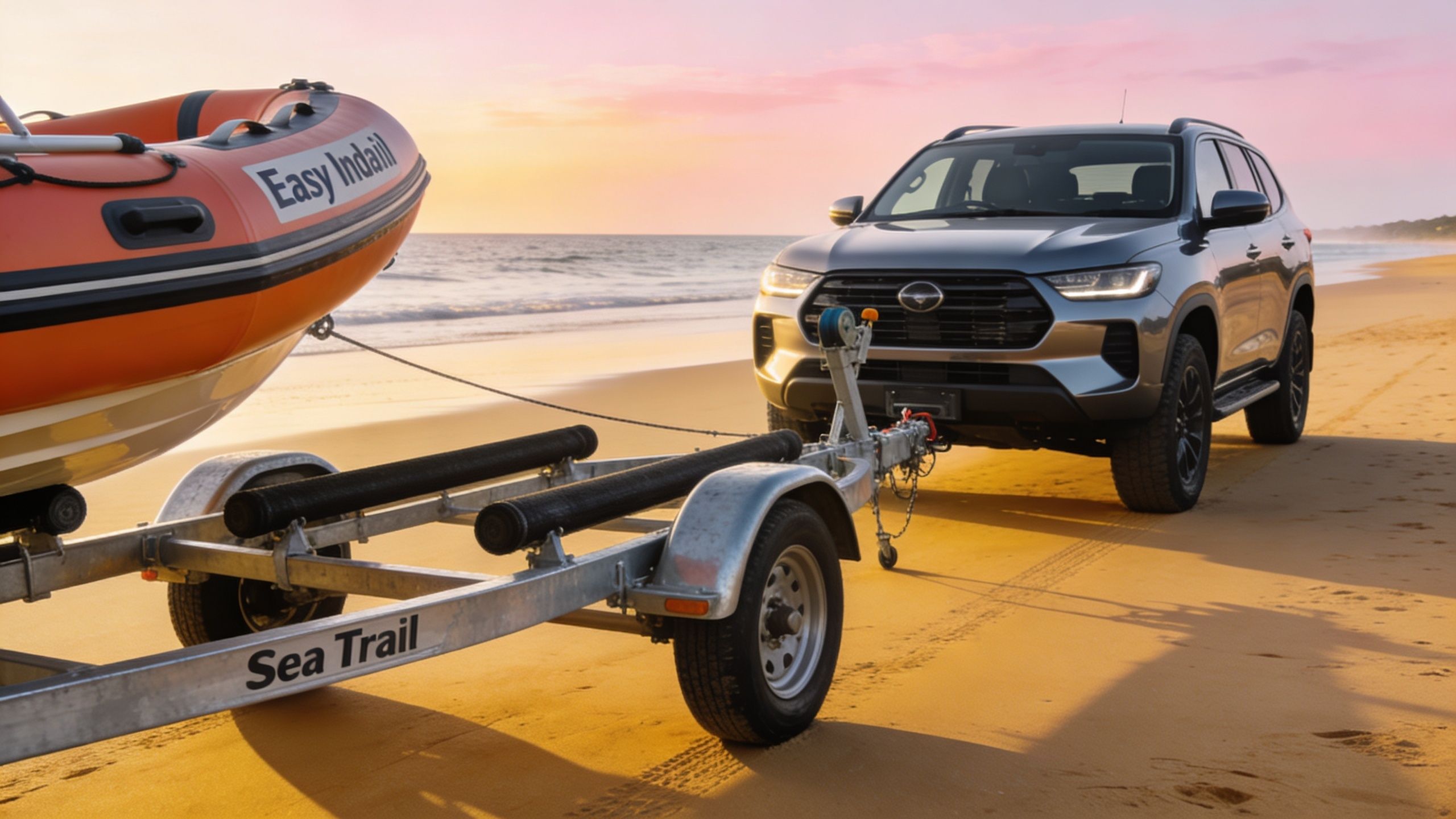
Imagine packing your entire boat and motor into the back of your SUV or caravan. This convenience opens up a world of possibilities for campers, RV owners, and even apartment dwellers who want to get on the water without the hassle of storage fees or boat ramps. It’s this freedom that makes the 5hp and inflatable combo so popular right across Australia.
Finally, the shape of your boat’s hull plays a massive role in how it behaves on the water.
When you’re comparing prices and features for a 5hp outboard motor, it’s easy to get lost in a sea of brands. But if you’re after real value, solid reliability, and modern features, the Hidea 5hp four-stroke consistently comes out on top for Aussie boaters. Let’s go head-to-head and see why it’s the smart choice for your recreational inflatable boat.
The Hidea philosophy is simple: deliver dependable, modern performance at a price that gets more people on the water. Instead of paying a premium for a legacy brand name, you get an engine packed with practical features, a tough build, and an easy-start system that just works. For a family outing, you won’t find better value.
At its core, the Hidea 5hp is built for Australian conditions. It features robust construction using high-grade marine aluminium alloys and multiple layers of paint for excellent corrosion resistance—a non-negotiable for anyone boating in saltwater.
It also comes packed with modern tech. The CDI (Capacitor Discharge Ignition) system is a perfect example. This solid-state ignition gives you a reliable spark for easy starting every time, and because it has no moving parts, it’s incredibly low-maintenance.
The user experience is another key difference. The tiller handle has a simple, ergonomic twist-grip throttle, and its lightweight design at around 25kg makes it genuinely portable. You can find all the specs on our detailed Hidea 5hp 4-Stroke product page.
The biggest advantage of the Hidea 5hp is its incredible value. It completely challenges the idea that you have to spend a fortune to get a reliable four-stroke motor. The price point is deliberately competitive, opening the door for families, anglers, and adventurers to get on the water without breaking the budget. If you’re looking for the best inflatable boats for recreational use available near you, pairing one with a Hidea is a winning combo.
But the value goes beyond the initial price tag:
By focusing on great engineering rather than just a brand name, Hidea delivers a motor that performs right alongside its more expensive competitors. It’s the savvy choice for boaters who want quality without the inflated price.
| Feature | Hidea 5HP Outboard | Typical Competitor (e.g., Yamaha, Mercury) |
|---|---|---|
| Price Point | Highly Competitive (Around $1,300 AUD) | Premium (Often $1,700 – $2,000+ AUD) |
| Engine Type | 139cc 4-Stroke Single Cylinder | Similar Displacement 4-Stroke |
| Weight (Short Shaft) | Approx. 25kg | Approx. 27kg |
| Ignition System | Standard CDI | Standard CDI |
| Warranty | Strong (Up to 3 Years) | Standard (2-3 Years) |
| After-Sales Support | Local Australian Network | Extensive Dealer Network |
| Value Proposition | Excellent price-to-performance ratio | Premium features for a premium price |
At the end of the day, choosing a Hidea 5hp is a smart, practical move. It proves you don’t need to overspend to get a reliable, feature-packed motor that will give you years of faithful service on the water.
Owning a 5hp outboard motor is your ticket to a whole world of on-water adventure, but knowing the rules is key to a safe and stress-free day. Australian boating regulations can feel a bit tangled because they change from state to state, but once you get the hang of it, it’s actually pretty straightforward. Get this right, and you can launch with confidence, knowing you’re good to go.
The two big things you need to have on your radar are boat registration and skipper licensing. Whether you need them often boils down to how much power your motor is putting out. A 5hp motor sits right on the edge of these rules in a few states, which makes it super important to know the law for your local waterway.
There’s no single, Australia-wide rule for registering a small boat. Each state and territory draws its own line in the sand based on engine power. That’s why your 5hp outboard might be good to go in one state but need full registration just across the border.
Here’s a quick rundown of the key states to keep you on the right side of the law:
These differences explain why certain portable motors are so popular in some areas. The demand for a 5hp outboard is sky-high in places like NSW and VIC where you can skip the rego paperwork. In contrast, QLD’s lower threshold at 3kW means even small motors need registration. This drives demand for reliable, efficient portables with specs like a 139cc displacement and a manageable dry weight of 27-28kg, making them easy to handle while still being compliant where needed.
Registration aside, carrying the right safety gear is non-negotiable anywhere in Australia. When you’re running a 5hp motor, you’re operating a powered vessel, and that means safety standards apply to you. If you’re keen to deepen your knowledge of the marine environment that shapes these rules, exploring further education in marine studies can be a great step.
While the exact list can differ slightly depending on the state and whether you’re in enclosed or open waters, the core items are always the same.
Having the right safety gear on board, all in date and in good condition, isn’t just about avoiding a fine. It’s about being ready for the unexpected and taking responsibility for yourself and anyone else on your boat.
Your essential safety kit should always have these items:
Before you head out, always double-check with your local maritime authority for the specific rules for your boat and the area you plan to explore. A few minutes of checking can ensure every trip you take is a safe one.
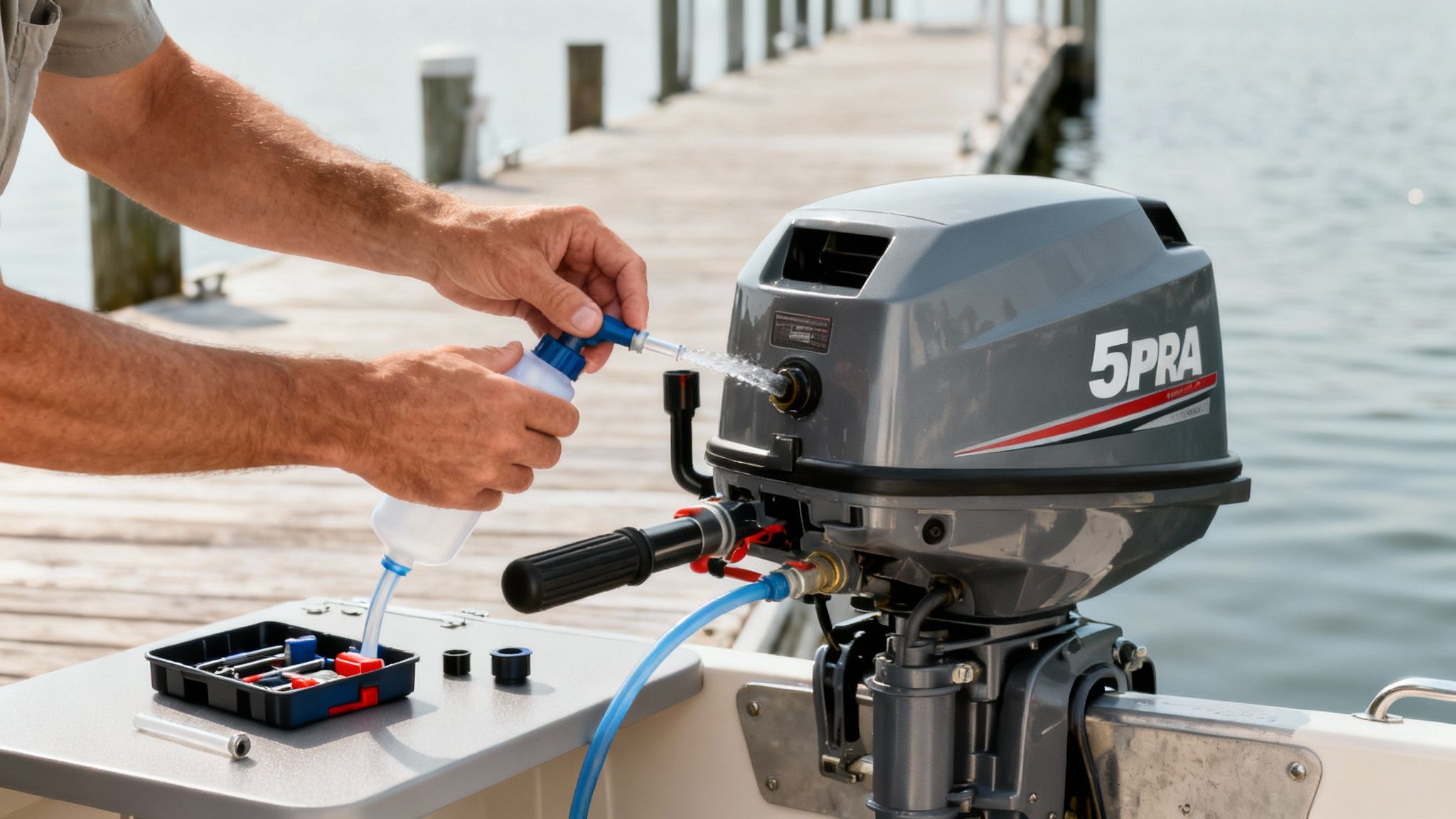
A little bit of care goes a very long way with a marine engine. Your 5hp outboard motor is a tough piece of kit, but some simple, regular maintenance is the secret to keeping it reliable for years and years. It’s all about preventative care to make sure it starts first pull, every time.
You wouldn’t drive your car for years without checking the oil, and your outboard is no different. Following a basic routine keeps it dependable, giving you total peace of mind when you’re out on the water. It’s a small investment of time that prevents small issues from turning into major headaches down the track.
This simple approach also highlights the value of having solid after-sales support for those moments when you might need a bit of expert advice.
You don’t need a mechanic’s workshop to keep your motor in top shape. Most of the critical jobs can be done at home with basic tools and a little know-how. This simple schedule covers the most important checks you should be doing through the boating season.
Before Every Trip (The Pre-Launch Check):
After Every Saltwater Trip:
“Flushing your outboard after every saltwater run is non-negotiable. It takes five minutes but can add years to the life of your motor by preventing destructive internal corrosion before it even starts.”
Even the best-kept motors can have a bad day. The good news is that most common problems with a 5hp outboard are surprisingly simple to diagnose and fix yourself. Here’s a quick guide to help you figure out what’s wrong and get back on the water fast.
| Symptom | Common Cause & Simple Solution |
|---|---|
| Motor Won’t Start | Stale Fuel: Drain the carburettor bowl and fill it with fresh petrol. Kill Switch Off: Make sure the safety lanyard clip is properly attached. Fouled Spark Plug: Pull it out and give it a clean, or just replace it. |
| Motor Runs Rough | Blocked Fuel Filter: This is a classic. The filter might just need a clean or a replacement. For a deeper dive, check out our guide on the outboard engine fuel line. |
| Water Not Coming Out | Blocked Water Intake: Look for weeds or mud blocking the intake screens on the lower unit. Worn Impeller: The water pump impeller might be worn out. It’s a good idea to replace this annually. |
Looking after your motor is a key part of boat ownership. The global aftermarket for outboards is strong, making up 62.86% of the market as boaters choose to re-power their vessels every 7-10 years for about 40% less than buying a whole new boat. This trend is perfect for the customisable setups from Easy Inflatables, especially in Australia where 70% of boaties prefer small craft. You can read more about these market trends and insights on Mordor Intelligence.
Let’s wrap things up by tackling some of the most common questions we get from boaters about the humble but mighty 5hp outboard. Think of this as the final checklist to make sure you’re heading to the checkout with total confidence.
We’ll cover everything from real-world speed and fuel burn to why getting the shaft length right is so important.
This is the big one, isn’t it? While a 5hp outboard isn’t going to set any speed records, you’ll be pleasantly surprised by the punch it packs. On a typical small inflatable or tender, you can expect a brisk cruising speed of 10 to 15 kilometres per hour.
Of course, your actual speed comes down to a few key factors: the boat’s total weight, its hull shape, and the conditions on the day. A solo angler in a lightweight inflatable might just nudge the higher end of that range, while a family loaded with gear will cruise happily and efficiently at the lower end.
Getting a boat “on plane”—where the hull lifts up and skims across the water’s surface—takes a serious amount of grunt. To be honest, a 5hp motor can sometimes get a very lightweight, flat-bottomed boat on plane with just one person and minimal gear. But that’s not really what it’s built for.
The true strength of a 5hp is providing reliable, efficient power at displacement speeds. It’s designed to push your boat through the water smoothly and quietly, without needing to scream at full revs. For a stable, predictable, and efficient ride, especially with a bit of a load, a 5hp is the perfect match.
Modern four-stroke 5hp outboards are incredibly stingy with fuel. The standard 1.1-litre internal fuel tank is usually enough for hours of fun on the water.
This amazing economy means you can head out for a full day of fishing or exploring without constantly checking the fuel gauge. It’s a huge plus in Australia’s boating scene, where the 70% of Aussie boaters with smaller fishing or family craft really value that fuel saving. You can dive deeper into these Australian outboard motor market insights on IndexBox.
Getting the shaft length wrong is one of the most critical mistakes you can make. It throws off your boat’s performance and can even be unsafe. An incorrect shaft length means the propeller sits at the wrong depth in the water, causing all sorts of problems.
If the shaft is too short, the propeller will be too close to the surface and suck in air. This is called “ventilating,” and it causes a sudden loss of thrust. If the shaft is too long, it digs too deep, creating massive drag that slows you down and puts a huge strain on both the motor and your boat’s transom.
For almost every inflatable boat on the market, a short shaft (15-inch) motor is the one you need. Always, always check your boat’s transom height and match the motor to it.
Ready to power your next adventure? At Easy Inflatables, we pair our high-quality Aerowave inflatable boats with the reliable Hidea 5hp outboard motor to create the perfect package. Explore our range and find the setup that’s right for you.