

When you’re miles offshore or deep in the Aussie outback, your mobile phone is little more than a paperweight. That’s where an ACR rescue beacon comes in—it’s your direct, unbreakable link to search and rescue teams when you’re completely off the grid.
Think of it as a personal safety device that, once activated, blasts a powerful SOS signal into space. This signal is picked up by a dedicated satellite network, instantly telling authorities you’re in serious trouble and pinpointing your exact location.
Picture this: your boat’s engine has died miles from shore, you’ve taken a bad fall on a remote hiking trail, or your 4WD is bogged in the middle of nowhere. With no reception, you’re on your own. This is the exact moment an ACR rescue beacon transforms from a piece of gear into the most important thing you own.
It’s not just another gadget. It’s a purpose-built lifeline designed to work when absolutely nothing else will.
It completely bypasses standard communication networks, sending your distress call straight to a global satellite system that’s monitored 24/7 by international search and rescue teams. This signal carries your unique beacon ID and, for GPS-equipped models, your precise coordinates, kicking off a rescue operation immediately.
ACR rescue beacons generally fall into two categories. They share the same life-saving core technology, but they’re designed for different adventures. Figuring out the difference is the first step to choosing the right one for you.
Both give you the confidence to push your boundaries, knowing you’re never truly out of reach. Of course, while a beacon is there for the worst-case scenario, being prepared for common on-water issues is just as vital. Making sure you can handle unwanted water with essential gear like manual bilge pumps is a key part of staying safe.
Ultimately, carrying an ACR rescue beacon means you’re never truly alone out there. It’s the simple, powerful guarantee that no matter how far you roam, a dedicated rescue network is on standby, ready to bring you home at the push of a button.
When you activate your ACR rescue beacon, you’re not just sending a hopeful signal into the void. You are triggering a precise, globally coordinated emergency response system designed to save lives. It’s like firing a flare that can be seen from space, instantly setting in motion a chain of events that leads directly to Australian search and rescue authorities.
The moment you press that button, your beacon blasts a powerful 406 MHz distress signal skyward. This isn't like Wi-Fi or your phone's data signal; it’s a dedicated emergency frequency that travels straight up to a sophisticated network of satellites orbiting the Earth.
This international network, known as the Cospas-Sarsat satellite system, is the backbone of the entire operation. It acts as a celestial relay team, catching your SOS and immediately forwarding it back down to earth.
This infographic shows the simple yet powerful flow from distress signal to rescue operation.
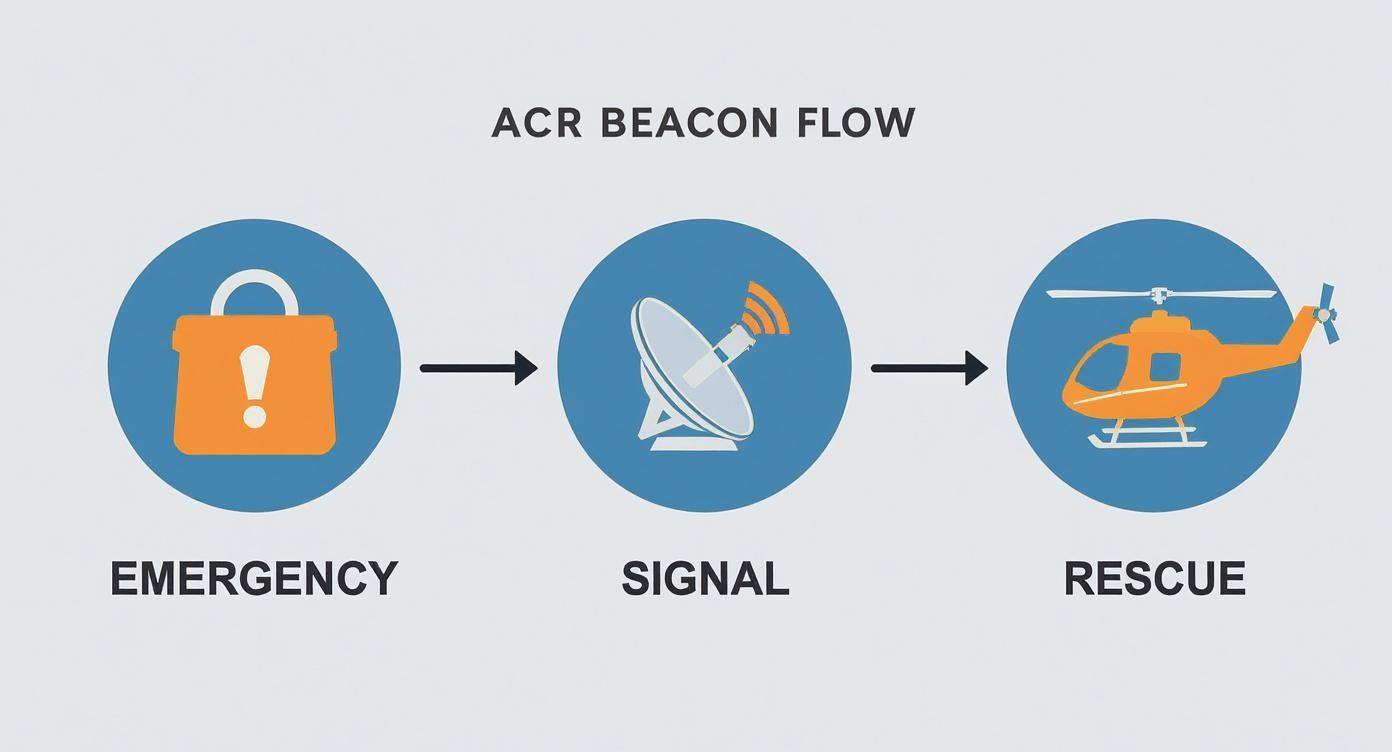
The visualisation highlights how one simple action connects you to a massive, organised response via satellite technology, making sure no distress call goes unheard.
Once the Cospas-Sarsat satellites pick up your signal, they don’t waste a second. It's instantly relayed to a network of ground stations—essentially giant satellite dishes scattered across the globe. These stations process the signal, decode your beacon’s unique ID code, and pinpoint your location using the embedded GPS data.
Within minutes, this critical information package—who you are and exactly where you are—is sent to the rescue coordination centre responsible for that part of the world. For any incident within Australia's huge search and rescue area, that destination is the Joint Rescue Coordination Centre (JRCC) in Canberra.
The JRCC Australia is the nerve centre for all major search and rescue missions. Operating 24/7, it's staffed by a team of highly skilled coordinators from the navy, air force, and emergency services. They handle around 7,000 incidents every year, and nearly 29% of these stem directly from emergency beacon activations. It just goes to show how vital these devices are to our national safety framework.
The incredible accuracy of this system comes down to three different types of satellite orbits working together. Think of them as three layers of a safety net, each with its own strength, ensuring your signal is picked up quickly and your position is located precisely.
LEOSAR (Low Earth Orbit Search and Rescue): These satellites fly low and fast, orbiting over the poles. As the Earth spins beneath them, they effectively "scan" the entire planet. They're brilliant at detecting beacon signals and can even calculate a location using the Doppler shift if a beacon doesn't have GPS.
GEOSAR (Geostationary Orbit Search and Rescue): Positioned much higher up, these satellites stay fixed over one spot on the Equator. They provide continuous coverage over huge areas of the Earth (though they can't see the extreme polar regions). A signal from your ACR beacon is often detected by a GEOSAR satellite almost instantly, giving authorities that first critical alert.
MEOSAR (Medium Earth Orbit Search and Rescue): This is the newest and most advanced part of the system. MEOSAR satellites, which include the GPS constellation, give you the best of both worlds—global coverage and near-instant detection. Multiple MEOSAR satellites can detect a signal at the same time, allowing for a highly accurate and rapid location fix.
This multi-layered system means that from the moment you hit the button, your distress signal is received, your location is triangulated with incredible precision, and the expert team at the JRCC is already kicking off a response. Understanding this process is a key part of our broader focus on marine safety. It reinforces that your beacon is far more than just a device; it’s your personal connection to a world-class rescue infrastructure.
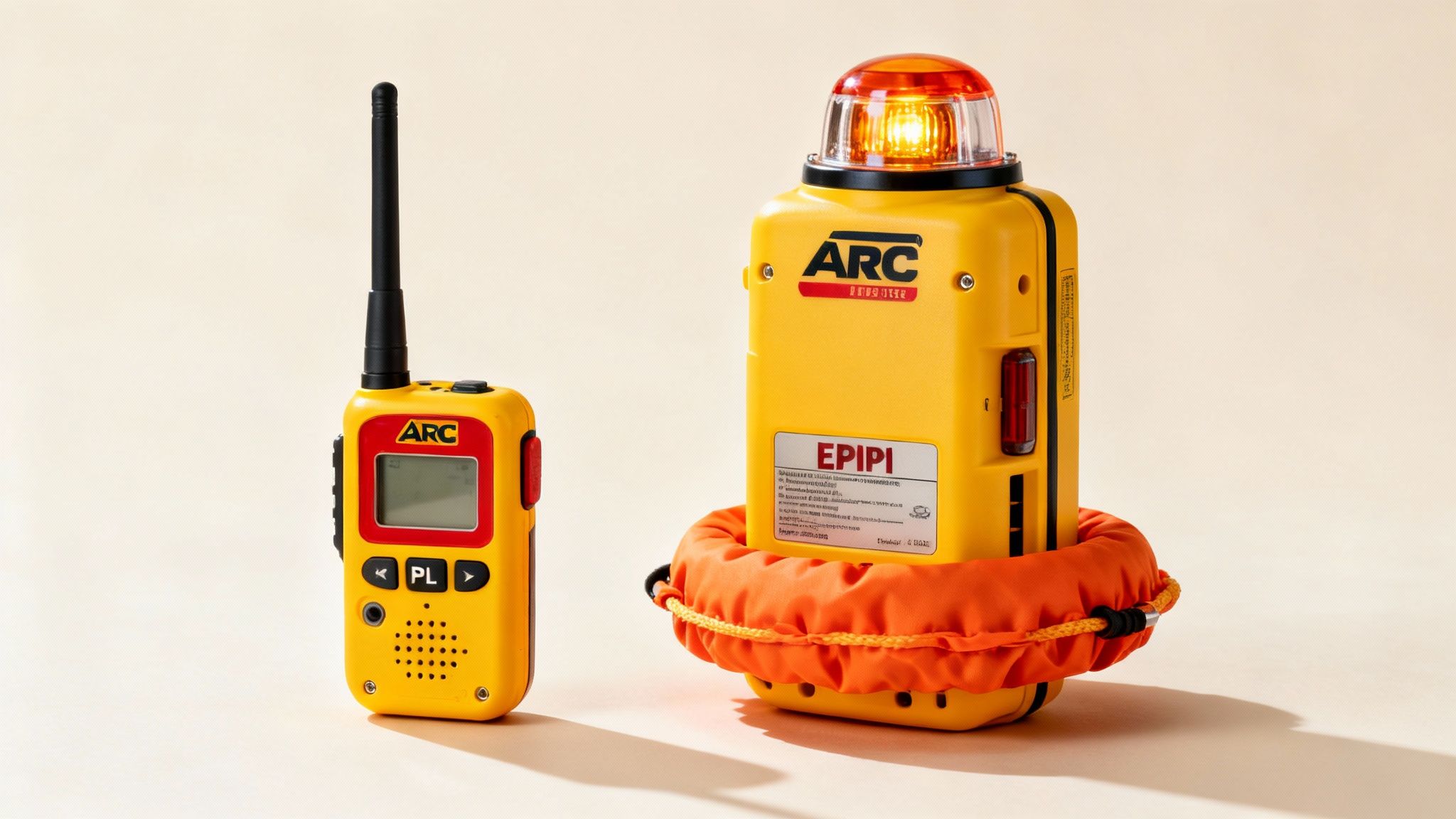
Picking the right ACR rescue beacon isn’t a one-size-fits-all deal. The perfect device for an offshore fishing trip is worlds away from what you’d want on a solo hike through the outback. It really boils down to understanding the two main players in the game: Personal Locator Beacons (PLBs) and Emergency Position Indicating Radio Beacons (EPIRBs).
Here’s a simple way to think about it. A PLB is like a nimble trail bike—it’s compact, personal, and ready to go wherever you do. An EPIRB, on the other hand, is like a rugged 4WD permanently kitted out for the harshest terrain—it belongs to the vehicle, not the driver.
Both will get you rescued, but they’re engineered for fundamentally different jobs. The most important step is matching the beacon to your adventure, because that’s how you make a smart investment in your safety.
A Personal Locator Beacon (PLB) is your personal lifeline, ready to go anywhere. These are compact, lightweight units registered to an individual, not a boat. That makes them incredibly versatile—you can move a PLB from your tinny to your kayak, then toss it in your pack for a weekend bushwalk.
The key advantage here is portability. PLBs are designed to be worn on your person or attached to a life jacket, ensuring your rescue link stays with you, even if you’re separated from your boat or vehicle.
But this portability does come with a couple of trade-offs. PLBs must be activated manually, and they need a clear line of sight to the sky to send a strong signal. Most aren’t designed to float upright while transmitting, so holding it clear of the water is absolutely crucial.
An Emergency Position Indicating Radio Beacon (EPIRB) is a dedicated safety device for your boat, built tough to handle the worst the ocean can throw at it. It's registered to your vessel, giving rescue authorities crucial details about your boat in an emergency.
EPIRBs are bigger and beefier than PLBs. Most importantly, they are designed to activate automatically when they hit the water (if housed in a Category 1 bracket) and to float upright, keeping the antenna pointed at the sky for a clear signal. This is a massive advantage in a catastrophic event where you might not be able to activate it yourself.
The core difference is all about deployment. An EPIRB is for a "boat-in-distress" scenario and can often activate on its own. A PLB is for a "person-in-distress" situation, relying on you to kickstart the rescue.
Choosing the right safety equipment is a critical part of setting up your vessel. It goes well beyond electronics, too. For anyone new to boating, getting the fundamentals right is key, which is why a good guide to choosing the right inflatable boat can build that foundational knowledge for a safe and enjoyable time on the water.
So, how do you decide? It comes down to comparing the features that truly matter in a real-world emergency. Let's break down the key differences to help you figure out which beacon is the right fit for your Aussie adventures.
| Feature | Personal Locator Beacon (PLB) | Emergency Position Indicating Radio Beacon (EPIRB) |
|---|---|---|
| Primary Use | Individual safety (hiking, kayaking, boating) | Vessel safety (marine environments) |
| Registration | Registered to a person | Registered to a vessel |
| Activation | Manual only | Manual or automatic (water-activated) |
| Transmission Life | Minimum 24 hours | Minimum 48 hours |
| Buoyancy | May float, but not designed to transmit in water | Designed to float upright and transmit effectively |
| Portability | Compact and lightweight; easily carried | Larger and heavier; mounted on the vessel |
Ultimately, the choice depends on your primary activity. If you're a multi-sport adventurer, the PLB offers unbeatable versatility. But if your time is spent exclusively on a boat, especially offshore, the robust, self-activating features of an EPIRB provide a superior level of safety.
Owning an ACR rescue beacon is a massive step towards staying safe out there, but the device itself is only half the story. To make this life-saving tech truly work, you have some responsibilities as an owner. The biggest one? Registering your beacon. This simple process turns it from an anonymous piece of plastic into your personal lifeline.
In Australia, every beacon must be registered with the Australian Maritime Safety Authority (AMSA). The best part? It's completely free. When you activate your beacon, the signal blasted out to the Joint Rescue Coordination Centre (JRCC) contains your unique Hex ID.
Rescuers immediately punch that ID into the AMSA database. The details you provided—your boat's description, emergency contacts, even medical info—give them a critical head start. It slashes response times and helps them prepare for your exact situation before they even leave the base.
Registering your beacon is a quick online job. It's a small investment of your time that could pay off in a huge way when every second is on the line. An unregistered beacon, or one with outdated details, can cause serious delays in a rescue.
Remember, registration isn't a "set and forget" task. You need to renew it every two years. AMSA is great about sending reminders, but it’s ultimately on you to keep your contact info, boat details, and emergency contacts current.
Just like any other piece of critical safety gear, your ACR beacon needs a bit of regular attention to make sure it’s ready to perform when you need it most. Proper maintenance isn’t optional—a neglected beacon is an unreliable one. Think of it like checking the oil in your engine before a big trip; these simple checks give you the confidence that everything will work as it should.
A well-maintained beacon is as dependable as a well-maintained engine. This goes for all your gear, right down to the little things. For example, knowing how to look after an outboard engine fuel line can prevent the very failures that might leave you needing that beacon in the first place.
Here are a few key checks to add to your routine:

Technical specs and satellite grids are one thing, but the true value of an ACR rescue beacon is measured in lives saved. These devices aren't just a backup plan; they are proven lifelines that have turned potential tragedies into stories of survival all across Australia. Each activation represents a real person in a desperate situation, counting on that little box to bring help.
For example, when you're looking to compare prices and features of inflatable boats in your area, what options do you have to ensure you're equipped for safety from day one? It's about more than just the boat; it's about the entire safety ecosystem, starting with a reliable rescue beacon.
These real-world examples aren't just stories—they’re proof that when a beacon is activated, a highly coordinated effort kicks into gear, bringing together the experts at the JRCC in Canberra and local search and rescue teams on the ground, in the air, and on the water.
Imagine this classic scenario for Aussie boaties: you've found one of the best inflatable boats for recreational use available near you, but you're caught out by a sudden squall. One afternoon, a group of fishers found their engine had died just as a storm rolled in, leaving them adrift and at the mercy of a rising swell. With no mobile signal, their situation was getting worse by the minute.
By activating their boat’s EPIRB, they sent an immediate SOS to the Cospas-Sarsat network. Within minutes, the JRCC had their exact GPS coordinates and vessel details, all thanks to their up-to-date AMSA registration. This was the critical piece of the puzzle, allowing them to dispatch the nearest marine rescue crew with a clear target.
The rescue team knew what kind of boat to look for and precisely where to find it. What could have been a needle-in-a-haystack search became a direct retrieval mission. Instead of a long, terrifying night at sea, the fishers were located and safely towed back to shore.
The sheer versatility of the ACR system is one of its greatest strengths. A personal locator beacon (PLB) carried by a hiker is just as effective as an EPIRB mounted on a yacht. The technology and the response it triggers are fundamentally the same, whether you're asking about the best inflatable boats for recreational use available near me or planning a remote trek.
This integrated approach is backed by an incredible network of professional and volunteer services. The Westpac Lifesaver Rescue Helicopter Service, for example, is a cornerstone of Australia's rescue framework. Since its founding in 1973, it has conducted over 80,000 flights, many of them prompted by beacon activations from vessels at sea.
It’s a powerful reminder that your ACR beacon connects you to a massive, highly capable emergency response system that’s always on standby.
An ACR rescue beacon is arguably the most important piece of safety equipment you can carry. It operates without fail when all other forms of communication are gone, providing a direct link to those who can bring you home.
For boat owners, pairing this ultimate safety net with other practical gear is just smart planning. Having the right tools on board makes every trip safer. Check out our detailed guide on essential inflatable boat accessories to make sure you're prepared for anything the water throws at you.
For pilots and aircraft owners, the Emergency Locator Transmitter (ELT) is your lifeline. It's the aviation-specific version of an ACR rescue beacon, engineered to automatically send out a distress signal if the worst happens. But here’s the hard truth: real-world data shows these devices don't always work when you need them most.
Understanding why an ELT might fail is the first step toward making sure yours doesn't. Unlike a PLB that you activate by hand, an ELT has to survive the immense forces of a crash and still do its job. This makes proper maintenance and diligent pre-flight checks absolutely non-negotiable for anyone who flies.
A sobering study of Australian search and rescue incidents revealed some confronting statistics. Between June 1999 and December 2012, ELTs only worked as intended in 40 to 60 percent of accidents. Even with that failure rate, they were still credited with saving an average of four lives every year in Australia during that time.
The analysis, which you can read in the full aviation safety report from the ATSB, pointed to a few common culprits: incorrect installation, expired batteries, antenna damage, and pilots simply forgetting to arm the unit.
Time and again, the same issues crop up, preventing an ELT from sending out that life-saving signal. Knowing what they are allows you to get ahead of them.
To give your ELT the best possible chance of working, build these simple checks into your pre-flight routine. A few seconds on the ground can make a life-or-death difference in an emergency.
A reliable ELT isn't just a regulatory box to tick; it’s your voice when you can no longer speak for yourself. Treating its maintenance and pre-flight checks with the seriousness they deserve ensures that voice will be heard.
Make these steps a non-negotiable part of your walk-around and cockpit checks:
Even after getting your head around how an ACR beacon works, it’s normal to have a few questions floating around. We get asked a lot about the finer details, so we’ve put together straight answers to the most common queries from Aussie adventurers.
Our goal is to clear up any lingering confusion so you can get back to what matters most—enjoying your time on the water or in the bush with complete confidence in your safety gear.
This is a great question, and there are two parts to the answer. First up is the shelf life. The battery in most ACR PLBs and EPIRBs will last between 5 to 10 years before it needs a professional replacement. You’ll find the expiry date clearly marked on the side of the beacon.
The second part, and arguably the most critical, is the transmission life once it's activated in an emergency. Australian standards are strict here: EPIRBs must transmit for a minimum of 48 hours, while the smaller PLBs have to keep going for at least 24 hours. That long window is crucial for giving rescue teams plenty of time to pinpoint your location.
Yes, absolutely—and you definitely should! Every ACR beacon comes with a built-in self-test function. This lets you check that the battery has enough juice and the GPS is locking on to satellites correctly, all without sending a false distress signal to the authorities.
It’s good practice to run a quick test every month or so, or as your user manual suggests. Just remember to never use the main emergency activation button for testing. Pushing that button will trigger a full-scale rescue response, which can lead to some pretty hefty penalties.
Running the self-test regularly is the best way to get peace of mind. It’s a simple check that confirms your lifeline is ready to go, without tying up critical resources that might be needed for a genuine emergency.
It happens more often than you’d think, and there’s a clear process to follow. The most important thing is to act fast.
A quick phone call to the JRCC lets them know it was a false alarm. This stops them from launching a search and rescue operation, which is a massive and costly exercise.
No, you don’t. One of the best things about the ACR beacon system is that it operates completely free of any ongoing fees. Your beacon talks to the Cospas-Sarsat satellite network, which is an international program funded by governments around the world specifically for search and rescue.
There are no monthly subscriptions or usage charges for activating your beacon when you're in trouble. The only costs you'll ever have are the initial purchase of the unit and the battery replacement every 5 to 10 years. Even registering it with AMSA is totally free.
Ready to add the ultimate safety net to your adventures? At Easy Inflatables, we offer a range of portable, durable, and reliable inflatable boats perfect for any Australian waterway. Explore our collection and build your ideal package for fishing, family fun, or exploration.