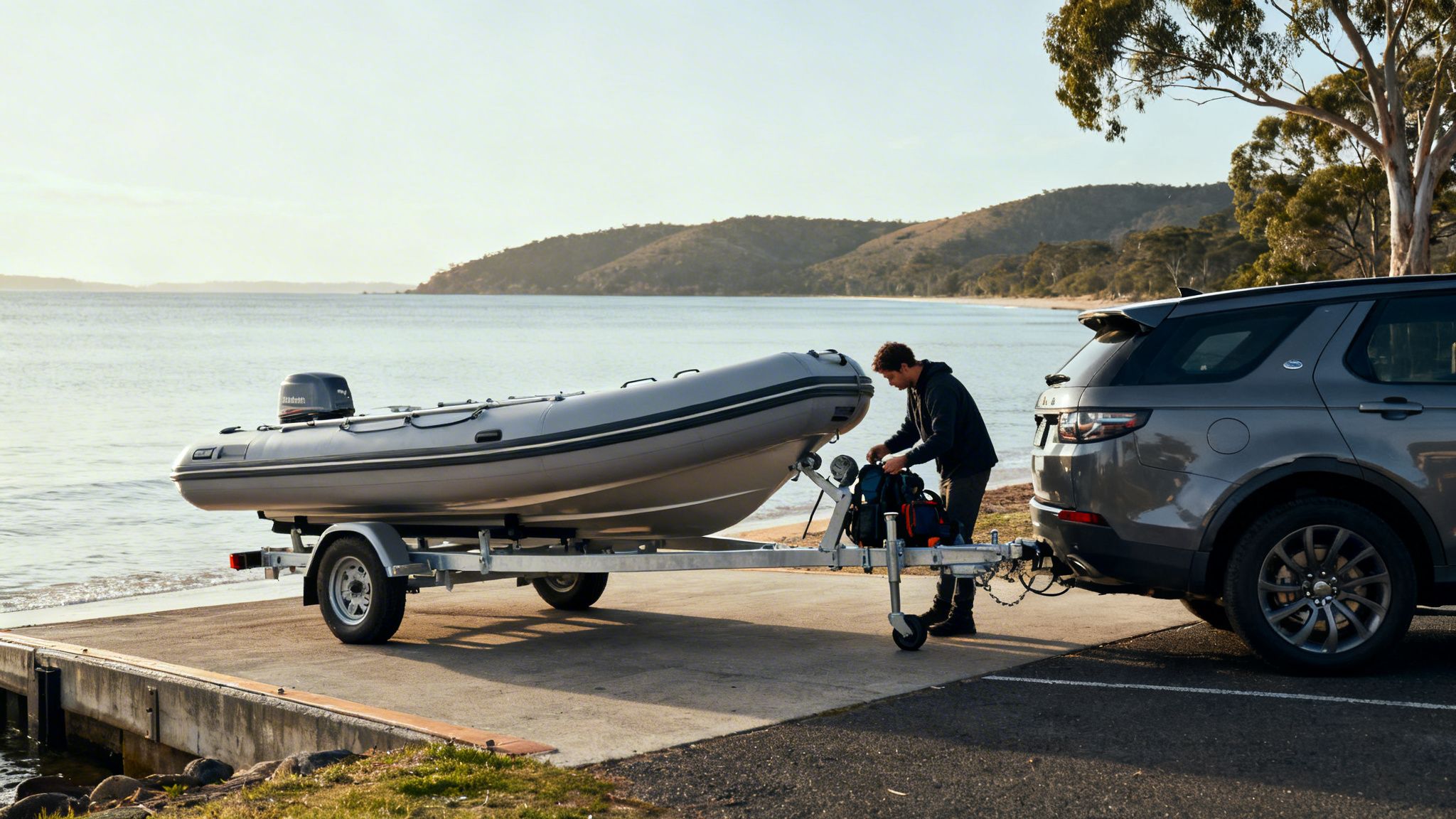

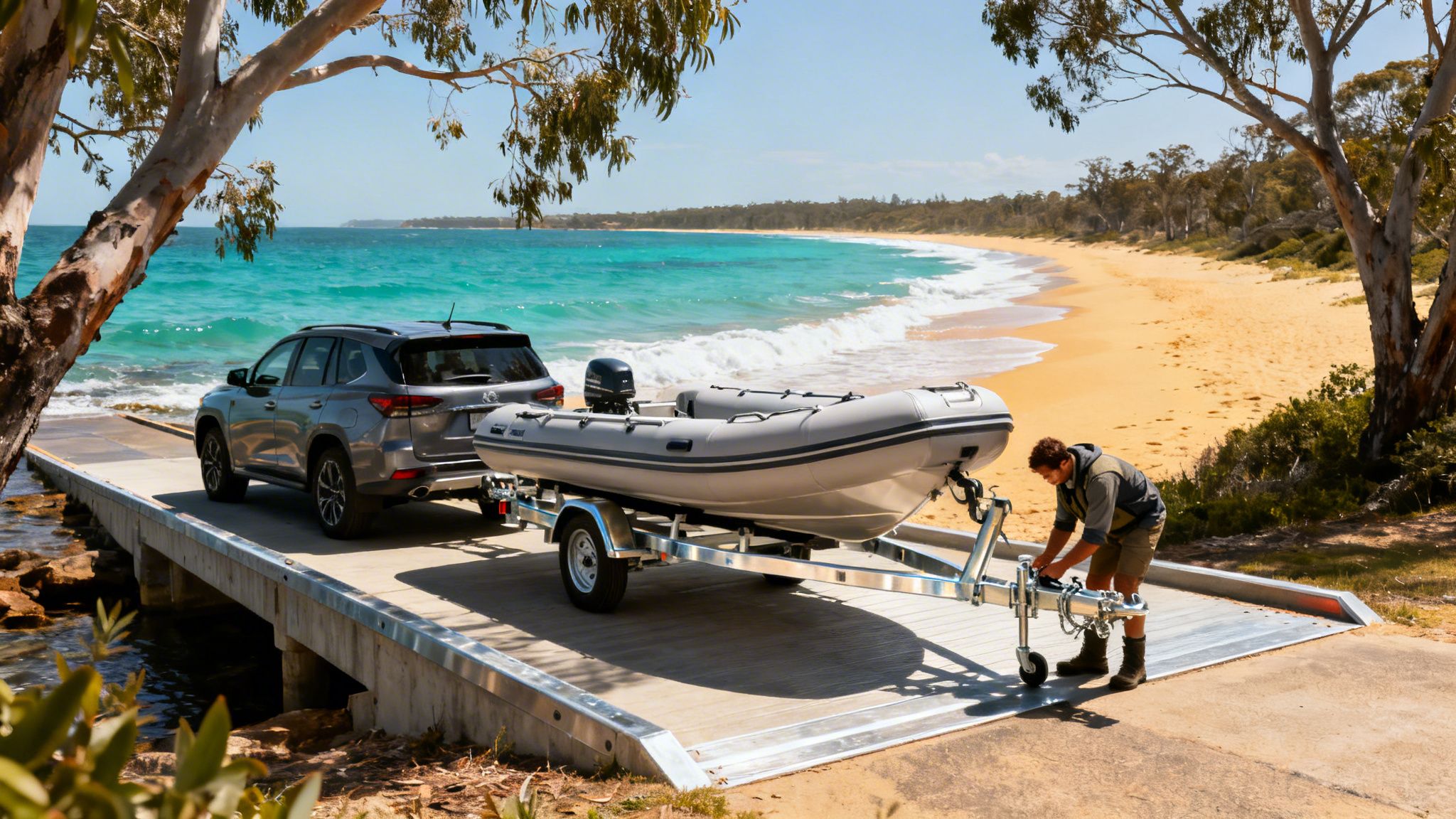
Picture this: you’re hooked up and ready to go, swapping the daily grind for the freedom of Australia’s stunning coastlines and inland waterways. Getting there is half the adventure, and it all starts with the right boat and trailer package. This guide is here to cut through the noise, giving you practical, real-world advice to get you on the water faster and with less stress.
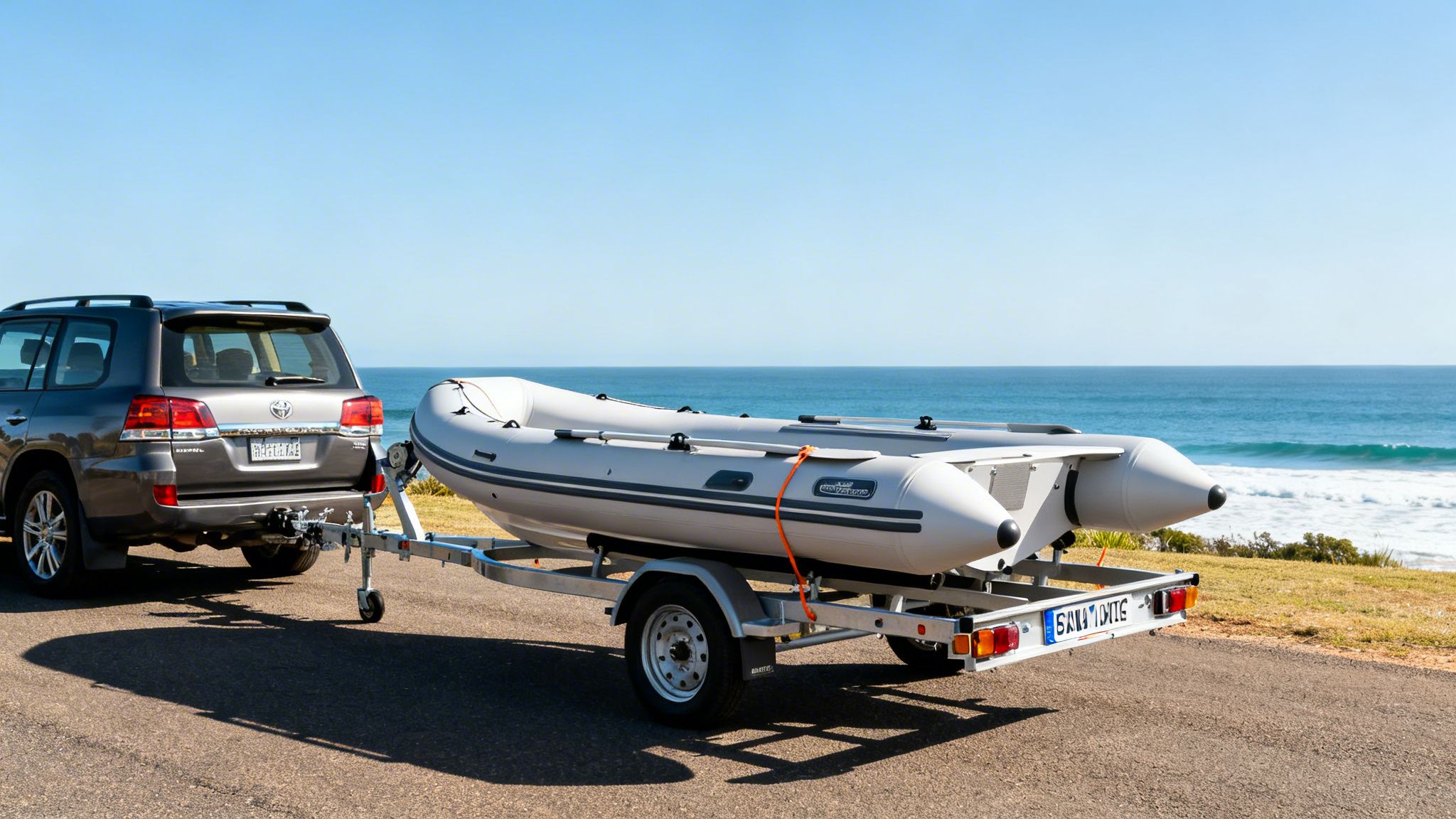
Hitting the road with your boat in tow is a classic Aussie ritual. It’s no surprise that with over 900,000 registered recreational boats in the country, the trailer market is humming right along. The reality is, a whopping 70% of Australian boats are trailered to their launch spots every year.
Most of these are sitting on single-axle bunk trailers, which dominate over 52% of the market—and for good reason. They are the perfect match for the lightweight, versatile vessels that Aussies love. This guide will walk you through everything you need to know, so you spend more time on the water and less time wrestling with gear at the ramp.
The first step is finding a boat and trailer that actually works for you. For many people, especially families or those tight on space, a lightweight setup like an inflatable catamaran is a game-changer. They’re a breeze to handle and their portability is perfect for those spontaneous weekend getaways.
The real advantage of a well-matched boat and trailer package is simplicity. It eliminates the guesswork, giving you a setup that’s balanced, safe, and ready for adventure from day one.
Choosing a pre-configured package saves you a mountain of time and potential headaches. It’s the difference between a smooth launch and a frustrating morning. A rig designed to work together seamlessly just makes sense.
To help you visualise what you might need, we’ve put together a quick guide matching our popular inflatable boats with the right kind of trailer.
| Inflatable Boat Type | Boat Length | Approx. Rig Weight (Boat + Motor) | Recommended Trailer Type | Key Trailer Feature |
|---|---|---|---|---|
| Easy Inflatables 270 | 2.7m | 70kg – 90kg | Small, single-axle unbraked | Keel rollers and side bunks |
| Aerowave Viper 330 | 3.3m | 100kg – 130kg | Single-axle unbraked | Adjustable winch post, wobble rollers |
| Aerowave Catamaran 380 | 3.8m | 150kg – 190kg | Single-axle unbraked/braked | Twin-hull support bunks |
| Viper 420 Heavy Duty | 4.2m | 200kg – 250kg | Single-axle braked | Galvanised frame for durability |
This table is a great starting point, but remember to always confirm the specific weight of your boat, motor, and gear before finalising your trailer choice.
Here’s why a matched package is so important:
By focusing on a complete solution from the start, you set yourself up for success. If you’re ready to see what’s out there, have a look at our full range of inflatable boat packages designed specifically for Australian conditions.
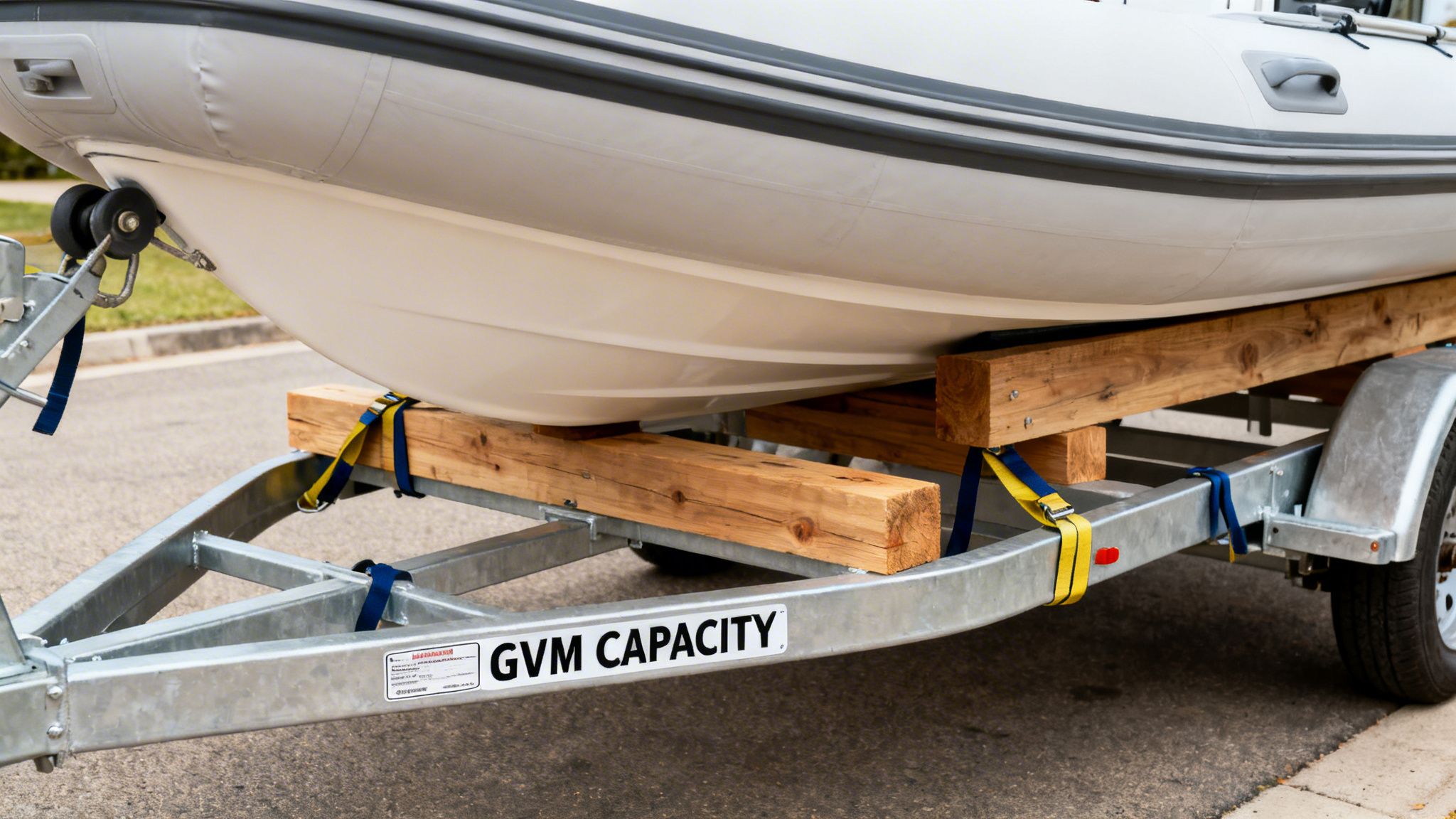
Getting the right trailer for your inflatable boat is about more than just getting from your driveway to the boat ramp. It’s the foundation for keeping your boat in top nick for years to come. The wrong trailer can put stress on the seams and hull, causing damage over time, while the right one provides perfect support, making transport a total breeze.
Think of your trailer as a custom-fit cradle for your boat. This is especially true for our inflatables, and even more so for an inflatable catamaran. Unlike a fibreglass hull that holds its own shape, an inflatable relies on the trailer to support its tubes and floor properly, preventing sagging and unnecessary wear and tear on the road.
You’ll generally come across two main types: bunk trailers and roller trailers. While rollers might seem handy for sliding a heavy tinny into the water, those individual pressure points are bad news for an inflatable’s flexible material.
Bunk trailers are almost always the superior choice for inflatable boats. The long, carpeted boards spread the boat’s weight evenly along the pontoons, giving you that continuous support that protects the hull and seams from strain.
For an inflatable catamaran, this is a must. You need a trailer with two perfectly spaced bunks that cradle each hull individually. This keeps the unique tunnel hull from twisting or flexing on those bumpy back roads to your secret fishing spot.
When you’re looking at different trailer options, don’t just trust the sales pitch. A few key specs will tell you everything you need to know. Getting your head around these will make you a much smarter buyer.
Let’s run through a quick example. Say you’ve got a 4.2m inflatable catamaran for the family. You’d add up the boat (100kg), your motor (60kg), a full tank of fuel (25kg), and another 40kg for safety gear, esky, and fishing tackle. That puts your total weight at 225kg. To be safe, you’d want a trailer with a GVM of at least 300kg to give yourself a nice buffer.
Here in Australia, our love for the water has created a huge demand for boat trailers. We’ve got one of the highest rates of boat ownership in the world, with around 18 boats per 1,000 people. It’s no surprise that bunk trailers have a massive 55% of the market share, as they’re the perfect match for the mid-sized tenders and fishing boats we specialise in at Easy Inflatables. With 65% of Aussie recreational boats being under 6 metres long, the most popular trailer load category (40% of the market) is for 1,500-3,000 kg, which fits right in our wheelhouse.
As you gear up, it’s also worth thinking about how you’ll protect your personal items from the inevitable splash. A lot of boaties find guides on the best waterproof phone case for kayaking really helpful for keeping their devices safe and dry.
At the end of the day, knowing these details lets you look at any boat and trailer package with confidence. And if you’re after the ultimate in portability, you might want to check out our guide on choosing a folding boat trailer—they offer incredible convenience without skimping on proper support.
Nothing ruins a great day on the water faster than seeing flashing lights in your rearview mirror. Getting your head around the legal side of towing your boat isn’t just about avoiding a fine—it’s about keeping yourself and everyone else on the road safe. The rules might seem a bit daunting at first, but they’re actually pretty straightforward once you know what to look for.
While each Australian state has its own little quirks, the main principles are the same everywhere. For most inflatable boat owners, your rig will fall into the simplest category. Still, it’s crucial to know exactly where you stand before you hitch up and head off.
You’ll hear two main acronyms thrown around when talking trailers: ATM and GTM. Understanding them is the key to towing legally and safely.
For a typical inflatable boat and trailer combo, the ATM is the number you really need to focus on. It’s the total weight you’re pulling, and it determines which rules apply. My advice? Always overestimate your gear weight a bit to give yourself a safe buffer.
Vehicle standards are mostly a federal thing, but registration and road rules are handled by the states. Here’s a quick rundown of what you need to know for NSW, QLD, and VIC when you’re towing a light trailer—the kind you’ll be using for an Easy Inflatables boat.
Registration and Brakes
Essential Safety Gear
No matter how much your trailer weighs, it needs a few key safety features to be road-legal anywhere in Australia.
Let’s put it into practice. Imagine you’ve got your SUV and you’re towing a new 3.8m inflatable catamaran. The boat, motor, and your fishing gear come to about 200kg, and the trailer itself is 130kg. That gives you a total ATM of 330kg.
This puts you well under the 750kg limit, so no brakes are required. Before hitting the road, you just need to do a quick two-minute check: is the trailer registered? Is the safety chain hooked up correctly? Do all the lights work? A simple walk-around like this guarantees a safe, fine-free trip to the boat ramp.
Getting your inflatable from the driveway to the water should be the easy part of the day. But let’s be honest, a few fumbles at the ramp or on the road can sour a trip before it even starts. This isn’t just a list of steps; it’s a pre-launch routine I’ve refined over years of boating to make sure every trip starts smoothly.
In Australia, we love our trailer boats. Around 75% of the nation’s 1.1 million recreational boats are trailered, and on average, each one gets towed about 28 times a year. That’s a lot of practice, but it’s easy to get complacent. When you hear about things like a 11% rate of axle failures in some safety reports, you realise those few minutes of pre-trip checks are non-negotiable.
Take five minutes in the driveway to run through this routine. It can save you from a world of pain on the road, trust me.
Lock in the Coupling: Lower the trailer coupling all the way onto the tow ball. Latch it, then—and this is the part people forget—insert the safety pin. Give the drawbar a solid upward pull to make sure it’s properly locked on. You don’t want to see your boat overtaking you on the highway.
Cross Your Chains: Attach the safety chains to your vehicle, making sure to cross them over in an ‘X’ shape under the coupling. If the worst happens and the coupling fails, this ‘X’ forms a cradle to catch the drawbar, stopping it from digging into the road and causing a major accident.
Do a Light Check: Plug in your trailer’s electrical connector. Get someone to stand behind the trailer while you test the brake lights, tail lights, and both indicators. It’s a legal requirement, and it’s the only way other drivers know what you’re doing.
Getting this simple sequence down to a habit is the foundation of safe towing. It ensures your rig is physically connected and legally visible before you even hit the street.
Towing isn’t just driving with a bit of extra weight. Everything changes—how you accelerate, how you brake, and especially how you turn. The whole rig is longer and heavier, and it demands a bit more respect and forward-thinking.
Your new mantra is smooth and steady. Sudden braking or sharp turns are your enemy; they can easily cause the trailer to sway or, in the worst case, jackknife. Always leave more room than you think you need.
I always tell new boat owners the same thing: drive as if you have a full cup of coffee on the dashboard and you don’t want to spill a drop. Gentle acceleration, smooth braking, and wide turns are your best friends when towing.
Shifting your mindset to be this deliberate will keep your boat stable and your journey stress-free.
This flowchart breaks down the key Australian towing rules, covering everything from weight limits to the safety gear you’re required to carry.
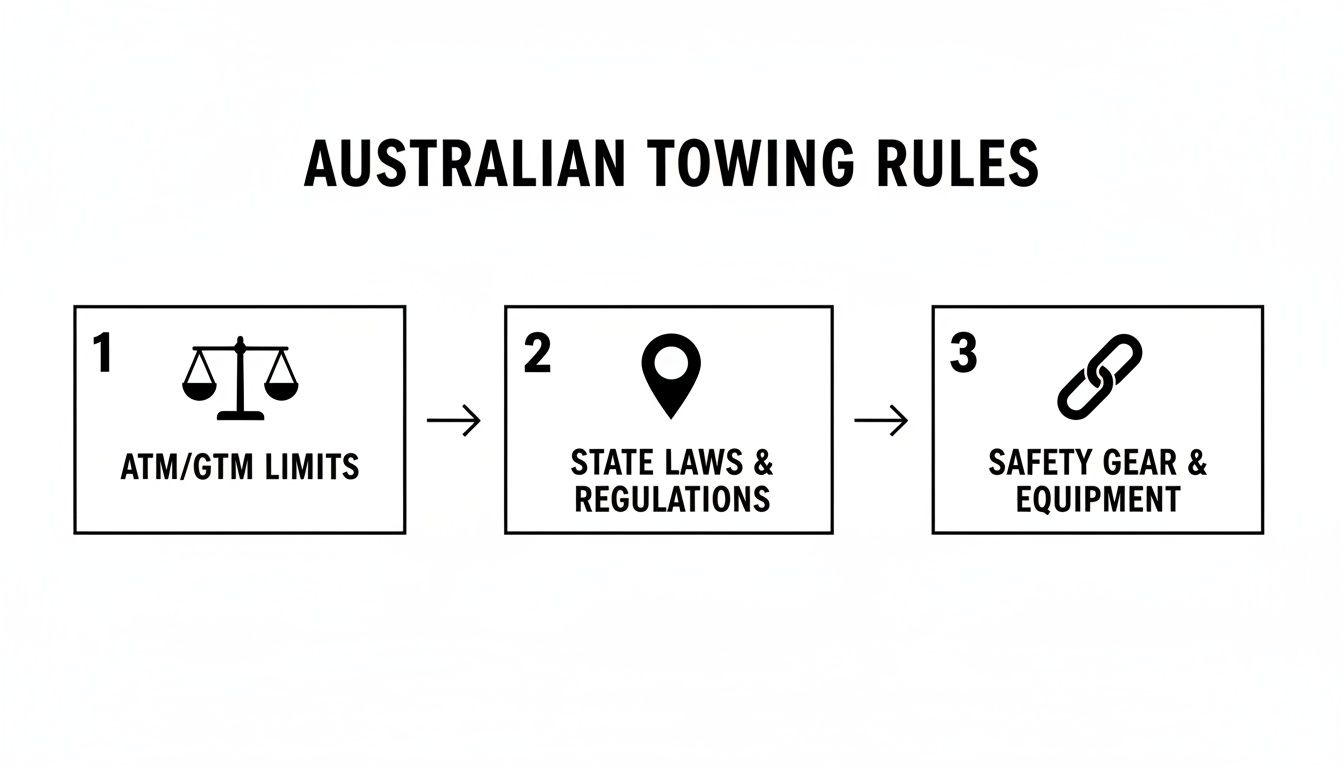
As you can see, it all starts with knowing your rig’s total weight (ATM/GTM). That number dictates which state laws apply and what safety equipment you need to have onboard.
The boat ramp is where a good day can turn bad fast, but it doesn’t have to be a pressure cooker. The secret is simple: do everything you can before you start backing down.
Ramp Prep Checklist
Getting this prep done in the parking area will make your time on the actual ramp quick and efficient, earning you a nod of approval from other boaties. For a deeper dive, our collection of boat guides for your boat and trailer has some fantastic resources.
When you’re backing down the ramp, take it slow. Small steering inputs are all you need. Use your mirrors, but don’t be afraid to look over your shoulder. If you get crooked, just pull forward a little to straighten out and start again.
Once the trailer is deep enough for the boat to start floating, you’re home free. Unhook the winch strap, give the boat a gentle push off the rollers, and use your ropes to walk it over to the jetty. Easy as that.
A great day on the water only truly ends once your boat and trailer are home, washed down, and ready for the next adventure. It’s tempting to skip that last step, but neglecting your trailer is the fastest way to ruin a future trip. A bit of simple, consistent care will keep you out of the breakdown lane and on the water where you belong.
For anyone boating in saltwater, the post-trip wash-down isn’t just a suggestion—it’s everything. Salt is relentless. It will chew through your trailer’s frame, axle, brakes, and wiring if you give it half a chance. A thorough freshwater rinse after every single dip in the ocean is the single most important job you can do.
Don’t just give it a quick once-over. Get in there and flush out all the nooks and crannies, especially inside a galvanised steel frame. Using a decent nozzle to force water inside the chassis pushes out the salt that would otherwise sit there, silently causing rust from the inside out. This little five-minute task can easily add years to your trailer’s life.
Wheel bearings are the classic weak spot on any boat trailer. Dunking hot hubs into cold water during launch and retrieval is a recipe for trouble. A seized bearing on the highway is more than just an inconvenience; it’s a dangerous, trip-ending disaster.
Get into the habit of checking them. Jack up each wheel and give it a good spin—it should turn smoothly with barely a whisper. Any grinding, rumbling, or side-to-side wobble means it’s time to get your hands dirty.
Lots of trailers have “bearing buddies” or similar grease caps, but they’re not a magical fix. Their job is to keep positive pressure in the hub to help stop water from getting in. You still need to hook up a grease gun and pump in fresh grease every few trips to push out any water that snuck past.
Tyres are the other big one. On a trailer, they almost always die from old age and sun damage, not from running out of tread.
If you do spot an issue with your bearings, sorting it out is a key skill for any boat owner. For a full rundown, check out our guide on how to handle a wheel bearing replacement.
Keeping your boat and trailer in top nick is all about being organised. A simple seasonal checklist stops small issues from turning into major headaches that cost you time and money.
Pre-Season (Before your first trip)
Mid-Season (After every few trips)
This proactive approach means you can hitch up and head off with confidence, knowing your trailer is just as ready for an adventure as you are.
When it comes to inflatable boats and trailers, we find the same questions pop up time and time again. We hear them every day from boaters across Australia, so we’ve put together some straight, practical answers to the most common queries to drive conversions and help you make the best choice.
Our goal is to give you that extra bit of confidence, whether you’re hitching up for the first time or just want to make sure you’re doing things right.
This is one of the most common questions we get. The truth is, the “best” inflatable boat is the one that fits your family’s needs and how you plan to use it. For recreational use, stability, portability, and durability are key.
For relaxed family days and exploring coastal waters, a super-stable model like an inflatable catamaran is hard to beat. Their twin-hull design provides exceptional stability, more internal space, and a smoother, drier ride. If you’re an angler, you’ll want something with plenty of deck space and the option to add rod holders.
While you could search for options “near me,” we simplify the process. We’ve curated a selection of premium inflatables, including versatile Inflatable Catamaran models, designed specifically for the Aussie lifestyle. We deliver right to your door, anywhere in Australia, which means the best boats are always available near you.
Thinking of a family outing? A great option is to hire inflatable boats in Australia. Many local marinas and boat rental businesses in holiday hotspots like the Gold Coast or the Whitsundays offer this service. It’s a fantastic way to try different sizes and styles before you commit.
When you look to compare prices and features of inflatable boats in your area, it’s tempting to just focus on the sticker price. However, real value is found in the quality of materials, construction methods, and what’s included in the package.
Here’s a quick comparison to show what separates a basic boat from a premium one:
| Feature | Basic Entry-Level Boat | Easy Inflatables Aerowave |
|---|---|---|
| Material | Standard 0.9mm PVC | Premium German Valmex® PVC or French Orca® Hypalon |
| Seams | Glued (can fail in heat) | Thermo-welded (stronger and more durable) |
| Transom | Plywood (can rot) | Standard aluminium (corrosion-resistant) |
| Warranty | Often 1 year | 3-5 years on hull and seams |
| Inclusions | Boat and oars only | Complete packages with pumps, bags, and more |
As you can see, a slightly higher initial investment often buys you years of extra life, better safety, and a much better experience on the water. Because we sell direct to you, we can offer these premium features without the usual dealership markup, giving you superior options no matter where “your area” is.
We get this question a lot, and our answer is always a firm no. It might seem like a quick and easy way to get to the water, but using a standard box trailer is one of the worst things you can do to your inflatable boat.
Box trailers have flat floors with zero support for the hull. This creates intense pressure points that chafe the fabric, strain the seams, and put enormous stress on the internal baffles. It’s a surefire way to cause damage and drastically shorten your boat’s lifespan.
A purpose-built boat trailer with carpeted bunks isn’t a luxury; it’s essential. It’s designed to cradle your boat’s hull, spreading the weight evenly and protecting your investment. This is even more critical for an inflatable catamaran, which needs specific support for its twin hulls.
Tying down an inflatable is a bit different from securing a tinny or a fibreglass boat. You need to create stable, opposing forces without squashing the tubes.
Secure the Bow: Your winch strap should connect directly to the bow’s main D-ring or towing eye. This is your primary anchor, stopping the boat from sliding backward off the trailer.
Lock in the Stern: At the back, use two separate tie-down straps. Run one from the port-side tow eye on the transom down to the trailer frame. Then, mirror it on the starboard side. This creates a solid “V” that prevents the boat from bouncing or shifting from side to side.
Add a Top Strap (For Highway Trips): On long drives, wind can get under the bow and create lift. A light strap over the top of the boat—just forward of the console or seats—can prevent this. Just make it snug; there’s no need to crank it down so hard that it deforms the tubes.
Whatever you do, avoid the common mistake of throwing one long strap over the top of the tubes from one side of the trailer to the other. It puts all the pressure on two small points and does a poor job of actually securing the boat.
Ready to find the perfect boat and trailer package that’s built for Australian adventures? At Easy Inflatables, we specialise in premium, lightweight inflatable boats and catamarans designed for performance and portability. Explore our range and discover your next adventure today at https://easyinflatables.com.au.