

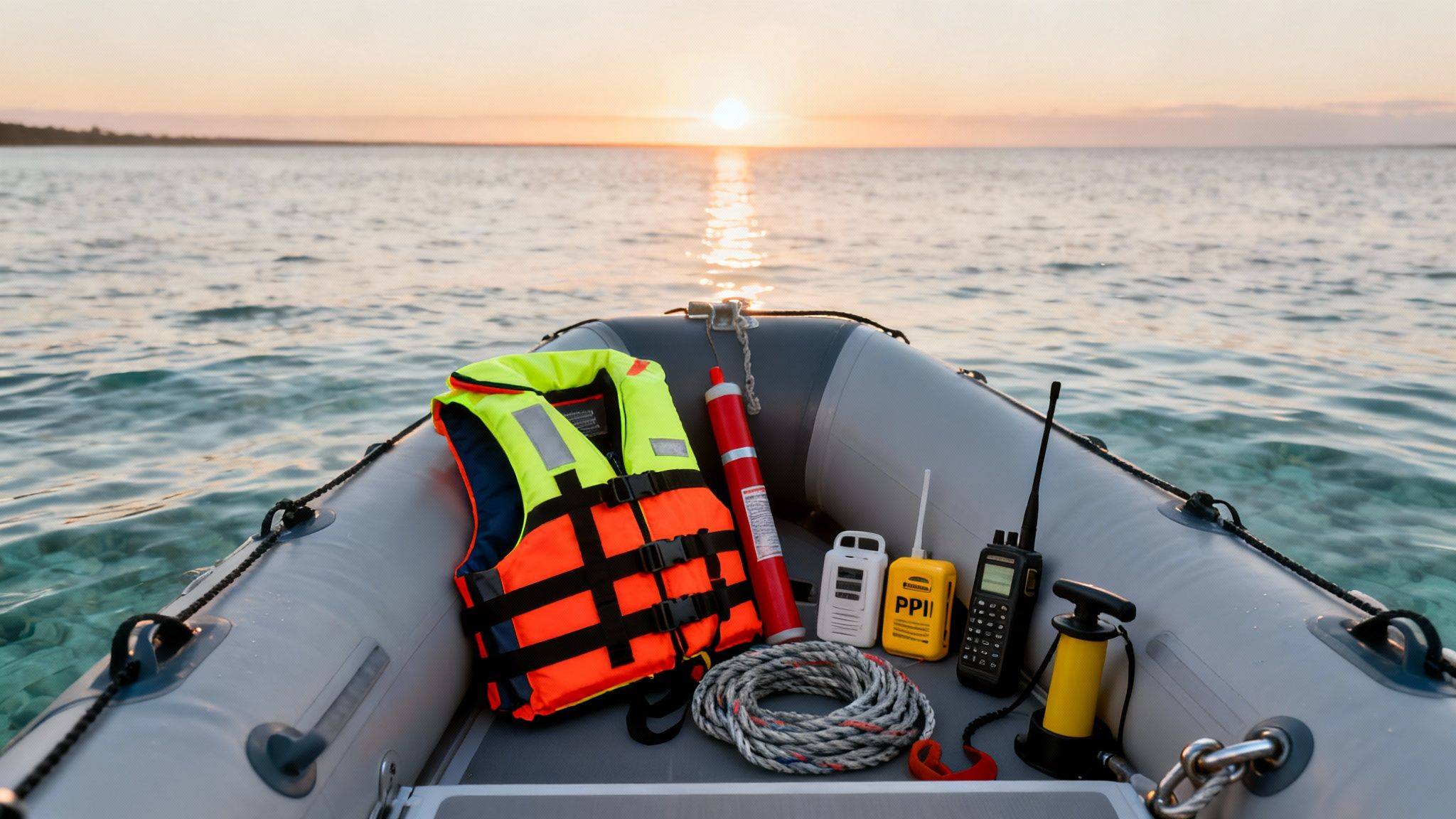
Heading out on the water is a classic Australian pastime, but real enjoyment begins with having the right boating safety equipment. This gear is more than just a list of items to tick off; it’s your primary defence against the unexpected, ensuring every trip on your inflatable boat ends as well as it began. Whether you’re comparing prices and features of inflatable boats in your area or looking to hire one for a family outing, understanding safety requirements is the first step.
Think of your safety gear as the essential toolkit for your vessel. Just as you wouldn’t take a screwdriver to fix a plumbing leak, the equipment you carry must be fit for the job. This concept of ‘fit-for-purpose’ is crucial; a coastal trip in an inflatable catamaran demands a different level of preparation than a calm river paddle in a small tender.
Safety isn’t just about avoiding fines. It’s about building the confidence and readiness to handle anything the water throws at you. It’s the solid foundation upon which every stress-free day on the water is built.
Failing to carry the correct or up-to-date gear has tangible consequences. According to the Australian Maritime Safety Authority’s 2023 Marine Incident Annual Report, nearly 600 expiation notices and cautions were issued in the 2023 boating season for expired flares, insufficient safety gear, or inappropriate equipment.
This shows that authorities are actively checking that boaters are compliant. You can dive deeper into the stats in the full marine incident report from AMSA.
Equipping your boat properly isn’t just about following rules. It’s about taking personal responsibility for yourself, your passengers, and other boaters who share the water with you. A well-prepared skipper is a safe skipper.
Figuring out the difference between legally required and highly recommended items can be confusing, especially since the rules change based on your location and vessel type. Let’s break it down simply.
To make things clearer, here’s a quick summary table that cuts through the noise.
| Equipment Category | Legally Required (Varies by State/Vessel) | Highly Recommended for All Boaters |
|---|---|---|
| Personal Flotation Devices (PFDs) | At least one properly fitting PFD for every person on board. | Self-inflating PFDs for comfort and mobility. |
| Distress Signals | Flares, V-sheet, horn, or sound signal (depending on distance from shore). | Emergency Position Indicating Radio Beacon (EPIRB) for offshore trips. |
| Fire Safety | At least one approved fire extinguisher (especially for vessels with engines). | A fire blanket in addition to an extinguisher. |
| Navigation & Communication | Navigation lights for night operation. | A VHF radio for reliable communication and a waterproof torch. |
| Anchoring | An anchor with appropriate rope/chain for your vessel size and location. | A secondary anchor (kedge anchor) for extra security. |
| First Aid | Not always legally required on smaller recreational boats. | A comprehensive, waterproof first-aid kit. |
This table is a starting point, but remember to always check your local state maritime authority for the specific rules that apply to you.
Now, let’s explore those categories in more detail:
This guide will cut through the confusion, helping you choose the right setup for your specific needs, whether you’re trying to find the best inflatable boats for recreational use available near you or looking for a place in Australia to hire inflatable boats for a family outing. To further understand the broader concepts of preparedness and what constitutes essential equipment for demanding situations, you might find this article insightful.
Trying to get your head around Australian maritime law can feel a bit like reading a map in choppy seas. The rules for essential boating safety equipment aren’t a simple one-size-fits-all deal. They change depending on your state, the type of boat you’re in—from a lightweight inflatable to a big cruiser—and exactly where you plan to go, whether that’s a calm river or out on the open ocean.
This section is your plain-English guide. We’ll cut through the jargon and explain the mandatory gear you need on board, like life jackets (Personal Flotation Devices or PFDs), flares, fire extinguishers, and various signalling devices.
Instead of just listing dense regulations, we’ll get into the ‘why’ behind each piece of equipment. Knowing this helps you make smarter choices, ensuring your inflatable catamaran or tender isn’t just legally compliant, but genuinely safe for everyone on board.
In Australia, boating safety is handled at the state and territory level. This means the gear you need for a family day out on Sydney Harbour might be different from what an angler needs off the coast of Perth. These regulations are the absolute minimum legal standard.
A few key things determine what equipment you’re required to carry:
Your best bet is to always check in with your local maritime authority—like NSW Maritime or Maritime Safety Queensland—for the most up-to-date rules for your area. Think of it as checking the local road rules before you head out for a drive.
Let’s break down the most common bits of legally required gear. These items are the foundation of your onboard safety kit, and understanding what they do is crucial for using them effectively when it really counts.
A Personal Flotation Device (PFD) is arguably the single most important piece of safety equipment you can have. The law is simple: you must carry at least one Australian Standard-approved PFD for every single person on your boat. They have to be the right size, in good nick, and easy to grab in a hurry—not buried under a pile of fishing gear.
A common mistake is thinking all life jackets do the same job. The rules specify different types (like Level 50 vs. Level 100) based on your activity and how far you are from shore. The rules are even stricter for kids, who often must wear one at all times on smaller boats.
This decision tree gives you a great visual on how your trip plans directly shape the equipment you’ll need to pack.
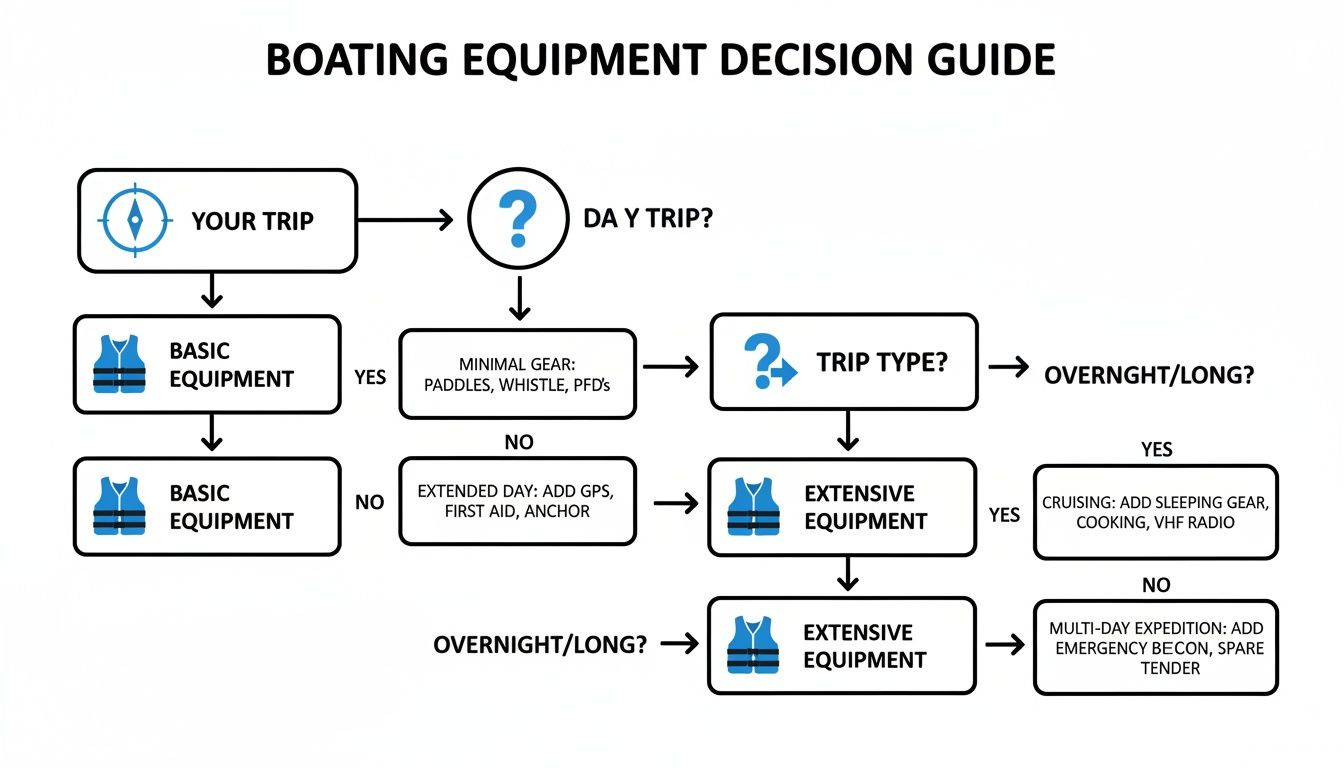
As you can see, the moment you move from enclosed waters to the open sea, the list of mandatory safety items gets a lot longer.
If you ever find yourself in a tight spot, your ability to signal for help is your lifeline. The devices you’re required to carry depend entirely on how far from the coast you plan to venture.
For any trip in open waters, carrying distress flares is mandatory. These come with strict expiry dates, and having out-of-date flares on board can land you a fine. For enclosed waters, you might only need a simple sound signal like a horn or whistle, plus a V-sheet (a big orange sheet with a black ‘V’).
For the ultimate peace of mind on any coastal or offshore adventure, an Emergency Position Indicating Radio Beacon (EPIRB) or a Personal Locator Beacon (PLB) is a non-negotiable. While not always legally required for recreational boats staying close to shore, these devices are lifesavers, transmitting a distress signal via satellite directly to search and rescue services. You can explore the benefits and learn more about how a modern ACR rescue beacon works in our detailed guide.
Inflatable boats, including popular Inflatable Catamarans, give you incredible portability and stability on the water. But those unique strengths also demand a smarter approach to your boating safety equipment. Kitting out your vessel isn’t about cramming a standard safety kit into a smaller space; it’s about choosing gear that fits your boat’s design and plays to its strengths.
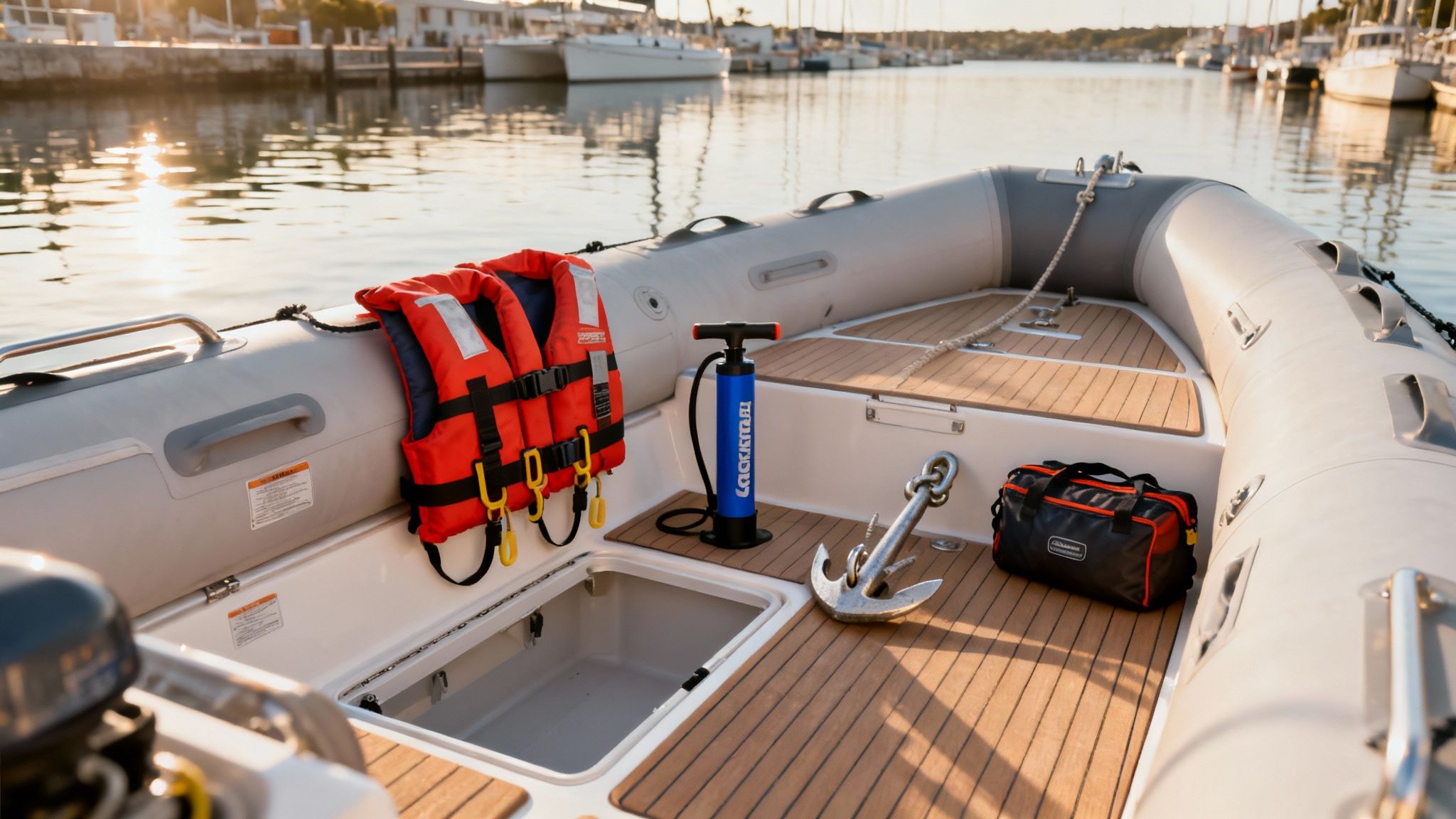
The trick is to think light and compact without ever compromising on performance. Your goal is a safety kit that works with your boat, not against it, making sure every item is there for a reason on your inflatable tender or catamaran.
Limited deck space is a fact of life on most inflatables, making every square centimetre count. This is where modern, space-saving safety equipment really proves its worth.
By choosing gear designed for portability, you can tick all the safety boxes without sacrificing precious room for passengers or gear—a huge win for those looking for the best inflatable boats for recreational use available near me.
Some safety gear does more than just sit there waiting for an emergency—it actually makes your inflatable boat more stable and perform better. A properly chosen anchor and a reliable pump are two of the most critical pieces you can have on board.
An anchor might seem like extra weight, but it’s absolutely essential for holding your position while you’re fishing or having a swim. For an inflatable, a lightweight but effective anchor like a fluke or grapnel-style is perfect. It gives you great holding power without adding unnecessary bulk.
The most overlooked piece of safety equipment for an inflatable is a high-capacity air pump. Keeping the right tube pressure is a core safety rule—under-inflated tubes flex way too much, killing performance and stability, while over-inflation risks blowing a seam.
The heartbreaking reality is that proper equipment can prevent tragedies. Of the 281 people who drowned in Australian waterways during 2023, about 17% of these deaths were linked to boating and watercraft incidents. This just hammers home how critical it is to be prepared.
When you put it all together, a solid safety kit for an inflatable boat should be all about efficiency and function. Beyond what the law requires, your kit should be tailored to the unique needs of your vessel.
A great starting point includes:
A well-organised boat is a safer boat. To learn more about setting up your vessel for a secure day on the water, check out our guide on inflatable boat setup tips for safety. This thoughtful approach ensures you have the right tools ready to go without cluttering up your valuable space.
Meeting the bare minimum legal requirements for boating safety equipment is your starting line, not the finish line. True confidence on the water comes from being ready for the unexpected ‘what ifs’—those moments that can turn a perfect day sour in a heartbeat. This is where you build a kit that offers total peace of mind.
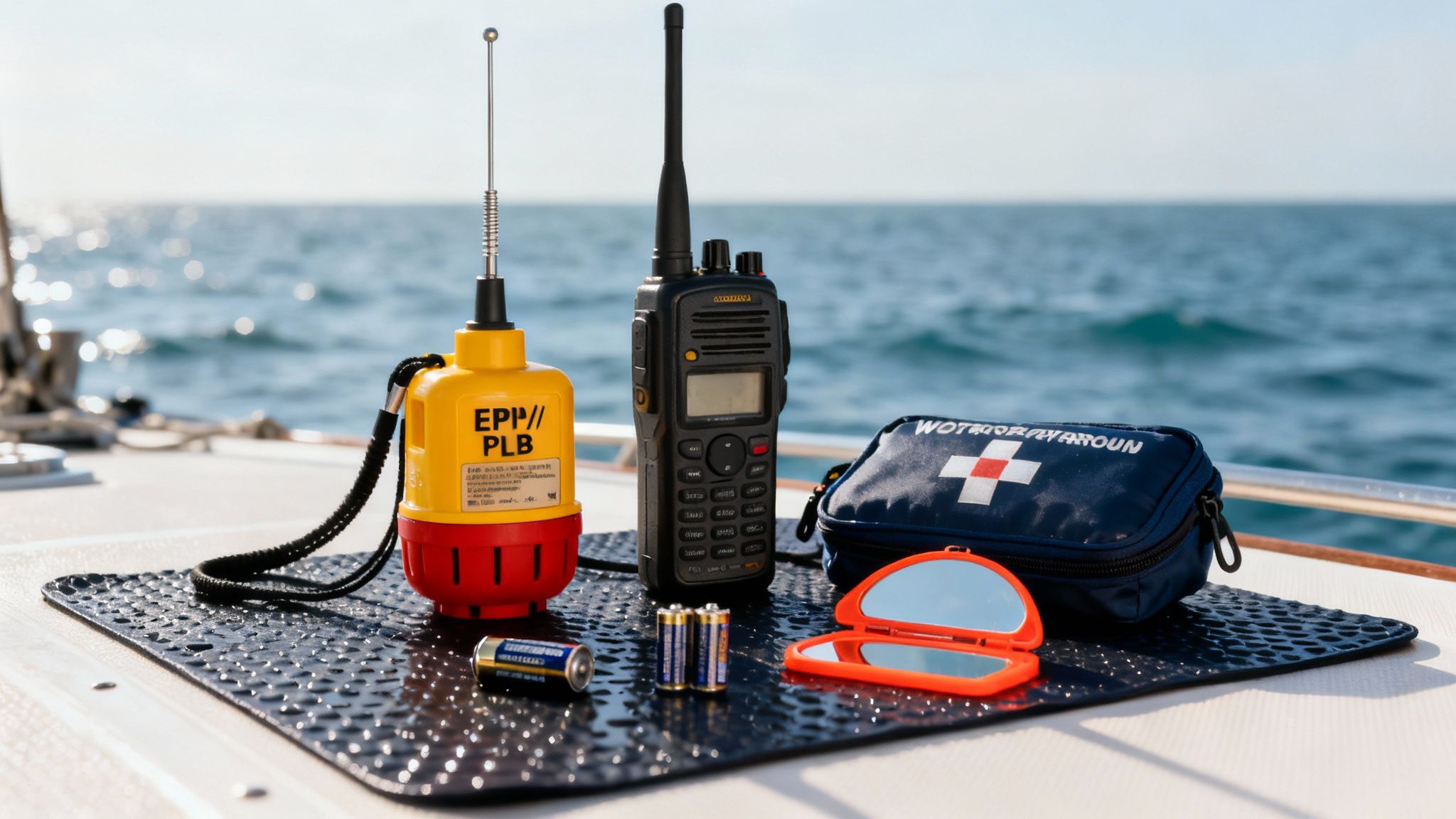
This advanced gear isn’t about being paranoid; it’s about being self-reliant. It’s the stuff that empowers you to handle almost any situation the water throws your way, turning potential disasters into manageable problems. This is especially critical when you’re exploring coastal areas in your Inflatable Catamaran.
Picture this: your engine cuts out, miles from shore. Your phone, predictably, has no signal. This is where the difference between an EPIRB and a PLB becomes crystal clear. Both are absolute lifesavers, but they play slightly different roles.
For anyone serious about boating, factoring one of these beacons into your budget is a non-negotiable. It’s a direct investment in your safety.
Choosing between these devices can feel tricky, but it really comes down to where and how you boat. This table breaks down the essentials to help you decide which lifeline is right for your adventures.
| Safety Device | Primary Use | Ideal Operating Area | Key Consideration |
|---|---|---|---|
| EPIRB | Vessel in distress | Offshore, remote coastal waters | Registered to the boat; best for group safety. |
| PLB | Individual in distress | Anywhere, including on-person | Registered to an individual; essential for man-overboard scenarios. |
| VHF Radio | Vessel-to-vessel & rescue comms | Within radio range (coastal) | Real-time communication, not just a distress signal. |
Ultimately, having a combination—like a vessel-mounted EPIRB and a PLB on your life jacket—offers the most comprehensive coverage for you and your crew.
Beyond the high-tech beacons, a few other items are the unsung heroes of any good safety kit. They’re the practical tools that solve common problems before they escalate into something serious.
A waterproof handheld VHF radio is one of the best tools you can own. Unlike a mobile, it doesn’t rely on patchy reception from cell towers, giving you a direct line to marine rescue services and other boats nearby. There’s a reason it’s the standard for marine communication.
A reliable power source is just as critical as the electronics themselves. There’s no point having the gear if the batteries are dead. For a deep dive on keeping your essential kit powered up, our guide to choosing the right marine battery and charger is a great place to start.
A comprehensive, waterproof first-aid kit is another non-negotiable. Minor cuts, sunburn, or seasickness can quickly ruin a day out, and a well-stocked kit lets you sort these issues out on the spot.
Finally, never underestimate simple, low-tech tools. A sturdy bailing bucket or even a large sponge can make a massive difference if you start taking on water. And believe me, carrying a small, separate container of spare fuel has saved countless boaters from a long, embarrassing paddle back to the ramp.
Equipping your boat with this next level of safety gear builds a genuine sense of confidence, letting you and your family truly relax and enjoy your time on the water.
Owning the best boating safety equipment is only half the battle. Let’s be honest, it’s completely useless if it fails you in an emergency. Proper maintenance and storage aren’t just chores you put on the to-do list—they’re critical routines that could save your life. Think of it as a regular health check for your most important gear, making sure everything is in perfect working order before you even dream of hitting the water.
This is especially true here in Australia, where the harsh sun and corrosive saltwater can chew through even the toughest materials. A simple, consistent maintenance routine is your best defence against wear and tear, guaranteeing every piece of equipment is ready to perform when you need it most.
The key here is building a habit. You don’t need a workshop full of complex tools or hours of your weekend—just a systematic way of checking your gear, ideally at the start and end of each boating season.
A great place to begin is with your Personal Flotation Devices (PFDs).
This same simple logic of checking for wear, tear, and expiry dates applies to all your gear. It’s a quick process that can make all the difference out on the water.
Some of the most critical items in your safety kit have a limited shelf life. Getting complacent here isn’t just dangerous; it could also land you a hefty fine from the maritime authorities.
Testing your electronics should also be part of this routine. Switch on your VHF radio for a quick radio check and flick on your navigation lights and waterproof torch to confirm the batteries are still good to go. For a deeper dive into looking after your vessel, our guide on inflatable boat maintenance made simple has some great practical tips that go beyond just safety gear.
How you store your equipment is just as important as how you maintain it. The goal is simple: protect it from moisture, sunlight, and extreme temperatures.
Store your safety gear in a cool, dry, and easily accessible place. A dedicated waterproof bag or container on your boat keeps everything organised and protected from the elements, ensuring you can grab it in a hurry.
After a day on the water, always make a habit of rinsing your gear—especially electronics and PFDs—with fresh water to get the salt residue off. Let everything dry completely in the shade before you pack it away to prevent mould and mildew from setting in. Proper storage ensures your safety gear stays in top condition, and for bigger items or off-season needs, you might even look into specialized equipment storage solutions. By making this small effort, you’ll significantly extend the life and reliability of your entire safety kit.
The last few moments before you launch are easily the most important. Turning your pre-departure check into a consistent ritual is the single best habit you can build to ensure a safe, fun day on the water. It’s about building muscle memory for safety—moving beyond just knowing your gear is on board to confirming it’s ready to go and easy to reach.
Think of this routine as your final line of defence against the usual suspects of boating problems. When it becomes second nature, you slash your risks and kick off every trip knowing you’re fully prepared for a great, stress-free adventure.
Before your inflatable even sniffs the water, your first checks should happen on solid ground. Aussie weather can turn on a dime, so checking the forecast isn’t just a suggestion—it’s a non-negotiable safety step.
With your trip plan sorted, it’s time to get hands-on with the boat itself. This is all about making sure your inflatable and its essential boating safety equipment are in top shape for the day ahead.
First up, give your inflatable’s tubes a once-over. Proper inflation is everything for stability and performance. You want them at the manufacturer’s recommended pressure—but remember that the air inside will expand in the sun, so don’t overdo it.
Next, a quick run-through of your safety gear.
A simple, repeatable checklist removes guesswork and stops complacency from creeping in. It ensures that even on the most exciting days, you never overlook the small details that make the biggest difference in an emergency.
To help you lock this habit in, we’ve put together a comprehensive resource you can use every single time you head out. Download and print our detailed boat safety equipment checklist to keep on your vessel as a constant reminder. Making this process a non-negotiable part of every trip is the mark of a truly safe and responsible skipper.
Heading out on the water is one of the best ways to spend a day, but it’s natural to have questions, especially when you’re just starting out or taking the family on an inflatable. If you’re looking to compare prices and features of inflatable boats in your area or find a place in Australia to hire inflatable boats for a family outing, getting the right answers first builds confidence and keeps everyone safe. Here are a few of the most common questions we get about boating safety equipment here in Australia.
We’ll break down the essentials so you can make smart, safe decisions before you even leave the shore.
This is one of the most important things to get right. In almost all Australian states, there are strict laws requiring children—usually anyone under 12 years old—to wear a life jacket at all times when on a boat under a certain size (like 4.8m) while it’s underway. This isn’t just a friendly suggestion; it’s the law.
The exact rules on age and boat size can differ slightly from state to state, so it’s always a good idea to double-check with your local maritime authority before you head out. Just as important, the life jacket has to fit the child properly based on their weight and be in good condition. A PFD that’s too big or damaged is a serious safety risk.
Whether you need flares comes down to one simple thing: where you’re planning to go. Here in Australia, flares are generally mandatory if you’re boating in open or coastal waters, which is usually defined as being more than two nautical miles from the coast. This rule applies to all boats, including our Inflatable Catamarans.
If you’re sticking to enclosed waters like rivers, sheltered bays, or lakes, you usually aren’t legally required to carry them. That said, having an in-date flare kit on board is always a smart move, even when it’s not required. Authorities are known to check expiry dates, and out-of-date flares are a common reason for fines, so make a habit of checking yours.
The lifespan of your safety equipment really varies, which is why regular checks are so crucial.
A good rule of thumb is to give all your boating safety equipment a thorough once-over at the start of every season. It’s a simple habit that makes sure everything is ready to go when you need it most.
Ready to gear up for your next adventure with confidence? At Easy Inflatables, we offer a wide range of Aerowave inflatable boats and essential accessories designed for Australian conditions. Explore our collection and find the perfect setup for your family fun or fishing trips. Find your perfect inflatable boat at Easy Inflatables.