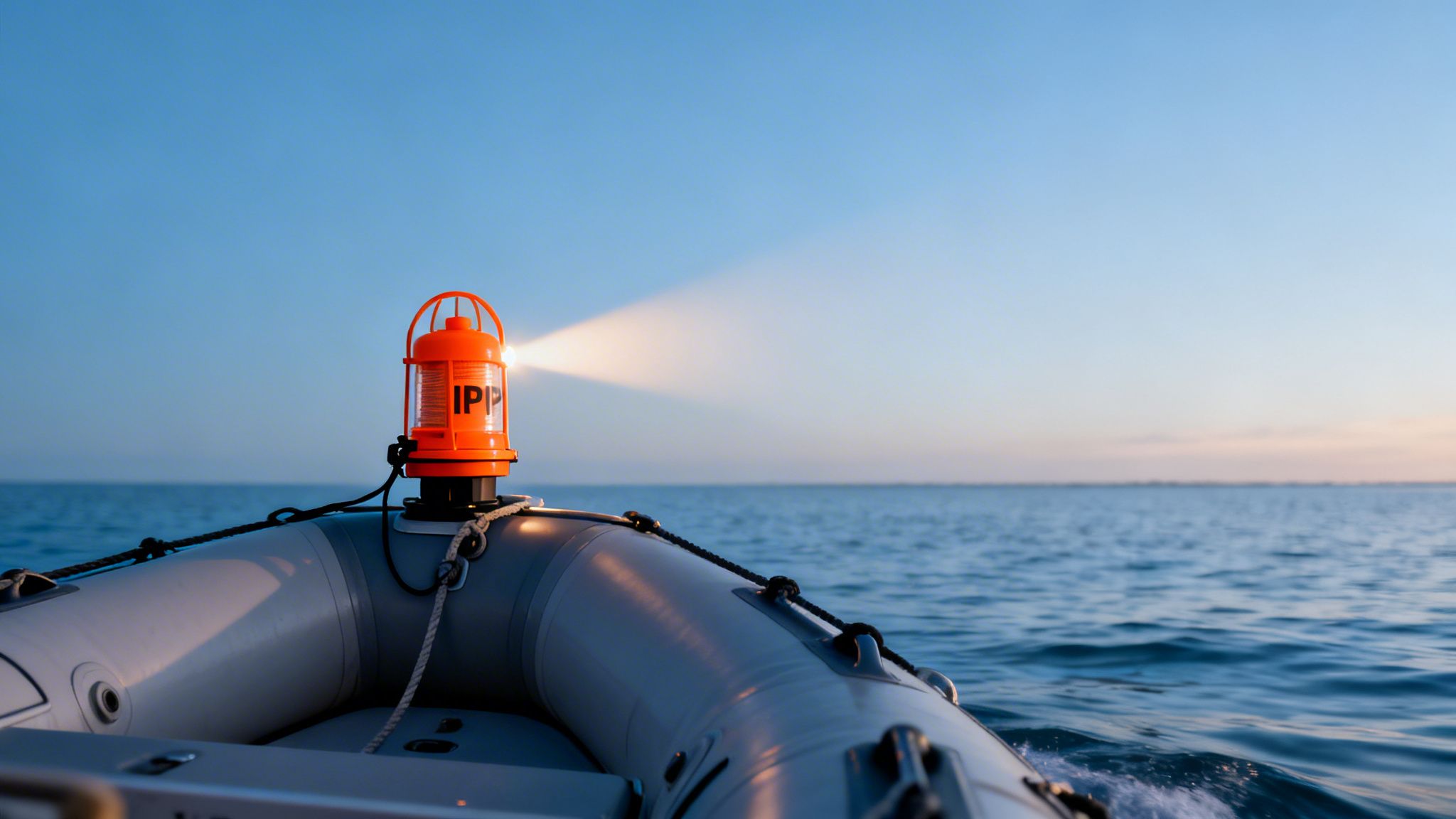

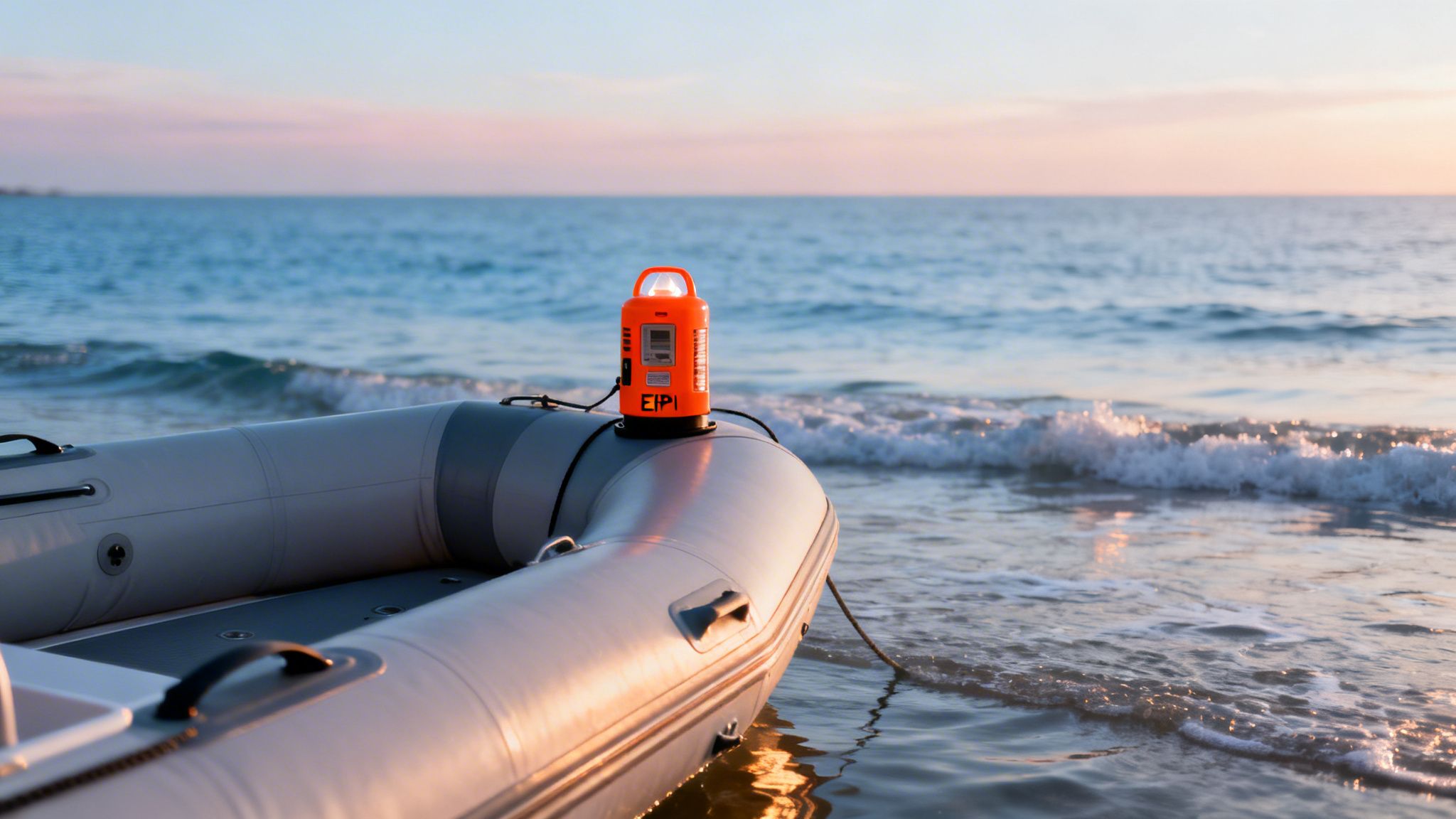
When you’re out on the water, your safety gear is non-negotiable. But what happens when you’re truly up against it, far from shore with no way to call for help? That’s where an EPIRB (Emergency Position Indicating Radio Beacon) comes in. It’s a specialised distress beacon designed for maritime emergencies, and it’s arguably the most important piece of safety kit you’ll ever own for your boat.
When activated, an EPIRB sends a powerful, unique signal via satellite directly to global search and rescue services. It tells them who you are and, crucially, where you are. It’s your ultimate lifeline when all other communication methods have failed, whether you’re on a small recreational vessel or a larger inflatable catamaran.

Picture this: you’re miles offshore on your inflatable catamaran or tender. The engine dies, a storm rolls in unexpectedly, or someone on board has a medical emergency. You’re well beyond mobile phone range, and your VHF radio calls are met with silence. How do you let someone know you’re in serious trouble?
This is exactly the scenario an EPIRB was designed for. It’s not just another gadget; it’s a dedicated, direct line to rescue authorities that works when nothing else will. Comparing prices and features of the best EPIRB for your boat is a small step for a huge return in safety.
The simplest way to think of an EPIRB is as a “Triple Zero call for the ocean.” When you’re facing grave and imminent danger, you activate it. This sends a coded distress signal containing a unique identifier that’s linked to your vessel through registration, immediately telling rescuers who you are.
Modern EPIRBs come with built-in GPS, which transmits your precise coordinates, cutting out the guesswork for search crews. This has been a game-changer, especially with the newer MEOSAR (Medium-altitude Earth Orbit Search and Rescue) satellite system now fully operational over Australian waters.
A GPS-enabled EPIRB can alert rescue services within 3 minutes to a positional accuracy of ±50 metres. That’s a massive leap forward in maritime safety.
This incredible accuracy gives boaties enormous peace of mind, knowing that if the worst happens, help can be sent to their exact location faster than ever before.
Once activated—either manually by you or automatically if the unit is submerged in water (depending on the model)—the EPIRB transmits a powerful distress signal on the 406 MHz frequency. This protected frequency is constantly monitored by the Cospas-Sarsat network, an international satellite system dedicated to search and rescue.
The satellite picks up your signal and relays it to a ground station, which then forwards the alert to a Rescue Coordination Centre. From there, authorities launch the right response—be it a plane, helicopter, or rescue vessel—using your beacon’s signal to home in on your location. It’s why having a quality unit is so critical; you can learn more about the ACR rescue beacon in our guide.
Working out when you legally need an EPIRB on your boat can feel a bit confusing, but it’s absolutely essential for staying safe and on the right side of the law in Australian waters. The rules do vary a little between states, but they all share a simple idea: the further you head offshore, the more you need to be self-reliant, and the more critical an EPIRB becomes.
The main thing that triggers the need for an EPIRB is your distance from the coast. In most states, once you travel more than a couple of nautical miles out, carrying a registered and working EPIRB changes from a smart idea to a legal must-have. This is especially true for owners of versatile boats like an inflatable catamaran, where a quick fishing trip can easily take you into an area where the law says you need one. Finding the best recreational boats for your needs also means equipping them correctly.
Getting your head around the specific local rules is key. For example, if you’re boating in South Australia, you need an EPIRB on board if you’re more than 3 nautical miles (about 5.5 km) from shore in coastal waters. That distance stretches to 5 nautical miles (around 9.2 km) if you’re in the Gulf of St Vincent and Spencer Gulf. And no matter where you are, any distress beacon used in Australian waters must be registered with the Australian Maritime Safety Authority. For the nitty-gritty details, it’s always worth checking the Marine Safety SA government site.
While the exact distances might differ slightly, the theme is the same across the country. Here’s a quick guide to what you can generally expect:
| State/Territory | Typical EPIRB Requirement (Distance Offshore) | Notes |
|---|---|---|
| New South Wales | More than 2 nautical miles | This applies to all recreational vessels. |
| Victoria | More than 2 nautical miles | It’s part of the mandatory safety gear list. |
| Queensland | More than 2 nautical miles | For any boats operating in open waters. |
| Western Australia | More than 2 nautical miles | Required for registrable recreational boats. |
| Tasmania | More than 2 nautical miles | Enforced for motor boats out in coastal waters. |
Just a heads-up: This table is a general guide. You should always double-check with your local maritime authority to get the most current and specific regulations for your area.
It’s really important to see these rules as the absolute minimum. Every maritime safety authority in the country strongly recommends carrying an EPIRB on all your boating trips, even when you’re not legally forced to. A sudden engine failure, a freak change in the weather, or a medical emergency can happen anywhere, and an EPIRB is often the only truly reliable way to call for help.
Your EPIRB is a one-off investment in your own safety and the well-being of every person on your boat. The legal rules are just a starting point; real peace of mind comes from knowing you’re ready for anything, no matter how close you are to shore.
At the end of the day, carrying the right gear isn’t just about avoiding a fine—it’s about making sure you have a lifeline when you need it most. Having the correct boating safety equipment on board is a responsibility every skipper shares.
When you start looking into distress beacons, you’ll quickly find yourself staring at two main acronyms: EPIRB and PLB. They both use the same life-saving satellite system to call for help, but they’re built for entirely different jobs.
Getting your head around the difference is actually pretty simple. Just remember this rule: an EPIRB is for the boat, and a PLB is for the person. Think of an EPIRB as the primary distress signal for your vessel, registered to it and ready to go if the whole boat is in trouble. A PLB, on the other hand, is registered to an individual and stays with them, no matter what.
An EPIRB is the undisputed champion for a vessel-wide emergency. These things are built like tanks to survive the harshest marine conditions and are required to transmit a signal for a minimum of 48 hours. In the vastness of Australian waters, where rescue can take time, that extended battery life is absolutely critical.
PLBs are much smaller and designed for personal carry, so their transmission requirement is a minimum of 24 hours. They’re perfect for individual safety scenarios, like falling overboard or having to abandon your inflatable catamaran for a liferaft.
An EPIRB is cleverly designed to float upright, ensuring its antenna is pointing skyward for the best possible signal. Many models will even activate automatically if they hit the water. A PLB, however, needs to be held out of the water manually to transmit properly.
This is a massive point of difference. If your boat capsizes unexpectedly, an automatically deploying EPIRB can be sending out a distress signal even if the crew can’t get to it. A PLB is completely reliant on a person to switch it on and hold it correctly. To see the different types available, you can explore our range of beacons to get a better feel for the options.
This decision tree gives you a straightforward guide on when an EPIRB goes from a good idea to a legal must-have.

As you can see, once you’re heading more than a couple of nautical miles from shore, the rules in many Australian states get very clear: an EPIRB becomes mandatory.
For owners of inflatable boats, tenders, or catamarans, the right choice often boils down to how and where you use your vessel. Seeing the features side-by-side makes it easy to decide what’s right for your setup. Whether you’re comparing prices and features or deciding on the best type for a family outing, this breakdown helps.
This table breaks down the core differences to help you choose the right beacon for your needs.
| Feature | EPIRB (For the Vessel) | PLB (For the Person) |
|---|---|---|
| Registration | Registered to a specific vessel. | Registered to an individual person. |
| Activation | Manual or automatic upon submersion. | Manual activation only. |
| Transmit Time | Minimum of 48 hours. | Minimum of 24 hours. |
| Floating | Floats upright to transmit signal. | Does not float in a transmitting position. |
| Best For | Vessel-wide emergencies (sinking, fire). | Personal safety (man overboard, solo trips). |
Ultimately, having the right beacon isn’t just about ticking a legal box—it’s about having a direct line to rescuers when you need it most. Many serious boaters carry both an EPIRB for the vessel and a PLB on their lifejacket for total peace of mind.

Choosing an EPIRB for an inflatable boat, tender, or catamaran isn’t the same as picking one for a big keelboat. Space is at a premium, weight actually matters, and your whole setup is designed to be portable. The best EPIRB for your boat will be one that fits these unique needs without ever compromising on safety.
The trick is to focus on compact, lightweight units that are easy to stow but even quicker to get to in a hurry. Those large, automatically deploying (Category 1) units you see on big vessels are usually overkill and impractical for an inflatable. Instead, a manually activated (Category 2) EPIRB is the perfect fit.
These devices are smaller, more affordable, and pack the exact same life-saving punch. They’re designed to be grabbed in an emergency and switched on by hand, which suits the hands-on nature of running a smaller boat. Finding the best inflatable boats for recreational use available near you is the first step; equipping them with the right safety gear is the next.
With very few solid surfaces, bolting on a traditional bracket can be a real challenge on an inflatable. But this limitation actually opens up more flexible and practical solutions that are arguably better for a portable boat anyway. The most common and effective method is stowing your EPIRB in a dedicated ditch bag or grab bag.
This bag keeps all your essential safety gear in one place, ready to go in an instant. Your EPIRB should live in this bag, protected from the elements but right at the top where you can grab it. This approach ensures your lifeline is with you, even if the worst happens and you have to leave your boat. You can find more detail on what to pack in our comprehensive boat safety equipment checklist.
Here are a few smart ways to store an EPIRB on your inflatable:
When you’re looking at different models, two features really stand out as essential for getting the fastest and most reliable rescue possible.
Look for an EPIRB with both integrated GPS and Return Link Service (RLS). This combination dramatically speeds up your rescue and provides crucial peace of mind that your signal has been received.
First, make sure the device has an internal GPS (Global Positioning System). A GPS-enabled EPIRB transmits your precise coordinates, allowing rescuers to zero in on your location to within about 50 metres, often in just minutes. Older, non-GPS models can take much longer for search teams to locate.
Second, go for a unit with Return Link Service (RLS). This is newer technology, available on Galileo-compatible beacons, that sends a confirmation signal back to your EPIRB—usually a flashing blue light. This confirms that your distress message has been received and that help is on its way. In a high-stress situation, that confirmation is a massive psychological boost.
Buying an EPIRB is a massive step towards safer boating, but the device itself is only half the puzzle. To make that life-saving connection complete, you absolutely must register it with the Australian Maritime Safety Authority (AMSA) and test it regularly.
Think of it this way: your EPIRB is an emergency phone, but registering it is like programming Triple Zero (000) into your contacts. It connects the device to you.
Registration is mandatory, free, and surprisingly simple. It links your beacon’s unique code (its Hex ID) to your boat and your personal details. Without registration, rescue services just get an anonymous blip on a screen, which causes critical, life-threatening delays. A registered beacon tells them who you are, what your boat looks like, and who to call on shore to verify your trip. This information dramatically speeds up the entire rescue process.
Before you jump online, it’s worth grabbing a few details to make the process a breeze. The whole thing is done on the AMSA website and takes maybe 10 minutes if you have everything ready to go.
Here’s what you’ll need:
Once you submit the form, AMSA will send you a registration sticker to pop on your beacon. It’s vital to remember this registration is only valid for two years and needs to be renewed to keep your details current.
Every EPIRB has a built-in self-test function that lets you check its vital signs without triggering a full-blown rescue. It’s a simple but crucial check you should get in the habit of doing before every single trip. This gives you confidence that your lifeline is ready to go if the worst happens.
Performing a self-test is like checking the fuel gauge in your car before a long drive. It’s a quick, simple action that confirms your equipment is ready for the journey ahead.
To run the test, just follow the instructions from the manufacturer—it’s usually as simple as pressing a “test” button. A successful test, often shown with a flashing light or a beep, confirms two critical things:
This simple routine takes only a few seconds but delivers priceless peace of mind, ensuring your epirb for boat is always ready to back you up.

An EPIRB is a long-term investment in your safety, but it’s not a “set and forget” device. Just like any critical piece of gear on your inflatable catamaran or tender, it needs a bit of looking after to make sure it works flawlessly when you need it most. And the most important part of that care comes down to its power source.
The battery inside your EPIRB is the heart of the unit. It’s engineered for one thing: extreme reliability and a long shelf life, not for recharging. When that switch is flipped, maritime regulations demand that the battery powers the beacon’s signal for a minimum of 48 continuous hours. This long operational window is absolutely crucial, giving rescue services a realistic timeframe to pinpoint your location, especially out in remote Australian waters.
To guarantee that 48-hour performance, EPIRB batteries come with a strict replacement schedule. This is typically every 5 to 10 years, depending on the model you own. That expiry date is non-negotiable and is always clearly marked on the unit itself.
Sticking to this date isn’t just a legal requirement; it’s a critical safety measure. Using an EPIRB with an expired battery means you simply can’t trust it to last the full two days. It might work for a bit, but it could die long before help arrives.
Modern beacons are making this easier to track. Newer models often feature Near Field Communication (NFC) technology, which lets you check the battery status instantly with a smartphone app. This gives you fantastic peace of mind between routine self-tests. You can find more details about this essential component in our article on choosing the right marine battery and charger. For a deeper dive into beacon batteries, the experts at Maritime Survey Australia also have some great advice.
Battery replacement is not a DIY job. It must be done by a manufacturer-authorised service agent. They have the tools and expertise to properly service the unit, reseal it, and test it to ensure it remains waterproof and ready for activation.
Beyond the battery, a few regular physical checks will keep your EPIRB in peak condition for years to come. These simple steps are all it takes to make sure it’s ready for action.
This straightforward maintenance routine ensures your epirb for boat will remain the reliable lifeline it was designed to be.
Even when you’ve got the basics down, a few practical questions always seem to pop up. Getting straight, simple answers is the key to feeling confident with your safety gear. Let’s tackle some of the most common queries we hear from Aussie boaters.
You sure can. Your Australian-registered EPIRB is designed to work anywhere on the planet, all thanks to the global Cospas-Sarsat satellite network. If you ever have to set it off, your distress signal gets automatically sent to the search and rescue authority responsible for that particular part of the world.
Here’s a pro tip: before you head off, jump onto your AMSA registration and add your travel itinerary. This little bit of extra information can be a massive help to rescuers if you get into trouble in foreign waters, giving them a much clearer picture of where you were headed.
First off, don’t panic—but you do need to act fast. The second you realise your EPIRB has been accidentally activated, switch it off immediately.
Your next step is non-negotiable: you must contact the Australian Maritime Safety Authority (AMSA) on their 24/7 emergency line to report the false alarm. This call is crucial because it stops a costly and unnecessary search and rescue operation from being launched.
Simply turning it off and hoping nobody noticed isn’t an option. A false alarm can divert precious resources away from a genuine emergency.
Nope. In Australia, you don’t need any special maritime licence to own or operate an epirb for boat. The single most important legal step is registration, not licencing.
Your EPIRB must be legally registered with AMSA, and the good news is, this process is completely free. This registration is the vital link that connects your beacon’s unique ID to your boat and your emergency contacts, making it one of the most critical safety steps you’ll take.
Owning an Easy Inflatables boat is all about freedom and adventure, and having the right safety gear means every trip is a worry-free one. Make sure your inflatable catamaran or tender is ready for anything by exploring our handpicked selection of the best safety beacons on the market. Visit us at https://easyinflatables.com.au to find the perfect safety solution for your setup.