Protect Your Vessel with an EPIRB for Your Boat: A Quick Guide
Discover epirb for boat basics: how to pick, register, and deploy the right beacon for inflatable boats and safer adventures.
At a glance
Discover epirb for boat basics: how to pick, register, and deploy the right beacon for inflatable boats and safer adventures.
- What Is an EPIRB and Why It’s Your Lifeline at Sea
- How Your Signal Triggers a Rescue
- The Power of GPS Precision
- Understanding Australian EPIRB Laws and Requirements
What we'd put you in
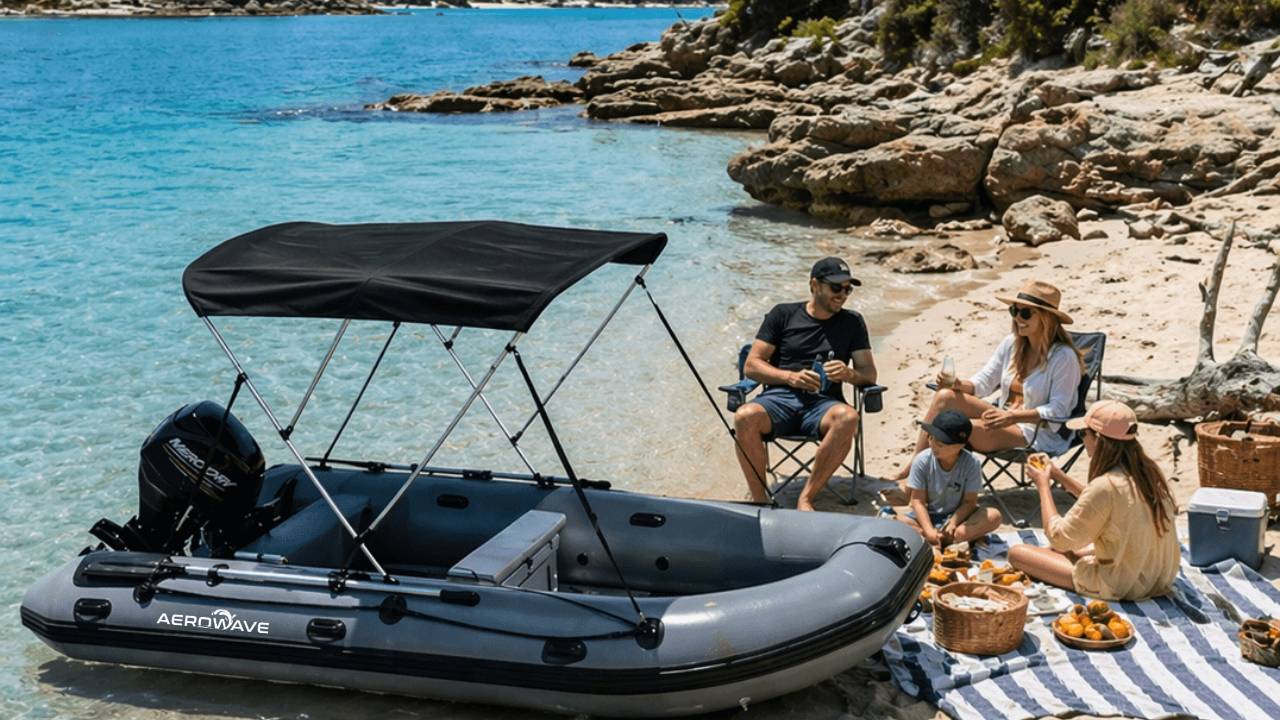
Aerowave Viper 400 Sovereign
Our best-selling boat: 4.0 m, 1.2 mm VALMEX hull, 7-year hull warranty.
US$3,167 USD
Delivered to your door, today's rate
- Free freight to United States · local taxes payable on arrival
- 7-year hull warranty
🇺🇸 Shipping to United States · landed price quoted in writing
Yes — we ship the Aerowave Viper 400 Sovereign to United States. Here's the landed price.
Our best-selling boat: 4.0 m, 1.2 mm VALMEX hull, 7-year hull warranty.
Aerowave Viper 400 Sovereign
- Boat package (export price)
- US$3,726
- 15% tariff relief credit
- − US$559
- Express air freight to United States
- Included
- Import duty, taxes & customs clearance
- Payable on arrival
- Estimated landed, USD
- US$3,167
Indicative, converted at today's rate, before local duty and tax on arrival. Ask below and we'll put a fixed figure in writing, valid 30 days.
- 7-year hull warranty
- 1500 GSM / 1.2 mm VALMEX® Heavy Plus hull
- CE certified to ISO 6185-3 and EU Directive 2013/53/EU
- Door-to-door, tracked the whole way
Your price, delivered to your door — freight included.
We email the full PDF quote (spec, freight, finance, WavePay) to your inbox in under 60 seconds. No spam — one quote, one follow-up.
See it for yourself
Real boats. Real owners. Real people behind them.
Plenty of what you read online these days is generated. Check us out properly — the factory, the reviews and the owners are all one click away. Why we use AI, and how to check we’re real
How our boats are built
Walk the production line: thermo-welded seams, 1.2 mm VALMEX Heavy Plus hulls, over-pressure relief valves on every chamber.
See the buildGoogle Maps reviews
Real Australian owners, five stars, published on our Google Business Profile with the map — read them there, not just on our own site.
Open Google Maps reviewsOwner stories
Boats in use — offshore, on rivers, on rescue duty. Photos and words from the people who actually own them.
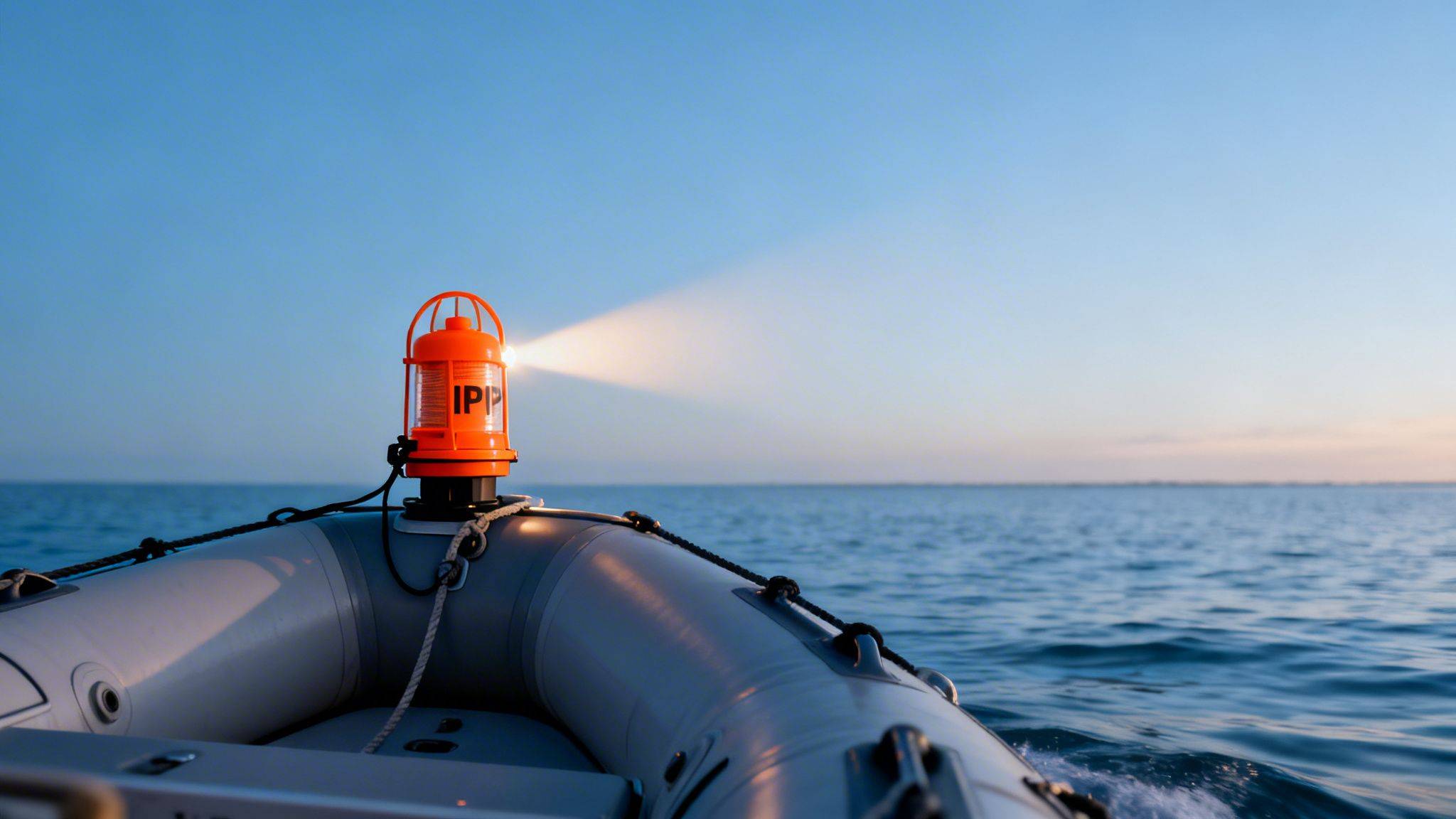
Read owner storiesThink of an EPIRB as your ultimate insurance policy on the water. It’s a direct line to rescuers when every other form of communication has failed—your ‘Triple Zero’ call for the ocean. For anyone looking at inflatable boats for recreational use, understanding this gear is essential.
An Emergency Position Indicating Radio Beacon, or EPIRB, is your lifeline when you’re in grave and imminent danger. It’s designed to transmit a powerful distress signal to a global satellite network, pinpointing your exact location so search and rescue authorities can find you.
What Is an EPIRB and Why It’s Your Lifeline at Sea
Picture this: you’re out on your inflatable boat, a good distance from shore, when the unexpected happens. Maybe the engine dies, a sudden storm rolls in, or someone on board has a medical emergency. You’re out of mobile range and your VHF radio is getting nothing but static. You’re totally on your own.
This is exactly the scenario where an EPIRB becomes the single most important piece of boating safety equipment you can possibly own.
An EPIRB is a compact, tough, waterproof, and buoyant device built for one job: saving lives in a maritime emergency. When you activate it—either manually yourself, or automatically if it hits the water—it blasts a powerful digital distress signal on the dedicated 406 MHz frequency.
That signal doesn’t rely on mobile towers or local radio repeaters. It beams straight up to the international Cospas-Sarsat satellite network, a system designed exclusively to detect and locate distress beacons anywhere on the planet. Once a satellite picks it up, the signal is relayed to a ground station and sent directly to the Australian Maritime Safety Authority (AMSA) response centre in Canberra.
How Your Signal Triggers a Rescue
From that moment, a full-scale search and rescue (SAR) operation kicks into gear. AMSA uses the unique code embedded in your EPIRB’s signal to identify your vessel from their registration database. This gives them crucial details like your boat’s description and your emergency contacts, which is vital for a fast and effective response.
The journey of an EPIRB signal is simple, direct, and incredibly reliable.
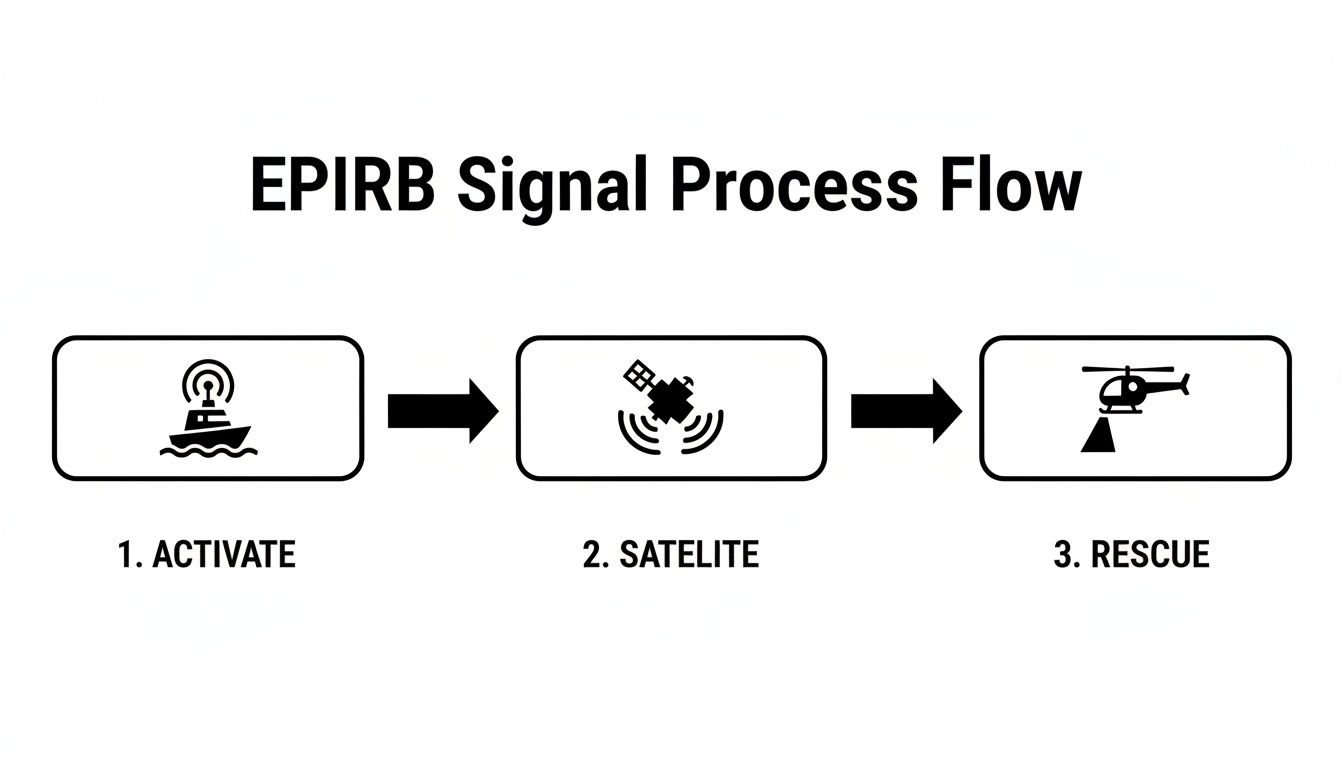
As you can see, the system is built to work when everything else has failed, bypassing all the usual communication networks to get help on its way.
The Power of GPS Precision
These days, almost every new EPIRB comes with a built-in GPS, and it’s an absolute game-changer. A non-GPS beacon can narrow your location down to a 5-kilometre radius, which is good, but not great when every minute counts.
A GPS-enabled EPIRB, on the other hand, can pinpoint your exact position to within +/- 50 metres.
This precision makes a massive difference. A GPS-equipped unit can alert authorities in as little as 3 minutes, while a basic model might take up to 45 minutes for its first alert to be confirmed. Aussies have one of the highest rates of beacon ownership in the world, with over 480,000 registered devices, and this technology is saving lives.
In a real-life rescue off Exmouth in Western Australia, it took just one hour from the moment the EPIRB was activated to help arriving on the scene. That incredible response time is only possible thanks to precise GPS data reaching AMSA’s Canberra centre almost instantly.
Ultimately, an EPIRB offers peace of mind. Whether you’re exploring on an inflatable catamaran or just pottering around in a tender, it ensures that no matter how remote your adventure takes you, help is just the press of a button away. For those planning a family outing, this safety feature is non-negotiable.
Understanding Australian EPIRB Laws and Requirements
Trying to figure out exactly when you need an EPIRB can feel a bit like wading through mud, but the rules are there for one simple reason: to keep you safe. In Australia, carrying an EPIRB isn’t just a smart move—it’s the law once you travel a certain distance from shore. These regulations create a clear safety net, giving rescue services the best possible chance of finding you when things go wrong.
For most boaters, the ‘two nautical miles from shore’ rule is the one to remember. While it can vary a little from state to state, it’s a critical line in the sand. Once you cross it, you’re in waters where self-rescue is a lot harder, and an EPIRB becomes your mandatory lifeline.
When Is an EPIRB Legally Required?
The exact rules depend on where you are and the type of water you’re in. It’s vital to get your head around the laws for your state because they are strictly enforced. The fines for not having one are hefty, but the real cost of being caught without an EPIRB is something you can’t put a price on.
These laws don’t discriminate. They apply to all vessels, from big cruisers right down to nimble inflatable boats and even inflatable catamarans. If your day on the water takes you beyond the designated limits, you must have a registered and working EPIRB on board. This is a key feature to consider when you compare prices and features of inflatable boats.
For instance, in South Australia, you’re required to carry a 406 MHz EPIRB if you’re operating more than three nautical miles from the coast. Queensland has a similar rule for boats travelling more than two nautical miles from land in open waters, although some smaller, lightweight boats might get away with carrying a PLB instead. No matter where you are, the Australian Maritime Safety Authority (AMSA) requires that your beacon meets the AS/NZS 4280.1:2022 standard and is properly registered. You can find all the details on South Australia’s beacon requirements to see how these regulations work in practice.
What This Means for Inflatable Boat Owners
If you own an inflatable boat, whether it’s a small tender or a larger model, you need to pay close attention. The beauty of these boats is how easily they let you explore further offshore, which means you can quickly cross that legal line where an EPIRB becomes compulsory.
Remember, the law doesn’t care if your boat is made of fibreglass or PVC. What matters is how far you are from shore—that’s what dictates your legal responsibility to carry an EPIRB.
Storage space on an inflatable can be tight, so it’s smart to plan exactly where you’ll mount or stow your beacon so you can grab it in a hurry. The registration is just as important. You can learn more about why proper AMSA registration for your beacon is so crucial; it’s what connects your device to your boat and your emergency contacts. This simple, free step is what turns a piece of plastic into a direct call for help.
EPIRB vs PLB vs AIS: Choosing the Right Beacon for Your Boat
With a few different safety beacons on the market, picking the right one can feel a bit confusing. It’s a critical choice, because while they might look similar, an EPIRB, a Personal Locator Beacon (PLB), and an AIS-SART serve very different functions. Getting this right means your safety gear will actually match the kind of boating you do.
An EPIRB (Emergency Position Indicating Radio Beacon) is the gold standard for your vessel. It’s registered directly to your boat and designed for serious maritime emergencies. Think of it as your boat’s ultimate distress call, ready to signal global rescue services if you’re in grave and imminent danger.
A PLB (Personal Locator Beacon), on the other hand, is registered to a person, not a boat. It’s small, portable, and designed to be kept on you—in a pocket or attached to a life jacket. This makes it perfect for a solo kayaker or a crew member who might fall overboard from an inflatable catamaran.
Finally, an AIS-SART (Automatic Identification System Search and Rescue Transponder) is mainly a collision avoidance and local rescue tool, not a distress beacon that contacts global authorities. It alerts nearby vessels of your position, which is fantastic for man-overboard situations in busy waters but doesn’t trigger an official search and rescue mission via satellite.
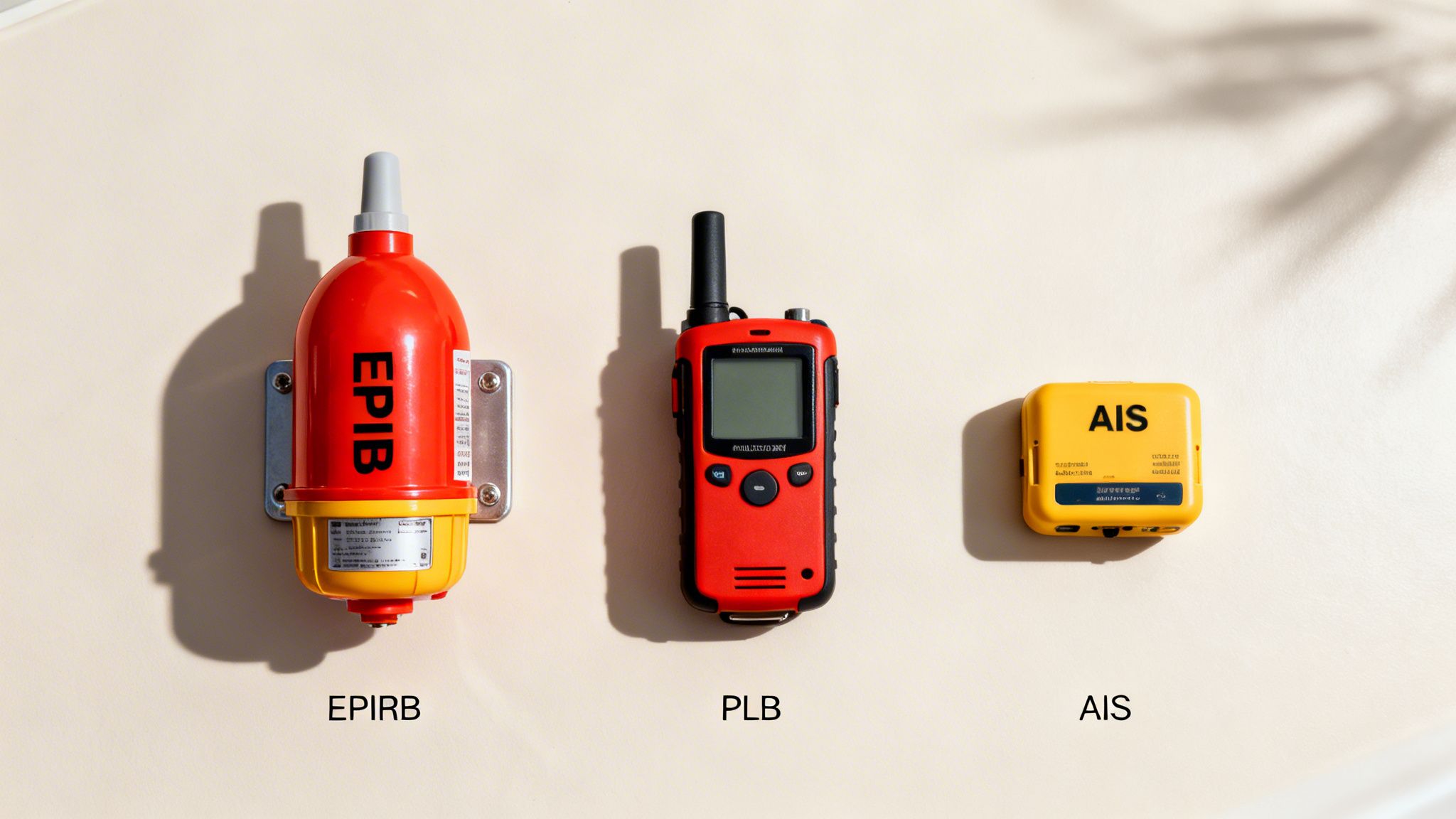
Core Differences at a Glance
The key distinctions really boil down to who (or what) they’re registered to, how long they last, and how they’re activated. An EPIRB is your vessel’s lifeline. A PLB is a personal one.
- Registration: An EPIRB is tied to your boat’s identity. A PLB is tied to you personally.
- Activation: Many EPIRBs can activate automatically when they hit the water, a crucial feature if a boat capsizes or sinks suddenly. PLBs are always manually activated.
- Operating Life: An EPIRB must transmit for a minimum of 48 hours, giving rescuers a long window to find you. A PLB is only required to broadcast for 24 hours.
Think of it this way: The EPIRB saves the ship, and the PLB saves the person. For a family cruising the coast on their inflatable boat, the EPIRB is non-negotiable. A PLB is the essential backup for each individual on board.
Making the Right Choice for Your Inflatable Boat
For any inflatable boat owner travelling more than two nautical miles from shore, an EPIRB is the correct and legally required choice. Its superior battery life and automatic activation features provide the highest level of safety for everyone on board. If you’re looking for the best inflatable boats for recreational use available near you, make sure an EPIRB is part of your budget.
A PLB is an excellent addition, especially for those fishing alone or for crew members on larger inflatable catamarans. It ensures that if someone goes overboard and gets separated from the vessel, they still have a direct line to rescuers.
And while an AIS-SART is a great local alert system, it relies on other boats being close enough and equipped to receive the signal. It’s a fantastic tool for high-traffic areas but lacks the global reach of a true satellite beacon. Knowing how these systems work, including their interaction with your VHF marine antenna setup, is the key to building a complete and reliable safety plan.
To make it even clearer, here’s a quick comparison of the three main types of beacons. This table should help you decide which device, or combination of devices, best suits your boat and your adventures on the water.
EPIRB vs PLB vs AIS-SART Quick Comparison
| Feature | EPIRB (Emergency Position Indicating Radio Beacon) | PLB (Personal Locator Beacon) | AIS-SART (Automatic Identification System Search and Rescue Transponder) |
|---|---|---|---|
| Primary Use | Vessel in distress | Person in distress | Collision avoidance & Man Overboard (MOB) |
| Registration | Registered to the vessel | Registered to a person | Programmed to the vessel (MMSI) |
| Activation | Manual or automatic (water-activated) | Manual only | Manual or automatic (water-activated) |
| Battery Life | 48+ hours | 24+ hours | Varies (local signal) |
| Signal Range | Global (via COSPAS-SARSAT satellite system) | Global (via COSPAS-SARSAT satellite system) | Local (VHF radio, a few nautical miles) |
| Best For | All vessels travelling offshore or more than 2nm from shore | Solo boaters, crew members, hikers, pilots | High-traffic areas, MOB situations |
Ultimately, for boat owners, an EPIRB is the foundational piece of safety equipment. A PLB adds a crucial layer of personal protection, while an AIS-SART enhances your safety in busy waterways. For most inflatable boat adventures that take you offshore, the EPIRB is the one you can’t go without.
How to Select the Perfect EPIRB for Your Inflatable Boat
Picking the right EPIRB for your inflatable isn’t about grabbing the most expensive one off the shelf; it’s about matching the right features to the way you boat. For owners of inflatables—from zippy tenders to spacious inflatable catamarans—space is tight and mounting options are limited. This guide will help you zero in on what really matters.
First things first: always, always get a model with built-in GPS. A GPS-enabled EPIRB shrinks the search area from a massive 5-kilometre radius down to a pinpoint +/- 50 metres. That’s a huge difference when rescue crews are trying to find you, and it can shave critical hours off your wait time.
Next up is how the beacon actually turns on. EPIRBs come in two main flavours, and for inflatable boaties, this choice is a big one.
Manual vs Automatic Activation
Understanding the difference here is vital, especially on an inflatable where a capsize can happen in a flash.
- Manual Activation (Category 2): You have to physically switch these beacons on yourself. They usually sit in a simple quick-release bracket. This is a solid, common-sense choice, but it does rely on you or a crewmate being able to get to it and activate it in an emergency.
- Automatic Activation (Category 1): These units live inside a special housing that automatically deploys and activates the beacon when it’s submerged. They’re fantastic for larger vessels where a capsize could make the beacon impossible to reach, but the bulky housing is often a real pain to mount on an inflatable.
For most inflatable catamarans and tenders, a manual Category 2 EPIRB is the most practical and reliable solution. Its smaller size makes it far easier to mount securely where it’s out of the way but still within arm’s reach. And while you’re at it, make sure the rest of your gear is up to scratch by checking a proper boat safety equipment checklist for Aussie waters.
Battery Life and Mounting Solutions
Every EPIRB sold in Australia is required to transmit its distress signal for at least 48 hours. The battery itself, however, has a much longer shelf life—usually somewhere between 5 to 10 years. Always check the expiry date before you buy, as getting it replaced involves sending it to a certified technician and can be a hefty cost.
The best EPIRB in the world is useless if it’s buried under a pile of gear in a storage locker. On an inflatable, access is everything. Your beacon needs to be mounted where you can grab it in seconds, without a second thought.
Mounting an EPIRB on an inflatable boat takes a bit of creative thinking. You could use a purpose-built rail mount on the transom or fix a custom bracket to a seat. The main goal is to keep it safe from spray and knocks, but ready to go instantly. Never, ever just toss it in a dry bag and hope for the best.
Registering and Testing Your EPIRB with AMSA
AMSA Ship Registration - YouTube
Tap to unmute
AMSA Ship Registration Australian Maritime Safety Authority

Australian Maritime Safety Authority3.92K subscribers
So you’ve got an EPIRB for your boat. Fantastic—that’s a huge step towards safer boating. But owning the beacon is only half the job. An unregistered EPIRB is like having an emergency phone that can’t tell anyone who’s calling. It can send out a signal for help, sure, but rescuers won’t know who you are, what your boat looks like, or who to call to confirm it’s a real emergency.
This is exactly why registering your device with the Australian Maritime Safety Authority (AMSA) is a legal requirement, but more importantly, it’s what makes your EPIRB truly effective. Registration is completely free and turns your anonymous distress signal into a detailed rescue profile.
When your beacon is activated, AMSA doesn’t just see a dot on a map. They instantly see your boat’s name, size, and colour, plus your emergency contacts. This isn’t just admin—it’s critical information that helps them verify the situation and send the right help, fast.
The Simple Steps to AMSA Registration
Getting your EPIRB registered is refreshingly straightforward. The whole process is designed to be quick and painless so you can get back on the water with genuine peace of mind.
- Head Online: Go to the official AMSA beacons registration website.
- Create an Account: You’ll need a free account to manage your details. It only takes a minute.
- Enter Beacon Details: Find the HexID (sometimes called a UIN) on the side of your EPIRB and punch it in.
- Provide Vessel and Personal Info: Add the details about your boat and list at least one reliable emergency contact.
- Confirm and Submit: Give everything a final check to make sure it’s all correct, then hit submit. You’re done.
Registration is valid for two years, and AMSA is great at sending out reminders when it’s time to renew. It’s your responsibility to jump online and update your details if you sell your boat or change your contact information. Keeping it current ensures rescuers have the right info when it matters most.
How to Safely Test Your EPIRB
You wouldn’t head out to sea without checking your fuel, and your EPIRB is no different. You need to know it’s working. But testing it has to be done carefully to avoid triggering a massive and unnecessary rescue operation.
Thankfully, every modern EPIRB has a built-in self-test function designed for this exact purpose. The process is dead simple and takes just a few seconds.
Usually, it’s as easy as pressing a dedicated “test” button. The beacon runs a quick internal check of its battery and circuitry, then confirms everything is A-OK with a flash of light or a series of beeps. Critically, this does not send a distress signal to the satellite network.
Always read the manual for your specific model, as the exact steps can vary. If you want to see how this works on a popular model, you can learn more about the features of an ACR rescue beacon and its testing procedure. A simple check every few months gives you the confidence that your lifeline is ready to go if you ever need it.
EPIRB Maintenance and Common Mistakes to Avoid
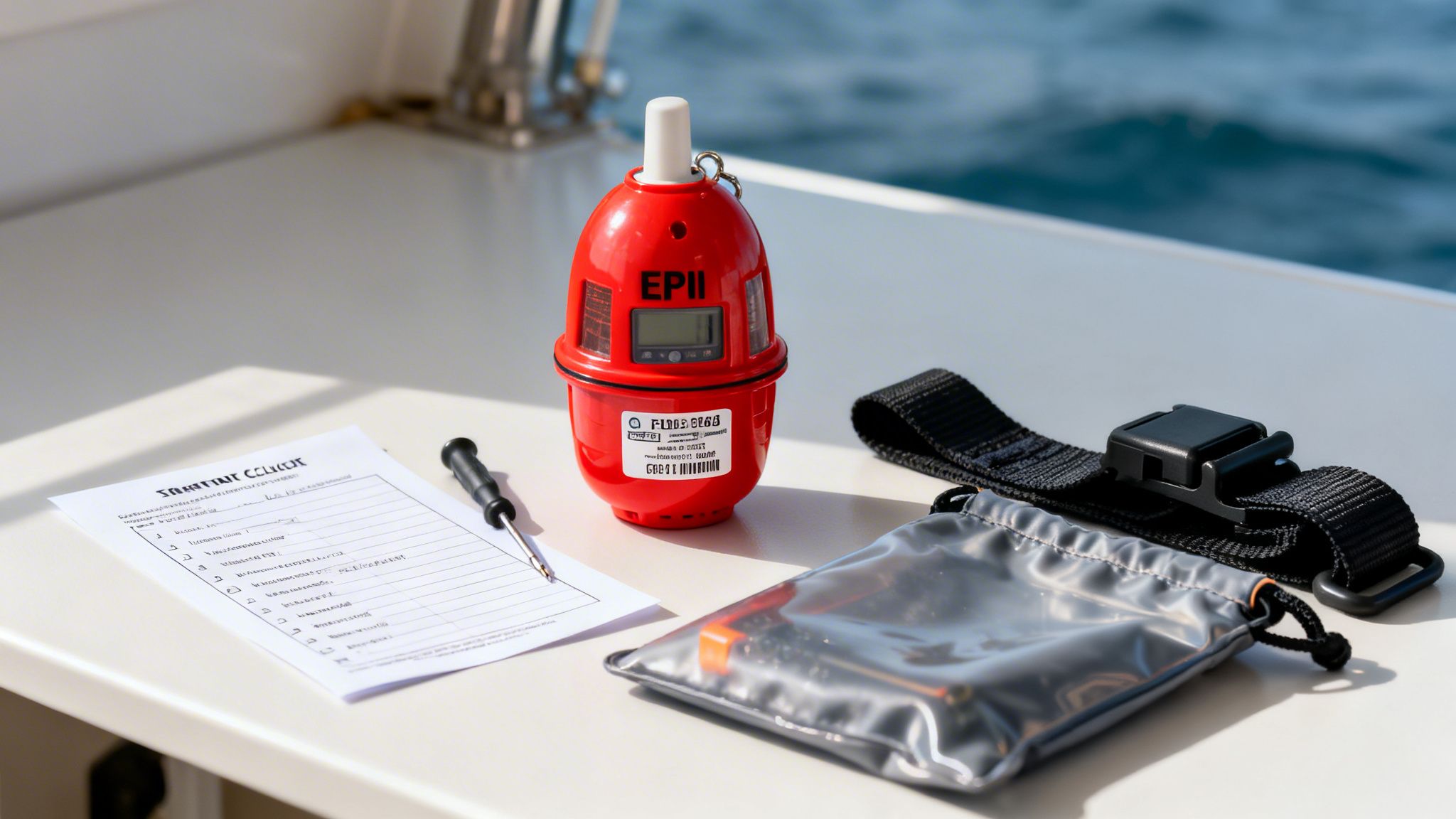
Your EPIRB is engineered to be a tough, reliable bit of kit that requires minimal fuss. That said, a “set and forget” attitude is a huge risk when it comes to life-saving equipment. A few simple, regular checks are all it takes to make sure your beacon is ready to perform when you need it most.
Proper maintenance isn’t complicated. It really just boils down to routine visual inspections and keeping a close eye on one very important date. This proactive approach will help you sidestep the most common—and potentially costly—mistakes that could render your beacon useless.
Simple Care for Long-Term Readiness
Your EPIRB maintenance checklist is short, but every point is non-negotiable. Get into the habit of running through these steps every few months and definitely before any big trip.
- Visual Inspection: Give the casing a good look-over for any cracks, damage, or serious wear and tear. Make sure the antenna is straight and flips up freely without sticking.
- Battery Expiry Date: This is the big one. The expiry date is always clearly marked on the unit itself. Once that date passes, the battery must be replaced by an authorised service agent to maintain its performance and, just as importantly, its waterproof seal.
- Clean Contacts: Keep the unit and its mounting bracket clean and free from salt corrosion. A quick wipe-down with a fresh, damp cloth is usually all it needs.
- Secure Mounting: Jiggle the beacon to make sure it’s clipped securely into its bracket. Then, check that the bracket itself is still firmly attached to the boat. On an inflatable, this is absolutely crucial to prevent it from being knocked loose in choppy seas.
Costly Mistakes Boaters Often Make
A few common slip-ups can easily compromise your safety net. The biggest mistake we see is people simply not knowing what to do if they accidentally trigger their beacon.
If you set off your EPIRB by mistake, switch it off immediately. Your next step is non-negotiable: you must phone AMSA’s 24/7 emergency line on 1800 641 792. Let them know it was a false alarm and give them your beacon’s HexID. There’s no penalty for this as long as you report it quickly—it saves a massive and expensive rescue effort from being launched.
Another frequent issue is improper storage. Stowing your EPIRB where it can get soaked, bashed around, or buried under other gear is a recipe for damage or accidental activation. For inflatable boat owners, it’s vital to have it mounted securely so it can’t be lost overboard when the weather turns rough.
Your EPIRB Questions Answered
When it comes to EPIRBs, a few questions pop up time and time again from Aussie boaters. Let’s clear up the common queries so you can head out on the water with complete confidence.
How Often Do I Need to Replace My EPIRB Battery?
In Australia, the rule is simple: your EPIRB battery must be replaced before the expiry date stamped on the unit. This is typically every 5 to 10 years.
This isn’t a DIY job you can tackle in the garage. It’s a legal requirement that the replacement is handled by an authorised service agent. They have the right tools to ensure the beacon is properly sealed, waterproof, and ready for another round of service.
What Should I Do If I Accidentally Activate My EPIRB?
First things first, don’t panic. If it’s safe to do so, switch the device off immediately.
Next, you must call the Australian Maritime Safety Authority (AMSA) on their 24/7 emergency line: 1800 641 792. Let them know it was a false activation and give them your beacon’s HexID. There are no penalties for accidental activations, as long as you report them straight away.
Can I Use a PLB Instead of an EPIRB on My Inflatable Boat?
Sometimes, but an EPIRB is almost always the smarter—and legally required—choice for your boat. A PLB has a much shorter battery life (think 24+ hours versus 48+ hours for an EPIRB) and is registered to a person, not the vessel itself.
While some states like Queensland might allow PLBs on smaller craft in very specific waters, a proper EPIRB for boat use is the recognised standard for offshore safety. When in doubt, stick with an EPIRB and always double-check your local maritime regulations. If you’re looking to hire inflatable boats for a family outing in Australia, ask the rental company about the safety equipment included.
Ready to find the perfect safety solution for your adventures? The team at Easy Inflatables can help you choose the right gear, from inflatable catamarans to essential safety equipment. Explore our range and get expert advice today.
Share the post now

Set Sail with Easy Inflatables
Experience the ultimate freedom on the water with our top-quality inflatable boats and accessories. Easy Inflatables is your trusted partner, providing everything you need for a safe and unforgettable adventure.
Categories
- Accessories & Gear (84)
- Adventure Destinations (63)
- Boat Accessories & Setup (25)
- Boat Comparisons (7)
- Boat Trailers (12)
- Boating Safety Gear (5)
- Catamaran Boats (12)
- Customer Stories & Experiences (4)
- Inflatable Boat Guides (47)
- Inflatable Boats & Kayaks (149)
- Inflatable Catamarans (12)
- Maintenance & Care (114)
- Outboard Motors (53)
- Outdoor Activities (26)
- Product Comparisons & Reviews (108)
- Setup & Safety Tips (52)
- Special Offers & Promotions (2)
- Sustainability Tips (13)
- Types of Boats (47)
Related Post
Your Guide to the Best Waterproof Battery Box of 2026
Sea Trail Boat Trailers A Complete Australian Guide
Choosing the Best Electric Trolling Engine: 2026 Guide
Inflatable Motorised Boat A Buyer’s Guide for Australia
Stay Connected
Join our community of water adventure enthusiasts! Sign up for Easy Inflatables' monthly newsletter for exclusive tips, product updates, and insights to make the most of your outdoor adventures.
Explore the Aerowave range
Weekend-Proof Score 17 questions · about 2 minutes
Will the boat you're about to buy survive an Australian summer?
Seventeen straight questions about where you'll use it, what you'll ask of it and the boat you're weighing up. You get a score out of 100, the exact weak points in your plan, and the one boat that genuinely fits.
Free · your result shows on screen · no email required
So which one is yours?
Pick how you'll actually use it and we'll take you straight to the right hull.
I want to fish it
Open bow, rod holders, deck space you can stand and cast from.
Viper Sport 400Family, diving and the beach
3.8 m Series 3 catamaran — low bow to climb back in wearing fins or a tank.
WaveRunner 380Tender / one-person launch
3.3 m hard-floor boat that packs into a bag and still takes a beach landing.
Viper 330Shop gear featured in this guide
Aerowave WaveRunner 380 Series 3 Catamaran Package
The WaveRunner 380 Series 3 is a premium 3.8m inflatable catamaran package built for Australian and worldwide families, fishing, and coastal day boating — ideal for snorkeling and spearfishing — offering serious stability and premium German Valmex® construction.
Free freight to United States · local taxes payable on arrival
Aerowave Viper 400 Sovereign
Flagship 4m enclosed-bow inflatable catamaran. German VALMEX® 7321 Heavy Plus 1.2mm commercial-grade fabric, 10 PSI high-pressure drop-stitch air deck floor with VALMEX non-slip surface, LockPro wheels, full Bimini and FREE express delivery Australia-wide included. Winter special — save $1,000 until 31 August 2026.
Free freight to United States · local taxes payable on arrival

Aerowave Viper 365 Open Bow
Premium 3.65m Inflatable catamaran — built the same way as our flagship Viper 400 sports boat, just 35cm shorter. German VALMEX® 7321 Heavy Plus 1.2mm commercial-grade fabric, 10 PSI high-pressure drop-stitch air deck floor with VALMEX non-slip surface, LockPro wheels, full Bimini and FREE express delivery Australia-wide included.
Free freight to United States · local taxes payable on arrival
Not sure which suits you? Talk to a real boat owner.
Before you spend a cent
Buying from Australia, delivered to United States
You have never heard of us, we are on the other side of the world, and the internet is full of fakes. Fair enough. Here is everything you would need to check us out, in one place — no forms, no chat bot.
Australian designed business
Easy Inflatables, Avoca Beach NSW 2251. ABN 96 856 548 613. International orders ship from our Hong Kong hub.
222 owner reviews, 4.8 average
Read them in full, good and bad, on our reviews page.
CE certified, 7-year hull warranty
ISO 6185-3 and EU Directive 2013/53/EU. Warranty honoured worldwide.
Tracked, insured, door to door
FREE freight to United States · local tax/duty on arrival.
- Who am I actually buying from?
- Easy Inflatables, Avoca Beach NSW 2251, Australia. ABN 96 856 548 613. Sean is the owner and skipper, Gary Stewart handles sales on +61 2 4335 1603, Karen Matthews handles email. The boats are Australian designed; international orders ship from our Hong Kong dispatch hub so your landed price stays competitive. Phone us before you pay a cent — a real person answers.
- Is this really an Australian product?
- Yes — Australian designed and engineered on the NSW Central Coast. Manufacturing is done offshore to our spec, and international orders ship direct from our Hong Kong dispatch hub. If we routed every boat through Australia first, the freight alone would roughly double or triple your cost for the same hull.
- What do I pay, and what is not included?
- The delivery and import terms depend on your country. EU, UK, New Zealand and named Asia/Pacific lanes include duty and tax; US freight is free but US buyers pay import charges on arrival. Other destinations show their terms before payment.
- How do I pay safely?
- Card through Stripe (Visa, Mastercard, Amex, Apple Pay, Google Pay) or bank transfer. Card payments carry your bank's own dispute protection. We never ask for crypto, gift cards or payment to a personal account.
- What if it arrives damaged?
- Every boat ships fully tracked and insured door to door. Photograph the carton and the boat on arrival and email us — transit damage is claimed and replaced through us, not left with you and the courier.
- Is the warranty real outside Australia?
- Yes. The 7-year hull warranty on 1.2 mm VALMEX Heavy Plus and Orca Hypalon hulls applies wherever you are. Replacement parts are held in Australia and at our overseas hub and go out by express courier to your door.
- Is the boat actually certified?
- All Aerowave catamarans are CE certified to ISO 6185-3 and EU Directive 2013/53/EU. Certification paperwork is supplied with the boat — ask and we will send it before you order.
Ready to set sail?
Premium German-fabric inflatable catamarans, built to order and delivered to your door. Talk to our team or browse the fleet.
Like this guide? Get the next one in your inbox.
Owner-tested tips, gear deep-dives and Aussie boating know-how — no spam.