
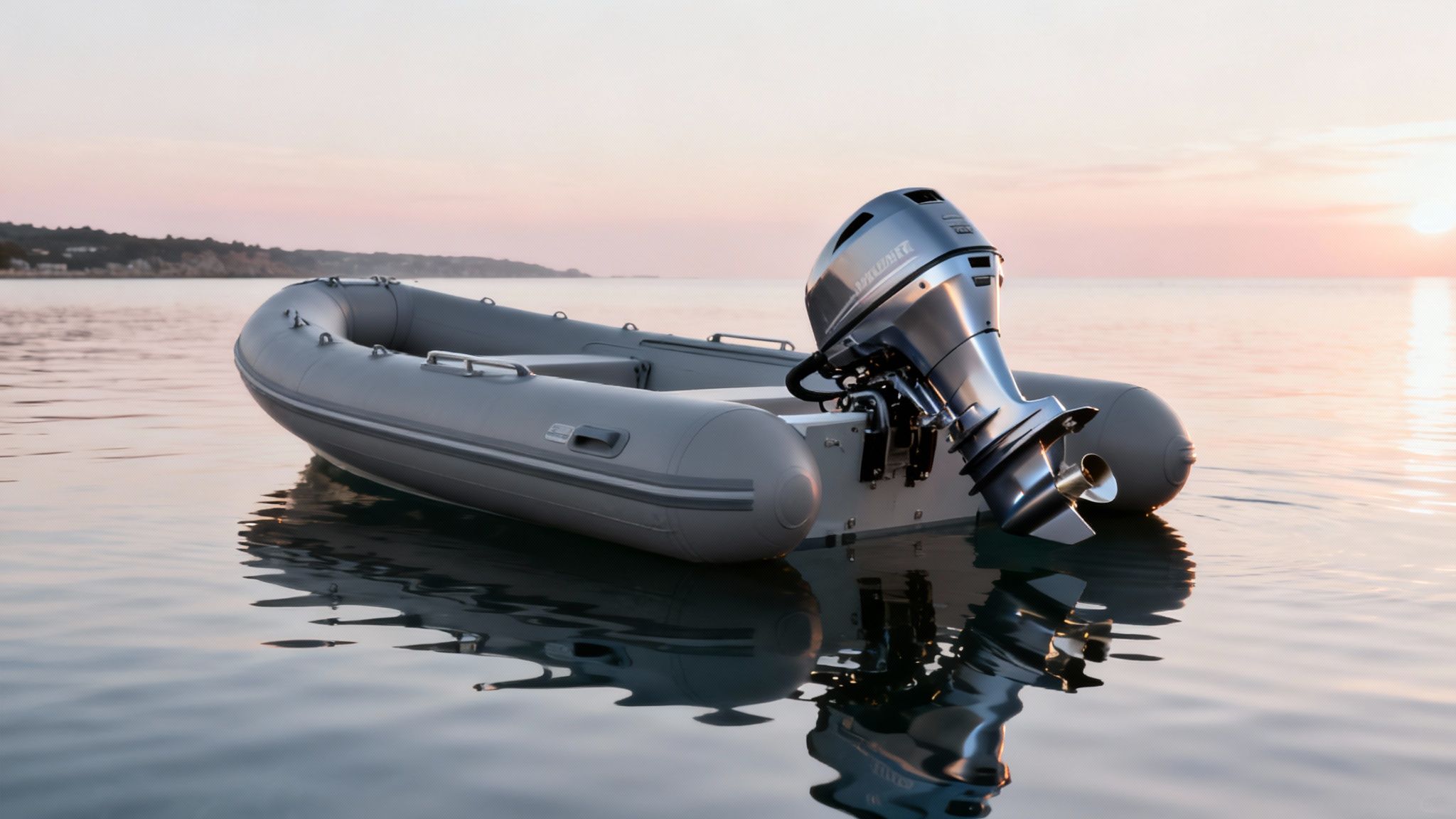
Choosing the right motor for an inflatable boat comes down to a simple trade-off: quiet, lightweight electric models for calm waters, or powerful petrol outboards for bigger adventures. No matter which way you’re leaning, your boat’s capacity plate is the final word, telling you exactly what horsepower and weight it can safely handle. Finding the right motor is key to enjoying recreational use on the water, whether you’re looking for a quiet day of fishing or a fun family outing.
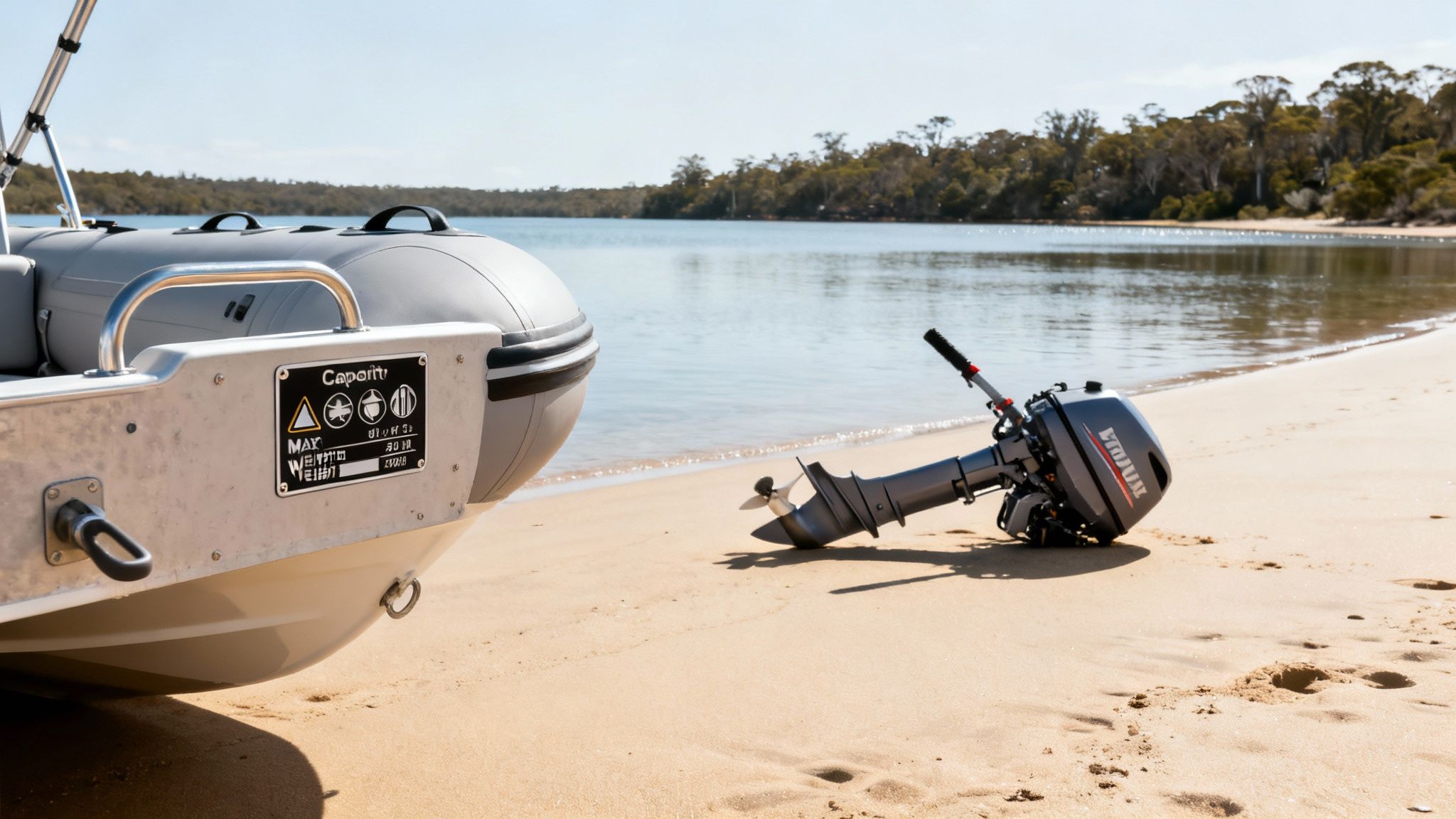
Picking the perfect motor is what separates a brilliant day on the water from a deeply frustrating one. It’s not about slapping the most powerful engine on the back; it’s about finding the right one for your specific boat and how you’ll actually be using it. Whether you are looking for the best inflatable boats for recreational use or need a reliable option for a family outing in Australia, getting this decision right dials in your boat’s performance, safety, and your overall enjoyment for years to come.
Here in Australia, the love for inflatable boats is booming. The market has swelled to around AUD 25 million, jumping 7.3% in just one year as more Aussies get out on the water. The motors for these boats are just as varied, from tiny electric trolling motors (0.5 to 3 horsepower) for stealthy fishing in estuaries, all the way up to punchy petrol outboards (up to 20 horsepower) needed for tackling coastal chop. Comparing prices and features is a crucial step for anyone in the market.
Before you even think about comparing brands or prices, find the capacity plate on your boat. It’s a small metal or plastic plate, usually fixed to the transom or inside the hull, and it is your single most important guide. This is the manufacturer telling you, in no uncertain terms, what the boat was designed to handle.
The capacity plate will clearly state:
Ignoring these numbers isn’t just a bad idea—it’s dangerous. An overpowered boat becomes unpredictable and can even cause the transom to fail under stress. Likewise, a motor that’s too heavy will make the boat handle poorly and increase the risk of taking on water.
To get this match just right, have a look at our detailed guide on selecting an inflatable motorised boat.
To simplify things, here’s a quick reference table to help you compare features and narrow down your options based on your boat’s size.
| Boat Size (metres) | Recommended HP Range | Engine Type (Ideal Use) | Shaft Length (Typical) |
|---|---|---|---|
| 2.0 – 2.7 | 2.5 – 6 HP | Electric (quiet bays), Small Petrol | Short (15″) |
| 2.7 – 3.3 | 5 – 9.9 HP | Petrol (all-rounder), Electric | Short (15″) |
| 3.3 – 4.0 | 9.9 – 15 HP | Petrol (coastal, heavier loads) | Short (15″) |
| 4.0+ | 15 – 25 HP | Petrol (offshore, speed, towing) | Long (20″) |
This table is a great starting point, but always, always double-check your boat’s specific capacity plate before making a final decision.
Now, think about what a typical day on the water looks like for you. Are you after a quiet motor for a relaxed family outing in a calm bay? Or do you need enough grunt to cover serious distance while fishing offshore? The perfect motor is the one that fits your lifestyle.
A common mistake is getting fixated only on horsepower. A heavy 15 HP motor might technically be within a boat’s rating, but a lighter 9.9 HP could give you far better balance and all-round performance, especially if you’re often boating solo. Always consider the total weight.
Whether you’re exploring a local lake or cruising along the coast, matching the motor to your main activity guarantees you get the best efficiency and the most fun. A small, portable motor is brilliant for quick, spontaneous trips. A larger, more powerful engine, on the other hand, makes perfect sense for those planning longer journeys or regularly carrying more passengers and gear.
Ultimately, your adventure defines your motor.
Choosing between an electric and a petrol outboard is one of the biggest calls you’ll make for your inflatable boat. This is the classic debate, and it goes way beyond just noise levels or fuel. Your choice will literally shape how and where you get to enjoy your boat, so it pays to think about what your typical day on the water actually looks like.
Imagine you’re an angler hoping to sneak into a sensitive waterway or a quiet estuary. An electric motor is your best mate here. Its near-silent operation won’t spook the fish, and the zero emissions mean you can access those eco-sensitive spots where petrol motors are often banned. It’s all about stealth and leaving no trace.
But what if you’re planning to cover more ground? Maybe exploring coastal islands or loading up the family for a full day trip? In that case, the reliable power and sheer range of a petrol motor are pretty hard to beat. You get the confidence to tackle changing conditions and the freedom to travel further without one eye glued to a battery gauge.
It’s easy to get fixated on the sticker price, but the true cost of owning a motor only reveals itself over time. Petrol outboards usually have a lower upfront cost for the same amount of power. But don’t forget to factor in the ongoing costs of fuel, oil, and more frequent maintenance like swapping out spark plugs and filters.
Electric motors often ask for a higher initial investment, especially once you add a top-notch lithium battery and a good charger to your cart. The payoff? Their running costs are incredibly low. You’re paying for a bit of electricity instead of a tank of petrol, and the maintenance is minimal—often just a quick inspection and a clean-up.
Your decision really boils down to which motor is the right tool for your kind of boating.
Think about these scenarios:
To make it even clearer, let’s break down the key differences side-by-side. Every boater’s needs are different, so seeing the trade-offs in black and white can really help you compare prices and features to figure out what matters most for your adventures.
| Feature | Electric Motor | Petrol Motor |
|---|---|---|
| Noise Level | Near-silent operation | Noticeable engine noise |
| Emissions | Zero emissions (eco-friendly) | Produces exhaust fumes |
| Upfront Cost | Generally higher | Generally lower |
| Running Costs | Very low (electricity) | Higher (fuel, oil) |
| Maintenance | Minimal (cleaning, checks) | Regular (plugs, filters, oil) |
| Range | Limited by battery capacity | Limited by fuel tank size |
| Power | Instant torque, but lower top speed | Higher horsepower and top speed |
| Weight | Lighter motor, heavy battery | Heavier motor unit |
| Best For | Fishing, tenders, eco-sensitive areas | Long distances, heavy loads, speed |
Ultimately, the best motor is the one that fits how you actually use your boat. Be realistic about your needs so you’re not paying for power you’ll never use or getting caught short on a trip.
It’s also worth noting that technology is constantly improving the performance of motors designed for inflatable boats in Australia. This is especially true for electric options, which are gaining huge popularity for their quiet operation and simple upkeep. In fact, market data shows that sales of electric outboard motors for inflatables in Australia have jumped by over 30% in recent years. You can see more on this trend from a recent market analysis on rigid inflatable boats.
The key takeaway is to be realistic about your needs. Don’t pay for petrol power you’ll never use, but also don’t get caught out with an electric motor that doesn’t have the range for your planned adventures.
To dive deeper into the specifics, check out our guide on the best electric outboard motors available in Australia for a detailed breakdown. By weighing these practical trade-offs, you can confidently pick the power source that’s going to give you the best days out on the water.
When it comes to powering your inflatable boat, horsepower and shaft length are way more than just numbers on a spec sheet. These two measurements are the absolute cornerstones of your boat’s performance, how efficiently it runs, and, most critically, its safety out on the water. Getting them wrong isn’t a small mistake—it can lead to everything from frustratingly poor handling to serious, costly damage to your transom.
First things first, find your boat’s capacity plate. This legally required plate is your bible—it tells you the absolute maximum horsepower (HP) the transom was designed to handle. Overpowering your boat is a recipe for disaster. It puts immense stress on the transom, can make the bow lift dangerously high, and turns the boat into an unpredictable beast that’s incredibly difficult to control. A small 3.5 HP motor might be perfect for a tender, but on a 4-metre boat loaded for a family outing, it would be dangerously underpowered against a current.
Picking the right horsepower isn’t about pushing the limits and maxing out the rating. It’s about finding the perfect balance between the engine’s power, your boat’s size, and what you actually plan to do with it. Often, a lighter motor that’s well within the boat’s limits gives you a much better-balanced and more enjoyable ride than a heavier, max-rated one.
Let’s look at a few real-world setups for recreational use:
Just as vital as horsepower is the motor’s shaft length. The goal is simple: you want the propeller and the cavitation plate (that flat plate just above the prop) to sit just below the bottom of the hull while you’re moving. This position ensures the prop gets a clean, uninterrupted flow of water to bite into.
The wrong shaft length is one of the most common and costly mistakes we see. A shaft that’s too short will cause the propeller to suck air from the surface—a phenomenon called ‘ventilation’—which results in a sudden loss of power and can potentially damage the engine. On the flip side, a shaft that’s too long creates a huge amount of drag, absolutely killing your speed and fuel efficiency.
Most inflatable boats here in Australia are designed for a short shaft (15 inches), but you absolutely must measure your own transom to be sure. It’s easy—just measure the vertical distance from the top of your transom (where the motor clamps on) straight down to the bottom of the hull. That measurement tells you exactly what you need.
The Aussie inflatable boat scene has exploded in recent years, with over 120,000 motorised units sold for recreational fun. This boom, especially with the rise of Rigid Hull Inflatable Boats (RHIBs), shows just how much people value powerful and stable motor technology. You can discover more insights on the Australian inflatable boats market to see the full picture. Nailing these fundamental specs is your first step to safely joining this growing community of adventurers.
You’ve picked out the perfect motor for your inflatable boat—now it’s time to get it mounted securely. This part is pretty straightforward, but getting it right is crucial for both safety and performance. A motor that’s not installed correctly can vibrate like crazy, run poorly, and in a worst-case scenario, decide to take a swim without you.
First things first: lifting the thing. Even the smaller outboards are awkward and can be deceptively heavy. To save your back, always lift with your legs, not your waist, and keep the motor hugged in close to your body. If you’re wrestling with a heavier engine, don’t be a hero—grab a mate to help you out.
With the motor in hand, carefully lower it onto the centre of your boat’s transom. The mounting bracket should slide down neatly over the transom plate. Once it’s sitting flush, start tightening the two clamp screws by hand until they’re nice and firm.
You’re aiming for a vice-like grip here. The trick is to tighten each clamp screw a few turns at a time, alternating between them to make sure the pressure is even. Once you’ve hand-tightened them as much as you can, give each one a final quarter-turn with a wrench. This locks it in and stops the motor from vibrating loose when you’re on the water.
The flowchart below shows the simple sizing process that gets you to this point.
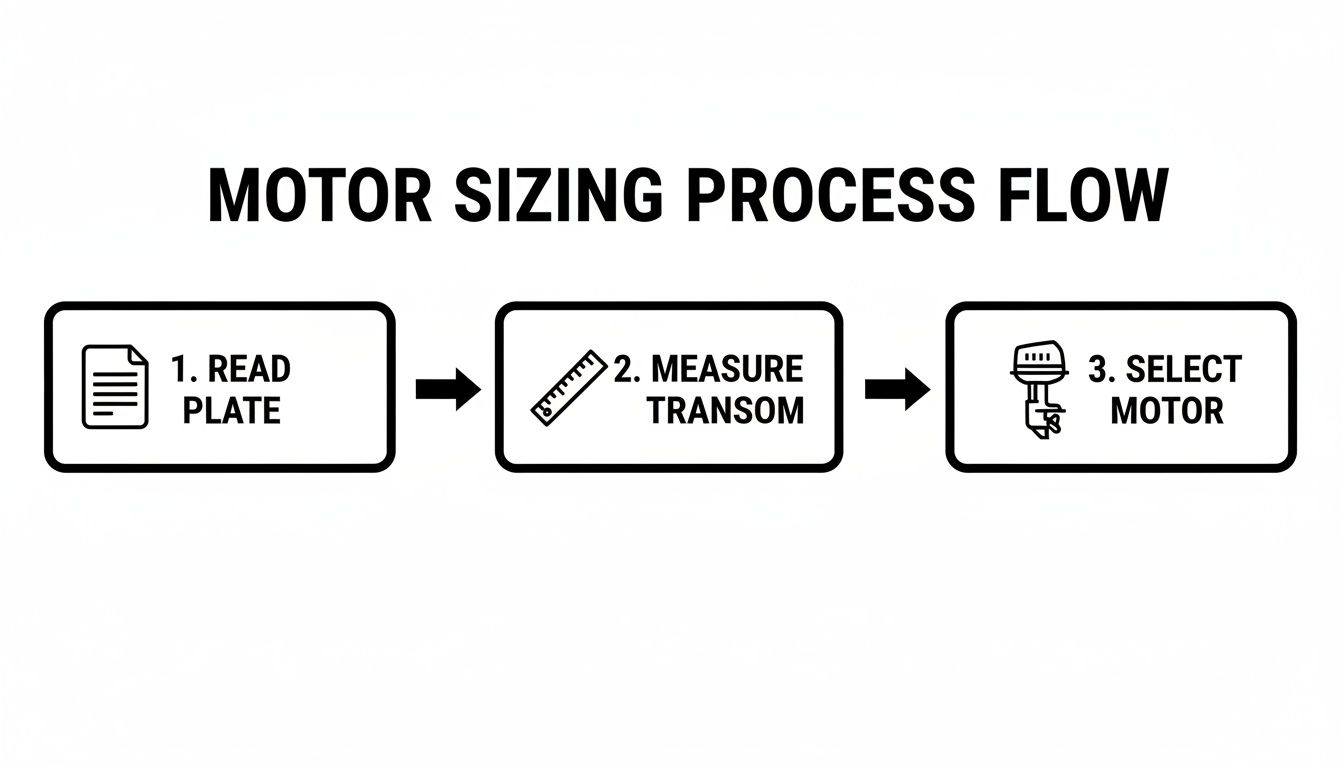
Following this flow—checking the capacity plate, measuring the transom, then picking your motor—is how you ensure the engine you’re installing is a safe and compatible match for your boat.
Getting the motor mounted is just the start; now you need to dial in its position for the best possible performance out on the water.
Here’s a pro tip: always add a secondary safety cable or chain. Loop it through a solid point on the motor and secure it firmly to the boat’s transom. This simple, cheap addition is your ultimate insurance policy against watching your valuable motor sink to the bottom if the clamps ever fail.
Finally, before you head out, give your fuel system a quick once-over. For a complete rundown on what to look for, our guide on the outboard engine fuel line covers everything you need to know, from inspection to connection.
Here’s the secret to a motor that never lets you down: it isn’t about luck, it’s about routine. A reliable motor is just a well-maintained one.
Putting together a simple, repeatable maintenance checklist is the single best way to keep your outboard in prime condition. It helps you avoid that frustrating day of troubleshooting at the boat ramp when all you want to do is get on the water. These straightforward habits will add years to your motor’s life and ensure it fires up every single time.
For anyone boating in Australian waters, the most important post-trip job is thoroughly flushing the engine with fresh water. Salt is incredibly corrosive, and leaving it to fester inside your motor’s cooling passages is a surefire way to cause expensive, long-term damage. This simple five-minute task after every saltwater trip is non-negotiable.
The best way to think about maintenance is in three simple stages: things you do after every trip, monthly checks, and an annual service. Sticking to this schedule will help you catch small issues before they snowball into big problems.
After Every Outing:
A regular visual check is your first line of defence against unexpected breakdowns.
Setting aside a small amount of time each month and year will keep your motor for an inflatable boat humming along nicely. These tasks are simple but absolutely crucial for longevity.
For petrol engines, make a habit of checking the gear oil monthly. If it looks milky or cloudy, that’s a tell-tale sign that water has gotten into the gearbox, which needs immediate attention. You’ll also want to manage your fuel properly; if it’s going to sit for more than a few weeks, add a fuel stabiliser to stop it from going stale and clogging up your fuel system.
An annual service is your chance for a deeper dive. This is the perfect time to replace the water pump impeller, spark plugs, and fuel filters, and to change the gearcase oil. If you’re not comfortable doing this yourself, booking it in with a professional is a worthwhile investment in your motor’s future.
For electric outboards, it’s all about battery health. Following lithium-ion battery charging best practices will seriously extend the life of your power source and guarantee reliable performance when you need it. Keeping the terminals clean and free from corrosion is also vital. For more on this, check out our guide on selecting a quality marine battery and charger.
When it comes to off-season storage for electric motors, store the battery in a cool, dry place at a partial charge—around 50-60% is ideal. This simple step helps preserve its capacity and ensures it’s ready to go for your next adventure.
Even after covering all the details, there are always a few final questions that pop up right before you pull the trigger. We get it. Here are some of the most common queries we hear from Aussie boaters, answered straight up to help you choose the right motor for your inflatable boat with total confidence.
You sure can. Tiller handles are the standard setup on most outboards up to around 20 HP, and for good reason—they’re simple, reliable, and give you that direct, connected feel when steering. They’re perfect for most inflatables where you’re sitting near the transom anyway.
But once you start getting into the bigger, heavier Rigid Inflatable Boats (RIBs), especially anything over 4 metres, a remote steering console really starts to make more sense. It offers a more comfortable driving position for longer days on the water and gives you a much more stable, controlled feel at higher speeds.
Buying a used motor can be a brilliant way to save some cash, but it definitely requires a bit more homework. A good deal isn’t just about the price tag; it’s about the motor’s history and its current health. When you compare prices and features of used options, be thorough.
Here’s a quick checklist I run through when looking at a pre-loved motor:
This is a big one, and the rules do change a bit depending on which state you’re in. But as a general rule, the moment you bolt any kind of motor onto your inflatable boat—no matter how small—you’ll almost certainly need to register the vessel, especially if you intend to use it for recreational purposes.
For instance, in New South Wales, pretty much any vessel with a motor needs to be registered. Up in Queensland, you need to register if your motor is 4 HP or more. Your best bet is to always check with your local state maritime authority for the latest rules to stay on the right side of the law.
For many people, the decision to get a motor is directly tied to the need to register. It’s an important step that also means you’ll need to carry mandatory safety gear, so make sure you factor that into your budget and planning. A quick search for your local maritime safety body will give you everything you need to know.
Ready to power up your adventures? Easy Inflatables offers complete boat and motor packages, all designed and supported right here in Australia. Whether you’re looking for the best inflatable boats for recreational use or a great package for a family outing, we can help. Check out our range of high-quality inflatable boats and Hidea outboards to build your perfect rig today.
Find your perfect boat and motor package at https://easyinflatables.com.au.