
You hitch up the trailer in the driveway, check the outboard, strap down the boat, plug in the lights, and head off thinking the hard part is done. For most owners, the focus sits on the hull, motor, bearings, and tyres. The small length of chain under the coupling gets a quick glance, if that.
That is a mistake.
A safety chain for trailer setup is not backup gear you can treat casually. On a boat trailer, it works in one of the harshest environments any trailer part sees. It gets sprayed with salt, dunked at the ramp, dried in the sun, then loaded again on corrugated roads and motorways. Generic towing advice misses that reality. Australian boat owners need chain advice that accounts for submersion, corrosion, brake setup, and the way boat trailers are used.
A common first-trip scenario goes like this. A new owner buys an inflatable boat package, gets excited about the maiden run, and checks all the obvious things. Fuel. Battery. Tie-downs. Drain plug. Winch strap. Then the trailer gets backed down a ramp, the chain gets soaked, and from that day on the corrosion cycle starts.
On a utility trailer, the chain may only see road grime and weather. On a boat trailer, it sees saltwater, repeated immersion, and frequent launching and retrieval. That difference matters. A chain that looks acceptable on the driveway can be hiding rust inside links, damage at the hook, or wear around attachment points.
The bigger problem is that many owners read generic road-trailer guidance and assume it applies cleanly to marine use. It does not. Marine-specific safety chain requirements for boat trailers differ from road trailers, and common guidance often overlooks corrosion-resistant materials, saltwater maintenance, and submerged coupling attachment points, as noted in this discussion of marine-specific trailer safety chain requirements.
At the ramp, parts of the trailer that are rarely wet on other trailers are regularly submerged. The coupling area, chain, shackles, and attachment hardware can all cop spray or direct immersion.
That creates a few practical issues:
If the coupling jumps the ball, opens, or fails to stay seated, the safety chain becomes the last connection between trailer and tow vehicle. When it is chosen and fitted properly, it gives the driver a chance to slow down and regain control.
Practical takeaway: On a boat trailer, the chain is not just a legal item. It is a marine wear item. Treat it like bearings, brakes, and tyres. Inspect it with the same seriousness.
That mindset matters whether you tow a rigid inflatable boat, an inflatable catamaran, or a compact fold-up package behind an SUV. The trailer may be small. The consequences of chain failure are not.
Australian safety chain rules are tied to the trailer’s rating, the chain assembly you fit, and how that assembly is attached. For boat owners, there is another layer. Repeated salt exposure and ramp submersion can turn a technically compliant setup into a poor one if the hardware is not suited to marine use.
The first figure to check is GTM, or Gross Trailer Mass. That is the load carried by the trailer axle or axles when the trailer is coupled to the tow vehicle. It is different from ATM, which is the total trailer mass when uncoupled. Boat owners often mix those up, then buy chain by eye or by what “looks heavy enough”. That is how mismatched chain assemblies end up on otherwise good trailers.
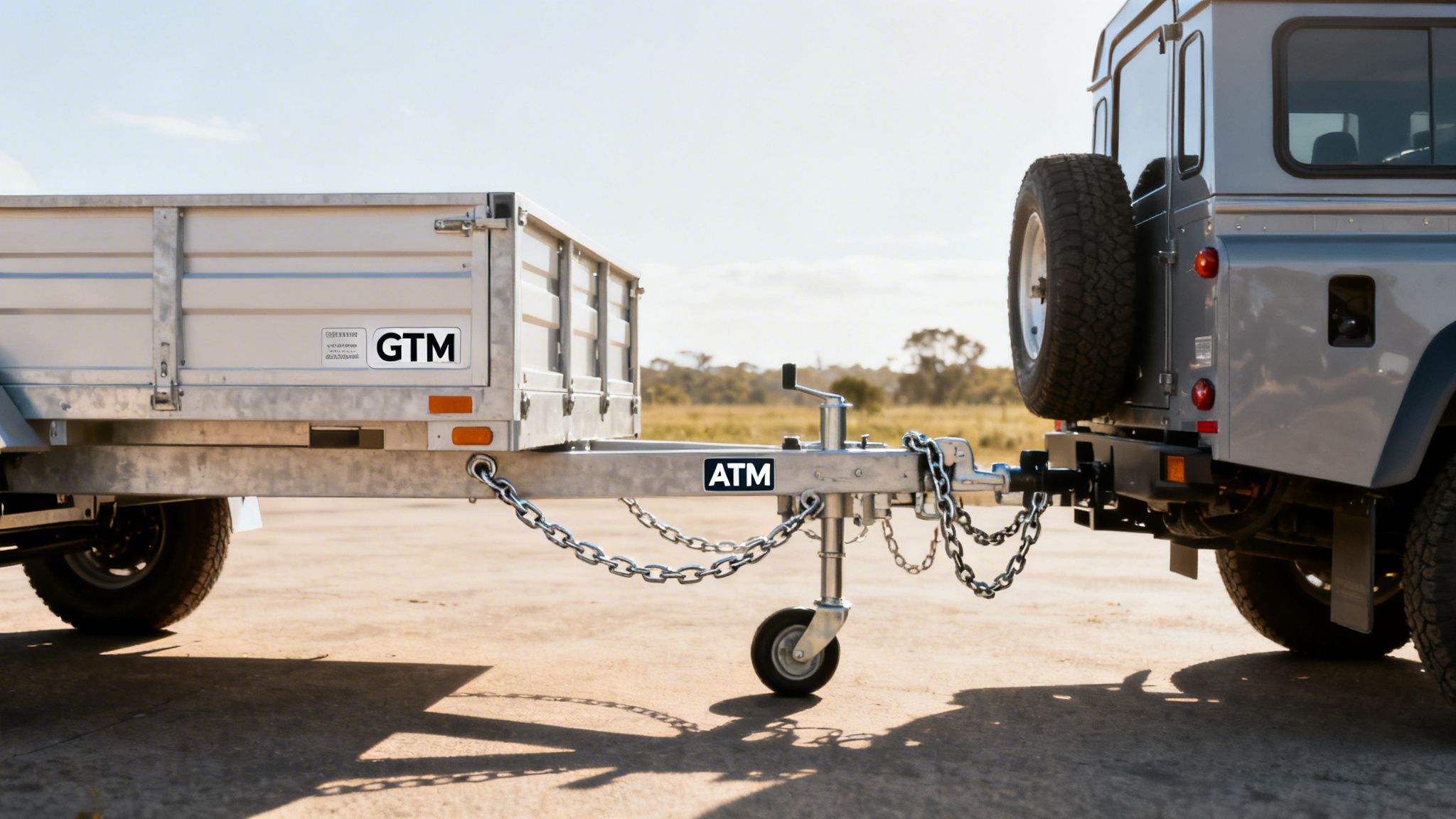
In Australia, trailer safety chains must comply with Australian Design Rule 62/01. The chain assembly must be suitable for the trailer’s rating, and the full assembly matters. That means the chain, hooks, shackles, and attachment points all need to match the job. A strong chain with a weak shackle or poor weld is still a weak system.
On a boat trailer, that matters more than many owners realise. Marine trailers get backed into water, parked wet, and exposed to salt around the exact parts that keep the trailer connected if the coupling fails. A chain can still look serviceable while corrosion has started around stressed links, hook throats, or the mounting area at the drawbar.
Start at the compliance plate, not the boat’s advertised hull weight.
A tinnie, inflatable, or compact RIB package can sit on a trailer with a higher rating than the boat alone suggests once you add the outboard, fuel, battery, anchor, safety gear, and camping or fishing kit. I see owners underestimate this all the time, especially with trailers that have been repurposed or upgraded over the years.
Use this sequence:
If you want a reference point, look at how a purpose-built small boat trailer is set up around the drawbar, coupling, and chain mounting area. The layout usually makes it easier to see whether the attachment points and hardware were designed properly from the start.
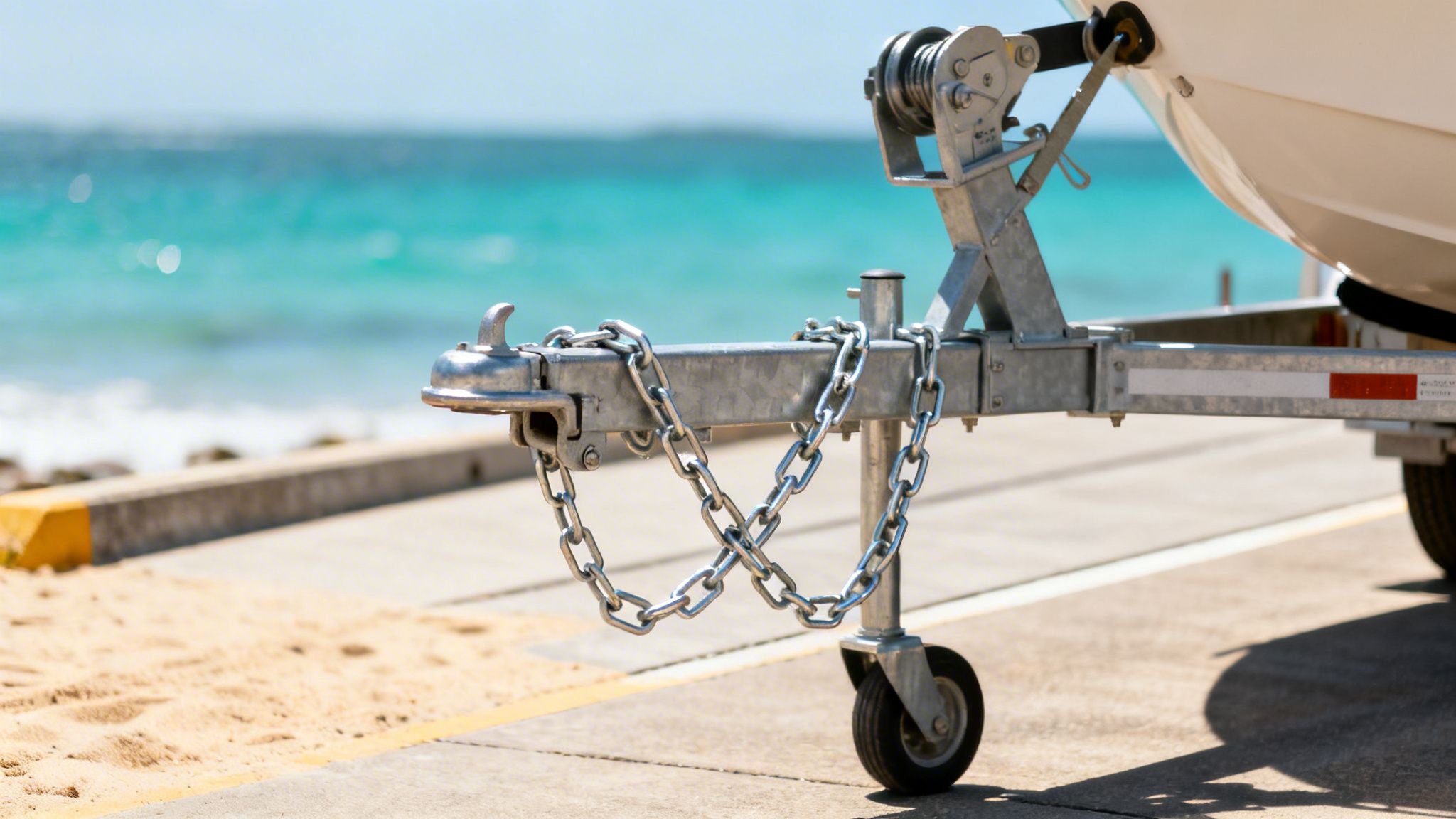
Crossing the chains under the coupling supports the drawbar if the coupling disconnects. That reduces the chance of the drawbar hitting the road and starting a violent bounce or yaw event.
This is not a box-ticking detail. On a wet launch-day trailer, chain length and routing matter because extra slack, twisted links, or badly placed hooks can let the drawbar drop lower than it should. The setup needs enough movement for turning, but not so much that the chains drag, snag, or fail to catch the drawbar early.
Key point: Compliance means more than fitting any legal-looking chain. The assembly has to match the trailer rating, resist marine wear, and be routed correctly every time you tow.
Use this quick check before a road trip or a trip to the ramp:
That is the standard to aim for on any trailer. On a boat trailer, it is the minimum.
Buying a safety chain for trailer use sounds simple until you stand at the counter looking at grades, coatings, hooks, and shackles. Many boat owners go wrong at this point. They buy whatever looks heavy enough, or whatever the trailer came with years ago, and assume it will do.
It will not.
Pick the chain after you confirm the trailer’s GTM. If you skip that step, everything else is guesswork.
For a marine trailer, think of the assembly as four linked decisions:
A higher-grade chain can achieve the required strength at a smaller diameter, but that does not automatically make it the best option for every boat trailer. Smaller links can be strong, yet some owners prefer a sturdier-feeling setup with marine-friendly coatings and easier inspection.
Grade tells you about strength. Material and finish tell you how the chain survives its environment.
The practical options usually look like this:
| Chain option | What it does well | Where it falls short |
|---|---|---|
| Standard steel | Low upfront cost | Rusts quickly in marine use |
| Zinc-plated steel | Better than bare steel for light exposure | Coating can suffer after repeated submersion |
| Hot-dipped galvanised steel | Well suited to boat ramps and salt exposure | Bulkier finish and can cost more |
| Stainless steel | Strong corrosion resistance in the right marine application | Selection must still be rating-based, not appearance-based |
For boat trailers that launch often, hot-dipped galvanised hardware is usually a sensible starting point because it is built for the abuse of salt spray and immersion. Stainless can make sense in some marine applications, but buyers still need to verify load suitability and compatibility with the rest of the assembly.
The verified guidance allows one specific practical recommendation: Grade 70 alloy chain with correctly rated clevis grab hooks to the applicable standard. That tells you the strength side can be handled properly with transport-grade hardware.
The trade-off is marine life. A strong chain that corrodes quickly at the ramp is not a smart buy. Boat owners need to balance strength with corrosion resistance. That is where many generic trailer guides fall short. They focus on road load and ignore repeated saltwater dunking.
Below is a simple comparison table format that many owners use when discussing chain size against trailer rating. The exact selection still needs to match the trailer’s compliance requirements and the stamped rating on the hardware you buy.
| Trailer GTM (Up to) | Minimum Chain Diameter (Grade L) | Minimum Chain Diameter (Grade T/80) |
|---|---|---|
| Match to trailer compliance rating | Check stamped specification | Check stamped specification |
That may look less satisfying than a chart packed with sizes, but it is the honest approach. If the stamped rating is not clear, do not guess. Ask for compliant transport hardware and verify that the full assembly is suitable for the trailer.
Compact trailers for portable boats often lull owners into under-specifying the chain. The trailer looks light. The boat is soft-floor or air-deck. The motor is small. Then gear gets added, a spare wheel gets mounted, and the trailer is used hard over distance.
If you use a compact transport setup, review how a foldable boat trailer handles coupling layout and chain routing before buying replacement hardware. Space is tighter on folding frames, and that can affect chain length and attachment choices.
A good buying decision usually looks like this:
Workshop rule: Buy the whole chain assembly like a system. The strongest link does not save the weakest shackle.
A good chain can still fail in service if it is fitted badly. Installation is where safe gear either becomes a working safety system or turns into dead weight.
Start with the visual process below, then walk through the checklist in order.
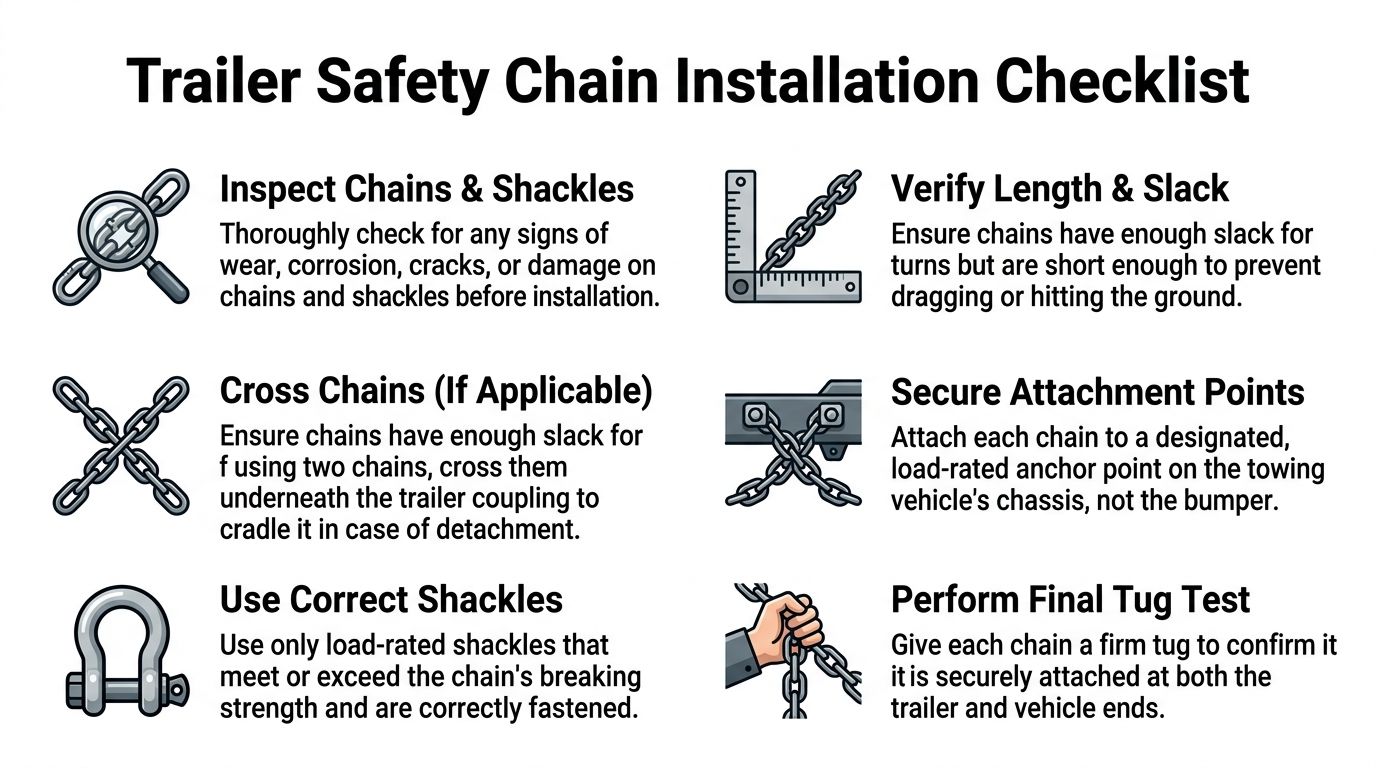
The trailer-side attachment matters more than many owners realise. Chains should be fixed to a proper load-rated attachment point on the drawbar or chassis area designed for the task. If welding is required, a qualified fabricator should do it. This is not the place for backyard guesswork.
Check these points before the chain ever reaches the tow vehicle:
Too much slack creates one problem. Too little creates another.
When chains are too long, they drag, wear rapidly, and can strike the road over dips and driveways. When they are too short, they bind on tight turns, place side load on the attachment points, and can restrict trailer movement at the ramp.
The right length gives enough articulation for normal turning while keeping the chain clear of the ground.
Here is a practical visual check. Hitch the trailer, cross the chains, then turn slowly to each lock position in a controlled space. Watch what the chain does, not what you think it should do.
A detailed trailer setup guide can help if you are checking the whole towing system at once, especially around the coupling and launch routine. This boat guides for boat trailer resource is useful for that broader walkaround.
To see the method in action, this demonstration is a helpful reference.
This is the single installation habit that most improves the outcome of a coupling failure.
Crossing creates a support cradle beneath the drawbar. If the coupling disconnects, the drawbar is more likely to stay lifted instead of spearing into the road surface. That buys control and time.
Do it the same way every time:
Do not finish installation and walk away. Give the system a deliberate tug test.
Best practice at the ramp: Recheck the chain after retrieval as well as before launch. Ramp use often shifts hardware, twists slack, and exposes problems that were not visible in the driveway.
The chain that looked fine in the driveway can be the one that lets go after a few months of ramp work. Boat trailers cop a harder life than box trailers. They get dipped in saltwater, parked wet, and dragged home with salt sitting in every crevice around the drawbar hardware.
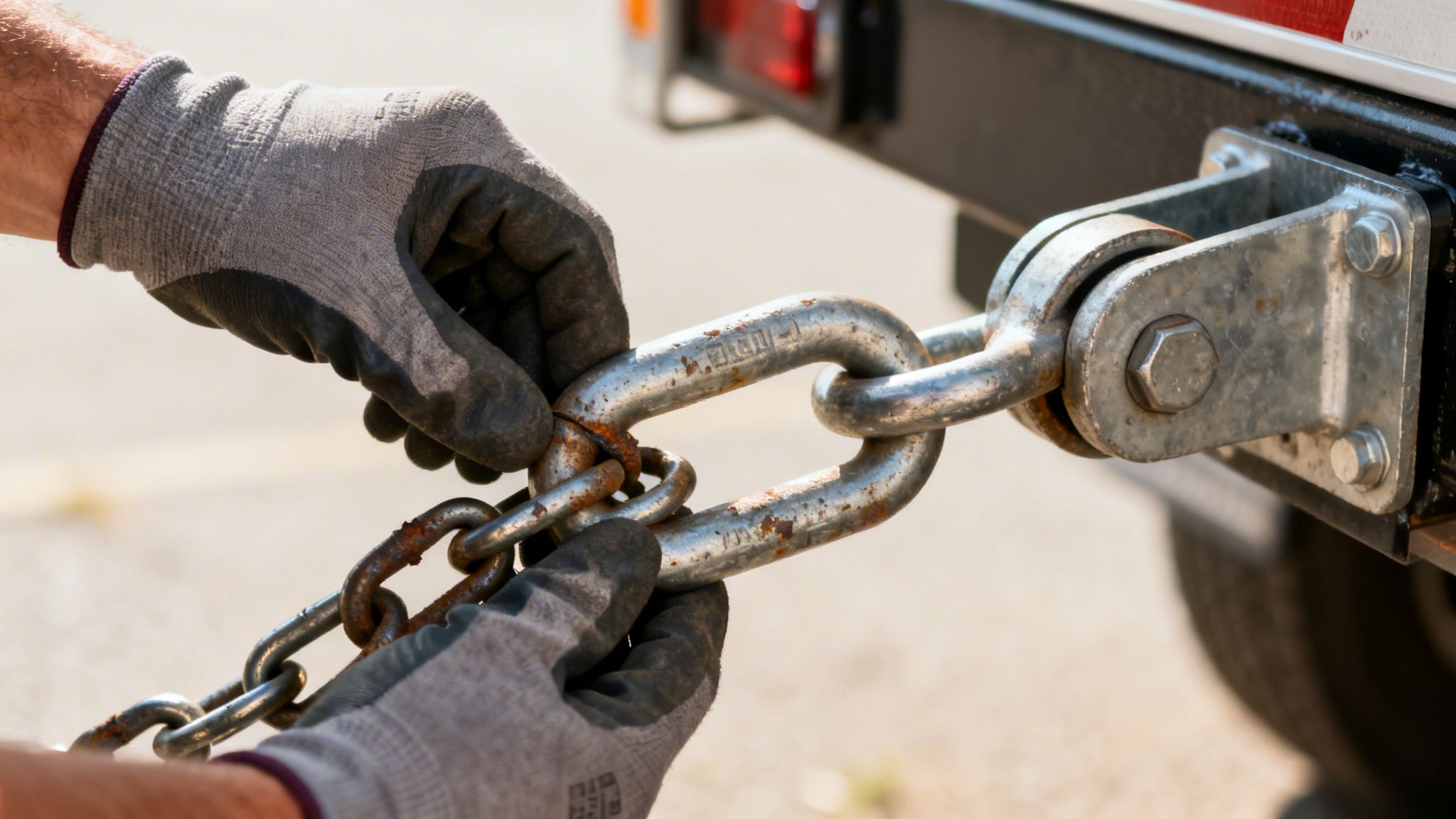
A good schedule is simple. Check it often enough that wear never gets the chance to turn into failure.
This is the fast check you do while hitching up, not after you are already late for the ramp.
Look for:
Run a gloved hand along the chain. If a link feels sharp, thinned, flattened, or rougher than the rest, stop and inspect it properly. On a boat trailer, surface rust can turn into real section loss faster than many owners expect.
Give the chain a closer look at least every few months, and more often if the trailer sees regular saltwater use.
Focus on signs that the chain is stretching or wearing unevenly:
Any visible elongation, deformation, or serious corrosion is enough reason to replace the chain. Do not wait for a formal test result if the condition is already telling you the answer. Chain and attachment hardware are cheap compared with losing control of a boat trailer on the road.
This is the maintenance habit that matters most for boat owners.
Ramp submersion changes the service life of trailer gear. It affects the chain, the mounting points, and the hardware that often gets ignored because it is small and easy to miss.
If you already service the trailer on a routine, tie this check in with other marine trailer jobs. A chain inspection sits well alongside boat trailer wheel bearing replacement and bearing service, because both jobs are driven by the same problem: saltwater gets into places that matter.
Once a year, get the trailer where you have good light and enough time to inspect the full assembly properly. Do not just glance at the hanging section of chain.
Inspect each part as a system:
If you cannot confirm the chain is sound, replace it. That is the practical rule I follow with marine trailers. Salt hides damage well, and safety chains do not get a second chance when the coupling fails.
Most chain failures in day-to-day use start long before an emergency. They start with habits.
The mistakes below show up constantly on boat trailers, especially older setups that have been “made to work” over time.
This is one of the easiest faults to spot and one of the most ignored. Dragging wears away the links, strips protective coating, and can damage the hooks.
Fix: Shorten the effective length correctly. Refit the chain, adjust the attachment method, or replace it with the proper length. Do not leave excess slack because “it has always been like that”.
Owners sometimes over-correct by making chains too tight. The result is binding in turns, side-loading of the chain, and stress on the trailer-side mounts.
Fix: Hitch up in a flat open area and test turning range at low speed. If the chain goes tight before the trailer reaches a normal turning angle, adjust the setup.
This one is common because it looks tidy. It is not good practice.
A twisted chain does not sit or load the same way as an untwisted one. It also makes inspection harder because wear points hide where the links overlap.
Fix: Shorten by changing the hardware arrangement or using the correct chain length. If the setup always needs a twisted chain to fit, the assembly is wrong for the trailer.
The chain might be excellent while the connecting hardware is cheap, soft, and unsuitable. That failure point often goes unnoticed because small parts do not attract attention.
Fix: Replace all connectors with properly load-rated hardware matched to the chain assembly. If a shackle does not clearly belong in a towing application, keep it off the trailer.
A chain needs a designated point on the tow vehicle or towbar assembly. Improvising to the bumper, removable accessory, or the wrong section of hardware creates a weak and unpredictable connection.
Fix: Use the attachment points intended for safety chains. If your current tow setup does not provide them clearly, resolve that before towing again.
Walk around your trailer and ask five blunt questions:
If any answer is no, fix it before the next trip. Chain problems are usually visible before they become dangerous.
Safe towing is not built on one part. It is built on repeated small checks done properly.
For a boat trailer, the essentials are straightforward. Know the trailer rating. Fit a safety chain for trailer use that matches it. Use compliant, rated hardware. Cross the chains under the coupling. Rinse and inspect after saltwater use. Replace anything doubtful early.
That habit makes the trip to the ramp calmer and the trip home safer.
A broader pre-departure routine also helps. If you already use a vehicle walkaround before long drives, something like this practical car inspection checklist is a useful reminder that towing safety starts with the tow vehicle as much as the trailer.
For the boating side, a dedicated pre-launch and pre-tow list keeps the process consistent. This boat safety equipment checklist is a good companion resource for finding the rest of the essentials around the boat and trailer on one page.
The reward is simple. Less second-guessing on the highway. Fewer avoidable failures at the ramp. More time spent using the boat instead of dealing with preventable trailer problems.
Yes. Heavier trailers move into a more demanding compliance space, and owners should not assume that light trailer practice carries over unchanged. The correct approach is to verify the trailer’s specific compliance requirements and hardware standards before towing. For heavier setups, get advice from a qualified trailer specialist rather than relying on light boat trailer habits.
Replacing or patching a single damaged link is not a good solution for a safety chain assembly. Once a link has cracked, stretched, worn badly, or corroded, confidence in the assembly is already compromised. In practice, replacement of the affected chain assembly is the safer call.
Some towing systems use cables, but owners should not assume they are interchangeable with chains on any trailer. The assembly still has to meet the applicable Australian requirements for the trailer. If there is any doubt, use a compliant, correctly rated chain assembly rather than improvising.
If the trailer is road-registered and towed on public roads, treat the chain requirement seriously even when carrying a light boat-in-a-bag or compact inflatable package. Small trailers can still detach. Light weight does not remove the need for compliant connection hardware.
Maybe, but do not make the call on colour alone. Light surface rust is different from pitting, flaking, seized movement, metal loss, or deformation. If rust is advancing into the links, around hooks, or at the attachment points, replacement is the safer choice.
Before every tow, then more thoroughly at regular intervals. Boat trailers live a harder life than many other trailers because of salt exposure and ramp use. If you launch often, inspect often. That rule saves trouble.
If you are choosing a new inflatable boat, tender, RIB, or inflatable catamaran package and want the trailer side sorted properly as well, Easy Inflatables is a solid place to start. The range is built for Australian conditions, and the practical guidance across the site helps owners set up, tow, launch, and maintain their gear with confidence.