
Picking the right trolling motor power can feel like you’re trying to crack a secret code. But it’s actually pretty simple. When we talk about power, we’re talking about two key things: the motor’s muscle to push your boat through the water, and its stamina to keep going all day. It’s less about outright speed and more about control and endurance, which is crucial whether you’re looking for the best inflatable boats for recreational use available near me or need a reliable motor for your existing one.
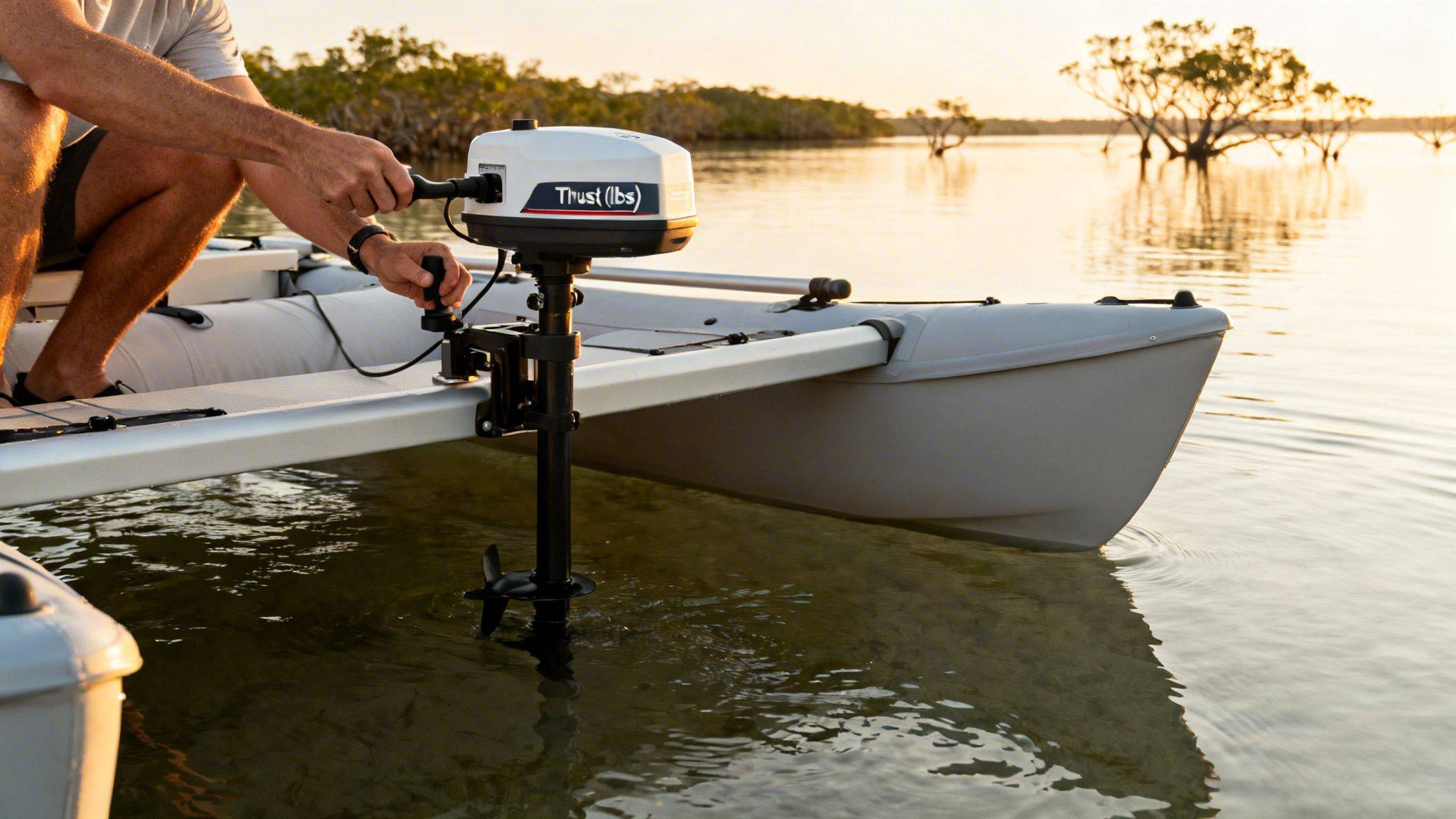
When you’re looking at a trolling motor, the big number you’ll see advertised is its thrust, measured in pounds (lbs). It’s easy to think this means speed, but that’s not quite right. Think of thrust as the motor’s raw strength. A higher thrust number means more muscle to hold your inflatable boat steady against a gust of wind or push through a strong current. It’s the difference between being in control and being at the mercy of the elements.
This pushing power is what really matters for trolling, not horsepower. Horsepower is all about how much work an engine can do over time, which is more relevant for the big, high-speed outboards. For the quiet, precise control you need for fishing or exploring, thrust is king. Getting this right is especially crucial for smaller craft, which you can learn more about in our guide on trolling motors for kayaks.
To give you a quick reference, here’s a simple breakdown of the main power ratings you’ll come across.
This table provides a quick summary of the key terms and what they mean for you out on the water.
| Power Metric | What It Measures | Real-World Analogy | Why It Matters for You |
|---|---|---|---|
| Thrust (lbs) | The motor’s static pushing or pulling force. | The motor’s raw muscle or strength. | More thrust helps you fight wind and currents, giving you better boat control. |
| Voltage (V) | The electrical potential of the battery system. | The motor’s energy system or stamina. | Higher voltage systems are more efficient, giving you longer run times for the same power. |
| Horsepower (HP) | The rate at which the motor does work (power over time). | An engine’s ability to maintain high speed. | Less important for trolling, more relevant for high-speed petrol outboards. |
| Watts (W) | The actual electrical power being consumed. | The rate of energy consumption. | A good way to compare the real power output of different motors, especially electric ones. |
Think of these metrics as different tools to measure performance. While thrust is the headline number, understanding how it relates to voltage and efficiency is what will help you choose the perfect motor for your needs.
Voltage—you’ll see 12V, 24V, or 36V—is the other half of the power equation. If thrust is the muscle, voltage is the motor’s energy system or stamina.
To really get your head around trolling motor power, it helps to know the basics of how electricity works, like the difference between watts and volts. In a nutshell, a higher voltage system draws fewer amps to produce the same amount of thrust, and that’s the secret to its greater efficiency.
Here’s a real-world example: Aussie boating experts note that a standard 12-volt Minn Kota motor drawing 30 amps at full throttle will run for about 3.4 hours on a 120 amp-hour battery. But if you drop the speed to a gentle troll drawing just 5 amps, that same battery can last over 20 hours—plenty of time for a full day chasing snapper.
Choosing the right trolling motor power is a critical decision, especially for lighter boats like our inflatable tenders and stable catamarans. Get it wrong, and you’ll find yourself either fighting against the slightest breeze or lugging around more weight than you actually need. Whether you’re comparing prices and features of inflatable boats in your area or kitting out a boat you already own, this is a step you can’t skip.
The good news is that picking the right motor is pretty straightforward once you understand the basic principle.
It all boils down to a simple rule of thumb: you need roughly 2 pounds of thrust for every 100 pounds (or about 45kg) of your boat’s total weight. Think of this as your starting line—it’s the minimum power you’ll need for decent control on a calm day.
Before you can use that rule, you need a clear idea of your boat’s fully loaded weight. This isn’t just the number on the box; it’s everything you’ll have on board for a typical day out on the water. It’s a simple bit of maths, but forgetting one item can leave you with an underpowered setup.
To get your total weight, just add these up:
A common mistake is to only calculate for the boat and motor. This almost always leads to frustratingly poor performance. Your total “on-water” weight is what the motor actually has to push, so an honest and complete calculation is your key to getting it right.
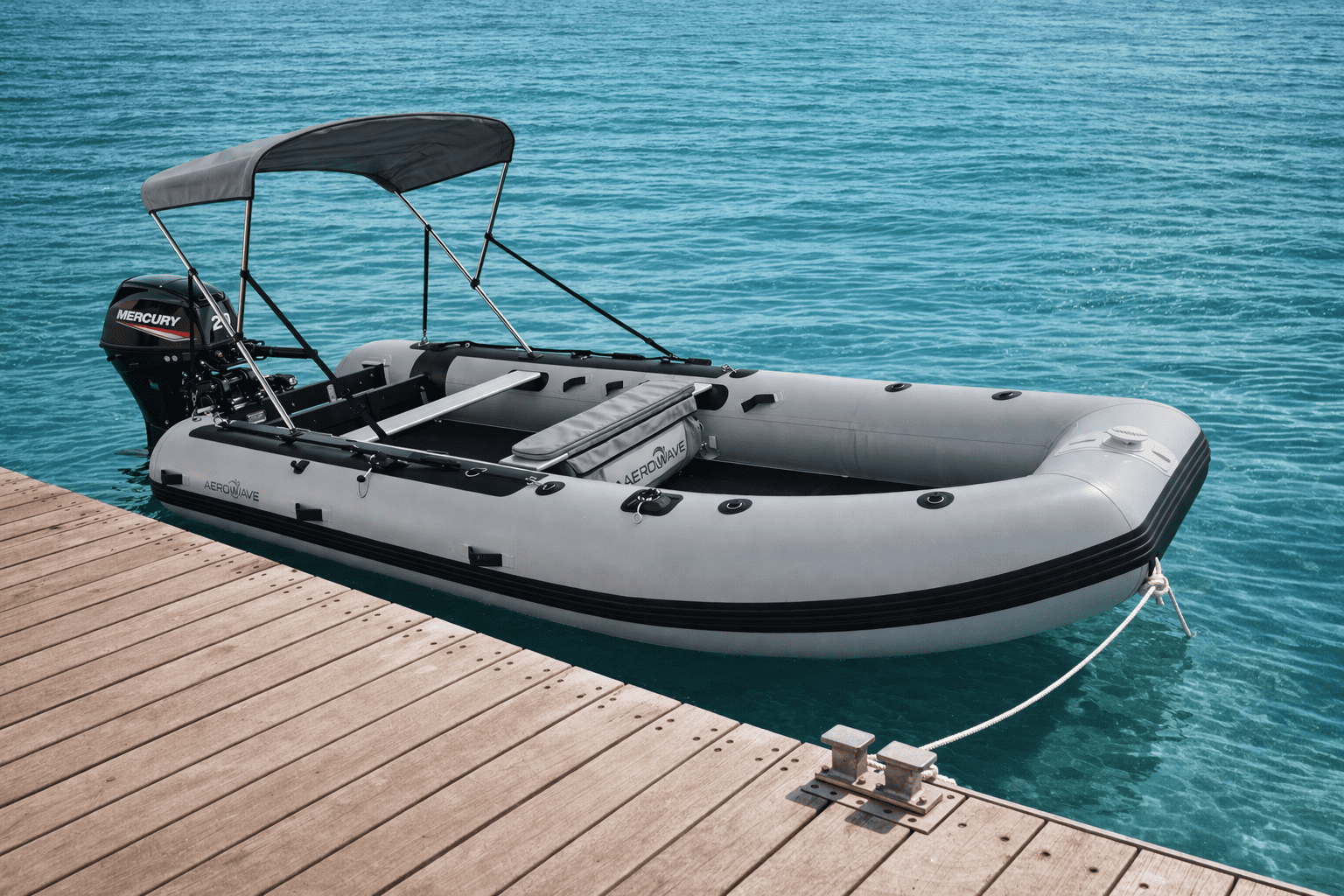
For example, take a 3.2m Aerowave RIB. Loaded up to 500kg with two adults, fishing gear, and an esky, the baseline rule (2 lbs of thrust per 45kg) suggests you’d need a minimum of about 22 lbs. As experts often point out, a 12V motor is fine for calm fishing in boats up to around 4.9m, but you might need a 24V system if you’re in a larger boat or battling stronger currents. You can find more great insights on trolling motor power over at JohnsonOutdoors.com.
Let’s walk through a real-world scenario with one of our popular Inflatable Catamaran models to see how it works.
Scenario: A 3.8m inflatable catamaran outing in a coastal estuary.
Total Calculated Weight: 55 + 28 + 160 + 25 = 268kg
Now, we apply the thrust rule. Since 268kg is roughly 590 pounds, we’ll need approximately 12 pounds of thrust (590 lbs / 100 lbs * 2 lbs) as our absolute minimum. This calculation is a vital step, and you can learn more about matching the right motor to your specific craft in our complete guide to choosing a motor for inflatable boats.
That minimum calculation is perfect for a glassy, calm day. But Aussie estuaries and coastal waters are rarely that predictable. A sudden gust of wind or a strong outgoing tide can quickly overwhelm an underpowered motor, turning a relaxing day into a stressful scramble.
This is exactly why we always recommend adding a safety buffer of at least 20% to your minimum thrust calculation.
For our 3.8m catamaran example, that means adding 20% to our 12lb minimum:
Rounding that up, a motor with 15-20 lbs of thrust is a much safer and more capable choice. This extra grunt gives you a crucial margin of control, making sure you can hold your spot while fishing or get back to the boat ramp safely when conditions change. Underpowering your boat is a recipe for frustration, but having that extra bit of power on tap is the key to safety and confidence on the water.
Once you’ve figured out how much thrust your boat needs, the next big question is voltage. Your choice between a 12V, 24V, or 36V setup will directly shape your motor’s performance, how long you can stay on the water, and the overall complexity of your rig. It’s a classic trade-off between power, weight, and convenience.
Think of voltage as the motor’s efficiency. A higher voltage system is like a finely-tuned athlete—it delivers more punch while using less energy, which means it runs cooler and for much longer. This is exactly why the more powerful, high-thrust motors require 24V or 36V systems to get the job done.
But there’s a catch: more voltage means more batteries. A 24V system needs two 12V batteries wired together, and a 36V setup needs three. This adds significant weight and eats up precious space, both critical factors on a portable inflatable boat or catamaran.
For most inflatable boat owners in Australia, a 12V system is the go-to choice. It’s the most straightforward setup out there, using a single deep-cycle battery that makes it the lightest, simplest, and most affordable option. If you have a smaller inflatable or tender and stick to calm estuaries, lakes, and sheltered bays, a 12V system is your perfect match. If you’re looking for an inflatable boat hire in Australia for a family outing, you’ll find that many of these are equipped with a simple and reliable 12V motor.
This setup is ideal for:
The simplicity of a single battery makes charging and setup a breeze. Getting your head around the basics of a quality power source, like a good 12V deep cycle battery, is the key to getting the most from this popular and practical setup.
The 24V system hits the sweet spot for many serious anglers and owners of larger inflatables. By linking two 12V batteries in series, you can run motors with higher thrust (typically 80lbs) and get a massive boost in efficiency. In real-world terms, this means more power on tap and much longer runtimes on a single charge.
A 24V system is what separates the casual boater from the enthusiast who demands more from their gear. It gives you the grunt needed to hold a larger Inflatable Catamaran steady in a strong tidal flow or punch through wind chop, extending your fishing time when others have to head home.
It’s time to consider a 24V system if you:
This infographic gives you a great starting point for the selection process. It shows how to use your boat’s total weight to figure out the thrust you need, which is a key step in deciding on the right voltage.
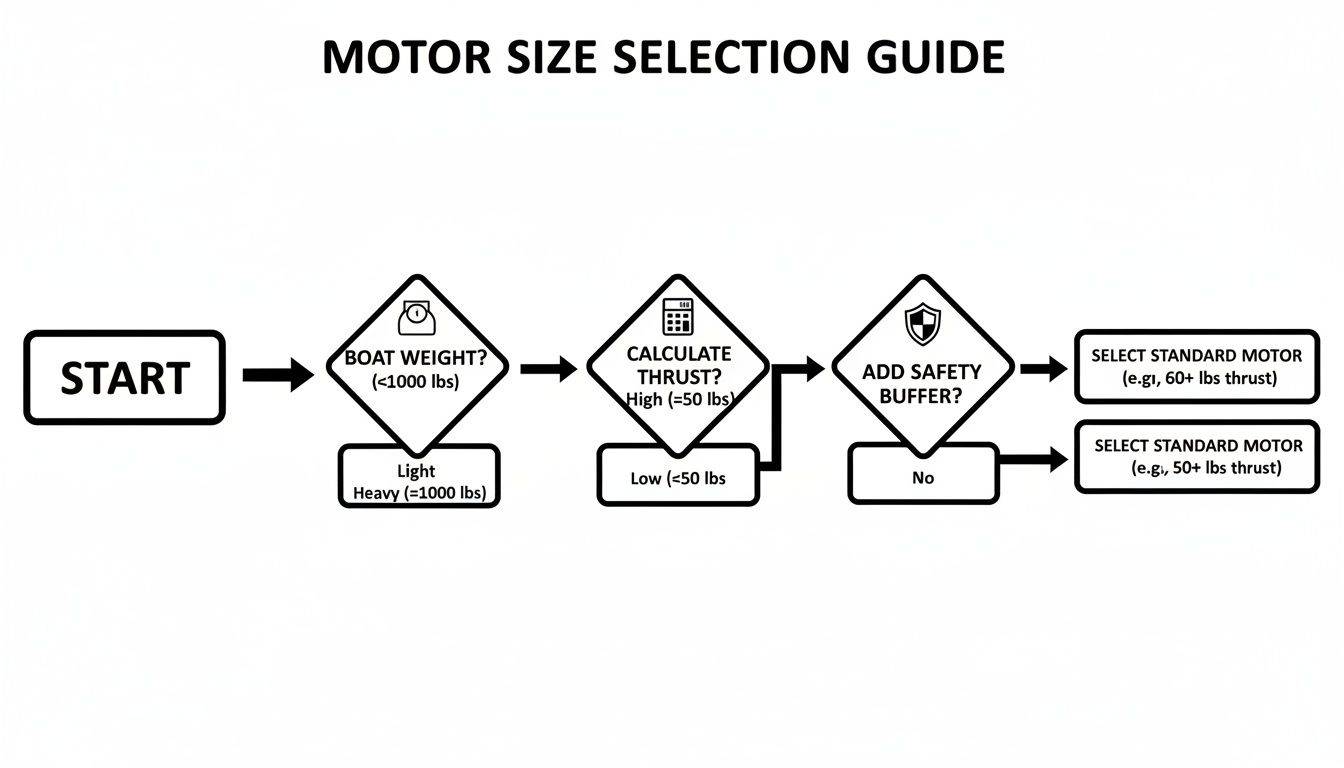
As the decision tree shows, it all starts with calculating your total weight. This informs the thrust you need and, ultimately, the voltage system that can support it. If you’re thinking about this upgrade, be sure to check out our detailed guide on choosing the right marine battery and charger to power your system correctly.
Let’s be blunt: for the vast majority of inflatable boat users, a 36V system is total overkill. These power-hungry setups require three heavy batteries and are designed for the most powerful trolling motors on the market (over 100lbs of thrust).
They’re almost exclusively found on large, heavy fibreglass or aluminium trailer boats that need maximum power to fight fierce offshore currents. While the efficiency is incredible, the weight and space penalty is simply not a practical trade-off for a portable boat.
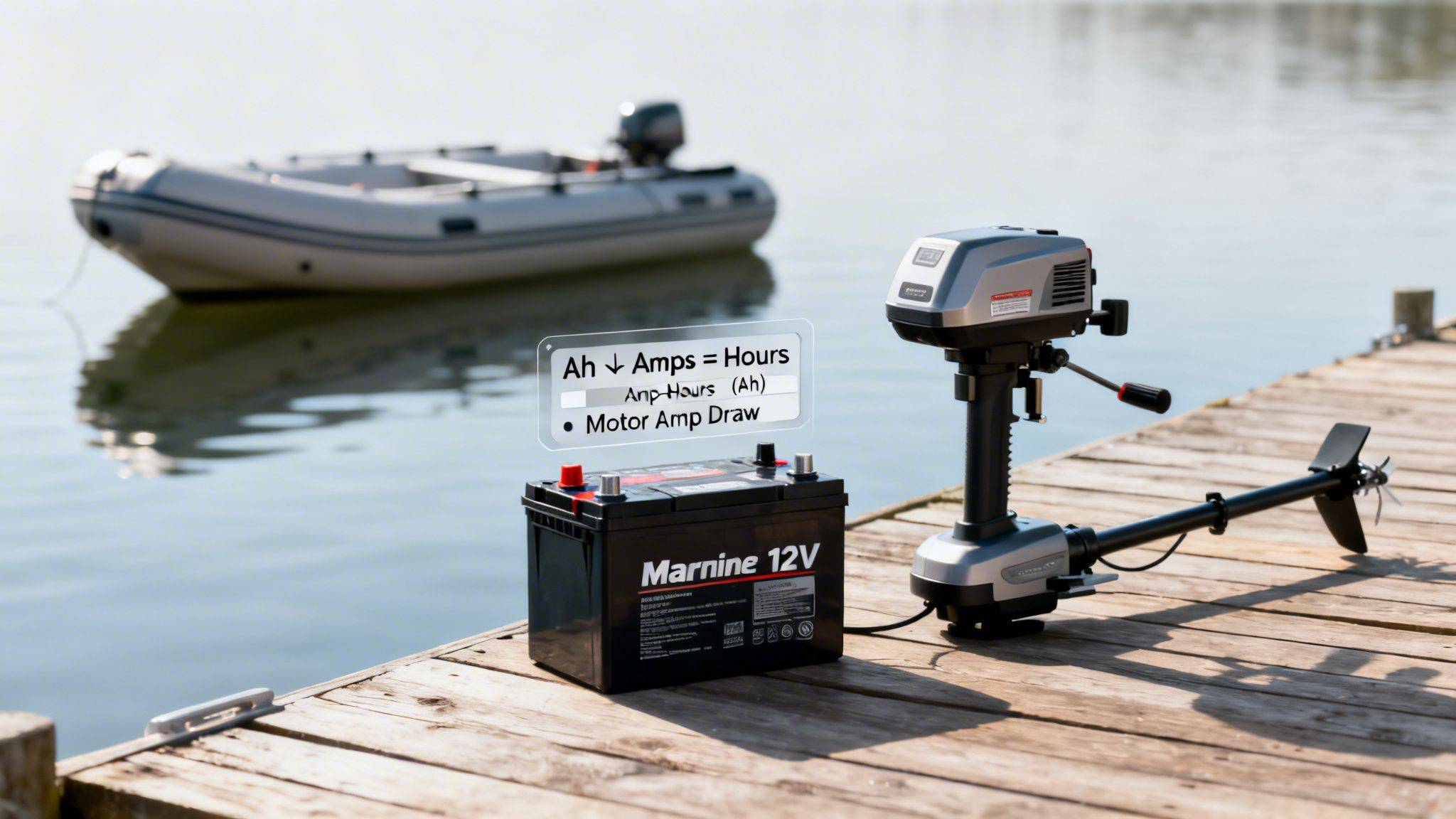
It’s the question every new trolling motor owner asks: “How long will my battery actually last?” There’s nothing worse than having your battery die halfway through a great day on the water. Thankfully, figuring out your runtime isn’t a guessing game. It all comes down to a simple bit of maths and understanding your gear.
The basic formula for estimating your time on the water is surprisingly simple.
Battery Amp-Hours (Ah) ÷ Motor Amp Draw (Amps) = Estimated Runtime (Hours)
This shows you the direct link between your battery’s “fuel tank” (its Ah rating) and how hard your motor is working (its amp draw). A motor running at full tilt will drain your battery much faster than one humming along at a slow trolling speed.
Let’s look at a common setup: you’ve got a standard 100Ah deep-cycle battery hooked up to a 55lb thrust motor. At full speed, that motor might be drawing around 50 amps. A quick calculation (100Ah ÷ 50A) gives you about 2 hours of continuous runtime. But let’s be honest, you’ll almost never be running flat-out for that long.
A more realistic scenario is slowly working a shoreline, where your motor is only drawing about 10 amps. Suddenly, the picture changes completely: 100Ah ÷ 10A = 10 hours of runtime. Now that’s a full day of fishing!
This is also where modern motors with digital speed controllers, like Minn Kota’s Digital Maximizer, really shine. By delivering only the precise amount of power needed, this tech can extend your runtime by up to five times on a single charge compared to older motors with fixed speed settings.
To help you visualise this, here’s a quick breakdown of how long you can expect a battery to last at different speeds.
| Battery Size (12V Deep Cycle) | Low Speed (5 Amps) | Medium Speed (20 Amps) | Full Speed (40 Amps) |
|---|---|---|---|
| 50Ah | 10 Hours | 2.5 Hours | 1.25 Hours |
| 100Ah | 20 Hours | 5 Hours | 2.5 Hours |
| 120Ah | 24 Hours | 6 Hours | 3 Hours |
As you can see, even a small adjustment in speed makes a massive difference. Running at half speed doesn’t mean half the runtime—it often means three or four times as much time on the water.
The battery you choose is just as critical as the motor itself. For anyone with a portable boat like an Aerowave catamaran, the choice between battery types directly impacts convenience and performance.
Lead-Acid (AGM/Wet-Cell): These are the traditional workhorses. They’re heavy and their voltage gradually drops as they discharge, but their low price makes them a popular starting point for many boaters.
Lithium (LiFePO4): Lithium Iron Phosphate batteries are the new gold standard, and for good reason. They weigh about half as much as a lead-acid equivalent—a huge win for portability. They also deliver steady power right until the end and have a lifespan that’s often 5-10 times longer.
For a lightweight inflatable boat, shedding 10-15kg of battery weight by going with lithium makes a massive difference. The boat is easier to carry, quicker to get on a plane, and simpler to handle. While the upfront cost is higher, the long-term value from a longer lifespan and better performance makes LiFePO4 a smart investment.
And don’t forget, protecting your battery from the elements is vital. A quality battery box for your boat is one of the best and cheapest bits of insurance you can buy.
No matter which battery chemistry you choose, you absolutely need a “deep-cycle” battery. These are designed specifically to be drained down and recharged repeatedly, providing steady power over many hours.
When you’re comparing options, the most important number to look at is the Amp-Hour (Ah) rating. Think of it as the size of the fuel tank. A higher Ah rating means more power in reserve.
For most 12V setups powering motors up to 55lbs thrust, a battery with at least a 100-110Ah rating is the smart choice. This gives you plenty of juice for a full day of adventure without the stress of watching your battery meter all day.
While sorting out your thrust and voltage is a great start, there are a few other details that are just as important for getting the right motor on your inflatable. Nailing these features is the difference between a perfect day on the water and a frustrating one. It’s about making sure your motor works seamlessly with your boat and the Aussie waters you love to explore.
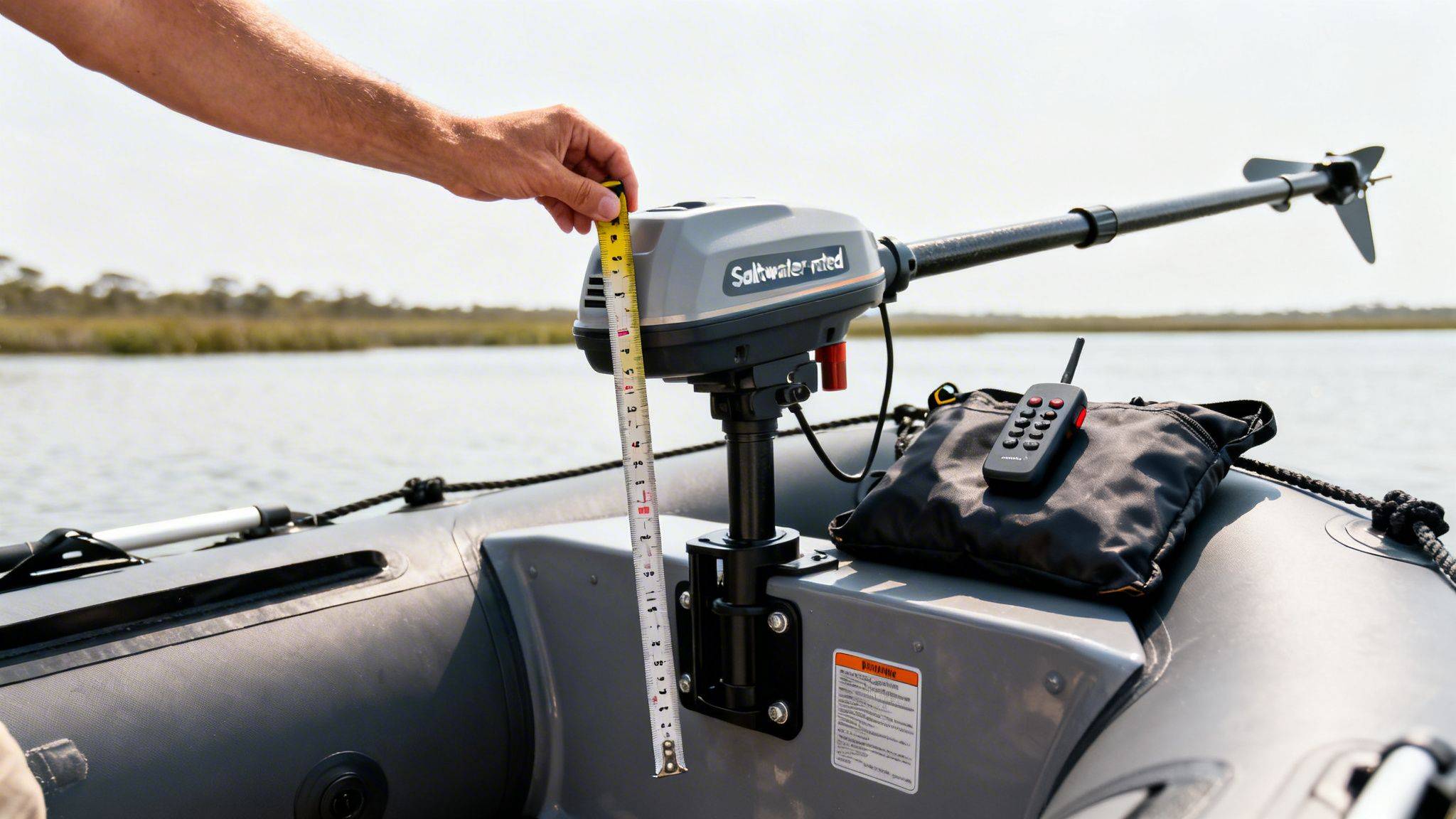
One of the most overlooked parts is the shaft length. The shaft is simply the long tube connecting the control head up top to the propeller down below. If it’s too short, the prop will jump out of the water in a bit of chop, spinning uselessly in the air and killing your momentum. Too long, and you risk scraping the bottom in the shallows.
Getting it right is easy. Just measure the vertical distance from where the motor will clamp onto your boat’s transom down to the waterline. Then, add about 50cm (or 20 inches) to that number. This ensures your prop stays fully submerged where it belongs, giving you consistent power even when the boat is pitching around in waves.
For anyone boating in Australia’s magnificent coastal waters, estuaries, or harbours, a saltwater-rated motor isn’t a “nice-to-have”—it’s an absolute must. Standard freshwater motors just aren’t built to handle the corrosive power of salt. They’re missing the special coatings, sealed electronics, and sacrificial anodes needed to survive.
Putting a freshwater model in the salt is a fast track to failure. Corrosion will quickly chew through the internal parts and electrical connections, leading to a very short lifespan and a dead motor.
Investing in a saltwater-rated motor is one of the smartest moves an Australian boater can make. These models are built tough with special paints, stainless steel components, and a sacrificial anode that protects the motor’s metal parts, guaranteeing you years of reliable service.
A proper saltwater motor might cost a little more upfront, but it will save you a fortune in the long run by not dying prematurely. It’s a crucial spec to look for.
Finally, think about how you’ll actually control and mount your motor. While some high-tech motors come with fancy remotes and foot pedals, the classic tiller control is often the most practical and bomb-proof choice for smaller inflatables. It gives you direct, intuitive steering and speed control right at your fingertips.
When it comes to mounting, the choice for inflatables and inflatable catamarans is even clearer. Forget the complex bow mounts you see on big fishing boats—the transom mount is the only way to go for portable craft.
A transom mount is the winner for a few simple reasons:
This straightforward, robust design is the perfect match for the grab-and-go nature of inflatable boats. To see how these motors pair with different boat packages, you can learn more about our range of electric outboard motors available in Australia. By paying attention to shaft length, saltwater protection, and practical controls, you’ll end up with a motor that’s a perfect partner for all your adventures.
Getting your head around trolling motor power can throw up a lot of questions. We get it. Here, we tackle the most common queries we hear from inflatable boat owners across Australia, giving you straight-up answers to help you lock in your decision with confidence.
You technically can, but in Australian conditions, it’s a terrible idea. Saltwater is relentlessly corrosive, and a freshwater motor just doesn’t have the armour to fight back. It will rust out and fail, sometimes in as little as one season.
Do yourself a favour and always invest in a saltwater-rated model. These come with sealed electronics, special corrosion-resistant coatings, and a sacrificial anode—a small metal block designed to corrode instead of your motor. It’s built to survive the harsh marine environment and will pay for itself in longevity.
Not at all. While you definitely don’t want to be underpowered, strapping a massive motor onto a small inflatable can be inefficient and, frankly, a bit dangerous. Way too much trolling motor power makes the boat hard to handle, especially when you’re trying to move slowly.
The smart way to go is to figure out the thrust you need for your boat’s total weight, then tack on a 20% safety buffer to handle wind and current. Going much higher than that gives you very little benefit and can mess with the handling of a lightweight boat like an Inflatable Catamaran.
For a portable inflatable boat, a lithium (LiFePO4) battery is an absolute game-changer. They’re usually about half the weight of an old-school lead-acid battery, which makes a massive difference when you’re lugging your gear down to the water’s edge.
They also deliver full, consistent power right until they’re empty and last for thousands more charge cycles. Yes, the upfront cost is higher, but their killer performance, lighter weight, and much longer lifespan make them a far better investment for most inflatable boat owners in the long run.
Inflatable Catamarans, like our Aerowave models, are incredibly efficient and don’t need a heap of thrust to get moving. Their twin-hull design is super stable and gets on the plane with ease. A 12V system with 40-55lbs of thrust is typically the sweet spot for models up to 4 metres long.
That stability also makes them a fantastic platform for bow-mount motors with GPS spot-lock, though a simple transom mount is still the most popular and practical choice for its straightforward setup and portability.
Ready to find the perfect power solution for your adventures? Explore the full range of customisable boat and motor packages at Easy Inflatables and get expert advice tailored for Australian waters. Find your ideal setup today!