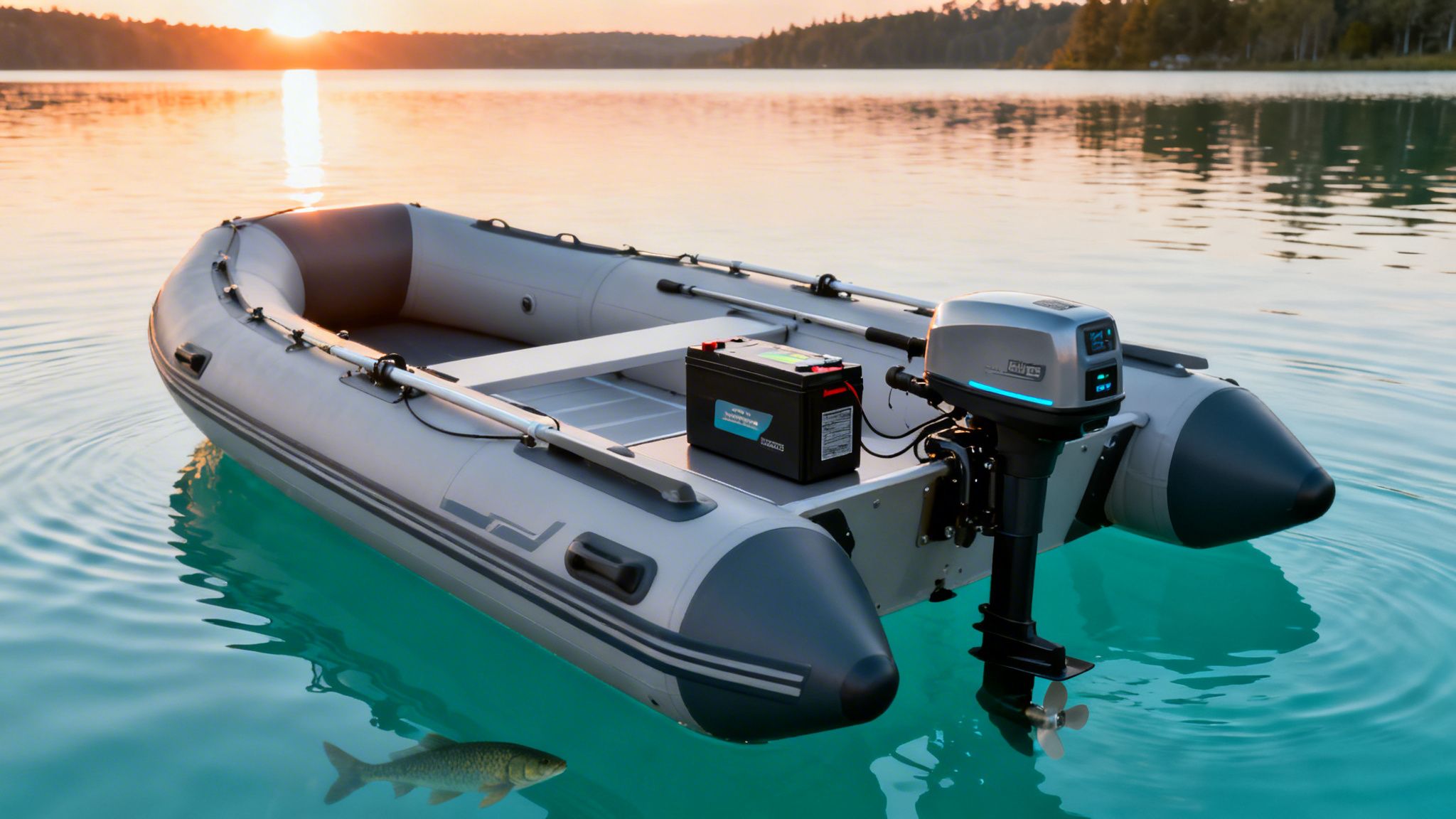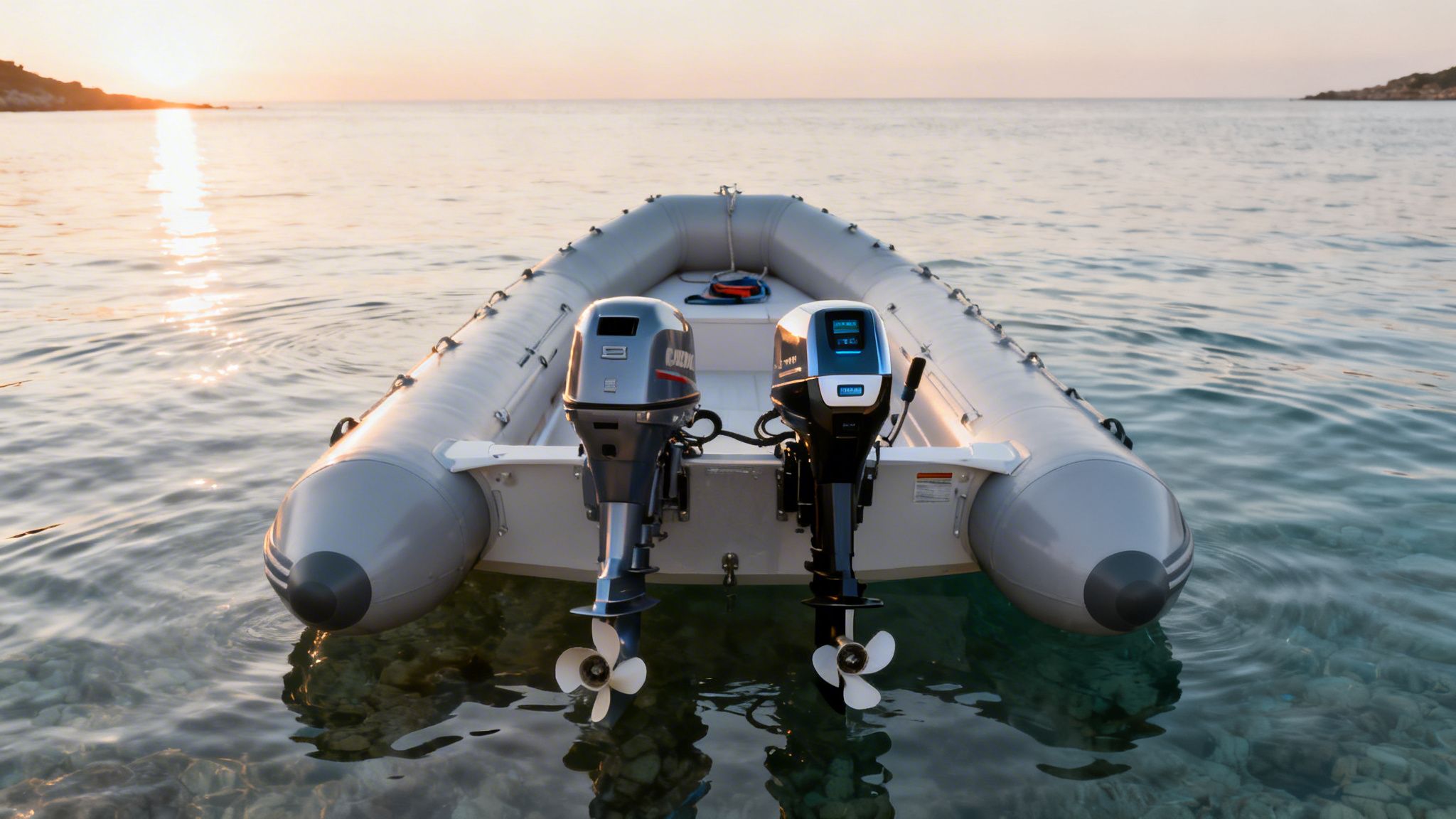

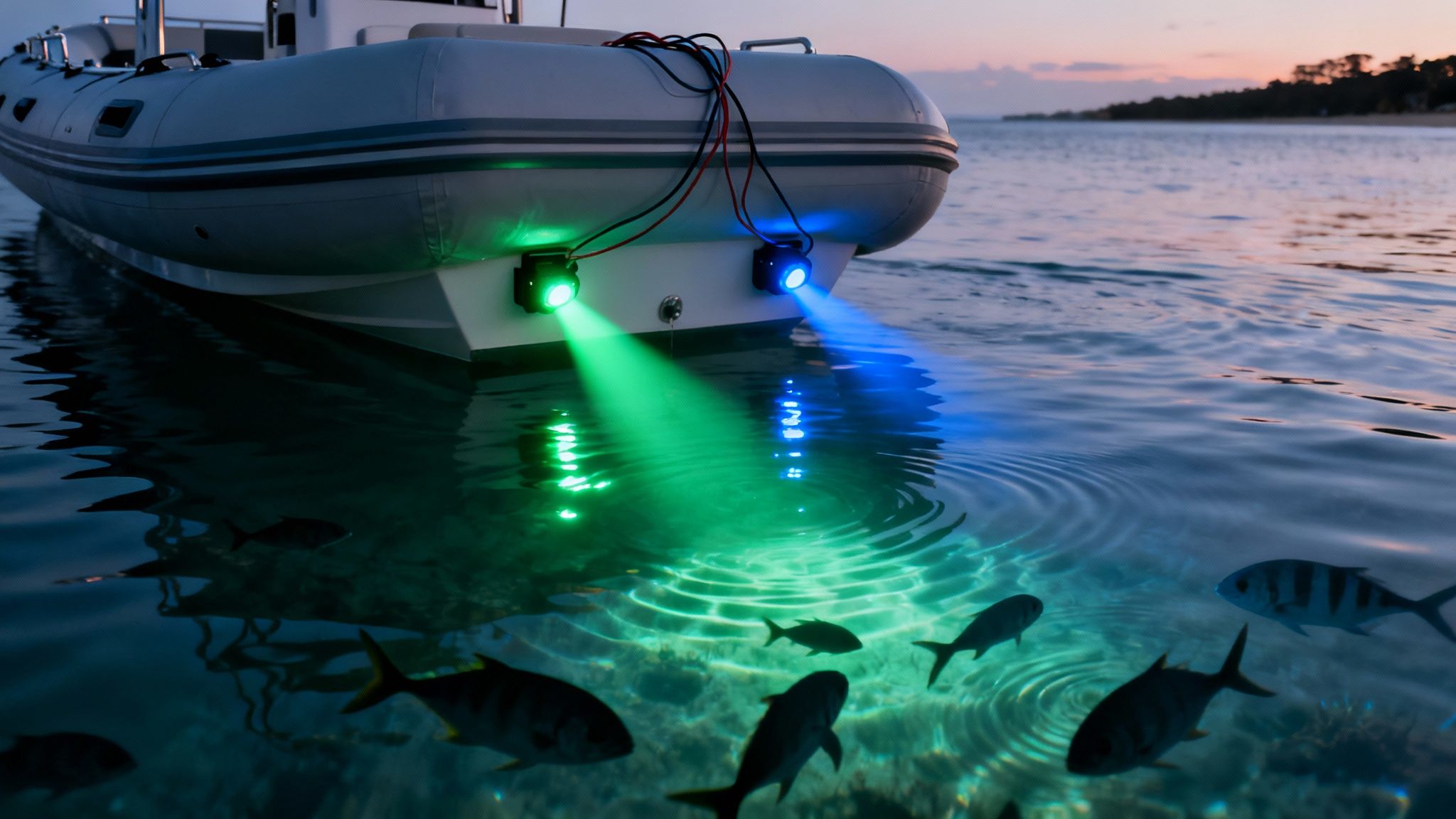
Picture this: your boat, anchored in a quiet bay, casting a vibrant halo of light into the dark water. The best underwater lights for boats aren’t just a flashy accessory; they’re a massive upgrade for safety, fishing, and creating an incredible atmosphere on Australian waters. From inflatable catamarans to slick yacht tenders, the right lighting is a game-changer for every moment you spend out there.
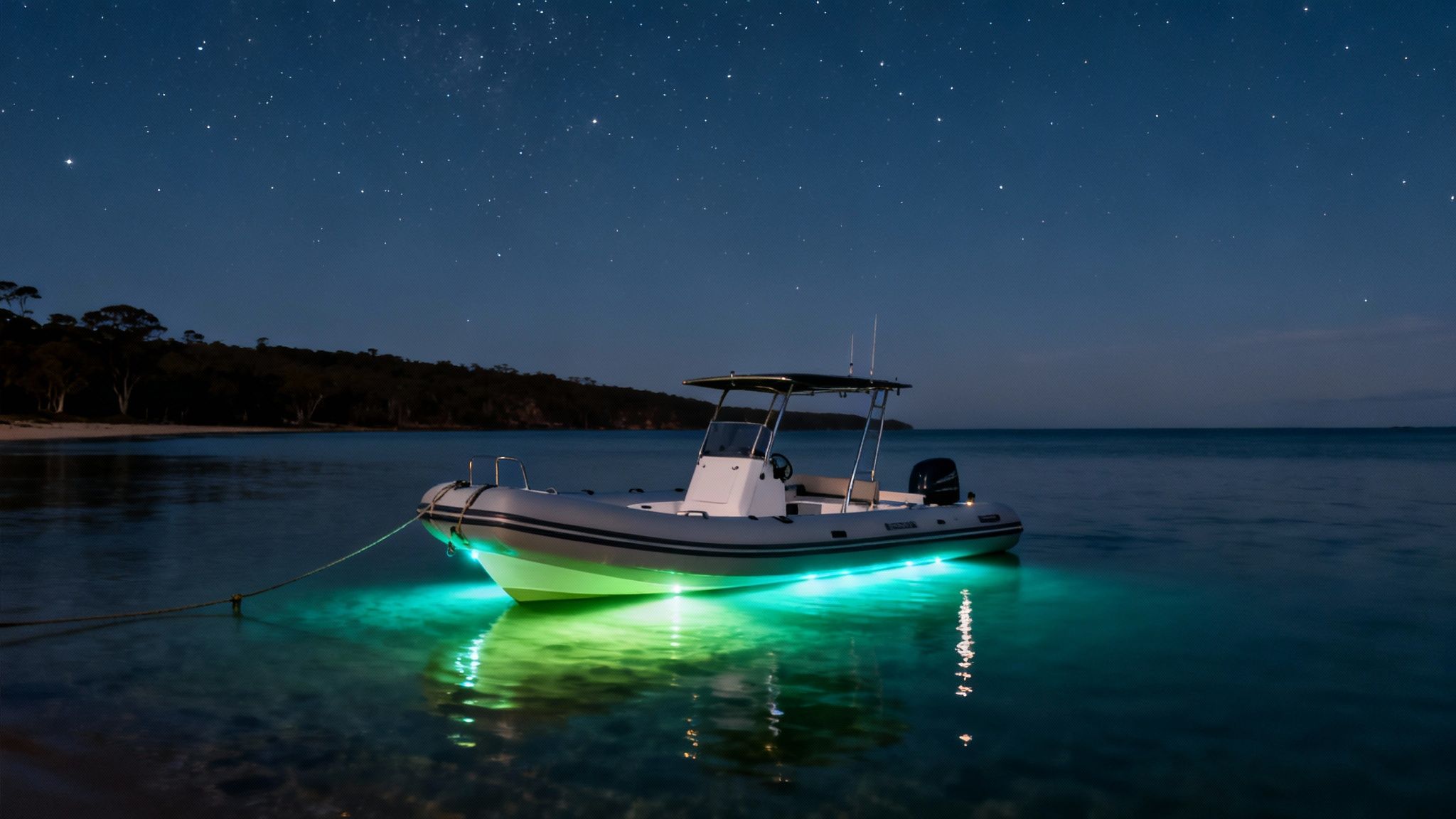
When the sun dips below the horizon, your time on the water doesn’t have to end. In fact, it can transform into a whole new adventure. Installing underwater lights on your boat opens up a world of possibilities, turning a dark, mysterious environment into your own private aquatic theatre.
This guide is for any Aussie boater looking to get the most out of their vessel after dark. If you’re looking to compare prices and features of inflatable boats in your area, or wondering “what are the best inflatable boats for recreational use available near me?”, this guide will help you choose the perfect lighting to complement your chosen craft.
First and foremost, the most practical reason for underwater lights is safety. When you’re anchoring in a dark bay or trying to navigate a tricky mooring at night, lighting up the water around your hull gives you crucial visibility. You can instantly spot submerged hazards like rocks, debris, or shallow patches that would otherwise be invisible.
That extra clarity gives you the confidence to manoeuvre safely, especially in unfamiliar waters. For anyone running a tender back to a larger yacht or returning to the ramp after a late fishing session, this feature is simply invaluable.
Beyond the practical stuff, underwater lights create an incredible vibe. That soft glow transforms your boat into a stunning centrepiece, whether you’re entertaining guests at the dock or just enjoying a quiet evening with the family.
The rich, vibrant colours cast beneath the water create a high-end, stylish feel that elevates the entire boating experience. It’s the difference between simply being on the water and making a statement.
Underwater lights aren’t just for show; they can completely transform your experience. For instance, have you ever seen those incredible tours for snorkeling with manta rays in Kona, Hawaii? They rely on powerful underwater lights to attract plankton, which in turn draws in the majestic manta rays for an unforgettable nighttime spectacle.
For those who are serious about their fishing, underwater lights are a genuine game changer. Certain light colours, especially green and white, are brilliant at attracting phytoplankton. This microscopic life is food for baitfish, which then lures the bigger predatory fish you’re after right to your boat.
It’s a natural food chain reaction that effectively turns the water around your vessel into a bustling, active feeding zone. To get your whole setup dialled in, check out our guide on the best fishing gear for your inflatable. This one addition can seriously increase your chances of a successful night on the water.
To put it all together, here’s a quick look at how underwater lights can level up your favourite boating activities here in Australia.
| Boating Activity | Primary Benefit | Recommended Light Feature |
|---|---|---|
| Night Fishing | Attracts baitfish and predators | Bright green or white LED lights |
| Family Cruising | Creates a magical, safe atmosphere | Colour-changing RGB/W lights |
| Yacht Tendering | Improves safety for docking and boarding | Bright white or blue surface-mounts |
| Entertaining at Anchor | Sets a sophisticated, high-end mood | Multi-colour options with remote control |
Ultimately, whether you’re chasing the catch of a lifetime or just soaking up the serenity of a calm night, underwater lights add a whole new dimension to your time on the water.
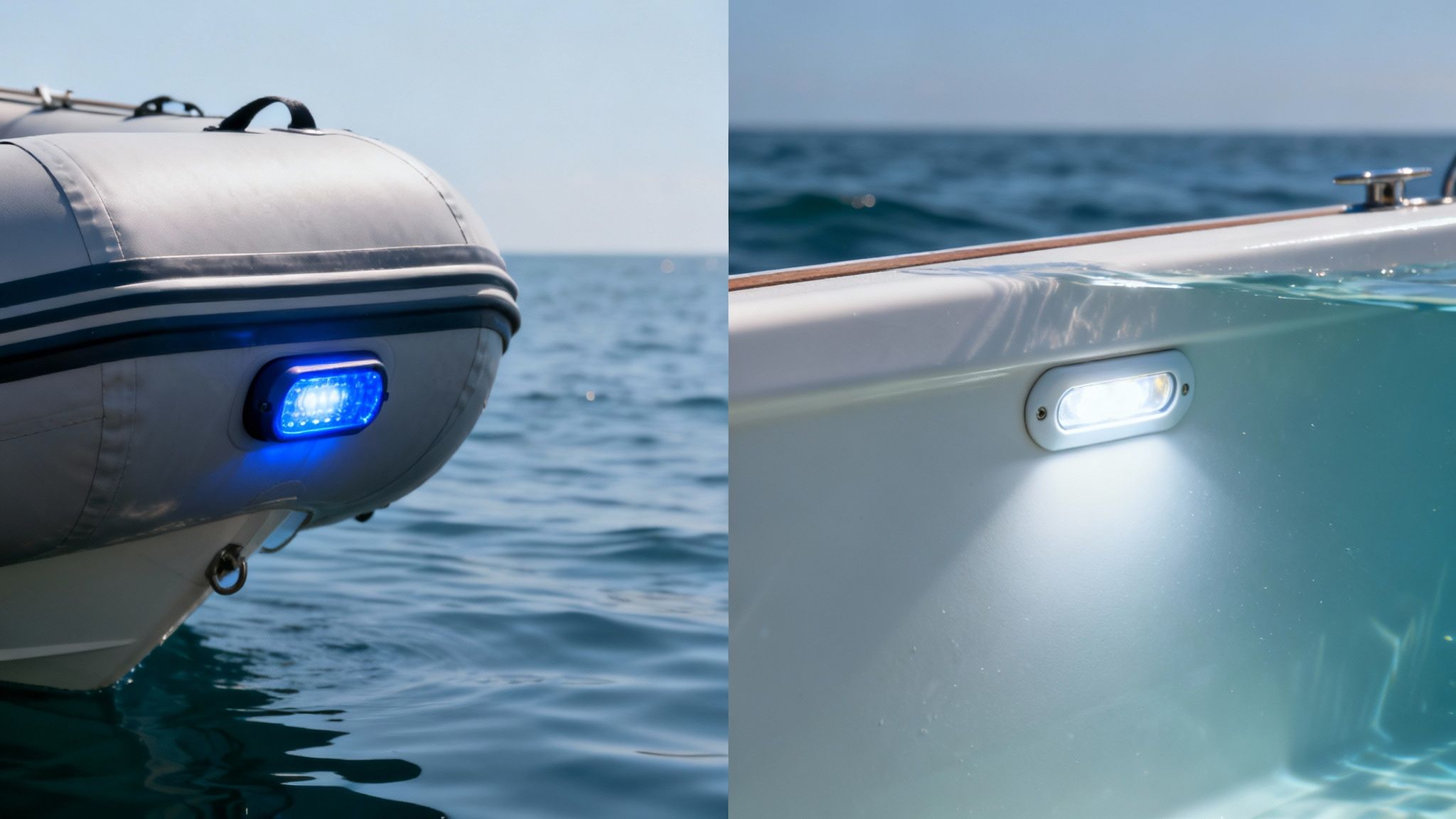
So, you’ve decided to add underwater lights for your boat. Fantastic. Now comes the biggest decision you’ll make in the whole process: how to attach them. The choice between surface-mount and thru-hull lights is a crucial one, directly shaping your installation process, budget, and future maintenance.
Think of it like lighting your house. Surface-mount lights are the outdoor spotlights you can screw onto any wall. They’re self-contained, versatile, and easy to install. On the other hand, thru-hull lights are like built-in recessed lighting—sleeker and more powerful, but they require cutting a hole for that seamless, integrated finish.
Each style has its place, and one is a clear winner for the inflatable boats and tenders we see all across Australia.
For most boat owners, especially if you’re working with an inflatable or planning a DIY job, surface-mount lights are the way to go. These are fully sealed units that you mount directly onto your transom or hull with just a few screws and a tiny hole for the power cable to pass through.
That straightforward installation is their biggest selling point. A modern inflatable catamaran, for example, has a solid transom that provides the perfect sturdy surface to mount a couple of these lights. There’s absolutely no need to drill a large, nerve-wracking hole below the waterline, which makes it an upgrade anyone can tackle.
Here’s why they’re so popular:
This ease of access is a huge factor in Australia’s booming AUD 10.12 billion boating industry. As the market for underwater lights for boats keeps growing—at an expected 6.21% CAGR through 2031—it’s no surprise that surface-mount options are leading the charge. In fact, a massive 64.12% of revenue comes from these simple-to-install lights, loved by DIY boaties from Sydney Harbour to the Gold Coast.
Thru-hull lights are a different beast entirely, offering a premium level of performance and a super-clean aesthetic. As the name suggests, they’re installed through a hole drilled in the hull, allowing them to sit perfectly flush with the surface for a professional, factory-fitted look.
This integrated design allows for much larger, more powerful lighting elements that throw a wider and more intense beam deep into the water. With the core components housed safely inside the hull, they are incredibly durable and well-protected from the harsh marine world. If you want the absolute brightest lights possible, this is your ticket.
Our guide on rigid hull inflatable boats is a great resource if you’re exploring vessels that are prime candidates for these powerful systems.
While the installation is far more involved—and honestly, best left to the pros—the result is a sleek, powerful, and incredibly durable lighting system.
Let’s put them side-by-side to make the choice clear for your inflatable boat.
| Feature | Surface-Mount Lights | Thru-Hull Lights |
|---|---|---|
| Installation | Simple; small hole for wire | Complex; requires large hole in hull |
| Best For | DIY projects, inflatable boats, budget-conscious owners | New builds, major refits, maximum brightness |
| Maintenance | Easy to replace or service from outside the boat | May require hauling the boat out for service |
| Durability | Good, but exposed to potential impacts | Excellent, with components protected inside the hull |
Ultimately, for the vast majority of inflatable boat owners in Australia, surface-mount lights hit that sweet spot of performance, affordability, and simple installation. They’re a brilliant way to light up the water without the cost and complexity of a thru-hull system.
Diving into the world of underwater lights for boats can feel a bit like learning a new language. You’ll hear terms like lumens, kelvins, and IP ratings thrown around, but don’t worry—these concepts are far simpler than they sound.
Getting a handle on the basic tech is the key to choosing lights that not only look fantastic but will also perform reliably in Australia’s tough marine conditions. Think of this as your quick-start guide to the specs that actually matter. We’ll break down the jargon into practical knowledge so you can compare products with confidence and find the perfect match for your inflatable.
Let’s start with the most important metric of all: lumens. This is simply a measure of the total amount of visible light a bulb puts out. The higher the lumen count, the brighter the light will be. It’s the most honest way to judge brightness.
A good way to picture it is to think of the old-fashioned lightbulbs at home. While not a perfect one-to-one comparison, a 100-watt incandescent bulb produces about 1,600 lumens. For underwater boat lights, you’ll see figures ranging from 900 lumens for smaller, entry-level units up to a massive 10,000 lumens or more for high-end thru-hull models.
For a typical inflatable boat or tender, a pair of lights each producing between 2,000 to 5,000 lumens is the sweet spot. This gives you a brilliant glow that cuts through the water effectively without being total overkill for a smaller vessel.
Once you’ve figured out brightness, the next choice is colour. This decision comes down to what you’ll be using the lights for and, of course, your personal style.
Your main options are:
RGBW lights offer the ultimate versatility. You can match the lighting to your mood, your activity, or even the colour scheme of your boat, giving you complete creative control over your on-water atmosphere.
Durability is completely non-negotiable, especially in saltwater. The key specification to look for here is the IP rating, which stands for Ingress Protection. This simple two-digit number tells you exactly how well a piece of electronics is sealed against solids (like dust) and liquids (like water).
The first digit rates protection against solids, and the second rates protection against liquids. For underwater lights for boats, you should only ever consider products with an IP68 rating.
An IP68 rating is your guarantee that the light is built to live permanently submerged and can handle the constant pressure and corrosive effects of the marine environment. The quality of the materials used in the boat itself plays a huge role here, too. To learn more about what makes a boat’s construction truly durable for Australian conditions, you can read about the benefits of Hypalon vs PVC material in our detailed guide.
Another critical factor is power draw, especially for smaller inflatable boats with simpler battery systems. Modern LED lights are incredibly efficient, but it’s still wise to check the amperage (amp) draw. Most lights pull between 1 to 5 amps each, which is a manageable load for most marine batteries, even when anchored with the engine off.
To make it even easier, here’s a quick cheat sheet to help you decode the technical jargon you’ll find on the box.
| Specification | What It Means for You | Top Pick for Inflatables |
|---|---|---|
| Lumens | The measure of brightness. Higher lumens = brighter light and better water penetration. | 2,000 – 5,000 lumens per light is a great balance of brightness and power draw. |
| Colour Temp (Kelvin) | Describes the shade of white light, from warm yellow to cool blue. | 5000K to 6500K provides a crisp, modern “daylight” white that looks clean in the water. |
| IP Rating | How waterproof and dustproof the light is. This is absolutely critical for underwater use. | IP68 is the only rating you should consider. Anything less won’t last. |
| Power Draw (Amps) | How much electricity the light uses. Lower is better for preserving your battery. | 1 to 5 amps per light is efficient and won’t drain your system quickly. |
This table should give you the confidence to look at any product’s specs and know exactly what you’re getting and whether it’s the right fit for your boat.
Alright, you’ve got the lowdown on the tech behind underwater lights for boats. Now for the fun part: getting them installed. This guide will walk you through fitting surface-mount lights, which are the perfect match for the solid transoms on inflatable boats—including popular inflatable catamaran models.
With the right tools and a bit of patience, this is a DIY project you can absolutely handle. We’ll cover everything from picking the best spot to getting a completely waterproof seal, giving you the confidence to do the job yourself or know exactly what to talk about with a professional installer.
Before a single hole gets drilled, planning is everything. The goal is to position your lights for the best possible light spread while making sure they stay safely submerged when your boat is up on the plane.
For most inflatables, the sweet spot is on the transom, about 15 to 25 centimetres below the waterline. This keeps them underwater so they stay cool and can throw that wide, impressive beam. You’ll want to place them symmetrically—an equal distance from the boat’s centreline—to get a balanced, professional look. Grab a tape measure and a pencil and mark your exact mounting points.
This is the part that makes most boat owners a bit nervous, but trust me, with a little care, it’s straightforward. Since surface-mount lights only need a small hole for the power cable, the risk is minimal.
Don’t be shy with the sealant. A little bit squeezing out when you tighten the screws is actually a good sign—it means you’ve got a solid seal protecting your transom. You can always wipe away the extra before it cures.
Proper wiring is crucial for both safety and performance. The marine environment is brutal on electrical components, so using the right materials isn’t just a good idea, it’s a necessity.
This diagram breaks down the key specs to lock in before you even think about installation.
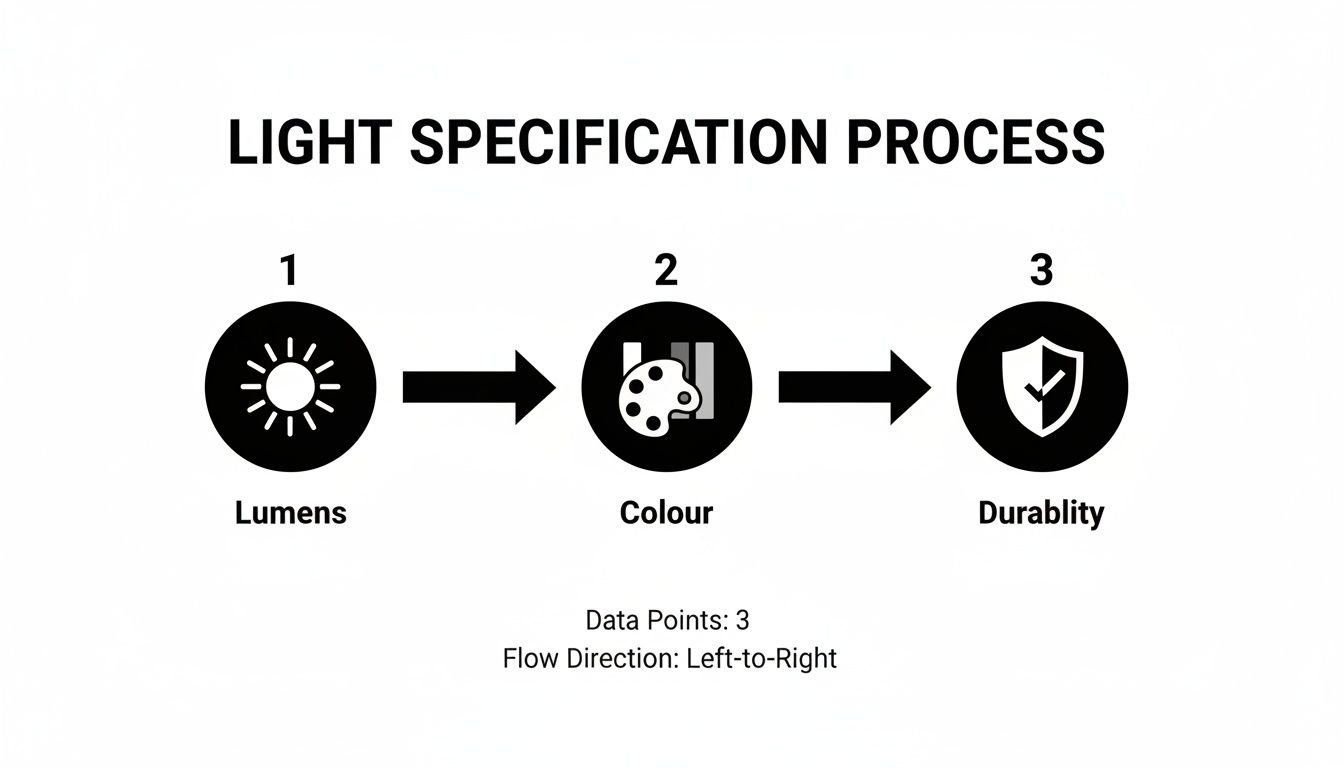
As you can see, it flows from evaluating lumens for brightness, to choosing the right colour for your needs, and finally, confirming high durability ratings. Nail these three, and you’ll have the perfect lights for your boat.
Once everything is wired up, it’s the moment of truth. Flick the switch and make sure both lights fire up correctly. If you’ve gone with RGB lights, cycle through the different colours and functions to confirm everything is responding as it should.
Finally, give all your wiring a gentle tug to make sure the connections are solid. Tidy everything up with zip ties, keeping the wires well away from any moving parts or hot surfaces. For more great ideas, check out our detailed article on inflatable boat setup tips for safety to ensure your whole vessel is ready for the water.
Adding a set of underwater lights for your boat is one of the most exciting upgrades you can make, but before you fire them up, it’s crucial to get your head around the local maritime safety rules. The last thing anyone wants is to cause confusion on the water or, worse, cop a fine while you’re trying to enjoy that beautiful glow. Knowing the rules is just part of being a responsible skipper.
Don’t worry, navigating these regulations is much simpler than it sounds. The golden rule is to avoid displaying any light that could be mistaken for an official navigation signal or a distress light. It’s all about clear communication and keeping everyone safe out on the water.
The Australian Maritime Safety Authority (AMSA) has clear guidelines for boat lighting to prevent dangerous mix-ups. When your boat is moving, the colour of your lights means something very specific, and every other skipper needs to be able to recognise it instantly.
Think of it like traffic lights on the water. The red and green lights on your port and starboard sides, plus a white stern light, tell other boaters exactly where you are, how big your vessel is, and which way you’re headed.
The most important rule to remember is this: never display blue, red, or flashing white lights from your underwater setup while underway. Blue lights are strictly reserved for law enforcement and emergency vessels, while red can be easily confused with port-side navigation lights or distress signals. Using these colours while you’re moving is a serious safety hazard.
So, when can you show off that incredible spectrum of colours? The rules are generally much more relaxed once your boat is stationary.
Once you’re safely anchored up or tied to a mooring, you can usually fire up your full spectrum of RGB underwater lights and create that perfect evening atmosphere. This is the time to cycle through colours for a night swim or set a relaxing blue glow while you’ve got guests on board. Of course, it’s always good practice to be considerate of other boats if you’re in a crowded anchorage.
While the national guidelines give us a solid framework, the rules can vary slightly depending on where you’re boating in Australia. If you’re looking for a place in Australia to hire inflatable boats for a family outing, it’s wise to check with the rental company about any local lighting restrictions in their operating area. Some states or marine park authorities may have specific regulations about decorative lighting, often to protect wildlife or minimise disturbances in sensitive ecosystems.
Before you head out, especially if you’re exploring a new spot, it’s always a good idea to quickly check the local maritime authority’s website for any specific bylaws. This is particularly important in protected areas, like parts of the Great Barrier Reef Marine Park.
For any boater, understanding lighting is a core safety skill. You can also check out our detailed guide on the requirements for an anchor light for your boat to make sure you’re covered in all situations.
Getting the colours right is one thing, but making sure the installation itself is safe is absolutely paramount. All the wiring and connections for your underwater lights for boats must meet Australian standards for marine electrical systems.
This means you’ll need to:
Sticking to these standards prevents electrical faults that could lead to fires or system failures, keeping you and your passengers safe. Follow these simple guidelines, and you can enjoy the spectacular look of your underwater lights with complete peace of mind.
Technical specs are one thing, but the real magic happens when you find a lighting setup that genuinely improves your time on the water. The best lights aren’t always the brightest or the most feature-packed; they’re the ones that make your favourite activities better. This is where we connect all the dots and figure out what’s right for you.
Let’s walk through three common ways Aussie boaters use their inflatables. Whether you’re a serious angler chasing the next big catch, a family enjoying weekend adventures on an inflatable catamaran, or a yacht owner needing a reliable tender, there’s a lighting solution built for your lifestyle.
If your inflatable is your fishing platform, then underwater lights are a piece of essential gear, not just a fancy add-on. For anglers, the goal is simple: attract fish. And that’s where specific light colours become your secret weapon.
For a serious fishing setup, a pair of powerful, single-colour green or white lights pushing out 3,000 lumens or more will turn the water behind your boat into your own personal hunting ground.
When the boat is all about family fun, your lighting choices shift from pure function to creating an atmosphere. This is where colour-changing RGB (Red, Green, Blue) or RGBW (which adds a dedicated White diode) lights truly shine, turning an inflatable catamaran into the perfect stage for evening entertainment.
Imagine dropping anchor in a calm bay and letting the kids pick the colour for an after-dark swim. A vibrant blue, a soft purple, or even a slow-cycling rainbow can transform a simple evening into a magical experience they’ll never forget.
RGBW lights give you the best of both worlds. Flick them over to a practical, bright white when you need to see clearly for docking or packing up, then shift to any colour you can imagine to set the mood. That versatility makes them the ultimate choice for families who do a bit of everything.
For a yacht tender, underwater lights are a blend of sophisticated style and practical safety. They need to look sleek and elegant to complement the mothership, while also providing crucial illumination for safely boarding and disembarking at night.
This is a big part of a rapidly growing market. The Australia Underwater Lighting Market hit USD 4.89 million and is projected to climb to USD 7.47 million by 2033, driven by Australia’s massive fleet of over 1 million registered recreational vessels. For everyone from families on RIBs to dedicated anglers, these lights can boost visibility by up to 30 metres. Even better, safety reports show that well-lit boats have 25% fewer nighttime incidents—a vital statistic for anyone out on our extensive coastline. You can dive deeper into the data on the booming Australian underwater lighting market and its impact.
Still weighing things up before adding underwater lights for boats? Good. It’s smart to have all the facts. Here are a few of the most common questions we get from Aussie boaters, answered plain and simple.
You absolutely can. Modern inflatables, especially an Inflatable Catamaran, have a seriously robust transom that gives you a perfect, solid surface for mounting surface-mount LED lights. This style is the go-to choice because it avoids cutting a big hole below the waterline, making it a straightforward and incredibly effective upgrade.
Just be sure to use a top-shelf marine-grade sealant like 3M 5200 when you’re installing them. That’s the key to a completely waterproof and rock-solid seal that’ll last.
Not these days, no. Modern LED underwater lights are ridiculously efficient, usually drawing only 1 to 5 amps for a standard pair. While it’s always smart to keep an eye on your battery if you’re anchored up with the engine off for hours, their power draw is pretty minimal for most marine electrical systems.
If you’re planning on spending long nights at anchor and want total peace of mind, a dual battery setup or a portable power station is a great investment. That way, you’ll have more than enough juice for your lights and everything else on board.
Power anxiety shouldn’t stop you. The low draw of modern LEDs means you can light up the water for hours without a single worry about getting left in the dark.
For Aussie waters, you can’t go wrong with green or white. They’re the proven performers.
Some anglers also swear by blue light, especially when they’re fishing in super clear, deep offshore waters where that particular wavelength travels the furthest.
Good news—maintenance is refreshingly simple, but it’s the key to keeping them performing for years. All it takes is a quick rinse with fresh water after each trip to wash off any salt build-up.
Every few weeks, just give the lens a gentle wipe with a soft cloth to clear off any marine growth, which can really dim the light’s output. The most important thing is to avoid using abrasive scourers, harsh chemicals, or scrapers—they’ll permanently scratch the lens. This simple routine is all it takes to keep your lights shining like new.
Ready to see your boat in a whole new light? At Easy Inflatables, we build a fantastic range of inflatable boats and catamarans that make the perfect platform for an epic underwater lighting setup. Check out our durable, high-performance models and find the ideal boat for your next adventure at https://easyinflatables.com.au.