
Sick of tripping over that red fuel can on your deck? Let's talk about one of the best upgrades you can make to your boat: an underfloor fuel tank. This isn't just about stashing fuel out of sight; it's about transforming how you use your boat, boosting its performance, and unlocking longer, better adventures on the water.
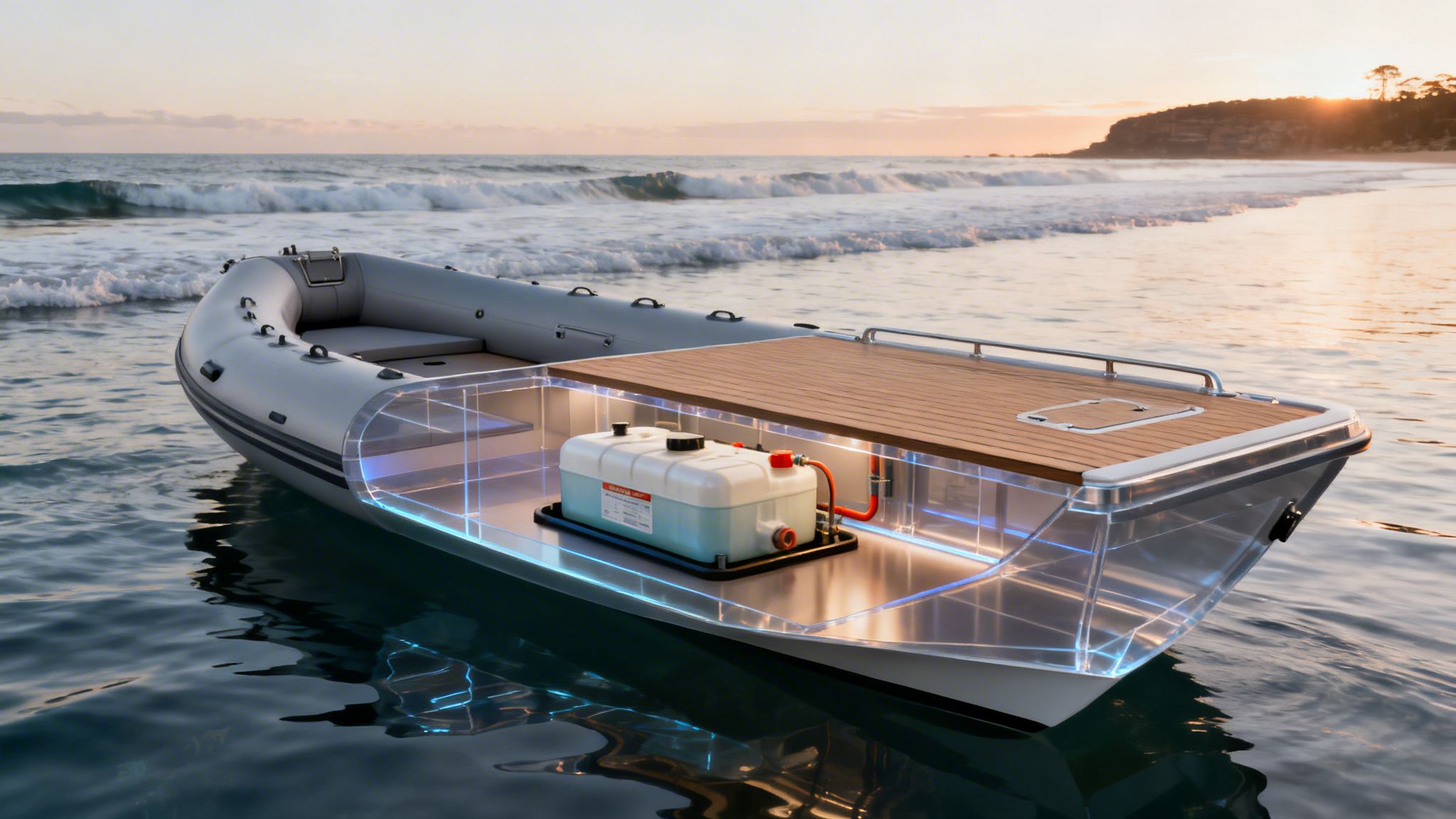
An underfloor fuel tank for a boat is a purpose-built, permanently installed tank that sits low within your boat's hull, completely hidden beneath the deck. It's a game-changer for Aussie boaters looking to free up precious deck space, increase their range, and seriously improve stability out on the water.
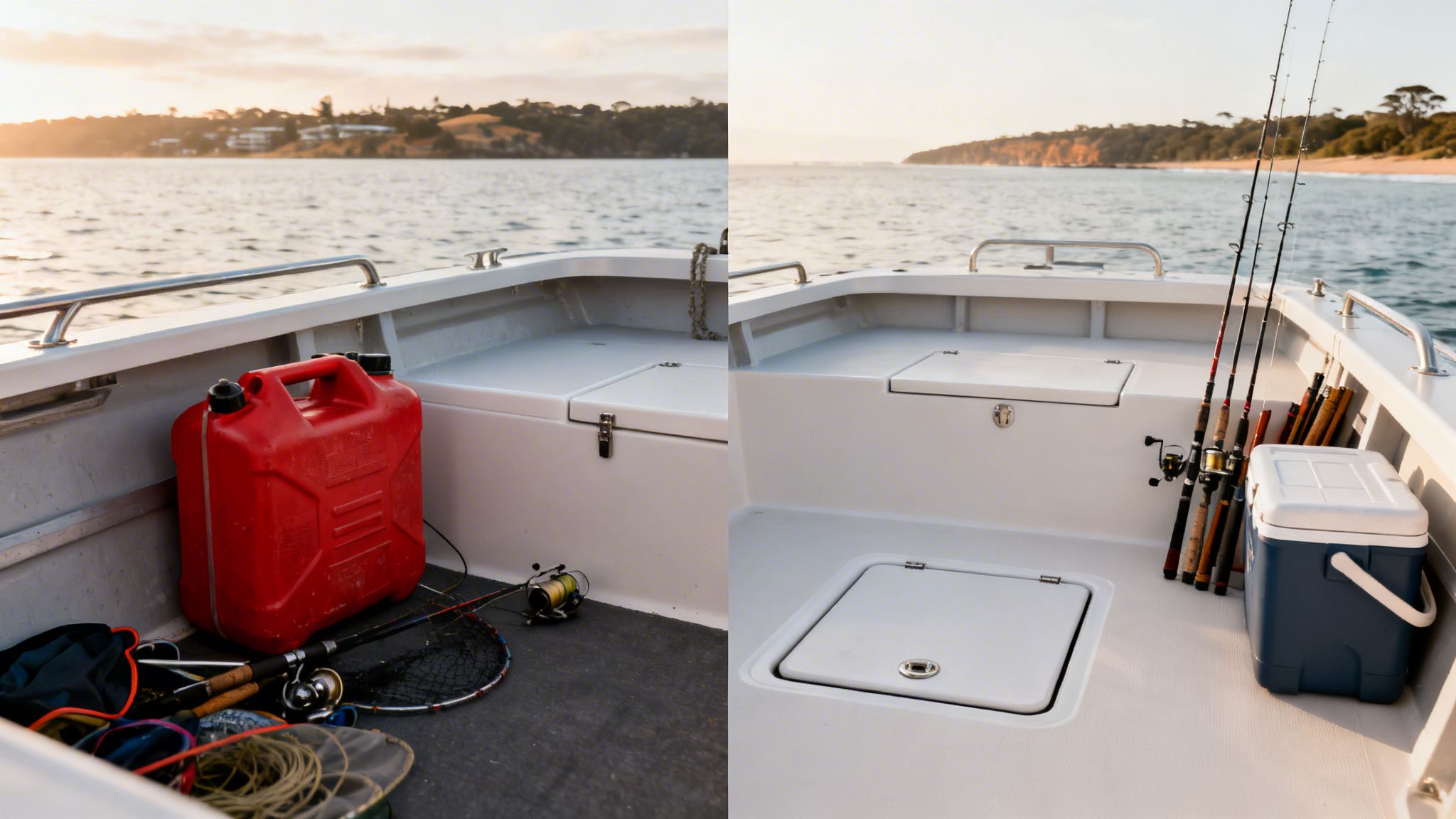
Most of us start our boating journey with those familiar portable "tote" tanks. They're simple and they get you out there, but let's be honest—they have their downsides. They get in the way, they're a tripping hazard, and you’re constantly lugging them back and forth from the servo.
Now, imagine a day on the water where your deck is completely clear. No more navigating around bulky cans. That's the real magic of an underfloor tank. It’s more than just a bit of kit; it’s a massive upgrade that gives you your deck back for what it’s actually for—fishing, family, or just kicking back and enjoying the view.
Think of it like this: a portable fuel can is like using a little power bank to keep your phone alive. It works, sure, but having a fully integrated, long-lasting battery is a whole different level of convenience. An underfloor tank gives your boat that same seamless, integrated feel.
By shifting the fuel load from the deck into a fixed position low in the hull, you're doing a lot more than just hiding it away.
To get a clearer picture, let's break down the key differences.
This table gives a quick snapshot of how a permanent underfloor system stacks up against the traditional portable cans most of us started with.
| Feature | Underfloor Fuel Tank | Portable Fuel Tank |
|---|---|---|
| Deck Space | Frees up 100% of deck space, keeping it clear and safe. | Takes up valuable deck space, creating a trip hazard. |
| Capacity & Range | High capacity (77L+) for significantly longer range. | Limited capacity (10-30L), requiring frequent refills. |
| Stability | Improves stability by lowering the centre of gravity. | Can negatively affect balance, especially when full. |
| Convenience | Fill up at the bowser just like a car; fuel gauge on dash. | Must be removed, carried, and manually refilled. |
| Installation | Professional installation required; permanent fixture. | No installation needed; "grab and go". |
| Cost | Higher initial investment for the tank and installation. | Very low initial cost; often included with the motor. |
While portable tanks are a great, low-cost starting point, it's easy to see why so many boaters eventually make the switch to an underfloor system for a more capable and enjoyable setup.
An underfloor fuel tank isn’t just a container; it's the foundation for a safer, more capable, and clutter-free boating experience. It transforms your vessel from a day-tripper into a serious adventurer.
This upgrade is a fantastic choice for all sorts of boats, from tough rigid inflatable boats (RIBs) and yacht tenders to the classic Aussie aluminium tinnie. If you're weighing up your options, our guide on the best petrol tank for an outboard engine offers some great context. Ultimately, moving to an underfloor system is about setting your boat up for better performance and more fun on the water.
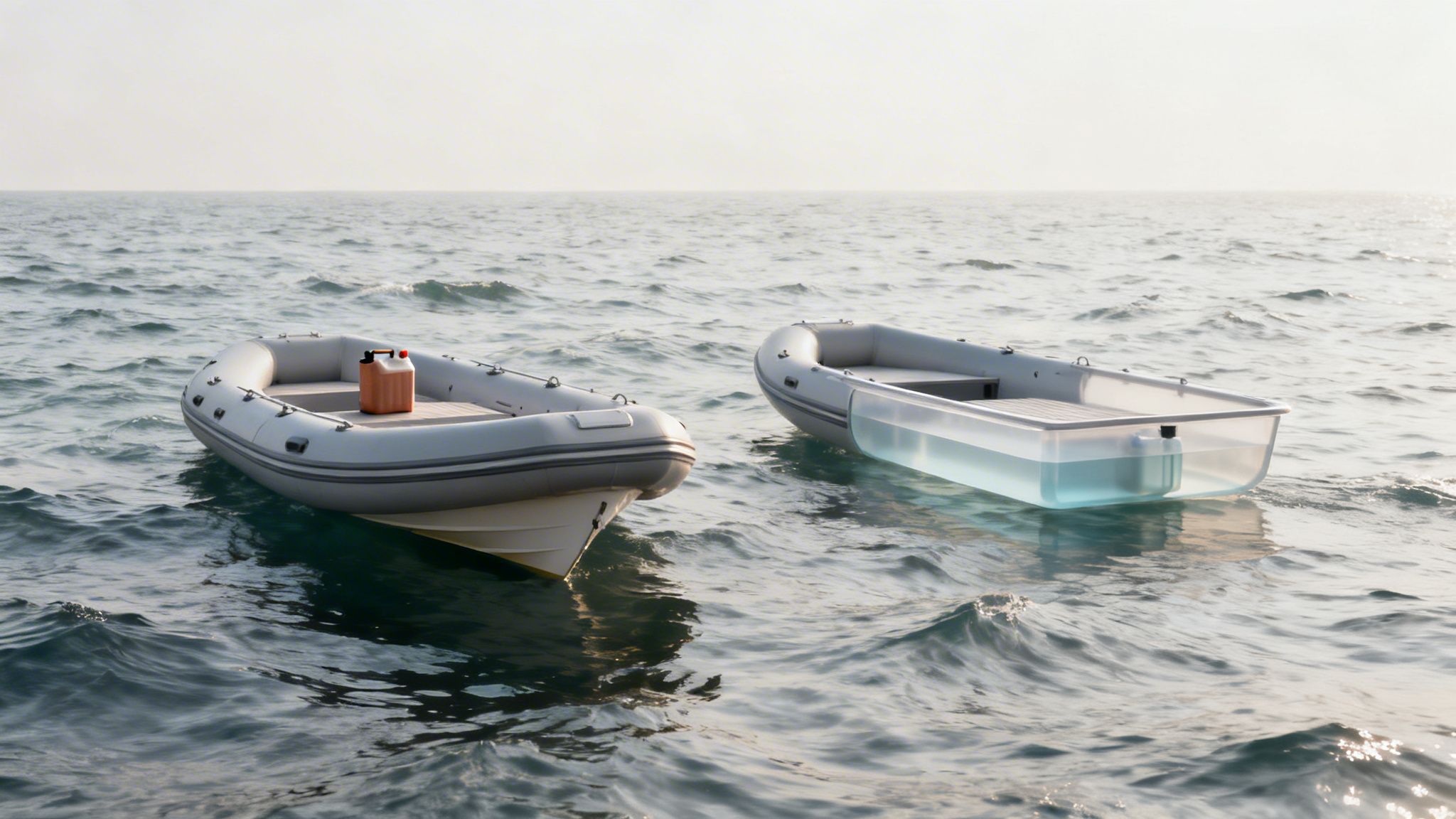
Fitting an underfloor fuel tank does so much more than just tuck your fuel out of sight. It completely transforms how your boat feels and behaves on the water, starting with a massive leap in stability and handling. By moving that heavy fuel load low down and right in the centre of the hull, you’re dramatically lowering the boat's centre of gravity.
This one change makes a world of difference. Your boat feels more planted, more predictable, and far less prone to rolling from side to side when the chop picks up. For lighter boats like RIBs and tenders, this isn't just about comfort—it's a critical safety upgrade.
Think about how race car engineers obsess over getting the weight as low as possible. It helps the car hug the track for incredible control. The same logic applies to your boat. A lower centre of gravity gives you and your passengers a smoother, safer, and far more confidence-inspiring ride.
Ever tried to balance a broomstick on your hand? It’s a lot easier to do it from the bottom (a low centre of gravity) than trying to balance it from the top (a high centre of gravity). A boat with portable fuel cans sloshing around on deck has a higher centre of gravity, making it feel "tippy" and more vulnerable to rolling.
An underfloor fuel tank for a boat essentially acts as permanent ballast, planted low in the hull to counteract the forces from waves and wind. The moment you get on the water, you'll feel it:
This rock-solid stability is exactly why underfloor tanks are standard on purpose-built offshore rigs, like the Haines Hunter 625 Offshore or Stacer's Sea Ranger series. These boats often come with tanks ranging from 77L to well over 200L, designed to keep them stable and safe far from shore.
Beyond the ride, a professionally installed underfloor tank is a massive win for safety. It creates a fully sealed and integrated fuel system, which is a world away from loose portable cans. Those cans, with their manual connections and vent caps, are one of the most common sources of small fuel spills and flammable vapour leaks on deck.
A sealed underfloor fuel system is built to contain dangerous fuel vapours and prevent leaks—directly tackling some of the most serious fire and explosion risks on any recreational boat.
This isn’t just theory; it's a lesson learned the hard way and now a cornerstone of Australian boat safety. Early analysis of boating accidents showed that for boats under 6 metres, poor buoyancy—often made worse by badly fitted or unsecured fuel systems—was a contributing factor in 12% of fatal accidents. This data was crucial in driving the creation of the Australian Builders Plate (ABP) standards, which now mandate proper fuel system installation to prevent leaks and maintain stability.
An underfloor system is designed to solve these problems. Vents are routed safely outside the hull, channelling explosive vapours away from the cockpit and bilge. Fuel lines are permanently fixed, practically eliminating the risk of a connection vibrating loose while you're bouncing through chop. It all adds up to a much safer environment for everyone onboard and is a vital part of being a responsible skipper. To make sure you've got all your bases covered, have a look at our guide to essential boating safety equipment.
Picking the right underfloor fuel tank isn't just about bolting in a plastic box; it’s one of the most important decisions you'll make for your boat. Get it right, and you’ve got the freedom to explore further with total peace of mind. Get it wrong, and you could be cutting your day short or, worse, caught out when the weather turns.
It’s all about finding that sweet spot between your engine's thirst for fuel, how far you want to go, and keeping a safe amount in reserve. Let’s break down how to choose the perfect tank size and material for your setup.
Think of it just like planning a long-distance road trip; you wouldn't set off without knowing your car's fuel economy and how far you need to drive. For your boat, the key figure is your engine's fuel burn in litres per hour (LPH) when you're cruising comfortably.
To avoid those nerve-wracking moments staring at a low fuel gauge miles from shore, every smart skipper lives by one golden rule: the ‘Rule of Thirds’. This simple bit of wisdom is your best friend for fuel planning and is non-negotiable for safe boating.
The rule is beautifully simple:
Let's put it into practice. Imagine you have a 60HP outboard that sips about 20 litres per hour at a steady cruise. You’re planning a run out to a reef that takes two hours to reach.
Right there, you know you need a total capacity of at least 120 litres. That reserve isn’t just for show—it’s your lifeline if you hit strong currents, face a headwind on the way home, or just decide to explore that next bay. We always recommend sizing up slightly; you'll never regret having too much fuel, but you'll definitely regret having too little.
Once you’ve nailed down the capacity, your next decision is the material. The two heavyweights in the world of an underfloor fuel tank for a boat are high-density polyethylene (plastic) and marine-grade aluminium. Each has its own strengths, and the right choice depends on your boat and how you use it. For context, it’s useful to see how different metals are used across industries, like in metal oil tanks, to appreciate the properties of each.
Polyethylene tanks have become hugely popular, and for good reason—especially for small to mid-sized trailer boats and RIBs. They are rotationally moulded, creating a single, seamless unit. This completely eliminates the risk of welds cracking or failing over time, which is a massive win for long-term durability.
Aluminium tanks, on the other hand, are the weapon of choice for custom builds and larger offshore beasts. Their biggest advantage is that they can be fabricated into almost any shape, letting you squeeze every last litre of fuel capacity out of an unusual hull space where a standard poly tank just won't fit. You'll see them fitted as standard in many high-performance Aussie plate boats, with capacities often starting from 77L and going well over 215L.
To make the choice easier, here's how the two materials stack up head-to-head.
Deciding between plastic and aluminium can feel like a tough call. This table breaks down the key differences to help you find the best fit for your vessel and your budget.
| Attribute | Polyethylene (Plastic) | Aluminium |
|---|---|---|
| Durability | Extremely impact-resistant and will not corrode. Takes knocks and bumps well. | Strong, but can be prone to corrosion, especially from saltwater trapped against the hull. |
| Cost | Generally more affordable for standard off-the-shelf sizes. Great value for money. | More expensive, particularly for custom-fabricated shapes and sizes. |
| Weight | Lighter than aluminium, which is a big plus for performance and efficiency on smaller boats. | Heavier, which can slightly impact handling and fuel economy. |
| Corrosion Resistance | Excellent. Totally immune to rust and corrosion from saltwater and ethanol-blended fuels. | Good, but needs care. Prone to pitting and crevice corrosion if water gets trapped around it. |
| Shape & Customisation | Limited to standard, off-the-shelf sizes and shapes. | Can be custom-built to precisely fit any hull space, maximising your fuel capacity. |
For most recreational boaters, especially those with RIBs and fibreglass or aluminium trailer boats, a high-quality polyethylene tank is the clear winner. It offers a fantastic mix of durability, low maintenance, and affordability. In the harsh saltwater environment, its immunity to corrosion is a game-changer.
For most recreational boaters, particularly those with RIBs or trailer boats operating in saltwater, a high-quality polyethylene tank offers the best combination of durability, low maintenance, and value. Its immunity to corrosion is a massive advantage in the harsh marine environment.
Ultimately, the best material really does depend on your specific boat and ambitions. For many popular boats, including the Inflatable Catamaran and tenders, a pre-made poly tank is a perfect, no-fuss solution. But if you're building a custom weapon and need to maximise every inch of space for those long-range trips, a fabricated aluminium tank is the way to go.
If you're still weighing up your options, our guide to outboard engine fuel tanks has more great info to help you make the right call.
Fitting an underfloor fuel tank for a boat is a serious upgrade, and it’s one that needs to be done right. While it might look like a simple job—cut a hole, drop in a tank—the reality is a lot more involved. This isn't a weekend DIY project; it's a specialised task where getting a professional to handle the installation is absolutely critical for your safety and your boat’s performance.
Trying to do it yourself is just asking for trouble. A small mistake can cause anything from frustrating engine problems to a genuine disaster on the water. A professional installer has seen it all and understands the small details that make the difference between a reliable fuel system and a ticking time bomb.
The first job is always a thorough check of the under-deck space. An expert won't just see if the tank fits; they'll make sure there's enough room for all the fittings, hoses, and most importantly, the ventilation paths. They’ll also look at the structural integrity of your hull and stringers to ensure they can handle the immense dynamic forces of a full fuel tank.
That tank needs to be perfectly supported and secured. Picture 80-120 kilograms of fuel sloshing around violently in rough seas. If that tank isn’t properly braced, it can shift, chafe against the hull, or even break free completely, causing massive damage and creating a huge safety risk.
A professional installer doesn’t just fit a tank; they integrate it into the boat's very structure. They make sure it’s bedded down with cushioning materials to absorb shock and prevent chafing, then strap it in so it won’t budge an inch, no matter how rough it gets out there.
Even if you have the space and support sorted, there’s still plenty that can go wrong with the installation itself. How the fuel lines, vents, and wiring are routed is vital. A tiny oversight here can lead to major headaches down the track.
Here’s a quick list of common installation mistakes that a professional knows to steer clear of:
To get a better handle on all the parts that make up a safe system, check out our guide on the crucial role of the outboard engine fuel line.
Finally, it all comes down to compatibility. The truth is, not every boat is a good candidate for an underfloor tank. This is particularly true for inflatable boats, where getting an expert's opinion is non-negotiable.
An experienced fitter can look at specific models, like our Aerowave inflatable boats and inflatable catamarans, and figure out the best way forward. They know the unique construction of RIBs and how to install a tank without compromising the hull’s strength or the boat’s handling. They’ll recommend the right tank size and material to perfectly match your boat’s design, delivering a safe, seamless, and fully compliant setup.
Talking to an expert ensures your investment not only works perfectly but also adds to your boat's value and your safety on the water.
Here in Australia, fitting an underfloor fuel tank to your boat is about more than just extra range and a cleaner deck. It’s about meeting strict safety laws that are in place to protect every single person out on the water. Boating safety is something we take very seriously, and having a properly installed and maintained fuel system isn't just a good idea—it's a non-negotiable part of being a responsible boat owner.
To put it simply, your system needs to be compliant to be legal, insurable, and above all, safe.
The starting point for compliance is the Australian Builders Plate (ABP). You’ll find this plate on all new powered boats, and it’s your guarantee that the vessel was built to essential safety standards, including those for fuel systems. For an underfloor fuel tank, this generally means following international standards like ISO 10088, which dictates everything from the tank's construction and materials to how the hoses and vents must be installed.
One of the single most important safety features of any underfloor fuel system is ventilation. Petrol is incredibly volatile, and its vapours are heavier than air. Think of it like a slow, invisible leak. Without a way to escape, these explosive vapours can sink and pool in the lowest part of your boat—the bilge—creating a ticking time bomb just waiting for a spark.
A compliant system is designed to stop this from ever happening by safely funnelling any vapours out of the hull. This involves two key things:
Getting your head around how to manage fuel storage safely is crucial. For those who want to dig deeper into the science behind classifying areas with flammable materials, guides on hazardous location classifications are a great resource. Ultimately, managing fuel vapours properly is the difference between a safe day on the water and a serious hazard.
Properly installed, a compliant underfloor fuel tank dramatically reduces the risk of fire and explosion by containing fuel and safely managing vapours—a cornerstone of modern boat safety in Australia.
The data backs this up. The AIMS Index of Marine Industry 2023 highlights just how big recreational boating is in Australia and why safe systems are so vital for the thousands of businesses in marinas and boating infrastructure. For smaller boats like the RIBs and tenders popular with Aussie families, well-designed integrated tanks also help with stability—a key factor in 12% of fatalities involving boats under 6 metres. You can review the full report to understand more about the marine industry's contribution and safety data.
While an underfloor fuel tank is a classic "set and forget" component, "low maintenance" never means "no maintenance." A few simple checks before you kick off your boating season will keep your system reliable and safe for years. This isn't just about protecting your boat; it's about protecting the people on board.
Here’s a quick pre-season checklist to run through:
This simple routine barely takes any time but delivers huge peace of mind. By staying on top of maintenance and ensuring your system is up to Australian standards, you’re doing your part to keep our waterways safe for everyone.
Thinking about upgrading to an underfloor fuel system? It’s a great move, but it’s one that naturally brings up a lot of practical questions. This is a significant improvement for your boat, so it’s smart to get the facts straight before you dive in. Here, we tackle the most common queries we get from customers, giving you clear, straightforward answers to help you make the best choice.
This is a fantastic question and probably the most important one to ask first. The short answer is no—not every inflatable boat is right for a permanent, underfloor fuel tank. The key is having a rigid or semi-rigid hull and enough space under the deck to safely house the tank and its connections.
This is exactly why Rigid Inflatable Boats (RIBs) are the perfect candidates for this kind of upgrade. Their strong fibreglass or aluminium hulls provide the structural support needed to handle the weight and forces of a full fuel tank. Many of our Aerowave models, for instance, are designed with this potential upgrade in mind from the get-go. On the flip side, soft-floor or "boat-in-a-bag" models simply don't have the rigid framework needed to install a permanent tank safely.
The golden rule is always to get expert advice. A professional can look at your specific boat model, including popular Inflatable Catamarans, and tell you for sure if it can be modified safely and effectively. It’s the only way to ensure you aren't compromising your boat's integrity or safety.
The total cost for an underfloor tank setup can vary quite a bit, depending on the tank itself and your boat's layout. For the tank alone, a smaller off-the-shelf poly model might set you back a few hundred dollars. A large, custom-fabricated aluminium tank, however, could run into the thousands.
Then there’s the professional installation cost, and this is one corner you should never cut. For a standard installation, you can expect to pay anywhere from $500 to over $1,500. This fee isn't just for labour; it covers a whole range of critical tasks:
Always ask for a detailed quote that breaks down the costs for both parts and labour. That way, you know exactly what you’re paying for.
In Australia, permanent fuel systems are governed by strict safety standards designed to protect you and your passengers. Any professionally installed underfloor fuel tank for a boat must comply with the regulations noted on the Australian Builders Plate (ABP), which usually point to international standards like ISO 10088.
These rules aren’t just red tape; they're based on decades of real-world safety data. The key requirements include:
Failing to meet these standards can not only void your boat's insurance but also creates an incredibly dangerous situation on the water. This is yet another reason why using a qualified professional is so important. If you’re still weighing your options, our overview of different portable petrol tanks can also give you some helpful context on fuel system safety.
Expert Insight: "Choosing the right underfloor fuel tank is more than just a purchase; it’s an investment in safety and compliance. A professionally installed, compliant system gives you the confidence to explore further, knowing your boat meets Australia’s high safety standards."
This focus on safety and compliance gives you peace of mind, letting you fully enjoy your time on the water without a second thought about your fuel system.
At Easy Inflatables, we don't just sell boats; we provide the expertise to help you build your perfect setup. Whether you're trying to compare prices and features of inflatable boats in your area or need advice on fitting an underfloor fuel tank to your new Aerowave RIB, our team is here to help. If you want to compare prices and features of inflatable boats in your area, we have many options. We can also help you find the best inflatable boats for recreational use available near me. As a top boating resource in Australia, we can even recommend a place to hire inflatable boats for a family outing. Contact us today to discuss your next adventure at https://easyinflatables.com.au.