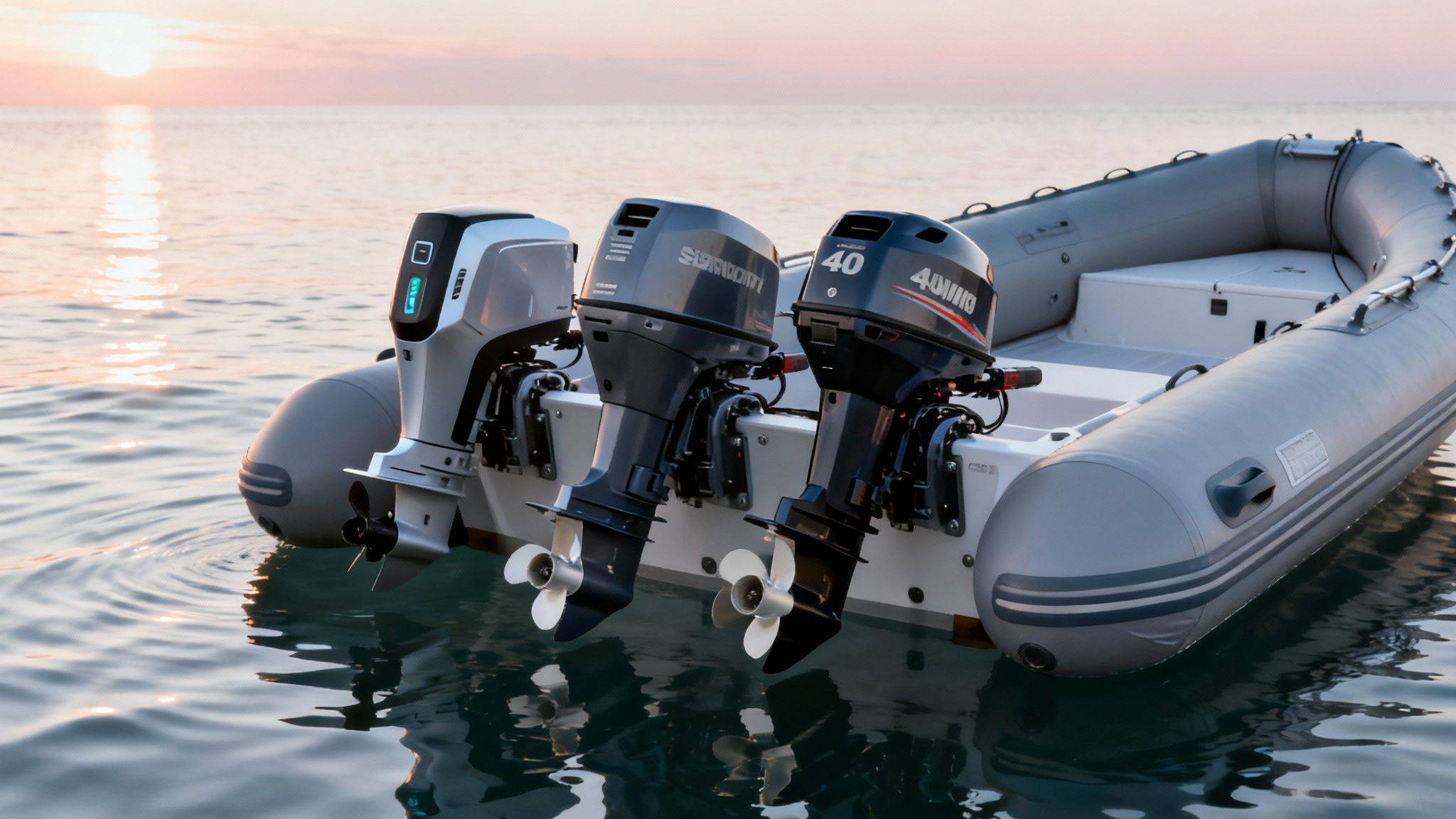
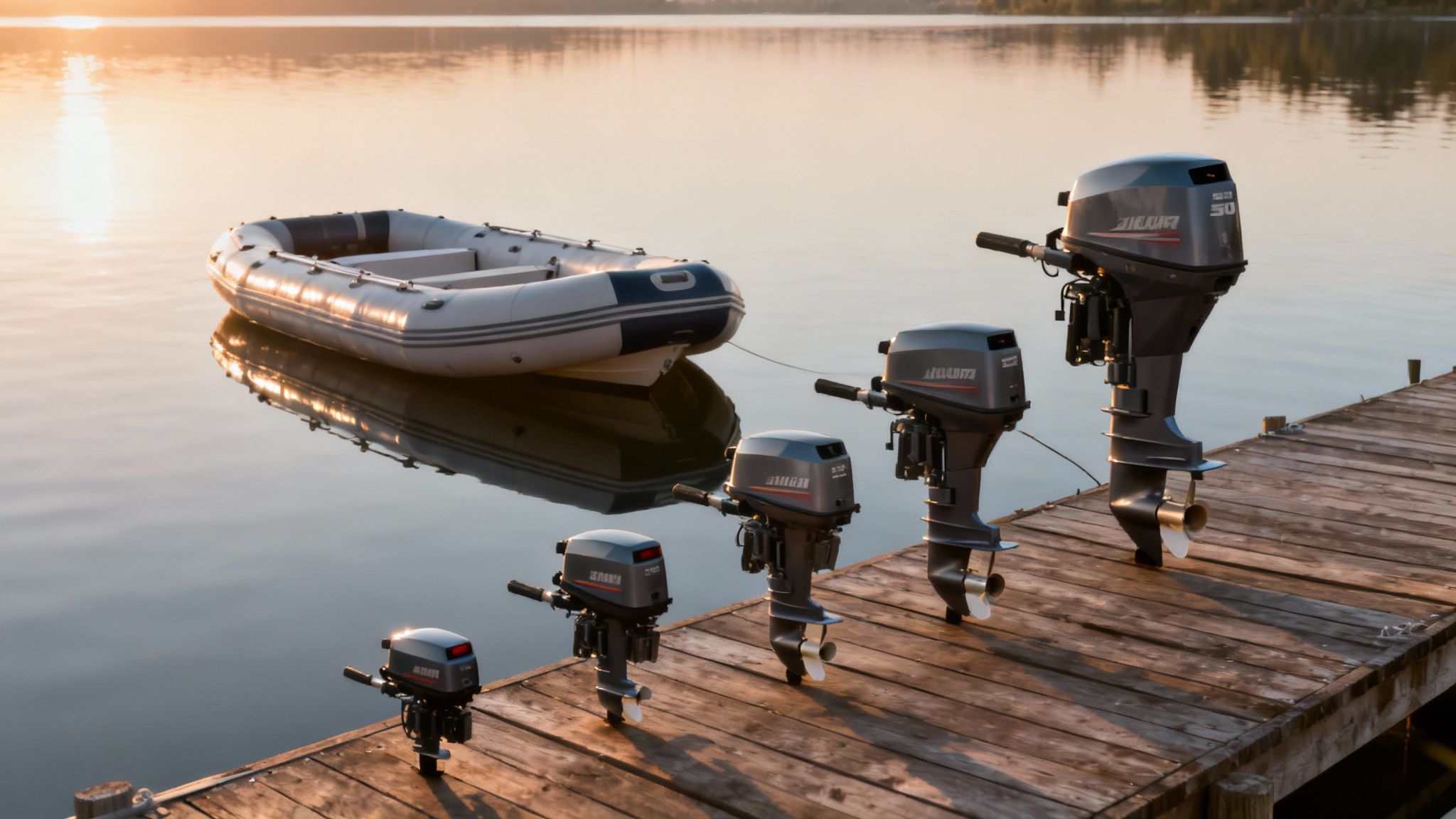

Picking the right motor for your inflatable boat isn’t about chasing the biggest horsepower figure. It’s about finding the perfect partner for your specific adventures. A small, efficient motor is your best mate for tender duties or quiet solo fishing trips, while a beefier option unlocks family fun and lets you explore further down the coast.
It all comes down to choosing the right tool for the job to guarantee safety, efficiency, and maximum fun on the water. Wondering about the best inflatable boats for recreational use available near you? This guide will help you match the perfect motor to your ideal boat.
Deciding on the perfect motor for your inflatable starts with one simple but critical question: what are you actually planning to do out there? Thinking about how you’ll use your boat is the best way to narrow down the choices. It stops you from paying for power you don’t need or, worse, getting stuck with a motor that just can’t keep up.
It’s a bit like picking a car. You wouldn’t buy a zippy sports car to tackle a rugged off-road track, would you? The ideal horsepower for a quiet fishing trip in a calm inlet is worlds away from what you need for a family day out on open coastal waters. Each activity has its own demands for speed, control, and endurance.
If you’re an angler who loves sneaking up on fish, or a yachtie needing a reliable runabout to get from your mooring to the jetty, a smaller horsepower motor is your best friend. A nimble and lightweight motor in the 2.5HP to 5HP range is a game-changer.
When the plan involves loading up the family, covering more ground, or tackling unpredictable conditions like wind and currents, you’re going to need more muscle. Stepping up to a more powerful motor completely transforms your inflatable into a seriously versatile vessel for family fun and proper exploration.
Motors in the 9.9HP to 20HP range are the true all-rounders in the inflatable boat world. They deliver the thrust needed to get a loaded boat “on plane”—that sweet spot where it skims across the top of the water instead of ploughing through it. This doesn’t just make you go faster; it actually improves your fuel efficiency once you’re cruising.
An engine in this power band gives you the confidence to venture further offshore, the grunt to tow the kids on a tube, and the reliability to get everyone home safely if the weather turns. It’s the sweet spot for all-around Aussie recreational boating.
If you’re looking at a robust option for an inflatable catamaran or a larger boat, it’s worth understanding what a more powerful engine can do. You can learn more about what a 20 HP outboard engine brings to the table in our detailed guide. This power level hits that perfect blend of performance and versatility that so many Australian boaters are looking for in their next family adventure.
Getting the right motor size isn’t just about speed—it’s the absolute cornerstone of safety, fuel efficiency, and how your boat handles on the water. A motor that’s too big or too small won’t just perform poorly; it can create genuinely dangerous situations. Let’s break down the technical side of things into simple, practical steps to make sure you find that perfect match.
The whole process boils down to a logical flow: start with what you want to do, look at the specs of your boat, and then find the motor power that fits.
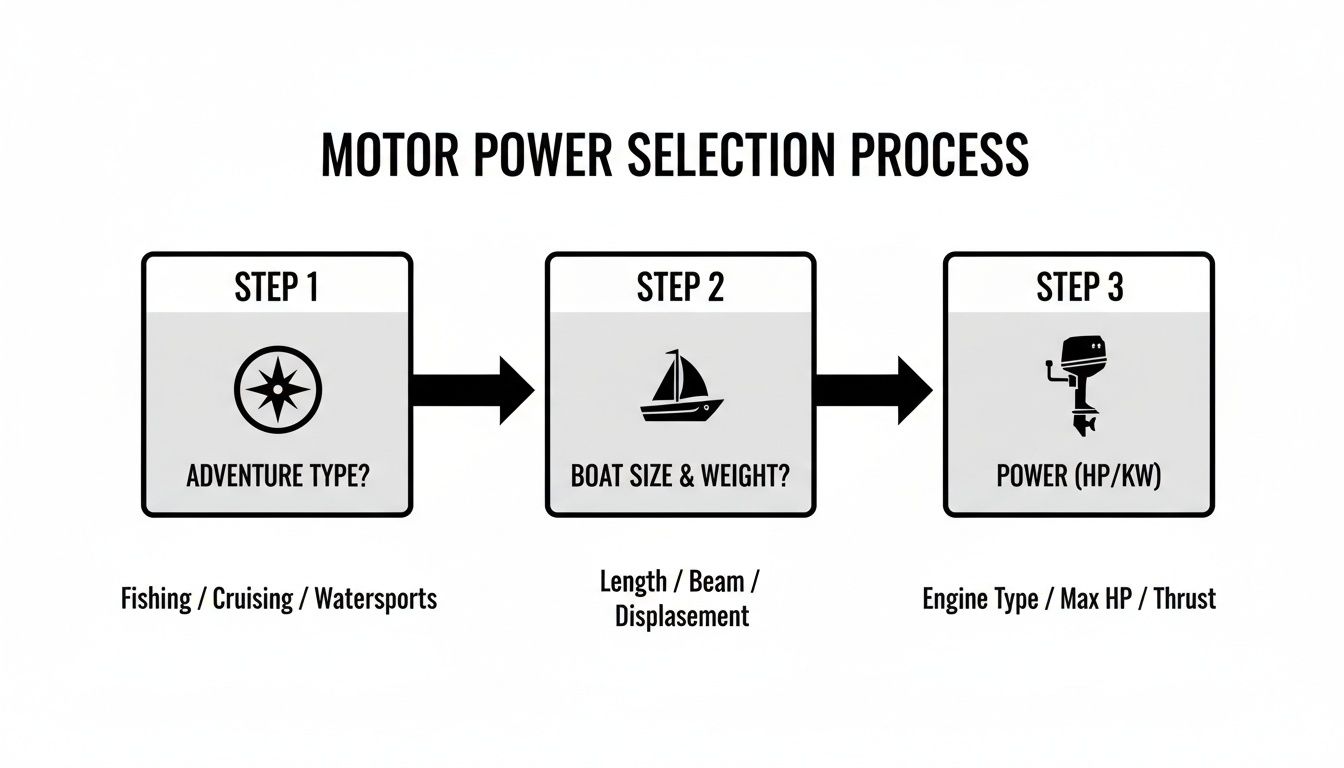
This flowchart gives you a great visual path. Think of it as moving from your dream adventure to the hardware that makes it happen, ending with the ideal horsepower for your setup.
Every certified inflatable boat has a small metal or plastic plate, usually fixed to the inside of the transom. This is the Australian Builders Plate (ABP), or capacity plate, and it’s the most important piece of information you have. It spells out the maximum horsepower (HP), total weight, and the number of people your boat can safely carry.
Never, ever exceed the maximum horsepower rating on your boat’s capacity plate. Overpowering a boat can cause the transom to fail, make it dangerously unstable at speed, and will likely void your insurance. Treat it as a non-negotiable rule for safe boating.
Sticking to this limit is absolutely critical for staying in control and protecting the structural integrity of your boat.
Beyond horsepower, the next critical measurement is the motor’s shaft length. This needs to perfectly match your boat’s transom height. For most inflatable boats, you’ll come across two standard sizes: short shaft (15 inches) and long shaft (20 inches).
Getting this wrong creates major headaches:
Our Aerowave inflatable catamarans, for example, are designed with transom heights that pair seamlessly with standard short-shaft motors, ensuring you get peak performance right out of the box.
To find your fit, just grab a tape measure. Measure from the top of the transom (where the motor clamps on) straight down to the bottom of the hull. That measurement tells you exactly which shaft length you need.
While the capacity plate gives you the absolute maximum HP, the ideal power is often somewhere below that number. It’s all about finding a balance that suits how you actually use your boat.
If you’re looking to compare prices and features of inflatable boats in your area and want to find what options you have, understanding the right motor is the first step. For instance, in Sydney, a massive part of the market is yacht tenders. A common and very effective setup is a 1.2mm 2000D German Valmex PVC hull paired with a 9.9HP Hidea motor. This combo provides excellent stability at speeds up to 25km/h and sips fuel at around 1.5L/hour—perfect for anglers chasing snapper without emptying their wallet.
To make things even easier, here’s a quick guide matching our popular Aerowave boat sizes with recommended Hidea motor horsepower ranges.
| Aerowave Boat Length (metres) | Ideal for Solo/Tender (HP) | Ideal for Family/Fishing (HP) | Maximum Rated HP |
|---|---|---|---|
| 2.7m – 2.9m | 2.5 – 4 HP | 5 – 8 HP | 10 HP |
| 3.2m – 3.3m | 5 – 6 HP | 9.9 – 15 HP | 15 HP |
| 3.6m – 3.8m | 8 – 9.9 HP | 15 – 20 HP | 20 HP |
| 4.2m+ | 15 HP | 20 – 25 HP | 25 HP |
This table helps you quickly compare options for different activities, whether you’re planning quiet solo trips or spirited family outings on your inflatable catamaran. It gives you a solid starting point for finding that perfect performance balance.
Choosing between a classic petrol outboard and a modern electric motor is one of the biggest calls you’ll make for your inflatable boat. This isn’t just about how you power your vessel; it’s about shaping your entire on-water experience. It’s a trade-off between raw power and stealthy silence, and between endless range and effortless maintenance.
There’s no single “best” answer here—only what’s best for you. Let’s dive into a real-world comparison to help you find the perfect match for your boating style, whether you’re chasing fish or cruising with the family.

Petrol outboard motors, like the reliable Hidea range we offer, are the traditional workhorses of the boating world for a reason. Their biggest drawcard is unmatched power and range.
If your plans involve covering long distances, carrying heavy loads, or punching through strong currents and tides, petrol is often the only practical choice. Refuelling is as simple as swinging by a servo or bringing a spare jerry can, giving you the freedom to explore all day without a hint of range anxiety. This makes petrol ideal for exploring vast Australian waterways or getting a heavier boat on plane quickly.
For sheer versatility and the confidence to handle unpredictable conditions far from shore, the power density of petrol is hard to beat. It provides the muscle needed for a wide range of recreational activities.
Of course, this power comes with a few trade-offs. Petrol motors need more regular maintenance—think oil changes, spark plug checks, and fuel system care. They’re also louder and produce emissions, which can be a deal-breaker in pristine, quiet environments.
Electric motors have exploded in popularity, offering a totally different boating vibe. Their most celebrated feature is their near-silent operation. For anglers, this is a game-changer, letting you sneak up on fishing spots without spooking every fish in a kilometre radius. The peace and quiet also appeals to nature lovers who just want to glide through the water with minimal disturbance.
Another massive win is the incredibly low maintenance. With no oil, fuel filters, or spark plugs to worry about, upkeep is a breeze. You just charge the battery and go. This plug-and-play simplicity makes them a fantastic choice for anyone who wants a hassle-free motor for inflatable boats.
The main limit with electric is range, which is tied directly to your battery capacity. You have to plan your trips around your charge level, and “refuelling” means finding a power point for several hours. While they might not have the top-end speed of a petrol equivalent, they deliver instant torque for surprisingly zippy acceleration off the mark.
For anyone looking to find the best inflatable boats for recreational use available near them, the choice between petrol and electric is a key part of the decision.
To help you make the call, let’s break down the key differences in a simple table. This lays out how each motor type stacks up in the areas that matter most.
This side-by-side comparison highlights the strengths and weaknesses of petrol and electric motors, helping you align your choice with your specific boating needs.
| Feature | Petrol Outboard (e.g., Hidea) | Electric Outboard |
|---|---|---|
| Best For | Long distances, heavy loads, speed, and all-day exploring. | Fishing, quiet cruising, wildlife watching, and short-to-medium trips. |
| Performance | High top speeds and consistent power output for planing. | Instant torque for quick acceleration, but lower top speeds. |
| Range & Fuelling | Virtually unlimited with spare fuel cans; quick refuelling. | Limited by battery capacity; requires hours to recharge. |
| Noise Level | Noticeable engine noise, especially at higher speeds. | Nearly silent, allowing for conversation and stealth. |
| Maintenance | Requires regular oil changes, spark plugs, and fuel system checks. | Minimal; essentially just charging the battery and keeping it clean. |
| Upfront Cost | Generally lower for the equivalent horsepower. | Often higher, especially when factoring in high-capacity batteries. |
| Environmental | Produces exhaust emissions and has a risk of fuel spills. | Zero on-water emissions, making it an eco-friendly choice. |
The market is definitely changing. Since 2020, digital features have boosted electric motor adoption by 24% in green-conscious marine segments. This shift is also supported by local incentives that have helped place over 680,000 tourism rentals with outboard power on Australian waters.
Ultimately, the choice comes down to your personal priorities: the raw, go-anywhere power of petrol or the quiet, simple convenience of electric.
A reliable motor is one that’s installed right and looked after properly. Getting this sorted from day one is the key to enjoying years of trouble-free performance out on the water. Think of this section as your practical handbook for making sure your new motor for inflatable boats is a dependable partner on every single trip.
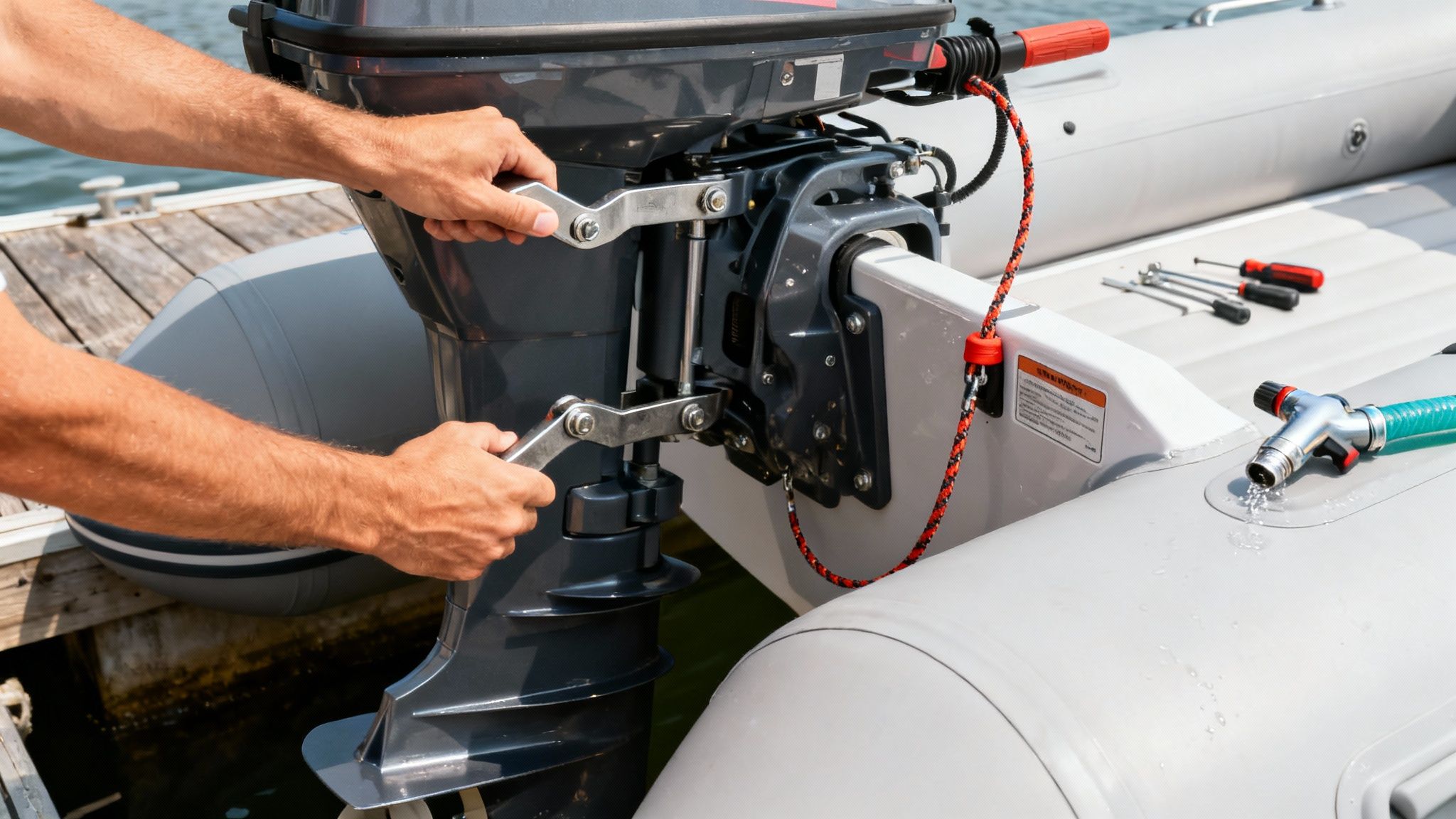
We’ll walk you through the essentials of mounting your motor securely, then map out a simple maintenance schedule that anyone can follow. It’s all about preventing common problems before they start, so you can maximise your time fishing, cruising, or just relaxing.
Getting your motor installed correctly is the first—and most important—step for both safety and performance. A poorly secured outboard can vibrate like crazy, run inefficiently, or, in the worst-case scenario, detach from the boat entirely.
Here’s a straightforward process to get it right, every single time:
Preventative maintenance is the real secret to a long-lasting outboard. You don’t need to be a mechanic; just a few simple habits will make a world of difference, especially in the harsh Australian saltwater environment.
The single most effective maintenance task you can do is flush the engine with fresh water after every single trip in saltwater. This simple five-minute job prevents internal salt buildup, which is the number one cause of cooling system blockages and corrosion.
Following a basic schedule will keep your motor in top nick.
Before you even think about leaving the ramp, a quick check can be the difference between a great day and a ruined one.
What you do after your trip is just as important as what you do before.
When you’re running an electric motor, having a solid grasp of your power setup is vital. For a detailed primer on the fundamentals of 12V electrical systems, which is highly relevant to many marine setups, a comprehensive guide can be an invaluable resource. The principles it covers are directly transferable to keeping your battery and connections in top shape.
Hitting the water in Australia is one of life’s great pleasures, but doing it responsibly is key. It’s not just about knowing how to handle your boat; it’s about respecting the rules that keep everyone safe and our beautiful marine environments pristine. Let’s break down the essential safety and registration requirements for inflatable boat motors, so you can get out there legally and with total confidence.
The regulations can seem a bit tangled at first, mainly because they vary depending on where you are in Australia and the size of your motor. But don’t worry, they all share the same simple goal: keeping you and everyone else safe on the water.
In Australia, whether or not you need to register your inflatable boat usually comes down to your motor’s power. While the specifics can differ slightly between states, there’s a common line in the sand.
Generally, any boat powered by a motor of 4.0 kilowatts (kW) or more—which is roughly 5.4 horsepower (HP)—needs to be registered. So, if you’re eyeing a popular Hidea 6HP motor or anything bigger, you’ll need to go through the registration process with your state’s maritime authority, like Transport for NSW or Maritime Safety Queensland.
The key takeaway is simple: once you cross that ~5HP threshold, registration becomes mandatory. It’s always best to check the specific requirements for your local state or territory, as fines for operating an unregistered vessel can be significant.
This process usually involves getting a hull identification number (HIN) if your boat doesn’t have one, filling out some paperwork, and paying a fee. It’s a straightforward but absolutely essential step for any responsible boat owner.
Just like you need a licence to drive a car, you need one to operate a powered boat at speed. In most Australian states, you’re required to hold a current recreational boat licence if you plan to drive any powered vessel at a speed of 10 knots (about 18.5 km/h) or more.
Since even a small inflatable paired with a 6HP motor can easily top that speed, getting a boat licence is a practical must-have for most operators. The process typically involves a theory test on safety rules and navigation, and sometimes a practical assessment. It’s all about making sure you know the “rules of the road” on the water.
Carrying the right safety equipment isn’t just a good idea—it’s the law. The gear you’re required to have on board depends on your boat’s size and where you’re headed. The rules for enclosed waters like rivers and lakes are different from those for open, coastal waters.
Here’s a basic checklist of the essentials you’ll almost certainly need:
For those planning bigger adventures that require more fuel, getting familiar with the different types of portable petrol tanks is a smart move. Having a safe and compliant fuel setup is a core part of your overall safety system, ensuring your trips stay worry-free.
Even after covering the basics, a few practical questions always pop up when you’re getting ready to pair a motor with your new inflatable. This is the spot where we tackle the most common queries we get from boaters all across Australia. We’ve pulled together clear, straightforward answers to help you handle those final details with confidence.
Running out of fuel on the water is one of the biggest worries for new boat owners, but it’s also one of the easiest to avoid. The trick is to use the classic “one-third rule”—a simple guideline that gives you a fantastic safety margin every single time you head out.
The rule is dead simple: plan to use one-third of your fuel to get where you’re going, one-third to get back home, and keep the final one-third in reserve. That last third is your safety net. It’s what gets you home if you have to fight a strong headwind, navigate a surprise current, or just can’t resist exploring one last bay before calling it a day.
To give you a rough idea, smaller Hidea motors in the 2.5-6HP range will typically sip about 1-2 litres per hour at a steady cruise. The more popular mid-range models, like a 9.9-20HP outboard, will use closer to 3-6 litres per hour. Always check your motor’s specific fuel consumption rate and, when in doubt, pack a little extra. Peace of mind is priceless.
The whole 2-stroke versus 4-stroke debate used to be a hot topic, but these days, the answer is much clearer for recreational boaters. The fundamental difference is all in their internal mechanics and how they handle lubrication.
A 2-stroke engine is simpler and generally lighter. It completes a full power cycle in just two piston strokes and requires you to pre-mix oil directly into the petrol. A 4-stroke motor, like all the modern Hidea outboards we offer, works more like a car engine with a separate oil system (a sump).
That 4-stroke design makes them significantly quieter, much more fuel-efficient, and far cleaner-burning. For boating in Australia, the smooth, reliable power and dramatically reduced emissions of a 4-stroke make it the hands-down winner. You might find some old 2-strokes on the secondhand market, but a 4-stroke is the modern standard for very good reasons.
Absolutely. Modern outboards from reputable brands like Hidea are built from the ground up for saltwater use. They’re made with special corrosion-resistant alloys and coatings designed to stand up to the harsh marine environment. However, how long they last in the salt comes down to one simple, non-negotiable maintenance habit.
You absolutely must flush the engine’s cooling system with fresh water after every single trip in saltwater. No exceptions. This quick rinse prevents corrosive salt crystals from building up inside the cooling passages, which can lead to overheating, blockages, and serious internal damage down the track.
It’s an easy job:
This small habit is the single most important thing you can do to ensure your motor for inflatable boats gives you years of reliable service.
An inflatable catamaran, like our Aerowave models, is a platform that’s uniquely suited to outboard power, and it delivers some huge advantages over a traditional V-hull inflatable. The secret is all in the twin-hull design.
As the boat moves forward, the two hulls trap a cushion of air in the tunnel between them. This air cushion literally lifts the boat, dramatically cutting down on drag. The result? The boat gets on plane much faster and with less horsepower needed. That efficiency translates directly into better top speeds and improved fuel economy from a smaller, lighter motor.
The incredible stability of an inflatable catamaran also makes it a far better platform for fishing or family days out. There’s a lot less rocking, giving you a solid, confidence-inspiring base for casting lines or moving around. It also slices through choppy water for a much smoother, drier ride.
This design makes it one of the most efficient and comfortable options you can get. If you’re weighing up different options, our guide to finding quality used outboard boat motors can also help you evaluate pre-owned models that might be a perfect fit for your catamaran or V-hull.
At Easy Inflatables, we’re here to help you find the perfect turnkey package for your next adventure. Whether you need to hire inflatable boats for a family outing in Australia or purchase your own, we have the expertise to guide you. Explore our full range of Aerowave inflatable catamarans and reliable Hidea outboard motors to build your ideal setup. Visit us at https://easyinflatables.com.au to get started.