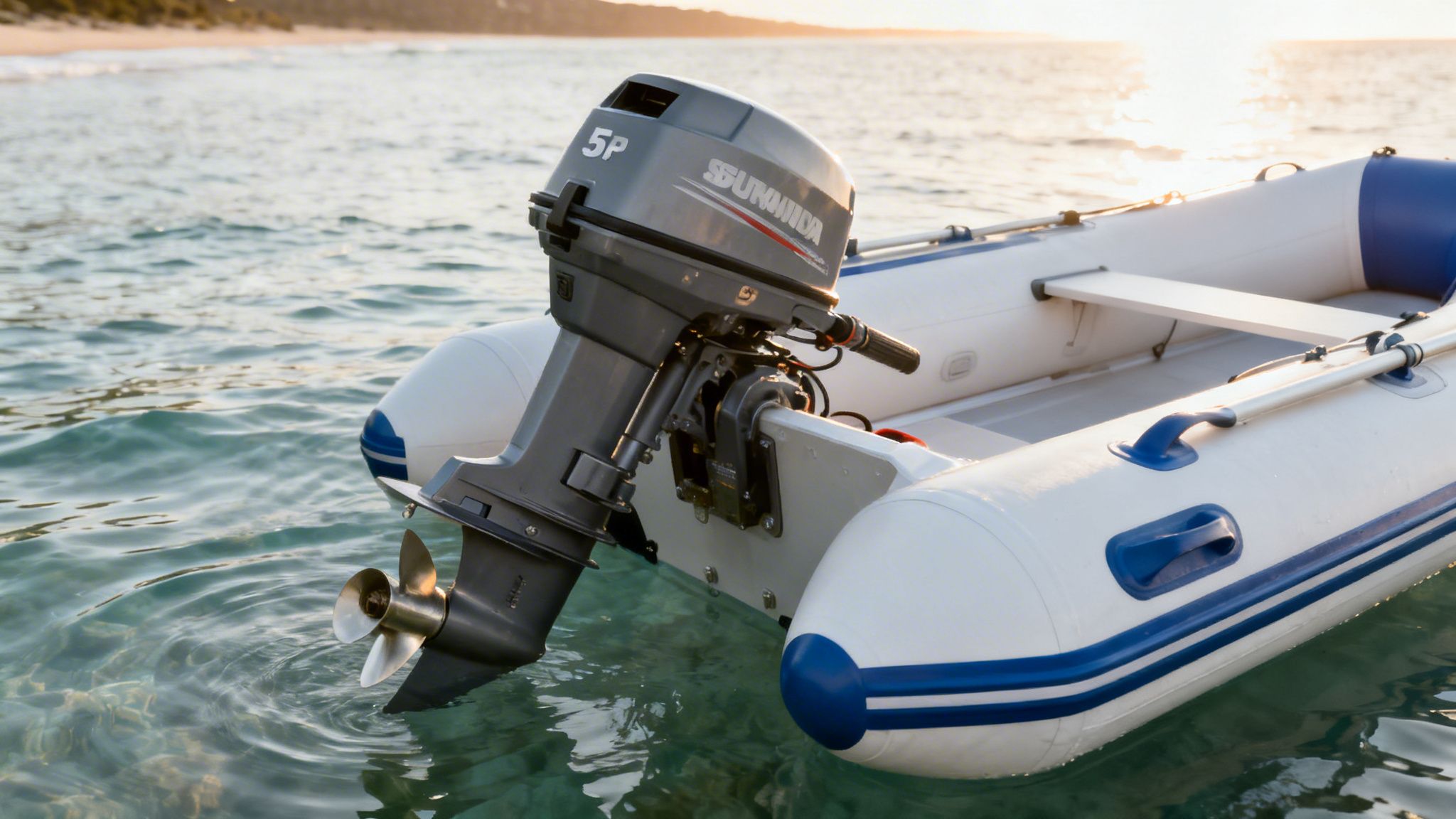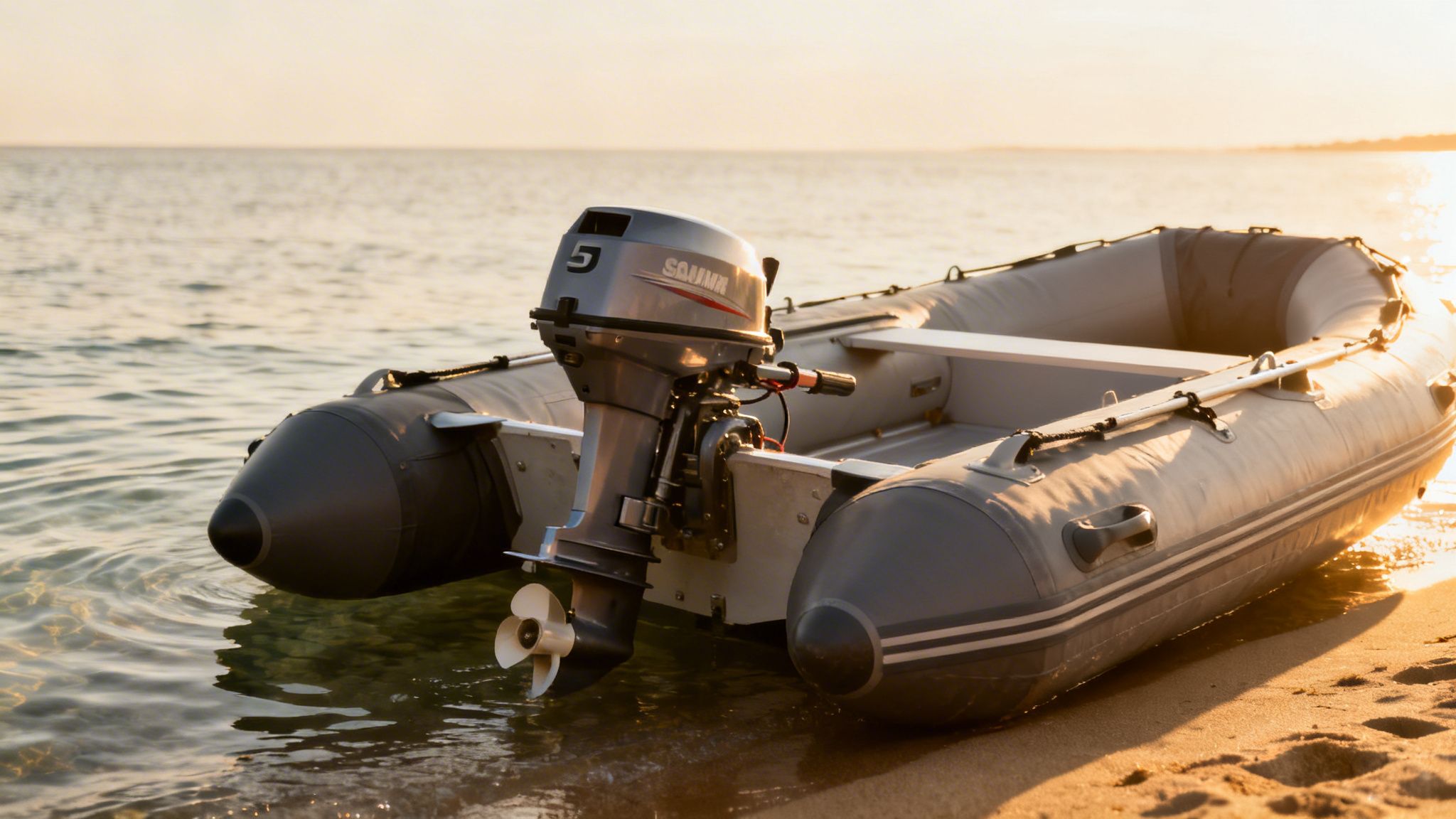
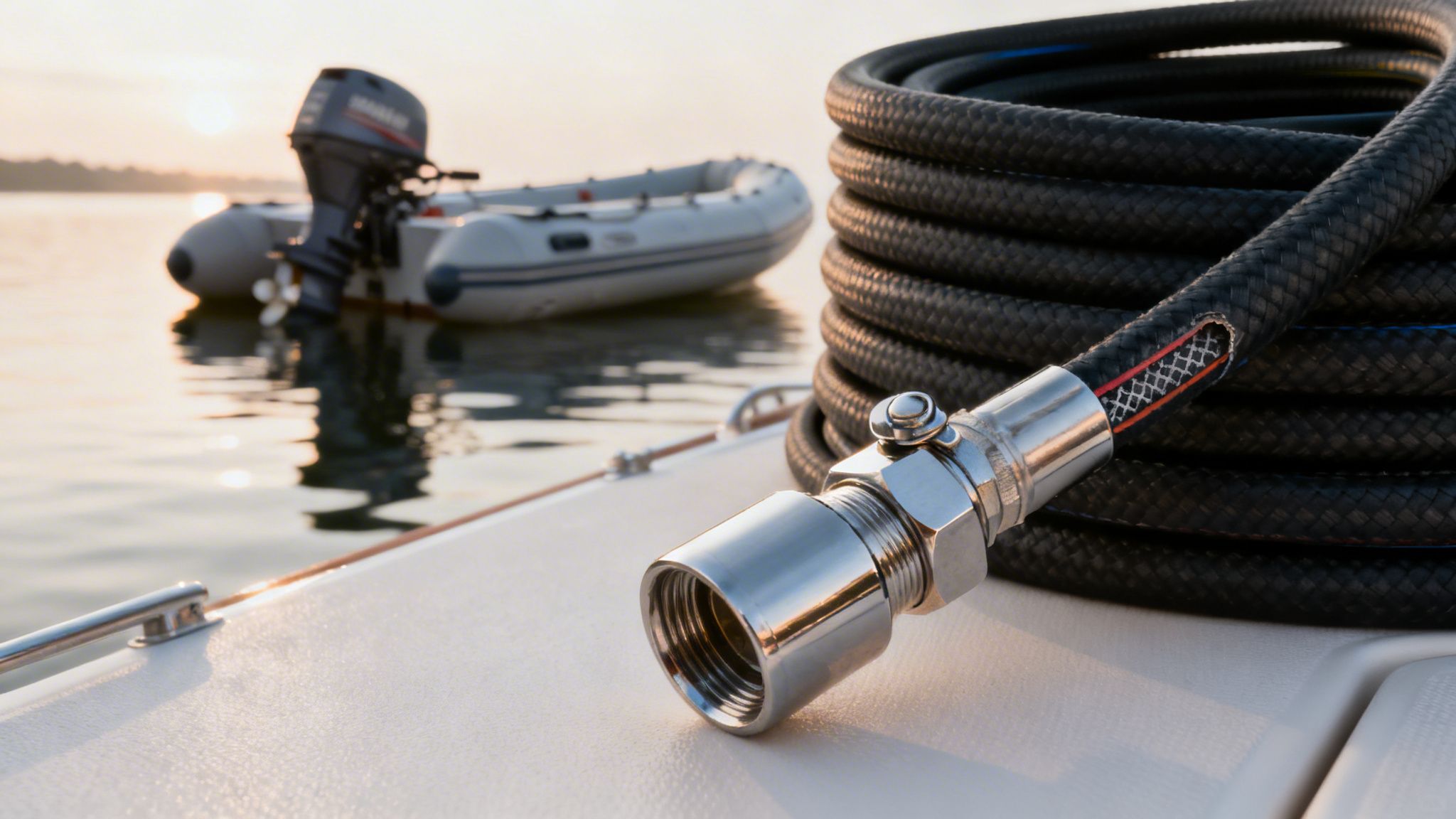

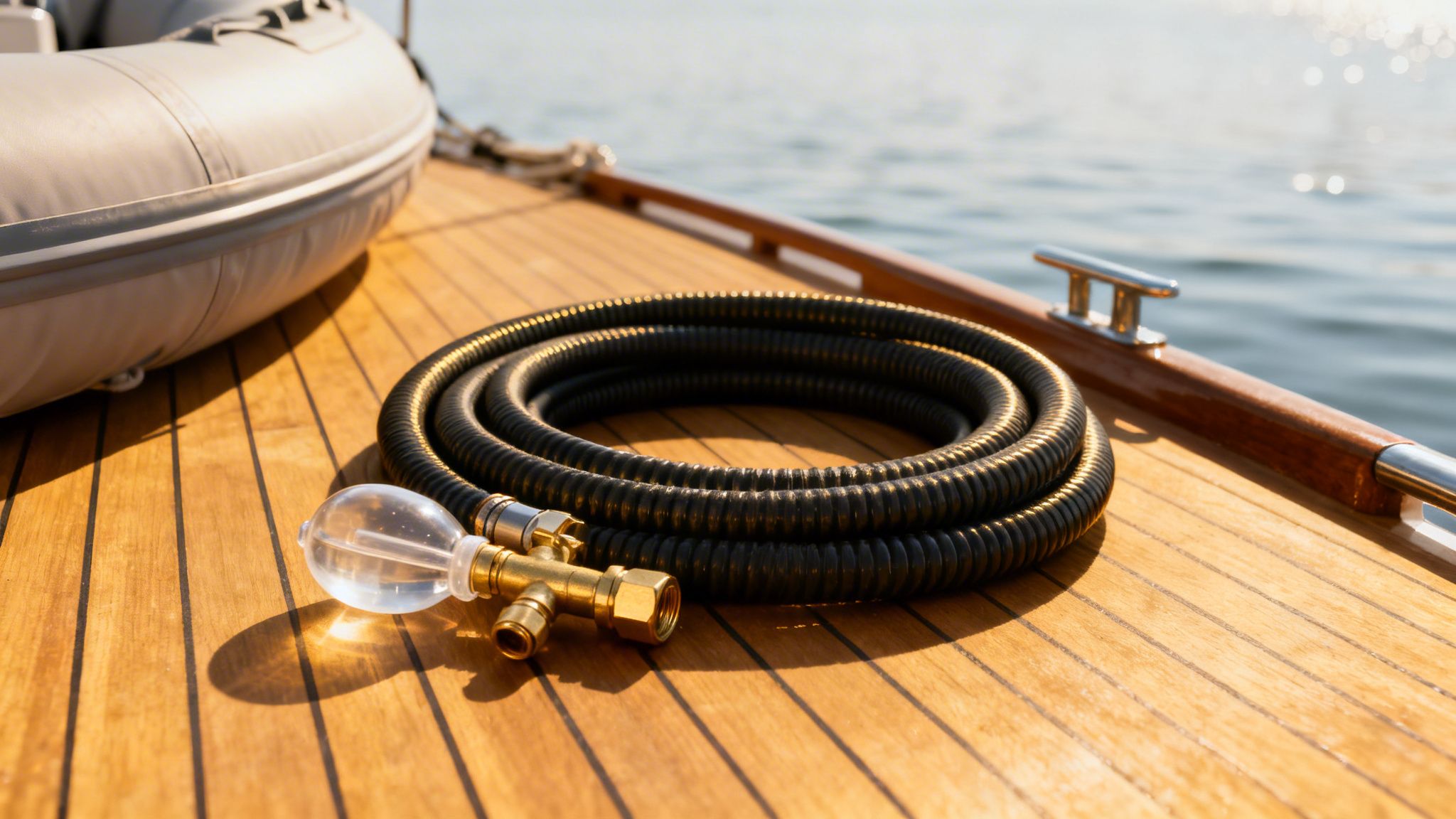
Your outboard motor’s fuel line is the vital artery connecting your fuel tank to the engine. It’s a simple setup—usually just a hose, a primer bulb, and a couple of connectors—but getting it right is absolutely critical for safe, reliable boating.

Think of the fuel line like a simple drinking straw. Its job is to move liquid—in this case, petrol—from the tank to the engine. If that straw has a crack, it lets in air, making it impossible to get a drink. It’s the same deal with a faulty fuel line. Any crack, leak, or blockage will starve your engine of fuel and leave you stranded.
This humble component is non-negotiable for performance and safety, especially here in Australia. With more and more people hitting our beautiful waterways, keeping your fuel system in top shape has never been more important.
Every standard outboard fuel line assembly is made of three key parts working in harmony:
A well-maintained fuel line is your first line of defence against engine trouble. Ignoring it is one of the quickest ways to ruin a perfect day on the water, turning a fun outing with the family into a frustrating and potentially unsafe situation.
For those of us with versatile setups like inflatable catamarans or compact RIBs that use portable fuel tanks, this assembly is your entire fuel delivery system. The quality of your outboard motor fuel line directly impacts the reliability of your whole rig. If you’re curious, check out our guide on choosing the right outboard engine fuel tank.
This focus on reliable fuel systems is especially relevant now, with Australia’s boating scene absolutely booming. In 2023, there were over 905,000 registered boats on our waters, and a huge chunk of those are outboards running on these exact portable fuel systems. This trend just goes to show why a dependable fuel line isn’t a “nice-to-have”—it’s a must-have for safe boating.
Picking the right components for your outboard’s fuel line is about so much more than just finding parts that screw together. It’s about building a system you can trust, one that guarantees safety, reliability, and peak performance every single time you hit the water. This is one of those areas where cutting corners can lead to serious trouble, from a dead engine miles from shore to dangerous fuel leaks.
Getting these parts right means you can head out with confidence, whether you’re powering one of the best inflatable boats for recreational use or a rugged fishing tender. And it all starts with the most critical part: the fuel hose itself.
It’s a common and incredibly risky mistake to use a generic automotive fuel hose on a boat. The marine environment is just a different beast altogether, and only a hose built specifically for it will last. Here in Australia, you need to be using a hose that meets standards like AS/NZS 2699.
These specialised hoses are engineered to fight off three key enemies:
A proper marine-rated outboard motor fuel line is a multi-layered piece of engineering. Each layer has a specific job, from giving it structural strength to stopping fuel vapours from escaping. It’s a small extra investment for a massive leap in safety and peace of mind.
Think of it like this: you wouldn’t use regular indoor paint on the outside of your house and expect it to hold up. The same logic applies here—you need the right material for the job to ensure it’s both durable and safe.
The differences between a proper marine-rated hose and a generic one from the local auto shop are stark. Seeing them side-by-side makes the choice crystal clear.
Here’s a quick breakdown to show you why using anything but a marine-grade hose is a gamble you don’t want to take.
| Feature | Marine-Rated Fuel Hose (AS/NZS 2699) | Generic Automotive Fuel Hose |
|---|---|---|
| Material Construction | Multi-layer design with resistance to UV, ozone, and ethanol. Often fire-retardant. | Single-layer rubber, not designed for prolonged UV or saltwater exposure. |
| Ethanol Resistance | Specifically formulated to handle ethanol-blended fuels without degrading. | Can break down, swell, or become brittle when exposed to ethanol fuels. |
| Safety Rating | Certified for marine use, meeting strict fire and permeation standards. | Not rated for enclosed or semi-enclosed marine engine compartments. |
| Durability | Built to withstand the constant motion and vibration of a boat on the water. | May chafe and fail more quickly in a marine environment. |
As you can see, the automotive hose just isn’t built for the harsh reality of boating. It’s not a matter of if it will fail, but when.
With the hose sorted, your next focus should be the primer bulb. A good quality bulb feels robust in your hand, contains internal check valves to stop fuel from siphoning back to the tank, and stays firm once you’ve squeezed the air out. If a bulb feels flimsy or goes soft after priming, it’s a sure sign it’s letting air into the system and is due for replacement.
Finally, check your connectors. You need to be certain they match both your engine and your fuel tank perfectly. Worn-out or mismatched connectors are one of the most common causes of frustrating air and fuel leaks. They should click into place with a solid, satisfying lock. For anyone needing to source specific engine parts, looking into genuine Mercury outboard parts is a great way to guarantee you get a perfect fit and a reliable seal for your setup.
Having a top-quality outboard motor fuel line is only half the battle; proper installation is where you turn great parts into a reliable system. It’s a common mistake to see people invest in a good hose only to rush the setup.
Incorrectly fitting or routing your fuel line can lead to everything from frustrating engine stalls to dangerous fuel leaks. Following a few best practices ensures your boat runs smoothly and safely on Australian waterways, giving you peace of mind on every trip.
The first step is creating leak-proof connections. When you’re attaching the hose to the connectors and primer bulb, push it on firmly and secure it with a marine-grade stainless steel clamp. Whatever you do, don’t use zip ties or generic hardware store clamps. They’ll loosen with vibration or corrode in saltwater, creating a prime spot for air to enter or fuel to escape.
A proper seal is the absolute foundation of a reliable fuel system. You’ll thank yourself later for taking the time to get this part right.
This diagram shows the simple, three-part flow of a standard fuel line assembly.

Each component—the hose, bulb, and connector—must be assembled correctly to ensure an uninterrupted fuel supply gets to your motor.
How you route the hose from the tank to the engine is just as important as the connections themselves. The goal here is simple: create a path that avoids stress and damage.
Keep the hose well away from any hot surfaces on the engine, like the exhaust cover. You also need to prevent it from rubbing against sharp edges or getting pinched under eskies, tackle boxes, or other gear. Over time, this constant chafing will wear straight through the hose material.
Route your fuel line with smooth, gentle curves. Sharp bends or kinks can restrict fuel flow, effectively starving your engine, and will weaken the hose wall over time.
Finally, think about where you place your primer bulb. It should be easy to reach, but not in a high-traffic area where it could be accidentally kicked or stepped on. A classic rookie mistake!
Make sure the arrow on the bulb points towards the engine, indicating the direction of fuel flow. For more tips on setting up your portable fuel system, explore our detailed guide to selecting the perfect petrol tank for your outboard engine.

Is your outboard motor being a pain to start? Stalling just when you’ve found the perfect spot? Or maybe you’ve caught a whiff of petrol on the breeze? These are classic signs that your outboard motor fuel line might be the culprit. But before you start worrying about a trip to the mechanic, a few simple checks can help you figure out what’s going on and often fix it yourself.
Most fuel line headaches boil down to a handful of tell-tale symptoms. By learning what to look for, you can quickly diagnose the problem, save yourself a bit of time and money, and get back on the water where you belong.
If you can smell petrol around your boat, stop what you’re doing. This isn’t just a nuisance—it’s a serious fire hazard and needs your immediate attention.
Your first move is a simple hands-on inspection. With the engine cold and turned off, run your fingers along the entire fuel hose, from where it connects to your fuel tank right up to the engine. Feel for any wet spots and look closely for:
An engine that struggles to kick over or dies for no good reason is often starving for fuel. This is usually caused by an air leak somewhere in the fuel line, and your primer bulb is the best tool for sniffing it out.
Give the primer bulb a few good squeezes. It should get firm and, just as importantly, stay firm. If you can’t get it hard or it goes soft again after a few minutes, that’s the smoking gun—air is getting into the system. It means you’ve got a leak somewhere, so go back and double-check every single connection point to make sure it’s airtight.
A primer bulb that won’t stay firm is one of the most reliable indicators of an air leak. It’s the fuel system’s way of telling you something is wrong, and it’s almost always a simple fix related to a loose clamp or a crack in the hose.
Ask any seasoned marine mechanic, and they’ll tell you the same thing: the vast majority of outboard issues are fuel-related. Some even say that 95-100% of outboard engine troubles trace back to problems in the fuel system, whether it’s stale fuel, air leaks, or a degraded hose. That statistic alone shows why giving your fuel line a regular once-over is so important.
What if your motor purrs along nicely at idle but starts to sputter or bog down the second you open the throttle? This points to a fuel flow restriction. Something is preventing the engine from getting the fuel it needs to perform under pressure.
Start by checking for the obvious. Make sure the hose isn’t kinked, pinched under a seat, or tangled up in your gear. Next, have a look at the primer bulb itself. The internal check valves can wear out and fail, effectively creating a bottleneck that restricts fuel flow. If your hose routing is clear and all the connections are tight, a faulty primer bulb is a very likely suspect.
Learning to spot these symptoms is a key part of staying safe and keeping your boat running smoothly. If you do find a problem, our comprehensive guide on the complete outboard engine fuel line has everything you need to choose the right replacement parts.

Being proactive is the secret to a boat that’s always ready for adventure. Instead of waiting for a fuel line to fail halfway across the bay, a simple and consistent checklist keeps your outboard motor fuel line reliable. In Australia’s demanding climate, this routine is your best defence against being stranded.
This isn’t about getting greasy and pulling things apart; it’s about forming smart habits. A few minutes of inspection before you launch and proper care during storage can make all the difference, whether you’re looking for a place to hire inflatable boats for a family outing or maintaining your own vessel.
To keep your outboard running smoothly for years, it’s smart to have a good equipment preventative maintenance checklist. Applying these same principles to your fuel system will head off the most common—and frustrating—issues that boaties face.
Before every single trip, take just two minutes to run through this quick hands-on check. Honestly, it’s the easiest way to catch a problem before it ruins your day on the water.
Beyond the daily once-over, your fuel line needs a bit more love to fight off the effects of UV rays, heat, and time. This is especially true for those of us with inflatables and tenders, where the fuel line is often more exposed to the elements.
As a rule of thumb, you should plan to replace your entire fuel line assembly every 3 to 5 years, no matter how good it looks. Australia’s harsh sun and heat degrade the materials from the inside out. A proactive replacement is always cheaper than a tow back to the ramp.
Here are a few tips to get the most out of your fuel system:
Managing your fuel system is a breeze when you have the right gear. If you’re looking to upgrade or replace your tank, our guide on choosing the best portable petrol tanks can help you find the perfect match for your inflatable.
Even after getting the rundown on fuel lines, you might still have a few questions buzzing around. That’s completely normal. When you’re dealing with something as crucial as your boat’s fuel system, you want to be 100% confident.
We’ve pulled together the most common queries we get from Aussie boaters just like you. Think of this as a quick-reference guide to help you manage your fuel system like a seasoned pro, so you can spend less time worrying and more time enjoying the water.
As a general rule of thumb, you should plan to replace your entire outboard motor fuel line assembly every 3 to 5 years. That includes the hose, the primer bulb, and the connectors. Here in Australia, our intense UV and wild temperature swings degrade the materials from the inside out, often long before you can see any damage.
That said, you need to replace it immediately if you notice any of these red flags:
A constant smell of petrol or a primer bulb that won’t stay firm are also massive clues that it’s time for a replacement. Being proactive is always safer—and far less stressful—than dealing with a breakdown on the water.
Absolutely not. We can’t stress this enough. Using an automotive fuel hose on a boat is a dangerous shortcut that puts your boat, and everyone on it, in serious jeopardy. You must use a proper marine-rated fuel hose that meets Australian standards like AS/NZS 2699.
Car hoses just aren’t built for the harsh marine world. They lack the right protection against UV radiation, saltwater corrosion, and the ever-present risk of fire.
More importantly, car hoses aren’t designed to handle the ethanol often found in modern petrol. Ethanol can eat away at the inner lining of an automotive hose, causing it to break down, leak fuel, and create a massive fire hazard on your inflatable boat or tender. If you’re looking to compare prices and features of inflatable boats in your area, you’ll see this safety standard mentioned repeatedly. Always invest in the right marine-grade gear for your own safety.
Ah, the classic soft primer bulb. It’s one of the most common—and frustrating—fuel system headaches. If your primer bulb refuses to firm up or goes soft right after you stop squeezing, it’s almost always one of three things: an air leak, a faulty valve, or a blockage.
Start with the easiest culprit: an air leak. Go over every single hose clamp and make sure they are properly tight and secure. Even a tiny gap can suck in air and stop the system from priming.
If all your connections are solid, the problem is likely the primer bulb itself. The little one-way check valves inside can get stuck with gunk or simply wear out. The third possibility is a blocked fuel pickup inside the tank. But if your connections are airtight, the primer bulb assembly is the most likely culprit and should just be replaced.
For the vast majority of recreational outboards—from the little 2.5hp kickers up to punchy 60hp units—an 8mm (5/16 inch) internal diameter fuel line is the standard. This is the go-to size for most brands, including the reliable Hidea outboards we often see paired with inflatable boats and inflatable catamarans.
This 8mm diameter hits the sweet spot. It allows plenty of fuel to flow to the engine but isn’t so big that it makes priming a chore, or so small that it starves the engine of fuel when you’re running at high revs. When you’re buying a new outboard motor fuel line assembly, just look for the 8mm or 5/16″ size on the packaging to make sure you’ve got the right one.
At Easy Inflatables, we believe that confidence on the water starts with reliable gear. From durable inflatable catamarans to the right fuel line components, we can help you find the best inflatable boats for recreational use available near you. Explore our full range of boats and accessories to start your next adventure.
https://easyinflatables.com.au