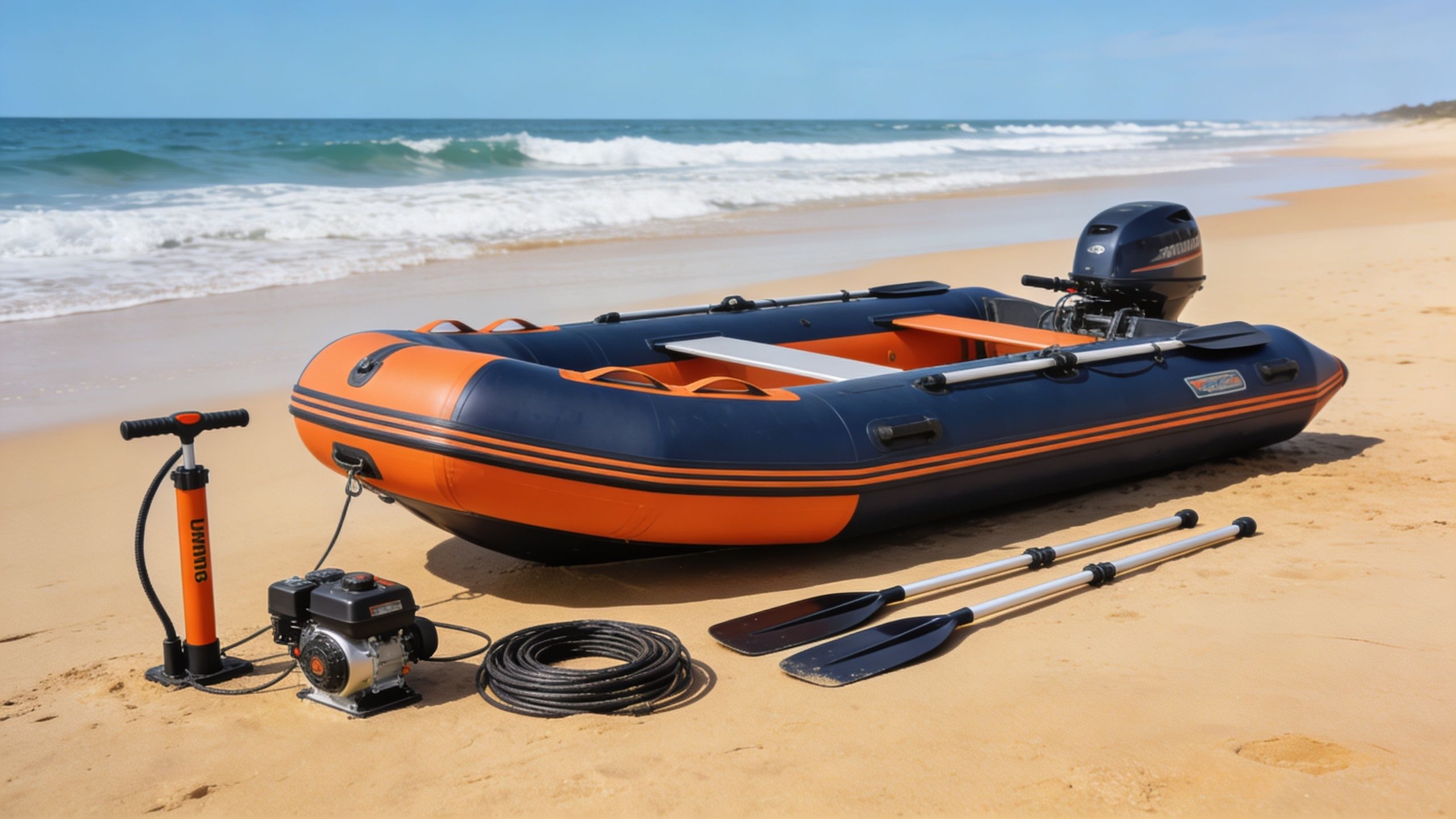

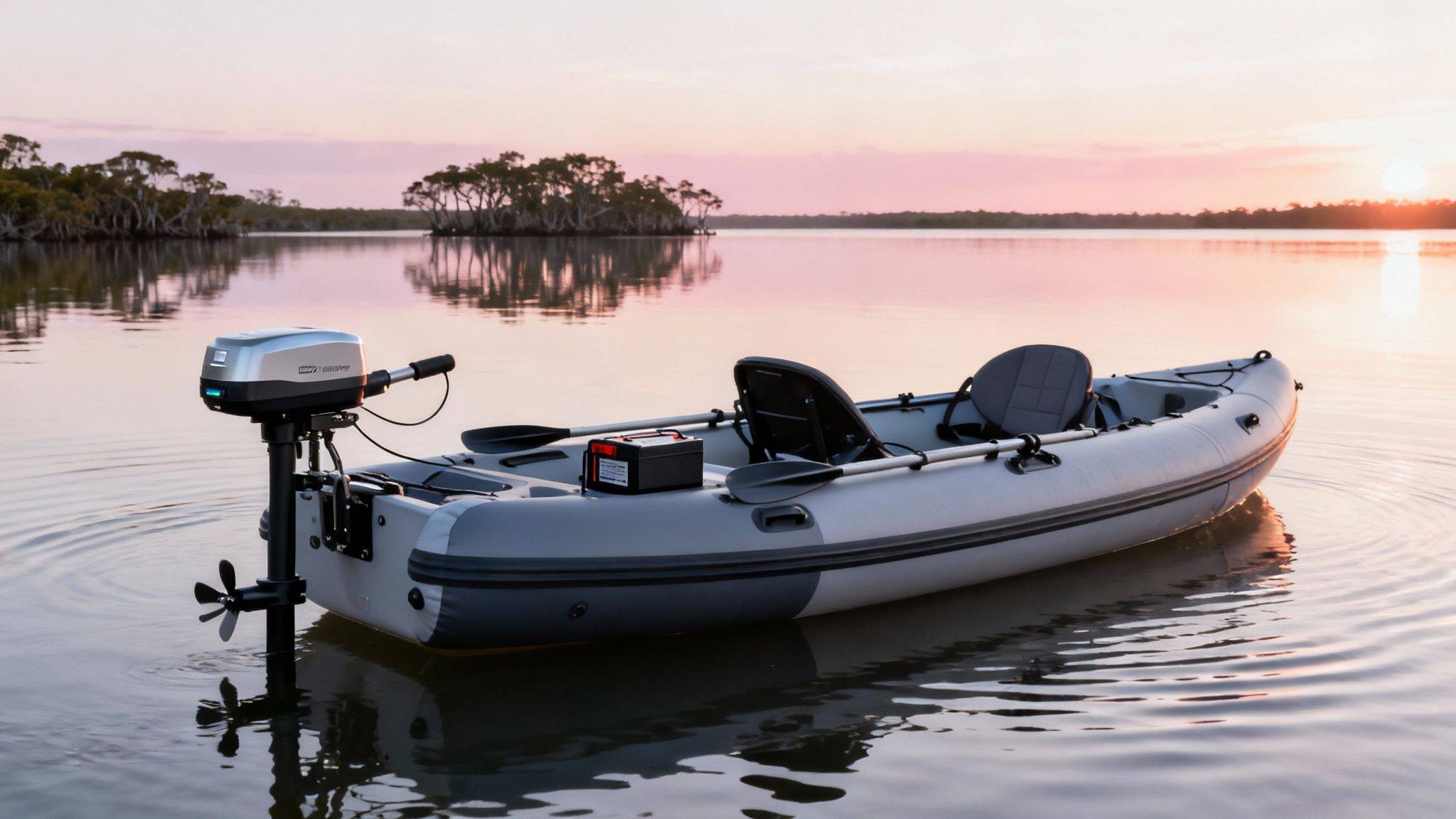
Think of a kayak trolling motor as a small, quiet, electric motor that completely transforms your paddle craft. It’s easily the single biggest upgrade you can make, giving you hands-free propulsion, the ability to hold your position against wind and current, and the power to cover far more water without getting exhausted. Whether you’re in a traditional kayak or one of the best inflatable boats for recreational use available near you, a motor adds a new dimension to your adventures.
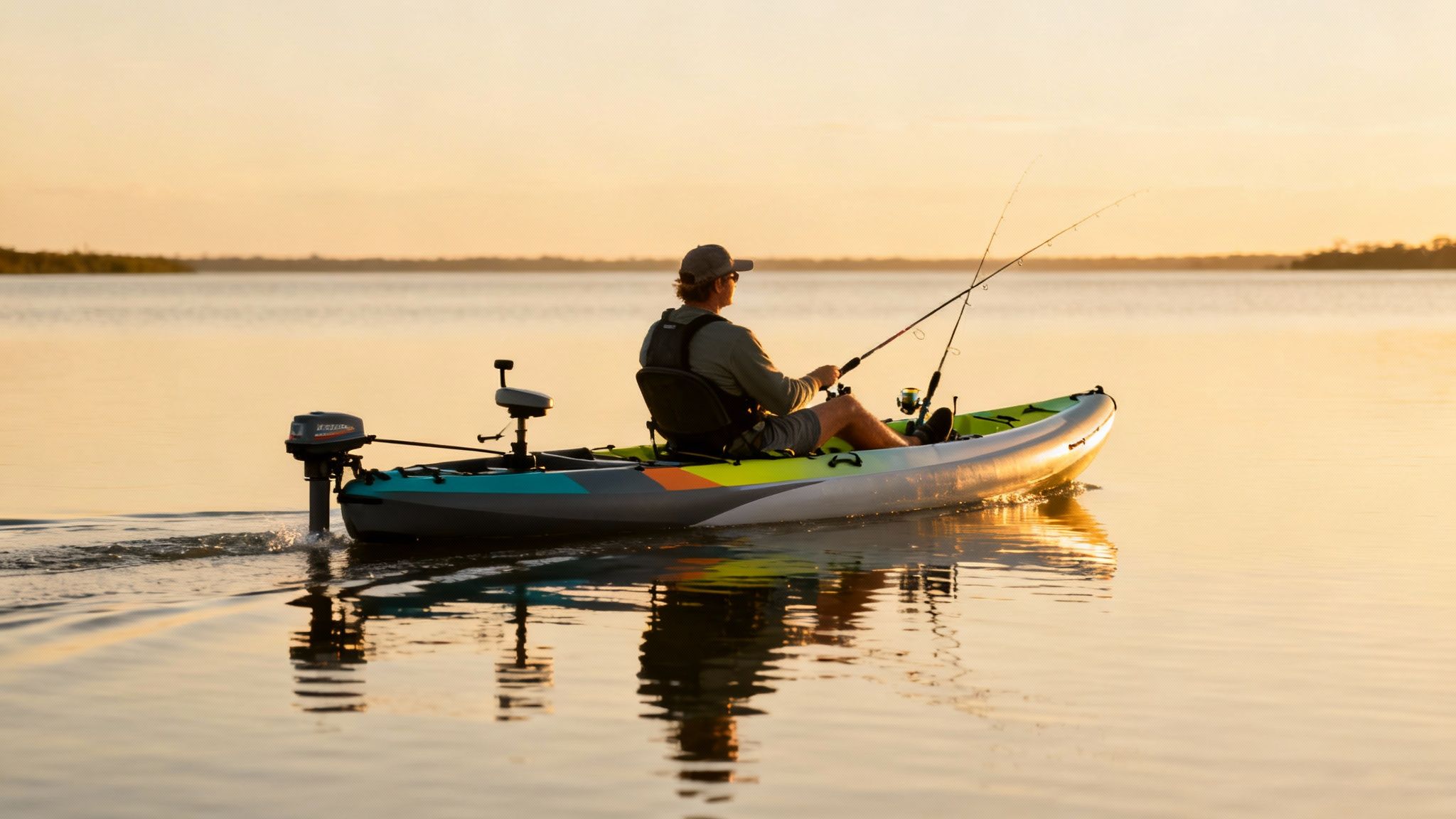
Imagine gliding silently towards a perfect fishing spot, both hands free to cast. Picture yourself holding steady in a gentle current without constantly dipping a paddle in the water. That’s the freedom a kayak trolling motor brings to the table, turning a good day out into a truly memorable one.
This isn’t about replacing your paddle—it’s about adding a powerful and strategic tool to your kit. For anglers, it means stealthy approaches and the ability to “spot lock” over a school of fish. For explorers, it unlocks distant coves and stretches of shoreline that felt just a bit too far for a paddle-only trip.
The main benefit boils down to one word: efficiency. Instead of burning energy fighting the wind or paddling between spots, you can focus on what you came to do. A motor helps you save your stamina for the moments that count, whether that’s landing a big one or exploring a hidden beach with the family. This is especially true for owners of inflatable boats and inflatable catamarans.
A quiet electric motor lets you sneak up on fish and hold your position in wind or current, fundamentally changing how you can fish from a small vessel. It turns your kayak from a simple paddle craft into a precision fishing machine.
Modern inflatable boats, particularly models like our Aerowave with integrated aluminium transoms, are designed for exactly this. The solid transom gives you a secure, stable mounting point, making installation a breeze and completely reliable. It takes the guesswork out of the equation, ensuring your setup is safe and performs perfectly from day one.
Adding a trolling motor to your inflatable boat unlocks some serious advantages:
So, what exactly is a kayak trolling motor? In simple terms, it’s a compact, all-in-one propulsion unit designed for stealth and precision. It combines an electric motor, a propeller, and a shaft into a single package that you can easily attach to your boat. With a twist of the handle, you get controlled, quiet power.
Unlike a noisy, fume-belching petrol outboard, an electric trolling motor is all about finesse. It’s not built for raw speed; its job is to let you glide silently through the water, hold your position against the current, or creep along a shoreline while you focus on casting a line or just soaking in the scenery.
When you start browsing for a kayak trolling motor, you’ll quickly see two main styles, named for where they attach to your boat. Getting this right is crucial, especially for an inflatable.
For anyone with an inflatable, the transom-mount motor is the clear winner. It’s simple, stable, and perfectly compatible.
While you can find small petrol outboards, electric trolling motors have become the go-to for kayaks and small inflatable boats for some very good reasons. The decision really boils down to three things: noise, weight, and your impact on the environment.
An electric motor is whisper-quiet, letting you sneak up on fishing spots or get close to wildlife without sending everything scattering. A petrol motor, on the other hand, is loud and smelly, which can completely ruin the peaceful vibe of being out on the water.
The quiet operation of an electric motor is its greatest advantage. It allows for a stealthy approach that petrol motors simply cannot match, preserving the natural tranquility of the environment and increasing your chances of fishing success.
Beyond the noise, electric motors are much lighter and easier to carry around. This is a massive plus for inflatable boat owners who are constantly setting up and packing down their gear. Petrol motors are heavy, require you to lug around fuel, and need more maintenance. To get the full picture, you can learn more about the advantages of electric trolling motors for kayaks in our detailed guide.
You’re going to see two terms pop up everywhere: ‘thrust’ and ‘voltage’. They might sound technical, but the ideas behind them are straightforward.
Thrust is simply a measure of the motor’s pushing power, measured in pounds (lbs). It’s not about how fast you’ll go. A good way to think of it is like horsepower in a car—it’s the raw muscle the motor has to push your boat. More thrust is great for handling heavier loads, fighting against strong winds, or dealing with a fast-moving current.
Voltage tells you how much electrical juice the motor needs to run. The vast majority of kayak trolling motors use a 12-volt (12V) system, which means they need a single 12V deep cycle battery. You’ll sometimes see more powerful motors that need 24V or 36V systems, which means wiring two or three batteries together. For most inflatable boats, a 12V setup strikes the perfect balance of power, weight, and simplicity.
Choosing the perfect motor for your inflatable boat can feel like a complex puzzle, but it really just comes down to two key pieces: thrust and shaft length. Get these right, and you’ll have a setup that handles beautifully and performs safely in almost any conditions. Get them wrong, and you’ll either be fighting against a gentle breeze or burning through your battery with a motor that’s far too powerful for your needs.
Think of it like picking an engine for a car. You wouldn’t put a massive V8 in a tiny hatchback, and a heavy-duty ute would be useless with a scooter motor. The goal is to find that sweet spot—enough power to get the job done without wasting money and battery life on performance you’ll never use.
Thrust, measured in pounds (lbs), is all about pushing power. It has very little to do with top speed and everything to do with giving your motor the muscle it needs to move your boat’s total weight through the water, especially when the wind picks up or you’re dealing with a current.
A common mistake is to go for way too much thrust, thinking it’ll make the boat faster. In reality, the hull shape of most inflatable boats puts a cap on their top speed. Any extra power just chews through your battery faster. On the other hand, too little thrust can be downright dangerous, leaving you powerless to make headway when conditions turn against you.
The golden rule for inflatable boats is to have at least 2 lbs of thrust for every 45 kg of fully loaded weight. This isn’t just the boat itself—it includes the motor, battery, all your gear, and every person on board.
To make things even simpler, we’ve put together a quick guide to help you match the right thrust to your boat. For most of our Aerowave owners, a motor in the 30-55lb thrust range is the perfect match.
This table gives you a straightforward reference for picking the right thrust based on your boat’s size and how you plan to use it in typical Aussie conditions.
| Boat Length (ft) | Fully Loaded Weight (kg) | Recommended Thrust (lbs) | Ideal Use Case |
|---|---|---|---|
| Up to 10 ft | Up to 270 kg | 30 lbs | Calm lakes, estuaries, and solo fishing trips. |
| 10 – 14 ft | 270 – 450 kg | 45 lbs | All-round use with 1-2 people and moderate gear. |
| Over 14 ft | 450 – 680 kg | 55 lbs | Larger inflatables, carrying more gear, or in wind. |
Getting the right thrust ensures you have enough power for safe boating without paying for performance you don’t need.
Once you’ve locked in the thrust, the next critical measurement is the motor’s shaft length. The shaft is simply the long tube connecting the motor head at the top to the propeller down below. If it’s too short, the propeller will be too close to the surface and start sucking in air—a process called “cavitating.” It makes a lot of noise and gives you zero push. Too long, and you risk smacking the prop on the bottom every time you venture into the shallows.
The aim is to have the top of the propeller submerged at least 15 cm below the waterline. This gives you the best performance.
Here’s a quick, foolproof way to get it right:
This simple calculation ensures your kayak trolling motor runs efficiently, quietly, and effectively. If you want to dive deeper, our comprehensive guide on choosing the right motor for inflatable boats has more detailed examples to help you lock in your choice.
For Aussie anglers, a kayak trolling motor has gone from a nice-to-have accessory to an essential piece of kit. This is especially true on the saltwater flats and in the thousands of estuaries dotted along our nation’s massive 35,000‑kilometre coastline. It’s not just a local trend, either; global data shows that fishing is the biggest driver of trolling motor sales. Analysts point specifically to Australia as a country with “well‑established” kayak fishing communities that heavily rely on motors. For those looking to hire inflatable boats for a family outing in Australia, you’ll find that many reputable rental companies offer motorised options, understanding their popularity and practicality.
When you’re looking at options, it pays to see what different brands are up to. Staying informed about innovations from companies like ePropulsion electric motors can give you a good sense of the latest tech available. By correctly matching thrust and shaft length, you’re not just buying a motor—you’re equipping your inflatable boat with a reliable tool perfectly suited for exploring Australia’s incredible waterways.
Picking the right trolling motor is only half the job. The real heart of your setup is the battery. It’s what decides how long you can stay out on the water, how much weight you’re lugging around, and what your total setup will cost. The choice really boils down to two main players: the old-school lead-acid deep cycle batteries and the modern Lithium Iron Phosphate (LiFePO4) ones.
Think of a lead-acid battery like a trusty old ute. It’s the cheaper choice upfront and has been a reliable workhorse for boaters for years. But its weight is a serious drawback for a portable inflatable boat, and you can really only use about 50% of its rated capacity before you risk damaging it.
On the other hand, a LiFePO4 battery is like a high-performance athlete. It’s incredibly light—often less than half the weight of a lead-acid equivalent—and you can safely drain it almost completely. This means a 50Ah lithium battery gives you nearly the same usable grunt as a 100Ah lead-acid battery, but in a package that’s much easier to carry and store.
For inflatable boat owners where every kilo counts, the weight you save with lithium is a massive win. While they cost a bit more to get started, their incredible lifespan (often 5-10 times more charge cycles) makes them a smarter investment in the long run.
To help you decide, here’s a quick side-by-side comparison:
| Feature | Lead-Acid Deep Cycle | Lithium (LiFePO4) |
|---|---|---|
| Weight | Very heavy | Extremely lightweight (up to 70% lighter) |
| Usable Capacity | Approx. 50% | 90-100% |
| Lifespan | 300-500 cycles | 2,000-5,000+ cycles |
| Upfront Cost | Low | High |
| Performance | Voltage drops as it drains | Consistent power until empty |
| Maintenance | Requires some upkeep | Virtually none |
The move towards lightweight, powerful batteries isn’t just a small trend; it’s changing how Aussies get on the water. Between 2015 and 2023, electric-powered boat registrations jumped by almost 300%. At the same time, an 18% drop in motor prices since 2018 has made these compact trolling motor and lithium battery combos far more accessible for everyday boaters and kayakers.
Knowing how long your battery will last is essential for planning a safe and enjoyable day out. The good news is, you don’t need to be an electrical engineer to work it out. Here’s a simple, step-by-step formula to get a good estimate.
(Battery Ah Rating / Motor Amp Draw) x Speed Adjustment = Estimated RuntimeSo, with a 100Ah battery and a motor pulling 50 amps:
(100Ah / 50A) = 2 hours of runtime if you’re going flat out.
But let’s be realistic—you’ll rarely be running your motor at full speed. At half speed, your motor might only draw 15-20 amps. This stretches your time on the water dramatically, often to 5-6 hours or more.
This decision chart is a great visual guide to help you pick the right motor for your boat size, which is the first step before you even think about batteries.
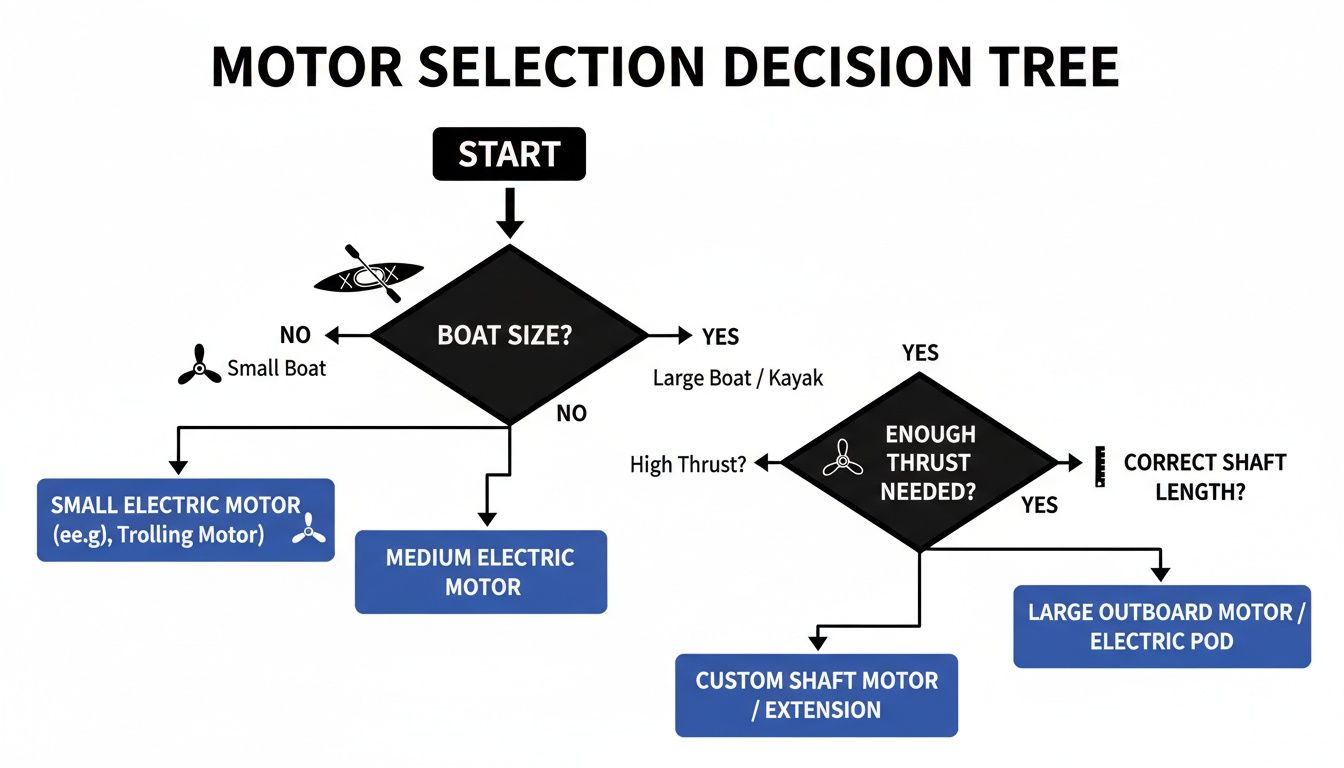
The key takeaway here is that getting the right motor thrust for your boat’s size directly impacts how much battery power you’ll need to perform properly.
By choosing the right battery type and understanding your power needs, you can head out with total confidence. For a bit of extra reading, understanding how long ebike batteries last offers some really useful insights into getting the most life out of your battery through proper care. To see what’s available, check out our guide on choosing a marine battery and charger to find the perfect power source for your setup.

Getting your new kayak trolling motor mounted correctly is the single most important step for safe, reliable performance out on the water. A secure installation isn’t just about efficiency; it’s about giving you complete peace of mind. This guide will walk you through setting up a transom-mount motor, specifically for an inflatable boat with a solid transom.
Fortunately, boats like our Aerowave series make this incredibly simple. Their built-in aluminium transom plates give you a rock-solid mounting surface right out of the box. There’s no guesswork or need for extra brackets—just unbox your motor and get it attached.
First things first, let’s get that motor sitting perfectly on the transom. Proper positioning ensures the propeller gets the best possible bite in the water, giving you maximum thrust and preventing it from sucking in air—a nasty habit called cavitation that kills your power.
Here’s how to nail it every time:
A correctly positioned and securely fastened motor is the foundation of a safe setup. Before every trip, give the motor a firm shake to confirm the clamps are still tight and haven’t loosened during transport.
Once it’s mounted, you can play with the angle using the tilt-lock mechanism. This nifty feature lets you lift the propeller clean out of the water when you’re launching, beaching the boat, or sneaking through super shallow spots.
With the motor locked in place, it’s time to hook up the power. Tidy wiring isn’t just about looking professional; it’s a critical safety step to prevent trips, snags, and nasty electrical shorts on the water. The goal here is a clean, organised system that’s completely out of the way.
Find a stable spot in the boat for your battery where it won’t slide around. Best practice is to keep it contained inside a protective case. We’ve got a great selection of durable and practical options in our guide to marine battery boxes that will keep your power source secure and shielded from the elements.
Connecting the battery is the final piece of the puzzle. Always, always do this with the motor’s power switch set to “OFF” and make sure the propeller is clear of any obstructions. Safety first.
Run through this quick checklist for a safe connection:
By following these simple steps, even a first-timer can get a professional, safe, and reliable installation sorted in no time. You’ll be ready to hit the water with confidence, knowing your setup is ready for action.
The moment you clamp a kayak trolling motor onto your inflatable boat, you often cross an important legal line. In the eyes of maritime law, your paddlecraft is now considered a powerboat, and that means a whole new set of rules applies to keep everyone safe on the water.
Navigating these regulations can seem tricky, as they differ from one state to another. Getting your head around your duties is crucial for staying compliant and avoiding some pretty hefty fines. The two biggest changes to be aware of are vessel registration and operator licensing.
In nearly every Australian state and territory, adding any form of motor—electric or petrol—means your boat needs to be registered with the local maritime authority. This usually involves a fee and gets you a unique registration number, which you’ll need to display clearly on the hull.
Likewise, once your boat is motorised, you may be required to hold a recreational boat operator’s licence. The rules for when you need a licence can vary, so it’s essential to check what applies in your local area. Some states require a licence for any boat that can go over a certain speed, while others base it on the motor’s power output.
Crucial Takeaway: The responsibility to know and follow local laws is entirely yours. Before your first trip, you must check the most current regulations with your state’s maritime authority. Websites like Transport for NSW or Maritime Safety Queensland are your best source of truth.
The safety gear you need for a motorised kayak or inflatable is a fair bit more extensive than for a simple paddle craft. This isn’t about bureaucracy; it’s about making sure you have the right tools to handle an emergency if something goes wrong when you’re further from shore.
Your specific requirements will depend on where you are boating (think enclosed waters vs. open sea) and the size of your boat. However, some items are almost universally mandatory for small powerboats right across Australia.
Commonly Required Safety Gear Includes:
For a complete rundown of what you need to carry, our comprehensive boat safety equipment checklist gives you a detailed overview tailored for small Aussie vessels. Taking a few minutes to make sure you have the right gear is the easiest way to guarantee a safe and stress-free day on the water.
Stepping into the world of kayak trolling motors can bring up a few questions, especially when you’re getting started. To help you feel confident in your choice, we’ve put together answers to the most common queries we hear from inflatable boat enthusiasts right here in Australia.
Yes, this is a big one. In nearly every Australian state and territory, the moment you attach any kind of motor to your kayak or inflatable boat, it’s legally considered a motorised vessel.
This means you’ll have to register it with your local maritime authority, like Maritime Safety Queensland or Transport for NSW. Don’t skip this step—operating an unregistered boat can lead to some hefty fines. Always check the specific rules in your area before you hit the water.
For anyone with an inflatable boat, a Lithium Iron Phosphate (LiFePO4) battery is easily the best way to go. Yes, they cost a bit more upfront than old-school lead-acid batteries, but the advantages for a portable setup are massive.
LiFePO4 batteries are incredibly light, which makes a huge difference to your boat’s handling and makes carrying your gear a breeze. They also deliver consistent power right until they’re almost empty and last for thousands of charge cycles. It’s a smart investment that pays off in performance and convenience.
The lightweight design and incredible lifespan of lithium batteries make them perfect for the “boat-in-a-bag” lifestyle. You get more power in a smaller, lighter package that you’ll appreciate every single trip.
Absolutely, but you have to use a motor that’s specifically built for it. Look for a designated saltwater model, as these are engineered to survive the harsh marine environment.
To make sure your motor lasts for years, you must give it a thorough rinse with fresh water after every single trip in the sea. No exceptions!
Thrust isn’t about top speed; it’s about pushing power and control. Getting this right means you can handle wind and currents without a struggle. For most inflatable kayaks and boats under 12 feet, a motor with 30-55 lbs of thrust is the sweet spot.
A good rule of thumb is to have at least 2 lbs of thrust for every 45 kg of your boat’s total weight—that includes the boat, motor, battery, all your gear, and everyone on board. If you often find yourself in windy spots or strong currents, aiming for the higher end of that range will give you a welcome safety buffer and much better control.
Ready to transform your adventures on the water? Explore our complete range of Aerowave inflatable boats and perfectly matched motor packages at Easy Inflatables. If you’re looking to compare prices and features of inflatable boats in your area, what options do you have? Start with us. Find your ideal setup today and experience the ultimate in portable, reliable performance. Visit us at https://easyinflatables.com.au.