
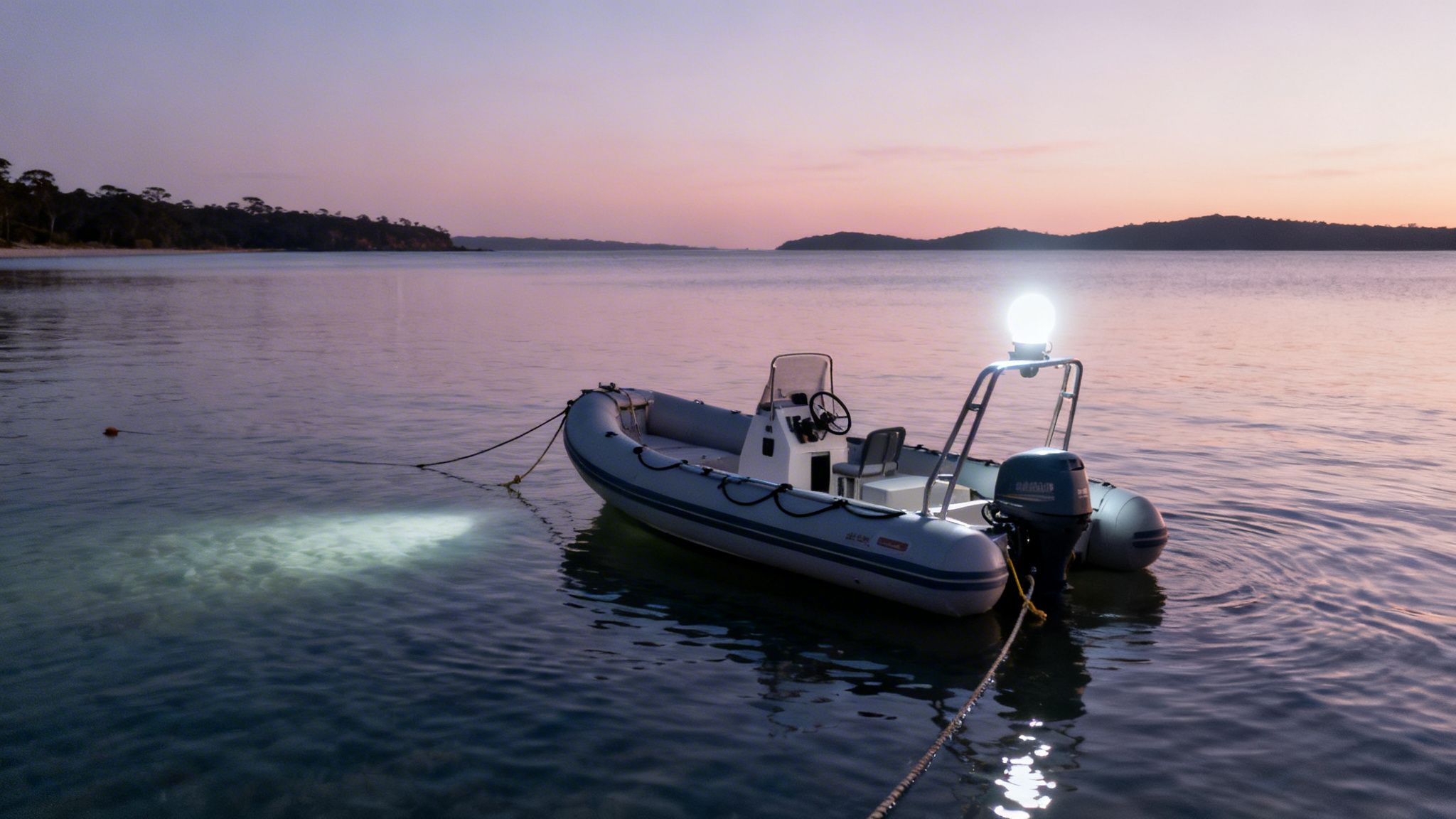
Think of an anchor light as your boat’s personal little lighthouse—a small but vital beacon that tells every other vessel on the water, “I’m parked here for the night.” It’s a single, all-round white light that has to be seen from 360 degrees. Its one and only job? To stop boats from bumping into each other in the dark when you’re stationary.
Picture this: you’ve dropped anchor in a quiet, moonless cove after a perfect day of recreational boating. As the sun dips below the horizon, your boat melts into the darkness, becoming practically invisible. This is where an anchor light goes from being a bit of gear to your most critical piece of nighttime safety equipment. It’s not there to help you see; it’s all about making sure everyone else can see you.
Without that small but powerful light, another boat cruising along has no idea your inflatable boat or tender is sitting right in its path until it’s dangerously close. That single white light is a universal signal that says your boat isn’t moving, giving others plenty of time to steer clear. It’s a simple idea with huge consequences for protecting your boat, your crew, and other boaters enjoying their time on the water.
Beyond just being a common-sense safety move, showing an anchor light is a legal requirement right across Australia. The rules are clear and strictly enforced because they keep our waterways safe for everyone, from families out for a weekend outing to keen anglers chasing the next big catch. Whether you’re looking to hire an inflatable boat for a family outing in Australia or comparing prices and features of the best inflatable boats for recreational use, understanding this rule is crucial.
Australian maritime safety regulations state that any vessel under 50 metres long—and yes, that includes our popular Easy Inflatables boats—must display an all-round white anchor light where it can be best seen. This rule is in effect from sunset to sunrise and during periods of poor visibility, like heavy fog or rain. This isn’t a state-by-state thing; it’s a uniform rule based on the international Prevention of Collisions at Sea Regulations, making sure anchored boats like our Inflatable Catamarans are visible.
For instance, the WA Department of Transport makes it crystal clear that this light is mandatory for any boat anchored at night. This directly impacts Aussie families and fishos who love using lightweight, portable inflatables for weekend trips along our coasts.
An anchor light is your boat’s silent, tireless watchkeeper. It works all night, broadcasting a clear and simple message—”I am here, steer clear”—to every other vessel on the water, preventing a peaceful evening from turning into a preventable emergency.
This isn’t just a rule for big yachts. It applies just as much to the versatile inflatable boats and Inflatable Catamarans that are perfect for exploring Australia’s incredible coastline. Getting this right is a fundamental part of being a responsible skipper. To make sure you’re fully kitted out, it’s a great idea to review our complete guide to essential boating safety equipment.
Knowing the law is your first line of defence against fines and, more importantly, accidents on the water. While the need for an anchor light is a national rule in Australia, the finer details can sometimes feel a bit murky. Let’s cut through the jargon and explain the rules in plain English, so you’re always compliant, whether you’re dropping anchor in a compact tender or a spacious Inflatable Catamaran.
The absolute cornerstone of Australian maritime law is the all-round white light. This isn’t just any old torch; it must be visible from 360 degrees and placed where other boats can see it best. The idea is simple: no matter which way another vessel approaches, they can spot your stationary boat and steer clear.
This simple decision tree nails it down.

The message is crystal clear: if you’re anchored between sunset and sunrise or in poor visibility, your light must be on.
While the national standards set the baseline, it’s vital to know that states can have their own small but significant variations. These differences often account for local boating conditions and the kinds of boats you’ll find in those waters. For anyone with a smaller inflatable, these local exemptions are especially important to understand.
For example, in South Australia, vessels under 7m—like our compact inflatable boats—are exempt from showing an all-round white light when anchored in designated “special anchorages,” as long as they’re not in a narrow channel. This is a massive plus for those with portable setups. Other states like Western Australia and Victoria, however, stick closer to the national standards for all vessels under 50m, requiring the light to be displayed prominently.
This is exactly why local knowledge is king. An exemption that applies in a quiet South Australian cove won’t help you if you’re anchored in a busy channel in NSW or Queensland. When in doubt, always assume a light is required. Staying on top of these details is a key part of responsible boat ownership, something we cover more in our boat safety equipment checklist.
To help you stay on the right side of the law, here’s a simplified breakdown of the rules for small recreational boats across the major Australian states. Keep in mind, this is a guide, and it’s always best to check with your local maritime authority for the most current regulations.
| State/Territory | Requirement for Vessels Under 7m | General Requirement (7m-50m) | Notable Exemptions or Special Rules |
|---|---|---|---|
| New South Wales | All-round white light required at night. | All-round white light, visible for 2 nautical miles. | Exemptions may apply in designated special anchorages if not impeding traffic. |
| Queensland | All-round white light required when anchored. | All-round white light, visible for 2 nautical miles. | No light needed if aground in a drying harbour or moored to a registered mooring. |
| Victoria | Must display an all-round white light. | All-round white light, clearly visible. | Light not required if anchored or moored in an area set aside where anchoring is not normally expected. |
| Western Australia | An all-round white light is mandatory. | All-round white light, visible from every direction. | Regulations are strictly aligned with national standards, with very few exceptions for small craft. |
| South Australia | Exempt in special anchorages unless in a narrow channel. | All-round white light, visible for 2 nautical miles. | The exemption for smaller vessels is a key distinction for tenders and small inflatables. |
The golden rule is this: When in doubt, switch it on. It’s always better to be seen and safe than to risk a fine—or worse, a collision—by second-guessing an exemption.
Ultimately, these rules exist for one reason: to keep everyone safe. By understanding both the national standards and the local quirks, you can enjoy your time on the water with total confidence, knowing you’ve done your part to protect your boat, your crew, and other boaters.
Alright, now that you know the rules, it’s time for the fun part: picking the right anchor light for your boat. Think of this as your personal shopping guide. We’ll help you find a reliable beacon that not only keeps you legal but genuinely safe out on the water, especially after the sun goes down. If you’re looking to compare prices and features of the best inflatable boats available near you, consider the anchor light as a critical accessory in your budget.
The options can feel a bit overwhelming at first, but they really boil down to a few key choices. We’re going to break down the different light technologies and mounting styles, with a special focus on what works best for inflatable boats and our Inflatable Catamarans. Your decision here directly impacts how much battery you use, how easy the light is to set up, and how much you can trust it to work all night long.

The single biggest decision you’ll make is what kind of bulb is inside your light. For years, old-school incandescent and halogen bulbs were the only option, but modern LED (Light Emitting Diode) technology has completely changed the game. It’s not even a fair fight anymore.
When you’re weighing up the options, efficiency and lifespan are everything. This detailed comparison of Halogen vs LED Lights makes it crystal clear why one is better than the other. For any boater, especially those with a limited battery supply, the choice is simple.
Here’s why LED anchor lights are the only real choice:
For inflatable boat owners who often run everything off a portable battery pack, the tiny power draw of an LED light isn’t just a nice-to-have—it’s absolutely essential.
How you attach the light to your boat is just as important as the light itself. The whole point is to make sure it can be seen from 360 degrees without anything blocking it. The best mounting style really comes down to your type of vessel.
The rule is simple: the light must be placed ‘where it can best be seen.’ This means it should be the highest point on your boat, clear of any obstructions like a bimini top, passengers, or fishing gear.
Permanent Mounts are bolted or screwed directly onto a boat’s structure, like a mast, cabin roof, or hardtop. They’re perfect for larger boats with a rigid frame and a built-in 12V electrical system. You wire it in once and it’s always ready to go—a real set-and-forget solution.
Portable Mounts are the go-to for inflatable boats, tenders, and small tinnies. Their flexibility is their biggest superpower. Common portable options include:
For owners of an inflatable boat or a compact tender, a portable pole-mounted LED light is the perfect combination. It gives you compliance, fantastic visibility, and total convenience. You can stash it away when you don’t need it and deploy it in seconds when you drop anchor for the night. That’s the kind of adaptability you need for a versatile boat.

Fitting an anchor light to a boat made of PVC or Hypalon throws up a different set of challenges compared to a fibreglass tinnie. You can’t just grab a drill and make a hole wherever you fancy, so smart, non-invasive solutions are the name of the game. Thankfully, there are plenty of practical and secure ways to get your light mounted and powered up, keeping your inflatable safe and legal without causing any damage.
The two main goals are simple: get the light high enough for 360-degree visibility, and give it a reliable power source that won’t die in the middle of the night. For owners of versatile inflatable boats, balancing performance with portability is everything, and your lighting setup should be no different.
The best thing about an inflatable is its flexibility, and your mounting system should be just as adaptable. Put the power drill away; these methods use your boat’s existing features or specialised accessories to create a solid base for your anchor light.
Once your light is mounted, it needs juice. For inflatable boats, the choice really boils down to two paths: ultimate portability or integrated convenience. Your decision will likely depend on whether your boat already has a 12V battery system on board.
Option 1: The Self-Contained Battery Unit
For most small to medium-sized inflatables and tenders, a portable, battery-powered anchor light is a perfect match. These all-in-one units are the definition of simplicity.
Option 2: The Wired-In 12V System
Bigger inflatables, especially RIBs or those with an electric-start outboard, often have a 12V marine battery. If that’s your setup, wiring the anchor light directly into your boat’s electrical system is a rock-solid option. This gives you a constant power source managed by your main battery switch. You can learn more about managing your power with our guide on marine battery boxes.
When you’re choosing an anchor light, don’t just gloss over its IP rating. This stands for Ingress Protection, and it tells you exactly how well the light is sealed against water and dust. A marine environment is unforgiving, and your light is going to get hit with spray, rain, and humidity.
Look for an anchor light with a rating of at least IP67. The ‘6’ means it’s completely dust-tight, and the ‘7’ means it can be submerged in up to one metre of water for 30 minutes without failing. This isn’t just a nice feature—it’s essential for reliability on the water.
A light with a lower IP rating might save you a few dollars initially, but it’s a gamble you don’t want to take. A light that fails from water damage in the middle of a dark, rainy night is a serious safety hazard. Investing in a quality, IP67-rated light ensures it will turn on when you need it most, protecting you, your crew, and your boat.
To make picking the right light even easier, here’s a quick checklist of what to look for when you’re shopping around.
| Feature | What to Look For | Why It Matters for Inflatables |
|---|---|---|
| Mounting Type | Rod holder, clamp, or adhesive mounts | You need a no-drill solution that’s secure but won’t damage your boat’s tubes or transom. |
| IP Rating | IP67 or higher | Guarantees the light is fully waterproof and can handle spray, rain, and even a quick dunking. |
| Visibility Range | 2-3 nautical miles (3.7-5.5 km) | Ensures your boat is seen from a safe distance by other vessels in all conditions. |
| Power Source | Battery-powered or 12V hardwired | Choose battery power for simplicity and portability, or hardwire it if you have a 12V system for reliability. |
| Light Type | LED | LEDs are incredibly energy-efficient, brighter, and last far longer than old-school incandescent bulbs. |
| Size & Weight | Compact and lightweight | Easy to store in a dry bag and won’t add unnecessary weight or bulk to your setup. |
Thinking through these key features will help you find an anchor light that’s not just compliant, but perfectly suited to the unique demands of boating with an inflatable.
Getting your anchor light installed properly is about more than just flipping a switch and seeing it turn on. It’s about building a reliable, safe, and legally compliant system you can count on when you’re anchored in the dead of night. This is especially true when you’re wiring a light into your boat’s 12V system, where one small mistake can lead to electrical faults or a dead battery just when you need it most.
Whether you’re fitting a permanent light to a larger RIB or just setting up a simple circuit for a portable pole light, the fundamental rules of safe marine wiring don’t change. Following Australian standards isn’t just about passing a safety inspection; it’s about giving yourself complete peace of mind.
Boat wiring lives in a brutal world of moisture, salt, and constant vibration. To survive, every single component you use has to be up to the job. Taking shortcuts with the wrong materials is a fast track to corrosion, failure, and headaches.
Here are the non-negotiables for a rock-solid 12V installation:
Wiring an anchor light is a pretty straightforward job if you just follow a logical process. Here’s a basic rundown for connecting a light to your boat’s 12V battery through a switch panel.
Getting the wiring right is a critical compliance checkpoint. While 97% of Certificate of Survey applications are approved by AMSA annually, the remaining rejections often highlight failures in navigation light compliance, a key issue for recreational boats. For those seeking professional guidance on selecting the right power setup, our article on choosing a marine battery and charger is an excellent resource.
Australian maritime regulations are strict for a reason. Compliance is a major hurdle for many boat owners, as AMSA’s survey data shows that anchor light circuits are a common point of failure. You can learn more about these specific compliance requirements from the AMSA Survey Matters newsletter. By following these best practices, you can be sure your setup is not only safe but 100% legal.
Your anchor light is one of the most important bits of safety gear on your boat, but it’s often a classic case of “out of sight, out of mind”… until it doesn’t work. The good news is, keeping it in top shape is dead simple, and a regular check-up ensures it’s ready to do its job every time you drop the hook for the night.
When an anchor light fails, it’s rarely the bulb’s fault. The real culprit is usually the silent killer of all marine electronics: corrosion. Salt, spray, and humidity are a nasty team, constantly attacking electrical contacts and causing everything from a flicker to a complete blackout. A little preventative care goes a very long way.

Spending a few minutes on inspection before you head out can save you from a seriously dangerous situation later. Just make these checks part of your pre-launch routine.
Even with the best maintenance, things can still go wrong. If your anchor light is on the fritz, don’t panic. This quick guide will help you track down the most common culprits in no time.
The usual suspects are almost always the simplest: a dead battery, a loose wire, or a corroded connection. Always start with the basics before you assume the light itself is cactus.
Here’s a quick-fire table to help you nail the problem:
| Symptom | Possible Cause | Solution |
|---|---|---|
| Light Won’t Turn On | Dead batteries or blown fuse | Swap in new batteries or check and replace the inline fuse. |
| Light Is Dim | Low battery voltage or dirty lens | Charge or replace your batteries and give the lens a good clean. |
| Light Flickers | Loose connection or corrosion | Check all wire connections are tight and clean off any corroded contacts. |
The golden rule is to always have a backup. For battery-powered lights, chuck a spare set of fresh batteries in a waterproof bag. If your system is hardwired, keep spare fuses of the right amperage on board. A little bit of prep gives you the confidence that your anchor light will never let you down. For more tips on keeping your vessel shipshape, check out our guide to inflatable boat repairs in Australia. A well-maintained light on a well-maintained boat is your ticket to safe and stress-free adventures.
When it comes to anchor lights, we hear the same great questions from owners time and again. Getting clear, straightforward answers is key to boating with confidence. Here are the most common queries we get from the Easy Inflatables community, all answered in one place.
Yes, in almost all situations. If you’re anchored at night or in poor visibility anywhere in Australian waters, an anchor light is a legal must-have. It’s your boat’s “I’m here!” signal to everyone else on the water.
While some states have minor exemptions for boats under 7 metres in special, designated anchorages, these almost never apply in busy channels or open waters where you’re likely to be. The safest and most compliant choice is always to use an all-round white anchor light. It’s a small precaution that prevents big problems.
For an inflatable boat without a built-in 12V system, you can’t beat a high-quality, portable LED anchor light. These self-contained units are the perfect solution, powered by batteries for maximum convenience and dead-simple operation.
Look for models that run on common batteries, like D-cells, or feature a long-lasting rechargeable battery. The most important feature? Make sure it has an IP67 waterproof rating and can be mounted on a telescopic pole. This lets you get it high enough to be seen clearly from every direction.
The official rule is beautifully simple: the light must be placed “where it can best be seen.” On an inflatable, that means getting it high enough to give other vessels a completely unobstructed 360-degree view as they approach.
Your light shouldn’t be blocked by passengers, a bimini top, or any other gear you have on board. A portable, telescopic pole mount is one of the most effective ways to get the height you need for total visibility and compliance.
Absolutely not. A lantern, torch, or mobile phone light is not a legal or safe substitute for a proper anchor light. There’s a huge difference in performance.
Compliant marine anchor lights are specifically designed and tested to emit an unbroken, all-round white light visible for a required distance—typically 2 nautical miles. A camping lantern just can’t meet these strict standards. Using one could land you a significant fine and, more importantly, dramatically increases the risk of a nighttime collision.
At Easy Inflatables, we believe that safety and simplicity should go hand-in-hand. Explore our range of durable, portable, and regulation-compliant anchor lights designed specifically for inflatable boats. Find the perfect lighting solution for your vessel at https://easyinflatables.com.au.