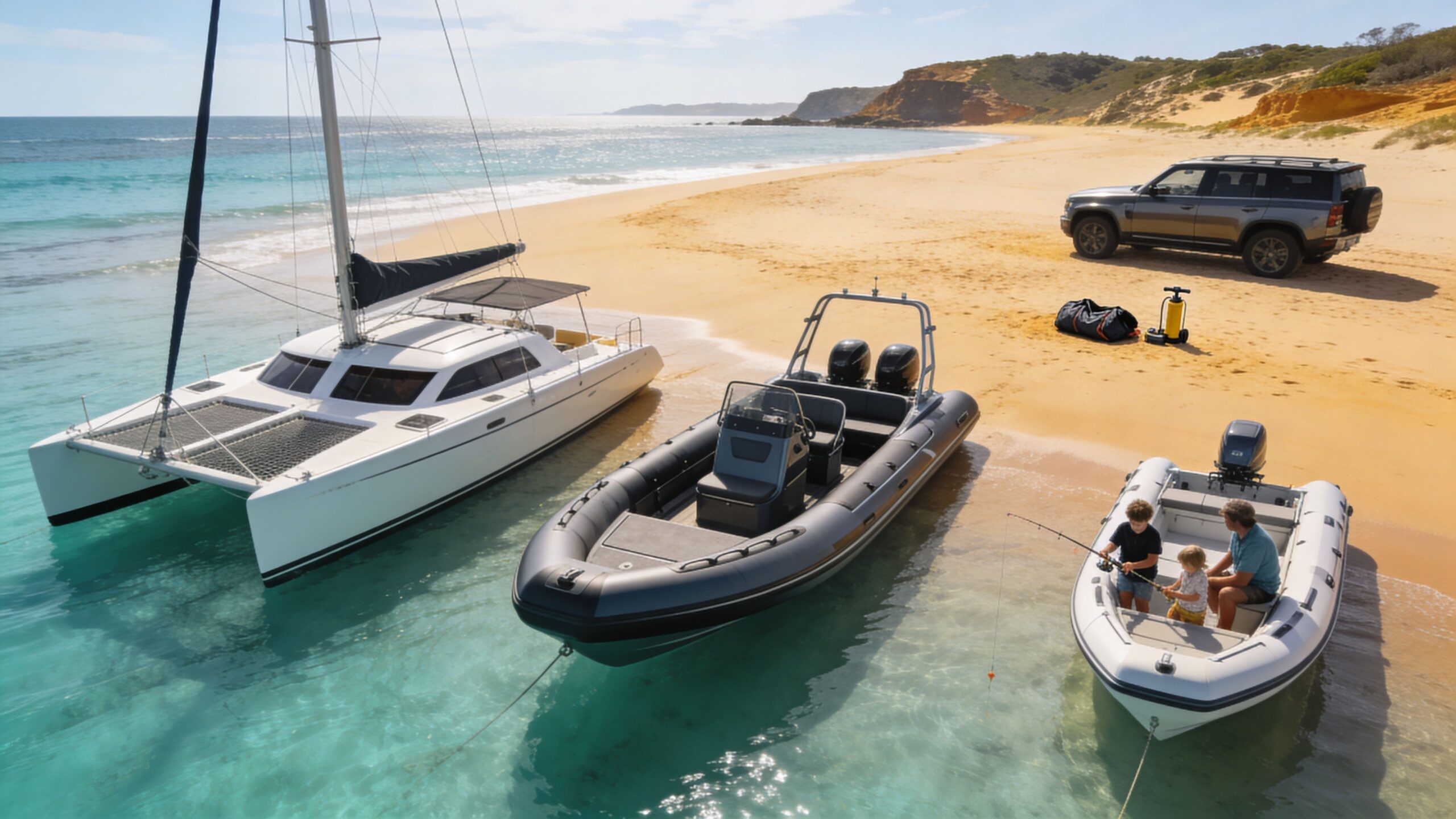

You’re probably looking at a few inflatable boats online right now and seeing the same claims over and over. Stable. Tough. Great value. Good for fishing. That’s the easy part. The harder part is working out which boats will hold up in Australian conditions, and which ones only look good on a product page.
That matters more here than it does in milder markets. Australian inflatable boats deal with harsh UV, salt, sand, rough launch spots, oyster-covered edges, coral in some regions, and that annoying reality where a calm morning can turn into a sloppy afternoon. A boat that feels acceptable in sheltered water for half an hour can feel very different once you’ve loaded gear, added a motor, and run through chop with family on board.
The best inflatable boats australia buyers end up happiest with usually aren’t the cheapest ones. They’re the boats that match the job properly. The right hull. The right size. The right fabric. The right motor. And, equally, the right level of safety margin for the sort of water you truly use, not the water you imagine using on your best day.
A good inflatable can be a brilliant Australian boat. RIBs are popular across local waterways because they combine stability, performance, and safety, and a Queensland builder like Swift offers around 50 models from 2.4 to 13 metres with aluminium-hulled RIBs and Orca Hypalon tubes for everything from family boating to fishing and water sports, as noted in this Australian inflatable boat buyer’s guide. But not every inflatable buyer needs a rigid-hull setup. Many first-time owners are better served by a larger portable inflatable or an inflatable catamaran that gives better packability and a more forgiving platform.
Here’s a practical snapshot before getting into the details.
| Boat type | Best suited to | Main strength | Main trade-off | Typical buying note |
|---|---|---|---|---|
| Soft inflatable | Tender use, calm water, occasional short trips | Lowest entry cost and easy storage | Least capable in rougher conditions | Better for light-duty use than regular coastal work |
| Roll-up inflatable | Travellers, campers, light fishing, simple transport | Packs down well and stays versatile | Less planted than more substantial hulls | Good if storage matters more than offshore confidence |
| RIB | Coastal running, performance, mixed family use | Strong handling and rigid hull feel | Less portable and often more involved to store or trailer | Strong option if you want more speed and less compromise |
| Inflatable catamaran | Fishing, family stability, beach launching, touring | Very stable platform and easy portability | Model choice matters more than buyers realise | Often the smartest fit for people who value stability over outright speed |
Australian buyers should start with conditions, not brand names. Lakes, estuaries, rivers, bays, island runs, beach launches, and yacht tender work all ask different things from a boat. If you get that part wrong, every other choice becomes expensive.
The first filter is simple. Decide where the boat will spend most of its life. A boat used for calm inland water can get away with a lighter, simpler build. A boat used around coastal chop, exposed ramps, rocky foreshores, or regular fishing missions needs more structure, better materials, and a bigger safety buffer.
A lot of first buyers shop by person count alone. That’s a mistake. Two adults on a dead-flat lake is one thing. Two adults, gear, an esky, a battery, and a motor in a breezy coastal bay is something else entirely.
Use these questions to narrow it down:
Where will you launch most often
Beach launches and rough foreshore launches punish thin material and flimsy fittings.
Who’s coming with you
Kids, anglers, dogs, dive gear, camping gear, and fuel all change the space and stability you need.
How far from shore do you plan to go
Even for recreational use, more distance means less tolerance for bargain-grade construction.
How will you store and transport it
Some buyers need a proper boat-in-a-bag setup. Others are fine with a trailer or roof-loading arrangement.
One area many buyers skip is local compliance and safety obligations. Before buying, it’s worth checking this guide to inflatable boat compliance in Australia so your boat, motor pairing, and intended use line up with the rules that apply where you operate.
For most recreational buyers, the strongest all-round inflatable is one that balances portability with enough substance to handle changing conditions. That usually means avoiding the absolute bottom end of the market unless the boat is only for very light-duty use.
Buy for the worst realistic conditions you’ll accept, not the best conditions you hope for.
That mindset saves money and hassle. It also keeps you safer.
The buyers who get the most use from their inflatable tend to choose boats that are easy enough to transport, but large and well-built enough that they still feel comfortable once the wind gets up or the load increases. That’s where size, hull design, and fabric quality start to matter a lot more than glossy marketing.
The cheapest inflatable in the search results often isn’t the cheapest boat to own. It’s usually the one that asks for compromises straight away. Less confidence at launch. Less comfort in chop. More worry around hooks, rocks, and sun damage. Less resale appeal when you want to move it on.
That’s why I’d separate price from value. Price is what you pay on day one. Value is what the boat gives back over years of use.
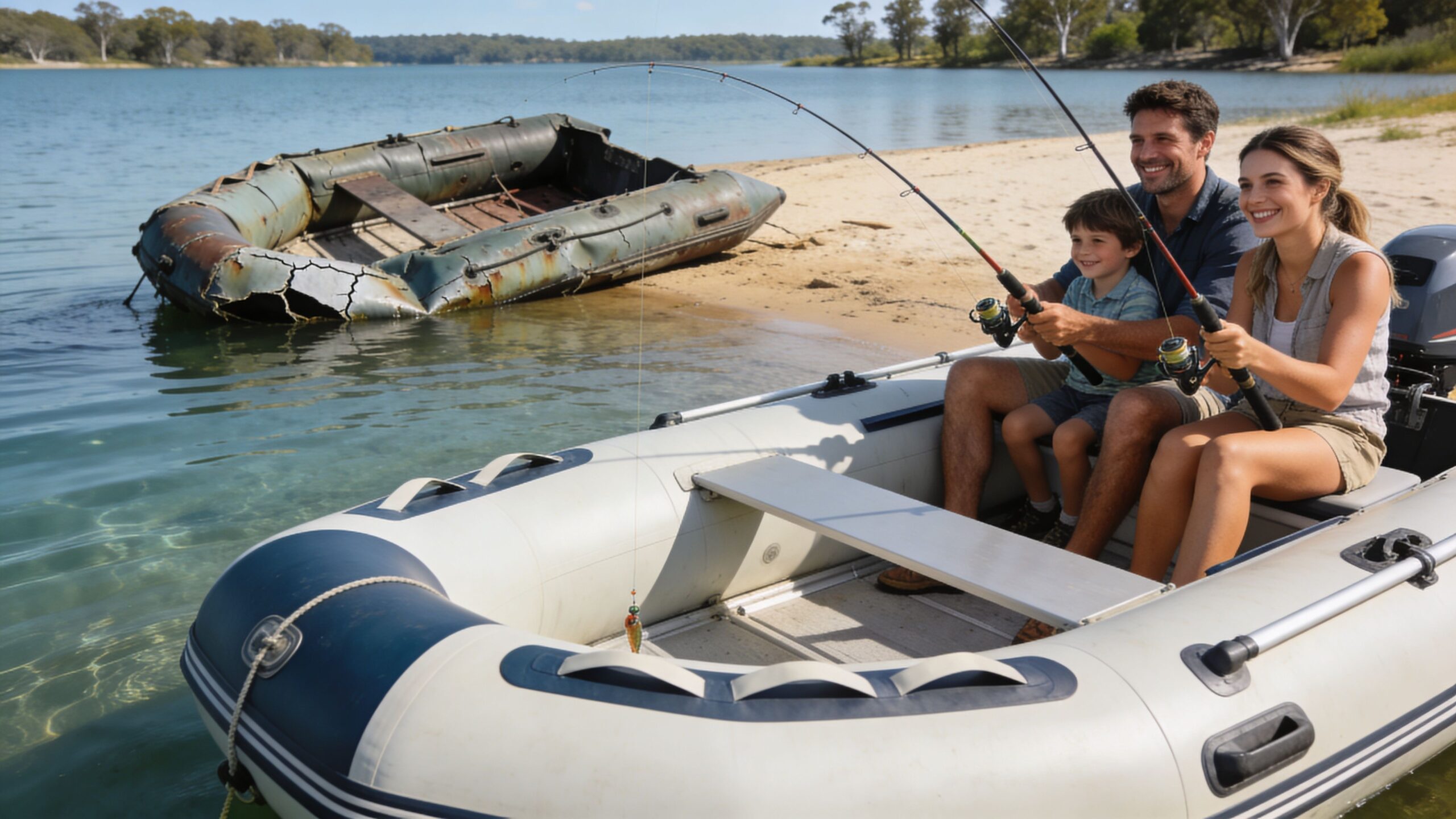
Inflatables are attractive because they make boating far more accessible than many hard-hull alternatives. In Australia, a complete entry-level setup with a 2.5-metre inflatable plus a 5–10hp outboard can come in under $5,000, while RIBs sit in the $2,000–$20,000 range and remain well below the cost of a typical $20,000 fibreglass runabout, according to this Australian inflatable pricing guide.
That affordability is real. It’s one of the best things about the category.
The trap is assuming every inflatable delivers the same value because the purchase price looks low. They don’t. Cheap boats often save money by cutting material quality, seam quality, fittings, floor structure, or after-sales backup. Those are exactly the areas that matter once the boat leaves the showroom.
A quality inflatable tends to make sense in four practical ways:
Durability in real use
Better fabric and better seams cope with repeated inflation, UV, salt, and scrapes far better than bargain boats.
Safer handling margin
A more stable hull and a properly sized boat feel calmer when people move around or weather shifts.
More usable days on the water
If a boat only feels pleasant in perfect conditions, it won’t get used nearly as often.
Less regret after the first season
Many buyers outgrow a too-small or too-light boat quickly. Then they buy twice.
Practical rule: If you’re using the boat in Australian coastal or mixed conditions, think of the extra spend as paying for confidence, not just features.
The worst value buy is usually the boat that sits in the middle awkwardly. Not cheap enough to be disposable. Not good enough to trust properly. Those models can look sensible on paper, then feel underdone once loaded with people and gear.
If the budget is tight, it’s often smarter to buy a simpler boat for simple use, or wait and move into a better-built model that suits your real boating life. That’s especially true if fishing, family outings, or travel are part of the plan.
Most inflatable boat regret starts with buying too small. People think small equals convenient, and it does on land. On water, though, small can also mean wetter, twitchier, and more cramped once real gear and real people climb aboard.
Australian buying patterns reflect that. Market data from Easy Inflatables shows the 3.3m to 4.0m range dominates sales, and those boats are designed to pair with 9.9 to 20HP outboards, which suits family and angler use in local conditions, as explained in this Australian inflatable sales guide.
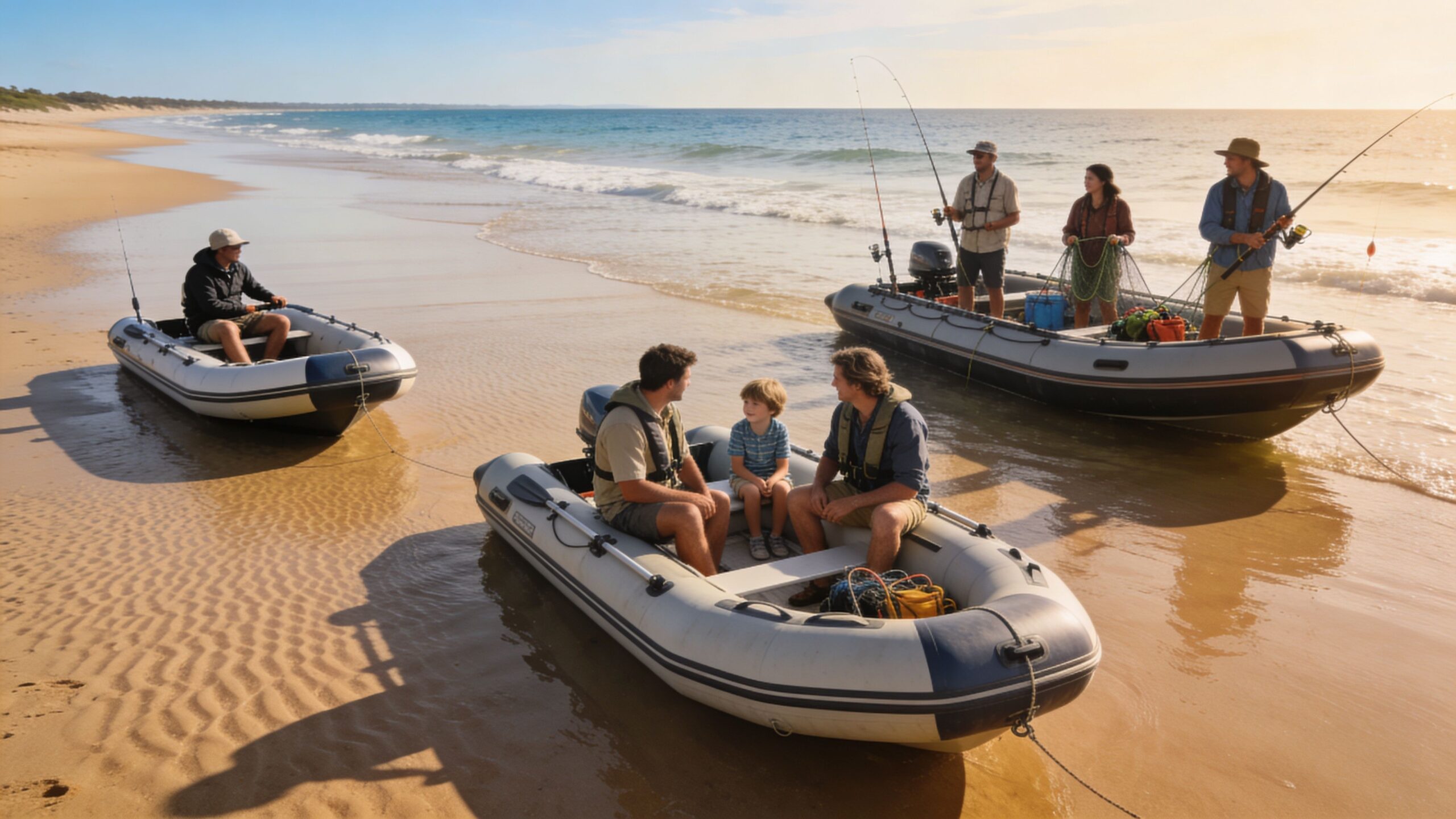
This size range works because it solves several problems at once. It still gives you portability. It still fits the way many Australian buyers store and transport their boats. But it also gives you enough hull length and deck area to feel like a real boat once conditions stop being perfect.
The practical gains are easy to notice:
More stability at rest
That matters when someone stands up, shifts seats, or leans over the side.
Better ride quality in chop
Longer hulls generally feel less abrupt and less nervous.
More room for gear
Fishing tackle, safety kit, fuel, and a few extras add up quickly.
Better match for versatile motor sizes
That’s where the common 9.9 to 20HP pairing becomes useful.
If you’re tossing up between a compact boat and a slightly larger one, I’d usually lean toward the larger option for Australian use. Not because bigger is always better, but because a bit more size gives you breathing room, both physically and metaphorically.
A boat in the 3.6m to 4.0m range tends to feel more forgiving when the breeze builds or when the crew gets restless. It also leaves enough room that the boat remains comfortable once you add normal extras like a sounder, dry bags, an anchor, or fishing gear.
The right size doesn’t feel big at home. It feels calm on the water.
Instead of asking “How many people can it carry?”, ask these three questions:
| Your real use | What to favour |
|---|---|
| Solo or pair, calm water, simple transport | Lighter end of the range |
| Family use, estuaries, bays, regular gear load | Mid to upper part of the range |
| Fishing, open water comfort, changing conditions | Closer to 3.6m to 4.0m with a more stable hull design |
Small inflatables still have their place. Tender work, quick lake trips, and ultra-compact storage are valid reasons to go smaller. But for buyers chasing the best inflatable boats australia options for broad recreational use, the practical sweet spot is usually not the smallest boat on the page.
Hull design changes everything. Two boats can look similar in photos, carry a similar motor, and still feel completely different once you’re crossing boat wash, drifting side-on in chop, or moving around with kids and fishing gear.
That’s why this comparison matters more than most buyers realise.
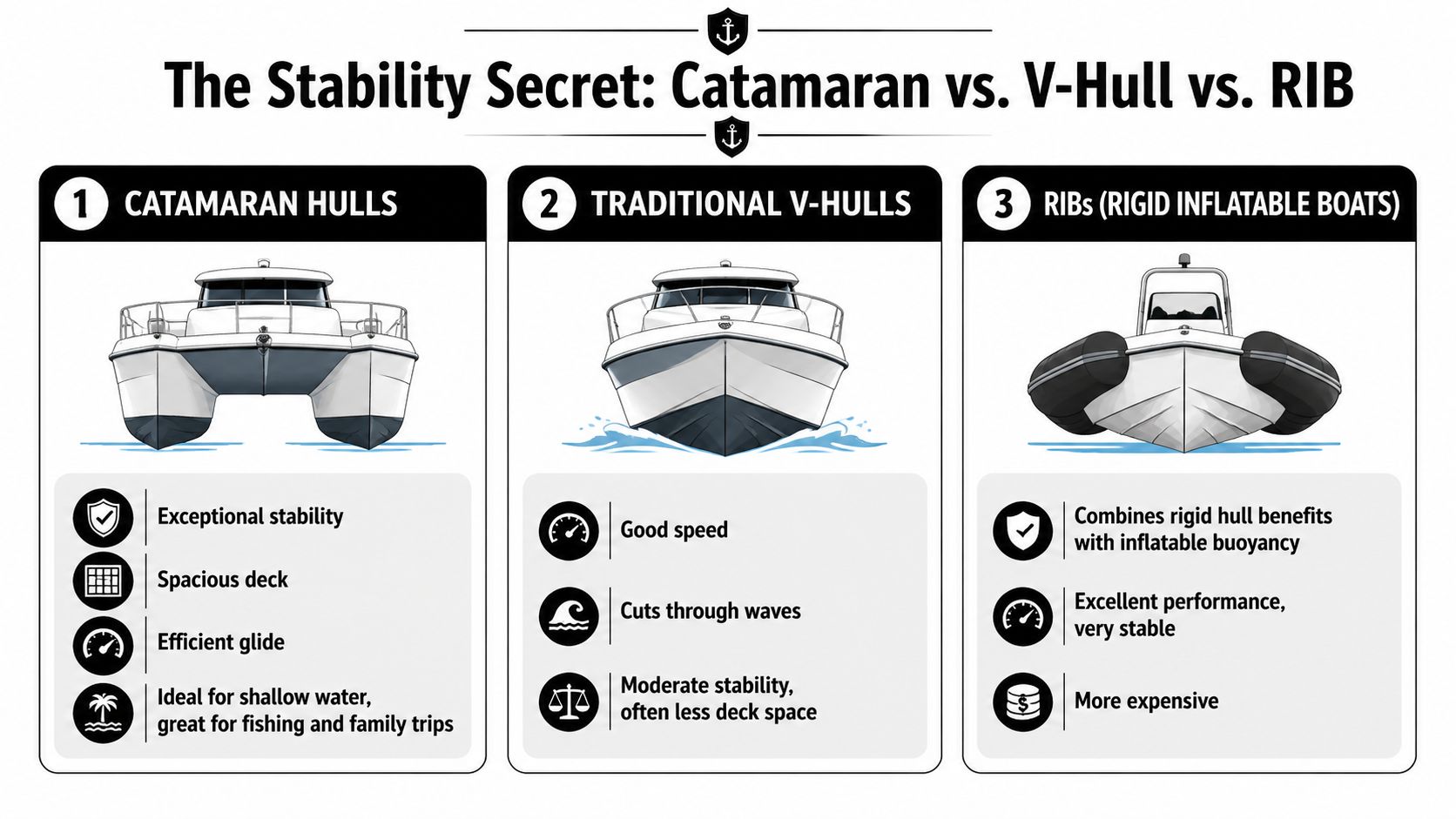
A traditional inflatable V-hull gives a familiar feel. It’s a common format, and it works well for general boating. It can ride nicely when driven properly and is easy for many buyers to understand because it behaves like the shape they already know from other small boats.
Its weak point is lateral stability compared with a good catamaran-style inflatable. If your boating involves standing to cast, shifting weight often, or carrying family members who move around unpredictably, a standard V-hull can feel more active underfoot.
RIBs combine a rigid hull with inflatable tubes, and that’s why they’ve become so popular in Australia. They offer strong performance, solid handling, and the confidence of a proper rigid bottom while still keeping the buoyancy and cushioning of inflatable tubes.
For buyers doing more coastal running, they make a lot of sense. They’re often the answer when someone wants a more serious boating feel without jumping to a full fibreglass runabout.
The trade-off is portability. You usually give up much of the compact, packable convenience that attracts people to inflatables in the first place.
Inflatable catamarans deserve more attention than they usually get. For recreational buyers, especially anglers and families, they often solve the biggest complaint people have with smaller boats. Side-to-side movement.
According to naval architecture principles cited in Royal Australian Navy guides, inflatable catamaran designs can reduce roll by up to 50% compared to monohulls, and in moderate swells they can keep heel angles below 5° where traditional monohulls can reach 12°, as outlined in this inflatable catamaran stability guide.
That sounds technical, but on the water it means something very simple. The boat feels more settled.
A family notices it when a child shifts from one side to the other. An angler notices it when leaning over for a cast or reaching for the net. Anyone with a cautious passenger notices it immediately.
For buyers comparing layouts, this inflatable catamaran range is worth looking at alongside standard inflatable formats and RIBs.
Here’s a quick side-by-side view.
| Hull style | Stability at rest | Ride character | Portability | Best fit |
|---|---|---|---|---|
| Traditional V-hull | Moderate | Familiar and direct | Good, depending on build | General boating |
| RIB | Very good | Strong performance and crisp handling | Lower than packable inflatables | Coastal users wanting rigid-hull feel |
| Inflatable catamaran | Excellent | Softer, calmer platform in mixed conditions | Strong for its capability | Fishing, families, touring |
For a visual look at how these boats behave on the water, this video helps.
If stability is your top priority, a catamaran-style inflatable is usually the smartest place to start.
That doesn’t mean every buyer should skip RIBs or V-hulls. It means you should choose based on the way you boat. If you value deck confidence, fishing stability, family comfort, and packability, inflatable catamarans are hard to ignore.
Material quality is where good inflatable boats separate themselves from disposable ones. If you only remember one thing from this guide, make it this. Hull shape matters. Size matters. But fabric and seam quality decide how the boat ages.
A lot of the frustration people have with inflatables comes from buying a boat that was built down to a price. It looks fine new. It feels fine in the driveway. Then Australian sun, salt, abrasion, and repeated packing start exposing the weak points.
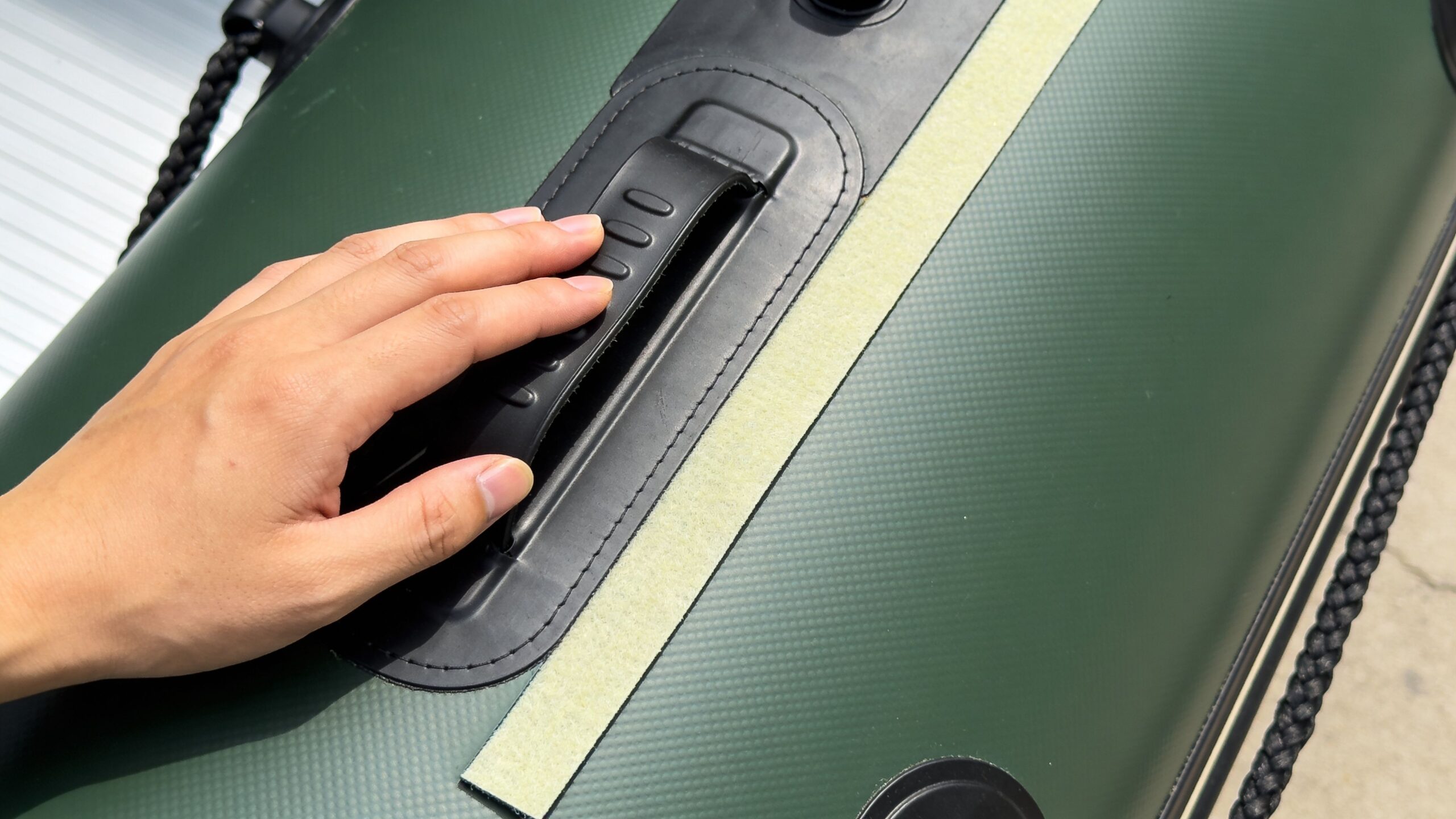
Many entry-level inflatables use 0.7mm to 0.9mm PVC. Premium boats use 1.2mm German Mehler Valmex® fabric. That makes the premium material 33.3% thicker than 0.9mm material.
The number matters because it translates into real-world resilience. A thicker fabric handles abrasion better when you drag over coarse sand, rub against rough ramps, or land near rocky edges. It also gives the boat a more solid, confidence-inspiring feel when fully inflated.
Premium Aerowave inflatable boats sold in Australia use 1.2mm German Valmex® PVC with thermo-welded seams, and that heavier construction provides better puncture and abrasion resistance for local conditions such as rocky foreshores and coral-laden waters, according to this inflatable material guide for Australian buyers.
I’m not saying every thinner boat is useless. For occasional calm-water use, a lighter boat can make sense. But many buyers ask too much of those boats. They use them in salt, leave them inflated in the sun, drag them over rough launch points, or pack them wet and sandy after a long day. That’s where budget construction starts to show.
A thicker premium fabric gives you more margin for everyday mistakes and harder environments. That’s a big deal in Australia, where sunlight alone is enough to punish neglected gear quickly.
Material check: If a boat seller avoids talking clearly about fabric thickness and seam construction, that’s usually a warning sign.
Seams are a common failure point on cheap inflatables. It’s one thing to have decent fabric. It’s another to join it properly.
Thermo-welding matters because it avoids the seam failures often seen in lower-grade glued boats when they spend time in extreme heat. That’s especially relevant in Australia, where boats can go from storage to hot beach sand to summer air temperatures very quickly.
If you want a deeper comparison between premium PVC and another established premium material, this guide on Hypalon vs German Mehler 1.2mm PVC material is useful.
When comparing boats, don’t stop at the headline photo. Ask or check for these details:
Fabric thickness
If the seller can’t state it clearly, keep digging.
Seam construction
Thermo-welded seams are a serious plus for hot-weather durability.
Transom quality
A good transom matters once a motor is involved.
Reinforcement in wear zones
Launching, beaching, and loading all stress the same areas repeatedly.
For best inflatable boats australia buyers who plan to keep their boat for years, material quality isn’t a minor spec. It’s the purchase decision.
You launch at first light on a breezy bay, a mate shifts to grab the tackle box, and the boat lurches harder than expected. That is the moment boat choice stops being about brochure specs and starts being about hull design, tube size, and fabric quality.
Australian use cases vary, but the pattern is consistent. The best inflatable for your trips is the one that stays predictable in the water you use, carries the load you really bring, and stands up to repeated sun, salt, sand, and rough launches. A well-made hull in 1.2mm PVC usually proves its worth here because it is doing a real job, not just filling a feature list.
Fishing rewards stability more than speed. If two adults are casting, moving around, reaching for gear, or leaning over the side, a twitchy hull gets tiring fast.
Catamaran-style inflatables make a lot of sense for estuaries, bays, and sheltered coastal work because they sit flatter and feel calmer at rest. A traditional V-hull can give a softer ride in chop, but many first-time buyers notice at-rest stability before they notice ride refinement. For lure casting, bait fishing, and crabbing, that trade-off matters.
I would prioritise these points for a fishing setup:
Stable footing at rest
Better for casting, landing fish, and shifting weight without upsetting the boat.
Enough room for actual fishing gear
Tackle, rods, landing nets, anchor gear, and safety equipment take up more space than buyers expect.
Material that can handle abuse
Hooks, sinkers, pliers, oyster-covered banks, and regular beaching are hard on light-duty fabric.
Family use puts different pressure on a boat. People climb aboard awkwardly, kids move suddenly, and someone is always reaching over the side or asking to stop at the next beach.
That usually means buyers are happier in a larger inflatable than they first planned. More internal space helps, but hull behaviour matters just as much. A stable platform with decent tube diameter and a forgiving layout feels safer during boarding, loading, and short runs in messy water. In Australian conditions, that is worth more than chasing a boat that looks sporty on paper.
A family boat should feel calm and easy to manage.
Portable inflatables suit touring well, but only if the packed weight, setup time, and on-water ability all stay realistic. A boat that technically fits in the van but is a pain to lift, pack, inflate, or launch often gets left behind.
The sweet spot for many travellers is a mid-size inflatable that still packs down but has enough hull length and tube volume to handle river systems, dams, protected inshore water, and the odd afternoon breeze. This is also where construction quality matters more than many buyers expect. Hot storage, repeated folding, beach launches, and long road trips are tough on cheap boats.
If you are planning trips around where the boat will get used, this guide to top destinations for inflatable boating in Australia gives a practical sense of the conditions a portable setup may face.
Tender work is repetitive and unforgiving. You drag the boat up ramps, bump pontoons, load groceries, carry fuel, and leave it exposed to sun and salt.
For that job, simple and durable usually beats clever and flashy. Low weight matters, but not if it comes from cutting too much out of the hull or fabric. A tender needs reliable fittings, good boarding manners, and enough structure in the transom and floor to avoid feeling flimsy after a season of hard use. This is one area where buying cheap often means buying twice.
| Your boating style | What usually suits best |
|---|---|
| Casual family days in mixed local water | Larger portable inflatable or stable catamaran |
| Estuary and bay fishing | Catamaran-style inflatable or roomy premium inflatable |
| RV and caravan touring | Packable mid-size inflatable that still handles load and chop sensibly |
| Yacht tender work | Durable, lighter inflatable with strong fittings and easy boarding |
| Coastal performance focus | RIB if storage and packability matter less than ride and speed |
A lot of inflatable boat listings make the hull look like the whole purchase. It isn’t. The ownership experience depends just as much on the motor match, what’s included, and what happens if something needs support later.
That’s where many first-time buyers either save themselves a headache or accidentally buy one.
The best setup is one where boat size, transom strength, and intended use all line up with the outboard. A package that’s too lightly powered can feel sluggish and frustrating. One that’s badly matched can feel unbalanced and unpleasant.
The boats that dominate Australian sales in the mid-size range are engineered around 9.9 to 20HP outboards, as noted earlier. That gives a practical benchmark for family and angler setups. If you’re shopping in that bracket, treat the motor as part of the boat, not an afterthought.
A complete setup should also make life easier on shore. This inflatable motorised boat range is a good example of the kind of category where buyers can compare hull and motor-ready options together instead of trying to piece everything together separately.
Package quality often shows up in the boring details. Those details matter.
Look for clear inclusions such as:
Pump and inflation gear
A proper pump setup saves time and gets the boat to the right pressure more reliably.
Carry bags and storage gear
If the boat is meant to be portable, the storage solution needs to be practical too.
Repair kit
A basic repair kit should be standard, not treated like a premium extra.
Fittings suited to your use
Rod holders, seats, or shade options only matter if they fit how you’ll boat.
Premium inflatable boats marketed in Australia may come with 3–5 year warranty coverage and local after-sales support infrastructure, which matters because inflatable boats do need ongoing care and sometimes repairs in saltwater conditions, according to the material and construction guidance cited earlier.
That’s one area where local support can justify paying more. If a seller disappears after checkout, a bargain stops looking like a bargain. The same applies to delivery. Buying online is now normal, but buyers should still expect transparent inclusions, clear freight arrangements, and realistic timelines.
A complete package isn’t the one with the longest accessory list. It’s the one that gets you on the water safely and keeps you there with the least fuss.
They can be, provided the boat is properly sized, well-built, and used within the conditions it suits. The two biggest mistakes are buying too small and overestimating what a bargain-grade boat can handle. For family use, stability matters more than shaving a bit off the purchase price.
If your boating includes chop, boat wash, or kids moving around, give yourself extra room and a calmer hull design. That’s why many family buyers end up happier in larger inflatables or catamaran-style layouts.
That depends on the hull, the size, the load, and the skipper. A quality inflatable can handle moderate chop far better than many first-time buyers expect, but no inflatable should be treated as a licence to ignore weather, swell, or load limits.
For coastal work, a well-built larger boat gives you a much better margin than a small soft inflatable. The right answer isn’t bravado. It’s matching the boat to the water accurately.
Rinse it with fresh water after use, let it dry properly before long storage, and keep it out of direct sun whenever possible. Shade, covers, and sensible storage do more for lifespan than people realise.
Australian conditions are hard on all marine gear. Inflatables reward owners who stay on top of basic care.
Small punctures are often manageable with the correct repair materials and a calm, methodical approach. The key is not rushing the job and not pretending a larger structural problem is a simple patch job.
If the damage is near a seam, transom area, or any high-stress point, get proper advice. A quick fix in the wrong place can create a much bigger issue later.
Neither is universally better. They do different jobs well. RIBs suit buyers who want stronger rigid-hull performance and don’t mind reduced portability. Inflatable catamarans suit buyers who want excellent stability, fishing comfort, and packable convenience.
That choice should come down to how you boat most often.
For broad recreational use in Australia, the mid-size category is usually the safest starting point. It gives enough room for passengers and gear without becoming awkward to manage. First-time buyers who go too small often end up upgrading sooner than they expected.
Yes, if the seller is transparent about materials, inclusions, support, and delivery. The main thing is to look past polished photos and compare the actual build details. Fabric thickness, seam type, package contents, and after-sales support matter far more than generic marketing copy.
If you’re comparing options and want a practical shortlist, Easy Inflatables is worth a look for Australian buyers seeking inflatable catamarans, RIBs, tenders, and motor-ready packages designed around portability, durability, and local support.