Your Expert Guide To Commercial Inflatable Boats Australia
Your expert guide to commercial inflatable boats australia. Learn about AMSA regulations, material quality, use-cases, & choosing the right supplier.
At a glance
Your expert guide to commercial inflatable boats australia. Learn about AMSA regulations, material quality, use-cases, & choosing the right supplier.
- Beyond the Beach Toy An Introduction to Commercial Inflatables
- Where commercial inflatables actually fit
- What Defines a True Commercial Inflatable Boat
- Fabric quality separates workboats from weekend boats
What we'd put you in
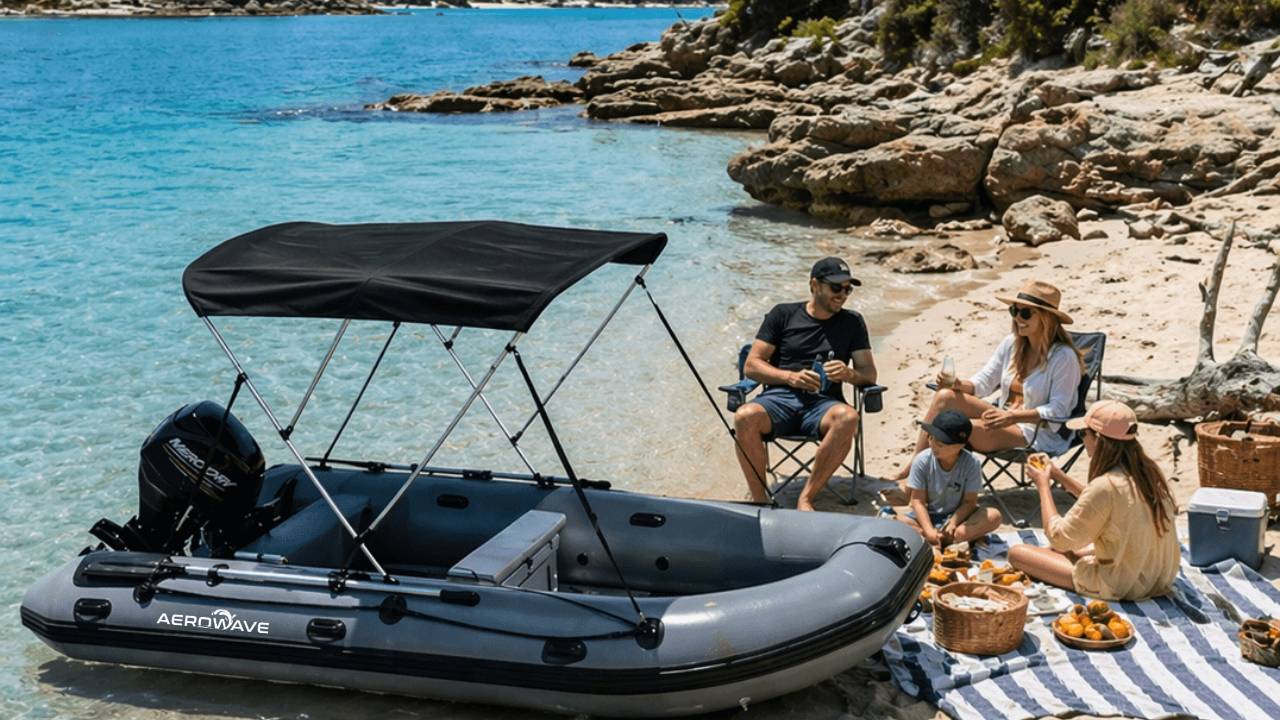
Aerowave Viper 400 Sovereign
Our best-selling boat: 4.0 m, 1.2 mm VALMEX hull, 7-year hull warranty.
US$3,167 USD
Delivered to your door, today's rate
- Free freight to United States · local taxes payable on arrival
- 7-year hull warranty
🇺🇸 Shipping to United States · landed price quoted in writing
Yes — we ship the Aerowave Viper 400 Sovereign to United States. Here's the landed price.
Our best-selling boat: 4.0 m, 1.2 mm VALMEX hull, 7-year hull warranty.
Written for Australian readers — but the boat ships to you. We are an Australian builder and this article is written from Australian waters. That changes nothing about what you can order: the same hull, the same 7-year warranty and the same certification go out to United States every week.
Aerowave Viper 400 Sovereign
- Boat package (export price)
- US$3,726
- 15% tariff relief credit
- − US$559
- Express air freight to United States
- Included
- Import duty, taxes & customs clearance
- Payable on arrival
- Estimated landed, USD
- US$3,167
Indicative, converted at today's rate, before local duty and tax on arrival. Ask below and we'll put a fixed figure in writing, valid 30 days.
- 7-year hull warranty
- 1500 GSM / 1.2 mm VALMEX® Heavy Plus hull
- CE certified to ISO 6185-3 and EU Directive 2013/53/EU
- Door-to-door, tracked the whole way
Your price, delivered to your door — freight included.
We email the full PDF quote (spec, freight, finance, WavePay) to your inbox in under 60 seconds. No spam — one quote, one follow-up.
See it for yourself
Real boats. Real owners. Real people behind them.
Plenty of what you read online these days is generated. Check us out properly — the factory, the reviews and the owners are all one click away. Why we use AI, and how to check we’re real
How our boats are built
Walk the production line: thermo-welded seams, 1.2 mm VALMEX Heavy Plus hulls, over-pressure relief valves on every chamber.
See the buildGoogle Maps reviews
Real Australian owners, five stars, published on our Google Business Profile with the map — read them there, not just on our own site.
Open Google Maps reviewsOwner stories
Boats in use — offshore, on rivers, on rescue duty. Photos and words from the people who actually own them.
Read owner storiesMost advice about inflatable boats in Australia starts in the wrong place. It starts with price, length, or motor size. For commercial work, those questions come later.
The first questions are harsher. Will the fabric survive UV, beach abrasion, and repeated loading? Will the boat satisfy Australian compliance expectations for commercial use? Will the hull and tube layout still give you a safe working platform when the weather turns ordinary jobs into difficult ones?
That’s where many buyers get caught. They compare a cheap inflatable with a commercial one as if they’re in the same category. They aren’t. A proper commercial inflatable is a tool. It’s built for charter support, rescue work, yacht tender duties, marine maintenance, patrol work, and hard daily use. In the Australian market, that means looking at construction, certification pathway, and on-water practicality as one package, not as separate decisions.
Beyond the Beach Toy An Introduction to Commercial Inflatables
A beach inflatable is built to be light, simple, and affordable. A commercial inflatable is built to keep working.
That difference matters in Australia because the operating environment is unforgiving. Sun exposure is brutal. Boat ramps are busy. Beach launches grind fabric against sand and shell. Remote operators need something they can trust without treating every trip like a gamble. If you’re researching inflatable boats in Australia, it helps to stop thinking about “inflatable” as a single category.
Commercial inflatable boats australia buyers usually fall into one of a few groups. Some need a stable platform for tourism or fishing support. Some need a tender that can shuttle crew and gear without fuss. Others need a lightweight workboat that can be launched quickly and packed away when space is tight.
Where commercial inflatables actually fit
These boats sit in a useful middle ground. They’re easier to transport and store than many hard boats, but they offer far more capability than entry-level inflatables sold for occasional family use.
Typical roles include:
- Rescue and response work where quick deployment matters
- Harbour and marina support where fenders, tubes, and low freeboard help alongside structures
- Charter and tender duties where operators want stability during boarding
- Fishing and diving support where deck usability counts just as much as speed
A commercial inflatable earns its keep when the owner stops worrying about whether the boat can handle the day’s work.
The boats that do this well usually share three traits. They use stronger fabric. They follow a clearer compliance path. They’re designed around real payload and stability needs, not showroom impressions.
What Defines a True Commercial Inflatable Boat
Commercial grade isn’t a styling package. It’s a construction standard.
A lot of boats look tough in product photos. Grey tubes, black trim, aluminium seat, tiller motor. None of that proves the boat is built for commercial duty. The key difference sits in the fabric, seams, transom, fittings, and how the whole boat handles sustained use.
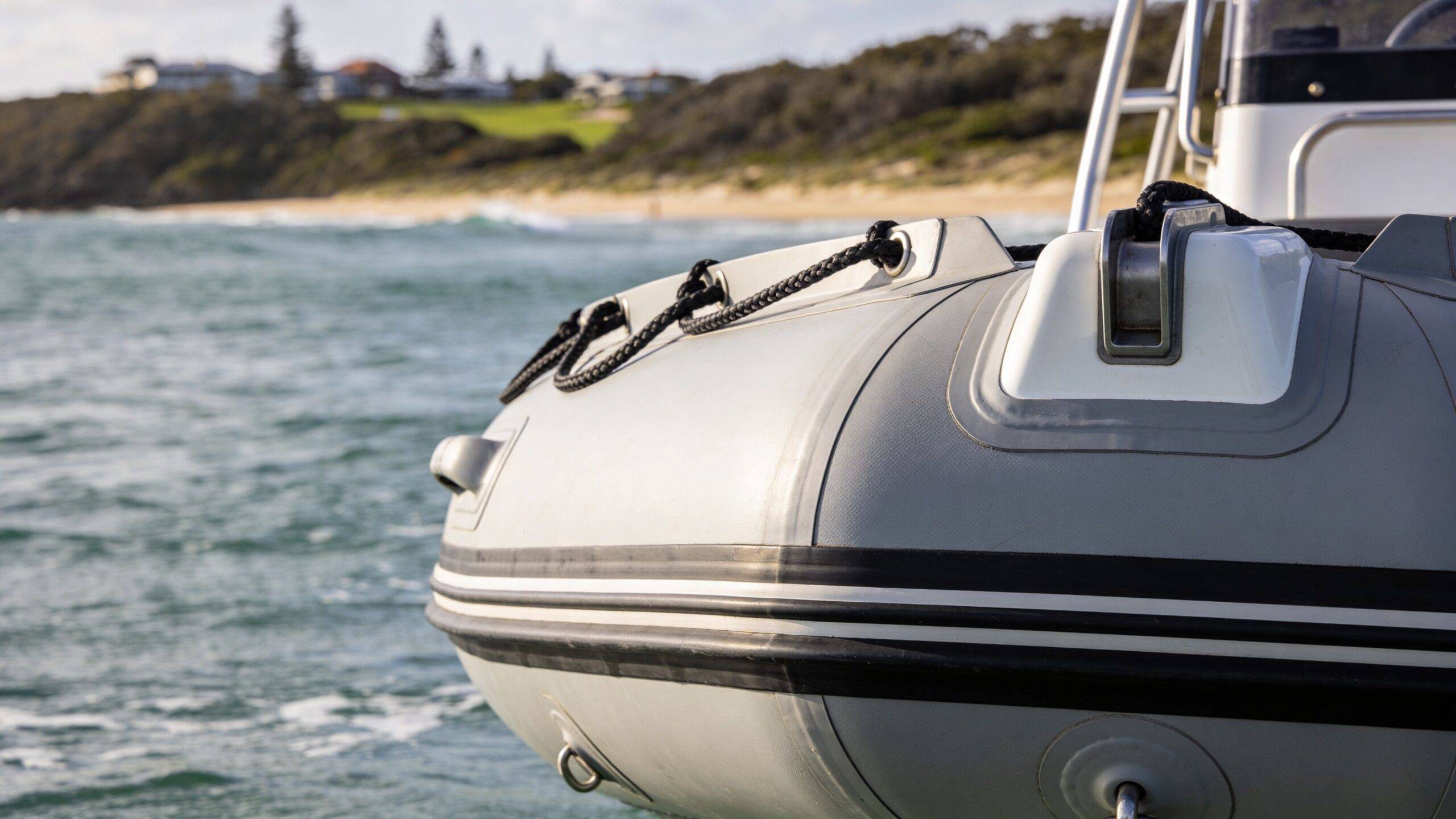
Fabric quality separates workboats from weekend boats
If you remember one buying rule, make it this one. Fabric spec tells you more about a commercial inflatable than almost anything else.
In Australian commercial inflatable boats, German 1.2mm 2000D Valmex PVC fabric provides superior puncture resistance and UV durability compared to standard 1100D polyester-coated PVC, enabling extended service life in harsh coastal conditions, according to AMSA guidance referenced here. That same fact set notes the material weighs approximately 2000 grams per square metre and is built to handle abrasion from beach launches and coral scrapes while maintaining airtight integrity under high-pressure inflation.
That’s the practical line between commercial and recreational construction. A lighter 0.7mm or 0.9mm fabric might suit occasional use, careful handling, and sheltered conditions. For regular loading, hard UV exposure, and repeated contact with ramps, jetties, and shorelines, it’s the wrong place to save money.
Footwear provides a useful comparison. A thin casual sneaker works for light walking, but it doesn’t belong on a building site. Commercial tubes need the marine equivalent of work boots.
Seams matter as much as the tube material
Fabric alone doesn’t carry the boat. Seam construction does the essential long-term work.
A well-built commercial inflatable should have seam construction designed for pressure retention and repeated thermal cycling. Thermo-welded seams are a strong sign that the boat was designed with longevity in mind, because they reduce the weak points that often appear first on low-grade glued boats.
Buyers often focus on the visible tube. Operators focus on what fails first. In cheaper inflatables, it’s often the seam, the join, or a fitting mounted onto fabric that wasn’t meant for commercial strain.
Practical rule: If the seller talks mostly about colour, accessories, or package deals and barely discusses fabric weight, denier, seam method, or transom build, keep looking.
Other signs you’re looking at a real commercial hull
A proper commercial inflatable usually shows its intent in the details:
- Transom strength: It should be suited to the rated outboard and repeated engine load, not just occasional use.
- Hardware placement: Handles, lifelines, towing points, and rubbing strakes should look purposeful rather than decorative.
- Floor and hull choice: Air deck, aluminium floor, or rigid hull design should match the job rather than trying to suit everybody.
- Repairability: Commercial operators need parts, support, and sensible servicing options.
This is also where many buyers start comparing PVC and Hypalon. That comparison matters, especially for long-term UV exposure and operating style, and this guide on Hypalon vs German Mehler 1.2mm PVC material is useful if you’re narrowing down fabric choice for your conditions.
Navigating Australian Commercial Vessel Regulations
A commercial inflatable is judged on paper before it proves itself on the water. That catches buyers out all the time.
In Australia, the real question is whether the boat, its build standard, and its intended use fit the AMSA compliance path for the work you plan to do. A hull can look well finished, carry a strong motor rating, and still create problems at survey stage if the design basis and documentation are weak. I see the same mistake repeatedly. Buyers choose by size and price first, then ask later whether the boat can be approved for commercial work.
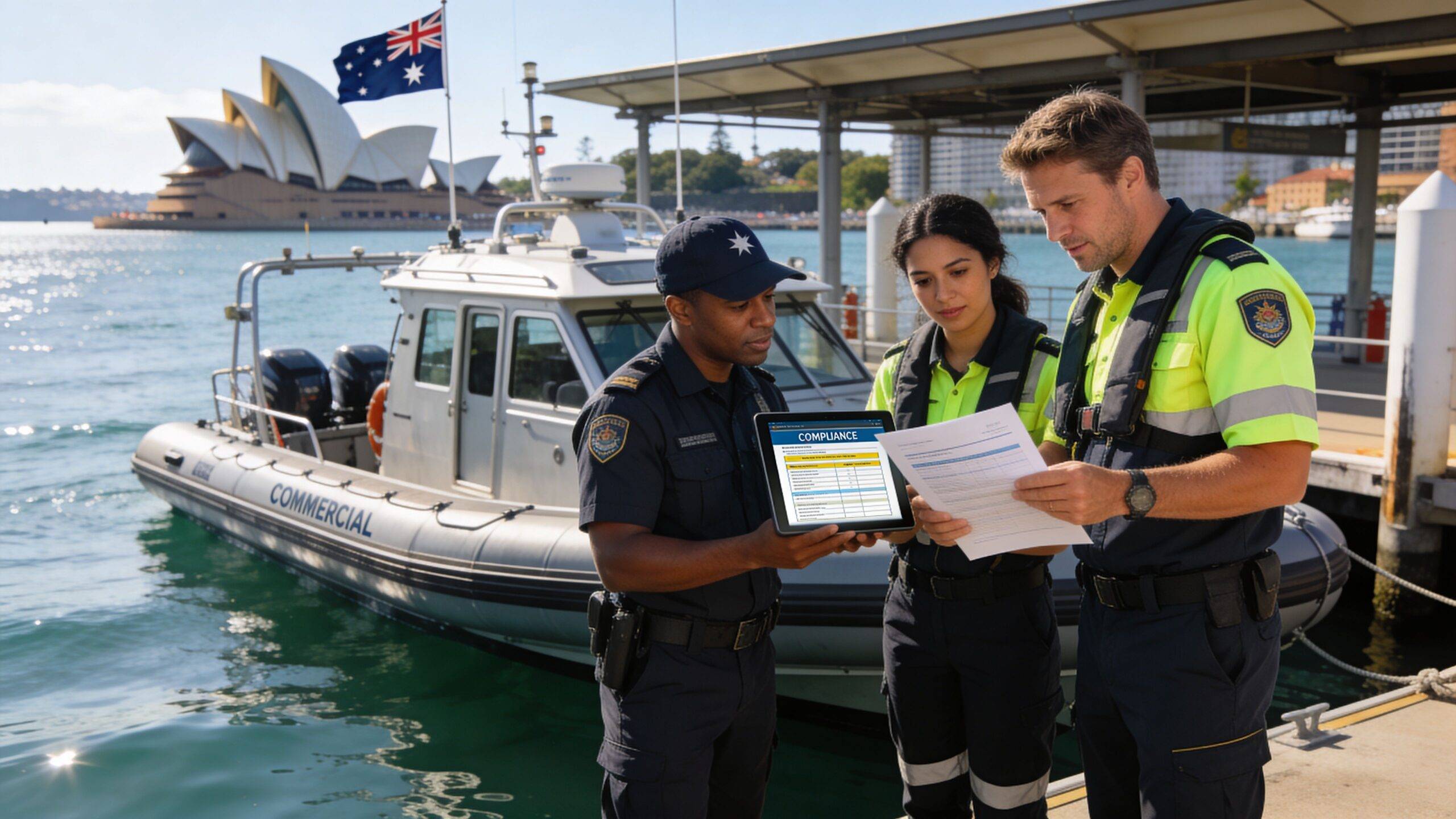
What AMSA compliance means in practice
For commercial inflatable boats australia operators, AMSA compliance is tied to how the vessel is classified, how it is equipped, and what standard supports the build. For many small commercial inflatable boats and RIBs, AMSA refers operators and builders to ISO 6185 as part of the compliance pathway under Marine Order 503 and the National Standard for Commercial Vessels. AMSA sets out that framework in its guidance on generic equivalent solutions for inflatable boats and rigid inflatable boats.
That matters because the regulation points straight back to material and construction decisions. Tube chambers, pressure relief, buoyancy, grab lines, load rating, and hull integrity are not brochure extras. They are part of whether the boat can meet the standard expected for commercial service.
This is also where material science gets practical. A boat built from quality 1.2mm German Valmex PVC with proper welding and documented production control gives a surveyor and a buyer something concrete to assess. A vague claim about “heavy-duty commercial fabric” does not. AMSA does not approve a boat because the fabric sounds tough. The boat needs a traceable standards basis and construction that matches the operating role.
Survey changes what counts as a good buy
A private owner can accept more compromise. A commercial operator usually pays for compromise later.
Survey affects seating, reserve buoyancy, stability assumptions, load carrying, fuel system choices, and what modifications are sensible after delivery. Even simple additions such as console changes, seating swaps, or deck hardware can complicate approval if the original boat was never specified with commercial use in mind.
Set the job first. Then choose the boat.
Ask these questions before comparing brands:
- Will the boat carry paying passengers, crew, equipment, or a mix of all three?
- What operating area will apply under the NSCV and AMSA rules?
- Is the supplier providing a realistic survey path, or only a recreational specification sheet?
- Do the tube material, seam method, and transom design suit repetitive commercial loading, not occasional weekend use?
That last point is the gap many articles miss. Compliance and material quality are linked. If the fabric, seams, fittings, and structure are not built for sustained commercial loads in Australian UV and heat, the paperwork alone will not save the purchase.
Imported boats and documentation traps
Imported inflatables can be excellent, average, or completely unsuitable. The trouble starts when listings blur the difference between commercial appearance and commercial documentation.
A useful background tool when you’re checking import classifications and documentation language is Harmonized Code Books. It will not replace marine legal advice, but it can help you understand how internationally traded boats and components are described when customs paperwork, online listings, and technical specifications do not match neatly.
For operators who want a clearer local pathway, this guide to inflatable boat compliance in Australia is worth reviewing before you compare brands.
What to confirm before paying a deposit
Get these answers in writing.
- Standards basis: Ask what ISO standard or equivalent solution the boat is being offered under for Australian commercial use.
- Build documents: Confirm whether the supplier can provide builder’s data, buoyancy details, capacity information, and supporting drawings if survey requires them.
- Tube construction: Check chamber layout, pressure management, and whether the material specification is named clearly, not described in generic marketing terms.
- Commercial intent: Ask whether this exact model is supplied into commercial service in Australia, not sold as a recreational package with optional extras.
- Local support: Confirm who will handle compliance questions, replacement parts, and repairs once the boat is in service.
If a seller gets precise about horsepower but vague about standards, documents, and fabric specification, treat that as a warning sign.
Key Construction Features for Performance and Safety
Commercial performance starts in the structure. A boat that will pass a weekend fishing trip can still be the wrong tool for paid work if the floor flexes, the transom moves under load, or the tubes lose shape in heat and UV. Under Australian commercial use, those weaknesses show up fast.
Material choice sits at the centre of that. AMSA compliance is not just paperwork. Survey, load capacity, stability, and builder documentation all rest on what the boat is made from and how it is assembled. A supplier who can specify the fabric weight, thickness, seam method, chamber layout, and pressure limits is usually supplying a serious commercial product. A supplier who stays vague is usually selling a recreational boat with commercial language wrapped around it.
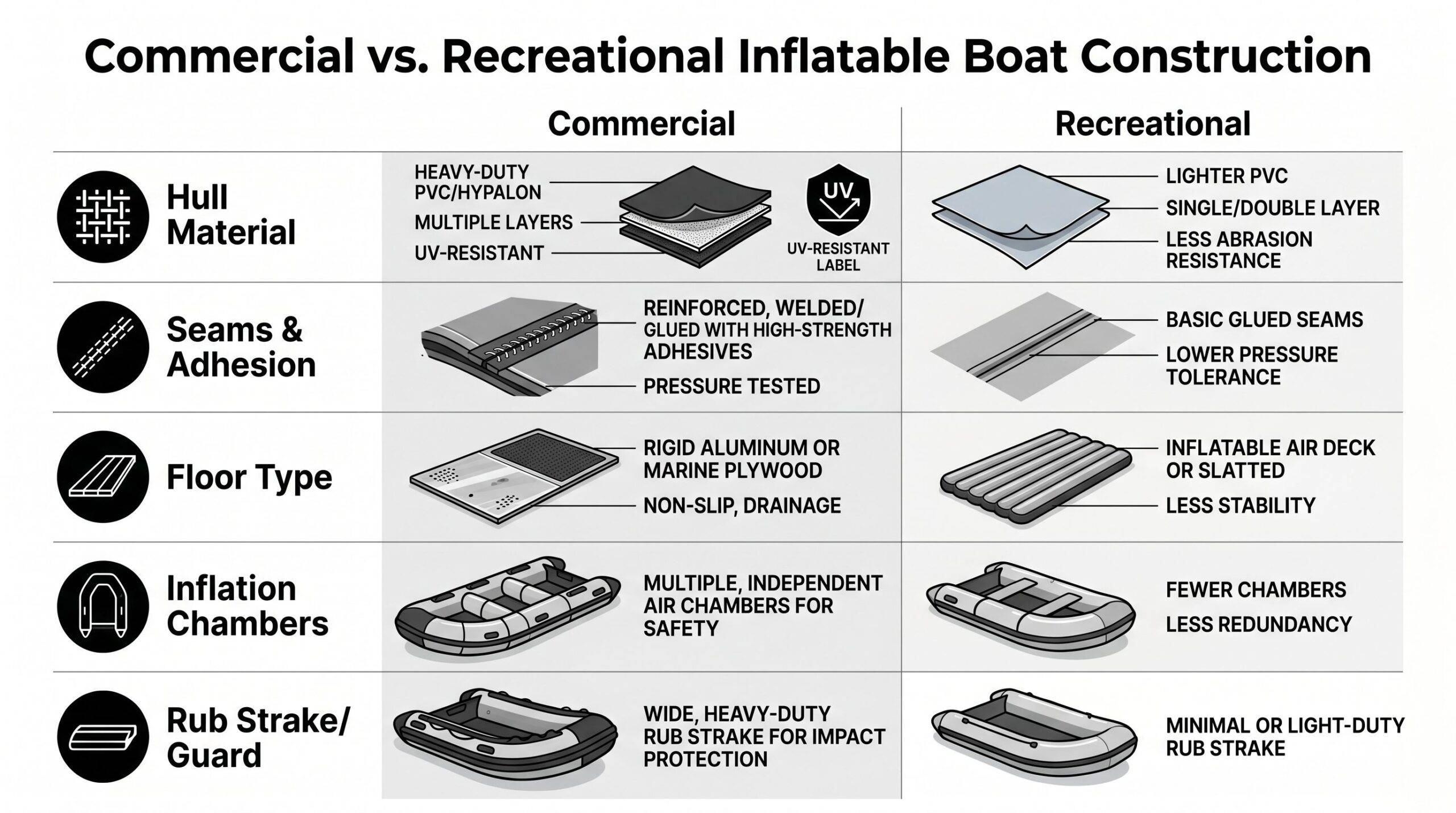
Floor systems and hull choices
The floor system changes how the boat works on the job.
High-pressure air deck boats suit operators who need low weight, simple transport, and fast setup. They work well for tenders, remote property access, and single-person launch situations. The compromise is torsional stiffness. Under repeated loading, rough beach launches, or passengers shifting side to side, an air deck will not feel as planted as a rigid platform.
Aluminium floor boats give a firmer deck and better footing for work that involves standing, handling gear, or boarding over the side. They take longer to assemble and they add weight to every launch and retrieval. In return, they usually feel more stable underfoot and more predictable with a commercial payload.
RIBs solve a different problem. The rigid hull improves tracking, planing efficiency, and ride control in chop. For operators running regular transits, carrying crew, or working in exposed water, that hull structure often pays for itself in handling and fatigue reduction. The trade-off is cost, storage space, and less portability.
Monohull versus catamaran style inflatables
Hull shape matters just as much as the fabric.
A monohull or V-hull inflatable usually gives a more familiar steering feel and a cleaner entry into short chop. That can suit operators covering distance at speed. It is the format many buyers ask for first because it looks like a conventional boat.
Inflatable catamarans deserve a harder look in commercial work. They usually offer better lateral stability at rest, useful deck area for their length, and a steadier platform when people are moving, boarding, or handling equipment. For flood response, survey support, fishing operations, and nearshore utility work, that extra stability can matter more than outright speed.
The tube material needs to match that operating profile. UV exposure, abrasion, fuel splash, heat, and storage conditions all affect service life, which is why buyers should compare Hypalon and German Mehler 1.2mm PVC material options for commercial inflatable boats before settling on a hull style.
The details buyers often miss
Small construction details decide whether a boat stays tight and predictable after months of work.
| Component | What works | What usually disappoints |
|---|---|---|
| Transom | Proper internal reinforcement, clean bonding, and an engine rating that matches real use | Flex under throttle, cracking around fittings, poor alignment over time |
| Tube diameter | Enough volume to keep the boat level and stable with crew and gear aboard | Tubes that sit low when loaded and lose confidence during boarding |
| Rub strake | Thick external protection that handles jetties, trailers, and beach landings | Light trim that wears through early |
| Seams and joins | Consistent welding or gluing, neat finishing, and no vague claims about fabric grade | Uneven joins, patchy finishing, and hard-to-verify material specs |
| Drainage | Simple water management that clears the deck during wet operations | Water pooling around feet and gear |
I tell commercial buyers to inspect these points before they get distracted by accessories. A boat can have good fabric on paper and still be a poor commercial platform if the transom is underbuilt, the floor system is wrong for the task, or the tubes are too small for the load.
Common Commercial Use Cases Across Australia
Commercial inflatables get dismissed as light-duty gear by buyers who have only seen cheap leisure packages. That mistake usually shows up on the first hard day of work. In Australian commercial use, the better boats earn their keep because they solve boarding, impact, storage, and compliance problems that rigid hulls do not solve as cheaply or as cleanly.
The jobs vary, but the buying logic is consistent. Match the boat to the operating pattern, then check whether the fabric, floor, transom, and buoyancy setup will stand up to that work and to the AMSA category the vessel will operate under. A tube material that looks acceptable in a brochure can become an expensive mistake if the boat spends its life alongside pontoons, on a trailer in full sun, or carrying crew and gear every day.
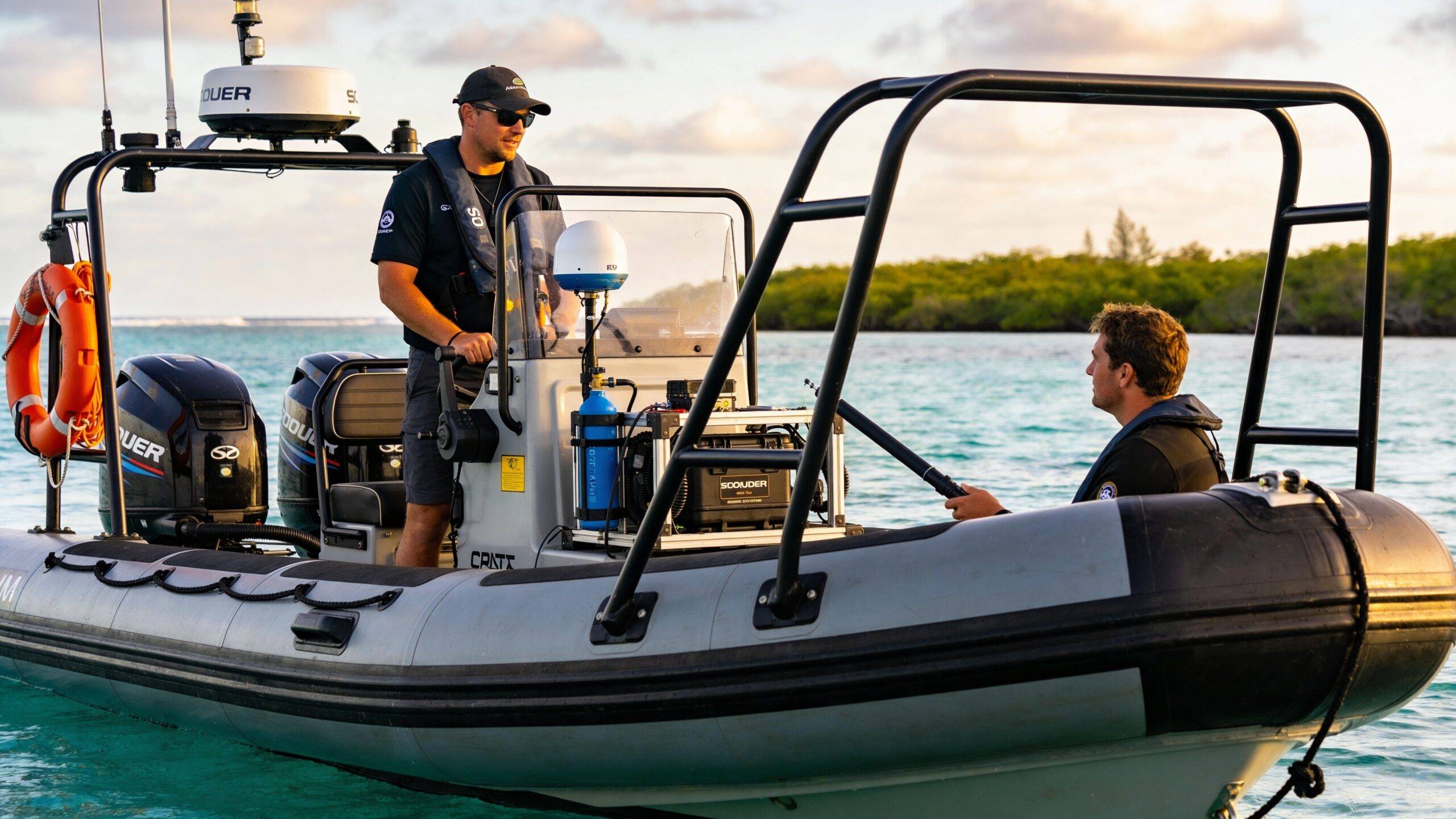
Fishing support and charter operations
Charter support work exposes bad design quickly. Clients shift their weight without warning, tackle comes aboard wet, and the deck has to stay clear enough for safe movement in low light and changing conditions.
For this role, operators usually need high buoyancy tubes, an uncluttered layout, and a transom that carries the motor without flex. Material choice matters more than many buyers expect. A 1.2mm commercial-grade PVC such as Valmex can make sense for operators who want lower weight and easier handling, but heavy UV exposure, constant abrasion, and year-round duty can justify stepping up to Hypalon. If the boat also has to cover emergency response, a purpose-built inflatable rescue boat layout is often a better starting point than modifying a general leisure tender.
Yacht tenders and marina support
Tender work in marinas sounds simple until it becomes a daily commercial task. Crew transfers, stores runs, fuel containers, tools, and awkward side boarding all put pressure on the hull, tubes, and floor system.
This is one of the clearest examples of the regulation and material link buyers miss. A marina tender operating under commercial requirements needs more than a convenient shape. It needs enough carrying capacity and stability for the survey or operational class involved, plus fabric and fittings that cope with repeated contact. Soft tubes are an advantage here, but only if the rub strake, seams, and boarding points are built for constant use.
Marine maintenance and waterfront work
Maintenance contractors working around pontoons, moorings, slipways, and shoreline assets usually want forgiveness on contact. Inflatable tubes do that job well. They reduce marking on client assets and make close-quarters work less stressful.
Speed is rarely the main issue. Stable trim at rest, easy boarding from awkward angles, secure handholds, and a floor that does not become a trip hazard matter more. In this category, I usually tell buyers to think about workload first. A lightly used support boat can perform well in quality PVC. A boat that spends long hours in heat, salt, and abrasion often pays back the extra cost of Hypalon through longer service life and fewer repairs.
Tourism, events, and resort operations
Resorts, hire operators, and event crews often need a platform that stores easily, launches without a dedicated ramp, and handles repeated passenger movement without fuss. The boat also has to present well. Cosmetic wear matters in these settings because clients see it up close.
That is where fabric finish and repairability start to matter. Some boats look acceptable when new, then fade, chalk, or loosen at stress points much faster than expected. For operators balancing purchase cost against appearance and service life, the right answer depends on how often the boat is deployed and how harsh the storage conditions are.
A commercial inflatable that suits Australian work is rarely the one with the most accessories. It is the one that matches the job, the operating category, and the material demands of the environment.
Sizing Your Boat and Matching an Outboard Motor
A lot of mismatched packages come from one mistake. Buyers choose the smallest boat they think they can get away with, then fit the biggest motor they can justify.
That usually creates a boat that’s unpleasant to work from. It may be quick in ideal conditions, but it won’t necessarily be balanced, practical, or easy to load. Start with the job, not the trailer footprint.
Work out the real payload first
Before looking at horsepower, list what the boat has to carry on a normal day:
- Crew numbers: Include the operator, not just passengers or staff.
- Equipment weight: Fuel tanks, batteries, tackle, tools, safety gear, eskies, dive gear, or maintenance supplies.
- Operating pattern: Short marina shuttles and beach launches need a different balance from longer open-water runs.
- Launch style: Solo setup changes what’s realistic in floor type and hull weight.
Most buyers underestimate payload because they imagine an empty boat at rest. Commercial work is never an empty boat at rest.
Then choose an engine to suit the hull
Once the hull size is honest, choose an outboard that gets the boat onto the plane cleanly without overloading the transom or turning the stern into dead weight.
General matching logic looks like this:
- Portable tender or compact utility boat
A lower-powered outboard often makes sense if the job is short transfers, light load, and simple transport.
- Fishing or mixed-use workboat
Mid-range power is usually the sweet spot. You want enough thrust to plane with gear aboard, not a package that becomes awkward at low speed.
- Heavier commercial support setup
If the boat regularly carries more people or gear, step up hull size first. Don’t rely on extra horsepower to solve an undersized platform.
An authorised dealer who understands both hull balance and practical rigging is worth using. If you’re sorting a package and want to compare realistic options, this guide on choosing a motor for inflatable boats helps frame the decision.
What works and what doesn’t
Here’s the short version from years of watching buyers get this right and wrong.
| Choice | What works | What doesn’t |
|---|---|---|
| Boat length | Leave room for crew movement and gear | Buying to the bare minimum spec |
| Engine size | Match power to loaded use | Choosing motor size for bragging rights |
| Weight balance | Keep the package launchable and trim-correct | Heavy stern setups on small hulls |
| Package planning | Buy boat, motor, and fittings as one system | Adding accessories later without considering balance |
A calm test run with one person aboard tells you very little. Judge a commercial package by how it behaves when loaded the way you’ll actually use it.
How to Choose the Right Australian Supplier
A commercial inflatable is only as dependable as the supplier standing behind it. In Australia, that matters for more than delivery and warranty. It affects whether you get straight answers on AMSA expectations, fabric grade, repair support, and the small build details that decide how the boat holds up in heat, UV, and daily commercial use.
Poor supplier choice usually shows up after payment. The listing looks convincing, the price is sharp, and then the answers turn vague once you ask about tube fabric thickness, seam method, transom construction, plate capacity, or replacement parts.
Material transparency is the first filter
Start with the fabric spec.
If a supplier cannot tell you whether the boat uses a proven commercial-grade fabric such as 1.2mm Valmex PVC, or they fall back on broad terms like “heavy-duty PVC”, you do not have enough information to buy with confidence. Commercial buyers need more than marketing language. They need to know what the tube material is, how it is welded or bonded, and how that construction suits Australian conditions.
This is the gap many buyers miss. Compliance and material science are linked. A supplier who understands commercial work should be able to explain not only what the boat is made from, but why that build is suitable for the intended class of operation and local environment.
Local knowledge matters more than broad product range
Some suppliers can sell you a boat. Fewer can explain whether that model is suited to Australian commercial use, what documents are available, and what support exists if AMSA-related questions come up during fitout or operation.
Ask direct questions:
- Is this model supplied with commercial use in mind, or is it a recreational boat being sold into a commercial job?
- What material specification can you provide in writing?
- What documentation comes with the boat?
- Who handles warranty support in Australia?
- Can you supply replacement valves, fittings, and accessories locally?
The quality of the answers matters as much as the answers themselves. A supplier who works in this space regularly will respond clearly and without hesitation.
Package support matters after delivery
Commercial operators often lose time by buying the hull from one seller, the motor from another, and accessories from somewhere else. That can work, but it often leaves no one accountable when the transom setup is wrong, the accessories do not fit properly, or the finished package does not suit the job.
A stronger supplier helps you avoid those avoidable mistakes. That usually means clear warranty terms, realistic lead times, guidance on included fittings, and after-sales support from someone who understands commercial use rather than general recreational retail.
Buying advice: Choose the supplier who can answer specific questions on materials, compliance, and support before you pay. That is usually the supplier who will still be useful six months later.
A practical shortlist for comparing suppliers
Use this checklist when narrowing the field:
- Written material specification, not generic sales language
- Understanding of Australian commercial requirements, including AMSA-related documentation and use case discussion
- Local warranty process, with a clear contact point in Australia
- Spare parts and repair support, especially for valves, fittings, and common wear items
- Honest lead times, with no confusion about stock, special orders, or custom build timing
- Commercial product knowledge, not recreational sales talk dressed up as commercial advice
The cheapest supplier often becomes the expensive one if they cannot support the boat once it is in service.
Frequently Asked Questions About Commercial Inflatables
Is it better to hire or buy a commercial inflatable boat
That depends on frequency, storage, and how specialised the setup needs to be.
Hiring makes sense for short-term projects, occasional events, or temporary support work where you don’t need a dedicated layout. It can also suit operators who are still learning what size and configuration they need.
Buying makes more sense when the boat is part of routine operations. Ownership gives you consistency in setup, known maintenance history, and a hull that’s configured around your work. If you need a specific transom arrangement, deck layout, tube material, or accessory fitout, buying usually becomes the more sensible long-term path.
How should I compare prices and features without getting misled
Start by removing the idea that the sticker price tells the whole story.
Compare boats in layers:
- Core build quality
Fabric specification, seam construction, transom quality, chamber design.
- Operational suitability
Floor type, hull shape, carrying behaviour, ease of launch, stability at rest.
- Support package
Warranty, local parts access, after-sales help, realistic delivery, compliance guidance.
A cheaper boat can become the more expensive option if it needs upgrades early, handles poorly under load, or lacks support when a valve, fitting, or seam issue appears.
Are inflatable catamarans actually better for commercial work
Sometimes yes, sometimes no. They’re better when your priority is platform stability, deck space, and confidence while people move around. They aren’t automatically better if your work involves frequent longer runs through chop where a rigid V-hull RIB may feel sharper and more controlled.
Here’s the practical comparison.
| Feature | Inflatable Monohull (V-Hull/RIB) | Inflatable Catamaran |
|---|---|---|
| Ride style | More traditional V-hull handling | Very stable, especially at rest |
| Best use | Transit, mixed sea states, general commercial running | Fishing, tender use, boarding, stable work platform |
| Deck feel | Often more directional and sporty | Often flatter and steadier |
| Storage practicality | Depends on hull and floor type | Often attractive for portable setups |
| Buyer fit | Operators prioritising handling in motion | Operators prioritising space and stability |
What should I ask before I order a boat online
Ask direct questions and get direct answers.
- What fabric is used, exactly
- How are the seams made
- Is the boat intended for commercial duty or only recreational use
- What documentation comes with it
- How is warranty support handled in Australia
- What accessories are included in the quoted package
- What is the actual delivery situation for this model
If a seller avoids specifics, that’s useful information.
Is a RIB always better than a soft-floor inflatable
No. It’s better for some jobs.
A RIB is often the right answer when you want stronger handling, more defined hull performance, and frequent transit in rougher water. A soft-floor or air-deck inflatable can be a better answer when portability, storage, launch convenience, and lower all-up weight are central to the job.
Commercial buyers often do best when they stop chasing the “best” boat in general and start choosing the best boat for one operating pattern.
What mistakes do first-time commercial buyers make most often
The most common mistakes are predictable:
- Underestimating payload
- Overfocusing on motor size
- Treating all PVC boats as equivalent
- Ignoring compliance questions until late
- Choosing by price before comparing construction
Most of those mistakes come from buying the category name instead of buying the build standard.
If you want expert help choosing a compliant, hard-wearing setup for Australian conditions, Easy Inflatables is a strong place to start. They’re an Australian-owned specialist in Aerowave inflatables, catamarans, RIBs, yacht tenders, and turnkey boat packages, with premium German 1.2mm 2000D Valmex PVC or Hypalon construction, authorised Hidea outboards, local support, free Australia-wide shipping, and practical guidance that makes the buying process far clearer than a generic online listing.
Share the post now
Set Sail with Easy Inflatables
Experience the ultimate freedom on the water with our top-quality inflatable boats and accessories. Easy Inflatables is your trusted partner, providing everything you need for a safe and unforgettable adventure.
Categories
- Accessories & Gear (84)
- Adventure Destinations (63)
- Boat Accessories & Setup (25)
- Boat Comparisons (7)
- Boat Trailers (12)
- Boating Safety Gear (5)
- Catamaran Boats (12)
- Customer Stories & Experiences (4)
- Inflatable Boat Guides (47)
- Inflatable Boats & Kayaks (149)
- Inflatable Catamarans (12)
- Maintenance & Care (114)
- Outboard Motors (53)
- Outdoor Activities (26)
- Product Comparisons & Reviews (108)
- Setup & Safety Tips (52)
- Special Offers & Promotions (2)
- Sustainability Tips (13)
- Types of Boats (47)
Related Post
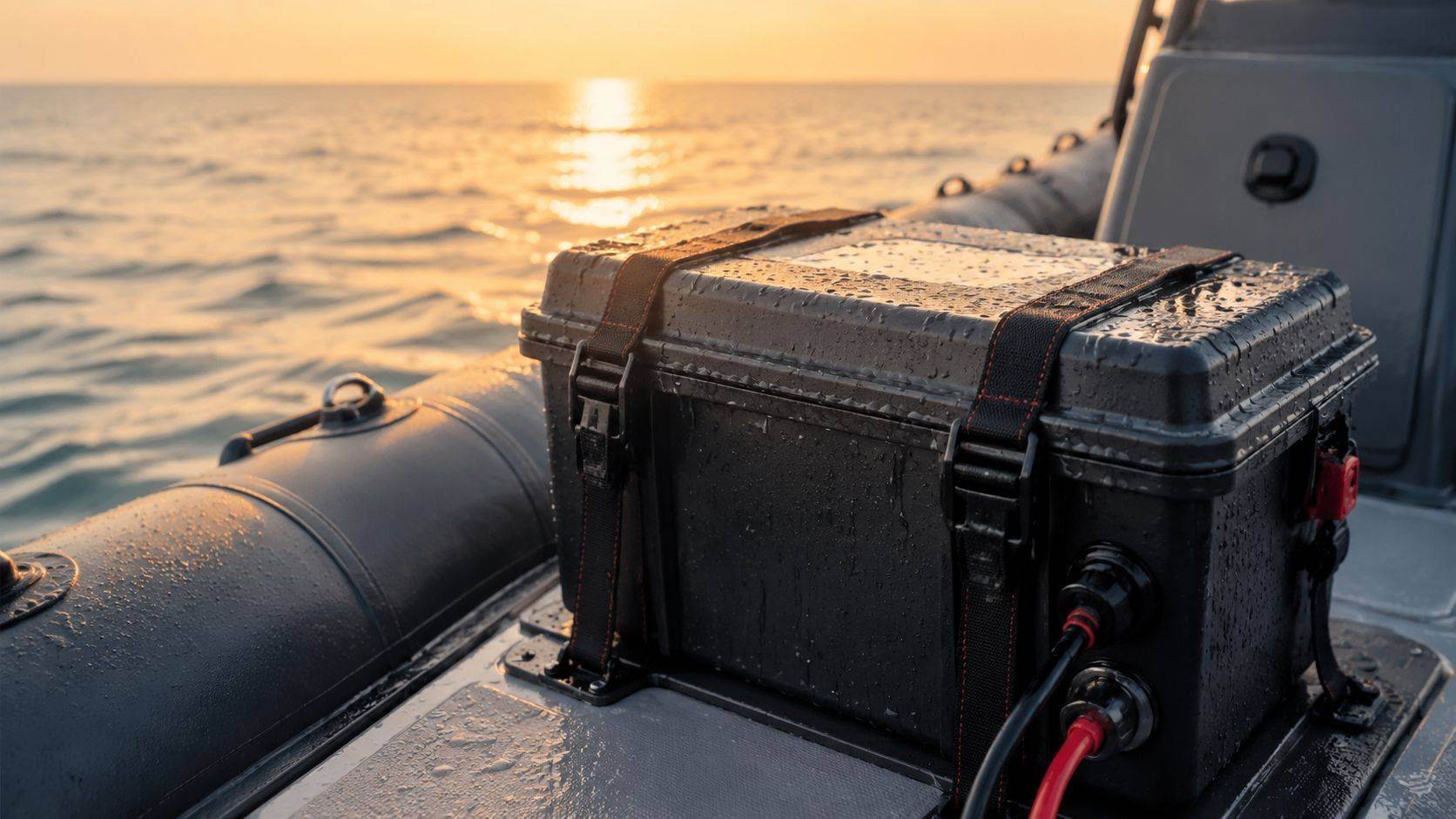
Your Guide to the Best Waterproof Battery Box of 2026
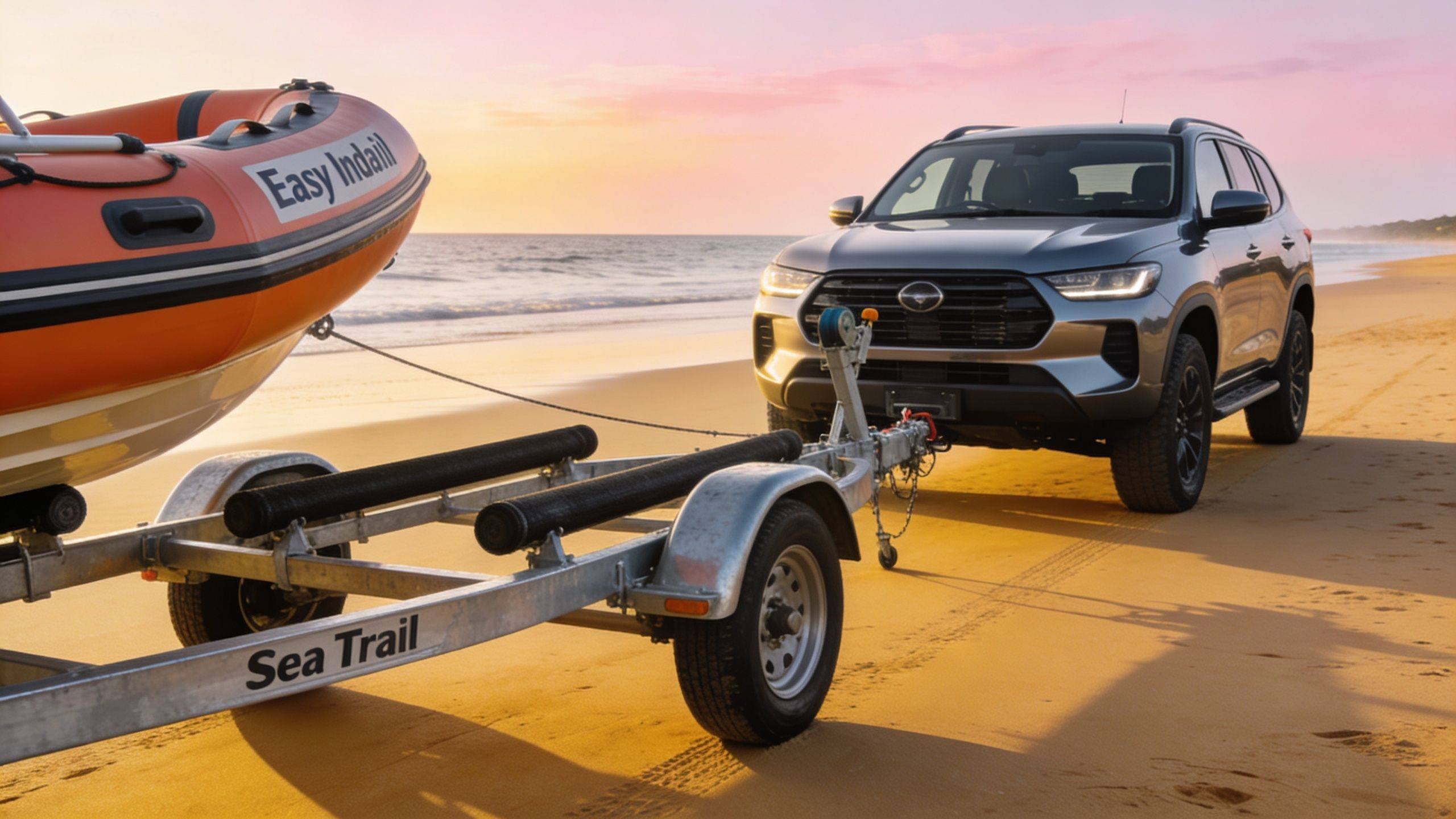
Sea Trail Boat Trailers A Complete Australian Guide
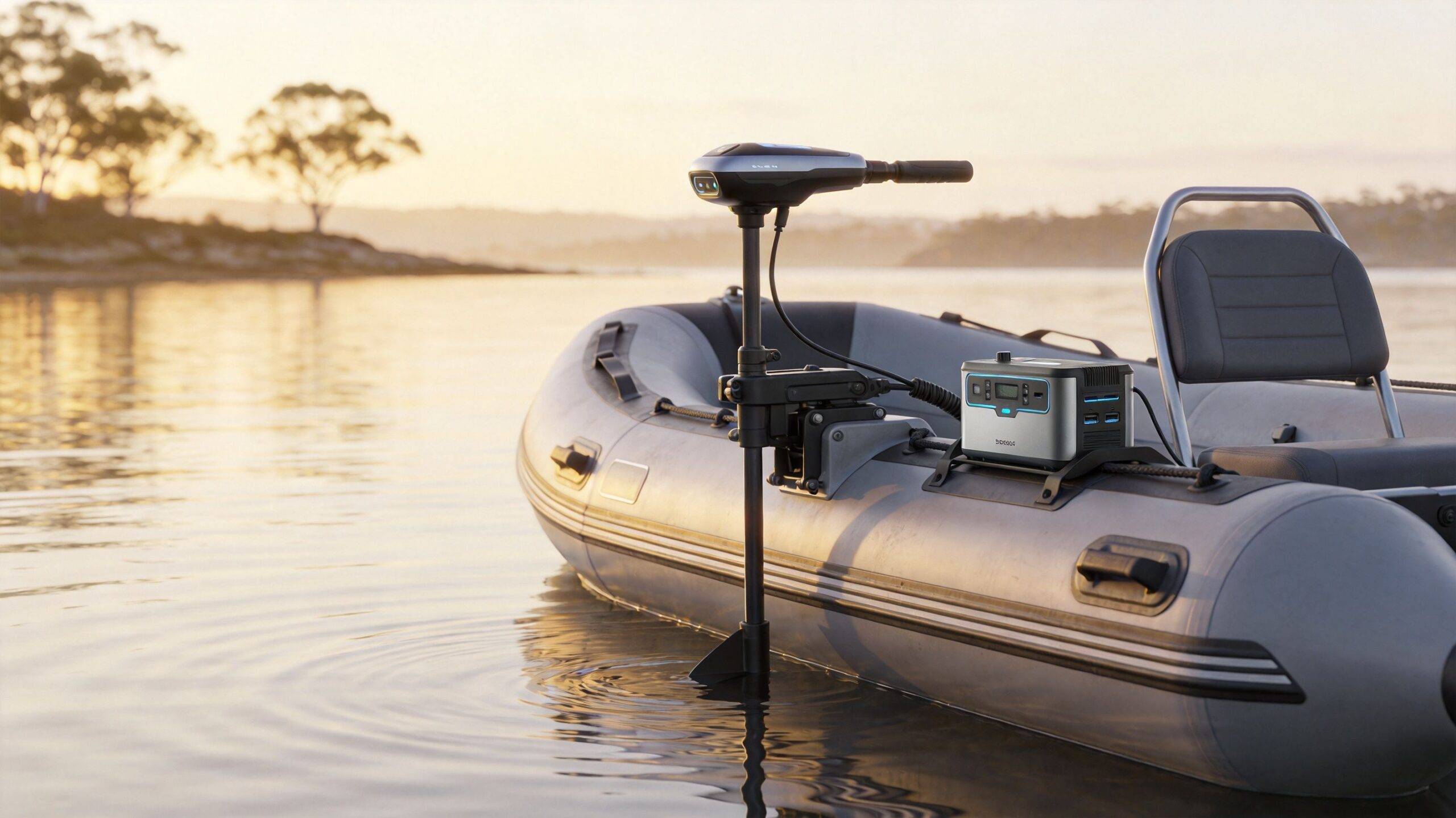
Choosing the Best Electric Trolling Engine: 2026 Guide
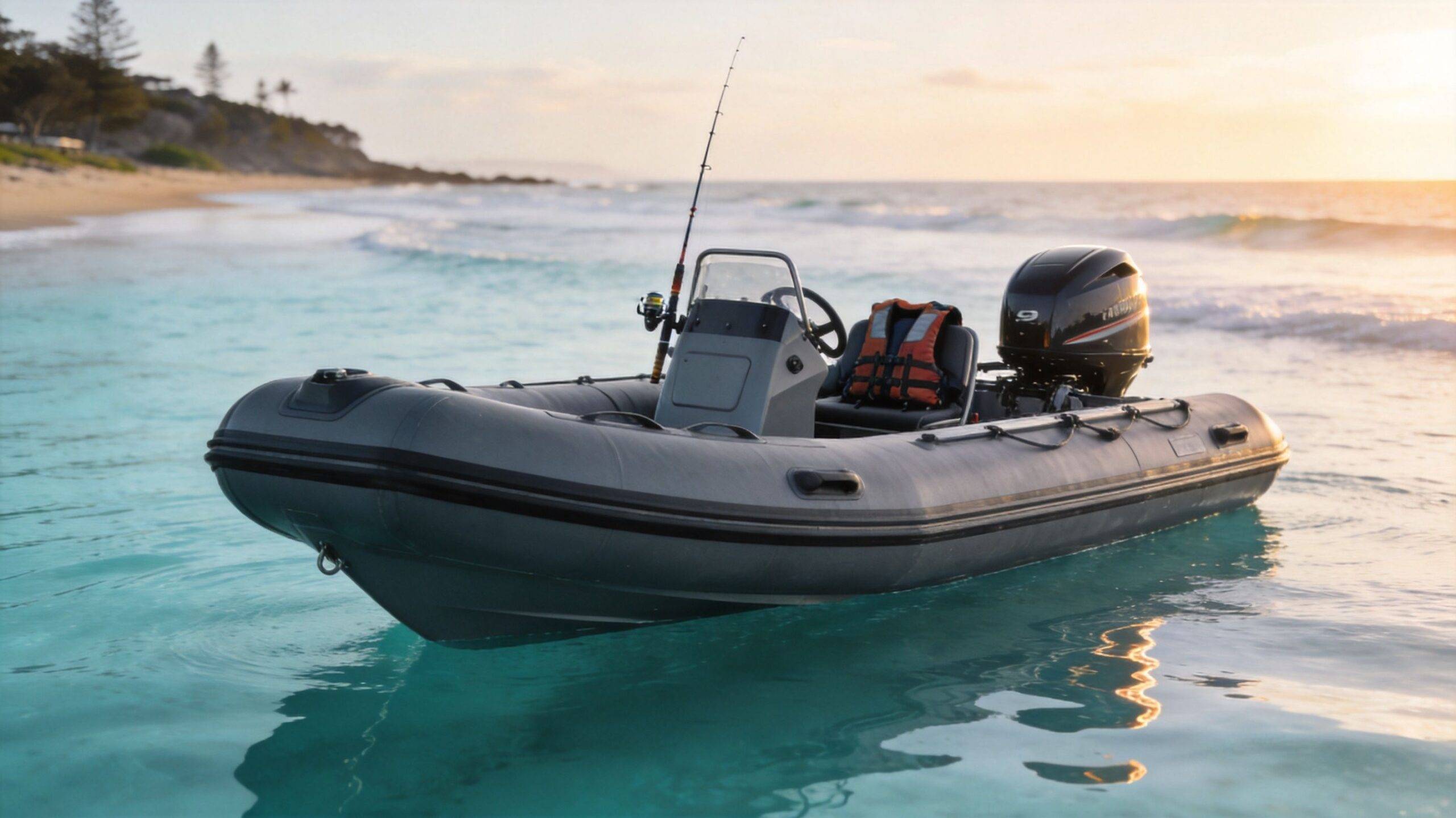
Inflatable Motorised Boat A Buyer’s Guide for Australia
Stay Connected
Join our community of water adventure enthusiasts! Sign up for Easy Inflatables' monthly newsletter for exclusive tips, product updates, and insights to make the most of your outdoor adventures.
Explore the Aerowave range
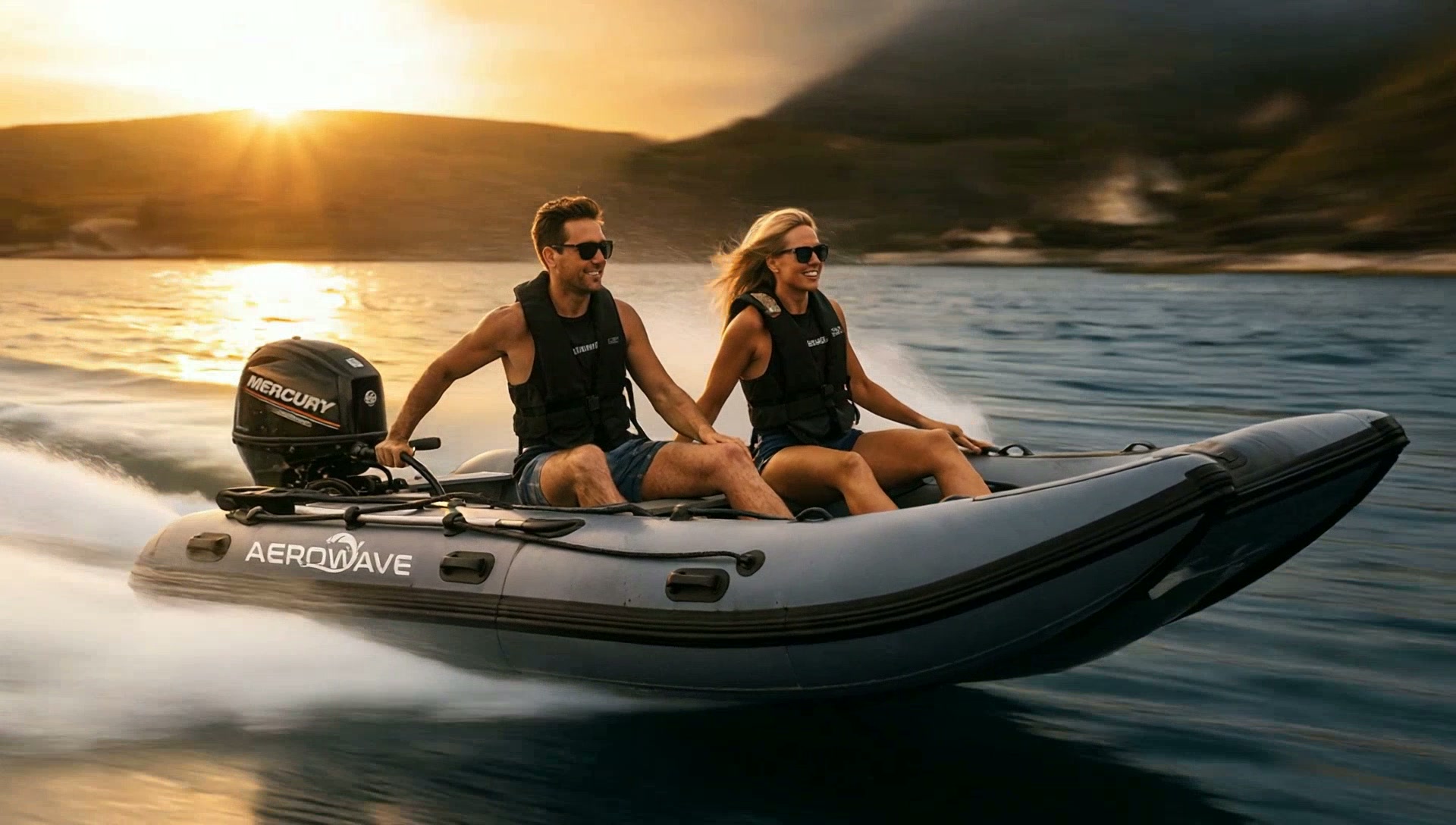
Weekend-Proof Score 17 questions · about 2 minutes
Will the boat you're about to buy survive an Australian summer?
Seventeen straight questions about where you'll use it, what you'll ask of it and the boat you're weighing up. You get a score out of 100, the exact weak points in your plan, and the one boat that genuinely fits.
Free · your result shows on screen · no email required
So which one is yours?
Pick how you'll actually use it and we'll take you straight to the right hull.
I want to fish it
Open bow, rod holders, deck space you can stand and cast from.
Viper Sport 400Family, diving and the beach
3.8 m Series 3 catamaran — low bow to climb back in wearing fins or a tank.
WaveRunner 380Tender / one-person launch
3.3 m hard-floor boat that packs into a bag and still takes a beach landing.
Viper 330Shop gear featured in this guide
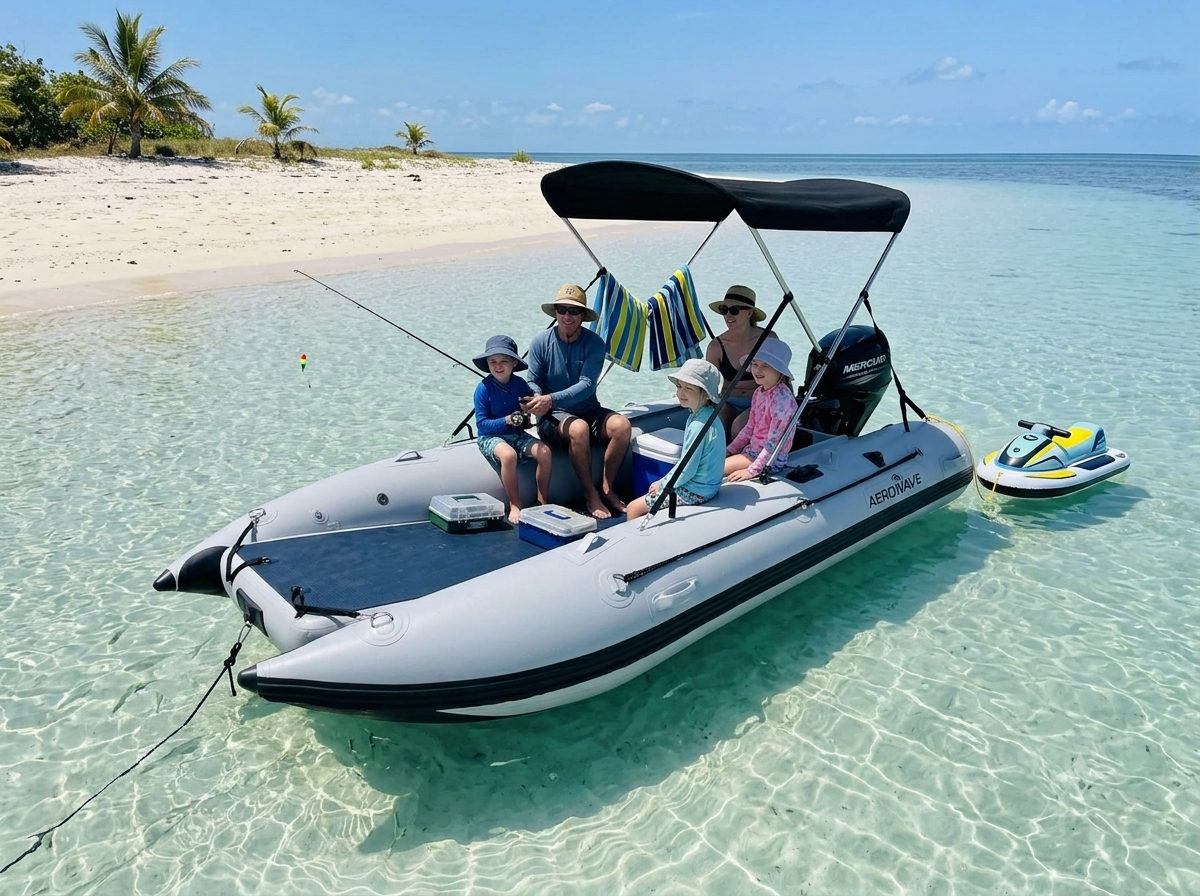
Aerowave WaveRunner 380 Series 3 Catamaran Package
The WaveRunner 380 Series 3 is a premium 3.8m inflatable catamaran package built for Australian and worldwide families, fishing, and coastal day boating — ideal for snorkeling and spearfishing — offering serious stability and premium German Valmex® construction.
Free freight to United States · local taxes payable on arrival
Aerowave Viper 400 Sovereign
Flagship 4m enclosed-bow inflatable catamaran. German VALMEX® 7321 Heavy Plus 1.2mm commercial-grade fabric, 10 PSI high-pressure drop-stitch air deck floor with VALMEX non-slip surface, LockPro wheels, full Bimini and FREE express delivery Australia-wide included. Winter special — save $1,000 until 31 August 2026.
Free freight to United States · local taxes payable on arrival
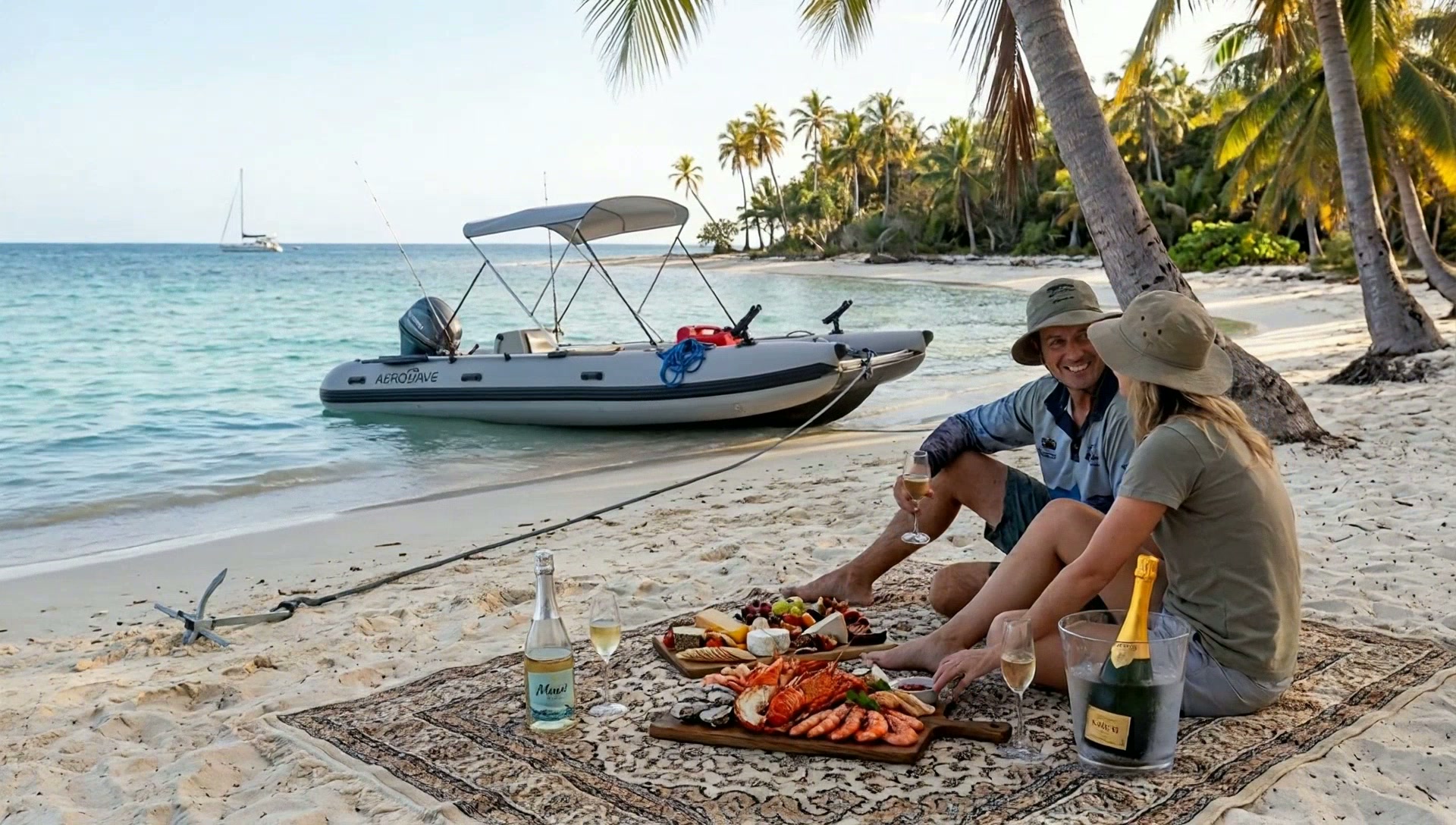
Aerowave Viper 365 Open Bow
Premium 3.65m Inflatable catamaran — built the same way as our flagship Viper 400 sports boat, just 35cm shorter. German VALMEX® 7321 Heavy Plus 1.2mm commercial-grade fabric, 10 PSI high-pressure drop-stitch air deck floor with VALMEX non-slip surface, LockPro wheels, full Bimini and FREE express delivery Australia-wide included.
Free freight to United States · local taxes payable on arrival
Not sure which suits you? Talk to a real boat owner.
Before you spend a cent
Buying from Australia, delivered to United States
You have never heard of us, we are on the other side of the world, and the internet is full of fakes. Fair enough. Here is everything you would need to check us out, in one place — no forms, no chat bot.
Australian designed business
Easy Inflatables, Avoca Beach NSW 2251. ABN 96 856 548 613. International orders ship from our Hong Kong hub.
222 owner reviews, 4.8 average
Read them in full, good and bad, on our reviews page.
CE certified, 7-year hull warranty
ISO 6185-3 and EU Directive 2013/53/EU. Warranty honoured worldwide.
Tracked, insured, door to door
FREE freight to United States · local tax/duty on arrival.
- Who am I actually buying from?
- Easy Inflatables, Avoca Beach NSW 2251, Australia. ABN 96 856 548 613. Sean is the owner and skipper, Gary Stewart handles sales on +61 2 4335 1603, Karen Matthews handles email. The boats are Australian designed; international orders ship from our Hong Kong dispatch hub so your landed price stays competitive. Phone us before you pay a cent — a real person answers.
- Is this really an Australian product?
- Yes — Australian designed and engineered on the NSW Central Coast. Manufacturing is done offshore to our spec, and international orders ship direct from our Hong Kong dispatch hub. If we routed every boat through Australia first, the freight alone would roughly double or triple your cost for the same hull.
- What do I pay, and what is not included?
- The delivery and import terms depend on your country. EU, UK, New Zealand and named Asia/Pacific lanes include duty and tax; US freight is free but US buyers pay import charges on arrival. Other destinations show their terms before payment.
- How do I pay safely?
- Card through Stripe (Visa, Mastercard, Amex, Apple Pay, Google Pay) or bank transfer. Card payments carry your bank's own dispute protection. We never ask for crypto, gift cards or payment to a personal account.
- What if it arrives damaged?
- Every boat ships fully tracked and insured door to door. Photograph the carton and the boat on arrival and email us — transit damage is claimed and replaced through us, not left with you and the courier.
- Is the warranty real outside Australia?
- Yes. The 7-year hull warranty on 1.2 mm VALMEX Heavy Plus and Orca Hypalon hulls applies wherever you are. Replacement parts are held in Australia and at our overseas hub and go out by express courier to your door.
- Is the boat actually certified?
- All Aerowave catamarans are CE certified to ISO 6185-3 and EU Directive 2013/53/EU. Certification paperwork is supplied with the boat — ask and we will send it before you order.
Ready to set sail?
Premium German-fabric inflatable catamarans, built to order and delivered to your door. Talk to our team or browse the fleet.
Like this guide? Get the next one in your inbox.
Owner-tested tips, gear deep-dives and Aussie boating know-how — no spam.