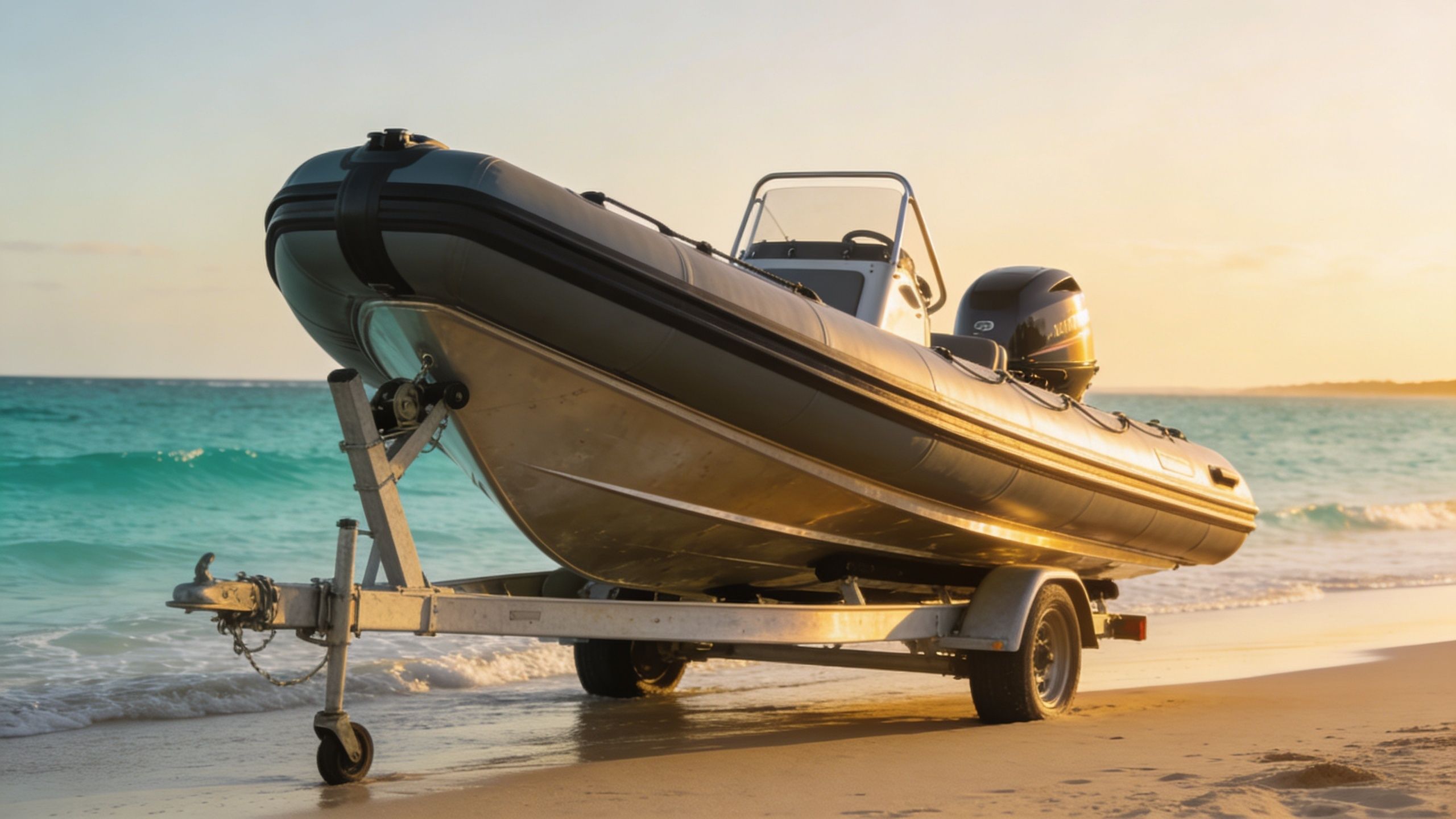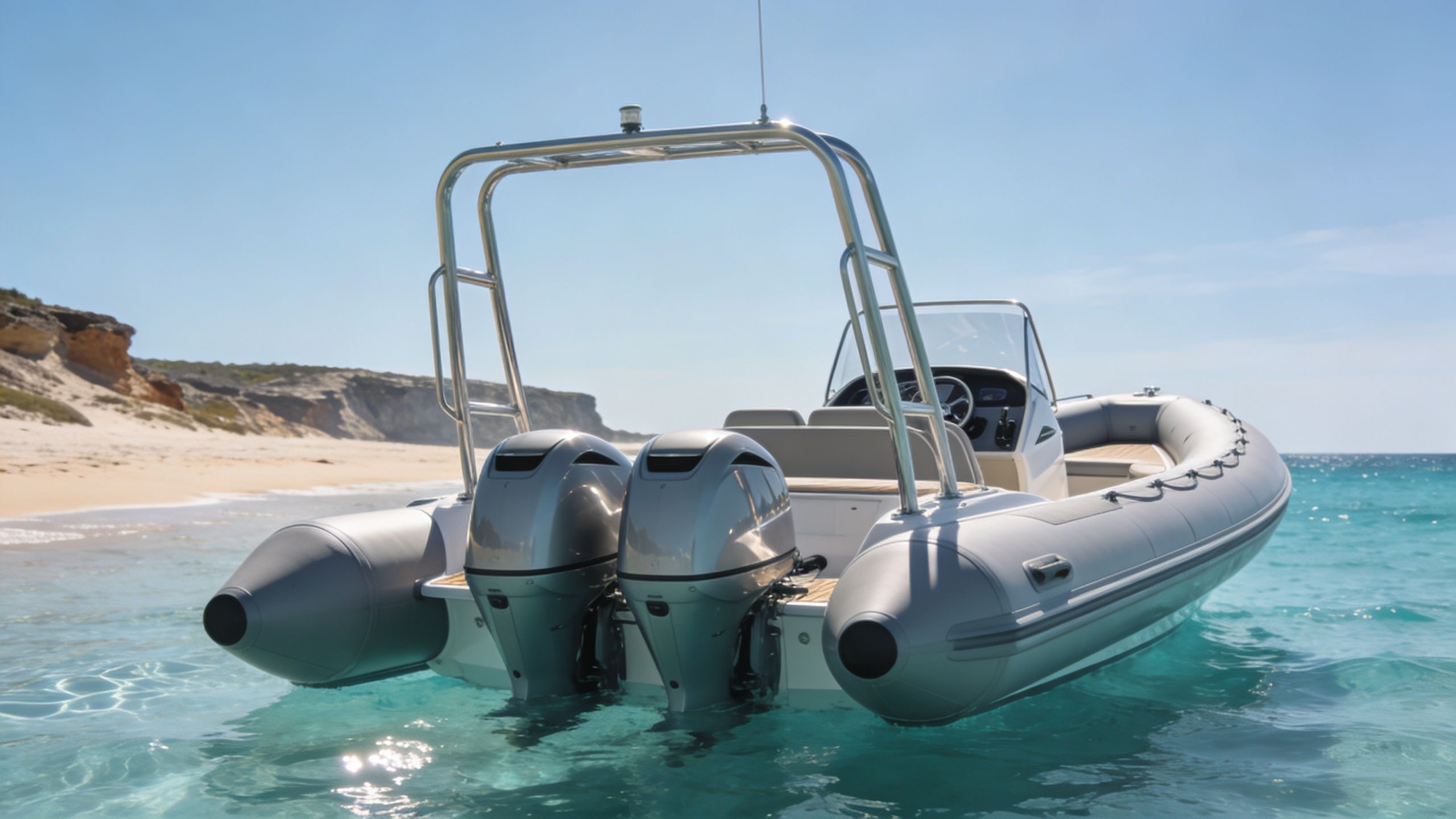

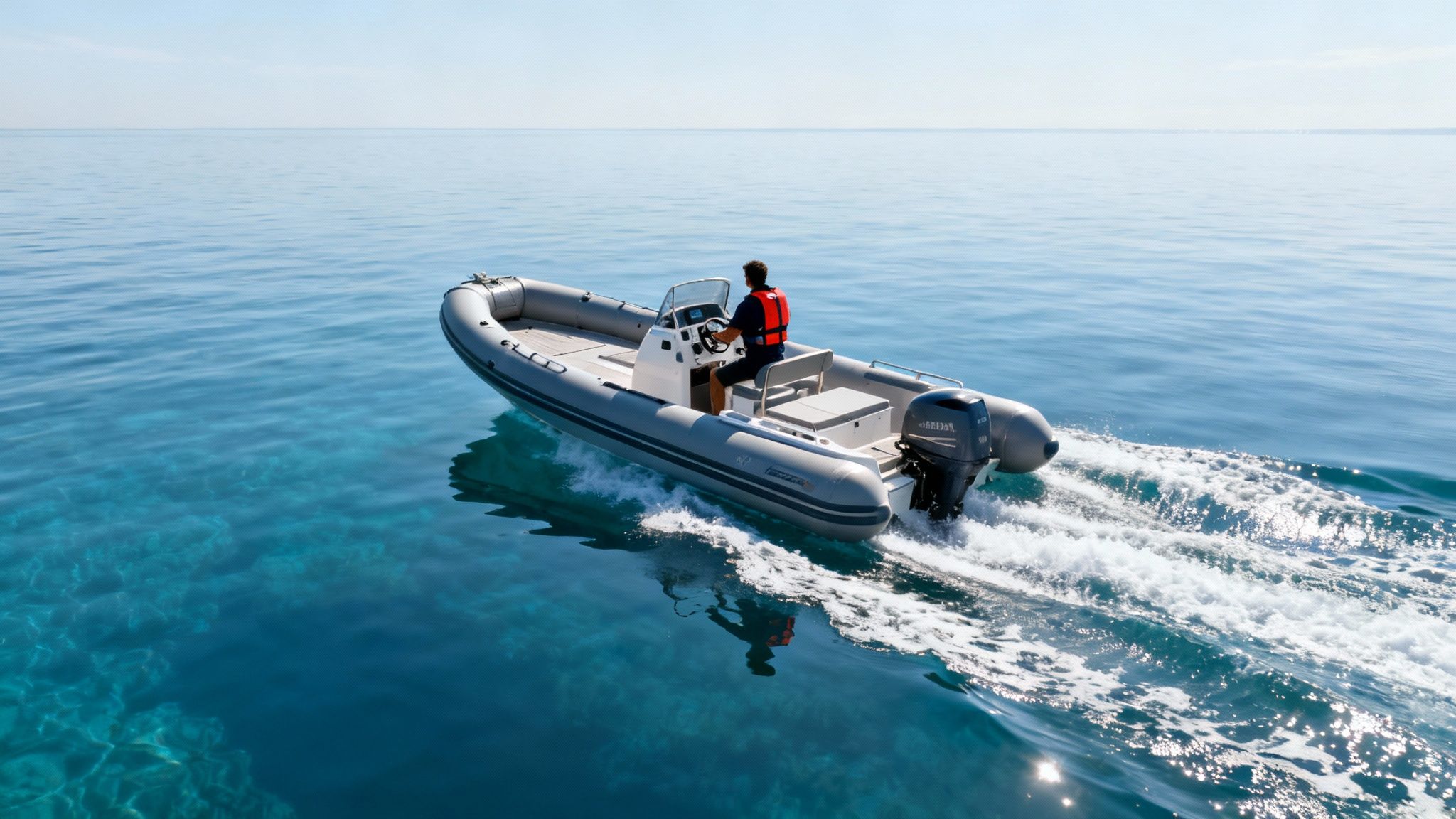
Ever seen a boat that looks like a tough, traditional V-hull but is wrapped in inflatable tubes? That’s the simple but brilliant idea behind a rigid inflatable boat (RIB). It’s a hybrid design that’s earned the nickname ‘the 4×4 of the sea’ for a good reason—it blends the best of both worlds to deliver incredible performance.
This unique combination of a solid hull and inflatable collar creates a boat that is shockingly stable, safe, and versatile.
A rigid inflatable boat is a lightweight, high-performance craft built with a solid, V-shaped hull surrounded by inflatable tubes, often called ‘sponsons’. Think of the rigid hull as the boat’s backbone; it provides the strength to cut cleanly through choppy water. The inflatable tubes, on the other hand, act like a built-in life jacket and shock absorber, making the boat ridiculously stable and almost unsinkable.
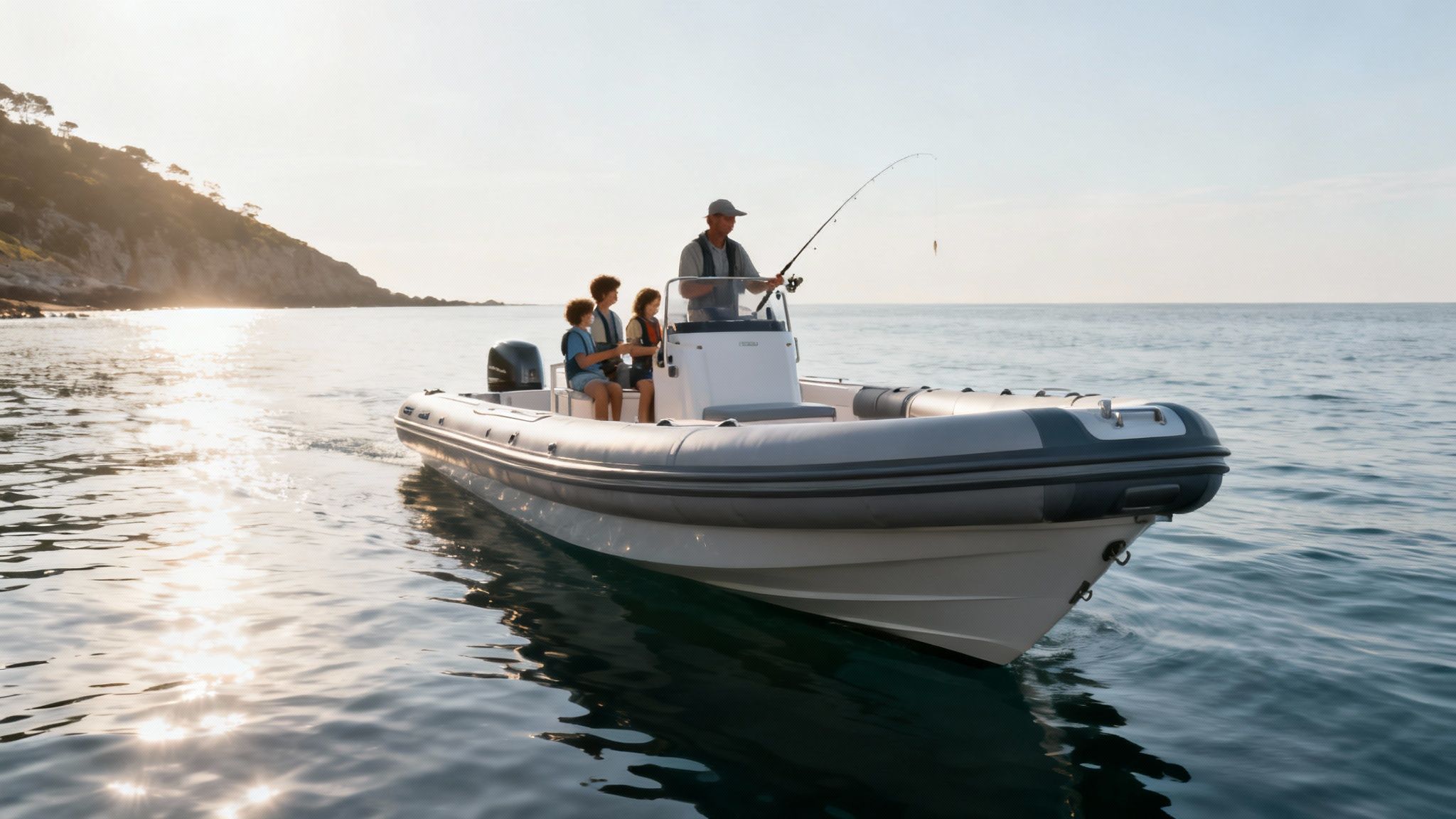
It’s this clever hybrid design that makes RIBs a top choice for a huge range of activities all over Australia. From family days out in Sydney Harbour to serious fishing trips off the Queensland coast, they provide a safe, reliable platform for almost any adventure you can dream up. If you’re wondering, “What are the best inflatable boats for recreational use available near me?” a RIB should be at the top of your list.
The real genius of the RIB is how it merges two completely different boating concepts into one superior vessel. You get the hard-wearing, wave-slicing performance of a conventional boat combined with the lightweight, buoyant, and shock-absorbing qualities of an inflatable. This blend delivers some key advantages that both weekend boaters and professionals swear by.
This adaptable design makes RIBs the ultimate all-rounder. Rigid inflatable boats are highly versatile vessels, ideal for a variety of marine uses including private boat charters that require reliable and adaptable performance. They’re just as comfortable serving as yacht tenders, dive boats, or rescue craft as they are being the perfect boat for a family weekend.
A RIB isn’t just a boat; it’s a platform for adventure. Its design solves the common challenges of stability, safety, and transport that can limit traditional boats, making it the ultimate all-rounder for Australian waters.
Brands like Easy Inflatables, with their Aerowave range, are making this advanced technology more accessible than ever before. They offer durable and portable solutions that let more people discover the unique freedom these vessels provide. If you want to dive deeper into the nitty-gritty, our guide on what is a RIB boat gives a full breakdown of how they work. Understanding the fundamentals is key to seeing why they are often the best inflatable boats you can buy for recreational use.
When you’re looking to compare prices and features of inflatable boats in your area, what really separates a good boat from a great one comes down to the nuts and bolts—the materials and the way it’s all put together. The quality of a rigid inflatable boat isn’t just one thing; it’s the sum of its parts, from the fabric tubes to the transom holding the motor.
Understanding these core components helps you make a much smarter choice. After all, you want a boat that’s built to last, especially in our tough Aussie conditions.
The inflatable tubes are the heart and soul of any RIB. The fabric they’re made from is the single biggest factor in determining the boat’s lifespan, durability, and ability to handle the elements. This is a big deal in Australia, where the sun and salt can be relentless.
The two main players in the RIB world are PVC (Polyvinyl Chloride) and Hypalon (a premium synthetic rubber). While both can be used to build fantastic boats, they have different strengths that suit different owners and environments.
For most recreational users, a high-quality, modern PVC boat provides all the durability you’ll need for years of adventure. But for those who demand the absolute best in longevity for extreme climates or commercial use, Hypalon is still king.
To get a deeper dive, check out our article on the benefits of Hypalon versus German Mehler PVC.
The choice between PVC and Hypalon really comes down to balancing your budget, how you’ll use the boat, and where you’ll store it. A thermo-welded PVC boat offers fantastic value and durability, while a Hypalon boat is a long-term investment against the harshest marine environments.
Choosing between PVC and Hypalon can feel tricky, but it’s simpler when you break it down by how you’ll use your boat. This table compares the key features to help you decide which material is the best fit for your adventures.
| Feature | German Valmex PVC | French Hypalon |
|---|---|---|
| Durability | Excellent abrasion and puncture resistance. Ideal for recreational use. | Superior long-term durability, especially against UV rays and chemicals. The top choice for extreme conditions. |
| Seam Construction | Thermo-welded seams create a fused, molecular bond that is stronger than the fabric itself. | Hand-glued seams, which are incredibly strong but rely on adhesive and artisan skill. |
| UV Resistance | Very good, especially with modern UV inhibitors. Best stored under a cover for maximum lifespan. | The best available. Highly resistant to fading and degradation from prolonged sun exposure. |
| Cost | More affordable upfront, offering incredible value and performance for the price. | A premium material with a higher initial cost, reflecting its longevity and resilience. |
| Maintenance | Easy to clean and repair with simple patch kits. | Requires occasional conditioning to maintain its finish but is extremely easy to repair. |
| Best For | Recreational boaters, RV travellers, and anyone looking for a high-performance boat on a sensible budget. | Commercial operators, superyacht tenders, and owners who store their boat uncovered in high-UV climates. |
Ultimately, for most Aussie boaters, a high-quality German Valmex PVC boat offers the perfect blend of performance, toughness, and value. But if your boat will live a hard life under the sun, Hypalon is an investment that pays off in the long run.
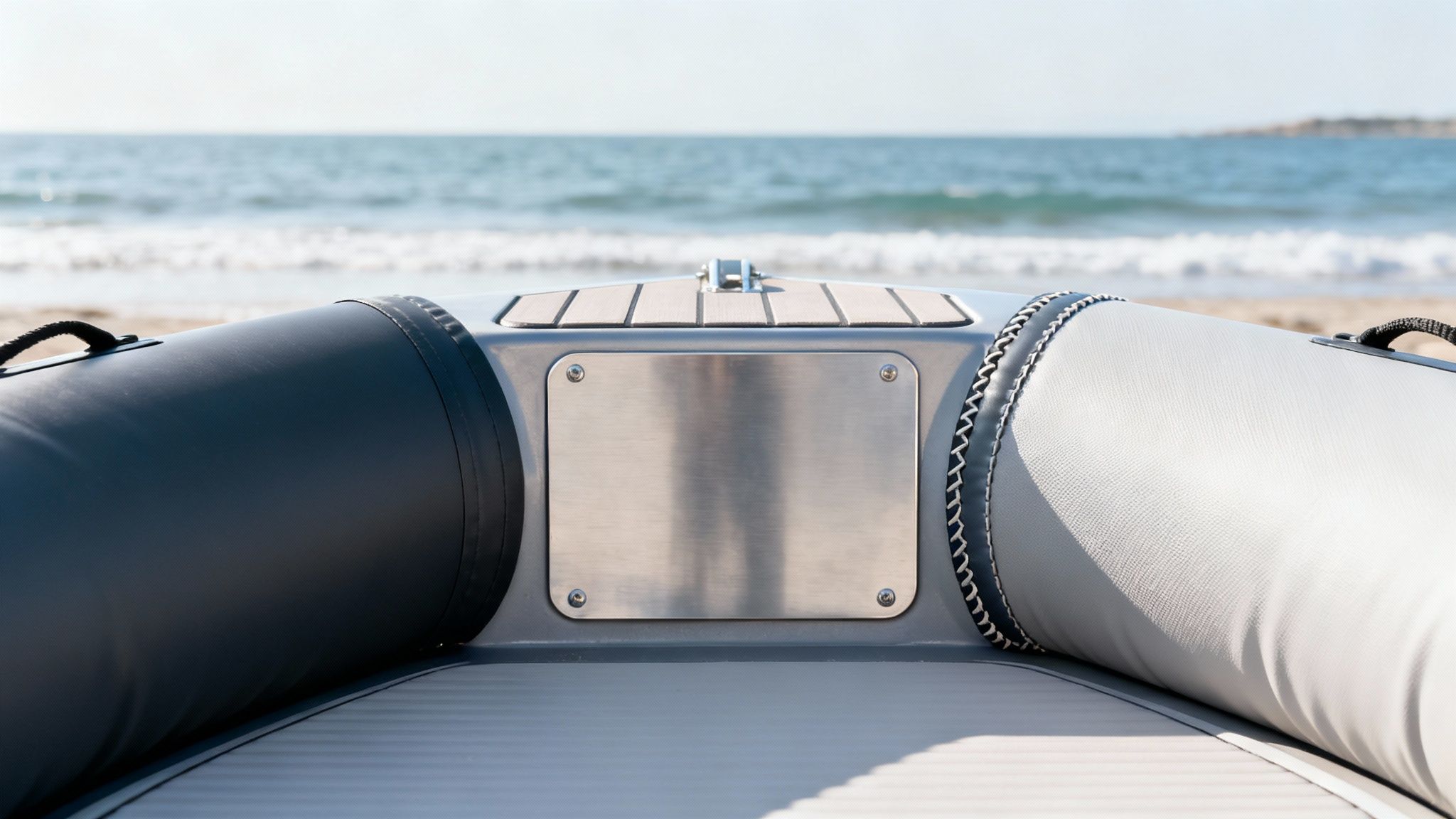
Beyond the tube fabric, the boat’s structural integrity comes from its core components. The transom, in particular, is the workhorse of a RIB. It’s the solid plate at the back that has the tough job of supporting the outboard motor.
A flimsy transom will flex under power, hurting performance and, in the worst-case scenario, leading to failure. That’s why Aerowave boats feature a solid aluminium transom as standard. Unlike plywood, aluminium will never rot, warp, or weaken from saltwater exposure, giving you a rock-solid foundation for your motor.
Just as critical are the seams holding the tubes together. Glued seams can be a weak point over time, especially when exposed to heat and humidity. That’s why we use thermo-welded seams on our PVC boats. This process uses heat to fuse the material together, creating a single, unified piece. It’s a modern technique that results in a far stronger and more reliable bond, massively extending the boat’s lifespan.
The final piece of the puzzle is the deck, which acts as the floor of the boat. While bigger RIBs might have a rigid fibreglass or aluminium floor, many of the most versatile and portable models use a high-pressure air deck.
An air deck is an amazing piece of engineering. It’s made from thousands of polyester threads stitched between two layers of fabric. When inflated to the right pressure, it becomes incredibly rigid and stable—you can stand on it with confidence. Aerowave models take this a step further with a double-stitched air-deck for extra rigidity and durability.
This is the technology that makes the “boat-in-a-bag” a reality. The entire boat, floor and all, can be deflated, rolled up, and tucked into a carry bag. It’s an absolute game-changer for anyone travelling with a caravan or RV, letting you bring a serious boat on your trip without the hassle of a trailer. It’s the perfect solution for exploring Australia’s hidden waterways, from remote coastal estuaries to quiet inland rivers.
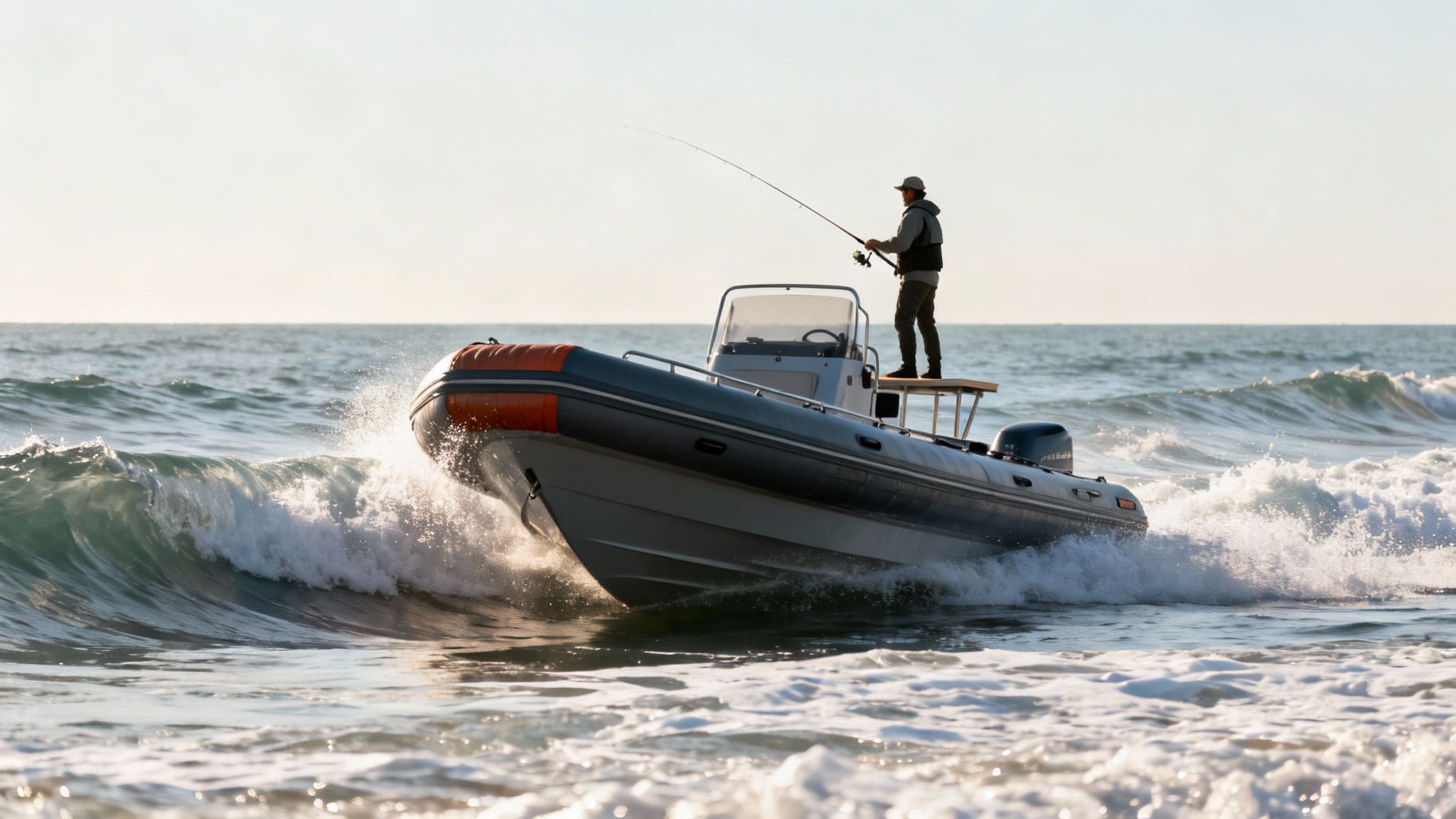
Have you ever watched a rigid inflatable boat handle choppy water and wondered how it stays so composed? It’s not magic; it’s a brilliant combination of two distinct design elements working in perfect harmony. This unique partnership between the rigid hull and the inflatable tubes is the secret behind a RIB’s legendary performance and safety.
The stability of a RIB starts with its inflatable collar, or sponsons. These large, air-filled tubes act as a powerful stabilising force, fundamentally changing how the boat interacts with the water.
Think of them as giant, built-in shock absorbers. When a wave hits the side of the boat, the flexible tube absorbs and dampens the impact, dramatically reducing the rocking and rolling you’d feel in a traditional hard-sided boat. This makes for a much more comfortable ride in less-than-perfect conditions.
The inflatable collar also provides an incredible amount of buoyancy, distributed all around the boat’s perimeter. This low-slung buoyancy makes the boat exceptionally stable when stationary—a feature that anglers and families absolutely love. It creates a solid platform for casting a line or for kids moving around without making the boat feel tippy.
The inflatable tubes on a rigid inflatable boat do more than just hold air; they provide a cushion against waves and create a wide, stable base. This makes the boat virtually unsinkable and gives it a solid, predictable feel, both at rest and at speed.
This immense buoyancy is why RIBs are trusted by maritime professionals. Rigid inflatable boats have become a cornerstone of Australia’s maritime safety operations, particularly with the Royal Australian Navy and Coast Guard. Statistics from the Australian Maritime Safety Authority (AMSA) show that between 2018 and 2023, RIB-equipped rescue teams responded to 12,450 distress calls, achieving a 98.7% success rate in personnel recovery, far surpassing traditional rigid hull boats. Learn more about the growth of inflatable boats in Australia and their role in safety.
While the tubes provide stability, the rigid hull does the heavy lifting. The deep V-shape of the hull is designed to slice cleanly through waves rather than slapping against them. This is a massive difference compared to a flat-bottomed tinnie or a fully inflatable boat, which can deliver a jarring ride in even mild chop.
This wave-cutting action results in several key benefits:
This combination of stability and performance is perfectly suited to Australian conditions. Imagine confidently navigating coastal swells off the coast of New South Wales, the V-hull cutting through the waves while the inflatable tubes keep the ride smooth and steady.
Or picture a calm day of fishing in a Queensland estuary. The incredible at-rest stability means you can stand and cast with confidence, knowing you have a solid platform beneath your feet. This blend of attributes is why so many people looking for the best inflatable boats for recreational use find their perfect match in a RIB. It delivers the performance needed to explore with confidence and the safety that provides peace of mind for the whole family.
Think of picking the right motor and accessories like choosing the perfect engine and options for a new car. It’s what turns a great rigid inflatable boat into your perfect adventure machine. The motor is the heart of your setup, deciding your speed, range, and how the boat feels on the water. Accessories are the smart extras that make the boat truly yours, whether you’re heading out for a fish, a family cruise, or exploring a remote coastline.
Getting the power right is all about finding that sweet spot between horsepower, weight, and fuel efficiency. If your motor’s underpowered, the boat will feel sluggish and struggle to get up on the plane, especially when it’s loaded with people and gear. Go too big, and you’re not only risking safety but also burning more fuel than you need to and putting extra stress on the transom.
The trick is to match the outboard’s horsepower (HP) to your boat’s size and how you plan to use it. A smaller RIB that serves as a tender or is used for a quiet fish on the lake will be perfectly happy with a lightweight 2.5HP motor. But if you’ve got a larger boat for family days out or cruising along the coast, you’ll want something in the 20HP to 60HP range. That extra power gives you the grunt to handle a bit of chop and carry more weight without a problem.
To take the guesswork out of this crucial decision, we offer perfectly matched Hidea outboard bundles here at Easy Inflatables. These packages pair our Aerowave RIBs with super-reliable outboards from 2.5HP up to 60HP, guaranteeing you get brilliant performance straight out of the box. For a deeper dive, check out our guide on choosing the best motor for inflatable boats—it’s packed with expert tips to help you weigh up your options.
Your outboard motor isn’t just about speed; it’s about control, safety, and reliability. Choosing a well-matched motor and boat package ensures you have the right power for every situation, from a slow troll to a quick dash back to shore.
To make it even easier, here’s a quick guide to matching our Aerowave RIBs with the right Hidea outboard for your needs.
| RIB Length (m) | Recommended HP (Hidea) | Primary Use Case |
|---|---|---|
| 2.9m | 5HP – 10HP | Tender, solo fishing, exploring calm waters |
| 3.3m | 10HP – 20HP | Couples, small family cruising, fishing estuaries |
| 3.6m | 20HP – 30HP | All-round family fun, coastal exploring, light towing |
| 4.2m | 30HP – 50HP | More serious fishing, carrying more passengers, bay cruising |
| 4.7m+ | 50HP – 60HP | Offshore capability, diving, watersports, maximum performance |
This table gives you a solid starting point, ensuring your boat performs exactly how you need it to, whether you’re chasing fish or just chasing the sunset.
Once you’ve got the power sorted, it’s time to customise your setup for maximum fun and practicality. The right accessories can genuinely make the difference between a good day and a great one. They add comfort, convenience, and capability, letting you stay out longer and do more with your boat.
Just think about how you’ll be using your boat most often. Are you a keen angler? A family looking for a sun-safe day out? Or maybe an RV traveller who needs maximum portability? Your answers will point you to the right gear.
Here are some of the most popular and practical additions for any RIB owner in Australia:
Choosing these kinds of thoughtful accessories helps you build a boat that fits your lifestyle perfectly. If you’re looking to compare prices and features of inflatable boats in your area, remember to factor in these essential extras for a complete adventure-ready setup.
The real magic of a rigid inflatable boat is its incredible versatility. It’s not just one type of boat; it’s a chameleon, ready to adapt to whatever adventure you throw at it. All across Australia, people are figuring out that a RIB is the perfect answer to the question, “What’s the best all-round boat for me?”
From the calm estuaries of New South Wales to the rugged coastlines of WA, these boats are opening up a world of new possibilities. Their unique mix of stability, safety, and performance makes them the go-to choice for a huge range of activities, turning a standard weekend into something unforgettable.
For keen fishos, a rigid inflatable boat is a genuine game-changer. Its incredible stability creates a solid casting platform, letting you stand and fish with confidence, even when there’s a bit of chop. The inflatable tubes act like shock absorbers, so you’re not getting tossed around like you would in a traditional tinnie.
That stability, paired with a shallow draft, lets anglers sneak into those secret fishing spots that bigger boats can only dream of. You can quietly poke around hidden creeks, explore mangrove systems, and get right up on the shallow flats where the big ones are hiding. Deck it out with some custom rod mounts and make the most of the ample gear space, and you’ve got yourself a serious fishing machine ready for anything from bream to barra.
When you’ve got the family on the water, safety is non-negotiable. This is where RIBs really step up. Their natural buoyancy and multiple separate air chambers make them virtually unsinkable, which is a massive peace of mind when the kids are on board.
The soft, rounded tubes are also much friendlier for little ones clambering about compared to the hard, sharp edges of a fibreglass boat. It’s easy to launch, simple to drive, and gives a smooth, dry ride that keeps everyone comfortable and happy. Throw on a bimini for sun protection, and you have the perfect recipe for weekend adventures.
A rigid inflatable boat is more than just a vessel; it’s a ticket to freedom and shared experiences. It offers families a safe and accessible way to create lasting memories, from picnics on secluded beaches to exploring local waterways together.
Talk to any yacht owner, and they’ll tell you the RIB is the undisputed king of tenders. Its lightweight design makes it a breeze to lift and store on board. Plus, its durable tubes act as a built-in fender, protecting the yacht’s pristine hull from accidental bumps and scrapes in the marina.
But it’s the performance that seals the deal. A RIB tender gets up on the plane in a flash, making quick work of trips to the shore for supplies or exploring a nearby cove. It’s tough enough to handle choppy conditions, ensuring a safe and dry ride for guests and crew—which is why you see them tied to yachts in every marina from Sydney to the Gold Coast.
This is where things get really exciting for modern adventurers, especially the 4×4 and caravan crowd. The “boat-in-a-bag” concept has completely changed how people explore Australia’s stunning waterways. A whole high-performance boat can be deflated, rolled up, and tucked into the back of an SUV or caravan.
This incredible portability means you’re no longer stuck launching at crowded boat ramps. You can explore remote rivers in the Kimberley, launch from a deserted beach in Tassie, or find your own private fishing spot on an inland lake. This freedom is driving a huge surge in popularity. The inflatable boat market in Australia is booming, with recreational boating registrations jumping 35% nationwide post-COVID. Tellingly, RIBs led the charge, making up 42% of new sales in Queensland as people shift to more portable, versatile options. You can discover more about the rigid inflatable boat market growth and see why they’re becoming the top choice for Aussie explorers.
Alright, you’re ready to make a choice. This is where we translate all that knowledge into finding the perfect boat for you. A smart buying decision really just comes down to ticking the right boxes—making sure the RIB you choose is a perfect match for your lifestyle, budget, and sense of adventure.
Before you even start comparing models and prices, take a moment. The first step isn’t about the boat; it’s about how you’re going to use it. Get this part clear in your mind, and every other decision becomes a whole lot simpler.
Start by asking yourself a few honest questions. How many people will you usually have on board? A boat built for a solo angler looks very different from one designed for weekend family outings.
Think about where you’ll be boating. Are you sticking to calm estuaries, exploring coastal bays, or heading out into open water? Finally, what about storage? Do you have space in the garage, or are you after a true ‘boat-in-a-bag’ solution to take on caravan trips?
This decision tree gives you a good idea of how different adventures lead to different RIB setups.

As you can see, whether your priority is casting a line, exploring remote waterways, or just having safe fun with the family, there’s a specific RIB configuration that’s going to serve you best.
Once you know what you need, it’s time to find a retailer who delivers on quality, value, and service. As a proudly Australian-owned business, we get the local conditions and know exactly what our customers are looking for. We’ve built our entire approach around making your purchase simple and giving you total confidence.
Your investment should go into the quality of the boat itself, not into navigating complex logistics. Transparent pricing, local support, and fast delivery are just as important as the materials and construction of your RIB.
Here’s how we make a difference for Aussie boaters:
Our value packs, which come complete with things like lithium pumps and solid 3-year warranties, make pro-level gear accessible to everyone. We’ve seen firsthand how this approach can slash the total cost of ownership by up to 20%. It’s about getting you on the water faster, without the fuss.
When you choose an Easy Inflatables package, you aren’t just buying a boat; you’re investing in a complete, adventure-ready setup. It’s all backed by a comprehensive warranty and genuine local after-sales support, giving you the confidence to get out there and explore, knowing you have a reliable, high-performance vessel built for Australian conditions.
We get asked a lot of questions about our RIBs, and we love answering them. It means you’re doing your homework to find the perfect boat. Here are a few of the most common queries we hear from customers just like you.
This is where a modern rigid inflatable boat truly shines, especially for anyone who loves road-tripping in an RV or simply doesn’t have a lot of storage space.
Most of our Aerowave models can be deflated, rolled up, and tucked away into a carry bag. Seriously, it’ll fit right in the boot of your SUV or a caravan storage compartment. With a good quality high-pressure pump, you can go from “boat-in-a-bag” to ready for the water in just a few minutes. It’s this incredible convenience that has made RIBs the go-to for so many Aussies wanting to explore our amazing waterways without being tied to a trailer.
Great question! While they both offer incredible stability on the water, they get there in slightly different ways. A classic RIB has a single, rigid V-shaped hull that’s designed to slice right through choppy water, giving you a surprisingly smooth ride even when conditions get a bit rough.
An inflatable catamaran, however, uses two separate, parallel inflatable hulls. This setup creates a super wide and stable platform with a very shallow draft. It’s perfect for gliding over calm waters, sneaking into skinny fishing spots, and maximising every inch of deck space. Your choice really comes down to where you’ll be spending most of your time on the water.
If you’re looking for a place in Australia to hire inflatable boats for a family outing, you might find some options in popular tourist spots. However, tracking down a high-performance rigid inflatable boat for a private trip can be tough—and often expensive. The real freedom and value come with owning your own.
When you own your boat, you get to know it inside and out, which is a huge part of being safe on the water. It’s also why understanding your safety gear, like having an ACR Rescue Beacon on board, is so critical for peace of mind. Our team is here to give you all the info you need, with clear pricing and solid warranties, so you can feel 100% confident you’re investing in the right boat for years of adventures.
Ready to start your adventure on the water? At Easy Inflatables, we have a huge range of in-stock models and packages perfect for Australian conditions.