
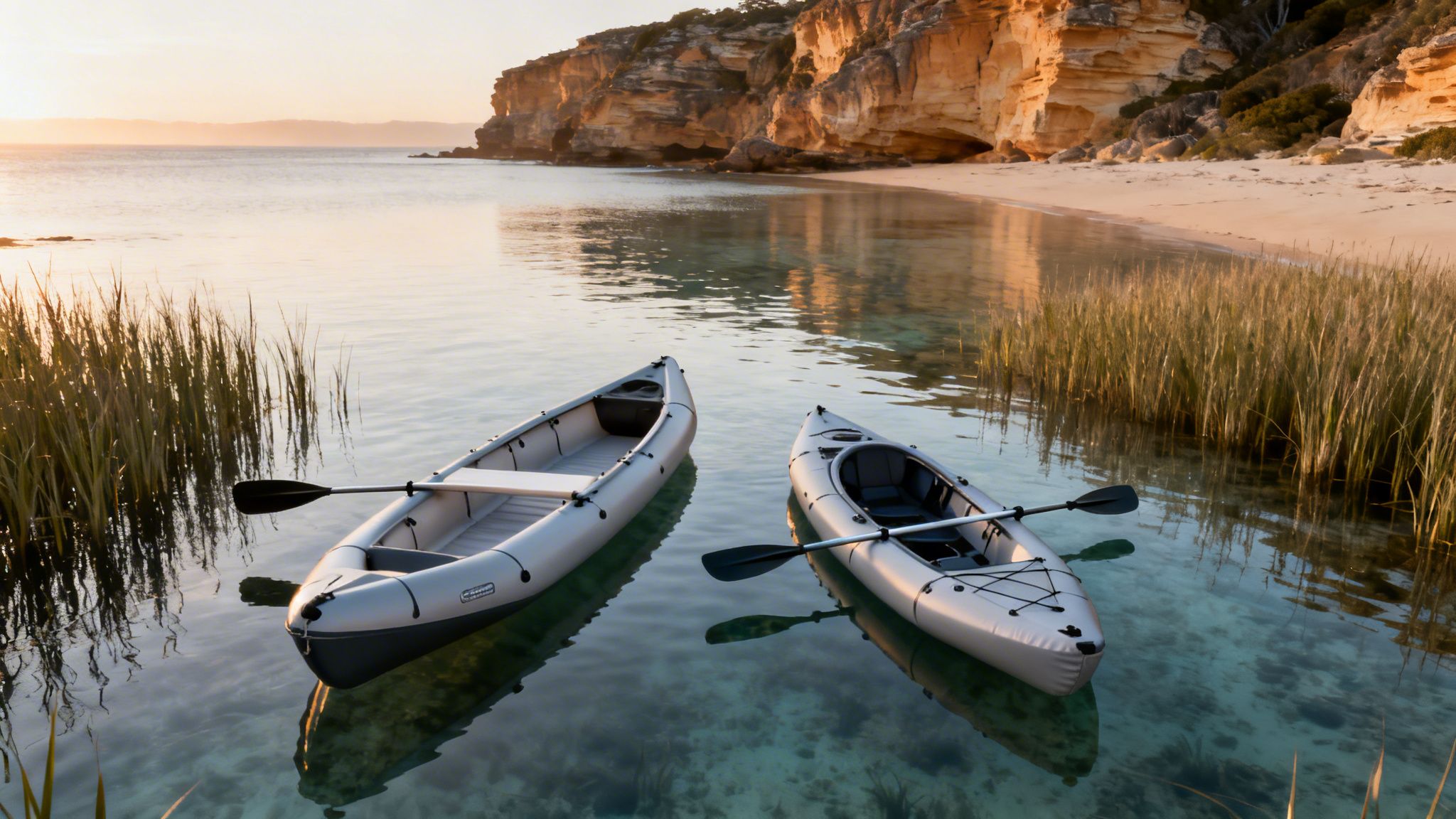
The age-old canoe vs. kayak debate isn’t about which is better, but which is better for you. It really boils down to what you want to do on the water. If you’re picturing relaxed, gear-heavy trips with family or a mate, a canoe’s open design and huge capacity is your ticket. But if you’re chasing speed, agility, and solo adventures on more challenging water, a kayak is probably your best bet.
Your choice is all about balancing space and stability against performance and pure handling.
Deciding between a canoe and a kayak is one of the first big choices for any Aussie looking to get on the water. Both are fantastic ways to explore our incredible coastlines, rivers, and lakes, but they’re built for fundamentally different experiences. This guide is here to cut through the noise and help you match the right boat to your lifestyle, whether that’s a chilled-out family day or a serious solo fishing mission.
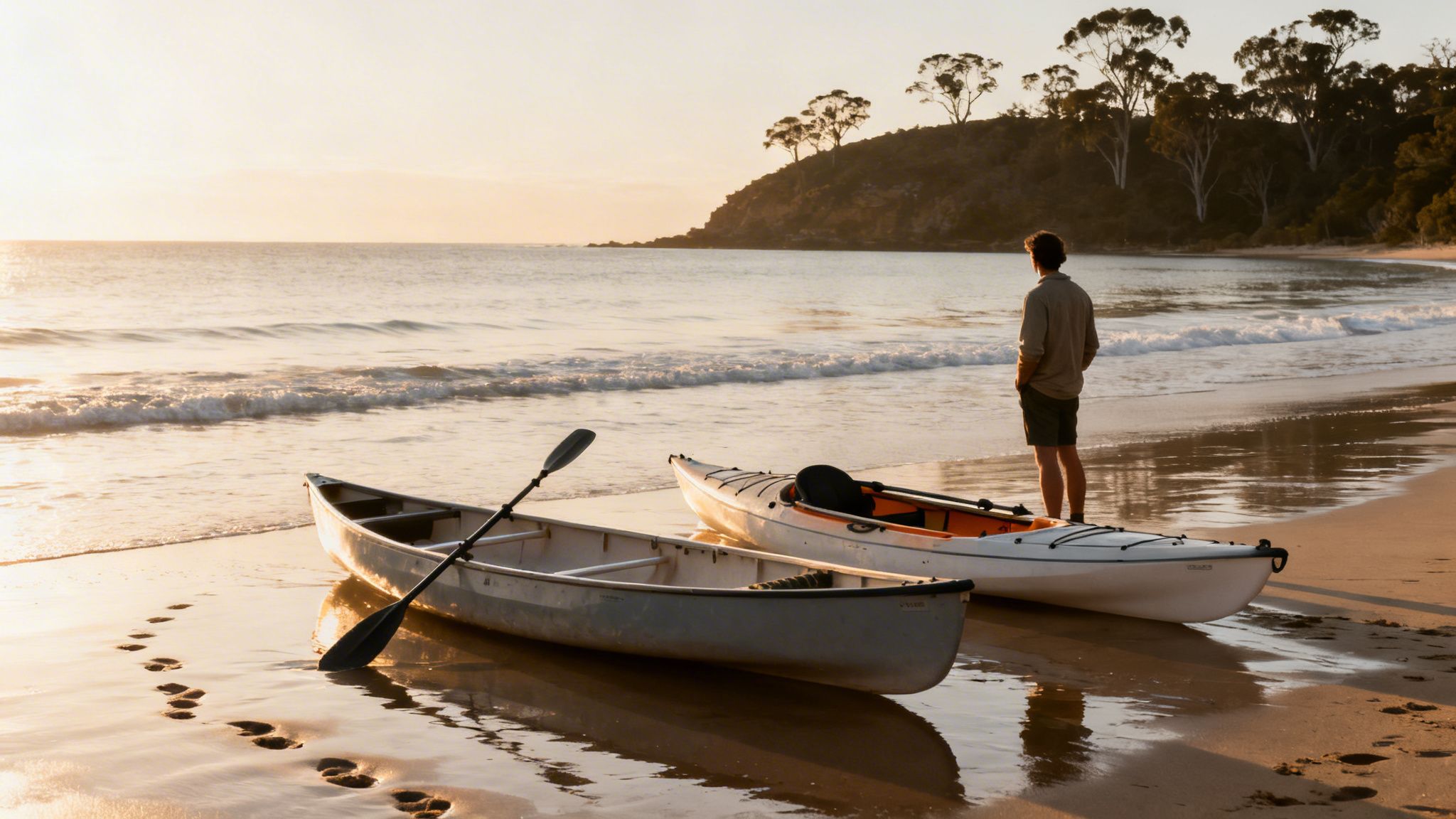
Getting your head around the core differences is the first step. A canoe has that classic open-top design, which lets you sit up high or kneel and makes loading gear a breeze. On the other hand, a kayak usually has a closed cockpit where you sit low with your legs stretched out, giving you a much lower centre of gravity.
These two approaches completely change how the boat feels and handles. To get a quick feel for which might suit you, here’s a look at their main characteristics.
This quick reference table sums up the key characteristics of canoes and kayaks to help you make an initial assessment.
| Characteristic | Inflatable Canoe | Inflatable Kayak |
|---|---|---|
| Seating Position | High, kneeling or seated on a bench | Low, seated on the floor with legs forward |
| Paddling Style | Single-bladed paddle | Double-bladed paddle |
| Best For | Family trips, gear-heavy outings, relaxed paddling | Solo travel, speed, exploring tight waterways |
| Primary Stability | Generally high and stable on flat water | Can feel less stable initially but excels in waves |
| Portability | Excellent; packs into a bag | Excellent; often more compact than a canoe |
While this table gives you a starting point, the real game-changer in recent years has been the quality of modern inflatables.
A huge factor in the modern canoe vs kayak discussion is just how good inflatable technology has become. Forget those flimsy pool toys from back in the day. Today’s high-quality inflatables, like the Aerowave boats we design right here, deliver rigidity and performance that truly rivals their hard-shell cousins.
This shift has made boating more accessible than ever, especially for us here in Australia.
This versatility means you no longer have to choose between a tough, capable boat and one that’s actually easy to store and transport. As you weigh your options, remember that there are many different types of boats you can buy, each built for different adventures. The right inflatable can be the perfect solution for exactly what you need, whether that’s a lazy paddle on a local lake or exploring remote coastal inlets.
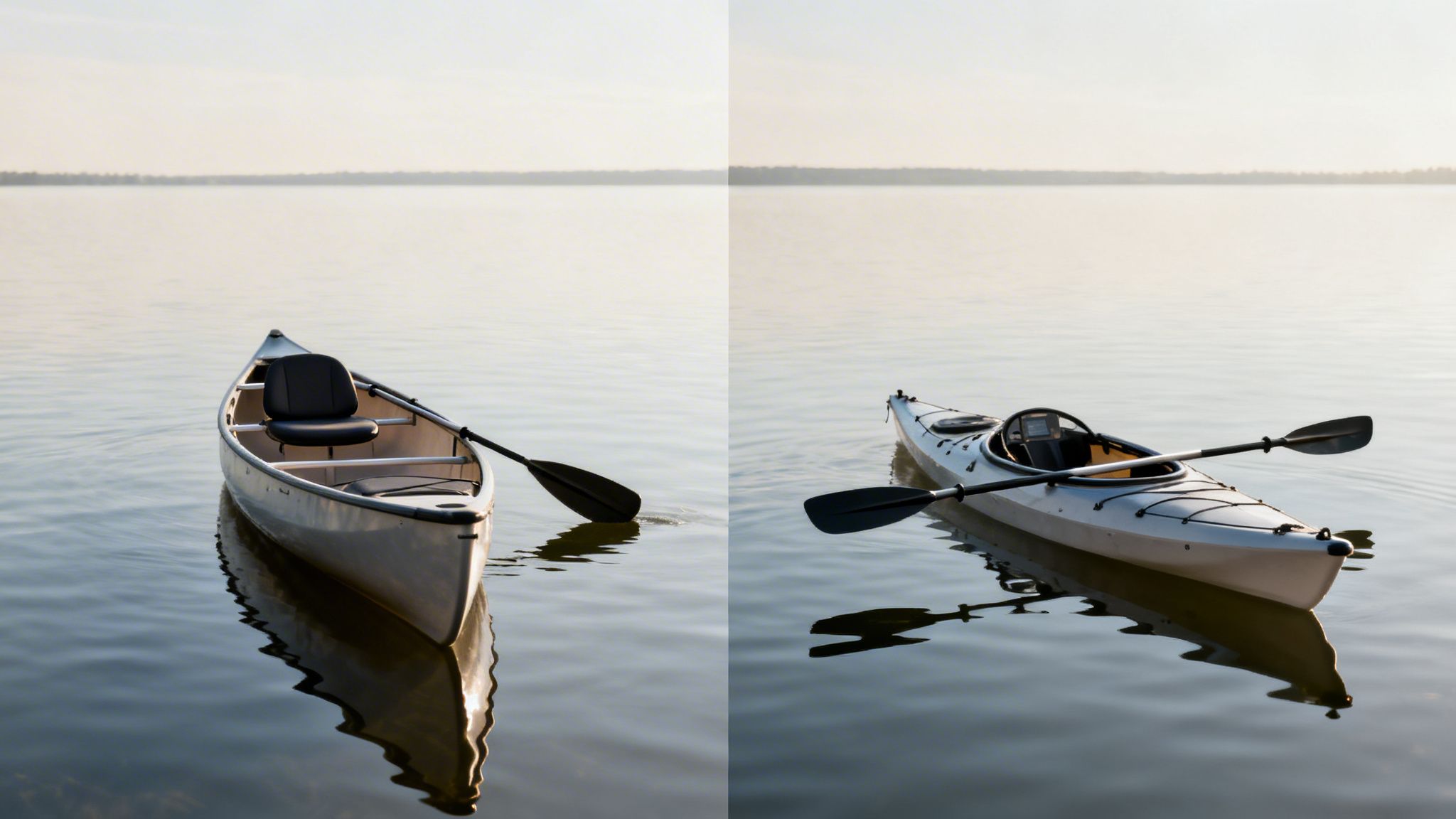
Sure, one is open and the other is closed, but the real story of a canoe versus a kayak is written in how they’re built. These core design choices are what shape your entire experience on the water, affecting everything from how stable you feel to how your body feels after a long day of paddling.
It all starts with the hull. A canoe’s wider, flatter bottom gives it fantastic primary stability. That’s the solid, steady feeling you get on calm water, making it perfect for loading up with kids and gear for a picnic on a placid river.
Kayaks, on the other hand, usually have a narrower hull with a more pronounced ‘V’ shape. This can feel a little wobbly at first, but it’s the key to their excellent secondary stability. When you lean a kayak on its edge to handle waves or turn sharply, it bites into the water and feels incredibly secure—a huge advantage in choppy Aussie bays.
The way you sit completely changes how you connect with the water. In a canoe, you’re perched high on a bench seat or kneeling, which gives you a great view and makes it easy to shift your weight. But that higher centre of gravity can feel a bit precarious when the water gets rough.
A kayak puts you right down in the cockpit, legs out in front. This low-slung position is the secret behind a kayak’s rock-solid feel in waves. It makes you part of the boat, letting you use your hips to steer and balance, giving you the confidence to tackle more dynamic conditions.
“A kayak’s low seating position isn’t just for comfort; it’s a core performance feature. It lowers your centre of gravity, making you one with the boat and providing the stability needed to confidently handle waves that would have a high-seated canoeist feeling very nervous.”
This sense of security is a big reason so many Aussies have embraced kayaking. It has quickly become one of our fastest-growing water sports, with beginners finding modern kayaks far more forgiving. In fact, many entry-level kayaks today offer two to three times better initial stability than traditional canoes, making it easier than ever to get started.
Your paddle is your engine, and it’s designed specifically for the boat you’re in.
The difference really comes down to this: a canoe paddle is for both steering and propulsion in one fluid motion. A kayak paddle is built for relentless forward momentum. The paddle isn’t just an accessory; it’s an essential part of the system. You can see just how different they are by checking out our guide on paddles for canoes.
Understanding how the hull, seat, and paddle work together is everything. It’s what determines whether you’re getting a stable, roomy craft for relaxed family trips or a sleek, responsive boat built for adventure and speed.
Moving from boat design to the real world, the true difference between a canoe and a kayak comes alive the moment your paddle touches the water. Performance isn’t just one thing; it’s a trade-off between stability, speed, and agility. Your perfect boat really depends on what you value most for a day out, whether that’s a quiet paddle in an estuary or taking on a choppy bay.
The first thing most people notice is how steady a boat feels when they first get in. We call this primary stability, and it’s where canoes have traditionally held the advantage. Their wide, flat-bottomed hulls create a reassuring platform on calm water. It’s easy to shift your weight, load up gear, or have kids and pets on board without that initial wobbly sensation.
But when the wind kicks up and the water gets choppy, the game changes to secondary stability. This is where kayaks really come into their own. Their lower centre of gravity and sleeker design mean you can lean them on their edge to cut through waves, giving you a sense of control that a high-sided canoe just can’t match in rougher conditions.
When you’re trying to choose between a canoe and a kayak, stability is more than just “will it tip over?” It’s about feeling confident and in control, no matter what the water is doing.
A canoe’s excellent initial stability is ideal for things like relaxed fishing or a family picnic on a glassy lake. The open deck means you can chuck in a big Esky, all your tackle, and camping gear without having to pack it perfectly. It feels solid and reliable, as long as the water stays flat.
A kayak’s strength, on the other hand, is its performance when things get a bit unpredictable. Because you’re sitting lower, you feel more connected to the boat and can use your body to balance against waves. This superior secondary stability is exactly why kayaks are the go-to for exploring open coastlines or paddling on windy days.
For anyone who loves to cover some serious distance, speed is a huge factor. A kayak is almost always the faster of the two, thanks to its sleek, hydrodynamic shape and the efficiency of a double-bladed paddle. That continuous, alternating paddling motion gives you more consistent power and momentum.
Australian boating sales data makes it clear: kayaks get the nod 70-80% of the time for their speed. A solo kayaker can easily cruise at speeds up to 8km/h, while a tandem canoe team will typically average around 5km/h. That’s a big difference when you’re exploring Australia’s massive network of over 400,000+ km of rivers and lakes. You can dig into these trends with insights from the Boating Industry Association.
A canoe’s single-bladed paddle requires more skill—like the classic J-stroke—just to keep it tracking in a straight line, which naturally cuts into its forward momentum. While it’s perfect for a relaxed journey down a lazy river, it just can’t keep up with the rhythmic efficiency of a double-bladed kayak paddle over a long haul.
How a boat reacts to your paddle strokes is what defines its handling. Here, the two boats offer completely different experiences that are suited to different environments.
For anglers and families, modern inflatable kayaks offer a compelling blend of stability and capacity. Many models are rated to handle loads over 200kg with a freeboard (the distance from the waterline to the top edge) of 0.5 metres, which reduces the risk of capsizing in choppy bays by up to 40% compared to shallower canoe profiles.
Choosing between a canoe and a kayak can feel a bit theoretical until you actually picture yourself out on the water. The best boat isn’t a one-size-fits-all answer; it’s the one that perfectly matches your adventure. To cut through the noise, let’s walk through some classic Australian scenarios and see which craft really shines.
By breaking it down into these real-world situations, you can stop debating general pros and cons and start focusing on what you’ll actually be doing out there.
When you’re planning a classic family day on a calm lake or gentle river, your checklist is simple: you need stability, space, and a stress-free experience. There has to be room for the kids, an Esky full of snacks, and maybe even the dog. If you’re looking for an inflatable boat hire in Australia for a family outing, this is a key consideration.
A traditional canoe, with its wide-open deck, seems like the obvious choice. It offers loads of space for everyone to pile in, and its initial stability on flat water feels reassuring with wriggly little passengers.
But this is where a premium inflatable tandem kayak or even an Inflatable Catamaran often pulls ahead. Many modern inflatables deliver exceptional stability, frequently feeling more planted on the water than a canoe. For families, the defined seating spots and lower centre of gravity in a kayak can feel much safer, keeping kids from shifting around and upsetting the balance.
Verdict: A stable, high-capacity inflatable kayak. While a canoe brings the space, a modern tandem inflatable kayak offers a fantastic blend of stability and security that gives families with young kids more confidence on the water.
Fishing from a boat brings a whole different set of demands. You’re looking for a stable casting platform, smart access to your gear, and options to mount essentials like rod holders and fish finders. For Aussie anglers, this is where the canoe vs. kayak debate gets really interesting.
A canoe gives you a massive, open cockpit. It’s a blank canvas for tackle boxes, multiple rods, and a net. That flat bottom also makes it stable enough for stand-up casting, provided the water is calm.
However, a purpose-built fishing kayak—especially a modern sit-on-top inflatable—is hard to beat. They often boast incredibly stable platforms designed specifically for standing, a lower profile that doesn’t catch the wind, and integrated gear tracks for easy customisation. Many anglers also find the supportive seating in a kayak far more comfortable for long hours chasing that perfect catch. If you want to dive deeper, you can learn more about the benefits of a sit-on-top kayak and see how they’re optimised for fishing.
Verdict: An inflatable fishing kayak. Its specialised features, superior stability for standing in different conditions, and customisation options make it the clear winner for any serious angler.
For anyone with limited storage space—whether in an apartment, an SUV, or a caravan—portability isn’t just a feature; it’s everything. Owning a high-performance boat without needing a garage or roof racks is a total game-changer.
This scenario is a hands-down win for modern inflatables. A rigid canoe or kayak is a logistical nightmare if you’re short on space. They’re bulky, heavy, and demand a dedicated spot for storage.
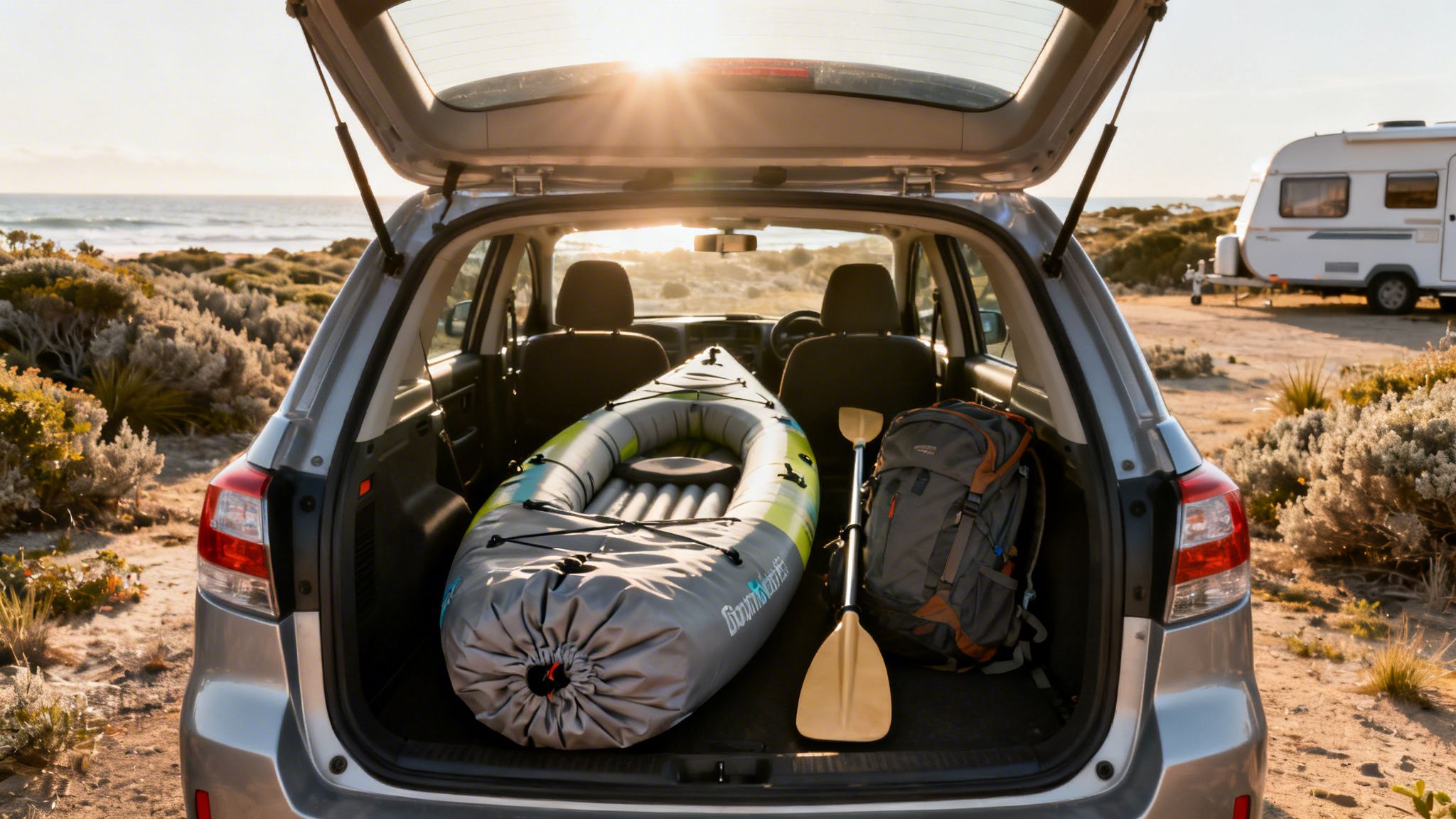
An Aerowave inflatable kayak, on the other hand, packs down into a bag that fits neatly in a car boot or a cupboard. This ‘boat-in-a-bag’ convenience means you can hit the water on a whim, with zero hassle. It makes boat ownership a genuine reality for city-dwellers and grey nomads alike.
Verdict: An inflatable kayak or boat. The unmatched portability and simple storage make it the only practical choice for adventurers who are short on space.
This decision tree can help you visualise the choice based on what you plan to do most.
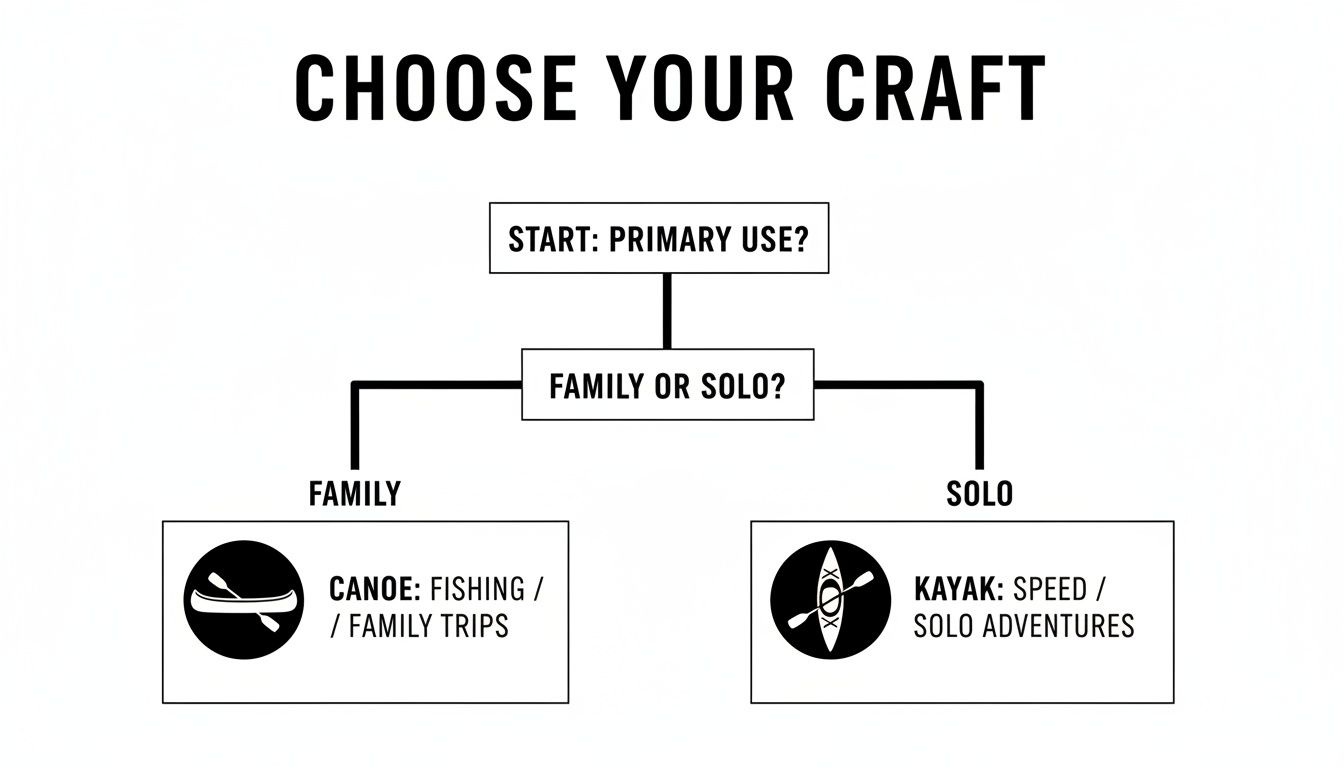
As the flowchart shows, if you’re planning a family day or a fishing trip, a spacious craft like a canoe or a stable kayak is perfect. But if you’re heading out solo or want to cover more distance, a kayak is your best bet.
For longer trips along Australia’s magnificent coastline or exploring remote river systems, your choice of boat becomes absolutely critical. You need efficiency to cover distance, serious storage for gear, and rock-solid reliability.
Touring kayaks are purpose-built for this, with their sleek design for speed and their ability to slice through choppy seas. On the other hand, canoes offer enormous gear capacity, which is a huge advantage for carrying camping equipment, food, and water. When you’re embarking on multi-day paddling adventures, knowing essential outdoor skills is key, including practical tips on how to purify water while camping.
There’s another brilliant option that’s often overlooked: an Inflatable Catamaran. These boats provide an incredibly stable and roomy platform, combining the gear capacity of a canoe with stability that rivals or even exceeds many kayaks. This makes them perfect for diving, fishing, or just hauling a huge load for a week-long expedition.
Verdict: An Inflatable Catamaran or touring kayak. The kayak wins on pure speed and efficiency, but an Inflatable Catamaran offers an unbeatable combination of stability and massive gear capacity for the most serious expeditions.
When you hear “inflatable boat,” what comes to mind? If it’s a flimsy pool toy, it’s time for a rethink. The image of heavy, hard-shell boats needing a garage and roof racks is outdated. Modern inflatable technology has completely changed the game, delivering performance that doesn’t just match but often beats traditional designs.
The secret is in the materials and the way they’re put together. Our Aerowave models aren’t made from cheap vinyl. They’re built with high-grade, multi-layered fabrics like 1.2mm 2000D German Valmex PVC. This is military-grade stuff, engineered to take a beating from rocks, oyster beds, and the harsh Aussie sun without flinching.
This tough fabric is then paired with modern construction. Instead of using glue that can fail after a few hot summers, the seams are thermo-welded. This process fuses the material together at a molecular level, creating a permanent bond that’s actually stronger than the material itself. The result is a boat built for years of reliable adventures.
One of the biggest myths about inflatables is that they’re soft and wobbly on the water. That couldn’t be further from the truth, thanks to drop-stitch technology. This is the core engineering used in the floors of our premium inflatable kayaks and catamarans, and it’s a total game-changer.
Imagine thousands of tough polyester threads stitched between two layers of PVC. When you pump air into it—up to 22 PSI—those threads pull tight, creating a platform as rigid as a wooden plank.
You get the on-water performance of a hard-shell boat, but without any of the storage or transport headaches.
The single biggest win for a modern inflatable is the freedom it gives you. Being able to pack your boat into a bag opens up a world of paddling spots that are completely off-limits to hard-shell boat owners. This convenience is a massive reason why kayaking is exploding in popularity across Australia, especially with active adventurers and RV travellers.
An Aerowave inflatable transforms from a high-performance watercraft into a bag that fits in a closet or car boot. This “boat-in-a-bag” design means no roof racks, no trailers, and no need for a dedicated boat ramp—you can launch your adventure from anywhere.
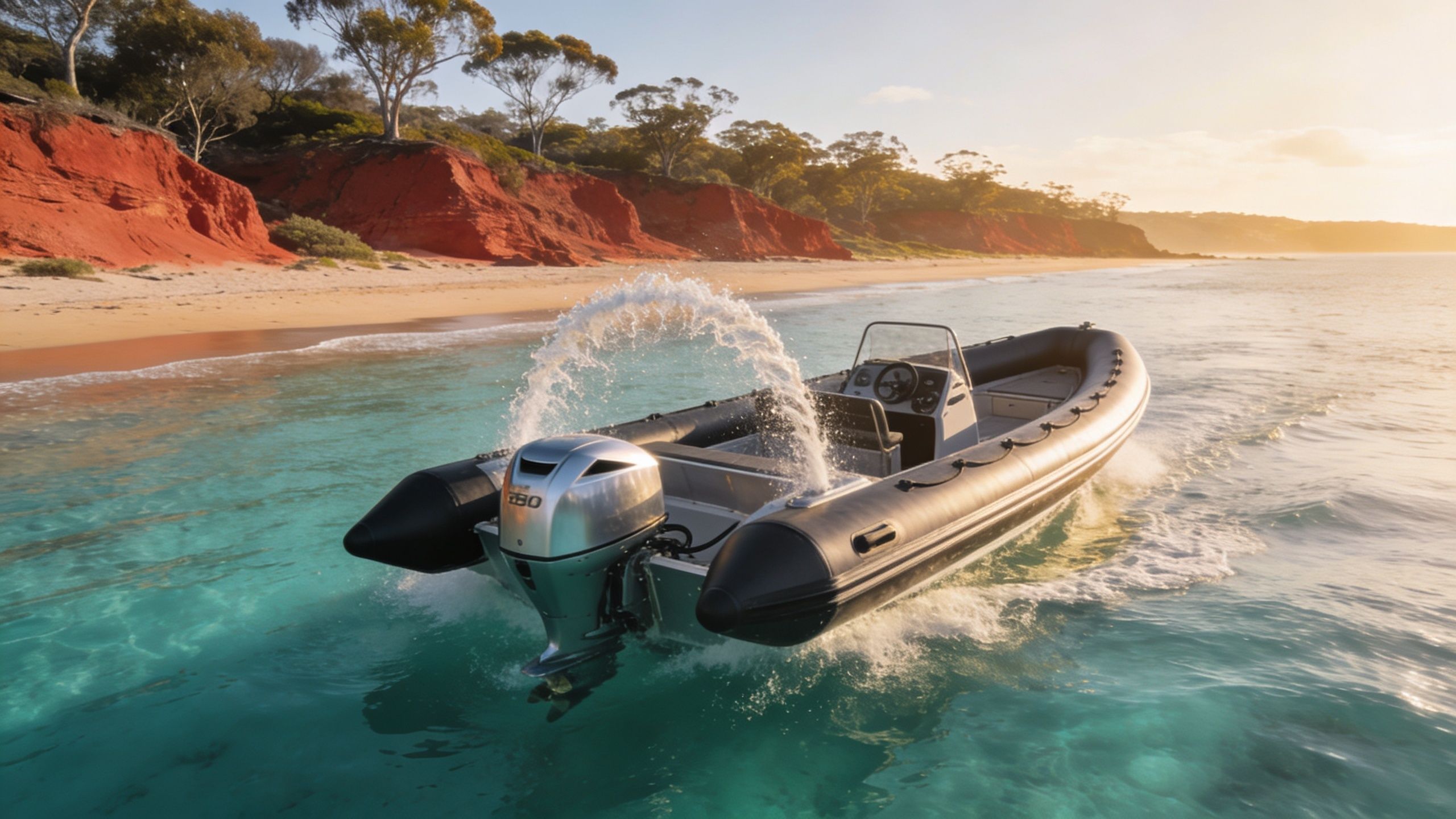
Modern inflatables aren’t just for paddling anymore. Many of our models, from boats to high-performance kayaks, are designed to handle an outboard motor. Our Aerowave boats feature reinforced transoms built to securely mount a reliable Hidea motor. This turns your portable boat into a seriously versatile machine, perfect for:
This ability to add power makes an inflatable an incredibly adaptable craft. You can be quietly paddling one weekend and motoring out to a remote reef the next. If you’re weighing up your options, our guide can help you find the best inflatable kayak for your weekend.
Ultimately, the inflatable advantage is about removing barriers. It gets rid of the storage problems, the transport hassles, and the performance myths, so you can spend more time enjoying Australia’s incredible waterways.
Still on the fence between a canoe and a kayak? It often comes down to the practical, real-world questions. We get asked these all the time, so we’ve put together the answers to help you make the right call for your next Aussie adventure.
For anyone new to paddling in typical Australian conditions, a modern inflatable kayak or an Inflatable Catamaran is the safer bet. It’s all about stability. Their wider base and low-slung seating mean you’re sitting closer to the water, which creates a much more stable, less ‘tippy’ feel than a traditional canoe.
Many of our kayaks are also self-bailing, which is a game-changer if you cop a bit of spray or hit some chop. Plus, the open-deck design of most inflatables makes them incredibly easy to climb back onto from the water. That alone is a massive confidence booster, especially for beginners or families with kids.
While your standard, off-the-shelf canoes and kayaks aren’t built for motors, our premium inflatable boats absolutely are. Many of our Aerowave models come with tough, integrated transoms specifically designed to handle a petrol or electric outboard.
This feature completely transforms the boat. Suddenly, you’ve got a versatile vessel that can get you to distant fishing spots without paddling, explore bigger waterways, or just get you back to the ramp quickly if the weather turns nasty. You can even bundle your boat with a reliable Hidea motor when you purchase.
When you’re looking to compare prices and features of inflatable boats in your area, it’s crucial to think beyond the initial ticket price. The true cost of ownership is where a premium inflatable boat really shines compared to a rigid canoe or kayak.
A hard-shell boat might seem like a one-off purchase, but you’ll be dealing with maintenance for scratches and dings, and you’ll likely need special storage racks or a trailer. All those things add up. In contrast, an inflatable made from military-grade PVC is incredibly tough, requires very little upkeep, and packs away into a bag.
At Easy Inflatables, our pricing is upfront and honest—it includes GST, import duties, and free shipping anywhere in Australia, all backed by a comprehensive 3–5 year warranty. It’s an all-in-one package that delivers incredible long-term value and makes our models some of the best inflatable boats for recreational use available near me, or anywhere in the country.
This is where a modern inflatable boat has an undeniable edge. A rigid canoe or kayak needs a lot of real estate—a garage, a big shed, or an expensive storage unit, which is a luxury most city-dwellers just don’t have.
An Aerowave inflatable kayak, catamaran, or boat solves that problem completely. The entire craft packs down into one compact carry bag. You can stash it in a cupboard, on a balcony, or in the boot of a hatchback. This “boat-in-a-bag” design makes owning a high-performance watercraft a genuine reality for anyone, no matter where you live.
Of course, beyond the boat itself, there’s a lot to learn about enjoying our waterways. For more great ideas on safe, budget-friendly ways to enjoy time outdoors, including boating, it’s always worth exploring your options. And before you ever hit the water, make sure you’re properly kitted out by learning about the essential boating safety equipment.