
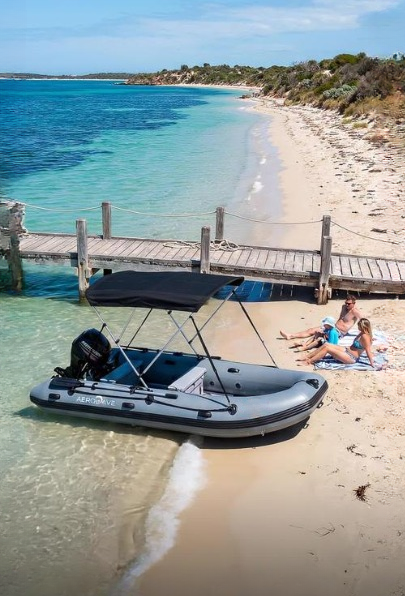
You’re probably here for one of two reasons. Either you’re tired of trailer queues, boat ramp hassle, and storing a hard boat that only gets used on the occasional weekend, or you’ve seen an inflatable catamaran on the water and realised it doesn’t behave like the old-school inflatable dinghies often imagined.
That difference matters in Australia. Our boating is rarely just one thing. One weekend it’s a quiet estuary session with a rod and tackle bag. The next it’s a beach launch, a tender run from a yacht, or a family day with kids climbing in and out over the side. A good inflatable catamaran australia setup has to handle all of that without becoming a burden on land or a compromise on water.
The smart buyers don’t just look at size and motor rating. They look at hull design, fabric, seam construction, packability, and how the boat behaves when the water stops being glassy. That’s where modern cat-style inflatables separate themselves from cheap inflatables and from some lighter-built competitors.
Australians want access, not admin. That’s the significant shift.
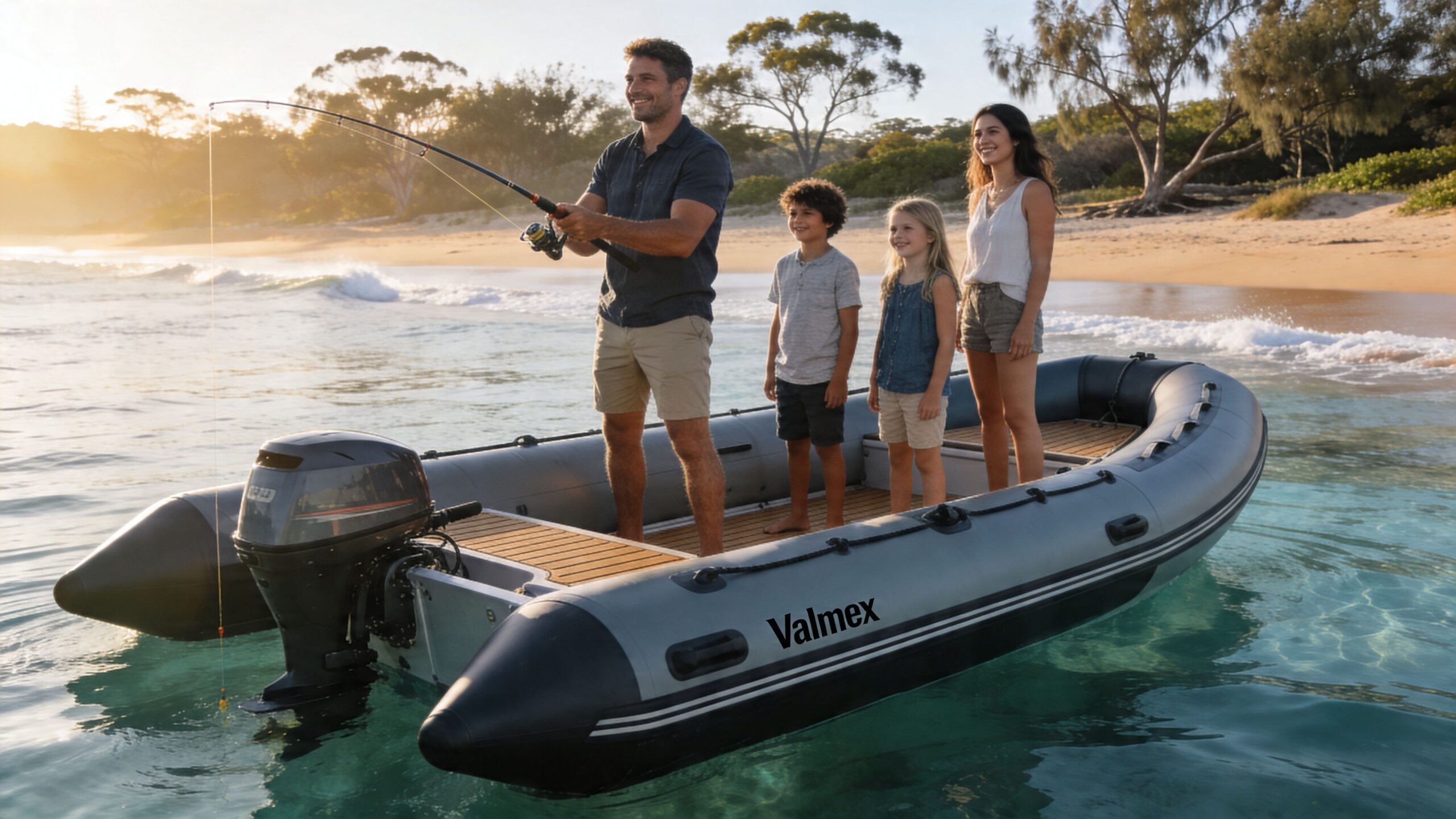
A lot of people still love the idea of a tinny, but they don’t love towing it, storing it, reversing it, washing a trailer, or waiting at a crowded ramp on a long weekend. Inflatable catamarans solve a big part of that problem. They pack down, travel easily, launch from places hard boats can’t, and still give you a capable platform for fishing, family use, and coastal exploring.
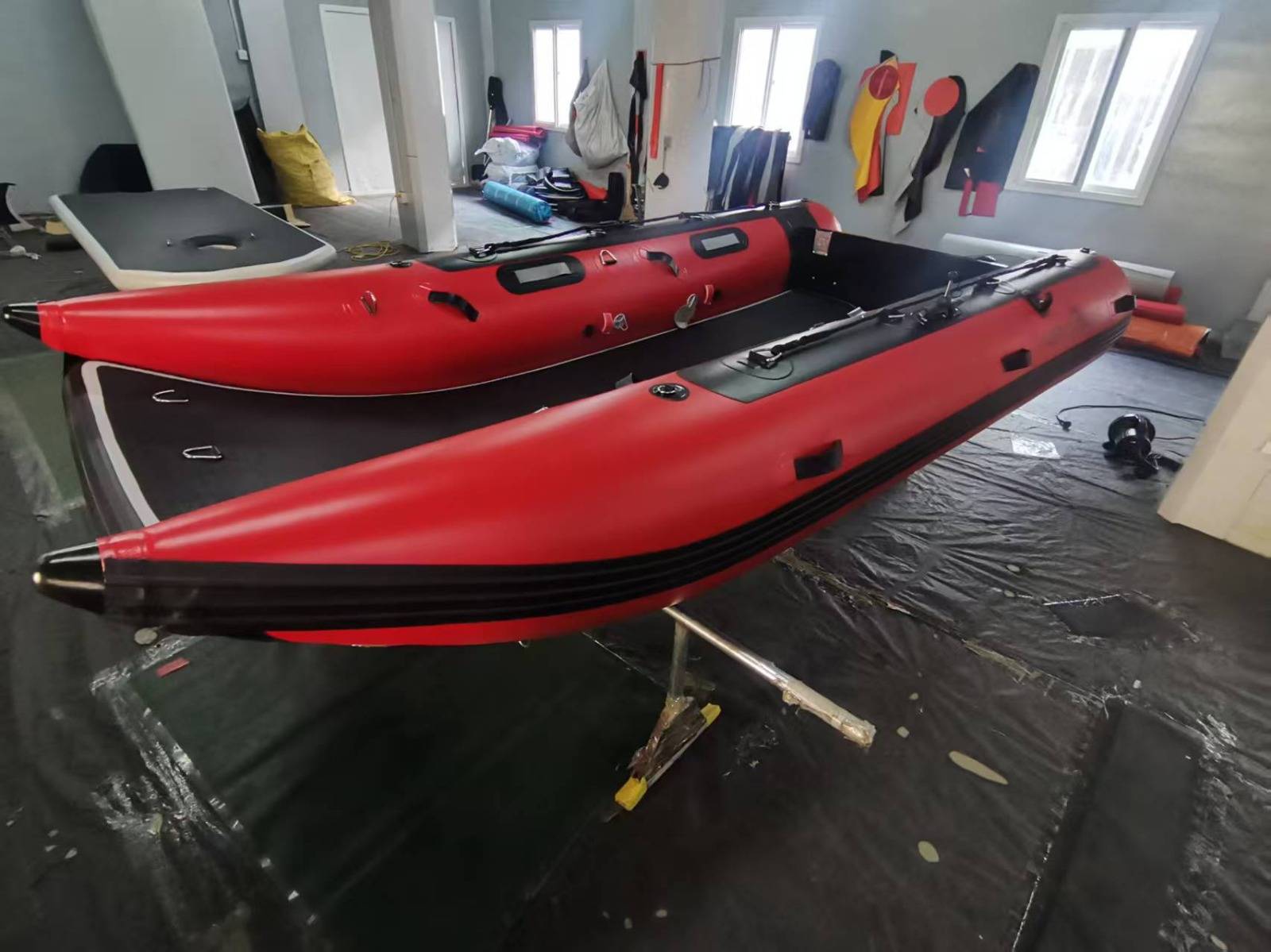
This isn’t a fringe category. Australia accounts for 82% of inflatable vessel sales in the Australia-Oceania region, and in 2023 the country recorded over 120,000 soft hull inflatable boats sold in the water sports category, according to Easy Inflatables’ overview of inflatable catamarans in Australia.
That tells you something practical. More buyers are deciding that portability, simpler storage, and beach-launch flexibility matter as much as traditional hard-hull habits.
For a lot of owners, the biggest benefit isn’t speed. It’s usage. Boats that are easier to transport and launch usually get used more often. That’s one reason interest in the benefits of buying an inflatable boat keeps growing across family, fishing, and travel buyers.
The catamaran format suits how many Australians use a small boat:
A boat that lives folded in the garage and launches from the beach often gets used more than the “better” boat that needs a trailer, a ramp, and a free half-day.
Inflatable catamarans sit in a sweet spot. They’re more capable than many buyers expect, but less demanding than a conventional trailer boat. That’s why they’ve become popular with fishos, caravan travellers, yacht owners, and families who want real boating without the usual friction.
The strongest appeal is simple. You can arrive, inflate, fit the outboard, and get moving without turning the whole trip into a logistics exercise.
The easiest way to understand a catamaran hull is to stop thinking about “inflatable” first and think about hull shape first.
A conventional inflatable with a V-hull behaves like a narrower platform. It can work well, but in chop it tends to roll more side to side. A catamaran spreads buoyancy across two separated pontoons, so the boat feels flatter and more planted. For many owners, that’s the first thing they notice.
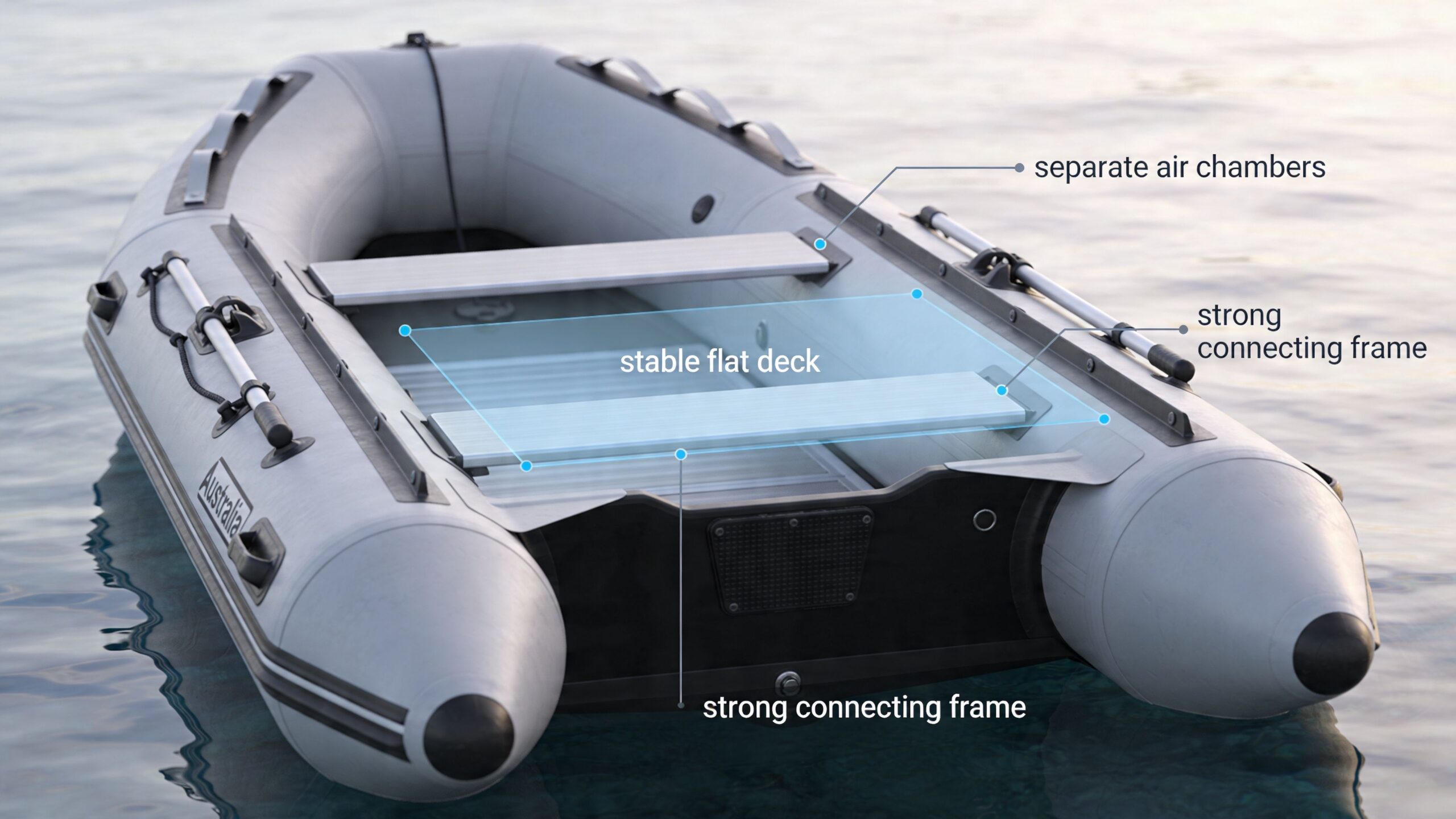
A key feature is the tunnel between the two hulls. On designs like the Aqua Marina Aircat, that tunnel traps an air cushion and creates hydrodynamic lift. According to MR Boats’ Aircat product details, this reduces wetted surface area and drag by up to 30-40% compared with traditional V-hull inflatables, which helps the boat plane faster with smaller motors.
That isn’t brochure fluff. On water, the effect shows up in three practical ways:
If you’re comparing layouts, stable inflatable boat options in Australia usually come down to this same principle. A wider stance and better lift give you a more forgiving platform.
For fishing, the gain is obvious. You can shift your weight, reach for gear, or stand to cast without that nervous rocking feeling common in narrower small boats.
For family use, it’s even more noticeable. Kids don’t move around like disciplined crew. They climb, twist, lean over the side, and crowd one corner at the wrong time. Catamarans tolerate that sort of movement better than many people expect from an inflatable.
Practical rule: If you want a small boat that feels calm underfoot, prioritise hull stance and lift before chasing extra horsepower.
A lot of buyers assume they need a larger outboard to get useful performance. Often they don’t. A well-designed inflatable catamaran can reward sensible motor matching instead of brute force.
That has a few knock-on benefits:
| Benefit | Why it matters |
|---|---|
| Lower fuel use | You’re not forcing a heavy hull onto the plane |
| Easier transport | Smaller motors are simpler to lift and store |
| Better balance | The boat stays composed instead of feeling overpowered |
| Simpler ownership | Less weight at the transom means easier setup and handling |
Inflatable catamarans shine when you want stability, shallow draft, easy beach launching, and efficient performance from modest power.
They’re not automatically the answer for every buyer. If your priority is one-person carrying over long distances, some ultra-light alternatives may appeal. If you want a rigid alloy deck and permanent trailer setup, you’re shopping a different category. But for mixed Australian use, estuaries, beaches, bays, camping trips, tenders, and family sessions, the cat design is hard to ignore because it solves several problems at once.
Most buying mistakes happen before the boat ever touches water. People compare shape, price, and included accessories, then ignore the fabric and seam method that determine how the boat will age.
That’s backwards. In Australia, material quality isn’t a luxury detail. It’s the difference between a boat that still feels tight and dependable after seasons of sun and salt, and one that starts looking tired far too early.
There’s a clear quality ladder in inflatable boats.
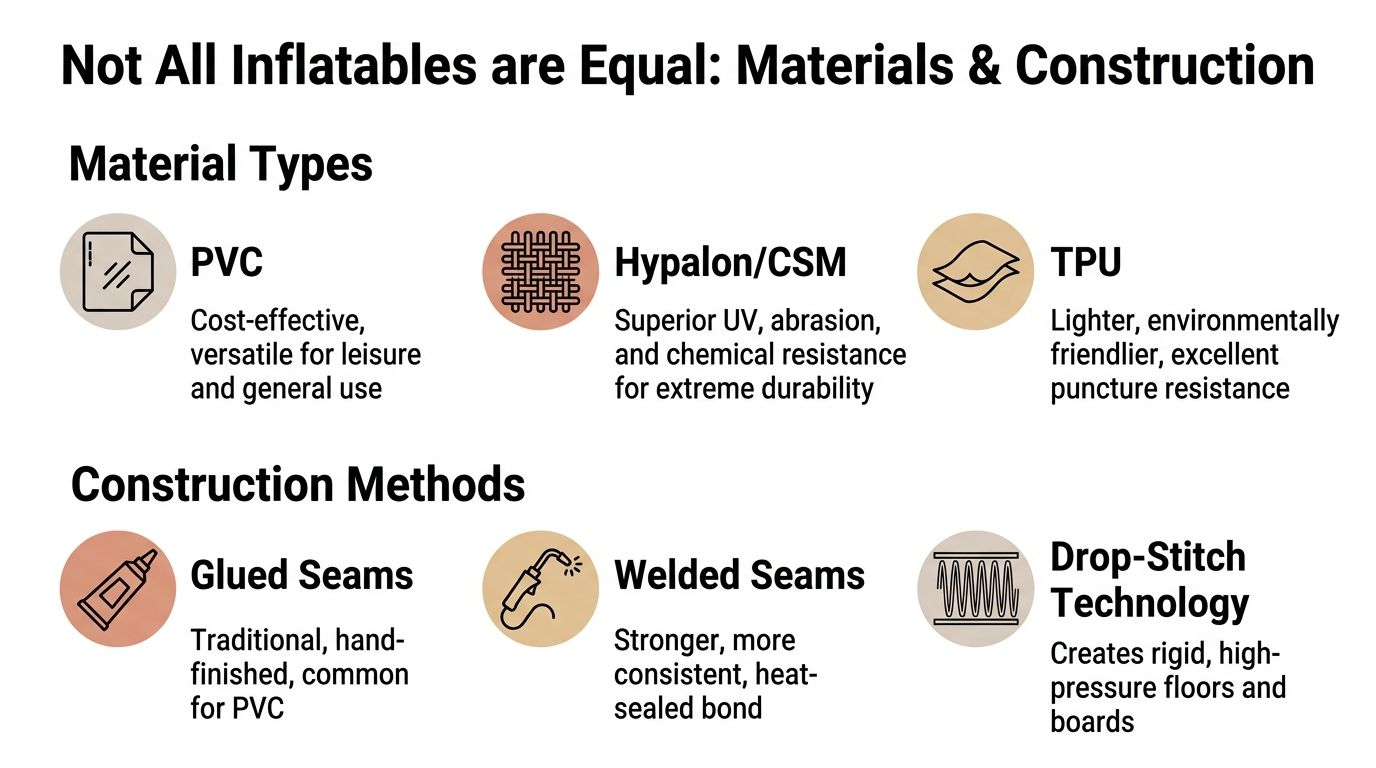
At the lower end, you’ll find lighter leisure-grade 0.7 to 0.9 PVC that can be fine for occasional sheltered use, but it generally won’t be what experienced buyers choose for repeated beach launching, reef edges, UV exposure, and regular packing and unpacking. At the stronger end, you get 1.2mm 2000D PVC and Hypalon, which are the materials serious buyers tend to focus on.
According to Island Inflatables’ ICAT335 details, high-end inflatable catamarans use 1100 D-Teck denier polyester-coated PVC. Weight: 1100 g/m2 Thickness 0.9mm & thermo-welded seams, and this construction can reduce pounding forces during wave transit by 25-50% compared with single-hull RIBs with flexible floors. The same source states this construction is rated to last 5+ years in high UV environments.
That matters because Australian use is punishing. Boats sit on hot sand, rub on oyster-encrusted ramps, cop salt spray, and spend long hours under a harsh sun. Thin material can look acceptable in a showroom and then disappoint in real life.
If you’re comparing Aerowave and Viper against Takacat or True Kit, the important question isn’t who has the slickest marketing language. It’s what fabric is being used, and what trade-off the brand has chosen.
Aerowave and Viper are built around German 1.2mm 2000D Valmex PVC or French Hypalon in the configurations highlighted by the publisher brief. That’s commercial-grade thinking. It puts durability and structural confidence ahead of shaving every possible kilo.
Takacat and True Kit attract buyers who value lightness and portability, and that can be a valid priority. But lighter construction isn’t automatically better. If your boat regularly carries family, fishing gear, fuel, and beach equipment, or if it sees constant setup and pack-down, tougher fabric usually pays you back in lifespan and feel.
Thicker, tougher material doesn’t just resist abrasion better. It also helps the hull keep its shape under load, which changes how the boat tracks and how solid it feels underfoot.
Seam construction is where many buyers get caught. A well-cut boat with ordinary seam work won’t age like a well-cut boat with proper thermo-welding.
Thermo-welded seams give you consistency and heat-bonded joins that are better suited to repeated inflation cycles and harsh marine use than older glue-dependent methods. In practical terms, they help the boat stay reliable where it matters most, along the seams, around stress points, and after repeated folding.
If you want a deeper material comparison, this guide to Hypalon vs German Mehler 1.2mm PVC material is worth reading alongside any spec sheet.
| Feature | Easy Inflatables (Aerowave/Viper) | Standard Competitors (e.g., Takacat, True Kit) |
|---|---|---|
| Fabric focus | German 1.2mm 2000D Valmex PVC or French Hypalon | Often positioned more around lighter-weight construction. They typically use 0.9mm 1100 D-Teck denier polyester-coated PVC. Weight: 1100 g |
| Seam method | Thermo-welded seams | Varies by brand and model. most are thermo welded. |
| Design priority | Durability, rigidity, real-world use, long term ownership | Portability and low carry weight often play a larger role |
| Best fit | Families, anglers, repeat-use owners, coastal users | Buyers prioritising lighter handling and compact carry |
| Long-term value logic | Higher-spec materials support longer service life 10-15 years | Lower weight can be useful, but may involve durability trade-offs |
What works:
What doesn’t:
A cheaper boat can become expensive if it loses shape, scuffs quickly, or starts needing attention before it should. A better-built inflatable catamaran australia package usually feels more expensive only on day one. After that, it often feels like the sensible buy.
Size selection is where a lot of buyers either get practical or get carried away.
Too small, and every trip feels cramped once the esky, safety gear, and motor are aboard. Too large, and you start losing the simple portability that made inflatable catamarans appealing in the first place. The right size depends less on ego and more on who’s using the boat, how far it’s being carried, and what gear comes every trip.
The fisho usually wants deck confidence first. Standing room, easy balance shifts, and enough load-carrying ability for rods, tackle, net, and a small cooler matter more than squeezing in extra passengers.
In practice, a compact to mid-size catamaran often makes sense here. It stays easy to launch and recover, but still gives you the planted feel that makes a cat hull attractive for casting and lure work. If fishing is your main use, this guide to a fishing inflatable boat covers the sort of layout choices that matter more than showroom extras.
Family buyers nearly always underestimate space. On paper, a boat may look fine for a couple of adults and children. On the beach, once towels, snacks, lifejackets, and spare clothes appear, the boat shrinks quickly.
For family use, I’d always lean toward enough room to move without everyone negotiating every step. The primary benefit isn’t just comfort. It’s safety and calm. A boat feels easier when people aren’t constantly stepping over each other.
A larger cat platform also helps when one person boards from the side or when kids gather at the bow. The boat stays more predictable, and that changes the tone of the day.
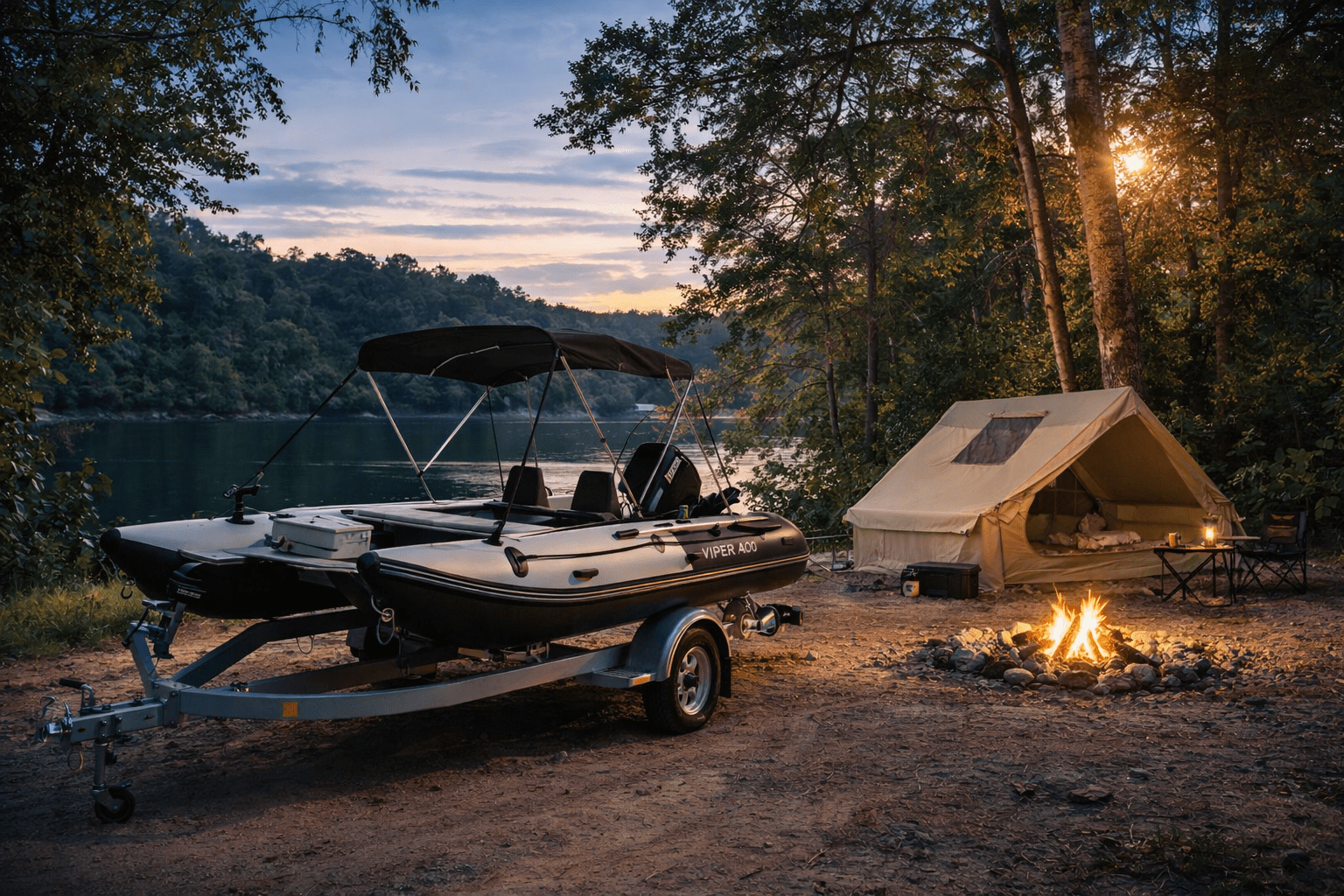
Grey nomads and road-based travellers want a boat that doesn’t create another storage problem. This buyer usually values a compact packed footprint, manageable setup, and a motor package they can handle without turning every launch into a workout.
For them, the best setup is often not the biggest one they can technically fit. It’s the one they’ll readily use at camp stops and beachside breaks. Mid-size catamarans tend to do well here because they still feel capable on water but remain realistic to pack, inflate, and move around.
Later in the decision process, it helps to watch a launch and setup sequence rather than just reading dimensions:
Tender buyers care about different things. Boarding ease, stable transfers, compact stowage, and reliable short-run performance matter more than chasing a top-end recreational setup.
An inflatable catamaran works well as a tender because the twin hulls stay composed during boarding and beach access. Open layouts also make loading groceries, bags, or fuel cans simpler than in cramped tender designs.
If the boat is mostly a tender, choose for boarding stability and storage practicality first. Extra size only helps if you can stow and handle it without hassle.
Use this filter instead of starting with the brochure’s biggest model:
The right catamaran feels easy before launch, during the trip, and when packing up wet after the trip. That’s the fit that lasts.
A good boat is only easy to own if you stay on top of the legal side and the basic care routine. Fortunately, inflatable catamarans aren’t difficult to maintain, and the rules are manageable if you check the authority for your state before heading out.
Boat registration and licensing rules vary across Australia. They commonly depend on factors such as engine size, power, vessel type, and where you operate. Don’t rely on a mate’s version of the rules, especially if they boat in a different state.
Use the official guidance for your area:
Before launch, check what safety equipment your state requires for your boating area and distance from shore. Most owners should think in terms of a basic ready-to-go kit rather than trying to add pieces later.
A sensible checklist includes:
For buyers building out a proper kit, boating safety equipment for inflatable boats is a useful planning reference.
You don’t need a complicated ritual. You need consistency.
After each saltwater trip, rinse the boat thoroughly with fresh water. Let it dry properly before packing it away. Store it out of direct sunlight where possible, and inspect valves, seams, and high-wear contact points before the next trip.
The owners who get the longest life from inflatable boats usually do the simple things every time:
Boats don’t usually fail because one dramatic thing happened. They wear out because salt, UV, moisture, and neglect keep getting a free run.
Once you’ve narrowed down hull style, fabric quality, and the right size, the next question is simple. Do you want to piece together a package from multiple sellers, or do you want a matched setup that’s ready to use?
For many buyers, turnkey makes more sense. A catamaran, outboard, pump, storage bag, and accessories work better when they’ve been selected to suit each other rather than assembled through trial and error. That’s especially true for first-time buyers and for travellers who don’t want surprises at the shoreline.
A proper inflatable catamaran package should solve the main ownership jobs in one go:
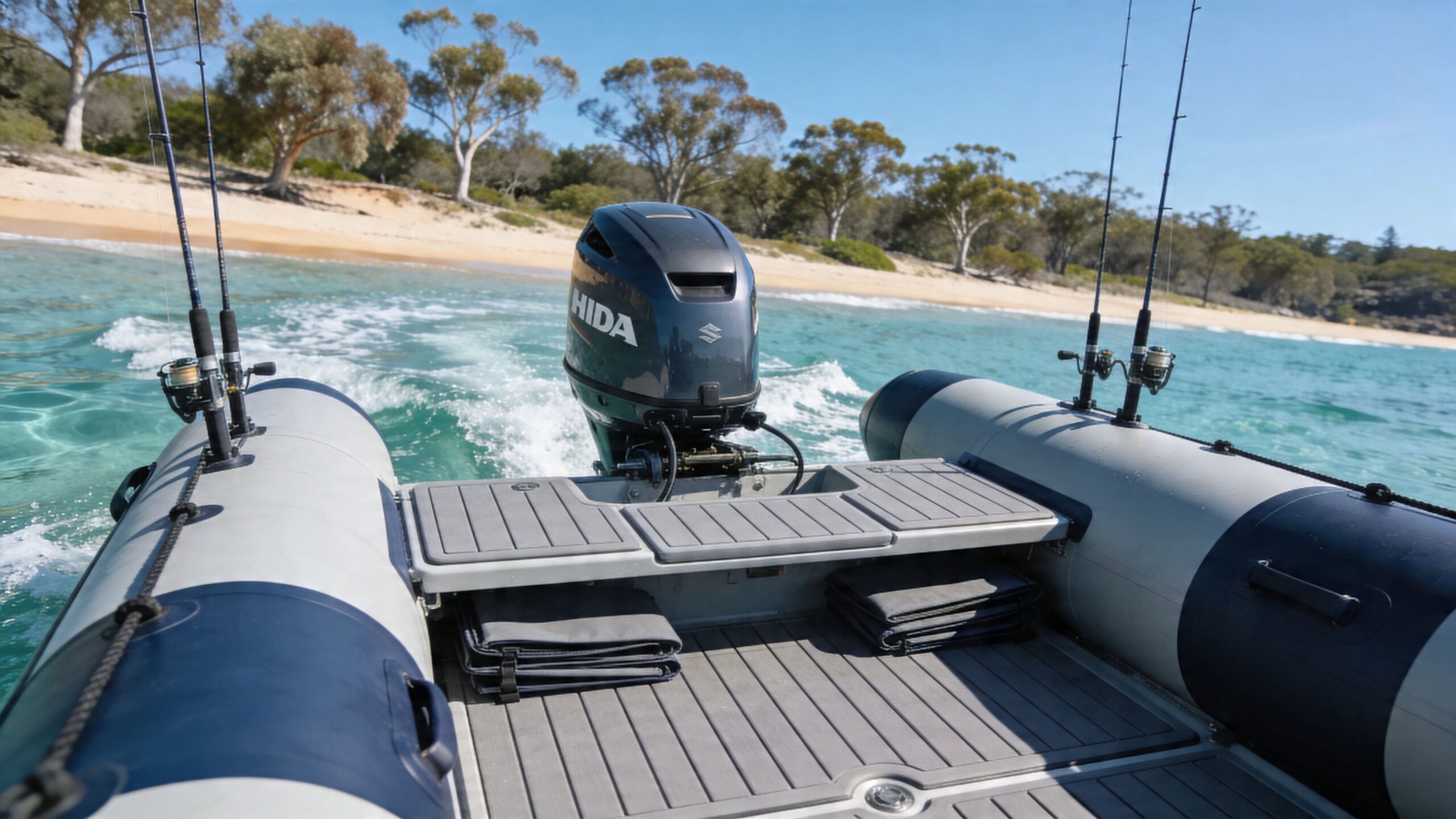
Easy Inflatables is one Australian retailer and designer in this category, offering Aerowave inflatable boats, catamarans, tenders, accessories, and Hidea outboard packages, with construction details in the publisher brief that include 1.2mm 2000D German Valmex PVC or French Hypalon, thermo-welded seams, aluminium transoms, and package options such as fitted biminis, bags, rod mounts, and high-pressure pumps.
A quality hull still becomes frustrating if the pump is weak, the motor match is poor, or the storage setup is an afterthought.
The best ownership experience comes from a rig that launches without fuss, runs efficiently, and packs away without a fight. That’s why practical buyers often look beyond the headline boat spec and ask better questions:
The most dependable inflatable catamaran australia setup is usually the one that balances four things well. Good fabric. Sound seam construction. Sensible motor matching. Accessories that support the way you really boat.
If you get those right, the boat becomes easy to own, not just exciting to buy.
Hire options vary a lot by region, and local operators change regularly, so the sensible move is to search within your coastal town, lake district, or holiday area and confirm exactly what type of boat they offer. Many hire fleets focus on standard tinnies, kayaks, or small runabouts rather than inflatable catamarans.
If you’re specifically interested in a catamaran-style inflatable, ask about hull type, passenger suitability, and whether the operator allows beach landings. That tells you more than a generic “boat hire available” listing.
That depends on your use. For calm family outings and mixed recreational boating, a catamaran-style inflatable is often the strongest all-rounder because it combines easy transport with a stable on-water feel. For dedicated carrying over long distances, lighter-weight boats may suit some buyers better. For more permanent trailer-based boating, a rigid boat may still be the right fit.
The useful comparison isn’t “which brand is best”. It’s “which construction and hull style match the way I boat most often”.
Start with construction, then compare package value. A lower upfront price can be misleading if the boat uses lighter fabric, less strong seam work, or a basic accessory bundle that you’ll replace later.
Use this order:
That gives you a realistic value comparison instead of a shallow price comparison.
The clearest difference is the design priority. Aerowave and Viper are positioned around tougher material specification and durable construction. Takacat and True Kit often appeal to buyers who place more value on lighter weight and easy portability.
Neither approach is automatically wrong. The better choice depends on your use. If you want a more durable, commercial-grade feel for regular Australian family, fishing, and coastal use, the heavier-duty material approach has a strong practical case. If your priority is minimising carry weight above all else, a lighter build may appeal.
They can be, but “open water” is too broad to answer casually. Conditions, distance offshore, load, motor choice, weather, and your local rules all matter.
What catamarans generally do well is provide a stable platform and predictable ride in the sort of coastal and bay conditions many small-boat owners use. That doesn’t remove the need for judgment. Always operate within the boat’s rating, carry the required safety gear, watch weather closely, and stay within the conditions your skill level supports.
No. They’re straightforward if you stay disciplined.
Rinse after saltwater use, dry before storage, inspect seams and valves, and store the boat out of harsh sun when it’s not in use. Most long-term problems come from poor storage and skipped post-trip care, not from the design itself.
If you’re ready to compare real inflatable catamaran options built for Australian conditions, browse the range at Easy Inflatables and match the boat to how you fish, travel, or spend time on the water.