
Getting an outboard from the car to the water is often the least enjoyable part of the day. The boat is packed, the weather looks good, and then you’re left awkwardly carrying a heavy motor across hot bitumen, loose gravel, or soft beach sand while trying not to knock the skeg, smear grease on your clothes, or strain your back before you’ve even launched.
For plenty of Australian boaters, that’s the point where a quick session turns into hard work. It’s even more noticeable with inflatable setups, because one of the biggest advantages of an Aerowave boat or inflatable catamaran is portability. If the motor still feels like a deadweight obstacle, the whole rig becomes less practical than it should be.
A familiar scene plays out at beaches and ramps all around Australia. You unload the boat bag, the pump, safety gear, rods, and fuel tank. The inflatable boat is manageable. The outboard is the awkward bit. It’s heavy in all the wrong places, slippery to hold, and unforgiving if you put it down badly.

That’s where an outboard motor trolley changes the experience. Instead of wrestling the motor from the vehicle to the transom, you roll it. You keep the engine upright and controlled. You stop treating the heaviest part of the setup like a problem that has to be manhandled every trip.
At a sealed boat ramp, a trolley saves effort. On beach access, it can be the difference between a smooth launch and a frustrating start. Families notice it because one person can focus on the kids or the gear while the other moves the motor safely. Anglers notice it because they can make solo launches without improvising. RV travellers notice it because every item needs to earn its place and do more than one job.
Practical rule: If moving your outboard feels like the hardest part of boating, the setup isn’t working as efficiently as it should.
A good trolley also fits the broader appeal of portable boating. You’re not just buying a cart. You’re reducing setup friction so the boat gets used more often. That’s part of the same thinking behind choosing a portable inflatable in the first place. If you’re comparing that style of boating with more traditional options, the benefits of buying an inflatable boat become even clearer once the motor is easy to move as well.
The main benefit isn’t glamour. It’s momentum. You arrive, unload, roll the motor over, mount it cleanly, and get on with the day. Less lifting, less risk, less hesitation about whether the trip is worth the effort.
That’s what makes a trolley one of those accessories people often buy after they’ve already had enough of carrying an outboard by hand.
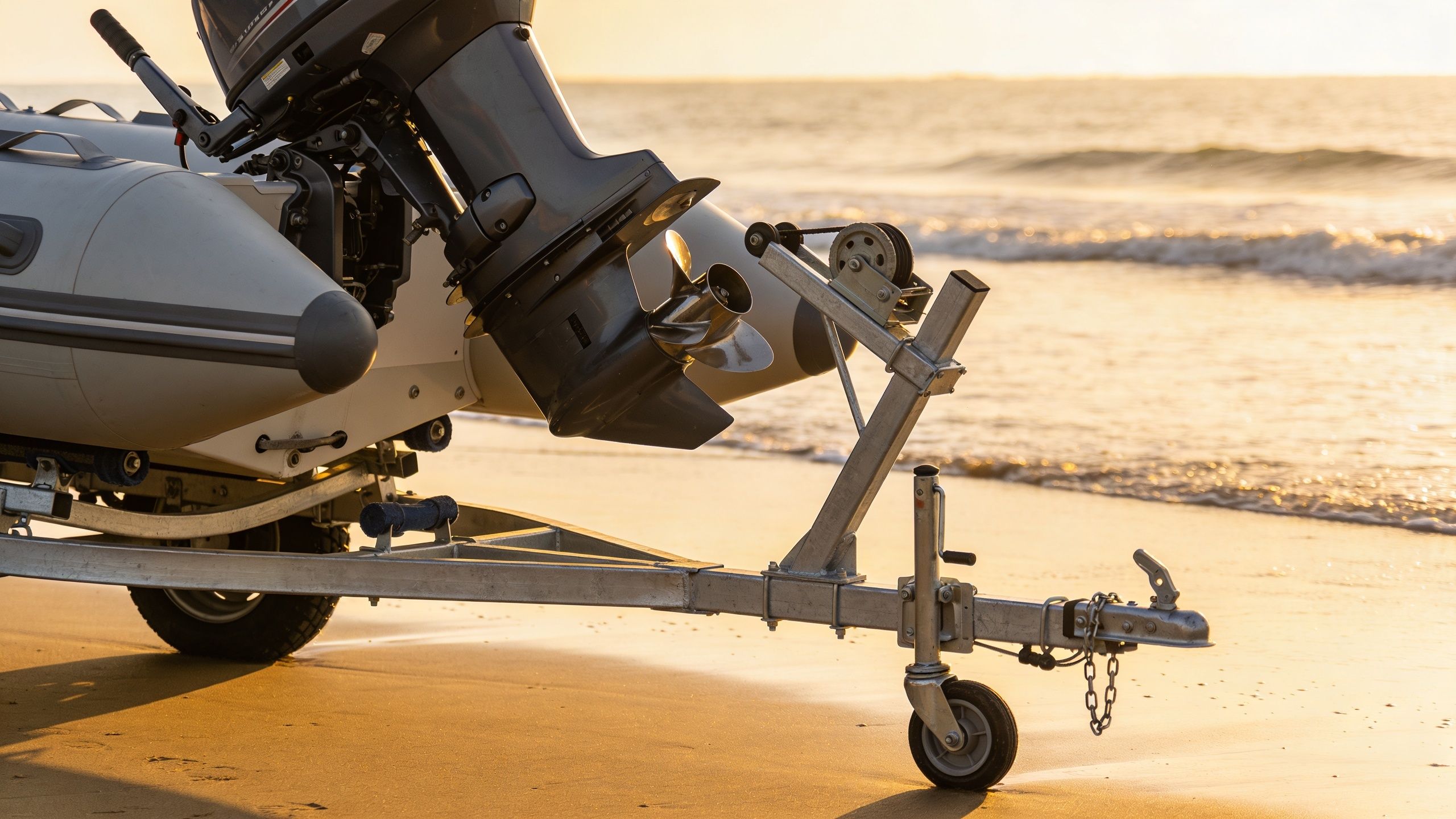
An outboard motor trolley is a wheeled stand designed to hold, move, and support an outboard motor when it’s off the boat. The simplest way to think about it is this. It’s part transport cart, part workshop stand.
That dual role is what makes it useful. A lot of people first look at one as a convenience item for the boat ramp, but in practice it earns its keep just as much at home, in the garage, beside the shed, or at the caravan site.
When you clamp the motor onto a trolley, you create a stable platform for moving it without dragging, tilting, or resting it on the wrong parts. That protects the lower unit and skeg from knocks and stops the sort of clumsy handling that often happens when two people try to “just carry it carefully”.
A trolley also keeps the motor at a workable height. That matters when you’re flushing after a saltwater trip, doing a quick inspection, or storing the engine between outings.
A good trolley acts like a workshop assistant for your outboard. It holds the engine where you need it, when you need it.
Transport
You move the motor from the car, trailer, garage, or campsite to the boat without awkward lifting over distance.
Storage and maintenance
You’ve got a stable stand for short-term storage, cleaning, and routine checks.
Protection
The motor stays off the ground and under control, which reduces accidental bumps and poor storage habits.
For inflatable boat owners, this matters even more because the rest of the package is already built around portability. Add proper wheels for an inflatable boat and the whole launch process becomes far more manageable from end to end.
A trolley isn’t a substitute for careful lifting technique. It also won’t fix a poor launch path. If you’re crossing very soft sand, steep rock edges, or deep ruts, wheel design and handling still matter. And if the trolley is undersized, badly balanced, or cheaply built, it can become another problem instead of a solution.
That’s why the right trolley feels secure and predictable. The wrong one feels flimsy before it even reaches the water.
Choosing the right outboard motor trolley comes down to three things. Capacity, construction, and usability in the places you launch. If one of those is wrong, the trolley becomes annoying very quickly.
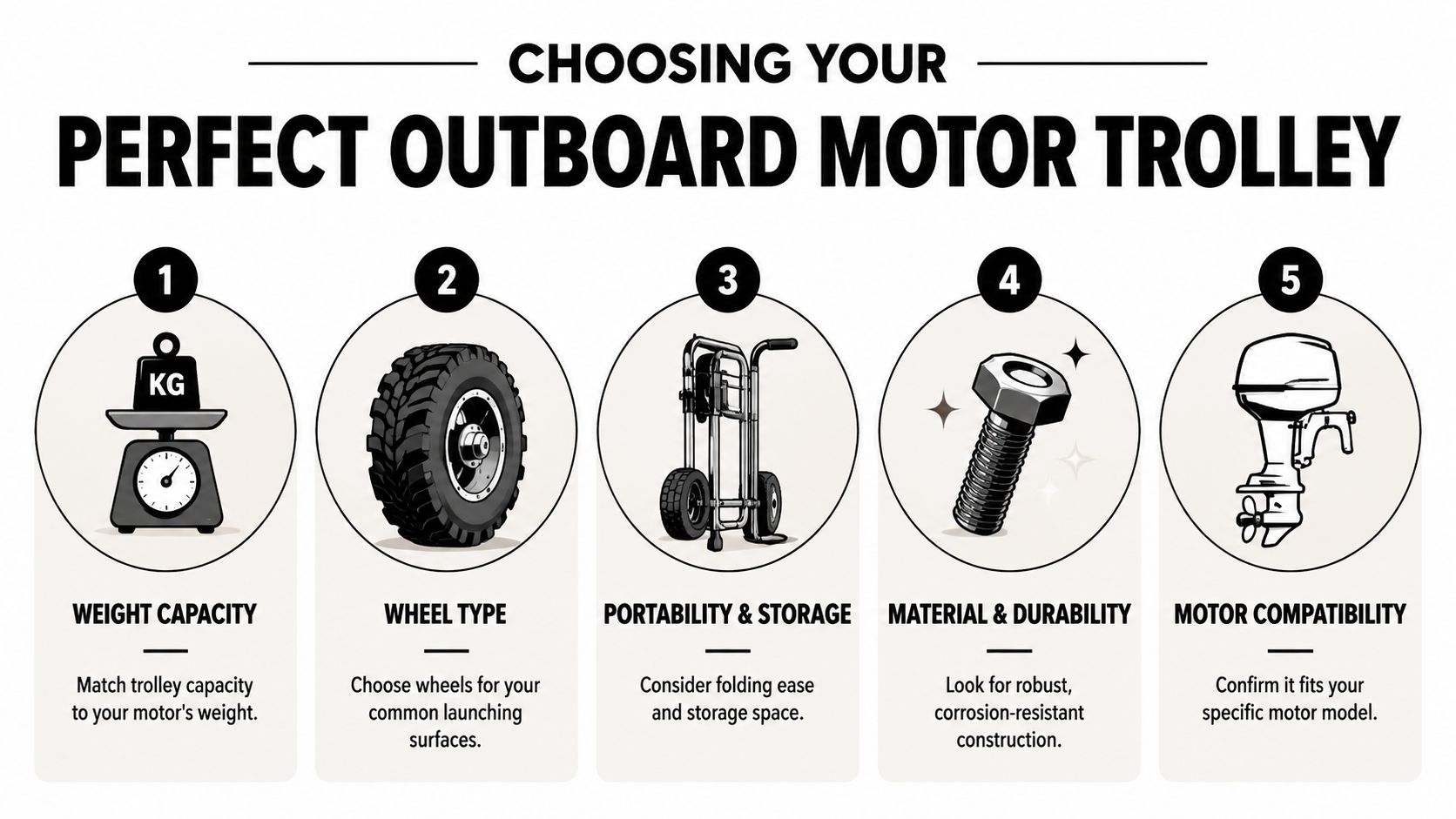
This is the first filter. Everything else comes after it.
Standard trolleys typically feature a 79 kg capacity suitable for motors up to a 30 HP 4-stroke. A popular 15 HP Hidea outboard weighs around 55 to 60 kg, which makes a 70 to 80 kg capacity trolley an appropriate match. Undersizing a trolley on rough Australian beach access tracks risks structural failure and costly damage to the motor, based on the guidance published by Boat Specialists on outboard motor trolley capacity.
That tells you two useful things. First, don’t choose by guesswork. Second, don’t buy right on the edge of the rating if your launch path is rough, uneven, or sandy.
Use the motor’s real carried weight as your starting point, then leave room for control and durability. A trolley that merely survives the load isn’t the same as one that handles confidently.
| Motor and use case | What to look for in a trolley |
|---|---|
| Small portable outboard for tender use | Light frame, simple storage, easy clamp access |
| Mid-size outboard for regular beach launching | Stable base, decent wheel size, secure mounting block |
| Larger outboard moved over rough ground | Heavy-duty frame, higher capacity, stronger wheel and axle setup |
Australian boating gear gets punished by salt spray, sand, humidity, and outdoor storage. A trolley might look fine in a product photo and still age badly if the frame coating chips or the hardware corrodes.
Here’s the actual trade-off.
For beach-launched inflatables, corrosion resistance usually matters more than showroom appearance. If the trolley will live in a garage and only travel on clean ramp days, you can accept more compromise. If it will see sand, rinse water, and coastal air week after week, choose materials accordingly.
The trolley doesn’t need to be fancy. It needs to stay straight, stable, and resistant to the environment you boat in.
At this stage, many buyers either choose well or end up with something that’s irritating every trip.
Not all wheels suit the same ground.
If you travel in an SUV, tow a camper, or pack for long weekends, folding design matters. A trolley that takes up too much room often gets left behind. That defeats the whole point.
A compact setup pairs well with other portable gear choices, including a foldable boat trailer when storage space is limited at home or on the road.
The mounting board should give the clamps a secure bite and hold the motor squarely. If the board flexes, sits too narrow, or feels unstable under load, the trolley won’t inspire confidence. Look at the width, the stance, and how the handle position affects balance when you tilt the weight back onto the wheels.
Works well: matching capacity properly, choosing corrosion-resistant materials, and selecting wheel size for your real launch terrain.
Doesn’t work well: buying purely on price, assuming every foldable trolley suits larger motors, or ignoring how far you need to move the engine each trip.
The right trolley feels boring in the best possible way. It just works.
An outboard motor trolley makes the most sense when the rest of the setup is portable too. That’s why inflatable boats, inflatable catamarans, and compact outboards are such a natural match for it. You’re building a system that one person can manage without drama.
For Aerowave owners, the main advantage is how neatly a trolley fits into the launch workflow. Inflate the boat, stage the gear, roll the motor into position, and transfer it to the aluminium transom with control. That’s a cleaner process than carrying the motor first and then trying to keep it upright while you organise everything else.
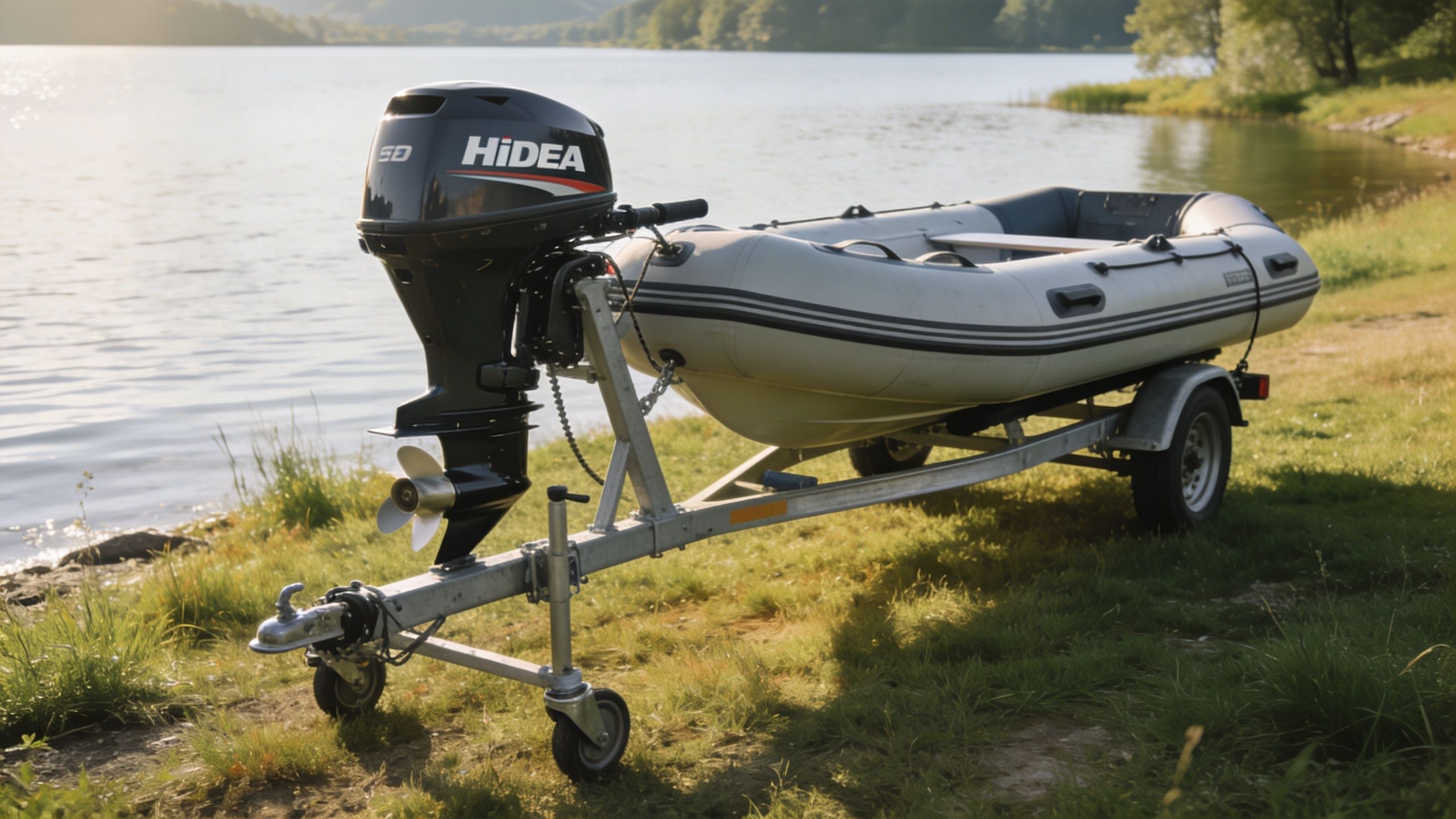
A portable boat only stays convenient if each component is manageable on its own. The hull can be light and compact, but the outboard is still dense and awkward. The trolley closes that gap.
That’s especially useful in common Australian scenarios:
If you’re running a smaller portable outboard, the focus is usually on easy lifting, compact storage, and quick mounting. With larger motors, frame strength and wheel stability matter more. The same trolley category won’t suit every motor in the range, even if it technically fits the clamps.
That’s why compatibility questions are worth checking early, especially if you plan to upgrade later. A lightweight trolley may suit a small tender motor perfectly and still be the wrong long-term choice for a bigger fishing rig.
Buy for the way you launch now, but don’t ignore the motor you’re likely to run next.
For owners comparing models, the Hidea outboard motors value-driven guide is useful for understanding where different outboards sit within a portable inflatable setup.
If you’re building a matched inflatable-and-outboard package, Easy Inflatables supplies Aerowave boats and Hidea outboards as part of that broader portable boating category. The key point isn’t branding. It’s that the trolley should be chosen as part of the full setup, not as an afterthought once the motor has already become inconvenient to move.
That’s usually where the smartest buying decisions happen.
Most problems with an outboard motor trolley come from rushing the basic handling. The trolley itself might be fine, but if the motor is clamped poorly, balanced badly, or pushed over unsuitable ground without control, things go wrong fast.
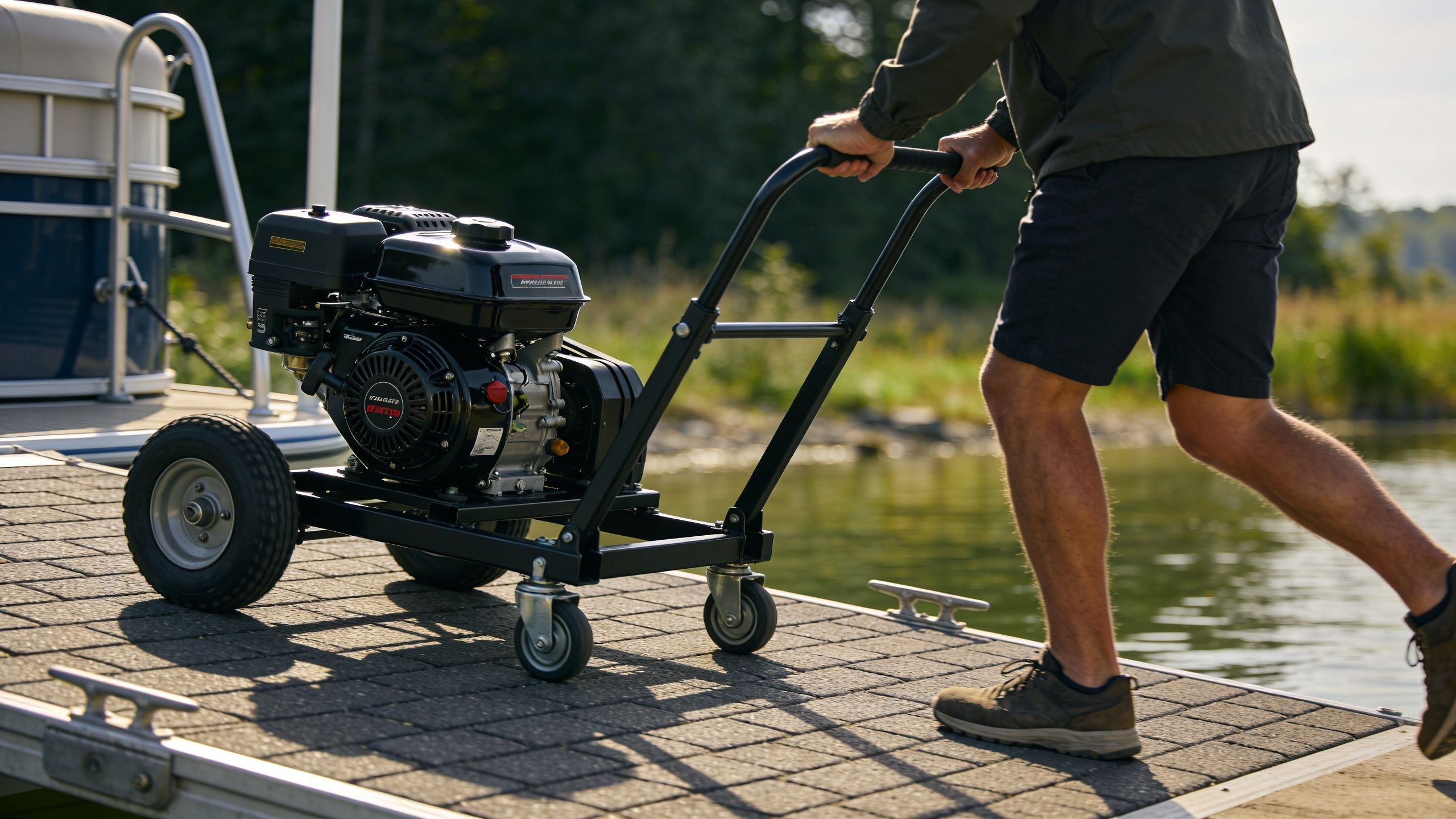
Start on level ground. Position the trolley so it can’t roll away while you’re loading the engine. Lift the motor with control, align it squarely on the mounting block, and tighten the clamps firmly and evenly.
Check that the engine sits centred, not twisted. If it leans to one side, the trolley will feel unstable as soon as you tilt it back onto the wheels.
A quick pre-move check helps:
Clamp security
Wiggle the leg gently. It shouldn’t shift on the board.
Handle balance
Tip the trolley back slightly and feel whether the load stays predictable.
Path assessment
Look ahead before moving. Sand pockets, drop-offs, ramp lips, and loose stones matter more when you’re carrying engine weight on wheels.
An outboard trolley should be pushed or pulled with deliberate control. Keep your speed down and avoid sharp direction changes on uneven surfaces. At ramps, stay clear of wet algae and polished concrete where wheels can slide.
On soft sand, don’t force it in a straight aggressive push if the wheels start digging. Short controlled movements work better. Sometimes it’s smarter to stop earlier, reposition the boat, and shorten the distance the trolley has to travel.
If the trolley starts feeling sketchy, the answer usually isn’t more force. It’s a better angle, a shorter route, or a second pair of hands.
The safest transfer is the one that involves the least twisting. Bring the trolley close to the transom, line up the motor before lifting, and keep the lift short. Don’t carry the engine while turning your torso if you can avoid it.
For inflatable boats, it helps to stabilise the stern first so the boat doesn’t drift or shift just as you lift. At the beach, that may mean keeping the boat lightly grounded. At the ramp, it may mean securing the boat briefly alongside.
This walk-through gives a good visual reference for the handling sequence:
Handled properly, the trolley takes strain out of the job. Handled badly, it just relocates the risk.
A trolley used around saltwater needs routine care. Not complicated care. Just consistent care. Most of the issues that shorten trolley life start after the trip, when salt, sand, and moisture are left sitting in the frame, wheels, fasteners, and mounting block.
Give the trolley a thorough freshwater rinse after any coastal use. Pay attention to wheel hubs, axle areas, bolts, and any place where sand can lodge. If you skip that step repeatedly, corrosion starts in the places you won’t notice until something stiffens, flakes, or seizes.
Then let it dry before storing it. Folding a wet trolley and shoving it into a vehicle or shed is a reliable way to trap moisture where you don’t want it.
A practical routine looks like this:
If your trolley uses pneumatic tyres, inspect them regularly. Dry cracking can creep up on gear that sits in the sun or spends long periods stored between trips. This tire dry rot prevention guide gives a useful general overview of what to watch for and how storage conditions affect tyre life.
A light protective treatment on exposed metal parts helps, particularly for boaters who launch often in saltwater. An anti-rust spray for marine gear can be part of that routine if used sensibly on appropriate areas.
Salt doesn’t need much time to start causing trouble. A quick rinse now saves replacement parts later.
A trolley adds value. It holds the outboard at a workable height for flushing, visual inspections, and general cleaning. That means you’re more likely to do the small maintenance jobs after a trip, because the motor is already in a stable position instead of sitting awkwardly on the ground or against a wall.
That habit protects both pieces of gear. The motor lasts better, and the trolley stays fit for the next launch.
An outboard motor trolley solves a very ordinary problem, but it has a big effect on how often and how confidently you use your boat. It reduces awkward lifting, protects the motor during transport, and makes setup and pack-down far less draining.
For inflatable boat owners, that matters more than it might with larger fixed setups. Portability only works when the whole package is manageable. If the outboard is still the part you dread moving, spontaneity disappears quickly.
A trolley also keeps your gear organised between trips. The motor has a proper place to sit. Flushing and inspections are easier. Launching at a beach or ramp feels more controlled.
That’s why this isn’t just another accessory. It’s a practical part of a portable boating system. Choose one that suits your motor, your launch terrain, and your storage space, and you’ll spend less time wrestling with equipment and more time doing what the boat was bought for in the first place.
Not always, but very small wheels usually become frustrating on mixed surfaces. If you launch from soft sand, loose gravel, or rough access points, a trolley with more substantial wheels is generally easier to control than a compact design built mainly for smooth concrete.
Yes, if the frame, joints, and capacity suit the motor you’re carrying. The issue isn’t whether it folds. The issue is whether the folding design stays rigid under load. A well-built foldable trolley is useful for SUV and caravan travel. A flimsy one feels loose every time you tilt it back.
It can be useful for short-term storage and maintenance, provided the trolley is stable, the motor is clamped securely, and the setup is kept in a suitable storage environment. For longer storage periods, check the manufacturer guidance for your motor and make sure the engine remains properly supported.
Keep the trolley from rolling or shifting, and stop the motor from twisting on the mount. Use proper tie-down points and avoid letting the engine rest against parts that can be damaged in transit. Because Australia-specific transport guidance varies and the available source material doesn’t provide authoritative local rules, the safest approach is to check your state or territory road requirements and your motor manufacturer’s handling guidance before travelling.
In many setups, yes. That’s one of the main advantages. A trolley helps one person move the engine in a controlled way while keeping the inflatable boat launch process organised. The key is matching the trolley to the motor and choosing a launch path that suits the wheel type and terrain.
Usually not for routine handling. Many owners use the trolley as their day-to-day transport and maintenance stand. If you do more involved workshop servicing, a dedicated stand may still be handy, but for most portable boating setups the trolley covers the main jobs well.
If you’re putting together a practical portable boating setup, Easy Inflatables is a useful place to compare Aerowave inflatables, inflatable catamarans, Hidea outboards, and supporting accessories that make beach launches and ramp days easier to manage.