
Owner setup guide
Fix Cavitation & Aeration on Your Outboard
The single most common setup issue on every light inflatable boat in the world — and it's solved with the correct transom height and a one-size-up high-thrust prop. No engine repair, no warranty claim, no expensive workshop. 20 minutes with a spanner.
Transom standard
380 – 410 mm
Aerowave open-bow
405 mm
Typical fix cost
AUD $80 – $160
Standard inflatable boat transom height
Every Easy Inflatables open-bow hull is built to the international short-shaft standard. The transom — the flat panel at the back of the boat where the outboard mounts — is set at 405 mm (40.5 cm). The international short-shaft transom range is 380 – 410 mm; anything inside that window will accept a standard short-shaft (S) outboard from Yamaha, Suzuki, Tohatsu, Mercury, Honda or Hidea without modification.
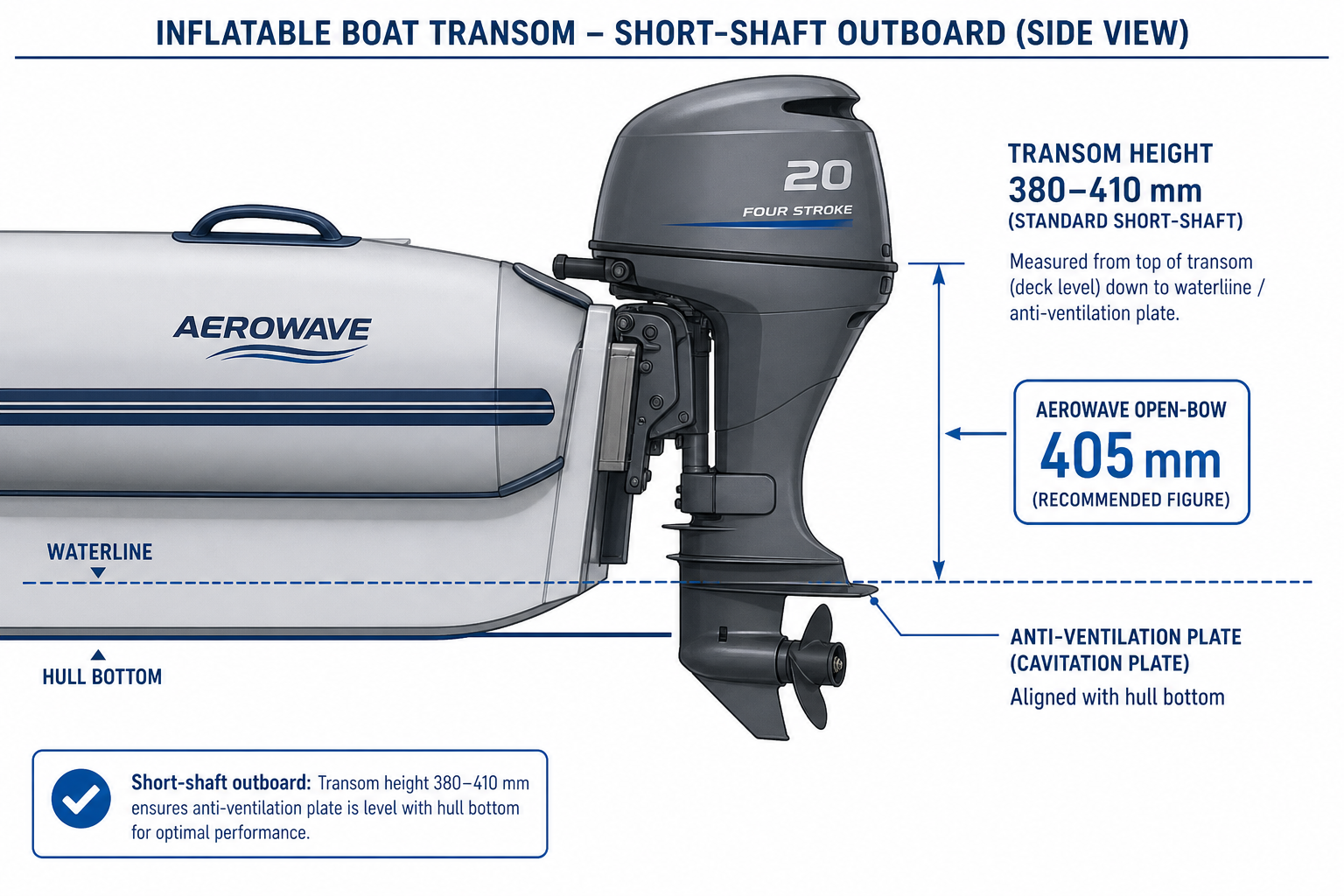
Correct setup
Anti-ventilation plate (the flat fin above the prop) sits level with the hull bottom. Water flows cleanly over it; air can't get to the prop blades.
Wrong setup
Plate sits above the hull line (motor too high on transom or long-shaft on a short transom) — air rolls under the plate on hole-shot and the prop ventilates. Fitting a long-shaft (L) motor to a 405 mm transom buries the powerhead too deep and floods the cowling.
Cavitation vs aeration — what's actually happening
Cavitation
Low pressure on the back side of a spinning prop blade turns water into vapour bubbles. The bubbles collapse against the blade and over time pit the metal. You hear it as a sudden over-rev with no thrust gain. Most common cause on inflatables: the wrong prop pitch for the boat weight.
Aeration (ventilation)
Air from the surface gets sucked down into the prop because the cavitation plate is too high or the bow is angled too far up on hole-shot. Same symptom — engine revs climb, boat doesn't accelerate — but the cause is air, not vapour. On a light inflatable, aeration is the bigger problem of the two.
How to tell your prop is wrong
If you tick two or more of these on your boat, you don't have an engine problem — you have a prop problem. The factory-supplied prop on most short-shaft outboards is pitched for a heavy aluminium dinghy, not a light inflatable that planes early and unloads the prop quickly.
- Engine over-revs past its WOT band — sounds shrill, frantic, no extra forward push.
- Boat sits flat in the water for 4–6 seconds before it gets onto the plane.
- Prop whines and air-sucks every time you punch the throttle from rest.
- Top speed feels lower than the brochure number, even with a healthy engine.
- Boat won't hold plane at low throttle — needs almost full throttle just to stay up.
The fix — go one size up to a high-thrust prop
On a light inflatable cat or open-bow you almost always want to go one size larger in diameter and drop one inch in pitch — what propeller shops call a high-thrust prop. More water grabbed per revolution, the engine settles into its correct rev band under load, and the prop keeps biting through hole-shot instead of spinning air.
| Outboard | Factory prop | Upgrade to (high-thrust) | What it fixes |
|---|---|---|---|
9.9 – 15 hp short shaft Yamaha · Suzuki · Tohatsu · Mercury · Hidea | 9-1/4 × 9 alloy | 10-3/8 × 8 high-thrust alloy | Hole-shot, aeration, plane time |
20 – 25 hp short shaft Yamaha · Suzuki · Tohatsu · Mercury · Hidea | 10-3/8 × 11 alloy | 10-3/4 × 9 or 11 × 10 high-thrust | Over-revving at WOT, mid-range bog |
30 hp short / long shaft Yamaha · Suzuki · Tohatsu · Mercury · Hidea | 10-3/8 × 13 alloy | 11 × 11 high-thrust | Drops 600–900 rpm into rated band |
Diameter and pitch are inversely related — going up 1″ in diameter usually means dropping 1″ in pitch to keep the engine in its rev band. Going up two pitch sizes without dropping diameter will over-load the engine and shorten its life. Always confirm against your engine's WOT rev range on a GPS speed run.
Self-diagnose in 5 minutes — the WOT rev check
- 1Warm the motor and load the boat as you normally use it (two adults plus gear).
- 2Run a GPS speed pass on flat water at WIDE-OPEN throttle for 10 seconds.
- 3Note the rpm reading (or listen — over-revving sounds shrill and frantic).
- 4ABOVE rated WOT band → go up 1″ pitch (or up 1″ diameter, down 1″ pitch).
- 5BELOW the band → drop 1″ pitch.
- 6IN band but plane time > 4 seconds → keep pitch, go up 1″ diameter, fit a hydrofoil or Permatrim.
Reference WOT bands: Hidea/Yamaha 9.9–15 hp short shaft → 5000–6000 rpm; 20–30 hp four-strokes → 5300–6300 rpm. Check the sticker on your engine cowl for the exact range.
Pair with a hydrofoil or Permatrim
A correctly sized prop plus a hydrofoil or Permatrim plate is the magic combination. The plate keeps air off the prop during hole-shot; the correctly pitched prop keeps the engine in its rev band once you're on the plane. Either one alone helps. Together they transform a light inflatable.
Read the full hydrofoil & Permatrim guideNot sure which prop to order?
Email sales@easyinflatables.com.au with your engine make/model, hull size, and the numbers stamped on your current prop. We'll spec the correct high-thrust replacement for you free of charge — no obligation, no upsell. We sell boats and outboards, not props, so the advice is honest.