ACR Rescue Beacon Your Ultimate Safety Guide
A complete guide to your ACR rescue beacon. Learn how it works, how to register it in Australia, and essential maintenance for any adventure.
At a glance
A complete guide to your ACR rescue beacon. Learn how it works, how to register it in Australia, and essential maintenance for any adventure.
- Your Lifeline When You're Off The Grid
- The Two Pillars of Personal Safety
- How Your Beacon Triggers a Rescue Mission
- From Space to Ground Control
What we'd put you in
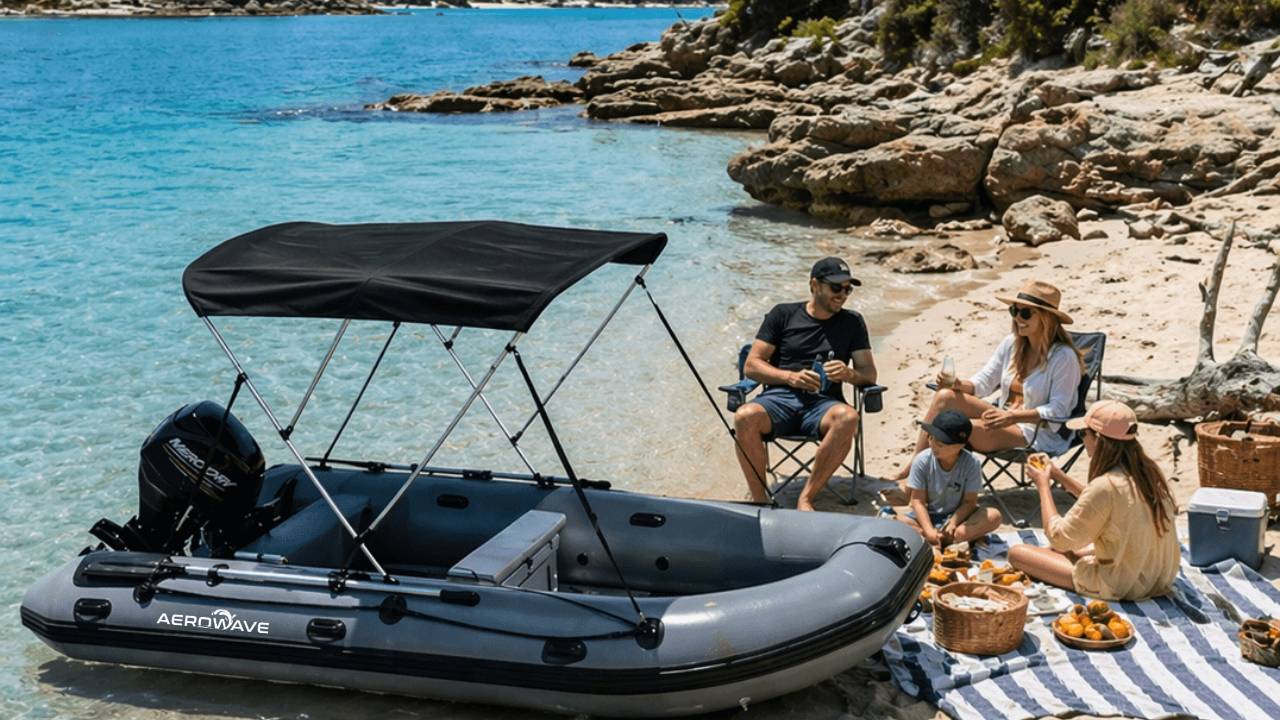
Aerowave Viper 400 Sovereign
Our best-selling boat: 4.0 m, 1.2 mm VALMEX hull, 7-year hull warranty.
US$3,167 USD
Delivered to your door, today's rate
- Free freight to United States · local taxes payable on arrival
- 7-year hull warranty
🇺🇸 Shipping to United States · landed price quoted in writing
Yes — we ship the Aerowave Viper 400 Sovereign to United States. Here's the landed price.
Our best-selling boat: 4.0 m, 1.2 mm VALMEX hull, 7-year hull warranty.
Aerowave Viper 400 Sovereign
- Boat package (export price)
- US$3,726
- 15% tariff relief credit
- − US$559
- Express air freight to United States
- Included
- Import duty, taxes & customs clearance
- Payable on arrival
- Estimated landed, USD
- US$3,167
Indicative, converted at today's rate, before local duty and tax on arrival. Ask below and we'll put a fixed figure in writing, valid 30 days.
- 7-year hull warranty
- 1500 GSM / 1.2 mm VALMEX® Heavy Plus hull
- CE certified to ISO 6185-3 and EU Directive 2013/53/EU
- Door-to-door, tracked the whole way
Your price, delivered to your door — freight included.
We email the full PDF quote (spec, freight, finance, WavePay) to your inbox in under 60 seconds. No spam — one quote, one follow-up.
See it for yourself
Real boats. Real owners. Real people behind them.
Plenty of what you read online these days is generated. Check us out properly — the factory, the reviews and the owners are all one click away. Why we use AI, and how to check we’re real
How our boats are built
Walk the production line: thermo-welded seams, 1.2 mm VALMEX Heavy Plus hulls, over-pressure relief valves on every chamber.
See the buildGoogle Maps reviews
Real Australian owners, five stars, published on our Google Business Profile with the map — read them there, not just on our own site.
Open Google Maps reviewsOwner stories
Boats in use — offshore, on rivers, on rescue duty. Photos and words from the people who actually own them.
Read owner storiesACR Rescue Beacon Your Ultimate Safety Guide

ACR Rescue Beacon Your Ultimate Safety Guide
When you’re miles offshore or deep in the Aussie outback, your mobile phone is little more than a paperweight. That’s where an ACR rescue beacon comes in—it’s your direct, unbreakable link to search and rescue teams when you’re completely off the grid.
Think of it as a personal safety device that, once activated, blasts a powerful SOS signal into space. This signal is picked up by a dedicated satellite network, instantly telling authorities you’re in serious trouble and pinpointing your exact location.
Your Lifeline When You're Off The Grid
Picture this: your boat’s engine has died miles from shore, you’ve taken a bad fall on a remote hiking trail, or your 4WD is bogged in the middle of nowhere. With no reception, you’re on your own. This is the exact moment an ACR rescue beacon transforms from a piece of gear into the most important thing you own.
It’s not just another gadget. It’s a purpose-built lifeline designed to work when absolutely nothing else will.
It completely bypasses standard communication networks, sending your distress call straight to a global satellite system that’s monitored 24/7 by international search and rescue teams. This signal carries your unique beacon ID and, for GPS-equipped models, your precise coordinates, kicking off a rescue operation immediately.
The Two Pillars of Personal Safety
ACR rescue beacons generally fall into two categories. They share the same life-saving core technology, but they’re designed for different adventures. Figuring out the difference is the first step to choosing the right one for you.
- Personal Locator Beacons (PLBs): These are the compact, lightweight units you register to yourself. They're perfect for hikers, solo adventurers, and anyone needing a portable safety net they can take from a boat to a bushwalk. A PLB is designed to be carried on you and activated by hand.
- Emergency Position Indicating Radio Beacons (EPIRBs): These are the bigger, tougher beacons registered to a specific vessel. EPIRBs are mandatory safety gear for many boats heading offshore. They are built to float upright and often activate automatically the second they hit the water, ensuring the signal gets out even if you can't.
Both give you the confidence to push your boundaries, knowing you’re never truly out of reach. Of course, while a beacon is there for the worst-case scenario, being prepared for common on-water issues is just as vital. Making sure you can handle unwanted water with essential gear like manual bilge pumps is a key part of staying safe.
Ultimately, carrying an ACR rescue beacon means you’re never truly alone out there. It’s the simple, powerful guarantee that no matter how far you roam, a dedicated rescue network is on standby, ready to bring you home at the push of a button.
How Your Beacon Triggers a Rescue Mission
When you activate your ACR rescue beacon, you’re not just sending a hopeful signal into the void. You are triggering a precise, globally coordinated emergency response system designed to save lives. It’s like firing a flare that can be seen from space, instantly setting in motion a chain of events that leads directly to Australian search and rescue authorities.
The moment you press that button, your beacon blasts a powerful 406 MHz distress signal skyward. This isn't like Wi-Fi or your phone's data signal; it’s a dedicated emergency frequency that travels straight up to a sophisticated network of satellites orbiting the Earth.
This international network, known as the Cospas-Sarsat satellite system, is the backbone of the entire operation. It acts as a celestial relay team, catching your SOS and immediately forwarding it back down to earth.
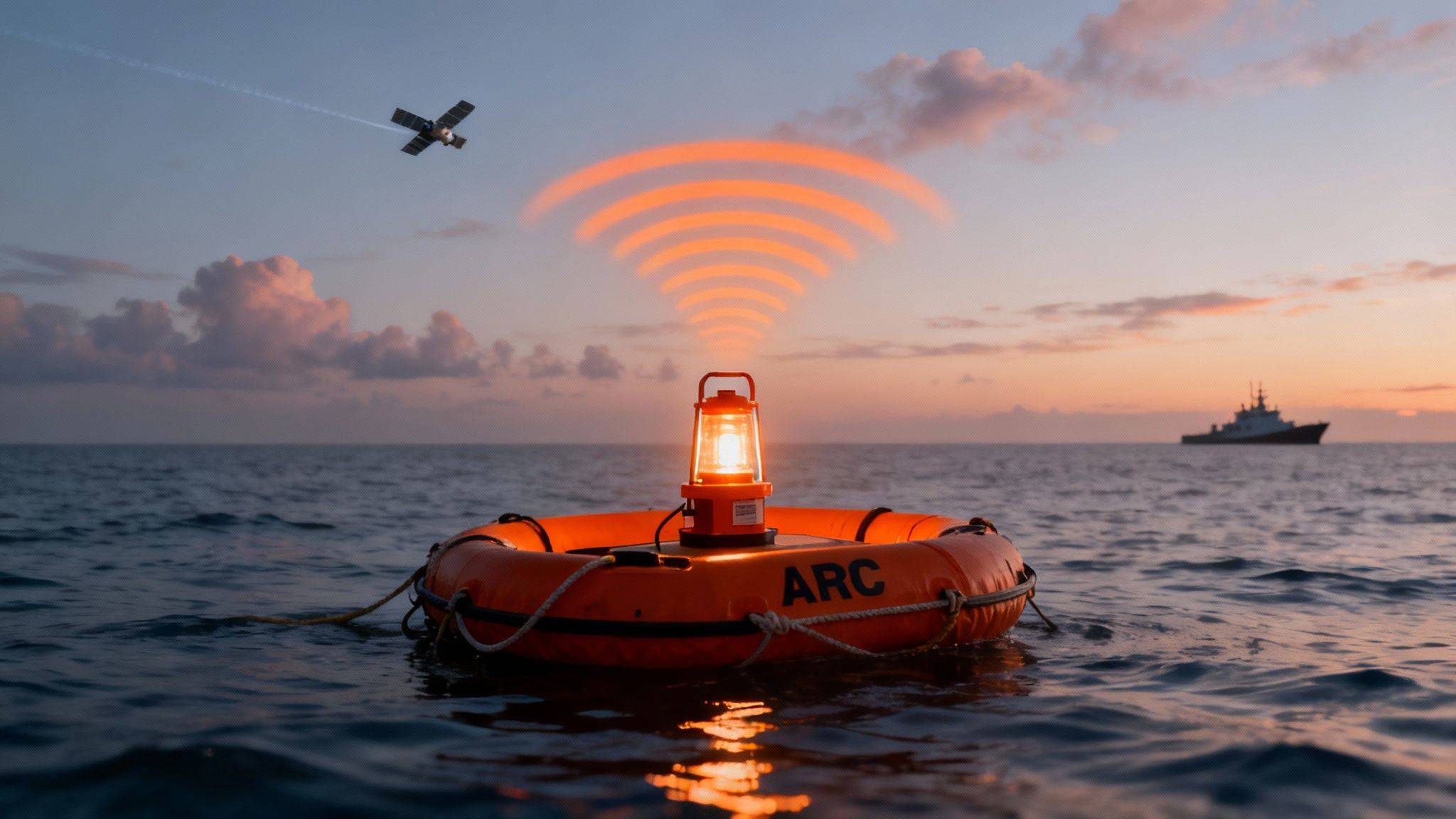
This infographic shows the simple yet powerful flow from distress signal to rescue operation.
The visualisation highlights how one simple action connects you to a massive, organised response via satellite technology, making sure no distress call goes unheard.
From Space to Ground Control
Once the Cospas-Sarsat satellites pick up your signal, they don’t waste a second. It's instantly relayed to a network of ground stations—essentially giant satellite dishes scattered across the globe. These stations process the signal, decode your beacon’s unique ID code, and pinpoint your location using the embedded GPS data.
Within minutes, this critical information package—who you are and exactly where you are—is sent to the rescue coordination centre responsible for that part of the world. For any incident within Australia's huge search and rescue area, that destination is the Joint Rescue Coordination Centre (JRCC) in Canberra.
The JRCC Australia is the nerve centre for all major search and rescue missions. Operating 24/7, it's staffed by a team of highly skilled coordinators from the navy, air force, and emergency services. They handle around 7,000 incidents every year, and nearly 29% of these stem directly from emergency beacon activations. It just goes to show how vital these devices are to our national safety framework.
Understanding the Satellite Constellations
The incredible accuracy of this system comes down to three different types of satellite orbits working together. Think of them as three layers of a safety net, each with its own strength, ensuring your signal is picked up quickly and your position is located precisely.
-
LEOSAR (Low Earth Orbit Search and Rescue): These satellites fly low and fast, orbiting over the poles. As the Earth spins beneath them, they effectively "scan" the entire planet. They're brilliant at detecting beacon signals and can even calculate a location using the Doppler shift if a beacon doesn't have GPS.
-
GEOSAR (Geostationary Orbit Search and Rescue): Positioned much higher up, these satellites stay fixed over one spot on the Equator. They provide continuous coverage over huge areas of the Earth (though they can't see the extreme polar regions). A signal from your ACR beacon is often detected by a GEOSAR satellite almost instantly, giving authorities that first critical alert.
-
MEOSAR (Medium Earth Orbit Search and Rescue): This is the newest and most advanced part of the system. MEOSAR satellites, which include the GPS constellation, give you the best of both worlds—global coverage and near-instant detection. Multiple MEOSAR satellites can detect a signal at the same time, allowing for a highly accurate and rapid location fix.
This multi-layered system means that from the moment you hit the button, your distress signal is received, your location is triangulated with incredible precision, and the expert team at the JRCC is already kicking off a response. Understanding this process is a key part of our broader focus on marine safety. It reinforces that your beacon is far more than just a device; it’s your personal connection to a world-class rescue infrastructure.
Choosing the Right Beacon for Your Adventure
Picking the right ACR rescue beacon isn’t a one-size-fits-all deal. The perfect device for an offshore fishing trip is worlds away from what you’d want on a solo hike through the outback. It really boils down to understanding the two main players in the game: Personal Locator Beacons (PLBs) and Emergency Position Indicating Radio Beacons (EPIRBs).
Here’s a simple way to think about it. A PLB is like a nimble trail bike—it’s compact, personal, and ready to go wherever you do. An EPIRB, on the other hand, is like a rugged 4WD permanently kitted out for the harshest terrain—it belongs to the vehicle, not the driver.
Both will get you rescued, but they’re engineered for fundamentally different jobs. The most important step is matching the beacon to your adventure, because that’s how you make a smart investment in your safety.
Personal Locator Beacons (PLBs) for Individual Safety
A Personal Locator Beacon (PLB) is your personal lifeline, ready to go anywhere. These are compact, lightweight units registered to an individual, not a boat. That makes them incredibly versatile—you can move a PLB from your tinny to your kayak, then toss it in your pack for a weekend bushwalk.
The key advantage here is portability. PLBs are designed to be worn on your person or attached to a life jacket, ensuring your rescue link stays with you, even if you’re separated from your boat or vehicle.
But this portability does come with a couple of trade-offs. PLBs must be activated manually, and they need a clear line of sight to the sky to send a strong signal. Most aren’t designed to float upright while transmitting, so holding it clear of the water is absolutely crucial.
- Best for: Hikers, kayakers, solo adventurers, 4WD enthusiasts, and boaties wanting a single beacon for multiple activities.
- Activation: Always manual. You have to deploy the antenna and push the button yourself.
- Registration: Linked directly to you as an individual.
Emergency Position Indicating Radio Beacons (EPIRBs) for Vessel Safety
An Emergency Position Indicating Radio Beacon (EPIRB) is a dedicated safety device for your boat, built tough to handle the worst the ocean can throw at it. It's registered to your vessel, giving rescue authorities crucial details about your boat in an emergency.
EPIRBs are bigger and beefier than PLBs. Most importantly, they are designed to activate automatically when they hit the water (if housed in a Category 1 bracket) and to float upright, keeping the antenna pointed at the sky for a clear signal. This is a massive advantage in a catastrophic event where you might not be able to activate it yourself.
The core difference is all about deployment. An EPIRB is for a "boat-in-distress" scenario and can often activate on its own. A PLB is for a "person-in-distress" situation, relying on you to kickstart the rescue.
Choosing the right safety equipment is a critical part of setting up your vessel. It goes well beyond electronics, too. For anyone new to boating, getting the fundamentals right is key, which is why a good guide to choosing the right inflatable boat can build that foundational knowledge for a safe and enjoyable time on the water.
PLB vs EPIRB: Which Beacon Is Right For You?
So, how do you decide? It comes down to comparing the features that truly matter in a real-world emergency. Let's break down the key differences to help you figure out which beacon is the right fit for your Aussie adventures.
Read the full guide at easyinflatables.com.au
Explore the Aerowave range
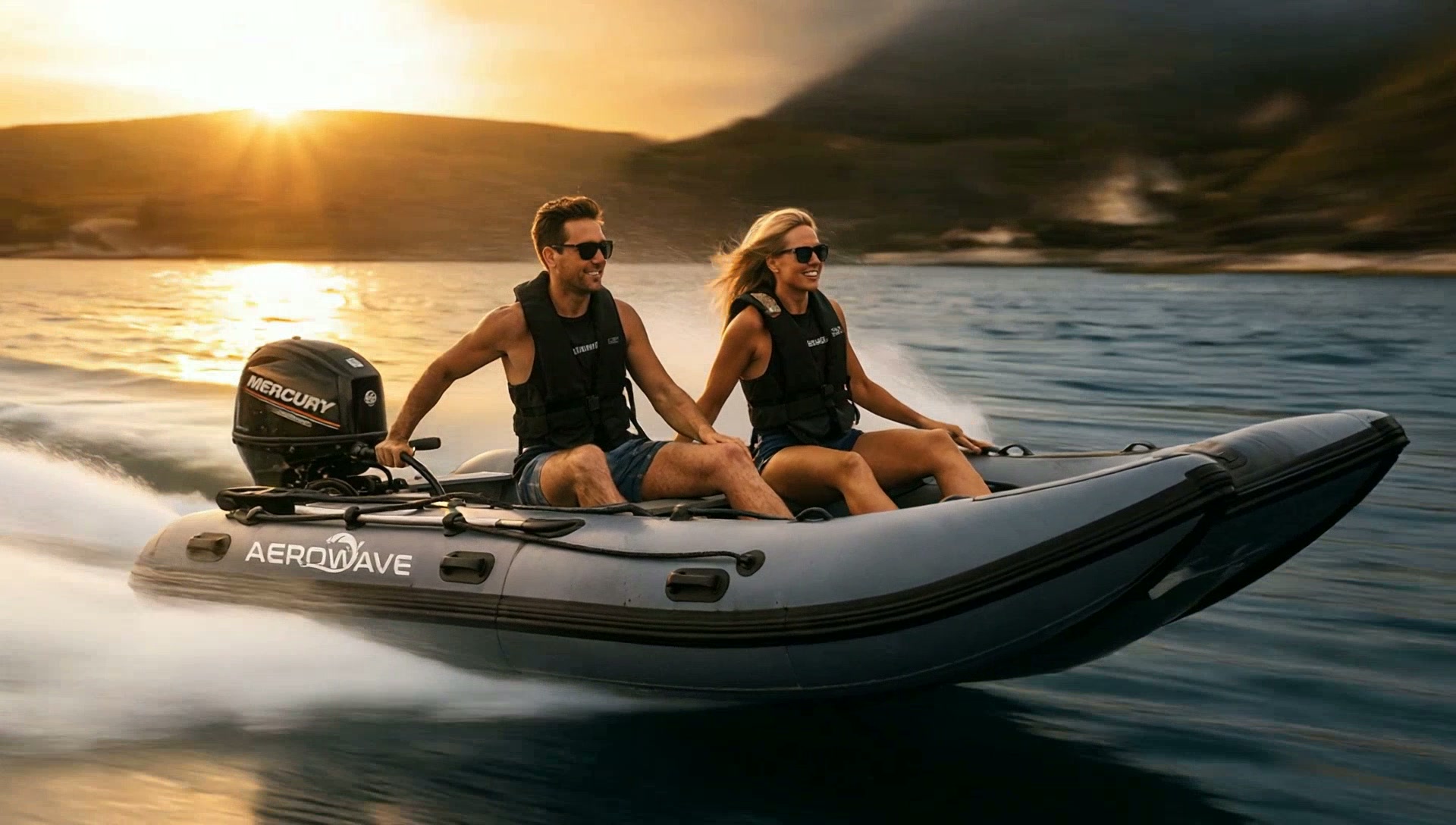
Weekend-Proof Score 17 questions · about 2 minutes
Will the boat you're about to buy survive an Australian summer?
Seventeen straight questions about where you'll use it, what you'll ask of it and the boat you're weighing up. You get a score out of 100, the exact weak points in your plan, and the one boat that genuinely fits.
Free · your result shows on screen · no email required
So which one is yours?
Pick how you'll actually use it and we'll take you straight to the right hull.
I want to fish it
Open bow, rod holders, deck space you can stand and cast from.
Viper Sport 400Family, diving and the beach
3.8 m Series 3 catamaran — low bow to climb back in wearing fins or a tank.
WaveRunner 380Tender / one-person launch
3.3 m hard-floor boat that packs into a bag and still takes a beach landing.
Viper 330Shop gear featured in this guide
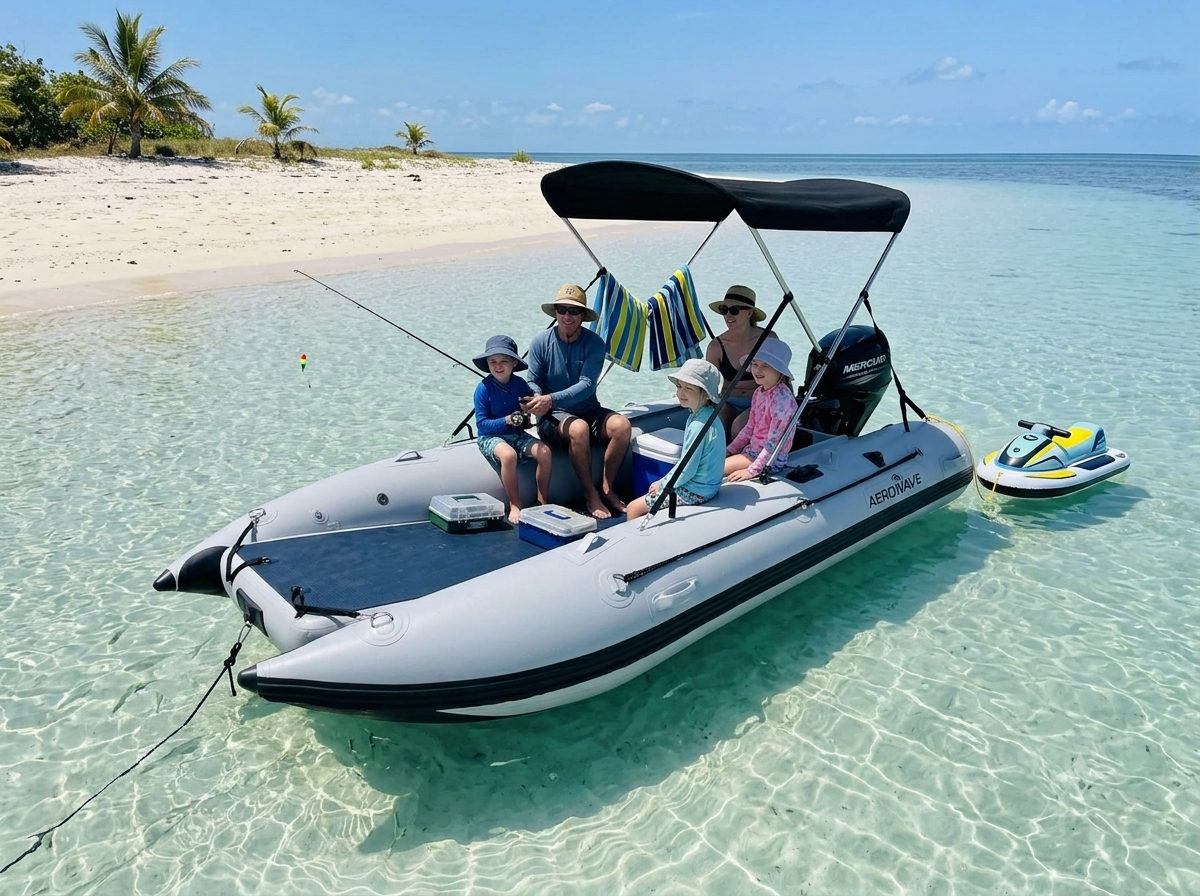
Aerowave WaveRunner 380 Series 3 Catamaran Package
The WaveRunner 380 Series 3 is a premium 3.8m inflatable catamaran package built for Australian and worldwide families, fishing, and coastal day boating — ideal for snorkeling and spearfishing — offering serious stability and premium German Valmex® construction.
Free freight to United States · local taxes payable on arrival
Aerowave Viper 400 Sovereign
Flagship 4m enclosed-bow inflatable catamaran. German VALMEX® 7321 Heavy Plus 1.2mm commercial-grade fabric, 10 PSI high-pressure drop-stitch air deck floor with VALMEX non-slip surface, LockPro wheels, full Bimini and FREE express delivery Australia-wide included. Winter special — save $1,000 until 31 August 2026.
Free freight to United States · local taxes payable on arrival
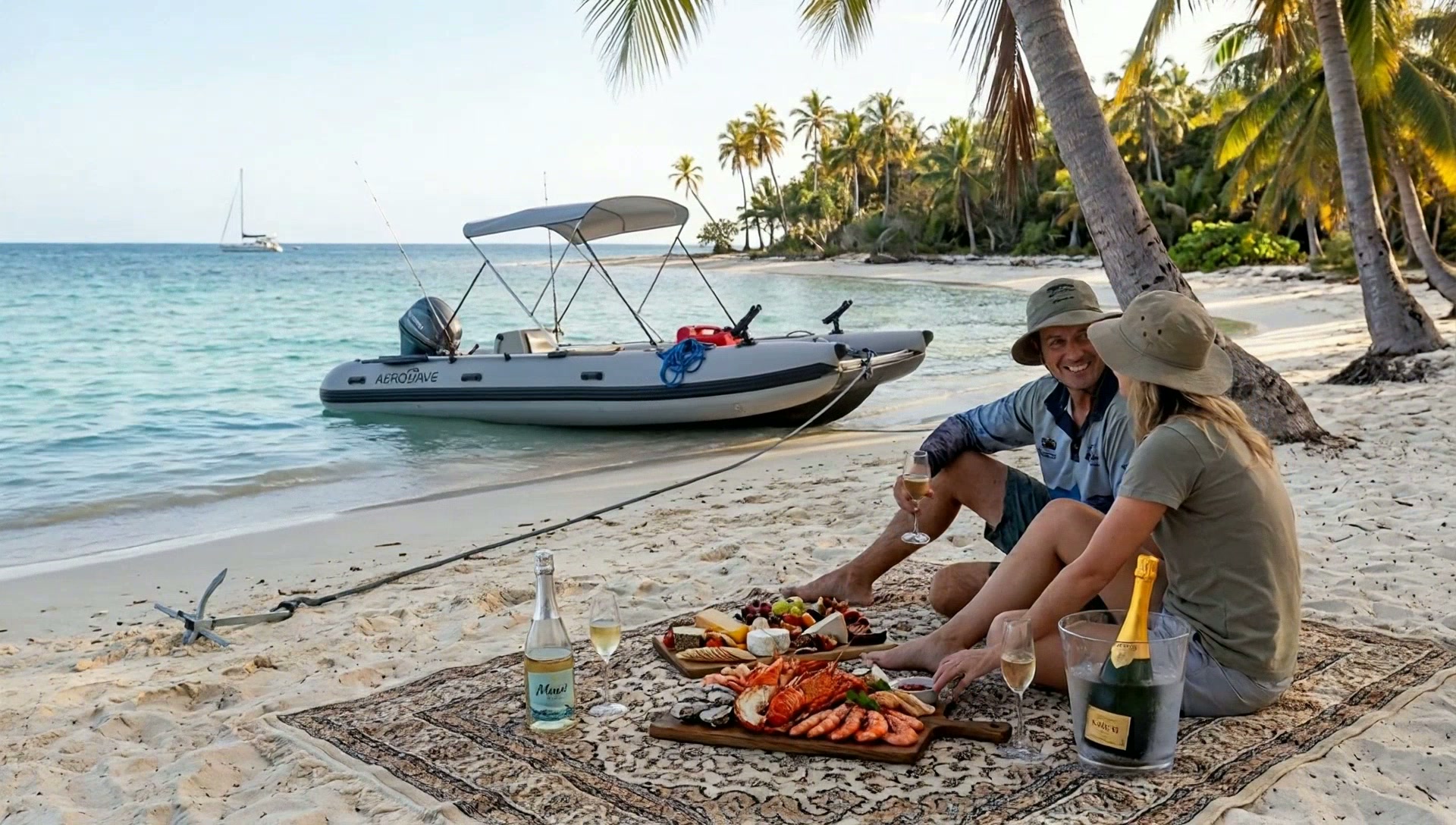
Aerowave Viper 365 Open Bow
Premium 3.65m Inflatable catamaran — built the same way as our flagship Viper 400 sports boat, just 35cm shorter. German VALMEX® 7321 Heavy Plus 1.2mm commercial-grade fabric, 10 PSI high-pressure drop-stitch air deck floor with VALMEX non-slip surface, LockPro wheels, full Bimini and FREE express delivery Australia-wide included.
Free freight to United States · local taxes payable on arrival
Not sure which suits you? Talk to a real boat owner.
Before you spend a cent
Buying from Australia, delivered to United States
You have never heard of us, we are on the other side of the world, and the internet is full of fakes. Fair enough. Here is everything you would need to check us out, in one place — no forms, no chat bot.
Australian designed business
Easy Inflatables, Avoca Beach NSW 2251. ABN 96 856 548 613. International orders ship from our Hong Kong hub.
222 owner reviews, 4.8 average
Read them in full, good and bad, on our reviews page.
CE certified, 7-year hull warranty
ISO 6185-3 and EU Directive 2013/53/EU. Warranty honoured worldwide.
Tracked, insured, door to door
FREE freight to United States · local tax/duty on arrival.
- Who am I actually buying from?
- Easy Inflatables, Avoca Beach NSW 2251, Australia. ABN 96 856 548 613. Sean is the owner and skipper, Gary Stewart handles sales on +61 2 4335 1603, Karen Matthews handles email. The boats are Australian designed; international orders ship from our Hong Kong dispatch hub so your landed price stays competitive. Phone us before you pay a cent — a real person answers.
- Is this really an Australian product?
- Yes — Australian designed and engineered on the NSW Central Coast. Manufacturing is done offshore to our spec, and international orders ship direct from our Hong Kong dispatch hub. If we routed every boat through Australia first, the freight alone would roughly double or triple your cost for the same hull.
- What do I pay, and what is not included?
- The delivery and import terms depend on your country. EU, UK, New Zealand and named Asia/Pacific lanes include duty and tax; US freight is free but US buyers pay import charges on arrival. Other destinations show their terms before payment.
- How do I pay safely?
- Card through Stripe (Visa, Mastercard, Amex, Apple Pay, Google Pay) or bank transfer. Card payments carry your bank's own dispute protection. We never ask for crypto, gift cards or payment to a personal account.
- What if it arrives damaged?
- Every boat ships fully tracked and insured door to door. Photograph the carton and the boat on arrival and email us — transit damage is claimed and replaced through us, not left with you and the courier.
- Is the warranty real outside Australia?
- Yes. The 7-year hull warranty on 1.2 mm VALMEX Heavy Plus and Orca Hypalon hulls applies wherever you are. Replacement parts are held in Australia and at our overseas hub and go out by express courier to your door.
- Is the boat actually certified?
- All Aerowave catamarans are CE certified to ISO 6185-3 and EU Directive 2013/53/EU. Certification paperwork is supplied with the boat — ask and we will send it before you order.
Ready to set sail?
Premium German-fabric inflatable catamarans, built to order and delivered to your door. Talk to our team or browse the fleet.
Like this guide? Get the next one in your inbox.
Owner-tested tips, gear deep-dives and Aussie boating know-how — no spam.